
I photographed the pages of the remaining stories with the honest goal of doing some blogging prep while I was away – there was a desk upstairs in the mezzanine “library” but I was too busy going in the hot tub most evenings! (As it turns out the chair at the desk was far too low to really use it for working at – but the view was nice.) But I’m back now and it’s time to knuckle down and get this series finished.
Previous parts look at story 1, stories 2 and 3, stories 4 and 5, stories 6 and 7, stories 8 to 10, stories 11 to 13, stories 14 to 16, stories 17 to 18, stories 19 to 20 and stories 21 and 22.

Staying With Auntie Sue
Originally titled The Spoilt Little Girl this story’s first appearance was in Sunny Stories #399 in 1947. Its name was changed for its first reprint in the Eleventh Holiday Book, and remained the same for its four subsequent reprints between 1970 and 2015.
A brief review
Katie’s not a very nice girl but honestly I feel very sorry for her. A lot of Blyton’s stories have spoilt, unpleasant children and we generally dislike them as they misbehave and so on, but somehow this one feels a little different. Katie’s parents have spoiled her – they admit that themselves at the beginning – and then call her unpleasant and tell her they’re sending her off to Auntie Sue as they need a break from her in the holidays.
Now she absolutely does need taking in hand but I think it’s pretty bad of them to not shoulder the responsibility of teaching her better behaviour. Instead they call her names, reject her, and send her away.
It’s just like the Naughtiest Girl then, where that rejection causes the girls to act out even worse than before. Elizabeth is wanting to be sent home, of course, while Katie is acting out her hurt.
I also feel sorry for Auntie Sue getting sent a spoilt and rejected child.
The story is a fairly classic be careful what you wish for tale – with Katie deciding to do as she pleases and her Aunt not stopping her. But staying up late (until TEN O’CLOCK, Blyton highlights as a terribly shocking time) and sleeping in means missing breakfast, and not wearing her overall means ruining her dresses and not going to a party. So Katie learns some harsh lessons.
Auntie Sue rides it all out impressively, however, and never rises to Katie’s tantrums. She has quite a lot of wise words to say on the subject of how you treat others, putting me in mind of Aunt Grace from House-at-the-Corner.
It isn’t very nice, is it, Katie, when we do what we like, and don’t bother about one another? But you have chosen that way of behaving, and I will choose it too.
This is probably one of the best stories in the collection but it has only the most tangential connection to the summer holiday theme of the book. Yes, it is the holidays, but given that Katie goes out without a coat, hat, or scarf (hats and scarves not being commonly needed in the summer) and gets soaked in a rain storm then catches a cold, I’d be inclined to think this wasn’t the height of summer at all.
The updates
Not a lot has been changed – in fact for a while I was wondering if they had forgotten about this one.
But frock has been changed to dress, and lighted the gas to lit the gas.
A short sentence has been removed – But not unless, which had previously followed this one: Now, if you are going to be sensible and do what you are told, for once , then I shall be sensible and kind, too.
Italics-wise I stopped counting as there were dozens of uses and all were left. In fact they have actually ADDED italics in this story. Katie says I shall DO as I like! With the capitalisation of DO giving all the emphasis you think it’d need, but no, this copy has italicized the DO as well. It’s all very confusing and inconsistent – though perhaps I’m missing some obscure grammar rule about only words beginning with certain letters and appearing in odd-numbered lines being allowed italics?
(It has also made me wonder what ‘version’ of the story they have copied. In the back they list all the first printings of the stories but do they have original manuscripts, copies of the magazines, digitised copies of the stories, or are they using later reprints such as the 1950s books I’m using, or even later prints from the 60s and 70s? Given that the copyright holders didn’t have the original Famous Five dustjackets for when they wanted to reuse the artwork for the paperbacks a few years ago I find it hard to believe they have runs of the magazines, but perhaps they protected the written words more carefully than the jackets?)
A few hyphens are removed from things like tea-time, over-sleeping and to-morrow.
One thing that was left was also a little surprising – What she really wanted, of course, was a good slap , but Auntie Sue knew that Katie’s mother would never forgive her if she slapped her. Slaps, real and threatened are usually removed!
The illustrations
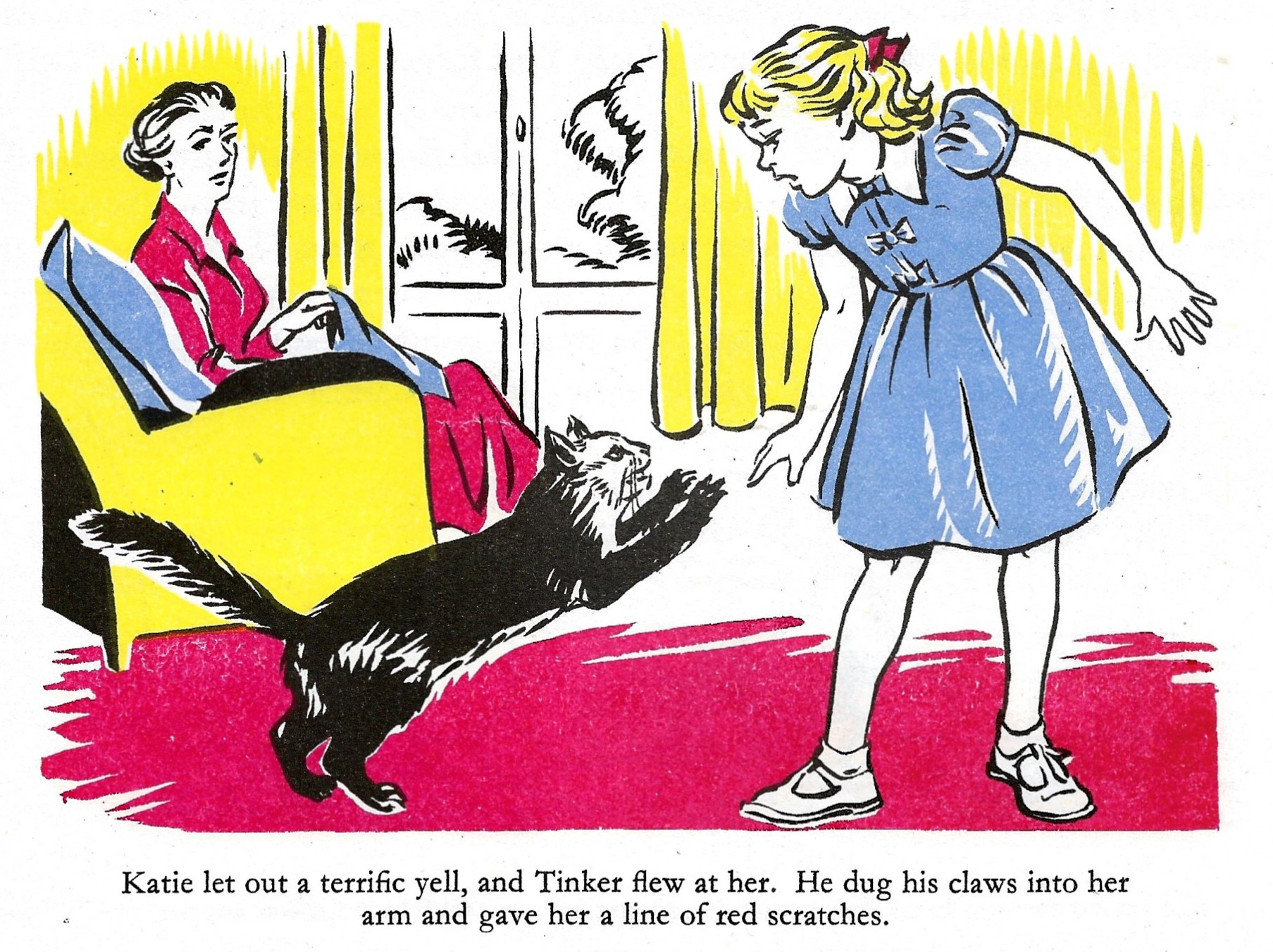
Jessie Land provided the illustrations for the magazine, while the Holiday Book has ones by Betty Ladler, and have a nice three colour overlay. It’s just a pity that there are no paint and plasticine stains on her blue dress as per the text.
A Puppy in Wonderland
Another one with a name change – this was originally called A Puppy in Fairyland and appeared in Sunny Stories For Little Folks #95 in 1930.
It has been reprinted a few times – with its original title three times between 1936 and 1966, then a further four times with the new name between 1986 and 2015. I’m not sure what changed in the 80s that Fairyland had to become Wonderland! I’m sure most people would associate wonderland with either Alice in Wonderland or perhaps something like Walking in a Winter Wonderland. It is still inhabited by fairyfolk and not wonderfolk at any rate. (Incidentally my spellchecker doesn’t like fairyfolk as one word, they way it appears in the reprint, but it does accept fairy-folk as per the original).
I didn’t have a copy of this story but a friend sent me a scan of News Chronicles Boys’ and Girls’ Story Book No 4 as I was in search of a story (which turned out to be the wrong version) but happily it contains this one! So thanks again to Pete.
A brief review
This is a longish story though I don’t feel as if an awful lot happens. Three children take their dog for a walk in the woods, but the dog chases a rabbit and disappears. The children discover that brownies have taken him because he has dug up an area they’d prepared for a party. They follow the brownies’ footprints, instantly find a secret trapdoor, go through it to find themselves in fairyland, get directions from the first person they see, walk straight into the castle and Chips is let free (the rabbit turns out to be a bad’un so he’s forgiven).
It’s not a bad story but it does feel as if it goes on a bit despite being very straightforward. There isn’t anything hugely inventive – or at least it feels that way having read so many of her other stories. The trapdoor leads to an underground river, with a boat to take them down it which has also been done (and more effectively) in both The Secret of Killimooin and The Mountain of Adventure – but both came much later. Perhaps they were both influenced by the idea she had for this story. One thing I did like was the use of spider’s web as rope to tie up the dog.
The updates
I feel like this was edited by someone entirely different from some of the previous stories. It is full of small changes!
First up Alan, Jim and Betty become Alan, James and Kate. Of course we all know how popular the name Alan is for boys nowadays? James is a classic, of course, and I’m sure there are plenty of Kates and Katherines particularly since Wills and Kate got married, but Jim and Betty aren’t much more old-fashioned than Alan. There was also a Katie in the previous story, so couldn’t they have been a little more inventive?
Every single use of italics is removed. Blyton was a bit heavy on them, perhaps, with 12 uses in 8 pages, but the story is not packed with them – and they all served a purpose in emphasising what was being said. I wonder if it was a conscious decision, seeing as some stories had their italics left alone, and others only lost some or most of them. Did someone perform some sort of formatting manoeuvre that deleted all the italics by mistake? (You’re probably wondering why I keep banging on about italics because it’s terribly boring, but it’s a) pointless changing of the text and b) the inconsistency of the pointless changes annoying me.)
because he would chew up slippers
it was hot
the Brownies didn’t know what to do
but we must catch him
oh, so it was your dog, was it?
oh dear, I am sorry
he really is naughty to do that
We must find Chips. Where can they have put him?
Then he is a good puppy, not a naughty one!
one night it ran away with the carriage
Chips nearly caught it
their mother had to believe them
Some of the changes are then attempts to modernise the language.
Dear little chap becomes dear little pup, in a trice becomes in no time at all, the children’s gardener (who was getting cross about Chips digging in the garden) is now their Daddy.
Some others I’m less sure about.
No bunny to be seen is changed to no rabbit to be seen – are children today not supposed to know that bunnies are rabbits are the same creature?
It was got ready becomes It was made ready. You don’t see that usage as often these days I don’t think, but it’s not wrong. Similarly till becomes until – both have the same meaning and both are right. Till is more common in speech and until in formal writing – but the till in this story comes from speech anyway.
A puppy dog becomes a puppy – yes the dog party is technically superfluous but it’s a common saying like pussy cat or kitty cat.
And lastly come on you others becomes come on you two. I mean, why? Seems like a change just for the sake of it!
The illustrations
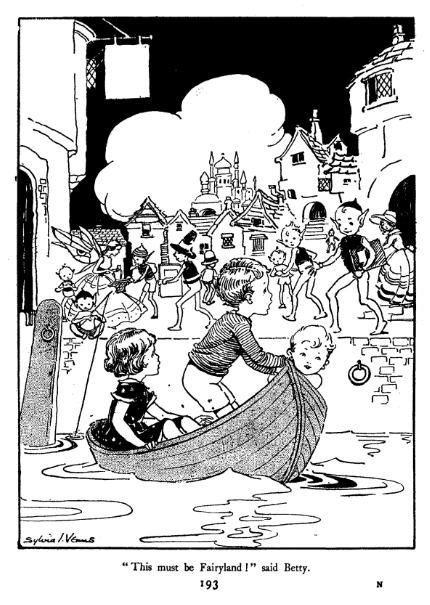
It’s not clear who illustrated the story for Sunny Stories. Sylvia I Venus did the cover and C Andrews is credited with additional illustrations. In the annual it is Sylvia I Venus’ work, so they could be the same ones used, or they may even have been redrawn like Soper did for the Famous Five. If anyone has the Sunny Stories issue in question let me know!
The annual has just four illustrations but they are lovely and include this detailed full-page one.

 Fiona
Fiona pippastef
 worldofblyton

 World of Blyton