
I treated myself to a new book the other week – Silver and Gold which is a collection of 30 poems.
First published in 1925 it was then released again in 1927 in a new edition. I have a slightly later copy of the second edition – it’s undated but it has the second edition illustrator and lacks the silver to the text on the boards. Still, it’s a fairly uncommon title and it’s definitely uncommon to see it going for only £20. It does have a few loose pages and it’s missing the free endpapers plus a few of the colour plates but the text is all there which is the important thing.

A confession
I have to begin by saying that poetry isn’t really my thing. Or more accurately, grown-up poetry isn’t my thing. Michael Rosen wrote some fantastic stuff – my family still quote various lines from Don’t Put Mustard in the Custard which is tragically out of print now – but I’d never pick up a grown-up poetry book for fun. The only one I own is Selected Poems by Sylvia Plath, and I actually don’t know why I have that other than remembering two of the poems in it from high school. Daddy and Morning Song, if you care to know. I’m not sure if I even like these two poems, or they are just familiar to me, having dissected them in detail over several lessons.
The only other poem I can recall from high school is Mr Bleaney by Philip Larkin, which is utterly dreary – though maybe that was the point?
All that is a roundabout way of saying that poetry is not my favourite Blyton genre, but I still can’t resist when something like this shows up.
Silver and Gold
The title of the book is also the title of the first poem, which is about an 8 year old who is not jealous of any of their friends’ money as they have
such lots of silver, and such lots of shining gold
By which they mean golden buttercups and silver dew, which they find down Cuckoo Lane.

The voice of a child
All but one of the poems in the book are in the first person, which Blyton rarely used in fiction, but more often did in poetry. It could be the same child speaking in every poem, as the language used is very similar – including the use of p’raps in at least half a dozen different poems. References to being 8 are also in more than one poem, so it could very well be the same child.
I think Blyton captures the child, or children’s, voice so well. Many of the poems draw on common themes from childhood, hunger, getting stuck up a tree (I’ve no idea how many times Brodie has climbed up something then shouted “Um, how am I going to get down??”), flights of fancy about becoming a sweet shop owner, joining the circus, living in a caravan etc, or communing with fairy folk, and so on.

Many people say that Blyton never really matured as an adult, or that she was stuck at the emotional maturity level of her 12 year old self (frozen by her father leaving) and some of these poems could make you half-believe that.
In Things I Won’t Forget the child is saying how they won’t ever forget the things that make up their childhood – both the good and the bad – and become one of those grown-ups that can’t remember what it was like to be a child.
When I’m grown up I’ll know what children like to do
I’ll know the things they’re frightened of, I’ll know the things they hate –
And oh! I hope they’ll love me, though they’ll know I’m long past eight.
I don’t know if Blyton ever thought something to that effect when she was eight, but she definitely did grow up to remember what children liked and were afraid of. She really understood children as a writer. I have vaguely similar thoughts at work sometimes – I don’t want to become someone who’s worked there for so long they’ve forgotten what it was like to be new and enthusiastic. I don’t know how well it works, though, best laid plans and all that.

Like Blyton but not like Blyton
I can’t quite put my finger on it but this book is very Blyton while also being a bit different.
Blyton’s first full-length novel is generally considered to be The Secret Island from 1938, while Adventures of the Wishing Chair came out in late 1937 (having been serlialised in Sunny Stories in early 1937) but that one’s more regarded as a novelette. Either way these are both more than ten years later than Silver and Gold.
I would definitely say that Blyton developed her writing style in those intervening years – but then it’s quite possible that writing and publishing changed somewhat too, and she just followed along.
There are words and phrases in the book – like p’raps, tho’, and me and the wind – that I don’t think she used much, if at all, later on.
One poem – To My Enemy – almost doesn’t sound like her at all.
I’d like to be a spider,
A nasty, crawly spider,
With just about a hundred legs
And twenty eyes.
And I’d scriggle down your neck,
A nasty, leggy speck,
And start a gobble-gobbling you,
Like spiders gobble flies.
It’s great but if you’d shown me that without context I don’t think I’d have guessed Blyton in a million years!
Yet some of the other stuff – like the weaving in of fairy folk and the place names are quintessential Blyton.
Talking of place names I kept a list of the ones she used as there’s a definite theme –
Cuckoo Lane (twice)
Cuckoo Wood (twice)
Primrose Lane
Buttercup Lane
Blackberry Lane
The illustrations
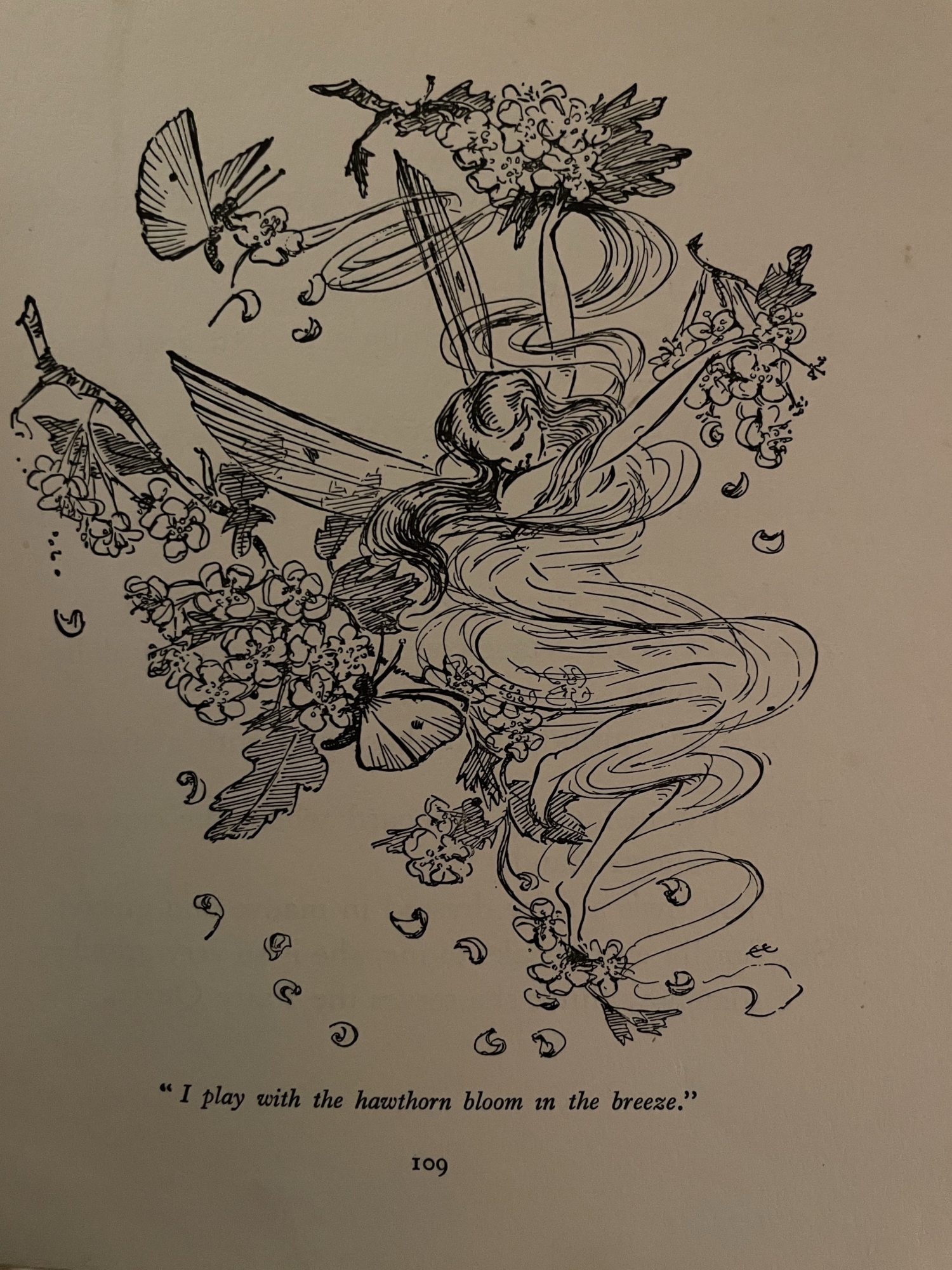
The first edition had illustrations by Lewis Baumer, while my reprint is illustrated by Ethel Everett.

Everett’s illustrations are lovely – very 1920s, and there are a lot of them. I feel like this must have been a reasonably expensive book, or perhaps an unnecessarily expensive one! I mean it is lovely, but some poems have been spread out a verse per page with illustrations in between. It’s very luxurious, and it makes for a lovely reading experience. Particularly one poem which introduces a new character in each verse, which is then accompanied by an illustration of the character. It doesn’t really need as many as 128 pages for 30 poems, though, so I wonder if this was a deliberate way of marketing it to a more wealthy class of readers.
There are also seven colour plates plus the frontis. These are slightly disappointing (at least the ones left in my copy are!) as I found the colours quite murky, and they don’t quite live up to the lively, movement-full line drawings.
All in all this is a really nice book, which despite my lack-of-love for poetry was an enjoyable read and I’m glad I bought it.

 Fiona
Fiona pippastef
 worldofblyton

 World of Blyton