
I have managed two write two full posts about this book, without having read past the first two chapters. In an attempt to not make it a post per chapter and be here for 21 posts, this time I’m going to look at the homes the children make on the island.
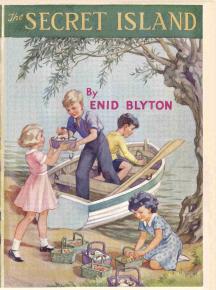
Changing homes on the island
Although setting up a camp or temporary home is a common theme in Blyton’s adventure stories, The Secret Island stands out as having three separate and well-used accommodations. Each of the three is well also well thought out and carefully created for maximum comfort (or at least, as much as the primitive setting allows!).
Normally there might be one example in a story of children making temporary accommodation – though sometimes children also spend a night under a tree, rock, or puffin burrow in cases of dire emergencies. The properly-set-up living spaces could be for fun – like the Five spending a few nights in the remaining room in Kirrin Castle during Five On a Treasure Island, or camping on the moors in Five Go Off to Camp, or out of necessity – like Kirrin Island’s previously unknown cave in Five Run Away Together, and the fern-cave in The Valley of Adventure.
As the Arnold children plus Jack intend to live on the island for the foreseeable future their living-spaces were created with a sort of permanence in mind – as opposed to the more usual temporary accommodation, designed to keep children safe and comfortable until rescue or escape was possible, until a mystery was solved, or until runaways could return home. This means that more work needed to be put into furnishings, storage etc as well as repairing and maintaining things.
The only other home intended to be permanent I can think of is the hollow tree in Hollow Tree House – though the Mannering/Trents certainly worried that their fern cave would end up being permanent if they couldn’t escape the valley.

The outdoor bedroom
Unlike many others I have never really had a desire to sleep out-of-doors. I like my comfortable bed and solid roof. Yet Blyton manages to make a completely outdoor bedroom sound perfectly comfortable.
This is the first sleeping-place the children arrange as it is quick and easy, though only suitable for fine weather.
Although the weather is to be settled they decide they ought to have some sort of shelter – this is provided by two large oak trees. Wind protection comes from some gorse bushes.
Do you see this little place here, almost surrounded by gorse, and carpeted with heather? The girls could sleep here, and we could sleep just outside their cosy spot, to protect them. The oak trees would shelter us nicely overhead.
Nora describes it as a green heathery bedroom, and claims the heather to be as soft as can be. I’m always a it doubtful of this as I’ve tramped through a lot of heather and it can be rather scratchy! They do (as Blyton’s children often do) recognise that the heather will get flat with use and add armfuls of bracken. I don’t think I knew what bracken was as a child – I always pictured it as brown and wiry. But it’s actually ferns – which are often full of ticks. They then dry out the bracken/ferns until they are brown. Perhaps ticks don’t like dry ferns.
Anyway, as an additional bonus there’s wild thyme growing in their outdoor bedroom, making it smell nice.
As Jack says:
Heyho for a starry night and a heathery bed!

Although this bedroom isn’t mentioned a great deal – there’s too much else going on – it’s implied they use it each night for their first weeks and months on the island.
July passed into August. The weather was thundery and hot. Two or three thunderstorms came along, and the children slept in Willow House for a few nights.
And then one nice description of it;
It was a warm night, so they slept in their outdoor bedroom among the gorse bushes, lying cosily on their heather beds. Nothing ever woke them now, as it had done at first. A hedgehog could crawl over Jack’s legs and he wouldn’t stir! A bat could flick Mike’s face and he didn’t even move. Once a little spider had made a web from Peggy’s nose to her shoulder, and when Nora awoke and saw it there she called the boys. How they laughed to see a web stretching from Peggy’s nose, and a little spider in the middle of it!
Willow tree house
With an outdoor bedroom which won’t be suitable for really rainy or cold nights, Jack soon turns his attention to building some better accommodations.
Unlike most tree houses, this one is at ground level. I know that my brain has produced a completely inaccurate picture of this house as I picture it as a rectangular cabin with pretty straight walls and 90° corners. I also see the walls made primarily of thin upright sticks/branches driven into the ground. Merely the roof and a few offshoots grow leaves in my mental picture, and the house stands freely, not attached to any others…
“Do you see these little willow-trees here—one there—one there—two there—and two there. Well, I think you will find that if we climb up and bend down the top branches, they will meet each other nicely in the centre, and we can weave them into one another. That will make the beginning of a roof. With my axe I shall chop down some other young willow-trees, and use the trunk and thicker branches for walls. We can drive the trunks and branches into the ground between the six willow-trees we are using, and fill up any cracks with smaller branches woven across. Then, if we stuff every corner and crevice with bracken and heather, we shall have a fine big house, with a splendid roof, wind-proof and rain-proof. What do you think of that?
The reality is quite different, as the above plan from Jack shows. I think that although I read that my mind couldn’t quite picture how it would all come together, and so made up my own picture of a fairly normal cabin with a few willowy features.
I’m not sure how realistic the whole thing is, actually. You can absolutely put Willow cuttings into the ground and bend them into little huts – there are some good instructions and images on this website. But for best results it requires the right soil, planting in late winter or early spring, and enough sunshine. So making one under a roof of willow in high summer doesn’t sound ideal though perhaps not impossible. I didn’t search extensively but it doesn’t seem like many people try to make a willow structure for anything more than an attractive garden feature so it’s hard to tell if one would actually work.
The closest I could find was some willow sculptures by Patrick Dougherty. If you search Google images for his work at the Santa Barbara Botanic gardens there are other image of it showing the willow partly covered in fresh green leaf growth.
Sadly there are not any great illustrations of the house in the book. There’s one of them beginning to bend and tie together the willow branches for the roof.
 And then this is probably the best one of the interior, showing the woven walls.

As it’s for long-term use a lot of work goes into the building. Not only a sound roof but tightly packed walls, which require regular maintenance to keep the gaps stuffed up.
Although the intent is for them to sleep in their outdoor bedroom as much as possible, come the autumn Willow House gets rather a lot more use.
“We’ll live in the open air mostly, I expect,” said Jack, “but it will be a good place to sleep in when the nights are cold and rainy, and a fine shelter on bad days. It’s our sort of home.”
Before walls are quite finished they add a door on a hinge, and later they build a dividing wall to make a bedroom and a living room.
Mike thought it would be a good idea to make two rooms inside Willow House, instead of one big room. The front part could be a sort of living-room, with the larder in a corner, and the back part could be a bedroom, piled with heather and bracken to make soft lying. So they worked at a partition made of willow, and put it up to make two rooms. They left a doorway between, but did not make a door. It was nice to have a two-roomed house!
Later they rig up shelves for their books and games and put up a hook to hang a lantern on. By all accounts it’s a proper little house, and they appreciate it, though it isn’t always the most fun when the weather is bad.
They were rather bored when they had to keep indoors in Willow House when it rained. They had read all their books and papers by that time, and although it was fun to play games for a while, they couldn’t do it all day long. Peggy didn’t mind—she had always plenty of mending to do.
The caves
Before they even decide to run away Jack has already thought about needing a warm place for the winter.
“We shall build a house of wood,” said Jack. “I know how to. That will do finely for the summer, and for the winter we will have to find a cave, I think.”
Within the first week or two on the island he is thinking about it again.
“It’s all right now it’s warm weather,” said Jack. “It won’t be quite so glorious when the cold winds begin to blow! But winter is a long way off yet.”
The first use of the caves is as a hiding-place rather than a living-space. They bundle the hens and then themselves into the smaller one when trippers come to the island.
This makes them realise that they should have a better plan for hiding should anyone else come to the island. And so they explore the caves, and this is where we get our first proper description of them.
The children had found three openings into the hillside—one where the hens had been put, another larger one, and a third very tiny one through which they could hardly crawl.
The one they used for the hens is just a smallish cave that doesn’t lead anywhere.
Initially the bigger cave seems just like a larger version of the small cave, and no use for hiding in. But, well-hidden in the rocky wall at the back is a passage.
At first it seemed as if the crack simply showed rock behind it—but it didn’t. There was a narrow, winding passage there, half hidden by a jutting-out piece of rock.
I always picture this as one of those optical illusions, a bit like in the movie Labyrinth, where Sarah thinks she is trapped in a never-ending path between two walls. Then a worm tells her there’s an opening right across from her.


Anyway, 80s movies aside, the passage is much longer and windier in the text than I can make my mind picture it. It comes out into a much larger cave deep inside the hill. And yet there’s daylight, and fresh air. This cave is perhaps a predecessor of the one on Kirrin Island as there’s a handy skylight courtesy of the rabbits.
From that cave a low passage leads to the the third, and smallest, opening they had found earlier.
Leaving aside their hiding-plans for another post, Peggy turns her thoughts to the winter ahead.
“Those caves will be cosy to live in in the wintertime,” said Peggy. “We could live in the outer one, and store our things in the inner one. We should be quite protected from bad weather.”
It is some point in autumn, after the leaves have started to change and fall that they move into the caves. A period of bad weather has meant the children have been wet and cold is the deciding factor – a long with a leak in Willow House’s bedroom.
“We’ll make this outer cave our living-room and bedroom!” Jack said, “and the inner one shall be our storeroom. We’ll always have a fire burning at the entrance, and that will warm us and cook our food. This is going to be rather fun! We shall be cave-people this winter!”

With Peggy in charge of the renovations, the cave is quickly turned into a very homely place.
“You two boys must make a few shelves to put round the cave,” she said. “You can weave them out of stout twigs, and put them up somehow. We will keep our books and games there, and any odd things we want. You must somehow manage to hang the lantern from the middle of the roof. Then, in the corner over here we will have our beds of heather and bracken.
I’m not sure how they managed to put up shelves in a cave, hammering nails into rock doesn’t sound at all practical – and if they did somehow manage then they’d surely be difficult to remove in a hurry should they need to move everything into the inner cave to hide – but orders from Peggy seem to get obeyed!
There are various moments when the real domesticity of their living situation is highlighted – such as having a proper door on Willow House. Peggy sweeping the floor of the cave with a brush they have made of heather twigs is another. The floor they cover with sand- the Kirrins’ cave already had a sandy floor, but the children have to bring sand up from the island’s beach.

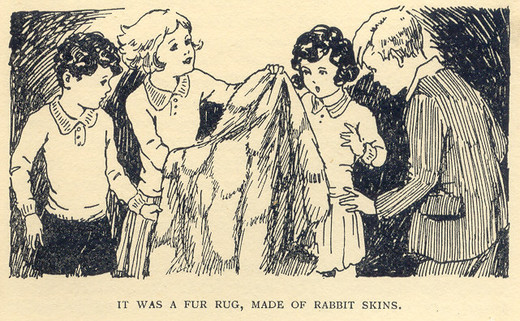
There were only three blankets but hard-working Peggy has created a rabbit-skin blanket they can take turns at having.
But she’s not the only craft one. Soon they have a little table made by Jack, with tree-branch legs and a plank top. It’s a little wobbly, but it’s actual furniture! Stools are formed from a tree trunk, sawn into sections.
They even have their own version of a fragrance diffuser – putting pine cones on the fire!
They manage in this way until the middle of December when Jack brings the Arnolds’ parents to the island and their island life is ended.
There was a bright fire crackling just outside, and the cave was warm and cosy. Jack hung the lantern up and placed two wooden stools for the children’s parents. Peggy flew to heat some milk, and put out rolls of bread and some potted meat she had been saving up for Christmas. She did so want her mother to see how nicely she could do things, even though they all lived in a cave!
“What a lovely home!” said Mrs. Arnold, as she looked round and saw the shelves, the stools, the table, the beds, and everything. The cave was very neat and tidy, and looked so cosy and friendly.
As happy as I am for the children at this point, I, like them, am rather sad that the adventure and island-living has to come to an end.
Saying that, I’m not convinced it is that realistic. Even with a fire outside the cave they’d probably be miserably cold in December.
Other bits of domesticity
While there are definitely those three distinct parts of the island which they used for living and sleeping, the whole island was really their home.
The beach – in the warmer months – was their kitchen, where they lit the fire and cooked their meals. Initially they kept their food stores in the tree-trunk larder there, but due to ants that ended up being just used for non-edible items.

The spring was their fridge, Jack making a circular space where the cold water could run around their bucket of milk to keep it cool.
 And the lake was their bath and their wash-tub.


I said I won’t go on for 21 posts but we might still be here a while. There are lots of topics still to cover!

 Fiona
Fiona pippastef
 worldofblyton

 World of Blyton
I enjoyed this story when I first read it and your excellent review have brought all of the details flooding back. Really great article. Thanks you so much.
LikeLike
Great review.
LikeLike
I love your article and look forwrad to part 4!!!
LikeLike
My book doesn’t have any illustrations, so this helps.
Thanks.
LikeLike
In the late 1950s I read another book titled “secret island.” Four siblings did not run away, but they spent a summer camping on a piece of land on a lake between two branches of a stream that flowed into the lake. They realized that their spot was surrounded by water, the lake and the two branches of the stream, thus a “secret” island. They built some kind of a house against a cliff and discovered a cave in the cliff behind it where they stored their supplies. I’d like to find that book and read it again. Does anyone remember that Secret Island book ?
LikeLike