
Until now I have only briefly mentioned one of the most important elements of the book (and indeed most of Blyton’s books) – the food!
It is first on an characters’ mind when planning a day away from home, let alone months. Even the Find-Outers who rarely stray more than a few miles from Peterswood are regularly found in one of the highstreets establishments refuelling their brains with copious numbers of macaroons.
The usual methods don’t really apply in this case though, as they are a) pack enough food for a few days-a week and/or b) make a note of the farms in the area and buy fresh bread, cheese, milk, and so on there (along with the inevitable free gift of a jar of honey or packet of sweets).
This food question is going to be a difficult one
Right from the start food was on the children’s minds and indeed they take as much as they can away with them (I listed most of this in part 2, but other foodstuff keeps getting mentioned in meals, so I am adding those as I go.)
But as that comprises:
Half a sack of potatoes
Peas, broad beans, radishes, carrots, cherries, lettuce.
Six eggs
Tea, cocoa
Currants, rice and bread
A few cakes
Margarine
Cheese
Whatever Jack managed to buy to put in the tins, such as sugar
Their first meals are the strange combinations you only seem to find in Enid Blyton adventures. Carrots and cake, or bread and peas, or mashed potatoes with boiled eggs, cherries and raw carrots.
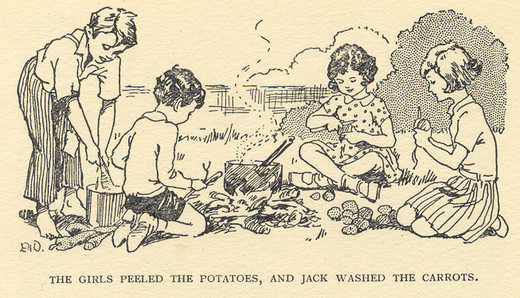
It’s not surprising that on their first night on the island Jack is already talking about doing some fishing the next day. That means their first breakfast on the island is fish fried in margarine with potatoes baked in their skins. Sounds like a pretty good meal, but perhaps not for breakfast.
On their second day he is thinking about rowing back to his granddad’s farm occasionally, so he can get more potatoes and eggs. Very risky for someone who’s run away, but the other risk is possibly starvation!
That evening when there are no fish on the line, Peggy sums up their meal options thus:
“There’s some bread left and a packet of currants. And some lettuces and margarine. Shall we have those?”
This is when Jack decided they’ll have to start catching rabbits for their meat. The girls are reluctant, but as Jack says, they’ve had rabbit pie before.
Breakfast the next day is fish and lettuce, with little more than potatoes left in the larder, and potatoes alone don’t make for a very good meal.
By my calculations it’s only day three of their escape but Jack is off to the mainland that night for more food. It’s just as well that they are living somewhere close enough to do that! I hesitate to accuse them of not thinking ahead more because they simply didn’t have access to any more food or money, and Jack at least does have plans for fish and rabbits, but they come exceptionally close to having to call the whole thing off and return home, tails well down.
He brings:
Seeds to plant
Tins of milk
Bread (rather stale)
More vegetables
Cherries
On a second trip, later, to fetch a pail, they bring more vegetables and fill the pail with plums.
Anyway, Jack brings back more than food on that first trip – he brings his hens (and corn for them). This means they should have eggs when they want them.
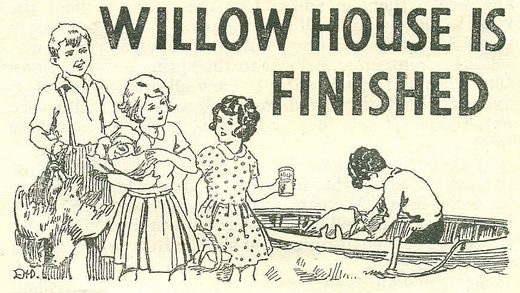
And so begins the Secret Island Farm.
Runaway farmers
With trips to the mainland being somewhat risky, it only makes sense for the children to do as much as they can to limit those by being self-sufficient.
The first job is to create a yard using willow-cuttings, to contain their hens and where they lay their eggs.

With their first livestock venture being a success, Jack heads off a few nights later to fetch his cow, Daisy. With a cow, they have milk. (It has just occurred to me, though, for the first time, that the milk would not be a permanent supply. Cows only produce milk for about 10 months after having a calf and then would have to have another calf before producing more. Obviously this is enough for Blyton’s needs, as she doesn’t intend the children to stay for more than five months, but it would be a problem should they have stayed longer.)
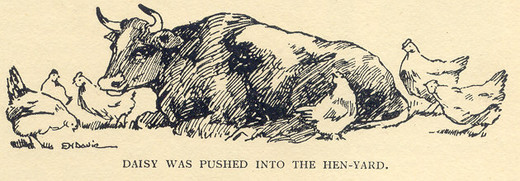
Milk makes their tea and cocoa taste better (though of course those will run out faster than the milk.) They can drink the milk on its own (hot or cold), Nora makes custard, the cream is skimmed off the top for desserts, it really does make a difference to their diet.
There’s no mention of them making butter – but it should have been possible to put the cream from the milk into a jar or other lidded container and shake it until butter is formed. (I watched Nancy Birtwistle doing this with double cream recently, it only took about ten minutes, though there may be a difference between shop-bought double cream and cream skimmed from fresh milk.)
Dairy and poultry aside, the seeds that Jack has brought back get planted up. Although it would have made a pretty mental image for them to have dug up a neat little allotment, this would make it far too obvious that the island is inhabited, should someone visit.
So instead they sow the seeds in small patches, here and there, which can easily be covered with heather.
The seeds are:
Lettuce
Radish
Mustard
Cress
Runner beans
Their seeds grew quickly. It was a proud day when Peggy was able to cut the first batch of mustard and cress and the first lettuce and mix it up into a salad to eat with hard-boiled eggs! The radishes, too, tasted very good, and were so hot that even Jack’s eyes watered when he ate them! Things grew amazingly well and quickly on the island.
Not necessarily the most useful crops, but any additional food is surely welcome, and the radish, mustard and cress would add a lot of flavour to the otherwise plain fish and rabbit.
In addition to these the island has its own crops of wild raspberries, strawberries and blackberries, and hazelnuts.
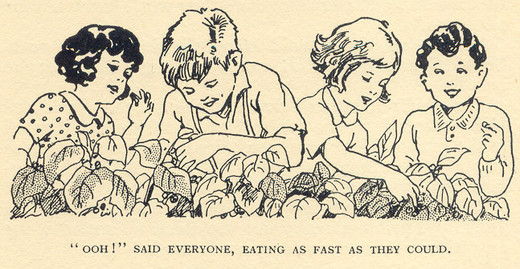
The children spend time tending these crops, pulling weeds, watering them, picking them, and also stuffing berries in their mouths every time they pass.
The wild raspberries ripened by the hundred. Wild strawberries began to appear in the shady parts of the island—not tiny ones, such as the children had often found round about the farm, but big, sweet, juicy ones, even nicer than garden ones. They tasted most delicious with cream. The blackberries grew ripe on the bushes that rambled all over the place, and the children’s mouths were always stained with them, for they picked them as they went about their various jobs.
So they are staving off scurvy, at the very least. But despite their odd meals they seem to be perfectly healthy – perhaps healthier than they were at home. Peggy, Mike and Nora were certainly under-fed at times, but it’s not clear how Jack fared. The below quote suggests they were all on the thin side before running away:
The children were fat, too, for although their food was a queer mixture, they had a great deal of creamy milk.
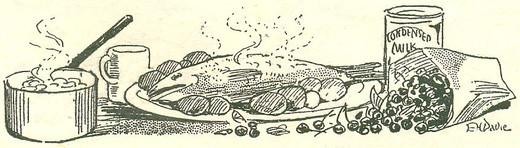
The island, in fact, is so bountiful that they turn to picking berries to sell on the mainland, and use the money to buy things the island can’t provide. But Jack’s business and his shopping lists are a topic for another post!

 Fiona
Fiona pippastef
 worldofblyton


 World of Blyton
I noticed food was a frequent topic of conversation in this book.
And many paragraphs devoted to long descriptions of food preparation etc.
Thanks Fiona
LikeLike
I notice many paragraphs are devoted to food discussions in this book.
Thanks Fiona.
LikeLike
Nowadays ordinary items like food are simply ignored. It shows that Enid Blyton had some kind of story path she developed beforehand and then followed. My guess is that children would detect plot holes and lose faith in the story teller. When Enid Blyton told a story children could follow and believe it. Nowadays children would commandeer a car and drive across the ‘Autobahn’ in a car with stick no less and the authors couldn’t understand why they can’t reach their pre teen readers.
You acn’t praise Enid Blyton enough for writing that many stories with the children don’t losing their faith in her. Not many can.
When the children sell their berries you wonder what would happen nowadays when someone asks about the origin and they can’t show a certificate. Additionally modern technology wouldn’t allow them to hide away 😦
Moody
LikeLike