
The children really have been industrious up until now; turning various parts of the island into comfortable accommodation and tending to their livestock and crops.
Yet the island can’t provide everything they need and so it’s time to start looking at the Secret Island commerce!
They only steal what they can’t afford (that’s everything!)
I’m misquoting Aladdin there – and I think that the children’s stealing is justified. Normally stealing is confined to the baddies in any Blyton tale, but if the children were properly looked after by their relations then they’d be getting fed and clothed anyway.
There is a great deal of making-do on the island, which the children are happy with. Using an old sack as a towel is preferable to having to live with their cruel relatives with their proper towels.
Some things they are able to source from either Uncle Henry’s farm or Jacks granddad’s farm.
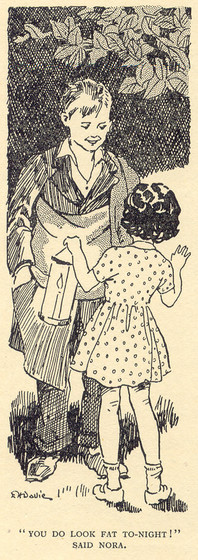 When Jack goes to fetch his cow he finds his granddad has left, and so he is able to check for anything useful left in the house. That amounts to a couple of old, dirty roller towels, and all of Jack’s remaining (and rather ragged) clothes.
Three shirts, a few vests, an odd pair of trousers, an overcoat, a pair of old shoes, and a ragged blanket!
Though when they get up the next morning they remember that they have no pail – this means that they have to milk Daisy into saucepans, the kettle, their bowls and jugs. An old pail has to then be fetched from the barn on Uncle Henry’s farm.
Various other trips are made – risky business, but obviously necessary.
Clothes being a second difficulty after food – as island life must be tough on clothes. Keeping them clean and mended with only one outfit each, especially so. Thus Mike collects some of his and the girls’ clothes from their old rooms (note that this will be mentioned in a later nitpicks post!).
two or three dresses for the girls, and a coat and shorts for
himself
In addition to the foodstuffs – mostly vegetables – I mentioned them collecting in the last post, Jack also gathers turnips for Daisy, and later can pick wild mushrooms from the mainland. More corn is needed for the hens,
It’s just as well that Jack’s granddad’s farm stays empty for so long (it all sounds rather dilapidated and shabby, so not an enticing prospect for many buyers) enabling them to pinch thing as needed. Perhaps Aunt Harriet and Uncle Henry have noticed things going missing, though, as they buy a new dog which bites a hole in Mike’s shorts. Perhaps it’s just a regular working dog, but it wouldn’t surprise me if it was also there as a guard dog. I very much doubt they are thinking it’s the children who are helping themselves to things on the farm, though!

Jack the salesman
There’s a limit to what they can steal from the farms – there’s never any suggestion they could or should take anything from inside Aunt Harriet’s house except the clothes which already belong to them.
I expect it’s mostly for moral reasons, but of course if they started taking food or candles or other supplies it would likely be noticed even more than an old pail and crops. It might even end up with the police involved.
So, they have to come up with another idea when the colder weather starts and their essentials start to run out. There’s only one candle left, and a few matches.
Jack points out that they’ll want a better light in the evenings, and another blanket.
Peggy says she really needs some more wool and thread, having had to already mend grey trousers with blue wool. She’d also love some flour so she could make rolls.
The corn for the hens is running low, says Nora.
Jack’s response surprises them:
Don’t you think it would be a good idea if I took the boat and went to the village at the other end of the lake and bought some of the things we badly need?
With what money? the children (and probably the reader) ask.
The idea is one that Blyton will reuse in Hollow Tree House seven years later – selling produce in pretty little woven baskets.
They’ve already been making little basket out of willow – Peggy having taught the others how to do this – and so Jack’s plan is to fill them with the wild mushrooms, sell them at a market and then use the money to buy supplies.

It’s a pretty good idea, actually. The only other idea I could think of would be for him to go to the mainland and offer to do odd jobs, but that would be more risky and possibly less profitable.
With that plan sorted the shopping list quickly grows.
“I wish we could have a book or two,” said Peggy.
“And a pencil would be nice,” said Nora. “I like drawing things.”
“And a new kettle,” said Peggy. “Ours leaks a bit now.”
“And a few more nails,” said Mike.
“And the flour and the wool and the black cotton,” said Peggy.
Later Peggy adds soap to Jack’s list – bringing it to 21 items.
On Jack’s first trip he ends up selling mushrooms in willow baskets, and strawberries in rush baskets. It doesn’t say how many baskets of mushrooms he takes, or what he sells them for, but there are 12 baskets of strawberries which the girls suggest are worth sixpence each. The strawberries alone would earn them six shillings that way.
He sells everything, thanks, in part, to the attractive presentation of the baskets.

He spends all the money on:
- A very large bag of flour.
- Wool and cotton for Peggy.
- Scores of candles and plenty of matches.
- A new kettle and two enamel plates.
- Some storybooks, and two pencils and a rubber.
- A drawing-book
- Some nails, soap, butter for a treat
- Some bars of chocolate, some tins of cocoa, tea and rice.
- Corn
- Tins of treacle and sugar
I found this handy chart on the government website which details 1938 prices for a number of foodstuffs. For example, flour was 1s 2 ¼d for 7lbs. Jack’s ‘very large bag’ could have been a 7lb bag, or perhaps smaller as that’s pretty heavy along with all his other purchases. Butter was 1s 4½d per lb, and sugar only 2½d per lb. Tea was more expensive, at 2s 4¼d per lb, but Jack may well have been buying things in smaller amounts.
Regardless, he has to stagger back under the weight of it all when he is done.

The storybooks were Robinson Crusoe, Stories from the Bible, Animals of the World and The Boy’s Book of Aeroplanes. The first edition of The Secret Island was priced at 3s 6d, but a year later a cheaper edition was produced at 2s. I assume that the books Jack has bought are either second-hand or from cheaper print runs.
I think Jack and the others get a bit over-confident about this, though. While it has been successful his statement that we needn’t be too careful now of all our things because I can go each week and sell mushrooms and strawberries and earn money to buy more seems a bit foolish.
Peggy points out that the mushrooms and strawberries will run out, but Jack plans to sell blackberries and nuts instead. He acknowledges that these won’t fetch as much money, but added up it will be fine.
I can get enough to store up plenty of things for the winter. If we can get flour, potatoes, rice, cocoa, and things like that, we shall be quite all right. Daisy can always give us milk and cream, and we get lots of eggs from the hens, fish from the lake, and a rabbit or two.
In all, it’s not a bad plan. Gathering free wild foods, making baskets, and selling the produce to buy essentials they can’t grow themselves is pretty sensible. Stocking up for winter is a very good idea.
Maybe it’s because I know what happens later on when Jack’s at the market, but I think they should carry on being careful with their supplies. Any number of things could happen – Jack could be recognised, the boat could become unrepairable, the weather could become too bad to get to the mainland, the sellable goods could run out…
Jack goes to market each Wednesday for several weeks, selling the strawberries and mushrooms, then the hazelnuts and blackberries, coming back with sacks of goods to stockpile.
And then, of, course, it does all go wrong. Jack comes back with a little money – but money’s no use on the island.
This is the end of my marketing, he says. But it’s more than that – it’s the beginning of the end of their island life.
Next time – moving on from survival skills I’ll look at their hiding skills.

 Fiona
Fiona pippastef
 worldofblyton

 World of Blyton
The boat could become unrepairable…this reminds me of “The Island Keeper” by Harry Mazer. Cleo, the girl who spent months undetected on an island owned by her father, has her stolen boat destroyed by a fallen tree. She has to wait until the ice on the lake is thick enough to cross the lake walking.
LikeLike
I really enjoy your posts on “the Secret Island”. You have some interesting view points.
LikeLike
Not a bad yard, tho I have not read it in a few years.
Thanks Fiona.
LikeLike