
Having written some 10,000 words about The Secret Island already I’m back for what I hope will be the last post in this series. There’s not much left to look at, but I’d like to write about the final chapter(s) as the children’s time on the island comes to an end, a few nitpicks, and some random thoughts I had along the way that didn’t fit into any previous posts.
A touching end of an era
All good things have to come to an end, and living free on an island is no different.
Despite the island being a necessary escape for the children they turned it into a real home and very much enjoyed living there. Once settled they rarely refer to their previous lives. There’s no it’s so nice to make food without Aunt Harriet shouting at me or I’m glad there’s no-one here to slap me for dropping those eggs. I suppose Blyton didn’t want them to dwell on the past, and instead focussed on the many joys of their new home.
That’s not to say that it was jolly fun all the time. The children were certainly cold, wet and hungry at times, not to mention bored when the weather was bad. They also worked hard and some, like Nora, had to learn some hard lessons about responsibility.
And yet when it comes to the end of the book they are reluctant to leave their island. Their parents – thought dead for at least a year if not more – have suddenly reappeared in their lives and it’s almost amusing that although the children are very excited and happy about this, they are also sad as it means leaving the island. In fact they are actually surprised when Captain Arnold says it’s time to go!
The children looked up at him. “Going! What do you mean, Daddy? Leave our island?”
I am getting ahead of myself, however. Although the reunion of the Arnolds is touching, I think my favourite scene is when Jack meets Captain and Mrs Arnold.
With Christmas approaching, and the other children making a rare comment about missing their parents, Jack decides to risk another trip to the mainland. He can’t (or so he presumably thinks) give them their parents, but he can give them some treats such as crackers, fruit, sweets and some small gifts. He still has the money he earned from his last time in the market, so he doesn’t need to risk the market again, but can just head straight to the shops in the next village over.
In a rare case of outright lying from a good Blyton character, Jack tells the others he is going for a row to get warm, and to do some fishing.
Later, they are worried as he hasn’t come back and they can’t see his boat on the lake.
Blyton briefly changes style:
We must go back to Jack and find out what had been happening to him.
Rather a lot, actually. Having decided on what to buy he joins the queue in the toy shop/post office but overhears a very interesting conversation.
The two ladies chatting give perhaps an unnatural amount of detail but the upshot is Jack is sure they are talking about the Arnold children, and the Arnold parents.
“It’s bad enough to come down in an aeroplane on a desert island, and not be found for two years—and then to come back safe to see your children—and learn that they’ve disappeared!”
Although I’ve read the book several times I couldn’t remember exactly when the parents had arrived back, and how long they had been looking. The men searching the island did say that a surprise awaited the children, implying that it was their parents that had organised the search (I bet they would be pretty annoyed with those men for not finding the children when they were right there the whole time!). It’s also very possible that when the policeman caught Jack in the market, the parents were back and everything could have been resolved neatly. But we know that’s not how it happens – the children, unknowingly, hide themselves from their parents and live on the island longer, giving us a longer and more interesting story.
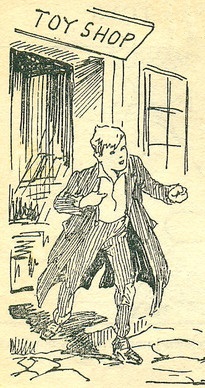 Back to Jack – he questions the women, and despite his raggedy appearance they answer him. Yes, the missing children are Peggy, Nora, Mike and Jack. Yes, they know where the parents are right now – in a hotel, not very far away, hoping for eventual news of their missing children.
Even that part is enough to make me start tearing up (I don’t think I ever got teary at these sort of bits until becoming a parent, but even before then it did make me feel a little emotional).
I get even more tearful as Jack arrives at the hotel and is nearly turned away by the porter on account of his shabbiness. But Captain Arnold (I love how Blyton pauses this breathless narrative long enough to clarify that he knew who to ask for because the other children had mentioned their father was a captain) is passing by, and happens to overhear.
He is exceptionally trusting – not once does he imagine that this ragamuffin of a boy wants money for telling him a location, which could well be truth or lie. Perhaps Blyton didn’t want to sully this fast-paced and joyous climax with suspicion. In half a sentence he has taken Jack upstairs to his wife and finally, Jack can tell them everything.

The story continues at great speed – a car takes them to the lake, a boat is hired, they arrive at the island.
The reunion is touching, not only for the Arnold family, but Jack, too:
“Mummy! Oh, Mummy! And Daddy!” shrieked the children, and flung themselves at their father and mother. You couldn’t tell which were children and which were grown-ups, because they were all so mixed up. Only Jack was alone. He stood apart, looking at them—but not for long. Nora stretched out her hand and pulled him into the crowd of excited, happy people. “You belong, too, Jack,” she said.
Their parents are very impressed with their cave (I wonder how it compares to wherever they lived on their island), and Mr Arnold promises that Aunt Harriet and Uncle Henry will be punished – but that’s the last time they are mentioned by any of the characters and so we never get to know their fate.

Warm and safe in the cave, stories are shared, until at last they all go to sleep in the heather beds. The book could really have ended there, but we get one more chapter to really tie up the loose ends.
The children pack a few of their possessions to take home, the rabbit rug, and their books, plus the chickens. Daisy will be collected by a fisherman later. In a true moment of Blytonian simplicity, Captain Arnold says he can probably buy the island, and the children can visit in the holidays.
Perhaps most importantly Mrs Arnold says that Jack is now part of the family, and will live with them. And so they all get new clothes, sleep in proper beds, and adjust to living in a house again. The children are returning to the familiar, while Jack has never had it so comfortable.
Their Christmas is described in a few paragraphs and surprisingly Nora briefly forsakes their beloved island:
“This is better than Christmas in the cave!” said Nora, unpacking a great big smiling doll with curly golden hair.
But she does have kinder words when the others discuss it at bed-time:
“I do just wish we could all be back in our cosy cave on our secret island for five minutes,” said Peggy.
“So do I,” said everyone, and they lay silent, thinking of the happy days and nights on the island.
“I shall never, never forget our island,” said Nora. “It’s the loveliest place in the world, I think. I hope it isn’t feeling lonely without us! Good-night, secret island! Wait for us till we come again!”
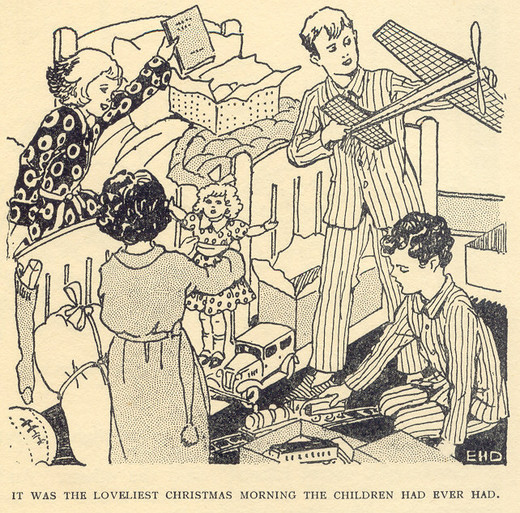
Blyton ends the book by promising the island that the children will visit it once again – and perhaps they do, but the only time we see them there again is briefly in The Secret of Spiggy Holes, the next book in the series.
Thoughts and nitpicks
I found it a minor irritation that Blyton refers to Mike, Peggy and Nora in that order. Peggy is the oldest, with Mike and Nora twins a year younger. I imagine she used that order as Mike is generally second in command after Jack, but that’s only because he’s a boy.
My imagination fails me on many accounts in this book. I find it hard to picture a lake big enough (though I’ve seen many enormous lochs) where the island can barely be seen. I also struggle to imagine an island big enough to not be explored all at once, and to be home to rabbits and birds. That’s not to say I think those descriptions are unrealistic, I just really struggle with imagining places on a grand scale!
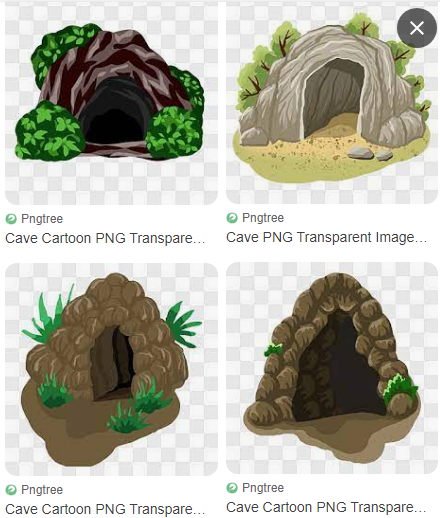
My mental picture of the caves is also atrocious, they are really just giant rocks with holes in, sticking out of the ground something like these stock images.
I’ve already mentioned by inaccurate mental picture of Willow House in a previous post.
I haven’t really talked about the children in great detail, but I think that their actions speak pretty loudly. With the slight exception of Nora who could be a little lazy and slap-dash but learned her lesson, the children are all hard-working and sensible. Jack – as I wrote about in rather a lot of detail here – is the leader, the main ideas man, and the one who knows how to build houses, make cows swim and so on. Peggy takes on the motherly role – she does most of the cooking, the mending, the ‘housework’, Nora does most of the animal care, and Mike is more or less Jack’s second in command and does all sorts of jobs around the island. I’d like to say that they all grow and develop over the book, but apart from Nora, they don’t really. They’ve all come from such miserable home, and been worked so hard, that the island is practically a paradise for them.
And now for the nitpicks! I don’t think that I have ever noticed any of these before – and I’m sure that no child readers would be worrying themselves about these little details.
First up, there are a few contradictions which I only noticed as I had been making lists of things they brought to the island.
After Jack brings Daisy over:
It was lovely to have milk after drinking nothing but tea and cocoa made with water. They could not have enough of it!
Yet not long before Jack had brought over tins of milk. They have cocoa with tinned milk on at least one occasion. Obviously having an endless* supply of fresh milk is far preferable to having a limited supply of tinned milk, but that’s not what the quote above says!
(*It wouldn’t actually be endless as a cow will only produce milk for around ten months after having a calf.)
The children’s clothes, or lack of, is also contradictory. In the early chapters the Arnolds bring all the clothes they possessed. Yet, one point Peggy wishes they had changes of clothes. When Jack and Mike get soaked they use the few things Jack brought from his Granddad’s farm. And later:
Mike managed to get into his aunt’s house one night and get some of his and the girls’ clothes—two or three dresses for the girls, and a coat and shorts for himself. Clothes were rather a difficulty, for they got dirty and ragged on the island, and as the girls had none to change into, it was difficult to keep their dresses clean and mended.
Obviously this is a nitpick as Mike can’t collect clothes they’d already taken but I have to add that surely the girls could wear one of Jack’s shirts, or the overcoat, or wrap up in a blanket while their dresses were washed or mended.
Lastly there’s the boat – When the boat first sinks:
Then Jack and Mike had to use all their brains and all their strength to get it up again and to mend it so that it would not leak quite so badly.
But when they decide to deliberately sink it:
We can easily get her up again and mend her if we want her.
I imagine having worked out how to do it the first time it might be a little easier in the future, but surely not as easy as their plan suggests!
Last thoughts
I’m already over 12,500 words in this series so I’ll try to keep this brief.
This surely has to be one of Blyton’s best books, and although there elements in it that were reused in various other stories, it does stand out as being very different from anything else she wrote. No other Blytonian children survive in the wild for so long, nor show such levels of self-sufficiency. The trippers, the policeman, the searchers, and Jack’s discovery at the end all add excitement, but the bulk of the book is a study of the children making a life on the island.

 Fiona
Fiona pippastef
 worldofblyton

 World of Blyton
Great review, Fiona, thank you. The idea of a living, growing willow house is reused in The Children Of Cherry-tree Farm. The “wild man”, Tammylan, lives in one in summer. And again, like these children, he lives in a cave in winter.
LikeLike
Ah, well pointed out – I have read that book but only once so I had forgotten about Tammylan’s house.
LikeLike
This series was a pleasure to read. I was glad to read “This surely has to be one of Blyton’s best books” as it is a string favourite if mine, and I was rather afraid you didn’t like it.
LikeLike
Ohh, no, well I never meant to give that impression!
LikeLike
Dear Fiona,
Your essay on ‘The Secret Island’ makes me want to read it but at the same time makes me a bit sad, since the story reminds me of a Jules Verne story. ‘The children of Captain Grant.’ In addition it reminds me of a German pre christmas four part TV-series in the 80ties. In case of Jules Verne, Enid Blyton would be a copy cat. Until now I only saw her as a creator of original stories. The TV series was most likely based on Jules Verne
LikeLiked by 1 person
I’m not familiar with ‘The Children of Captain Grant’ – I’ll have to look it up. Blyton probably had many influences from her childhood reading and perhaps was inspired by Jules Verne along with J M Ballantyne’s The Coral Island, and perhaps Swiss Family Robinson and Robinson Crusoe.
LikeLike
Couldn’t help but notice the accent on food in this book. Growing it, preparing it – sounds like real life doesn’t it??
Still a good read and thanks Fiona for your exhaustive review.
I also appreciate all those drawings from the book. My book does not contain any drawings, so those have been very welcome.
LikeLike
As Blyton says “An adventure was one thing – but an adventure without anything to eat was quite another thing.”
LikeLike
I’m not sure if Harry Mazer’s young adult book The Island Keeper” was inspired by “The Secret Island” as it’s a fact that Blyton is pretty much unknown in the US. But it has a few of the same elements (Cleo sleeping in the cave on the island and not being able to get off the island until…but I won’t give that away).
LikeLike