
In part one I listed the stories and where to find them, and looked at the first story.
The Lost Presents
This is credited as being from Enid Blyton’s Snowdrop Story Book, which was published in 1952, but actually it was first printed in Good Housekeeping in 1947. It’s not clear who illustrated the first printing, but the Snowdrop Story Book version had illustrations by Eileen Soper, so I’m sorry I don’t have a copy.
This is a very short Dan and Daisy story – Dan and Daisy being characters that Blyton used in various short stories.
Dan hides away his family’s presents and then can’t remember where he has put them. He wakes up late in the night on Christmas Eve, suddenly remembering. In the time it takes him to go and check on the hiding place, his and Daisy’s stockings have been filled.
Santa Claus Gets a Shock
This story was first published in Sunny Stories 154 in 1939, with illustrations by Sylvia I Venus. It was then included in Enid Blyton’s Happy Story Book with illustrations by Eileen Soper.
Betty and Fred are awake late on Christmas Eve and listening for Santa Claus to land on their roof. Instead they hear him landing in their pond. Fetched by his reindeer, the children pull Santa out of the pond and take him into the kitchen to dry off. He escapes just before Mother can see him, but must sneak back later as the children find a couple of unusual toys on their beds in the morning – toys just like Santa Claus was telling them about.
I’ve used the only other illustration from this story several times already so I thought I should treat you to the other one this time. It’s a shame the new book isn’t illustrated as nobody should have to miss out on the wonderful Eileen Soper!

There are only a couple of changes in this story. Happily Betty and Fred have remained Betty and Fred.
When wondering why Santa Claus hasn’t landed on the roof to come down a chimney, this has changed to come down our chimney. Considering houses in the 30s (and beyond) would have likely had multiple chimneys then a chimney is perfectly fine as it is the same as saying one of our chimneys. There are still plenty of houses with multiple chimneys today so it seems a silly change.
When making hot milk for Santa Betty originally put the pot on the fire. She now puts it on the stove. It’s probably rather uncommon to find an actual fire still burning in a kitchen fireplace in the middle of the night these days, so if that’s not updated to the radiators still being warm, then why not just let them heat the milk on the fire?
Apart from that there’s just one time italics are removed. (It’s like they sometimes have to make changes just to justify their jobs, isn’t it?)
A Family Christmas Part Two: Bringing Home the Holly
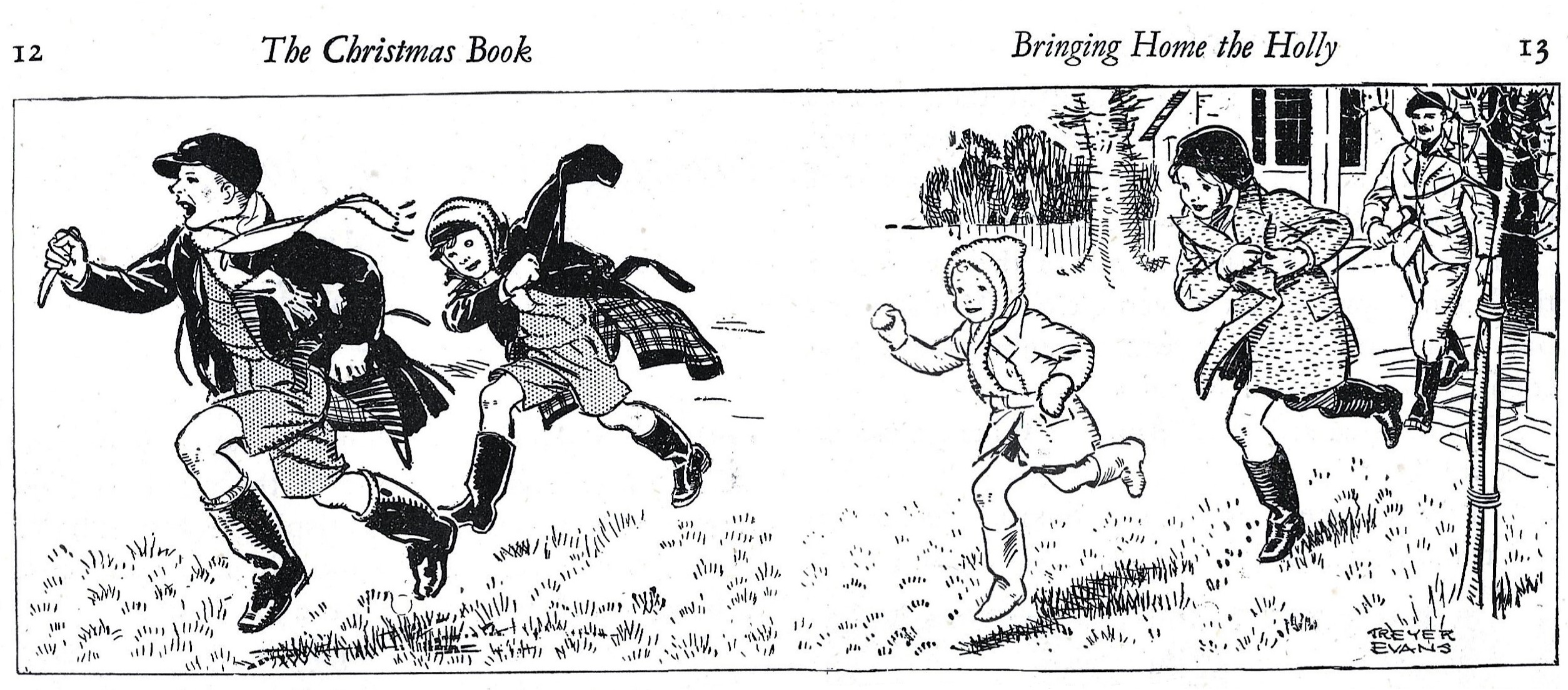
This is the second chapter of The Christmas book, where – as the title suggests – the children go out to collect holly with their father. As this is Blyton there is, of course, a little nature lesson involved – Ann learns the spiky leaves are to deter animals from eating it, but the topmost leaves are usually smooth as cows and horses can’t reach that high. They also open up some berries to find four stones inside.
Daddy then tells them some of the legends around holly. There are an interesting mix of Christian and non-Christian tales, and although the Roman one is presented as a “strange belief” of “olden times” the Christian ones are also presented very much as myth and legend.
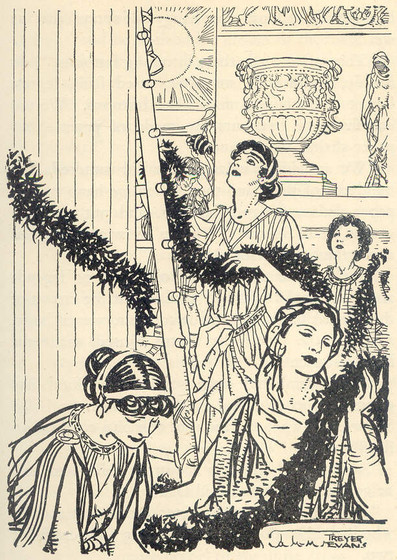
The children (and the reader!) learn that holly decoration dates back to Roman feasts for the god Saturn (though the term Saturnalia isn’t used). Holly and evergreens were brought in, as the belief was that there were gods and goddesses living in the woods and they could come in out of the cold with the boughs and sprays.
Parallels are drawn between their ancient evergreen festoons and our modern paper chain festoons.
Then there are two Christian legends about holly. One is that holly was in the crown of thorns, and Jesus’ blood stained the berries red. The other is that robins breasts are stained red with Jesus’ blood also, as a robin tried to peck the thorns out. It’s pointed out that this is partly why robins appear on so many Christmas cards.
Treyer Evans did several illustrations for each chapter, managing to both skilfully convey the boisterousness of the excited children and the more serious historical pieces. Of course, sadly, not a single illustration appears in the new book.
Now for the changes.
The missing quote is –
With holly and ivy,
So green and so gay,
We deck up our houses
As fresh as the day– Robin’s Almanac
From what I can tell this is a 1695 song from Poor Robin’s Almanack, Poor Robin being a pseudonym – the true author being a matter of debate.
There are only two changes made to the chapter and neither are a surprise.
The gay holly is just the holly, and queer becomes strange.
As an aside, Susan remarks that;
He’s such fun to be with and he’s not like some fathers I know. He really talks to us.
I can’t help but feel that this is a dig at Mr Lynton, though the first Barney mystery came five years later…
A Week Before Christmas
This story was specially written for Enid Blyton’s Treasury in 1947 and had illustrations by H Brock. You can also find it in The Secret of Sky Top Hill from Bounty in 1998 and 2014.
This is one of my favourite of Blyton’s Christmas stories and it’s a nice longish one. (I’ve summarised it for Blyton at Christmas 1946-1950 already but I’ll recap it again)
The Jameson family make plans for a modest Christmas. Daddy is away across the sea and Mother hasn’t much money. So it’ll be chicken, not turkey, a small Christmas-tree, and so on. The children are very grateful for what they have, and are looking forward to Christmas. But then Mother loses her handbag and all her money while out delivering magazines.
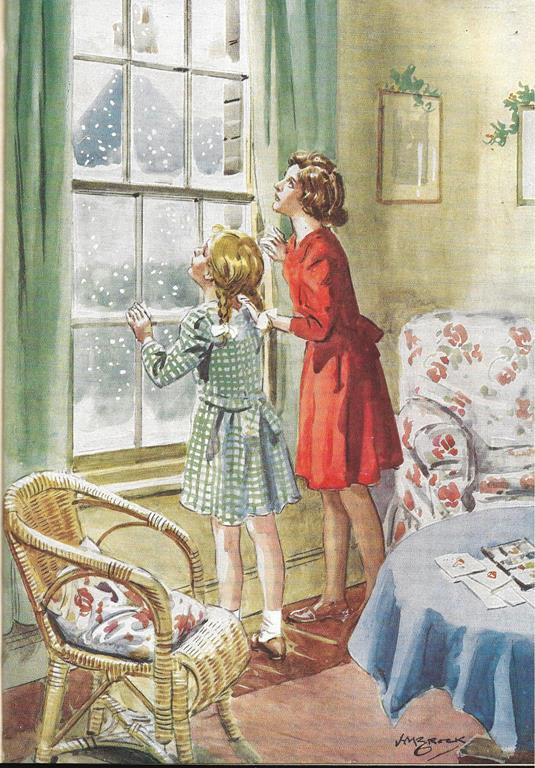
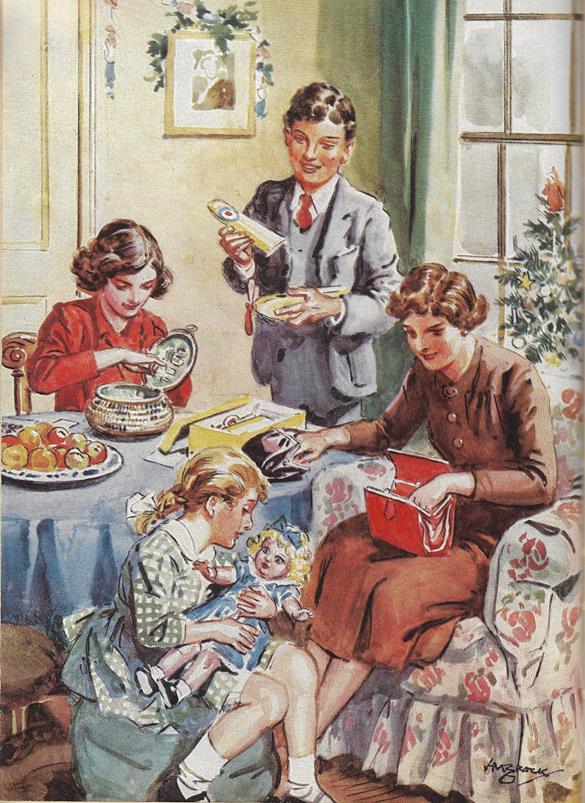
Again – I’ve used the other colour plate a few times, so here’s a different one. While I wouldn’t expect these beautiful full-colour plates to be reproduced, it’s a shame the line-drawings (see below) aren’t used either as they’re very good.
The children are from the same mould as those in The Family at Red Roofs and so they set to work to raise money for a chicken and tangerines – the absolute bare minimum for Christmas. Ronnie delivers prescriptions for the pharmacy, Ellen takes children out for walks and keeps them amused and Betsy goes to read to a blind woman as a companion.
Between them they earn a fair amount towards Christmas, but it is Ronnie who really saves the day, as he offers to sweep someone’s path for free and finds Mother’s handbag buried in the snow.
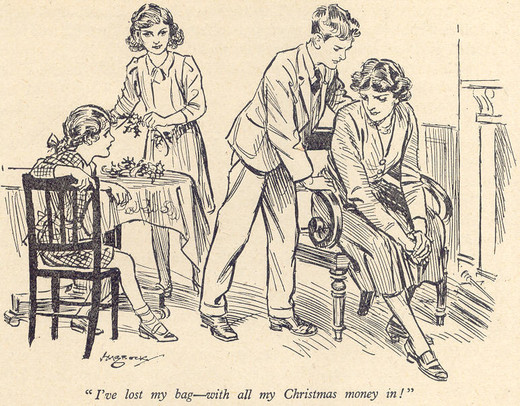
I’m really rather gobsmacked here – not only are the children still Ronnie, Ellen and Betsy, but the money has not been updated. They still earn shillings and half-crowns. Mother’s handbag still costs 30 shillings. I’m almost speechless.
Minor changes are made – gay (a gay Christmas tree, and so cheerful and gay) is removed twice. It’s a pity they couldn’t even replace it with jolly or another alternative instead of removing a descriptor altogether.
Apart from that there’s one loss of italics (another seemingly random change) and of course there are no hyphens now in to-day and to-morrow.
And we do get one other pointless change which I can’t understand. Originally the children had given their mother quite a lot of money. It’s now had got their mother quite a lot of money. What was wrong with given? They had earned it, then they gave it to their mother. Got isn’t wrong, but it really isn’t a necessary change, is it?

 Fiona
Fiona pippastef
 worldofblyton


 World of Blyton

To me it doesn’t make any sense when newly printed old editions all off a sudden have no longer their beautiful illustrations.
I was very upset when German Blyton publisher Erika Klopp Verlag decided in the 1980’s/1990’s to remove the Stuart Tresilian illustrations from their Adventure series. It was bad enough that German children had to put up for decades with much less Tresilian illustrations than British children. But to remove even those few was a very bad decision.
When I was 7 or 8 years old, it was the next illustration in my book that kept me reading until I reached the point where reading in itself started to make fun. But I always enjoyed and still enjoy today artful illustrations like those by Tresilian, Soper and Gilbert Dunlop (R series).
It’s obviously an art that slowly gets lost as illustrations in new children’s books these days look like drawings by 10 year old kids.
LikeLike