
This is the second half of what was originally going to be part 5, and is now part 6.
A Family Christmas Part Eight: Christmas Carols
Daddy tells them about carols which means a ring-dance, a dance in a circle. But then dancing was banned in churches, and it came to mean a merry song suggestive of dancing, a happy song, bringing in such things as the Nativity, or the shepherds or angels. I have to admit that I’m rather partial to a good carol and in the past have gone to the carol service in my former parish church on Christmas Eve, even though I’m not at all religious.

We then segue into what Boxing Day means – which is, that once, collecting boxes were put into churches for money which was then distributed the day after Christmas Day. After that apprentices would take boxes to their master’s customers begging for money. The children mention that the postman and the dustman still come around for their ‘boxes’ which are really money, on Boxing Day.
And Mother makes this very intelligent and apt comment, which hits very close to home reading it in in the present day –
“Even when the whole custom has completely died out, we shall still call the day after Christmas ‘Boxing Day,’ ” said Mother. “Always there are fingers of the past reaching out to us who live in the present.”
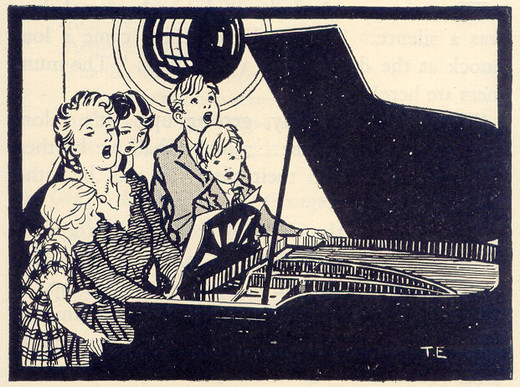
Then, conveniently, some carol singers arrive and sing Good King Wenceslas – the full lyrics of which are printed. I gave this one a good go as I do know the tune.
Then the family sing Hark the Herald Angels Sing, I Saw Three Ships Come Sailing In (I don’t know this one so well so I think I gave up after three or four verses), and The First Nowell the Angel did say (I’ve only seen it as Noel, and again I did a few verses before moving on – Brodie can’t read so he has no idea which line I’m reading, or not reading!),
Then the mummers turn up – what a coincidence! They perform a play, which is all typed out complete with stage directions. The play is acknowledged as coming from The English Folk Play, edited by Sir E. K. Chambers. By kind permission of the Clarendon Press.
Another quote from Old Christmastide by Walter Scott begins this chapter.
Then came the merry maskers in
And carols roared with blythesome din.
– Walter Scott
This is another chapter which gets bogged down with changes made to make it appear more up-to-date.
As above, boxing day is about boxes, sort of. But the postman etc no longer come round for the boxes/money on Boxing day but they used to come round.
Yet Ann (whose name has inexplicably been given an E here) still says But we don’t give them boxes, we give them money. I thought you didn’t give them anything?
Benny then pointed out that Our postman doesn’t bring a box, though. He just brings a bag for the money, and a book to put down the names of givers and the amount they give. He now says that Our Postman doesn’t bring a box, though. And he doesn’t come on Boxing Day. This makes very little sense. Does the postman still come for money another day?
To compound this, mother’s next line still begins Yes, before she then talks about the name being the same even when the custom dies out. Saying Yes to Benny’s previous lines makes no sense. Her wise words also seem out of place, as she talks about when the custom has completely died out but it already has, according to them.
The carols are no longer printed in full. Good King Wenceslas gets its first four lines, Hark the Herald Angels Sing two, and the others none. Ann no longer calls the third carol I saw Three Ships come sailing in, On Christmas Day, on Christmas Day, but just I saw Three Ships Come Sailing in (with added capitals).
To explain what I said earlier – by this point I’d gotten out the original to have at bedtime so that Brodie could see the illustrations. He wouldn’t let me read from it though, he wanted to hold it himself and look at the pictures. However, for this chapter, I noticed that stuff had been cut and foolishly insisted on reading the original – hence suffering through the singing.
More modernising to come.
The carol singers originally collect for the poor old people in this parish, to give them food and coals this winter – sounds perfectly reasonable even today, except perhaps the coal. They now collect for Age Concern. I thought it unusual for them to name a charity, usually books shy away from naming real charities, TV programmes, brands etc in case it becomes an issue.
Mother gives them some money rather than a shilling, and the singers are now singing carols for charity instead of for alms, despite the fact that the original clarified this straight after with getting money for charity.
The family no longer sing lustily but heartily.
As there’s no Cook and Jane the following line is cut – Cook and Jane in the kitchen joined in too, pleased to hear all the old carols.
Also completely cut is the mummers – seeing as Daddy said they don’t do it any more.
Then suddenly there came a loud knock at the door, and a voice cried, “The mummers are here!”
“Well!” said Daddy, getting up, “it’s a long time since any mummers came! Shall we let them in and see them do their play? It will be rather amusing, I expect.”
In excitement the children crowded to the front door, whilst Daddy asked the mummers in.
They were children from the village, all dressed up.
“Come into the big lounge and do your mumming there,” said Daddy, and the children trooped in, giggling. They began their play. Here it is.
As I said above the whole play – running to probably two pages had been printed.
The children all clapped loudly when the queer little play was finished, and the Slasher had fallen heavily to the ground with a most realistic groan.
“That was fine!” cried Ann. “I wish you could do it all over again!”
“No,” said Mother, firmly. “There isn’t time. Look, here is Jane bringing cocoa and biscuits for the mummers. We will share it with them.”
The mummers gulped down their cocoa, ate their biscuits, said their thanks and went off to do their mumming play to the neighbours.
All that is skipped and we go straight to mother looking at the clock (or indeed Mummy), before she agrees to tell the Christmas story.
And here we lose the most text I’ve ever seen – or rather, not seen. An entire chapter has been skipped.
Originally this chapter ended with So Mother began the old story, in her low, clear voice, and all the family listened, and then the next chapter is The Christmas Story, and is mother’s telling of the birth of Jesus and the nativity.
Instead, the carol chapter is extended. What had been the last line now reads So Mother began the old story, about the birth of Jesus, in her low, clear voice, and all the family listened.
It then skips all the way to There was a silence after Mother had finished telling the story. It’s just such a bizarre decision to not include the Christmas Story, in a book about Christmas traditions and their origins. If it was a matter of space/book length one of the short stories could easily have been omitted, as there are sometimes one and sometimes two in between each Family Christmas chapter. Needless to say, I read the full chapter from my original copy, then went back to the new version.
Anyway, the carols chapter finishes with the discussion that is found at the end of the Christmas story chapter.
And a last few small changes –
The Christ-Child is now Jesus (though he was the Christ-Child in the earlier story) and this time they retain the His and Him, whereas last time they were not capitalised.
Mother ringing the bell for supper is removed.
An exclamation mark is put at the end of a question isnstead of the surely correct question mark – “Did people dance in the churches in olden days then!”
One use italics is removed, and diaeresis (the two dots, I had to look up the name) are added to the e in Noel.
And Mother becomes Mummy 5 times, and Mum 3, seemingly at random.
The Very Full Stocking
This was first published in Sunny Stories #206 in 1940, illustrations uncredited. This has been reprinted five times (not including the collection I’m looking at today) but in only two titles… It has appeared in three versions of Jolly Tales (1948, 1952 and 1961) and two prints of The Donkey on the Sands (1996 and 2015). I don’t have any of the Jolly Tales versions, nor can I find one for sale – only a different book called Jolly Tales (Little Book No 3) which doesn’t have this story in it.
This is a story built entirely around the riddle ‘what can you put in a bucket to make it lighter.’ Or in this case, what can you add to a very full stocking.
This is a story about a cat – not a regular cat who happens to be able to talk (like in Smokey and the Seagull) but a cat called Fluffy who lives in a house with his cat parents, sleeps in a bed and hangs a stocking up at Christmas.
It just so happens to also be a story about a mouse that lives in their house, which comes out at night hoping for crumbs. He smells the delicious things in Fluffy’s stocking, but gets caught as he tries to get at them.
The stocking is Very Full, as per the title, and Fluffy decides to tease the mouse by agreeing to let him live if he can add anything to the stocking. Now, I’d be trying to add a hair, or a grain of sand, or something equally tiny as I refuse to believe that a stocking could be too full for those, but the mouse has other ideas. He’s obviously heard the riddle what can you add to a bucket to make it lighter?
Seeing as he’s been let loose to make his attempt he can easily run off home again, only to come back out later to catch the things as they fall through the hole (a bit of kipper, a sardine and a bit of cream cheese – hopefully all wrapped, but probably not!) and then pack his things to move to a safer house.
I can’t see anything that has obviously been updated, but it could well have been snoek in the stocking originally for all I know.

 Fiona
Fiona pippastef
 worldofblyton

 World of Blyton
Another great post, thanks. The Boxing Day tradition of calling for a Christmas Box – as I used to do as a paper boy in the 1970s – isn’t quite dead. My window cleaner still follows it. I’ve also seen Mummers performing a few times in recent years!
Chris
LikeLike
Nice to know these traditions are still around!
LikeLike