
We are at part 7 of 8, which means there’s only one blogging week until Christmas! I ran out of time this week, though, so only managed three stories instead of four. That means I have to try to squeeze in five stories next week…
In Santa Claus’s Castle
This is slightly different from the other short stories, as it is actually an extract from a longer short story. Enid Blyton’s Omnibus was published in 1952 with five stories all based on existing series, long enough to have chapters, but not long enough to be a full novel in their own right. One of those is titled The Faraway Tree, and like the others was originally serialised in Sunny Stories earlier in 1952. In Santa Claus’s Castle is the fourth, and final, chapter of the Faraway Tree story. Dorothy M Wheeler’s illustrations from Sunny Stories were (I assume) reused for the omnibus, and there have been no other printings of this title.
The Faraway Tree books are quite episodic, with adventures which take a chapter, or a few chapters, and many could be read as stand-alone stories. Chapter four of this story doesn’t quite work so well as it is the culmination in a four-chapter arc. Because of this the new version has had to include a summary of what came before:
In this adventure from The Enchanted wood [yes, wood with a small w], Joe, Beth and Frannie are stuck in the Land of Toys with Moon-Face, Saucepan Silky the Fairy. They have been turned into toys themselves, and Silky is nearly captured by Mr Oom-Boom-Boom, a spell-maker they go to for help. Joe has tied the man to a table with his own beard, and the six of them are making their escape…
Helpful as it saves me having to read and summarise three extra chapters for you!
With Mr Oom-Boom-Boom in pursuit the children dive into a friendly Golliwog’s car, and he suggests that they go to the Land of Santa Claus, as he may be able to turn them back into real children/fairies/whatever Moonface is. It makes sense, I suppose. Who knows toys better than Santa Claus?
Apparently there’s a train which runs to the Land of Santa Claus, though I cannot picture how that could possibly work… and perhaps to avoid having to describe the journey, Blyton has them all fall asleep so that they don’t witness it.
At Santa Claus’ castle there are imps and goblins adding finishing touches to real toys, and they mistake the new arrivals for toys. But luckily Santa Claus can tell straight away they they’re not toys made in his castle. What’s more, in an astonishingly meta conversation, he tells them that he’s heard of the famous Moonface with his slippery-slip, Silky and Saucepan Man too. Children write to him to ask for more books about them, which he has also read!

Santa’s sleigh is easier to imagine flying from his land to the tree, and Santa Claus enchants the slippery-slip to turn them back to their usual selves.
The first change is that the children’s names are changed in line with the main series – Jo, Fanny and Bessie are Joe, Frannie and Beth.
Given that the many of the stories in this book have been reprinted before, it’s difficult to know what changes were made previously, and which were made for this specific print. For this story, though, we know that the changes were made for this collection… and boy did they really go to town!
This seems to have had the most modernising of the language of all the chapters so far. The two queers are of course changed, one to peculiar and the other to strange, but that’s happened all through the book. Wakened becomes woke.
In addition, ought (which appears several times in other chapters) becomes should. I say! is changed too, twice to Goodness! and once, tragically, to Wow!
Fine is changed, to lovely, and to nice, while darling is also changed to lovely.
Santa Claus is called sir on several occasions and these are all removed.
It’s rather odd, having read quite a lot of old fashioned phrases in the previous 17 chapters, for it to then be modernised so much.
Other changes I can’t really ascribe to modernising, so they just seem petty and pointless.
None more so than:
WhoooooOOOOOsh! becoming WhoooooOOOOOOsh!
Yep – they stuck an extra capital O in there. I mean, who does that? Who looks at a made-up spelling of a sound and goes, no, can’t have five lowercase os and five uppercase. We’ll have to add another uppercase one… You could also ask who’s counting the os!? and the answer would be me – because I know this is the kind of thing they change sometimes! Interestingly, my spell-checker has underlined the spelling with the extra o, but not the original spelling!
Of course it could just have been a typo, but that’s less fun to rant about.
The imps are changed to pixies – I’m unaware of any negative connotations of imps, so if there are any let me know!
Being what you aren’t becomes being what you’re not. They both mean the same…
A bear was dressed just like a footman, now he’s dressed like a footman.
How do you know about us? becomes How do you know us?
And a bit of Santa Claus’ dialogue is cut from this sentence:
They keep asking me for books about you, to go into their stockings – let’s see, there are three books about you – and they all looked so exciting that I read them all.
The cut text is everything between the dashes, as I suppose there are more than three books about those characters now.
A few changes could be called corrections. Moonface is changed to Moon-Face, which is how his name was written in The Enchanted Wood. Blyton was not very consistent when it came to capitalising and hyphenating names like Moon-Face and Mr Pink-Whistle.
“What!” asked Jo is changed to “What?”, while the castle of the toy soldiers is changed to the fort of the toy soldiers. This ties in with it being called a fort in the earlier chapters, but as these chapters do not appear in the collection, the correction is hardly needed.
A couple of style changes that match the rest of the book – Christmas Tree vs Christmas tree, and my Land vs my land. Two uses of italics are removed, but far more remain.
And lastly, the golliwog problem. Of course they edit out the golliwogs, that’s absolutely standard and expected. So what I’m looking at really, is how they do it.
The golliwog in the car becomes a toy rabbit, or sometimes just rabbit.
Saucepan has become a golliwog too. The first reference to this is removed entirely, so at first I couldn’t remember what he had changed into instead:
“Is your face black enough?” cried another imp, running up with a large brush and a pot of black paint, and looking up at Saucepan’s black face. “Another dab or two, sir?”
“Go away” said Saucepan. “I’m not a golliwog. Don’t you DARE to dab me with that paint.”
After that it’s mentioned that he’s also a toy rabbit. I think it might have been better for him to have been something else, something where he did have a painted face, then the interaction about could have been retained, simply changing black to whatever colour. Or even if only his cheeks or ears were painted, that’d mean only changing two words.
Him being a rabbit also means other changes at the end when he becomes himself again:
Hurrah, his face isn’t black! (that’s such an unfortunate sentence I actually hate that I’ve had to type it out) is now Hurrah he’s back to normal! Again, we could have had wording closer to the original had they left his face painted a different colour. Or they could have had Hurrah, his face isn’t furry!
As a golliwog he had a mop of hair so instead of lamenting that he’s not got his mop of hair they say he’s lost his floppy ears. It annoys me to no end when they not only change the “necessary” things, but the rest of the wording too. What’s wrong with he’s not got his floppy ears?
And lastly I liked him with all that hair becomes I liked him with those long ears. Makes you wonder how he wore his Saucepan hat over those long ears, doesn’t it?

A Family Christmas Part Nine: A Visitor in the Night
Given that it is Christmas Eve, the visitor can only be one person!
The chapter begins with them hanging their stockings, and Ann planning to stay up to ask Santa Claus his story.
Mother isn’t sure on the exact origins of stockings, but tells them that French and Dutch children used to put out their wooden shoes—their sabots—on Christmas Eve for presents to be put into them.
Although Ann does try to sleep she’s still awake after midnight, so she hears the jingle of bells as their visitor arrives. Bravely she creeps downstairs, thinking he’ll come down the biggest chimney into the large fireplace where they burned the yule log.
Santa emerges from the chimney, bringing his sack of toys, and Ann is so overcome with a desire to give him a gift that she gets out some sweets she had bought and frightens the life of of the poor old man. (The whole thing puts paid to the idea that Santa only comes if you’re asleep, of course!)
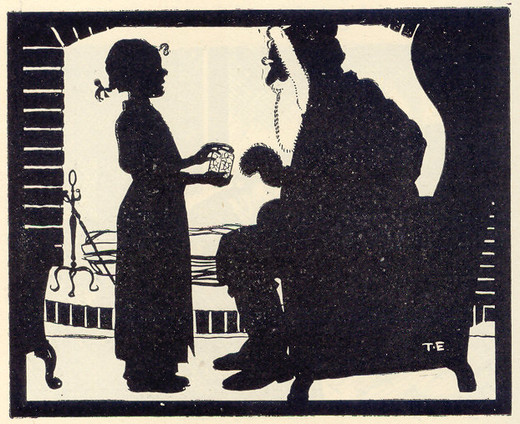
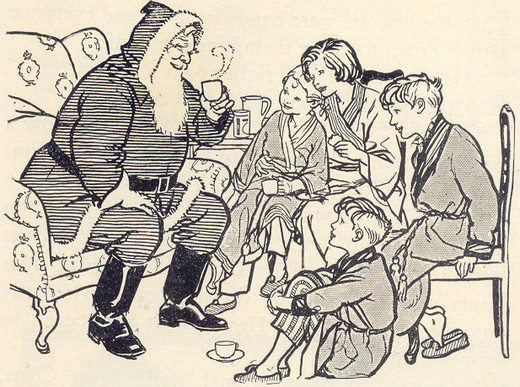
Suddenly wondering if she’s dreaming she fetches her sister and brothers down too, and they all have biscuits and cocoa with their visitor. And then the interrogation begins:
“Santa Claus, we’ve often wondered who you really are,” said Peter shyly. “How did you get your name? Is it really Claus? And what does Santa mean? And why do you come so secretly into people’s houses? How was it you began to give presents?”
The answers begin with his real name being Saint Nicolas, or San Nicolaas in Dutch, which, in an American accent, sounded like Santa Claus. (A bit like saying Space Ghettos in an American accent sounds like a Scot saying Spice Girls.)
He was a bishop, away in Lycia, and I was tortured and put into prison because I believed in Jesus Christ, and His teaching. Then he was made a saint, even though doesn’t believe in saints, which seems rather odd. But he’s the patron saint of travellers, sailors and children.
His full story has to wait for another chapter, though.
The quote at the start of the chapter is one most people will recognise – the beginning of the 1823 Clement (C or Clarke) Moore poem A Visit from St. Nicholas (though it’s often titled The Night Before Christmas, and wasn’t attributed to Moore until 1837)
’Twas the night before Christmas, when all through the house,
Not a creature was stirring, not even a mouse,
The stockings were hung by the chimney with care
In the hope that St. Nicholas soon would be there.
Nothing of real significance is changed here.
The boys’ football stockings become football socks, though Ann still borrows one of Daddy’s stockings.
Mother is no longer carrying a candle when she comes into the room.
Also cut is jingle bells like the ones Ann and Peter had on their reins. I have to admit I’m confused by that anyway, because it seems like Ann and Peter are at least five or six, and surely too old for reins!
Ann has bought sweets for her aunt instead of Cook – though they’re still in a bottle rather than a jar.
Waked up is changed to woken up.
Mother is changed to Mummy a few times.
Santa says before I come down the chimney instead of the original down a chimney – but he’s talking about in general, how he puts blankets on their reindeer before going down chimneys. A chimney was fine! Likewise originally he called softly up the chimney. Now he called up the chimney. It’s the middle of the night and he doesn’t want to wake the parents, so he’s not going to be shouting. If we’re talking about it being unrealistic that flying reindeer on a roof would hear a soft call up a chimney from Santa Claus, I think we’re looking at it too deeply.
What They Did at Miss Brown’s School
This is also a little different from the majority of the short stories in the collection. It is one part of a serialised story, originally printed in Enid Blyton’s Book of the Year in 1941. The Book of the Year is more of a teaching aid than a “normal” book, containing nature-themed stories, poems, plays and puzzles for each week of the year. Many of them came from Teachers World, while others were specially written. There is a specially written chapter about Miss Brown’s school for each month, with this one coming from December. It had illustrations by Harry Rountree, and has never been reprinted anywhere else.
This is a second story about making a little Christmas tree for birds, and I think it should have been left for a different Christmas collection. There are some similarities between other stories – Santa always has a reindeer and a sleigh, he often gets ‘caught’ by children who should be asleep, but somehow two Christmas trees for birds seems more similar somehow.
Anyway, the children at Miss Brown’s School are asking what they are doing to mark December, and that is to gift the birds with Christmas cake and a Christmas tree, just like the children have had.

The cake is more of a traybake with seeds and nuts suspended in melted fat, no cooking required. Then the tree is much the same as the previous one, with sprays of millet seed, chunks of coconut and pieces of bacon-rind.
It’s more educational than The Tiny Christmas Tree as they talk about which birds like which foods, other foods they’ll like – and how children should never eat bird food.
In a complete U-turn, this chapter has barely been touched.
Coco-nuts and pea-nuts lose their hyphens, gay is wonderful and one use of italics is removed. And that’s it.
The Christmas tree still costs ninepence, the millet sprays twopence each and Susan gets sixpence to buy them. There’s a fire in the school room, Miss Brown has a tray of dripping on the fire.
I mean how can you justify all the modernising in the previous chapter, yet have Christmas trees costing ninepence?

 Fiona
Fiona pippastef
 worldofblyton

 World of Blyton