
I bought this as it appealed on two counts: a Blytonian title, and illustrations by Eileen Soper.

The Six and the Caravan
The title is more accurate than Five Go Off in a Caravan (in which they, of course, use two caravans) as there is indeed one caravan, and six people. However three of the company sleep in a tent as Slow Coach the caravan (newly built but in the traditional gypsy style) isn’t big enough to actually accommodate six. I’m sure all six are inside at some point or another, though, so close enough.
The six in question are siblings Norry (13), Fred (10) and Cynthia (age not given, but younger than Norry), their older half-sister Grace, her husband Rodney, and her son Toddles (3).
A rollercoaster of a caravan holiday
I went into this not entirely sure what to expect. Was it going to be an adventure, à la Five Go Off in a Caravan? – that seemed unlikely after the first pages revealed there would be two adults and a toddler in the party.
The other option was something more akin to the Caravan family where the adventure is simply living in a caravan and travelling about.
As it turned out, it wasn’t that either! It looked, for a brief time that it might be, but things quickly plunged into the unexpected…
It began tamely enough. A letter inviting the children on the holiday, taking the train to meet their sister and her husband. Going for tea in the town then walking up to the field to find that The caravan had vanished!
This turns out to be because Rodney had parked it in a farmer’s field without permission, and the farmer had thrown him out (fair enough, really!). The caravan had only been moved to some common ground a little further on, so was found by the others quickly.
I thought that this sort of thing would be the only real drama they faced, but I was wrong, very wrong.
The book is under 100 pages, and yet manages to pack in two children nearly drowning, two children being swept out to sea in a rowing boat (unconnected to the drowning!), one child sneaking off to perform at a circus resulting in one badly sprained ankle, one night time prowler, one planned theft and one reunited grandmother and grandchild. Phew.


Each new chapter had a sense of what next?? Though sadly the mention of smugglers’ caves was just a brief mention and played no part in the story.
The only real disappointment in it all is that the big drama of the planned theft of Rodney’s money is over before it even begins. They hear of the plan and the boys go off to fetch the police
And that was the end of the gypsies’ plot to steal Rodney Dean’s money.
The police arrive before anything has happened and go to watch the gypsy camp through the night. In the morning the police interview Rodney and the gypsies. There’s no mention of them trying to sneak over to Slow Coach in the night let alone any detail of arrests.
Personal development
Somehow the book manages to also fit in some personal development for the three children amongst all the drama.
Fred has the most – he is described as (more so than shown to be) a bit on the lazy side. He is never shown to shirk duties when caravanning/camping but several times it seems to be expected that he would try to avoid work. Fred himself seems to be aware of this habit of his and as he flushes, or doesn’t meet Rodney’s eye on occasion.
He is told off once for grousing because they’ve been walking in the rain then have to fetch wood and water.
No grousing! You must take the rough with the smooth.
– Rodney
But there’s no dramatic occasion where Fred’s laziness leads to disaster actually – that’s left to his older brother Norry.
It is Norry who is left to supervise young Toddles (referred to as a baby multiple times despite being a sturdy three year old!) and a local friend the boy has made, and it is Norry who engrosses himself in a book and doesn’t notice them trying to sail a bathtub on the village pond until it’s almost too late.
You’ll never make a man if you aren’t trustworthy. No matter how clever, or loveable a person may be he’ll always be a failure if he can’t be relied upon. Make a beginning in small things, my boy, then in great ones you won’t be wanting.
– Rodney
This sort of speech wouldn’t be out of place in a Blyton book.
Only then does Norry reflect that he often forgets to post letters, or do jobs he had promised and treats this as a wake up call.
It is Cynthia who somehow ends up filling in at the circus – having meant to just buy some chocolate then return to the caravan.
She learns her lesson the hard way, by spraining her ankle and not being able to continue the holiday for a time.
We’re not going to punish you for you disobedience, my dear, because you have your own punishment in a good deal of pain and having to lie still when you would like to be running about. But, please remember that you are delaying everyone’s trip for a week or more, and that you have caused us a great deal of anxiety and expense. Rodney and I are very displeased, and if there is any more trouble through the behaviour of you children, you will all three be back off home without a moment’s delay.
– Grace
The first part of that speech is certainly something you’d find in a Blyton book – the worst or only punishment being the natural consequences of a person’s actions. I’m not sure that Blyton’s adult would then labour the point so much afterwards, though. I feel like Blyton’s child would perhaps reflect, guiltily on the impact their actions were having on others rather than having it said to them.

Coincidences and contrivances
Blyton’s books are in no way exempt from strange coincidences and obviously contrived situations but this book leans quite heavily on them.
The boy (Jerry) who sneaks into their camp looking to steal just so happens to be the grandson of an old lady they meet later, who just happens to lament that she’s all alone as her daughter is gone, having run off with a wandering man and then died. Obviously Jerry is the daughter’s son, who they just so happen to bump into later, and who just so happens to have lost his dad so that he can be passed into the care of his grandmother with very little fuss.
The planned theft of Rodney’s money also required a deliberate set of circumstances. He was expecting money from someone who sent actual money instead of a cheque, and this just happened to be overheard by some gypsies – from the same camp as Jerry – and Rodney just manages to take too long in thinking it over to go back to the post office before it shuts.

When Cynthia hurts her ankle there just so happens to be a doctor in the audience who has a spare room, as the local hospital is full. And he just so happens to have a daughter Cynthia’s age to make friends with her…
These things probably wouldn’t be so obvious in a longer book where they could be disguises or distracted from with other events and details.
I doubt children would notice or care but I did find some of it a bit unlikely and silly.
Some other thoughts
We don’t get to know the characters particularly well as this is a short book – for example Grace being the children’s half-sister is never explained (making me wonder why it was even mentioned, other than it sort of explaining why she’s so much older) and there isn’t time for the sort of jokes and teasing you get from the Famous Five or Adventure Series children. It’s more like The Treasure Hunters actually where the children are not overly detailed and are just there to have an adventure.
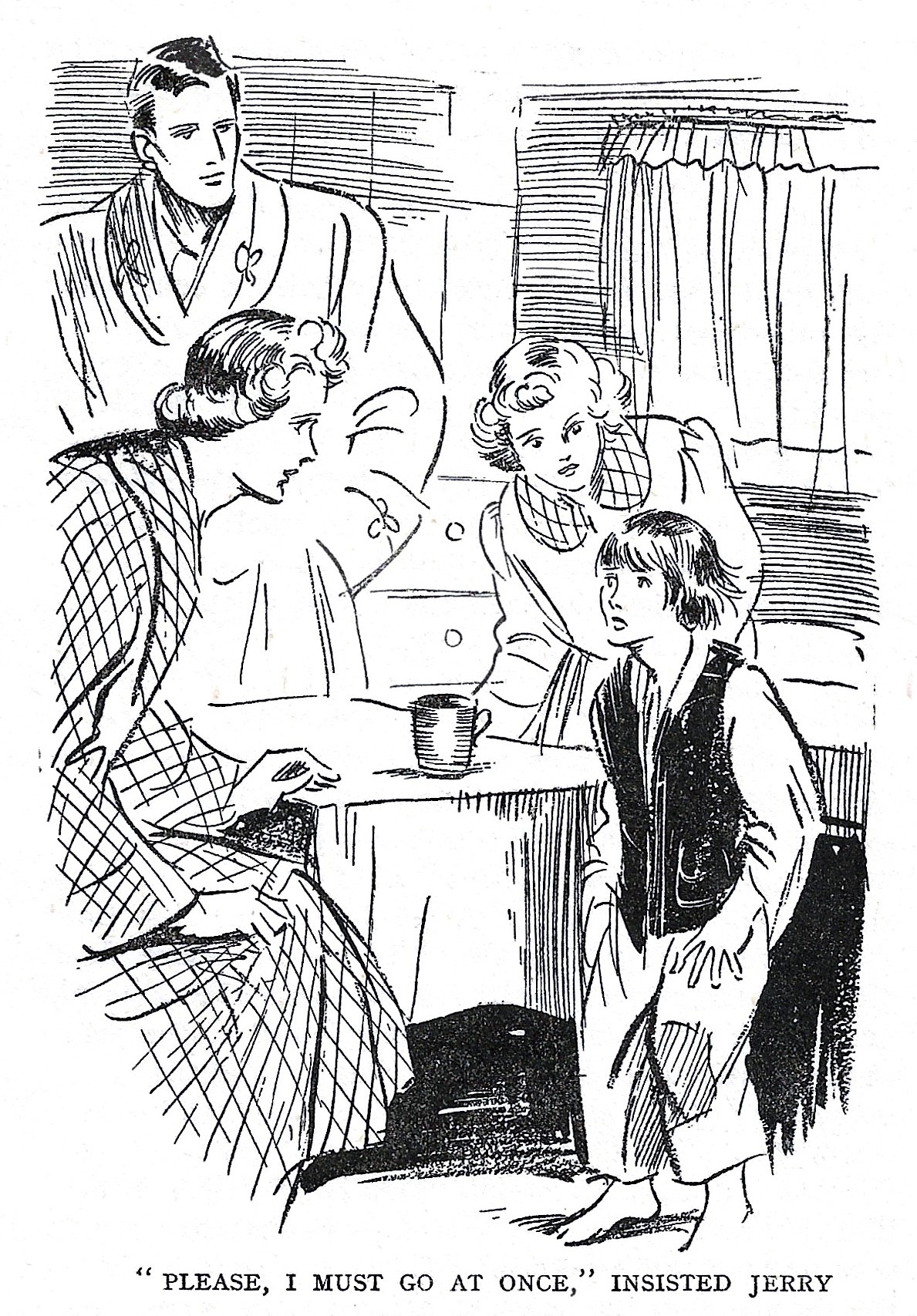
Jerry was similarly sketchy – and had a cringey way of calling Grace pretty lady or lovely lady every time he spoke to her. Likewise his Oh I am so hungry, so hungry! Do not beat me! came across as awkward.
His grandmother gets to talk in a strong Cornish dialect using words like foine, zee volks, zpot, darter (daughter) and so on but this tails off when she has several sentences to say at once!
There is a suggestion a few times that Grace and Rodney are too soft with Toddles.
It does seem crazy for a baby of three [to go on a caravanning holiday], but you know Rodney and Grace take him everywhere they go, and he never seems any the worse.
It would be odd not to take your three-year old on a caravan holiday these days, especially if you were going for six weeks! He also eats a great many more cakes than were good for such a little boy, but Grace only laughed and said no goodies could spoil his digestion.
There’s the usual boys vs girls attitudes, to be expected in a 1940s book. The boys camp out, Cynthia sleeps in the caravan. The boys fetch water and firewood, Cynthia helps make supper and put Toddles to bed. Worst of all when Cynthia is missing Norry is left at the caravan to take care of Grace and Toddles while Fred and Rodney go looking for her. Why on earth does a fully grown woman need a 13 year old boy to look after her!?
I was confused to begin with as the children are in the school room, and home lessons are mentioned but their mother writes to the heads of the children’s schools to make excuses for them taking a long trip away – despite it being as described as all the holidays. So they go to school, but have a school room at home, and home lessons, and have to be excused from the home lessons during the holidays?
I sort of like Cynthia’s idea of hanging fourteen inches of a tape measure up and snipping off an inch every day to count down to the trip, but it does seem a bit wasteful too! She could probably get several uses from a tape measure at least.
I liked that Fred didn’t enjoy his first night camping, as the ground was hard and uncomfortable – and the narration mentions how bad a night most people have when they’re not used to it. I know I’d never manage a good nights sleep on the ground, and find it vaguely annoying how well book characters always seem to sleep in the most uncomfortable places.
Unlike Blyton’s characters Rodney does not approve of going to the circus, presuming it to be vulgar entertainment – though that perhaps applied specifically to that circus and not all circuses.
Overall I enjoyed this – it was fast-paced and I never knew what was going to happen best. It lacks Blyton’s excellent descriptions of places and food, as well as banter and amusing incidents, but that aside, it was a good read. The Soper illustrations also helped!
I’ve included all the rest of the illustrations below as I’m not sure if any of them are online anywhere.


 Fiona
Fiona pippastef
 worldofblyton


 World of Blyton