
While in the children’s department of the library a few weeks ago a new delivery of books came in and amongst them were two books I’d never seen – or even heard of – before with the name Enid Blyton on the cover.
Sadly these are not previously undiscovered Enid Blyton books, they have been written by someone else, based on her books. But still – I found them really nice.
Lifting the flap
I chose the post title as a play on lifting the lid, because they are both lift-the-flap books. I loved lift-the-flap books as a child – I had several Spot books by Eric Hill, Dear Zoo by Rod Campbell amongst others, and even once I was a bit too old I’d still enjoy going through those, or ones I found at the library or in bookshops. Even as an adult I still enjoy them (having a child is a very good excuse to indulge in lift-the-flap books)! Particularly the detailed non-fiction ones like Usborne’s Inside Castles which allows you to see, well, inside parts of castles.
I had never seen an Enid Blyton one, though searching online shows there have been a couple of Noddy ones made, but not during her lifetime. There were some 1950s Noddy pop-up books, though.
It got me wondering about the history of lift-the-flap books, and I discovered that they have been around for hundreds of years – starting out as educational pieces such as guides to the human body where you could lift the flaps to see inside the body, and children’s ones were around in the 1930s. More information, and example of lift-the-flap and pop-up books from the past can be found here. (This explains why it always takes me so long to write what is supposed to be a simple review – I start wondering about things then fall down rabbit-holes on the internet.)
Anyway, the two books in question are Let’s Have a Picnic and Goodnight, Fairy.


Let’s Have a Picnic
This was the first one I picked up, which has a rather adorable baby Moon Face in a little onesie on the cover.
There isn’t a huge amount of story inside – which is pretty standard for a 10 page lift-the-flap book. Moon Face is hungry, so goes and fills his picnic basket with tasty treats (found, oddly enough, on “land” rather than up in the Faraway Tree where he starts off), before laying out a picnic blanket and waits for his friends to come and join him. From the pictures these look like Silky and the Saucepan Man (so young he has only collected one saucepan so far), plus another girl who I couldn’t identify.
Each double page has 2-4 flaps to lift, often revealing answers to the questions posed in the rhyming text alongside.
High up in the branches of the Faraway Tree, someone’s feeling hungry.
Who could it be?
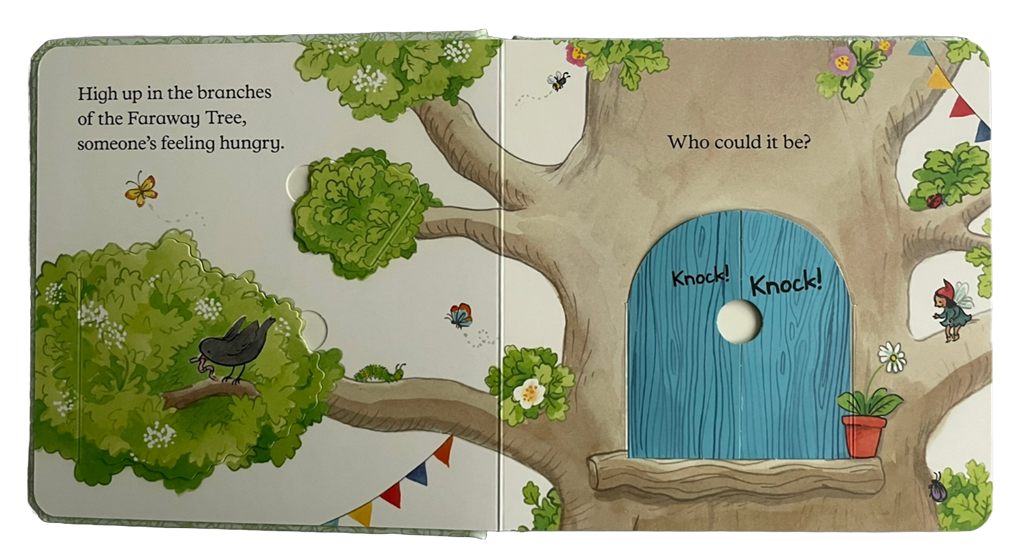
I hope it’s not a spoiler to say that the doors open to reveal Moon-Face!
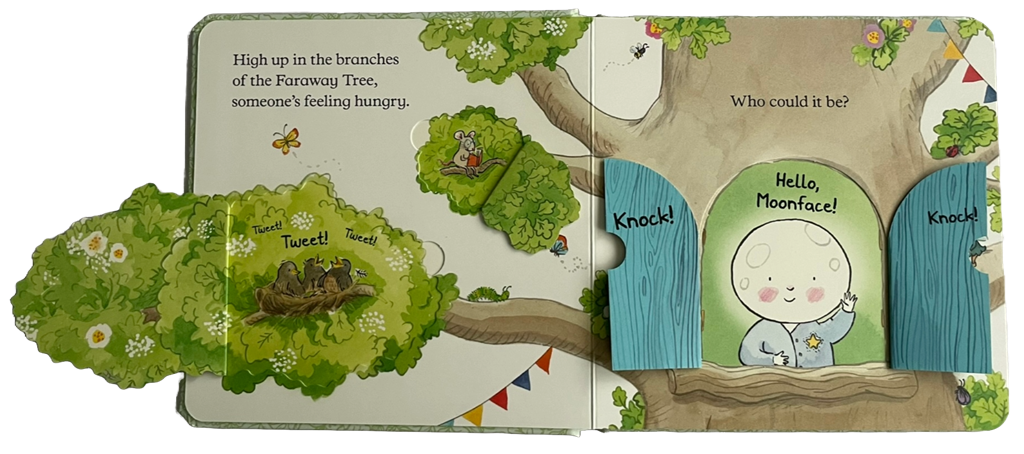
Other flaps lift to reveal woodland creatures and inhabitants of the tree.
My favourite is the slippery-slip which appears towards the end, opening this and folding it down changes the position of those sliding down it.


Goodnight, Fairy
Silky – who has wings like most previous incarnations in illustrations despite that not being in the text – has a similarly non-eventful story.
She finds her friends hiding in the tree then heads home to bed. Being a good little fairy she tidies up, takes a bath, has a bed-time story, and goes to sleep.
Only one of the flaps is lifted this time to answer a questions – who is hiding in the tree – but most are to show what happens next in each scene. Silky’s bedroom goes from (very slightly) untidy to tidy, we find a shooting star in the sky, Silky dons a very cute bathrobe after her bath and so on. I’m not sure what’s cuter, Silky’s bathrobe or Moon Face’s onesie.


There are also smaller flaps on the pages revealing fun glimpses of the forest animals. I like the story book she reads which is a teddy bear version of Cinderella.


My thoughts
I’m often reticent about continuation books as they never capture the characterisation of the originals for me.
Saying that, I don’t think it matters for babies! I really like these books (I hope there will be more, with other characters) as they are a great way to introduce very young children to Blyton. They are beautifully illustrated with a lot of fun details, and making the characters very young, and for the very young, avoids any need for continuity with the original novels (saying that, they haven’t done anything that clashes horribly.) We’ve had baby book versions of Winnie the Pooh and Peter Rabbit etc for a long time, so it’s good to see Blyton getting the same treatment.
I did wonder where Silky’s parents were, or if she lives alone as she’s clearly not more than a toddler – but I really doubt that the target audience is going to be worried about that.
It’s a shame that the true author isn’t credited, but I suspect that’s common with these very short books which are using someone else’s characters.
I’d definitely recommend these for any Blyton fan with a baby, or as a gift for anyone with a baby as you don’t have to be a Blyton fan to enjoy them.

 Fiona
Fiona pippastef
 worldofblyton

 World of Blyton