
I found the first graphic novel adaptation to be surprisingly good. Heavily abridged to fit the format, of course, but cleverly done. There were a couple of things added which didn’t seem necessary (George meeting the man on the beach, and the stuff about Incan treasure) but perhaps the graphic novel writers wanted to have something to differentiate it from a more straightforward abridgement. That, or, as they are translated from the original French, they are based on details from the French versions of the novels. I could see a translation referring to Incan gold perhaps, but not fabricating whole scenes.
Let’s see if they have managed to keep up the same quality in the second graphic novel.
Initial thoughts
I had to put it down seven words in to make a note – that’s not good. The scene is established with the children returning to Kirrin on… an autumn day.
I can understand if a TV series chose to portray autumn instead winter, seeing as snow wouldn’t have been within the budget – but this is a graphic novel. Colouring the scenery white is presumably not expensive.
We meet who I assume are to be the baddies on the train, only there is also a little girl called Jennifer who they are planning to follow, making me wonder which book this actually is.
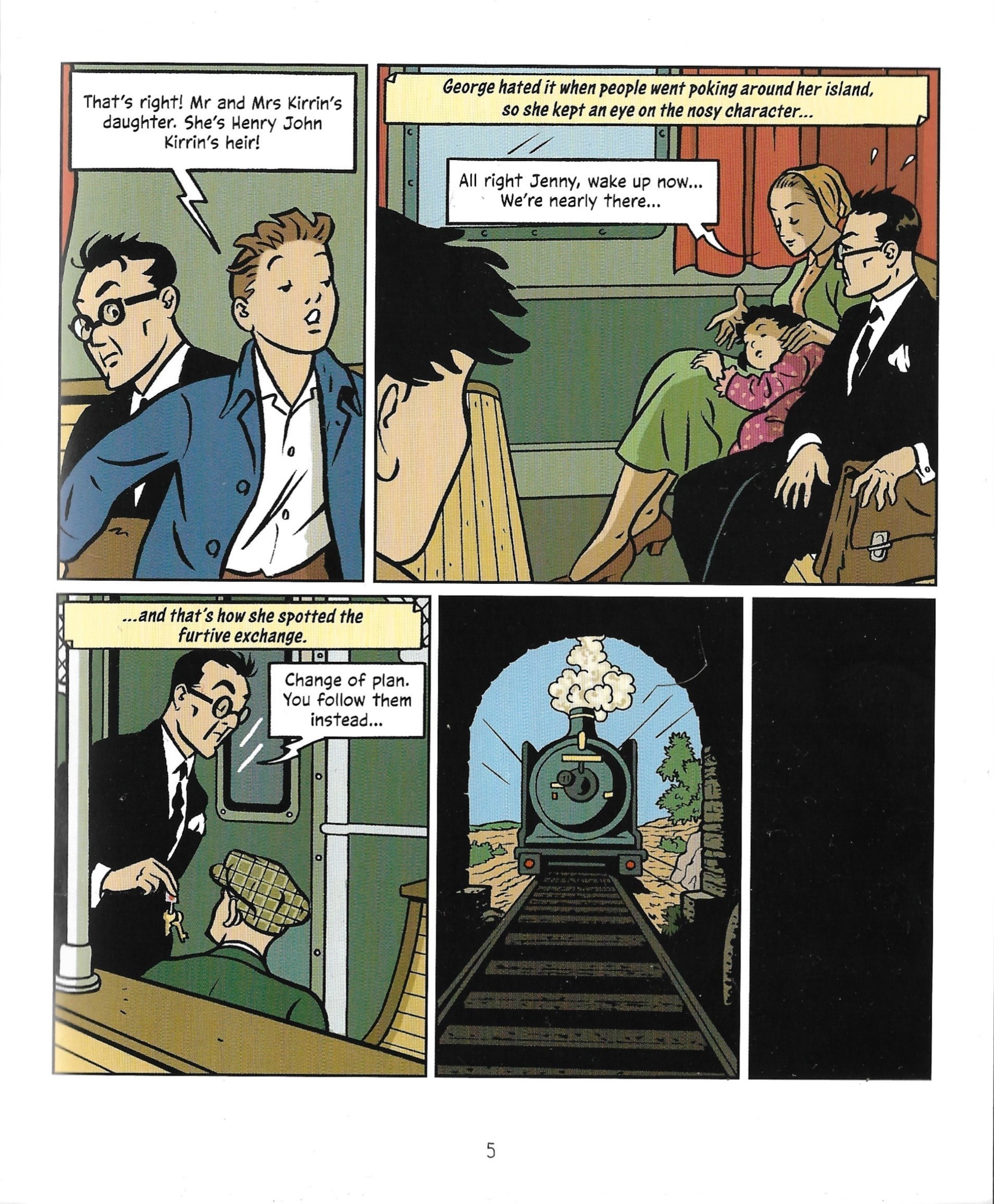
Timmy is waiting for them at the station instead of being at school with them, and Aunt Fanny delivers them home in a taxi. More unnecessary changes that are nothing to do with abridging the story or making it clearer.
At this point it is barely recognisable!
Along for the taxi ride is Mr Wilton (finally – something familiar) but he is an architect who is to be working on Kirrin Farm and Castle as the council is insisting something is done for safety reasons.
Why he is following one girl, then decides on a whim to follow the Five I don’t know. Was he planning the theft of Uncle Quentin’s documents already and realised this was a better way in?
So far so bad
We return to the original work as the children go to visit Mr and Mrs Sanders. They do discover a secret panel in the hallway, though in a much more dramatic manner. They do not get to play around with the false-backed cupboard.
The parchment they more or less decipher themselves – George showing up the boys by being better at Latin was amusing.
Mr Roland is introduced at this point as George is behind, Julian was off sick a lot and Dick has trouble sitting still and paying attention.
We then get the snow. In autumn. Why not just set it in winter to begin with?
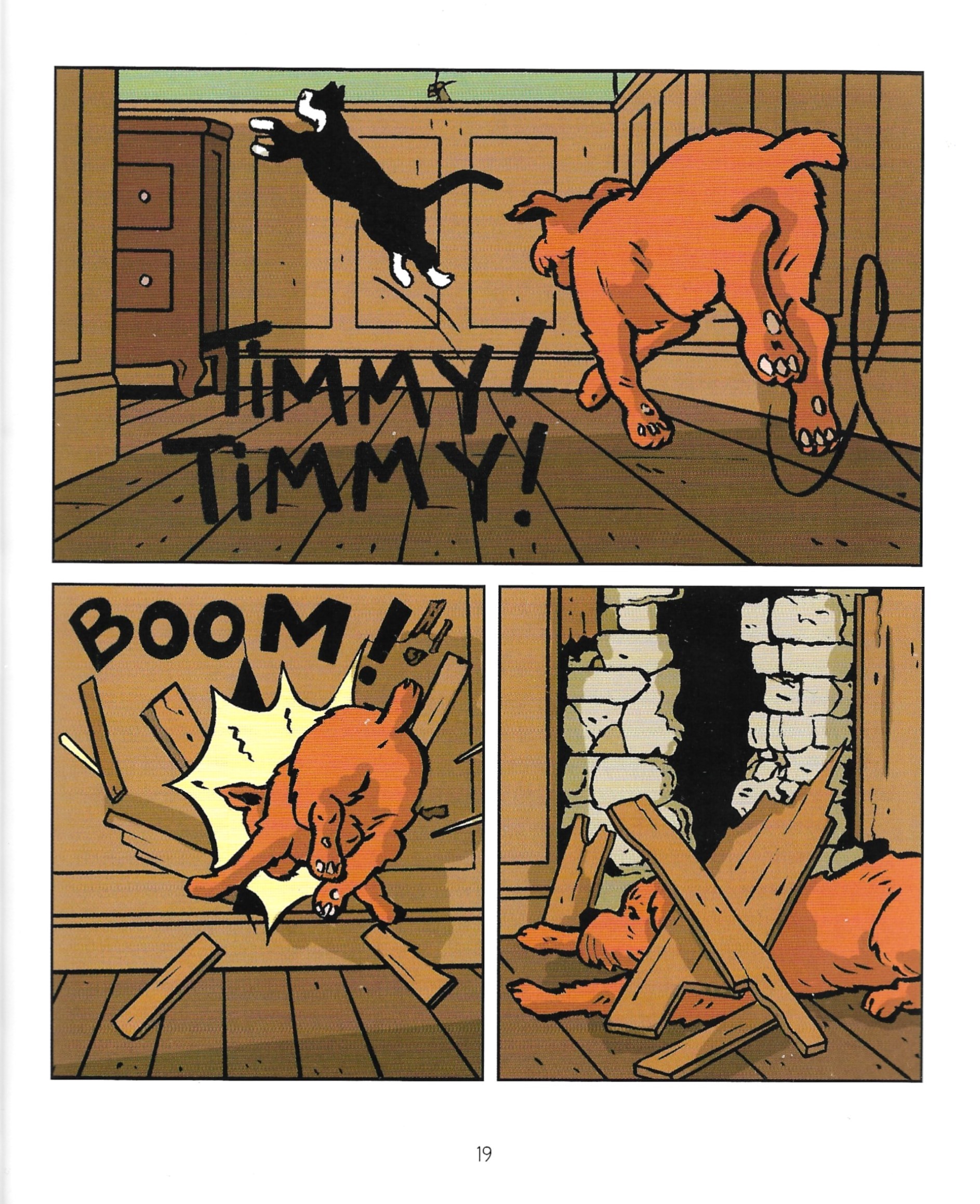
Timmy vs Mr Roland is well depicted, but everyone’s so upset about Timmy being turned out of the house Aunt Fanny gives them all tea full of sleep-inducing herbs. To help it work, she read them the unpronounceable Latin names of all the plants in the drink. This is sort of amusing as George claims to use a latin dictionary to help her fall asleep, but still, it’s a bit weird.
Mr Roland is in his pyjamas and is obviously staying at Kirrin Cottage, and says that Timmy is too dangerous to be roaming free. The next panel says that George learned that Mr Roland is staying at the farm. It’s not clear why, and the next night Uncle Quentin’s report is stolen. Are we supposed to think that Mr Roland and Mr Wilton have found the secret passage and used it? None of it is very clear.
Having brought Timmy back in from the cold George notices the stone floor and they find the secret passage, and here’s where it starts to go off the rails again.
They pass through a large space that must have sheltered a lot of refugees during the war.
A huge and extremely obvious door hides what looks like very obvious doors on the back of the wardrobe. And then they set off smoke bombs to get Mr Wilton and Mr Roland out the room. Realising they have been revealed as thieves the two are in such haste to get away they run through the snow barefoot and in underwear. Goodness knows where they think they’re going.

Not the end
I thought that would more or less be the end of the story, with perhaps a page or two for Uncle Quentin to admit he was wrong and them to make a last joke. But no. There are five more pages, which reveal Mr Wilton did know about the passage, and he had a photo of the girl from the train.
The children get ill from frolicking in the snow and the doctor is called. He tells them that they must take it easy for a few weeks.
Some time later Uncle Quentin shows them a newspaper article about Jennifer, a missing girl, who is suspected of being kidnapped by Mr Wilton… launching us into a fresh bout of confusion which might be cleared up by reading the next graphic novel, but who knows.
Sadly this one was nowhere near as good as the first, and I hope it isn’t a sign of what’s to come with the rest of the ones which have been published so far.

 Fiona
Fiona pippastef
 worldofblyton

 World of Blyton
Presumably the publisher has chosen to produce a so-called ‘graphic novel’, instead of reprinting the real novel (or writing a new novel based on these characters) because they believe children can’t read, or don’t like to read, so that a comic strip adaptation is expected to sell better. That is probably par for the course in children’s publishing these days: that children only like looking at pictures.
Since, by definition, the target audience won’t have read the book which this comic strip is based on, the publisher expects that no one will notice that there have been changes, by which logic any changes are acceptable (to the publisher), so why not make it a more exciting tale, by introducing a host of changes.
Maybe this type of adaptation is less offensive to modern children, who thereby don’t have to be exposed to the horrors of characters having to use a public phone box, or paying for things with old money, etc, a way around all those many aspects of the original novels that create a sense of time or period (or give the original tales charm). If the original books are perceived as old-fashioned, it offers a solution of sorts.
There’s a risk in this of making the stories bland, and of removing any trace of Enid’s personality, but maybe no more so than in a tv or movie adaptation.
It’s perhaps a good thing that any publisher is willing to promote Enid Blyton’s name these days.
Anyway, thank you for subjecting yourself to actually reading this adaptation.
LikeLike
Presumably the publisher has chosen to produce a so-called ‘graphic novel’, instead of reprinting the real novel (or writing a new novel based on these characters) because they believe children can’t read, or don’t like to read, so that a comic strip adaptation is expected to sell better. That is probably par for the course in children’s publishing these days: that children only like looking at pictures.
Since, by definition, the target audience won’t have read the book which this comic strip is based on, the publisher expects that no one will notice that there have been changes, by which logic any changes are acceptable (to the publisher), so why not make it a more exciting tale, by introducing a host of changes.
Maybe this type of adaptation is less offensive to modern children, who thereby don’t have to be exposed to the horrors of characters having to use a public phone box, or paying for things with old money, etc, a way around all those many aspects of the original novels that create a sense of time or period (or give the original tales charm). If the original books are perceived as old-fashioned, it offers a solution of sorts.
There’s a risk in this of making the stories bland, and of removing any trace of Enid’s personality, but maybe no more so than in a tv or movie adaptation.
It’s perhaps a good thing that any publisher is willing to promote Enid Blyton’s name these days.
Anyway, thank you for subjecting yourself to actually reading this adaptation.
LikeLike