
The graphic novel version of Five on a Treasure Island was fairly good, while Five Go Adventuring Again was rather poor.
What will I make of Five Run Away Together? Let’s find out.
An unrecognisable beginning
We start off with the Five out on a walk where Timmy crashes into two men on bicycles. I had thought they were perhaps station porters or something due to their uniforms, particularly the hats. They are, however, revealed to be policemen. (The text gets translated, clearly not the illustrations!)
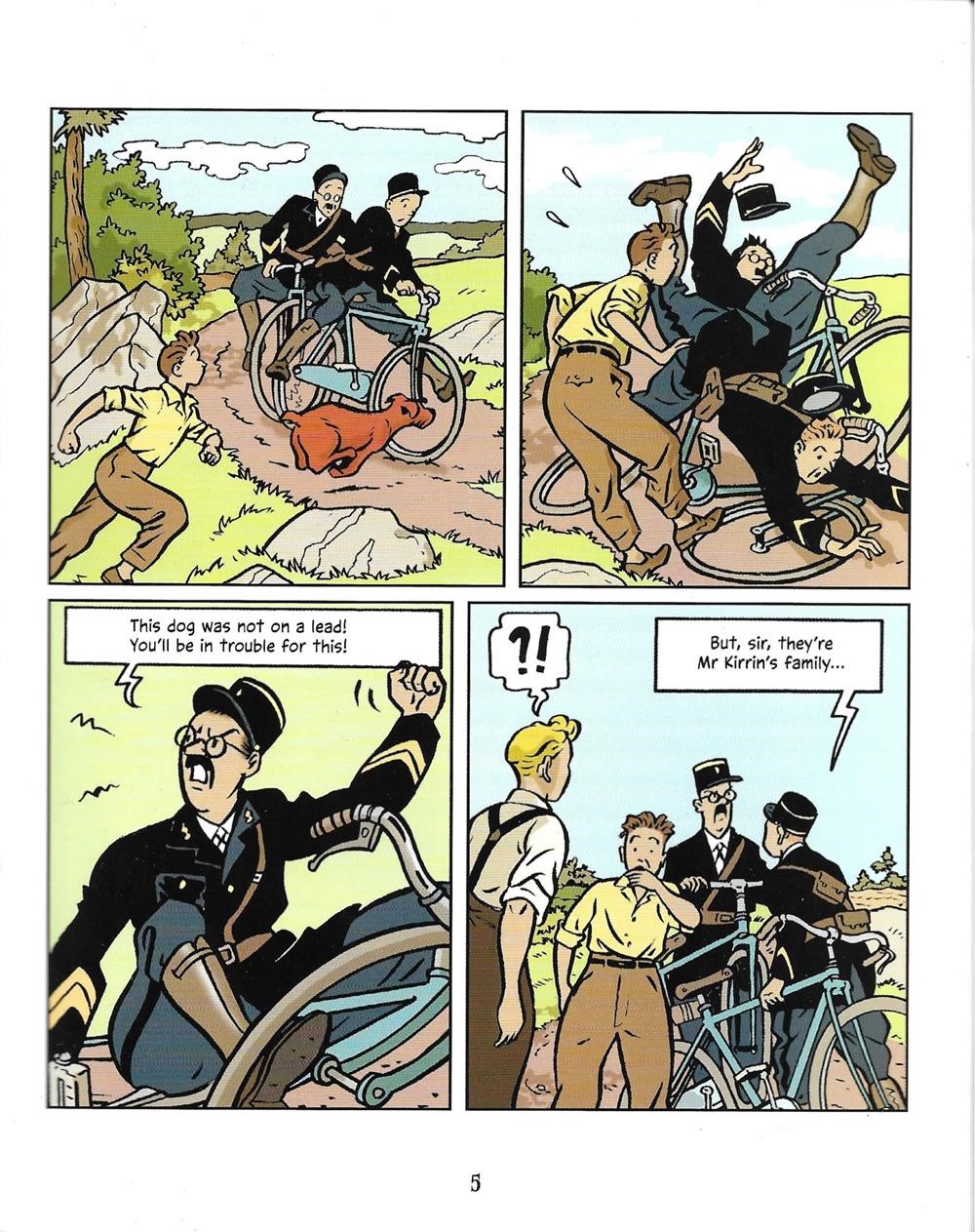
Then Uncle Quentin cycles up (!) to reveal that Aunt Fanny has been taken into hospital. The police, having been on their way to see him anyway, reveal that Jennifer Armstrong’s kidnappers have sent a ransom demand from the South Seas.
They return to Kirrin Cottage to meet Mrs Stick, Edgar and Tinker who have just arrived to replace Maria. (If they’re translating Francois, Mick, Annie, Claude and Dagobert back to Julian, Dick, George, Anne and Timmy, then why not Maria to Joan/na?) And just like that Uncle Quentin leaves them with these total strangers… What’s interesting is Uncle Quentin says that Maria recommended the Sticks. This may be to make it seem more sensible, leaving the children in the care of strangers, but it makes no sense considering the Sticks are not only unpleasant people but also criminals.
Not entirely unrecognisable, at least, beyond the strange run-in with the police. The heavy abridgement required means there was no time (or rather, page space) to have the Sticks arrive before Aunt Fanny goes into hospital.
The Sticks
While in the book the Sticks are at first only a bit annoying before becoming truly awful as soon as the Kirrin adults are out of the way, here they launch straight into being nasty.
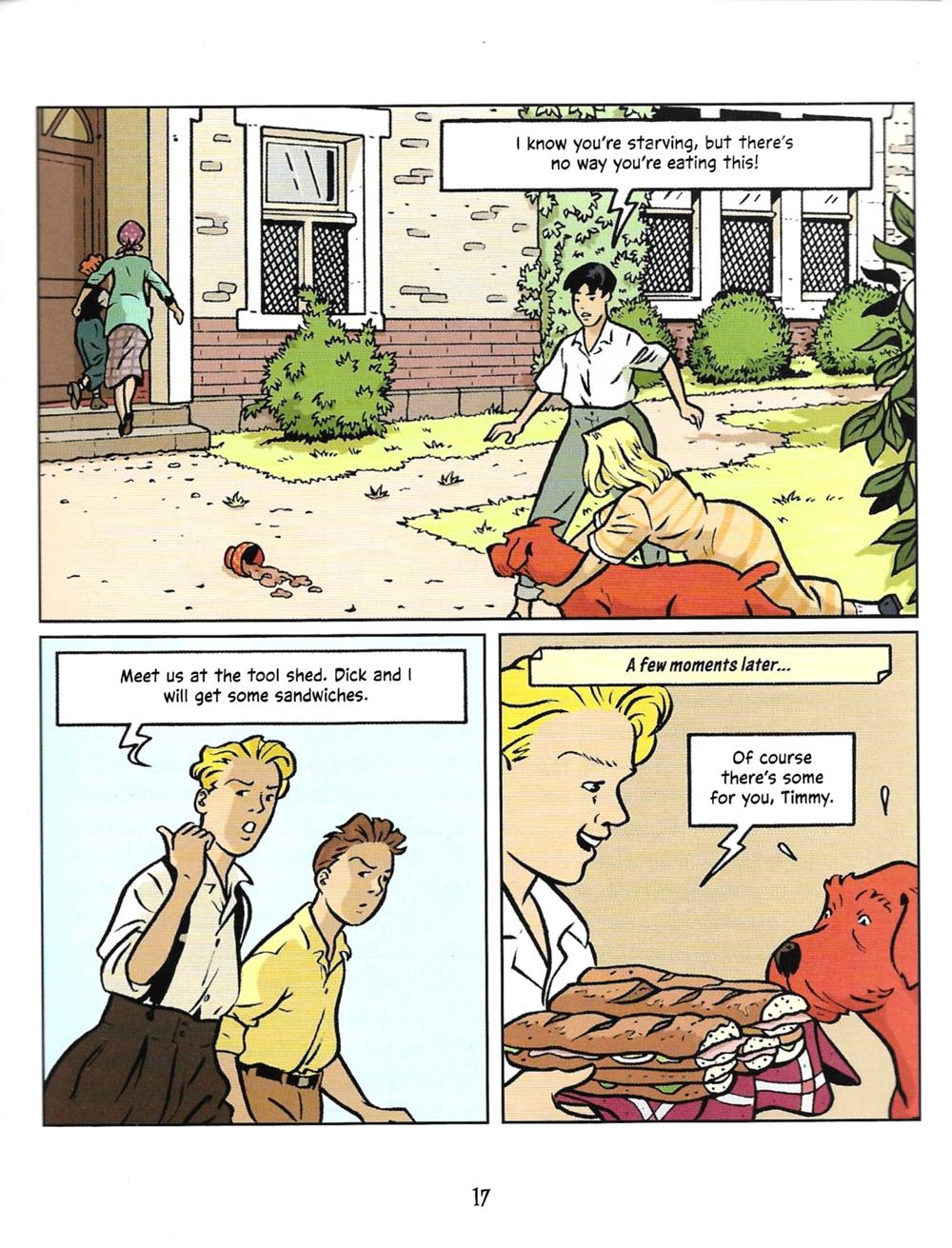
Within eleven panels of Uncle Quentin driving off, the Sticks are trying to poison Timmy, after he and Tinker have a bit of a fight. When Mrs Stick declares she doesn’t start work until 6pm the boys go make sandwiches (or rather, baguettes as it is France after all), but there’s no showdown with Mr Stick sadly.
George’s Plan
George goes off on her own for a bit, and when the others find her she says she has a plan and the others have to go home. After dinner she insists they all go for an evening walk. She sees a light on her island and declares it time to put her plan into action, rushing off across the beach and telling the others to go back.
Julian tells Dick and Anne to go after her, while he goes back to the house to fetch torches. He finds George’s note about going to stay on her island, but has to wait a while to return to the beach as Mr Stick has arrived. When he gets back to the beach he finds George heading off in her boat and Dick and Anne standing on the cliff uselessly.
I’m not sure that all makes sense, really. Why take her cousins out on an evening walk just to ditch them to head to her island, knowing they would try to stop her? I assume seeing the light hastened her plans, perhaps she intended to tire them out so she could sneak off that night while they slept, but then why leave the note on Julian’s pillow?
Anyway, despite the details, the general events were the same. George tried to row off and was stopped, the others planned to go with her. In a very non-Blyton turn Julian writes the Sticks a note with the blatant lie that they are all getting the train back home. (In the books they leave out a train timetable hoping that the Sticks will infer they’ve gone for the train.)
On the Island
Again, this is hugely abridged.
They discover signs of a squatter in the one whole room of the castle (depicted as much more grand than it ever appeared in my head) and are worried about the roof.

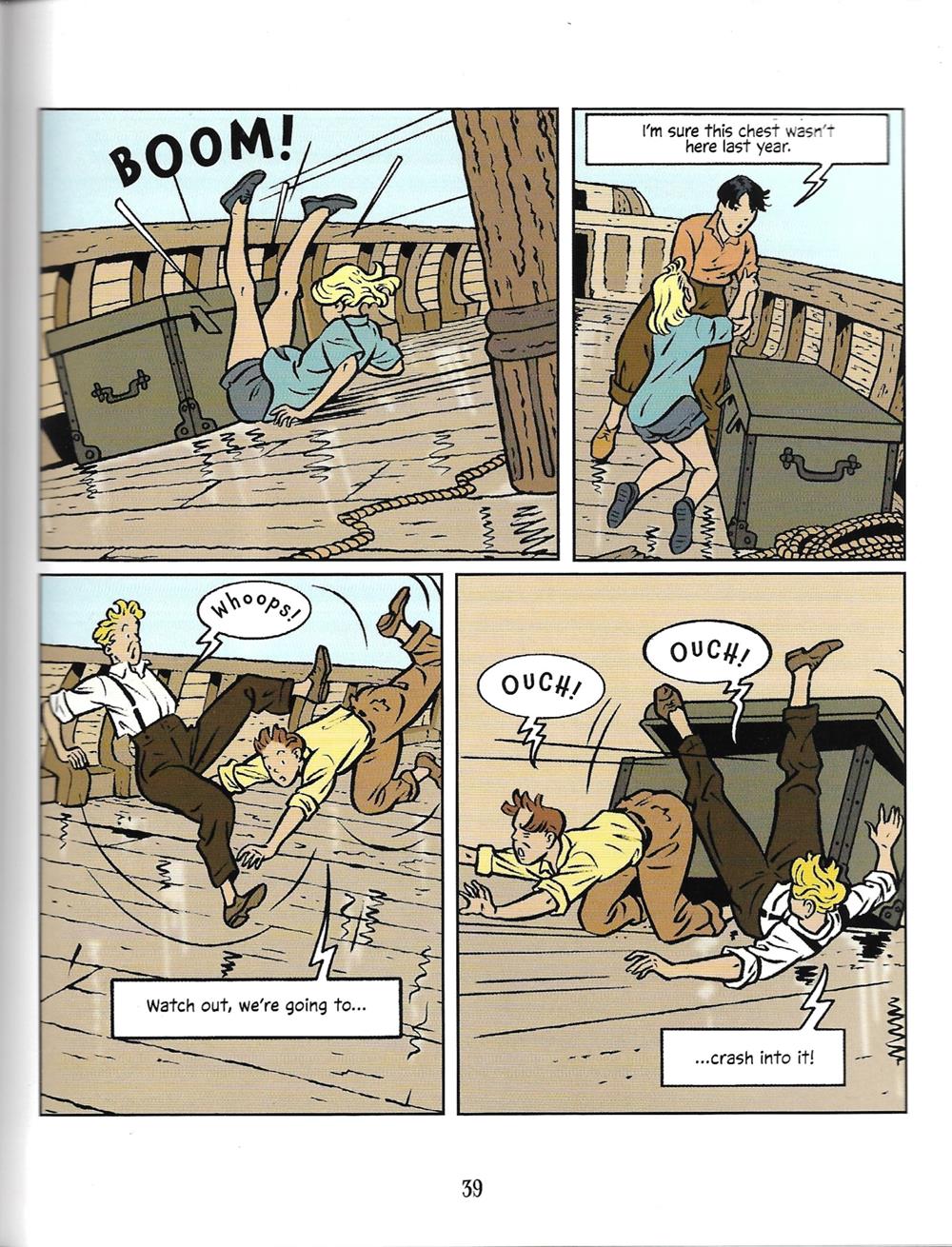
They check out the wreck (I can’t bring myself to call it the Ayacotl) which despite being beautifully seaweed-free is incredibly slippy. There they find a trunk (but fail to examine its contents).
From there Dick sees a load of greenery blow in the breeze to reveal a cave in the cliff (ala Mountain of Adventure). This makes George’s failure to ever find the cave before more understandable than it is in the books.
Interestingly, the illustrations show that they rig up a ladder rather than using a rope for the skylight entry/exit. Seeing as Timmy couldn’t manage either, they depict a clever solution that is never featured in the books thus leaving the odd plot hole.

The Sticks arrive that night with a large sack, and when they hear a scream the Five are straight out of the cave. Mr Stick mentions Mr Wilton – relating back to the previous book – and then he and the other Sticks go down into the dungeon whereby the Five block them in.
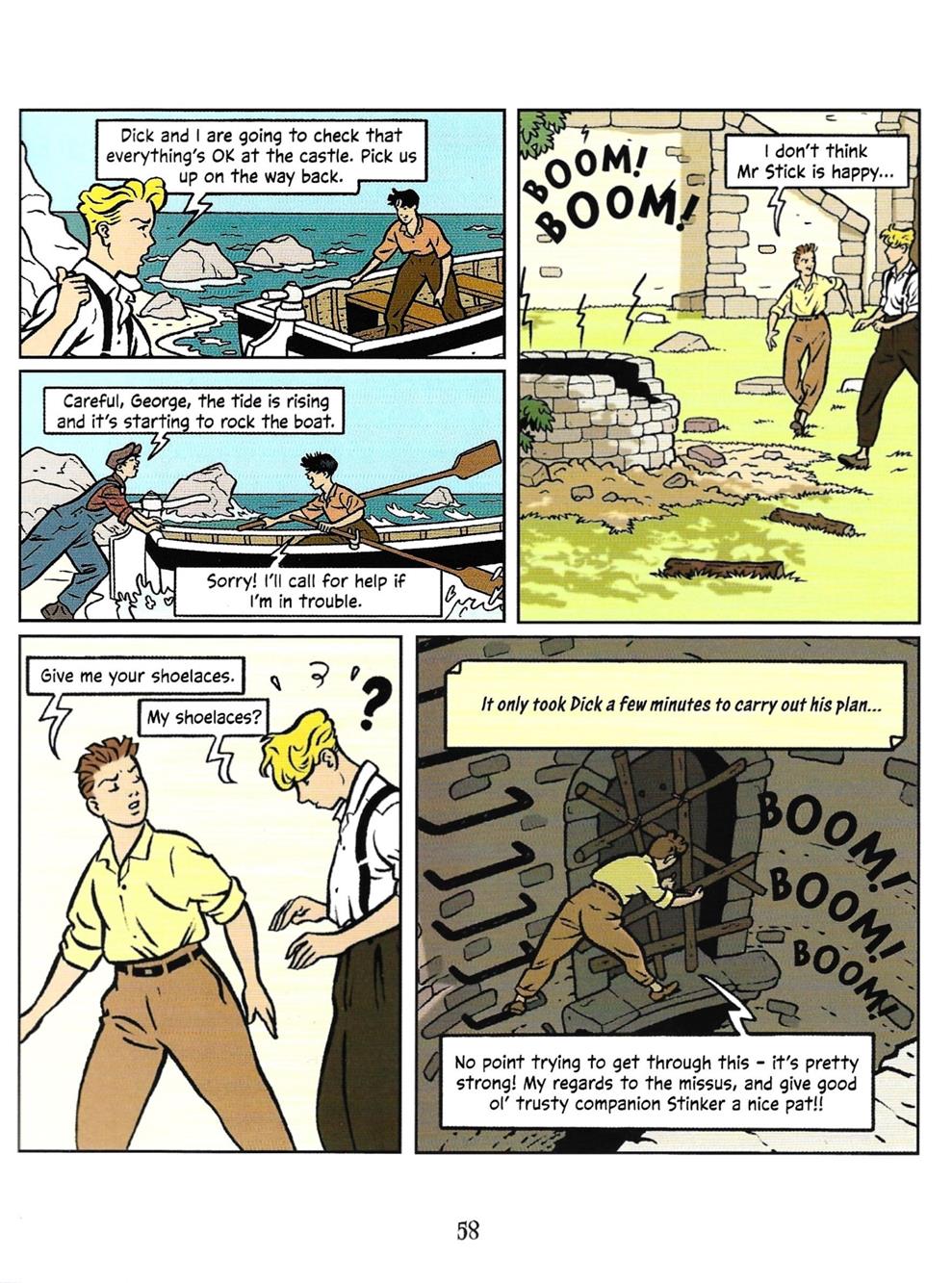
Nobody gets shut in the ingot room at all, but Dick does go down the well to block that exit off using nothing but big sticks and his and Julian’s shoe-laces. I couldn’t help but think of them tripping about in their loose shoes after that, but needs must! I also pondered where they found so many perfectly straight and exactly the right length sticks for their ladder, and the door blockade.
Despite the various nitpicks I’ve made I thought this was much better than the second one. It did change various parts of the story but crucially it didn’t add a whole lot of nonsense. Overall it remained recognisable as Five Run Away Together. I enjoyed seeing Natael’s impression of the cave in particular.
I wonder if Mr Wilton is going to be in the background of more of the stories of if that’s his involvement over. I don’t really like the idea of him working with Mr Barling or being shoe-horned into Lou and Dan’s thefts.

 Fiona
Fiona pippastef
 worldofblyton

 World of Blyton
When I saw the first image in this graphic novel, I was sure I’d stumbled upon Herge’s Adventures of TinTin !!
Since the boy and the dog are so obviously Tintin and Snowy, mixing-it with two comic policemen.
Did you form any opinion as to how long it might take an average child to read this ‘graphic novel’, or look at the pictures rather, compared to how long it takes to read the original novel it’s based on? Is it your impression that the whole point is to radically shorten the time needed to read the story?
I can see the advantage of doing the story in pictures, if modern children hate reading. And there’s an advantage in greatly abridging the story, if modern children have a short attention-span. But it means that most children will never read the original stories.
I don’t think I’d have enjoyed the original stories as cartoon strips. Particularly as cartoons which use all the hall-marks of Herge’s Adventures of TinTin, and in which very little remains of Enid Blyton.
LikeLike