
I have finally compiled enough references to make another non-fiction post worthwhile (the first was references in memoirs). That means that shortly after posting this I will undoubtedly find another reference and have to start a third post.
Lego Lost at Sea – Tracey Williams
A very interesting book about the cargo ship that lost several containers in 1997, spilling five million Lego pieces into the sea. Pieces regularly wash up on beaches in the South East of England but this book also touches on other curiosities that the author has found on beaches.
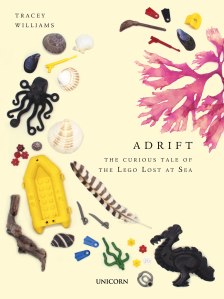
As time went on, I realised that much of the plastic I’d found was far older than I first thought. Not just the toys, but plugs made from Bakelite, poppit beads from the 1950s, ‘buried treasure’ ice-cream sticks from the 1960s and 1970s, Noddy toothbrushes and old fashioned hair curlers.
There’s also this picture of a washed-up Big Ears from a 1960s cereal packet.

The Library Book – Rebecca Gray
Several quotes from this one as it features writing from many authors on how they love libraries.
I suppose there must somewhere have been Enid Blyton, but since she too would have been backed in the same funereal but immensely serviceable boards she passed me by – Alan Bennett
I read all of Enid Blyton except for the Secret Seven, who irritated me for some reason –Val McDermid
Mrs Macgregor turned me into a crime writer. She introduced me to Enid Blyton, and then to Malcolm Saville, mysteries with chases and pace and surprise endings – Ann Cleeves

Strong Female Character – Fern Brady
Fern Brady’s memoir of growing up with undiagnosed autism and how that then affected her adult life has a couple of somewhat incongruous references.
Jeez. Sometimes it felt like we were characters in wildly different novels: Mum a wide-eyed schoolgirl in an Enid Blyton story and me a city slicker in a Jackie Collins bonkbuster.
…
Lisa worked in my first club, Big Daddy O’s, and made me feel as genteel as a kid from an Enid Blyton novel.

A History of Reading – Alberto Manguel
I had copied this reference from somewhere else as I have not read this book. I then had to track down the original post to give due credit – so thank you to Judith Crabb for this one. There are another few remarks in the book (but not full quotes given) and some additional context in Judith’s original post.
I knew about [jelly] from Enid Blyton’s books. [It] never matched, when I finally tasted it, the quality of that literary ambrosia.
…
[At one time he] saw a windowful of Noddy stories with their shrill-coloured covers.

My Scotland – Val McDermid / Nicola Sturgeon
Having been reading my way through Val McDermid’s novels a colleague then suggested her non-fiction work about Scotland (where various parts of her novels are set).
I didn’t pay attention to the heading for the first pages and initially thought this was Val McDermid’s words but having then seen husband and East Wemyss I looked again and realised that it was a foreword from Nicola Sturgeon.
When I read Enid Blyton’s Five Run Away Together, where the Famous Five set up camp in a cave on Kirrin Island, I was singularly unimpressed. Just one cave? In East Wemyss, we had half a dozen.
…
I remember as a child looking forward to the TV version of Enid Blyton’s The Famous Five, only to find myself, a few minutes in, stomping around the house complaining that they’d got it all wrong.
…
Fictional places would take shape in my mind’s eye with extraordinary detail. To this day, if I close my eyes, I can see with utter clarity my version of the Enchanted Forest, Kirrin Island, Narnia, Middle Earth, Treasure Island… and so many more of the imaginary landscapes of my childhood years.

Born in the 1940s – Tim Glynne-Jones
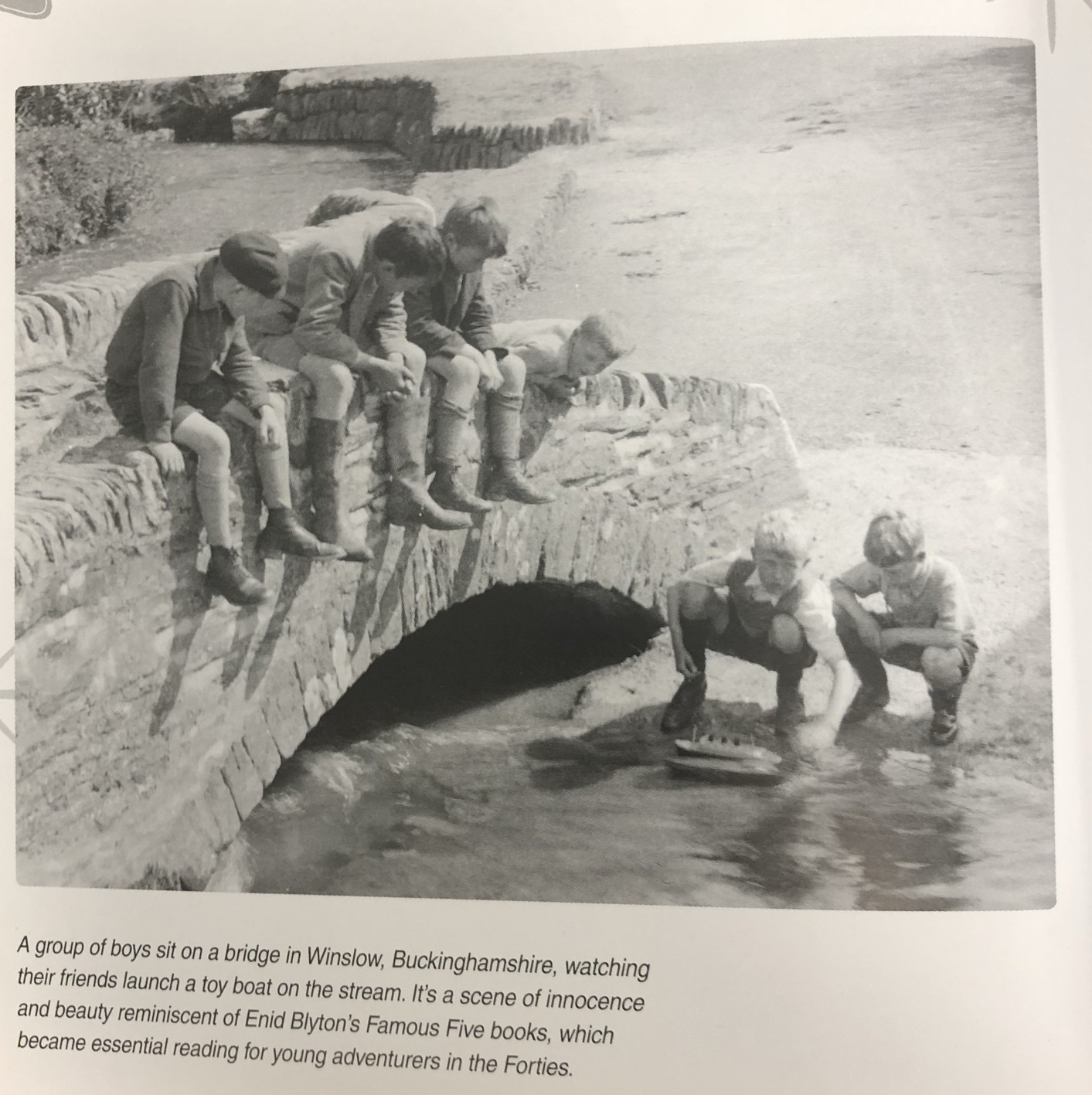
A group of boys sit on a bridge in Winslow, Buckinghamshire, watching their friends launch a toy boat on the stream. It’s a scene of innocence and beauty reminiscent of Enid Blyton’s Famous Five books, which became essential reading for young adventurers in the forties.
The Five were far to busy having adventures to play with toy boats – it’s perhaps more reminiscent of the Secret Seven and their toy aeroplane, or some of her many short stories.
The 1950s Scrapbook & The Fun of the Fifties: Ads, Fads and Fashion – Robert Opie
I took these pictures so long ago that I have no idea which of the two books above any of them came from!
Text reads:
Road Safety
‘When crossing remember your kerb drill: look right, look left, then right again – wait until all traffic has passed and then walk over quickly.’ The Royal Society for the Prevention of Accidents (ROSPA) had been founded in 1917, but as ownership increased in the 1950s and cars were driven faster, there were more pedestrian accidents, especially among children. RoSPA promoted safety messages through posters, leaflets, booklets, handkerchiefs, novelty cards and even a game called Tiddley (inspired by the game of Tiddley Winks – not being tipsy). Oxo produced a couple of road safety painting books. The Daily Mail sponsored Enid Blyton’s Road Safety Colouring Book, ‘A stands for Accident, Ambulances too, You must take care or it may come for you.’
Books for Children
A vast range of books were available for children to read – from the best- selling stories of Enid Blyton’s Famous Five (21 adventures between 1942 and 1963) and Captain W. E. Johns’ Biggles, tales of a pilot’s wartime exploits (96 titles published between 1932 and 1970), to the shunting of Thomas the Tank Engine and his friends, written by the Rev. Wilbert Awdry. Another train book from the early 1950s was Chuff’ty Puff’ty: The Jolly Railway Engine, which had a resemblance to the engine on the Sugar Puffs cereal box.
Annuals were a popular present at Christmas for boys and girls, and many comic papers and TV series created their own annuals, for instance, PC49 which ran for 112 episodes between 1947 and 1953. The Rupert Bear annual became a classic; the comic strip had begun in the Daily Express newspaper in 1920, with the first annual published in 1936- and they continue to this day.
Noddy
It was the inventive genius of Enid Blyton that created Noddy; she began with Noddy Goes to Toyland, which was published in 1949. She had been writing children’s stories since the 1920s.
In all, there were 24 Noddy books, the last one released in 1963. Along with Noddy’s best friend Big Ears, the world of television beckoned in 1955. Now every child was mesmerized by a boy wearing a blue pointy hat with a bell on top.
All types of toys joined in with Noddy fever. There were soft toys, lacing cards, fuzzy-felt, novelty egg cups and quoits, as well as the most frustrating thing in the toy cupboard, the hammering set – the nails held each wooden piece into a soft board, but they easily popped out as the next piece was being tapped in.


 Fiona
Fiona pippastef
 worldofblyton

 World of Blyton
The black & white photo under Cal McDermid’s “Scotland” book reminds me of the culvert in the thrilling Malcolm Saville adaptation and CFF production “Treasure at the Mill” which is still available on amazon.co.uk on DVD.
LikeLike