
Part one of the annual can be found here.
PLEASE TO REMEMBER!
A rather frightening-looking guy in this illustration for the Guy Fawkes night-themed poem. I didn’t guess that’s what the poem would be about though remember is a fairly good clue!

THE CHRISTMAS STORY
This is a straight-forward retelling of the nativity story – though I have to say I think Blyton would have done it better. There’s some very clunky sentences and a lot of commas here! 
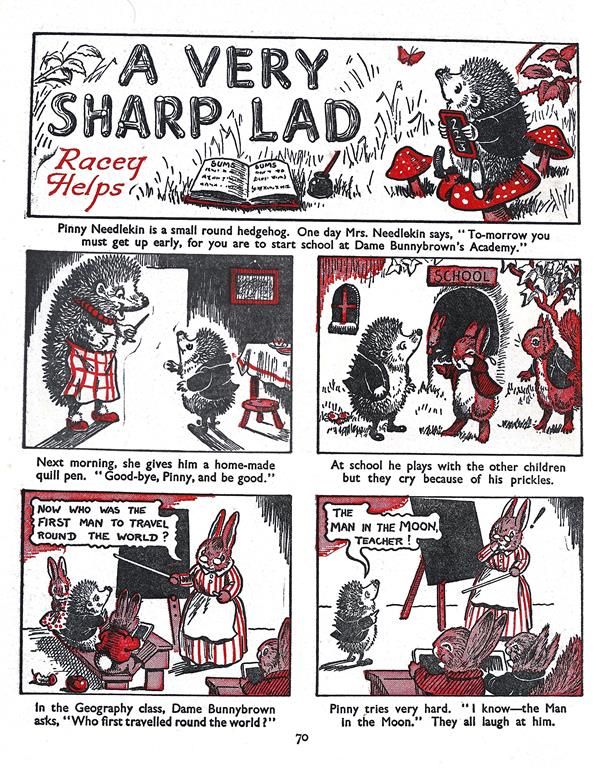
A VERY SHARP LAD
A nice play on words here. I expected this to be just a clever boy, but sharp has more than one meaning!
There are a few picture-strip stories in the annual but I thought it odd to have these two come one after the other. Normally different types of story are spread out through an annual.
Anyway, this is an amusing story where our hedgehog (Pinny Needlekin) is sharp of quill but not so much of brain. He does not do well at school and to add to it he keeps prickling the other children by mistake. He has good luck (ish) when he falls into some apples and discovers they protect others from his quills, and his teacher declares him very clever for finding a solution.
This is in present-tense which is not my preferred tense for reading, and is quite uncommon – at least in all the children’s books and stories I’ve read. The other odd thing is some of the illustrations have speech in them but they don’t match the speech in the captions. In the fourth part below the man in the moon dialogue is obviously just cut to fit, fair enough. But in the third the teacher asks Who first travelled round the world, or Who was the first man to travel around the world? depending on which text you look at. Annoying and unnecessary!
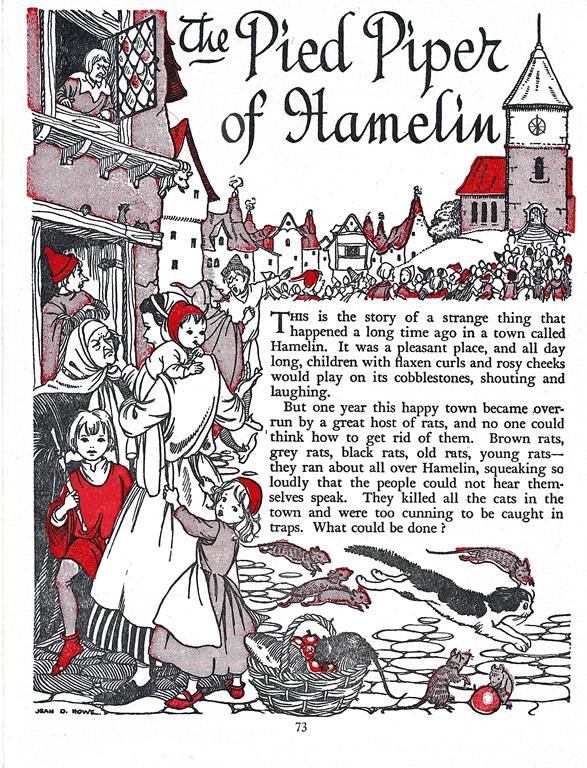
THE PIED PIPER OF HAMELIN
The story of the Pied Piper and the rats is pretty well-known, so there isn’t anything new or unusual in this retelling. I think there are sometimes differences in the ending- how many children are left behind, the exact description of where the children are led off to – but nothing that really changes the story. This one is lavishly illustrated though, which is nice.
A NONSENSE RHYME
Exactly what the title says – a nonsense rhyme asking what would happen if the ocean was dry and the land was sea. Would we swim and the fish walk, etc.
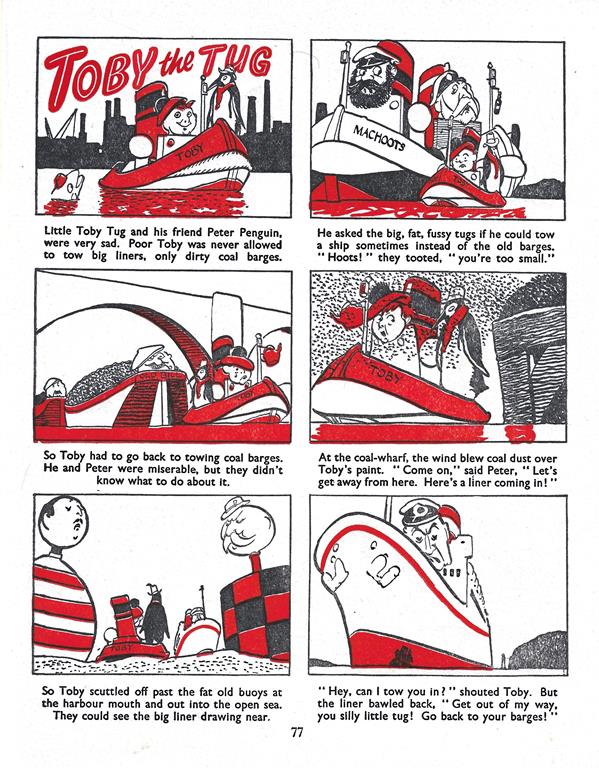
TOBY THE TUG
Another picture-strip this time illustrated by G.W. Backhouse who illustrated Blyton titles like Smuggler Ben and Shadow the Sheepdog.
This is a sort of nautical version of Thomas the Tank Engine – except the human boat faces are way creepier than anything on Sodor. It’s quite the rollercoaster too, with Toby being mocked by bigger boats before pulling a whale’s tooth, rescuing a run aground boat and so on.
WHERE ON EARTH WOULD YOU FIND THEM?
This one is eight (somewhat stereotypical) illustrations of people of different nationalities, and the question of where they come from.
THE WISHING STONE
Another recognisable name (to me!) as the illustrator Gilbert Dunlop worked on all the Barney Mystery books as well as The Mystery That Never Was.
 This is a fairly long story – not quite the longest in the book, but nearly – about Griselda (what a name!). The wishing stone barely features, really. Griselda believes it to be magic as it looks like a wizard’s face, and then when she is really very lonely she decides to ask it for one wish. She is staying with her aunt as her famous parents are off in America, so she wishes to see her parents again.
As soon as she gets home she finds a man there, waiting to whisk her off to New York to appear on This Is Your Life as a surprise for her parents.
Most of the story is actually taken up with her flight to New York, and stopping off for a hotdog, hamburger and ice-cream before finally arriving to film the TV programme. That bit did make me a little teary, though!
I think this was very much a wish-fulfilment for the readers, who I’m sure would have loved to go in an aeroplane and visit America, but very few would have at that time.

DOG PUZZLE
If these dogs could talk, what language would they speak?
HOW TO DRAW FIGURES
These remind me of the jokes I’ve seen online where step one is draw a circle, step two is draw some more circles, then add detail and somehow there’s a perfectly drawn wolf or something. The frame I could do, but the detail…

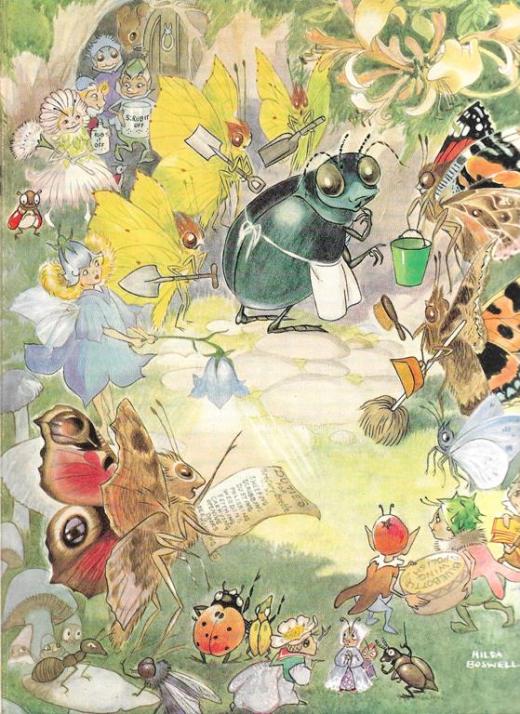
THE TALE OF GREGORY THE BEETLE
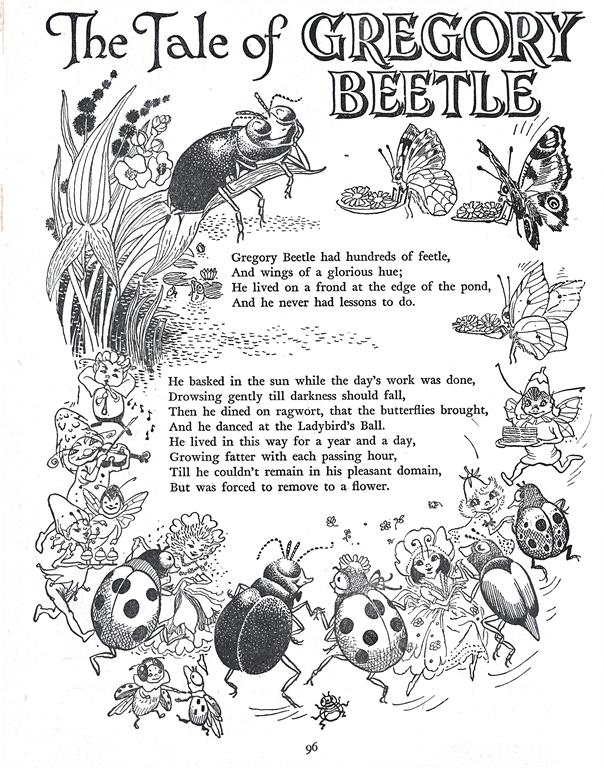
A funny two-page poem about a lazy beetle who gets his comeuppance.
HOW MANY WORDS
Apparently there are 70 words you can make out of millionaire. A previous owner has had a go, but only got to 12.
MUFFIN’S HAPPY CHRISTMAS
As soon as I saw Muffin I thought of Muffin the Mule. When Muffin turned out to be a donkey/mule I had to go researching. This is indeed Muffin the Mule, as it was written by the daughter of Annette Mills – the on-screen partner of Muffin, and who wrote a few books about him and various short stories. Later, Molly Blake would illustrate many Muffin books, and obviously write at least one short story about him.
On his way home Christmas evening Muffin finds a donkey left out in the cold. He takes him home and as there’s no room anywhere (the outbuildings are all full of alliterative animals like Katie Kangaroo and Peter Peregrine) he gives Dandy Donkey his own potting shed.
Luckily in the morning the neighbour’s monkey offers Dandy the summer house so Muffin doesn’t have to stay out in the cold and longer himself.

HOW THE WILDS BIRDS FEED THEIR YOUNG
This is written in a style similar to one Blyton sometimes uses – talking directly to the reader You might think that one wild bird feeds its chicks very much like another. But you’d be wrong.
This is a really interesting read and I learned quite a few things from it!

HUMPHREY – A BARGAIN
This last story is actually the longest coming in at 14 pages (compared to The Wishing Stone at 12). The illustrations are by Hilda McGavin who illustrated many Blyton books but is perhaps best known for the first editions of the Wishing Chair books and the Mr Twiddle books.

Another tale of children living with an aunt as their parents are abroad. This time it is Barbie, Alison and Peter, whose parents are in South Africa. Aunt Julia has said they can get a pet if they save up the money and get something quiet that won’t leave muddy footmarks. So a goldfish, perhaps, or a tortoise?
But Barbie is known for having ideas which cause trouble, so I can foresee that Humphry is not going to be something as ordinary as those.
Barbie then discovers a rather unconventional-looking horse looking gloomily over a gate nearby. There’s a sign saying he’s for sale. For £5, which is just within the children’s budget.
I don’t think I need tell you the name of the horse…
Barbie says that horses are quiet (I guess, except for the sound of hooves on the ground, and of neighing?) and he can’t leave footprints inside as he’s too big to come inside, which is true. Unfortunately he can eat Aunt Julia’s favourite plants… so Humphrey has to go!
He doesn’t go far, only to the gardens and stables of the abandoned house across the road. That is until the owner arrives to take a look…
Thankfully it has a happy ending!
This is a nice annual, if not overly-festive. It has a good mix of content and is very well illustrated throughout.

 Fiona
Fiona pippastef
 worldofblyton


 World of Blyton
The Tug Boat story reminded be a lot of the TV series “Tugs”. That really was a case of “Thomas the Tank- on water!”, being created by many of the people behind the original Thomas TV series; indeed apparently some of the Tugs sets and props ended up being recycled into later series of Thomas. The whole series has been put on YouTube: https://www.youtube.com/watch?v=tfOdQMOmaR4
LikeLike