Enid Blyton Christmas Gift Guide 2023

Despite still being popular and relevant new gift options for Blyton fans are often slim-pickings. Here’s the best of what I’ve been able to find.

(Previous guides can be found here, though I can’t guarantee all the items on them will still be available!)


Books

While a lovely vintage copy of a title they don’t have would go down a treat with any Blyton fan, you don’t need a gift guide for that. So instead here’s the books that have been released in 2023, which I’m sure children will love and even some adults too.

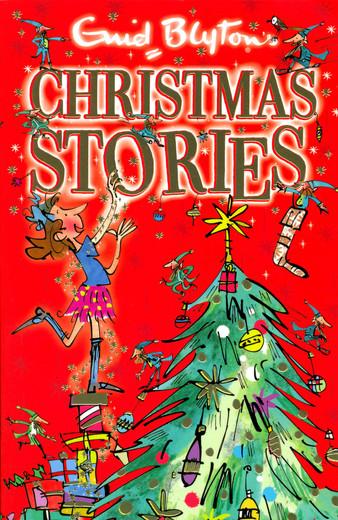
Starting with the Hodder story books, there are 4 of them this year. Stories for Christmas, Spellbinding Stories, Stories of Tails and Whiskers and Five-Minute Stories.  You always know what you’re getting with these – 25-30 stories picked for their theme, some which have never been reprinted before.

Stories for Christmas £6.49 (normally £7.99), Spellbinding Stories £6.49 (normally £7.99) and Stories of Tails and Whiskers £6.49 (normally £7.99), Five-Minute Stories £7.99, all from Waterstones.

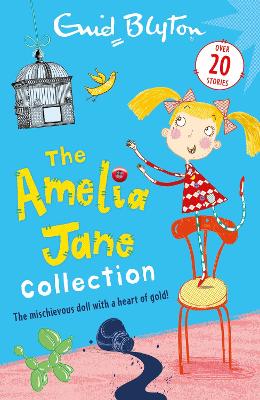
There is also a “new” collection of more than 20 Amelia Jane stories.

The Amelia Jane Collection, £9.99 from Waterstones

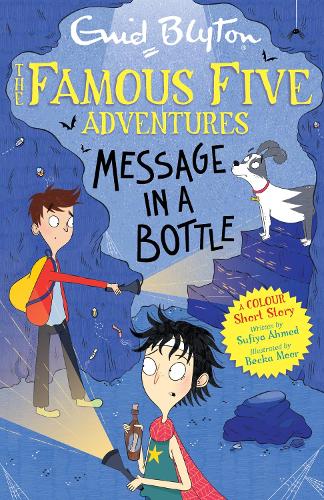
Then there’s this – which has me intrigued, at least. A new Famous Five short story by Sufiya Ahmed (good to see it being acknowledged on the cover that it’s not by Blyton). There’s more coming out next year, one of which has a plot about saving the local library so I might be tempted by that.

Famous Five Adventures: Message In a Bottle £6.99 at Waterstones

And lastly a new non-fiction book about Blyton, at least partly. I’ve never particularly connected Blyton with Bowie, but apparently you can.

In this one-of-a-kind book, novelist and academic Nicholas Royle brings together two remarkably different creative figures: Enid Blyton and David Bowie. His exploration of their lives and work delves deeply into questions about the value of art, music and literature, as well as the role of universities in society.

Blending elements of memoir and cultural commentary, Royle creates a tender and often hilarious portrait of family life during the pandemic, weaving it together with musings on dreams, second-hand bookshops and unpublished photos of Bowie taken by Stephen Finer. He also shares previously unrecorded details about Blyton’s personal life, notably her love affair with Royle’s grandmother.

David Bowie, Enid Blyton and the Sun Machine £15.99 (a hardback is out next year priced at £85!)


DVDs

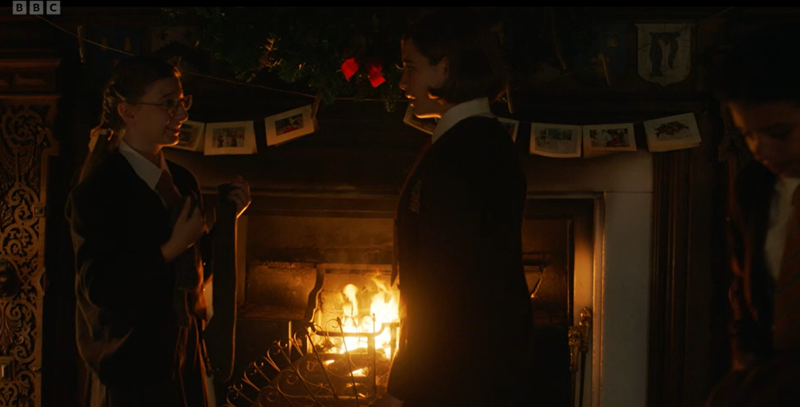
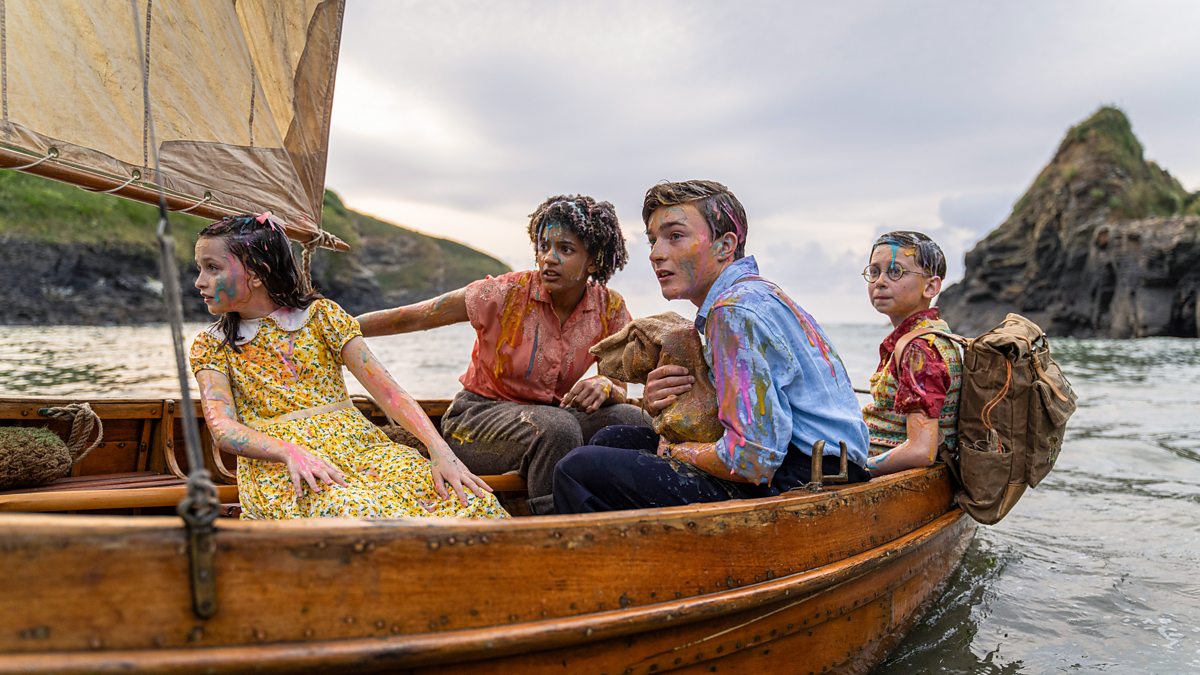
I included series 1-3 of Malory Towers in my last guide, but now series 4 is out and also a box set containing series 1-4 – both contain the two Christmas specials as well. As far as I know it’s all on the BBC iPlayer, but it can be nice to have the DVDs.

Series 4 £12.99 and series 1-4 £27.99, both on Amazon UK


Etsy for everything else

I can always rely on Etsy to have something Blyton related.

Various things I’ve put in previous gift-guides are still available but these posters are new.

Folk of the Faraway Tree Poster and Five Go to Demon’s Rocks Poster, both £14.95 for A4 and £19.95 for A3, by BooksnBobs


Posted in Seasonal | Tagged , , , , | 1 Comment

Monday #555

I see the Monday number creep up every week (or occasionally every other week when I miss one) but I don’t really pay attention other than making sure the last digit is one higher. Somehow I noticed it this week though and had to do some quick mental maths as 555 seems a ridiculously high number. But the blog has in fact been going over 10 years, 11 in fact, we just didn’t do Monday posts for the first while.

In a coincidence, tomorrow is will mark 55 years since Blyton’s death. I still find it incredible how relevant and loved she is after all that time, and she is still being discovered and enjoyed by children more than half a century after she died.

If I was the superstitious kind I’d be looking for more 5s – but would they be lucky or unlucky, who knows.

Enid Blyton Christmas gift guide 2023

and

Enid Blyton’s Christmas Stories then and now, part 4

I wrote this in 2020, but I never did get around to posting the answers list. There are – according to a comment I made in January 2021 – 22 songs to find. I can’t for the life of me find the list I made when I wrote this, but I’ve managed to identify 19 songs so far… can you do better?

Spot the Famous Five’s favourite Christmas songs

Merry Christmas and Happy Holidays!

Posted in Blog talk | Tagged , | 2 Comments

Enid Blyton’s Christmas Stories, then and now part 3

If I want to finish this series of posts by Christmas day I have to post one each week, and cover at least four stories in each. Part one and part two are already up meaning I’m on track so far…


A Family Christmas Part Three: The Curious Mistletoe

Having gathered the holly it’s now time for the ivy… no, sorry, the mistletoe. Ann, being the youngest, is the one not to know so much, and so she asks the questions which allows Blyton to educate the reader via Daddy – though the others ask questions, too. Much like Bets needs things explained to her by Fatty, and sometimes Anne by Julian.

I expect many readers learned from this book that mistletoe is a parasite which grows on other trees. And that mistletoe was once dedicated to the goddess of love, hence kissing under it. The nature element isn’t forgotten either, with talk of the mistletoe’s sinkers stealing sap from the tree, and the sticky seeds being planted by the mistle-thrush.

Daddy then gets to show off his knowledge talking about how Christians took over older customs, such as from pagans. Druids once worshipped oak trees and mistletoe -along with other “odd” things like the sun, moon, stars, trees, animals, idols of stone and wood. It’s a bit judgemental but Daddy does say that people believe what they are taught no matter what century they live in.

There are very few people who are strong enough to think out everything for themselves, so nearly all of us believe what we are told to believe, worship what we see other people worshipping, and follow the customs we have known from childhood.

This is an interesting point from an author who retold many Christian tales. Whilst you can choose to infer that people who did work it all out for themselves would come to the same conclusions as the masses, pairing it with the information about people worshipping “odd” things in the past, you could equally infer that Blyton is suggesting today’s religion is no more correct than any older one.

Then it’s back to how strange it is to believe that the life of the oak – whose leaves die off in winter – then lives in the mistletoe which stays green. Science would not back up that hypothesis, but then it also wouldn’t agree with a lot of Christian beliefs, so calling it queer is a bit of a double-standard. As is calling people ignorant for believing that mistletoe could open locks – considering that Daddy then portrays it as fact that mistletoe once killed a god called Balder and since has had to grow high up, out of reach…

Another quote from Walter Scott was at the start of this chapter, from Old Christmastide again.

Forth to the wood did merry-men go
To gather in the mistletoe

– Walter Scott

Not much is changed – though it might have been nice if they’d changed ignorant to something milder.

Oak-tree, apple-tree etc lose their hyphens, the three queers all become strange and one use of Mother becomes Mummy.

When Daddy calls the Druids priests of the folk this has been changed to priests of the people. Strange change to make, is that supposed to be more respectful or something, despite having just called them ignorant?

Lastly one which might be an error – Daddy is paraphrasing what the pagans would have said – the life of the oak has gone into the mistletoe but it now reads the life of the oak had gone into the mistletoe which is the wrong tense.


The Christmas Tree Aeroplane

First published in Sunny Stories 153 in 1939 this was illustrated by Hilda McGavin. The version I have is from The Second Holiday Book, 1947, which has uncredited illustrations. You can also find it in Fireside Tales (1972) and two versions of The Pig With Green Spots (1993 and 2015).

The lady who lives at the Big House has invited all the children to a Christmas party. There are crackers, balloons and a toy for each child. Yet Harry – who is poor and has an ill mother, and is probably more deserving of a little happiness than any of them – ends up with nothing has he either misses out on getting things, or he gives them away to children who have lost, burst, or not been given things themselves. (Badly organised party, if you ask me – only enough for one balloon per child, and not enough presents for them all!)

When Mrs Lee notices, Harry is given the Aeroplane from the top of the tree, some cakes and jelly, and given a lift home in her car.

This was one of the stories where a few things needed explaining to Brodie. He’s not familiar with real candles on trees, or putting presents on trees to cut off and give away. I’ve never not had the toy out of my own cracker because whoever I’ve pulled one with has passed it back to me (and vice-versa, or we’ve swapped depending on what was inside) – and Brodie’s experienced the same.

We also had to have a few words about he couldn’t wear a bonnet because he’s a boy. Fine if he doesn’t like the hat or want to wear it but if you’re insisting on making updates anyway that’s the kind of line we don’t really need.

Most of the changes that were made are of the style-guide kind. So ENORMOUS becomes enormous – yes, I know, they added italics! But they also removed some elsewhere. The apostrophe from ‘plane is also removed as it’s not needed nowadays.

The only ‘significant’ change is to the wording of one sentence, which actually seems to make it clumsier when it was perfectly clear to begin with.

There was not another balloon left for her to have (original) versus There was no balloon left for her to have another (new).


A Family Christmas Part Four: Balder the Bright and Beautiful

Almost the entire chapter is Daddy telling the story of Balder – though it is told in such a way that you rather forget it’s Daddy and not just Blyton! There are no interruptions, no pauses to remember anything, and it’s a very detailed story full of dialogue.

For those who haven’t read it – Balder is a god, the son of Frigga and Odin. He had a terrible dream that he would die, so Frigga made all the things on earth promise never to harm him. Believing he was therefore invulnerable the gods devise a new game of throwing spears at Balder, slashing at him with swords, and so on. And every object be it made of wood or metal is deflected and Balder is untouched. Until Loki comes along… dressed as an old woman he gets Frigga to admit she didn’t bother asking the mistletoe to make a promise as it was too weak to worry about. So Loki gets some mistletoe, forms it into a spear and has Balder’s blind brother, Hodor, throw it, killing Balder.

The quote at the beginning of the chapter is –

Twixt heaven and earth hangs mistletoe
Since Balder fell beneath its blow.

This is not attributed to anyone, suggesting that Blyton wrote it herself. The only matching result on Google is an ebook of The Christmas Book.

Not an awful lot of changes. A few stylistic ones – no-one becomes no one, Ringhorn, Balder’s ship gets italicised in the new version, but only for its first mention, and two paragraphs get combined into one.

In the original Daddy tells them the title of the story he is about to tell, and this is made into a centred, all caps heading. The new version just has it as part of his speech.

The speech marks are handled differently in the new version, too. Through the book the original has double speech marks for all speech, the new one uses single. For this story, as Daddy is telling it, we need speech marks to indicate he is speaking, then speech marks for the dialogue within.

The original has a set of double speech marks to indicate Daddy has begun talking – though interestingly they are missed off at the end!

The new version has a single speech mark to begin Daddy’s story, a single speech mark at the beginning of every paragraph, then double marks for the dialogue, and a single speech mark at the end. All the style guides online say that a speech mark should be placed at the start of each paragraph – though this was perhaps not the case 80 years ago. It’s unfortunate, perhaps, that so many of the paragraphs start with dialogue, meaning there’s a single then double speech mark cluttering up the start of every line.

Anyway, enough boring speech mark talk. The only other change is they no longer talk about dressing the Christmas tree, but decorating it instead.

A few things are left which, in other books, I’d expect to have been changed, but this one seems to have slightly less modernisation than some others. Daddy still has a pipe and a tobacco pouch, for example (whereas Jeremiah Boogle gets sweets, I believe, rather than tobacco) and there’s still a giantess rather than a giant.


A Hole in Santa’s Sack

I have a copy of this in The Magic Knitting Needles and Other Stories (1950) which was illustrated by Eileen Soper. It was first published in Sunny Stories 49 in 1937 and illustrated by E.H. Davie. It has also been used in Enid Blyton Readers 11 also with illustrations by Eileen Soper. You can also find it in two editions of The Wishing Jug – 1996 and 2015.

I feel like this is not one of Blyton’s best Christmas tales. Although it is Christmas-themed, Santa is only there briefly, and the rest takes place in a goblin-cave and could be any time of year.

Some goblins fly their aeroplane to land on a roof beside Santa’s sleigh, where they cut a hole in the sack. They only get one box before Santa notices and repairs it with a safety-pin. Back at their lair they open it up to find it’s a jack-in-the-box which gives them a fright. We don’t see Santa again as he hasn’t missed the present (or if he has, he hasn’t figured out where it went) but a rabbit offers the jack-in-the-box a new home with her baby bunnies.

For a shorter story this one has a surprising number of changes.

Wireless is updated to television, though I’d be surprised if many people still said television today rather than TV or telly. The jack-in-the-box wanted to live in a nursery to amuse the children, now it is in a house. No doubt the original meant a nursery in a house, but modern children would think of a nursery school – not that it would matter in the slightest as nursery schools are full of children.

The green box which falls out of the sack is now a red box. I was baffled by this initially but then realised that the goblins are called green goblins and perhaps the editors thought that it was too much green – though the box’s colour is only mentioned once. (And, oddly, the colour added to one picture of the goblins in my copy is orange!)

To continue the petty meaningless changes, slit a hole is now cut a hole, and to see what had fallen is now to see what had fallen out. 

A few style changes were made including one use of italics being removed. One of Blyton’s paragraphs is divided into two paragraphs which is unusual, I’ve rarely seen that done before. Lastly, the final use of jack-in-the-box has been given a capital J, possibly because the author is speaking to the jack and it is more of a name then.

One final thing – I’ve left this for last because I’ve been searching the dictionaries for evidence!

Originally Santa sings a rollicking song. He now sings a rollocking song. I can’t decide if this is simply a typing error or not, as rollocking is a variant (though uncommon) of rollicking. My browser spell-checker doesn’t like rollocking, though it also doesn’t like various other genuine words.

The Collins online dictionary defines rollicking as boisterously carefree. As a secondary definition it can mean a scolding.

Collins has rollocking also, (but Cambridge doesn’t) and its only definition is a scolding, in informal British English – possibly derived from a ruder, rhyming word beginning with B.

Santa singing a rollocking song, therefore, is just incorrect as far as I can work out!


Posted in Book reviews, Updating Blyton's Books | Tagged , , , , , | 1 Comment

Reading the Famous Five to Brodie

As I’ve mentioned a few times, I’ve started reading the Famous Five to Brodie. Initially, I wasn’t certain if it would be a success or not. He has often protested about starting or continuing a chapter books, wanting to read a favourite picture book instead. Though when we do read Roald Dahl or Dick King-Smith he hangs on every word and asks for just one more chapter.

I decided to put myself out there, prepared for rejection of my beloved Famous Five books and suggested we read Five on a Treasure Island. I told him what the book was about, he had a look at the dust jacket and, after thinking about it, said yes. And we’ve never looked back. We started it on the 1st of August, a few days before he turned six, and we finished it on the 17th of August. We are now on Five Go Off to Camp, meaning I’m reading through these books the fastest I have done for over ten years.


The reading experience

Reading something out loud is always different to reading in your head. Even though I’ve read the Famous Fives many times over, including times where I’ve read them more carefully for reviewing or logging the updates, I am still noticing new things when reading out loud.

Some of the quaint, old-fashioned language is more obvious when I have to say it out loud, and I’m not sure how convincing I sound saying things like Oh I say! in my Dundonian accent.

I’m having fun, though. The books are so familiar to me that I find them really easy to read. I’ve far from memorised them, but it’s so easy to read as I know what’s coming. I generally know who’s speaking so I can pick the right voice, and what tone they’ll be saying it in. I’m no voice actor but I do try to make each of the Five sound a little different from each other, and I have fun doing George’s rants and Julian’s bossiness. I also try to make the other characters stand out – the baddies might talk gruffly or smoothly, and I’ve developed a (probably terrible) all-purpose Cornish-ish accent for Joan/na, Alf/James and other Kirrin locals.

The other side, though, is getting feedback from an actual child. I make a lot of comments, nitpicks, and so on when I review the books so it’s fascinating to get reactions from someone under twelve in real-time.

Obviously Brodie doesn’t represent all children, but he is Blyton’s target audience, albeit some seventy years later. I’m glad to say that so far, he is proof that you don’t need to update Blyton’s books to make them relevant to today’s children. He has hung on every word of the books – not just the exciting bits, but the every-day bits too. He’s laughed at the funny parts, gasped at the dramatic moments and turned wide-eyed to me, desperate to know what’s going to happen. He has begged and begged for just one more chapter, and when that fails, he begs for just another page, just to know what happens. He also interrupts with questions, wanting to know what a word means, or why someone is doing something. Or he just has to tell me what he thinks is going to happen next.

I used to make tea while he had stories with his dad, though sometimes we’d swap, I did more bedtimes while we were reading Roald Dahl, but we often alternated. I now do every bedtime story (unless I’m working) because he wants the Famous Five every night.

When we finish a book, he asks how many more are left in the series. The next evening he scales the back of the sofa to find the next book.


Brodie’s comments on Five On a Treasure Island

Starting with Five Go Adventuring Again I have been sending Stef a message after each bedtime reading session and telling her what he’s said. Unfortunately I didn’t think of that for the first book so here’s what I can remember about what he said while reading it.

The first thing that I remember is that he was slightly upset and concerned that Julian, Dick and Anne’s parents weren’t staying when they dropped them off at Kirrin. He definitely wouldn’t have wanted to be left with people he didn’t know, but then he is a lot younger than the Five. He got over it pretty quickly, anyway, and I’m sure he will soon come to understand that fictional parents have to be got rid of in order for adventures to occur.

I then checked his thoughts on George’s attitude to girls things vs boys things, and we had a chat about historical expectations of boys and men vs girls and women. He was appalled to learn that in the past girls often weren’t educated at all.

A few times he interrupted me with a gasp and wide eyes to say “She won’t answer if you call her Georgina!”

It was interesting to hear his predictions about the story – I often pause for just a moment at certain parts of the story to see if he’ll say anything.

He guessed it was the wreck being flung about in the sea during the storm. I was kind of impressed by that but I may have given away a clue to that when I tried to describe the book to him before we started reading it. (He called the wreck a pirate ship all the way through which was funny).

To balance it out, he was certain that the entrance to the dungeon would be in the stone room, and that the ingots would be on the ship.

His rating for this book was: Two thumbs up and “I love the Famous Five!”

His favourite character was George, and his favourite part of the book was “All of it.”


Posted in Book reviews, Personal Experiences | Tagged , | 8 Comments

Monday #554

After last week’s little step into Christmas I’ve decided to just make the leap right into Christmas. The Christmas playlist has been downloaded from Spotify – and played, a Christmas movie has been watched on Netflix… but I really need to embrace the Christmas shopping, however, if I don’t want to be running around madly in a few weeks time.

Reading the Famous Five to Brodie

and

Enid Blyton’s Christmas Stories, then and now part 3

I tried to find a Christmas post that wasn’t already heavily linked to in the Christmas Stories then and now series… and success!

In 2020 we wrote a fic where the Famous Five and the Adventure Series children find themselves at the same Christmas market…

Adventure at the Christmas Market

Posted in Blog talk | Tagged , | Leave a comment

Enid Blyton’s Christmas Stories, then and now part 2

In part one I listed the stories and where to find them, and looked at the first story.


The Lost Presents

This is credited as being from Enid Blyton’s Snowdrop Story Book, which was published in 1952, but actually it was first printed in Good Housekeeping in 1947. It’s not clear who illustrated the first printing, but the Snowdrop Story Book version had illustrations by Eileen Soper, so I’m sorry I don’t have a copy.

This is a very short Dan and Daisy story – Dan and Daisy being characters that Blyton used in various short stories.

Dan hides away his family’s presents and then can’t remember where he has put them. He wakes up late in the night on Christmas Eve, suddenly remembering. In the time it takes him to go and check on the hiding place, his and Daisy’s stockings have been filled.


Santa Claus Gets a Shock

This story was first published in Sunny Stories 154 in 1939, with illustrations by Sylvia I Venus. It was then included in Enid Blyton’s Happy Story Book with illustrations by Eileen Soper.

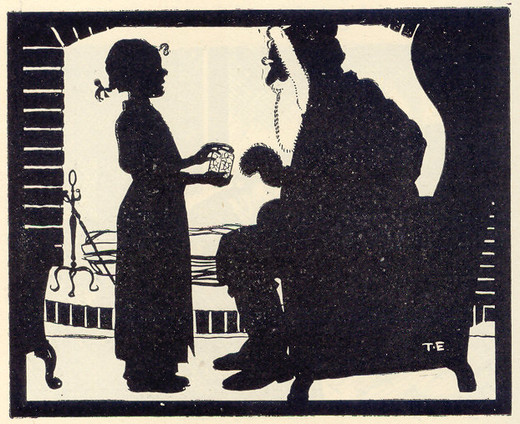
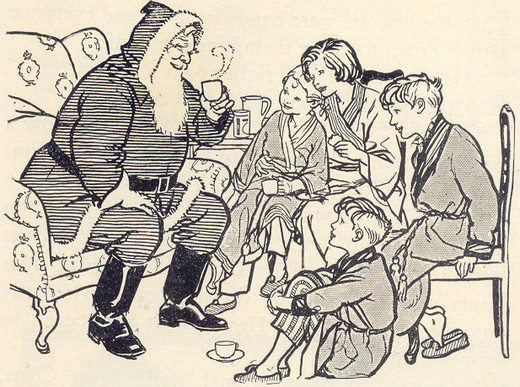
Betty and Fred are awake late on Christmas Eve and listening for Santa Claus to land on their roof. Instead they hear him landing in their pond. Fetched by his reindeer, the children pull Santa out of the pond and take him into the kitchen to dry off. He escapes just before Mother can see him, but must sneak back later as the children find a couple of unusual toys on their beds in the morning – toys just like Santa Claus was telling them about.

I’ve used the only other illustration from this story several times already so I thought I should treat you to the other one this time. It’s a shame the new book isn’t illustrated as nobody should have to miss out on the wonderful Eileen Soper!

There are only a couple of changes in this story. Happily Betty and Fred have remained Betty and Fred.

When wondering why Santa Claus hasn’t landed on the roof to come down a chimney, this has changed to come down our chimney. Considering houses in the 30s (and beyond) would have likely had multiple chimneys then a chimney is perfectly fine as it is the same as saying one of our chimneys. There are still plenty of houses with multiple chimneys today so it seems a silly change.

When making hot milk for Santa Betty originally put the pot on the fire. She now puts it on the stove. It’s probably rather uncommon to find an actual fire still burning in a kitchen fireplace in the middle of the night these days, so if that’s not updated to the radiators still being warm, then why not just let them heat the milk on the fire?

Apart from that there’s just one time italics are removed. (It’s like they sometimes have to make changes just to justify their jobs, isn’t it?)


A Family Christmas Part Two: Bringing Home the Holly

This is the second chapter of The Christmas book, where – as the title suggests – the children go out to collect holly with their father. As this is Blyton there is, of course, a little nature lesson involved – Ann learns the spiky leaves are to deter animals from eating it, but the topmost leaves are usually smooth as cows and horses can’t reach that high. They also open up some berries to find four stones inside.

Daddy then tells them some of the legends around holly. There are an interesting mix of Christian and non-Christian tales, and although the Roman one is presented as a “strange belief” of “olden times” the Christian ones are also presented very much as myth and legend.

The children (and the reader!) learn that holly decoration dates back to Roman feasts for the god Saturn (though the term Saturnalia isn’t used). Holly and evergreens were brought in, as the belief was that there were gods and goddesses living in the woods and they could come in out of the cold with the boughs and sprays.

Parallels are drawn between their ancient evergreen festoons and our modern paper chain festoons.

Then there are two Christian legends about holly. One is that holly was in the crown of thorns, and Jesus’ blood stained the berries red. The other is that robins breasts are stained red with Jesus’ blood also, as a robin tried to peck the thorns out. It’s pointed out that this is partly why robins appear on so many Christmas cards.

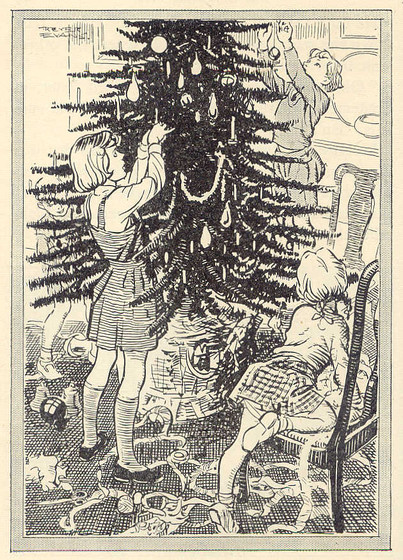
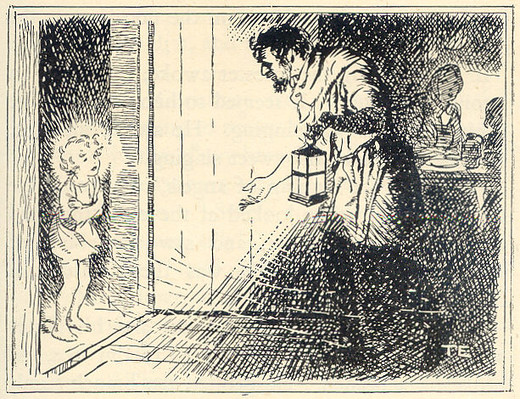
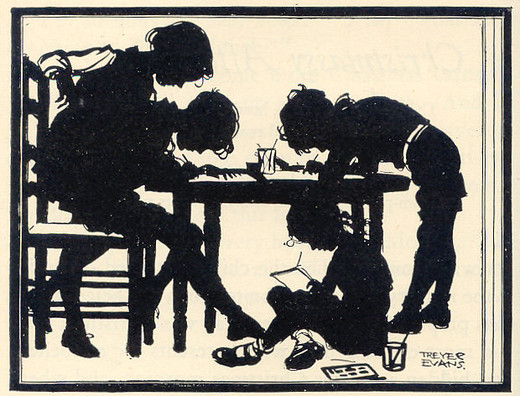
Treyer Evans did several illustrations for each chapter, managing to both skilfully convey the boisterousness of the excited children and the more serious historical pieces. Of course, sadly, not a single illustration appears in the new book.

Now for the changes.

The missing quote is –

With holly and ivy,
So green and so gay,
We deck up our houses
As fresh as the day

– Robin’s Almanac

From what I can tell this is a 1695 song from Poor Robin’s Almanack, Poor Robin being a pseudonym – the true author being a matter of debate.

There are only two changes made to the chapter and neither are a surprise.

The gay holly is just the holly, and queer becomes strange.

As an aside, Susan remarks that;

He’s such fun to be with and he’s not like some fathers I know. He really talks to us.

I can’t help but feel that this is a dig at Mr Lynton, though the first Barney mystery came five years later…


A Week Before Christmas

This story was specially written for Enid Blyton’s Treasury in 1947 and had illustrations by H Brock. You can also find it in The Secret of Sky Top Hill from Bounty in 1998 and 2014.

This is one of my favourite of Blyton’s Christmas stories and it’s a nice longish one. (I’ve summarised it for Blyton at Christmas 1946-1950 already but I’ll recap it again)

The Jameson family make plans for a modest Christmas. Daddy is away across the sea and Mother hasn’t much money. So it’ll be chicken, not turkey, a small Christmas-tree, and so on. The children are very grateful for what they have, and are looking forward to Christmas. But then Mother loses her handbag and all her money while out delivering magazines.

Again – I’ve used the other colour plate a few times, so here’s a different one. While I wouldn’t expect these beautiful full-colour plates to be reproduced, it’s a shame the line-drawings (see below) aren’t used either as they’re very good.

The children are from the same mould as those in The Family at Red Roofs and so they set to work to raise money for a chicken and tangerines – the absolute bare minimum for Christmas. Ronnie delivers prescriptions for the pharmacy, Ellen takes children out for walks and keeps them amused and Betsy goes to read to a blind woman as a companion.

Between them they earn a fair amount towards Christmas, but it is Ronnie who really saves the day, as he offers to sweep someone’s path for free and finds Mother’s handbag buried in the snow.

I’m really rather gobsmacked here – not only are the children still Ronnie, Ellen and Betsy, but the money has not been updated. They still earn shillings and half-crowns. Mother’s handbag still costs 30 shillings. I’m almost speechless.

Minor changes are made – gay (a gay Christmas tree, and so cheerful and gay) is removed twice. It’s a pity they couldn’t even replace it with jolly or another alternative instead of removing a descriptor altogether.

Apart from that there’s one loss of italics (another seemingly random change) and of course there are no hyphens now in to-day and to-morrow.

And we do get one other pointless change which I can’t understand. Originally the children  had given their mother quite a lot of money. It’s now had got their mother quite a lot of money. What was wrong with given? They had earned it, then they gave it to their mother. Got isn’t wrong, but it really isn’t a necessary change, is it?


Posted in Book reviews, Updating Blyton's Books | Tagged , , , , , , , , , | 1 Comment

Letters to Enid part 45: From volume 3 issue 7

Previous letters pages can be found here.


Letters page from Volume 3, issue 7.
March 30th – April 12th, 1955.

OUR

LETTER PAGE


A letter from Sibylla Edmonstone, Blanefield.
Dear Enid Blyton,
I am delighted to hear that I have won the second prize (in my age group) in the Club Competition. I would be very pleased if you would give the £3 to the Sunbeam Society for the Blind Children.
Yours truly,
Sibylla Edmonstone.

(Thank you, Sibylla-you are truly kind! But all the same you are going to have a prize -the one for the best letter on this page!)

A letter from Edwin Dale, nr. Stone, Staffs.
Dear Miss Blyton,
I thought you might be interested to know that we have got a black and white blackbird at our farm. She has been with us for over a year. Last year she had three lots of young birds.
Love from
Edwin Dale.

(I am interested, Edwin. We had a blackbird with a white wing, once and one of her young ones had two or three white feathers and stayed around our garden for years. But now we do not see him. Please tell me next Spring if yours is still about.)

A letter from Vivienne McGuim, Rathfriland, N. Ireland.
Dear Miss Blyton,
I had the flu and I had some medicine which I didn’t like. Daddy and Mummy gave me a penny each time I took it. I am sending you the money which is three shillings and sixpence for the Children’s Home.
With love from
Vivienne McGuim.

(You must have been quite sorry to stop taking your medicine in the end, Vivienne. It was very kind of you to send all your pennies to the Children’s Home, thank you!)

A letter from Susan Chapman, Bedford.
Dear Miss Blyton,
I also have a little kitten called Sooty. I hope you are well. I hope your little Sooty is well, mine is. I hope your little dog is well, too.
Love from
Susan Chapman.

(My little Sootie is very well, Susan, and he sends you and your little Sooty a very loud purr!)


Four letters this week, so no illustration.

Although Blyton chooses a variety of different letters, there are definitely common topics for children to write in about.

There’s the ever popular ‘how I/we raised funds for the blind children’ and we have two of these this week. The two this week are particularly selfless – giving away a prize they won, and giving away their medication bribe! (It’s good to see that 1950s parents weren’t above bribes – a couple of years ago Brodie got a little matchbox-type vehicle every time he got his eye drops done, which of course he kept and did not give away to the less fortunate).

There are also two letters of another common topic – wildlife and animals. Edwin gets what must be the longest response from Blyton yet – she was indeed very interested in his not-all-black blackbird. I expect Susan is quite young as hers is the sort of letter that might not seem worth a stamp to most people – but Susan obviously wanted to share something with Blyton and it’s nice that Blyton took the time to appreciate it.


Posted in Magazines | Tagged , , | Leave a comment

Monday #553

I’ve decided just to give in and embrace Christmas, not that I took much persuading. Obviously I’ve started my posts about Christmas Stories, but on Sunday we also visited a Christmas shop (and Brodie persuaded us we needed a new tree decoration), and then that evening he had Alexa play Elton John’s Step Into Christmas. So stepping into Christmas we are.

Letters to Enid part 45

and

Enid Blyton’s Christmas Stories part 2

It was recently brought to my attention that there’s a new Enid Blyton show on at the moment – Enid Blyton – Noddy, Big Ears and Lashings of Controversy. A fellow Blyton fan I know has already been to seen it and thoroughly enjoyed it.

Enid Blyton was loved by children.  She sold more than 600 million books, despite all her work being banned by the BBC and many libraries and schools for more than thirty years. She was accused of being racist and of using such limited vocabulary that it actually hindered children’s reading progress.
She had an interesting love life.
She enjoyed playing golf so much that she bought a golf course near Swanage.
She died of Alzheimer’s in 1968 aged 71, mourned by millions of readers all over the world.

Dates and locations (sadly nothing in Scotland).

Posted in Blog talk | Tagged , , | 2 Comments

Enid Blyton’s Christmas Stories, then and now

A while back I went through the entirety of Enid Blyton’s Holiday Stories – a 2015 Hodder collection, and both reviewed the story choices and checked them for updates to the text. My initial idea had actually been to do that with Christmas Stories, having just read it to Brodie at bedtimes in December. But it was too late for 2022, and too early for 2023, so I did Holiday Stories first.

There are 25 stories in this collection (there were 26 in Holiday Stories) but as 11 of them all come from The Christmas Book, my pile of books wasn’t quite so big this time around. Hopefully that will also make things a bit quicker as I won’t have to mess around with identifying so many different illustrators and publishing dates.


Christmas Stories Content

A Family Christmas Part One: Christmas Holidays The Christmas Book

The Lost Presents – Enid Blyton’s Snowdrop Story Book – I don’t have this. I’ve a few of the flower story books but the others are really hard to find!

Santa Claus Gets a Shock
Enid Blyton’s Happy Story Book

A Family Christmas Part Two: Bringing Home the Holly
The Christmas Book

A Week Before Christmas
Enid Blyton’s Treasury (despite it not appearing in the photo, because I managed to miss pulling it off the shelf, I do actually have this.)

A Family Christmas Part Three: The Curious Mistletoe –
The Christmas Book

The Christmas Tree AeroplaneThe Second Holiday Book

A Family Christmas Part Four: Balder the Bright and Beautiful – The Christmas Book

A Hole in Santa’s Sack The Magic Knitting Needles and Other Stories

A Family Christmas Part Five: The Christmas Tree The Christmas Book

The Tiny Christmas Tree Tales After Supper

A Family Christmas Part Six: A Christmassy Afternoon The Christmas Book

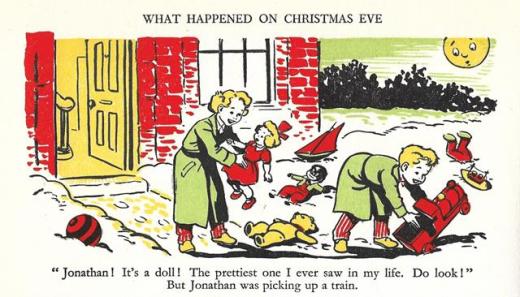
What Happened on Christmas Eve
The Eighth Holiday Book

A Family Christmas Part Seven: Bringing in the Yule Log
The Christmas Book

The Little Reindeer BellEnid Blyton’s Magazine No. 24 Vol. 4 – There are only four magazines I don’t have (out of 162) and this unfortunately is one of them.

A Family Christmas Part Eight: Christmas Carols The Christmas Book

The Very Full Stocking
Jolly Tales – this is in a few different printings of Jolly Tales, none of which I have. I can’t find any copies for sale either, only the earlier Little Book No 3, Jolly Tales, which doesn’t contain this story.

In Santa Claus’s Castle
Enid Blyton’s Omnibus

A Family Christmas Part Nine: A Visitor in the Night
The Christmas Book

What They Did at Miss Brown’s School
Enid Blyton’s Book of the Year

The Christmas Tree Party
Tricky the Goblin and Other Stories

A Family Christmas Part Ten: The Story of Santa Claus
The Christmas Book

Santa Claus Gets Busy
Enid Blyton’s Bright Story Book

A Family Christmas Part Eleven: Christmas Day
The Christmas Book

The Christmas Tree Fairy
The Enid Blyton Holiday Book 

I have already written a lot of posts about Blyton’s Christmas content – including a (brief) review of The Christmas Book so I probably won’t repeat too much of all that, and can focus on the updates instead.


A Family Christmas Part One: Christmas Holidays

Susan and Benny arrive home from boarding school, and along with Ann and Peter talk about their plans for Christmas and how wonderful that time of year is. They mention how many customs they follow, and start to wonder how they came about. Mother doesn’t know, and when Father comes home he tells them he’ll answer their questions tomorrow.

Being the first story in both books, I will make some points here that will apply to the rest of the Family Christmas chapters.

The first is that A Family Christmas is a new title, given presumably to make it clear that all these chapters are part of the same story. The first chapter of The Christmas Book is just titled Christmas Holidays.

It begins with a quote from Walter Scott (though it’s not stated it is from canto 6 – Old Christmastide – from the longer poem Marmion.)

Heap on more wood – the wind is chill;
But let it whistle as it will
We’ll keep our Christmas merry still.

But this (and the quote that begins each subsequent chapter) are omitted from the new version. Perhaps they thought that modern children wouldn’t know (or wouldn’t care) who the authors were?

In a promising start the children’s names are unchanged.

A few minor changes are made, updating stocking (the regular, every day foot-covering, not the kind put out for Santa to fill) to sock, and hols to holidays. When reading hols in the Famous Five I did have to explain to Brodie it was short for holidays, he perhaps thought I was saying halls. The quaint made holiday becomes made a holiday, boarding-school loses its hyphen, and one use of italics is removed (but all the rest remain).

So far so good – but there’s always something to spoil it.

In the original text Mother is always Mother. The children call her mother, the text refers to Mother or his/her/their mother. Nice and consistent.

The new text retains many uses of mother, but the children now go back and forth between calling her Mummy and Mother, with one use of Mum as well. Where the text used Mother as a name this is sometimes changed to his or their mother.

It makes no sense. I could understand if the younger children called her Mummy and the older ones Mother, but they all chop and change at random. Did they feel like the word Mother was overused and so had to swap it out? If I feel like there’s a decent justification for a change I don’t mind so much, but this sort of inconsistent changing of words/names really irritates me.

And now for a rare case of changes I kind of approve of! I’ve already mentioned in my review of The Christmas Book that it annoys me that Mother can’t ever answer any of the questions and passes them all to Daddy. What’s worse is her repeated comments about him being cleverer than she is, which I’m actually glad have been cut.

I begin to think I am not all that clever.

He is cleverer than I am.

I feel so stupid.

I’m sure all parents have moments where their children ask them things they can’t answer – I know Brodie regularly stumps me! But we can’t know everything – it doesn’t make us stupid. Obviously at the time Blyton was writing it wasn’t quite so easy to just look stuff up – I can quickly Google information and read it out, or find videos to explain how things work. But I bet the family at least had a set of Encyclopaedias which may have given them information about some of the customs.

On an individual level there’s nothing wrong with Mother not knowing certain things, and Daddy knowing them. I just think it’s a shame that Blyton chose to reinforce the stereotype of the housewife/mother who’s not expected or encouraged to use her brains,  while married to the clever, hard-working father when we know she’s capable of writing intelligent and resourceful girls and women. So it’s not a bad thing that the new edition has chosen to remove those references – especially as there’s no response to them (for example nobody tells her she’s not stupid as she knows loads about another subject).

Feminist rant over, if I remember correctly the rest of the book isn’t so bad, though Daddy does answer all the questions.

Lastly – of course the new edition is not illustrated, so we lose the lovely drawings of Treyer Evans.


Posted in Book reviews, Updating Blyton's Books | Tagged , | 3 Comments

Letters to Enid part 44: From volume 3 issue 6

Previous letters pages can be found here.


Letters page from Volume 3, issue 6.
March 16th – 19th, 1955.

OUR

LETTER PAGE

(This week I have chosen letters that tell something interesting about Nature or your pets. The first one wins my prize.)

A letter from Philip Lee-Wolf (aged 6), Lower Heyford, Oxford.
Dear Enid Blyton,
I must tell you about my birds, which I feed every day outside the back door. There is a big black-bird, a finch, two sparrows, a very tame robin. When we leave the back door open she comes in and pecks up the crumbs. Every spring she lays her eggs in a nest which she builds in a drain-pipe, but when the baby robins get big the nest falls down to the bottom and they die. So this year I have put one of my old woolly slippers in the top of the pipe, so that the robin can build her nest on it safely, and it will not fall down.
Love from
Philip Lee-Wolf.

(You are a real bird-lover, aren’t you, Philip! I did like your letter.)

A letter from Julie and Yvonne Hudson, Didsbury, Manchester.
Dear Enid Blyton,
I was at my friend’s house, and we were combing her dog; you should have seen the hairs that came out ! She gave it all to me. I am going to put it on my bird-table this spring for the birds to use when they make their nests.
With love from
Julie and Yvonne.

(I hope other children will do the same-it’s a very good idea!)

A letter from Doreen Petrie, Rockview Road, Dunedin.
Dear Enid Blyton,
We have 12 pet lambs to feed. We have three goats, three ducks, and two dogs and a pup. When we went up the paddock to look for rabbits’ nests we found forty baby rabbits. Our duck has got a nest in the cow-shed just where the cow puts her head. And do you know, when I was writing this letter, a baby calf was born.
Lots of love from
Doreen Petrie.

(How lucky you are to live on a farm and have so many birds and animals around, Doreen!)


This is the first themed set of letters as far as I can remember. Good thinking on Philip’s part – perhaps a Philip mannering in the making? Though Philip Mannering would probably have coaxed the robin into making a nest in one of his good slippers while it was still in his bedroom.

Leaving out dog hair is still recommended by the RSPB today – as long as it hasn’t been treated for fleas etc. What’s not a good idea though is long hair which the can get tangled in, or hair which has been bleached or permed etc.

I liked Doreen’s breathless description of life on what I assume to be her family’s farm. There’s still what looks like a farm on Rockview Road, Dunedin today, so that could well have been where Doreen wrote her letter from.


A bonus letter!

As the letters page moves around the magazine a lot, I often check the newsletter at the back as that sometimes gives the page number. This time there was another letter included.

6. A NICE LETTER. Here is a letter from the 50,000th member of our Magazine Club. “Dear Miss Blyton, I thank you for your telegram, the badge and the letter. What lovely surprises to have a telegram and a prize! If I am not asking too much, I would To like to have a camera. With love and thanks from Anthony Le Gros, Home for Boys, Gorey, Jersey, C.I.” Anthony has now got his camera, and is delighted with it. How lucky to be member No. 50,000!


Posted in Magazines | Tagged , , | 1 Comment

Monday #552

My big Christmas blogging project gets underway this week. It’s a little early (though perfectly allowable seeing as it’s November), but I anticipate it will take at least the 7 weeks (!!) we have left until Christmas. My similar series about Holiday Stories ran for 12 posts so I will have to be a bit less wordy this time around, or I’ll still be posting Christmas content into February…

Letters to Enid part 44

and

Enid Blyton’s Christmas Stories then and now, part 1

We have reached Five on Kirrin Island Again for bedtime stories, and have read as far as George (with difficulty) leaving Timmy on the island to protect her father. This one is, admittedly, slower to start as we are several chapters in and the only hint of adventure or mystery is a cough and a cigarette end. Brodie actually turned to me after we finished the latest chapter and asked when is the adventure going to begin? (Though the lack of adventure hasn’t stopped him from listening avidly to every word so far).

Of course I know of all the adventure to come – the discovering of the undersea passage, the near-blowing up of Kirrin Island… But I just had to tell him to wait and see what happens next.


Posted in Blog talk | Tagged , , | Leave a comment

Secret Island part 7 – The End and the Nitpicks

Having written some 10,000 words about The Secret Island already I’m back for what I hope will be the last post in this series. There’s not much left to look at, but I’d like to write about the final chapter(s) as the children’s time on the island comes to an end, a few nitpicks, and some random thoughts I had along the way that didn’t fit into any previous posts.


A touching end of an era

All good things have to come to an end, and living free on an island is no different.

Despite the island being a necessary escape for the children they turned it into a real home and very much enjoyed living there. Once settled they rarely refer to their previous lives. There’s no it’s so nice to make food without Aunt Harriet shouting at me or I’m glad there’s no-one here to slap me for dropping those eggs. I suppose Blyton didn’t want them to dwell on the past, and instead focussed on the many joys of their new home.

That’s not to say that it was jolly fun all the time. The children were certainly cold, wet and hungry at times, not to mention bored when the weather was bad. They also worked hard and some, like Nora, had to learn some hard lessons about responsibility.

And yet when it comes to the end of the book they are reluctant to leave their island. Their parents – thought dead for at least a year if not more – have suddenly reappeared in their lives and it’s almost amusing that although the children are very excited and happy about this, they are also sad as it means leaving the island. In fact they are actually surprised when Captain Arnold says it’s time to go!

The children looked up at him. “Going! What do you mean, Daddy? Leave our island?”

I am getting ahead of myself, however. Although the reunion of the Arnolds is touching, I think my favourite scene is when Jack meets Captain and Mrs Arnold.

With Christmas approaching, and the other children making a rare comment about missing their parents, Jack decides to risk another trip to the mainland. He can’t (or so he presumably thinks) give them their parents, but he can give them some treats such as crackers, fruit, sweets and some small gifts. He still has the money he earned from his last time in the market, so he doesn’t need to risk the market again, but can just head straight to the shops in the next village over.

In a rare case of outright lying from a good Blyton character, Jack tells the others he is going for a row to get warm, and to do some fishing.

Later, they are worried as he hasn’t come back and they can’t see his boat on the lake.

Blyton briefly changes style:

We must go back to Jack and find out what had been happening to him.

Rather a lot, actually. Having decided on what to buy he joins the queue in the toy shop/post office but overhears a very interesting conversation.

The two ladies chatting give perhaps an unnatural amount of detail but the upshot is Jack is sure they are talking about the Arnold children, and the Arnold parents.

“It’s bad enough to come down in an aeroplane on a desert island, and not be found for two years—and then to come back safe to see your children—and learn that they’ve disappeared!”

Although I’ve read the book several times I couldn’t remember exactly when the parents had arrived back, and how long they had been looking. The men searching the island did say that a surprise awaited the children, implying that it was their parents that had organised the search (I bet they would be pretty annoyed with those men for not finding the children when they were right there the whole time!). It’s also very possible that when the policeman caught Jack in the market, the parents were back and everything could have been resolved neatly. But we know that’s not how it happens – the children, unknowingly, hide themselves from their parents and live on the island longer, giving us a longer and more interesting story.

Back to Jack – he questions the women, and despite his raggedy appearance they answer him. Yes, the missing children are Peggy, Nora, Mike and Jack. Yes, they know where the parents are right now – in a hotel, not very far away, hoping for eventual news of their missing children.

Even that part is enough to make me start tearing up (I don’t think I ever got teary at these sort of bits until becoming a parent, but even before then it did make me feel a little emotional).

I get even more tearful as Jack arrives at the hotel and is nearly turned away by the porter on account of his shabbiness. But Captain Arnold (I love how Blyton pauses this breathless narrative long enough to clarify that he knew who to ask for because the other children had mentioned their father was a captain) is passing by, and happens to overhear.

He is exceptionally trusting – not once does he imagine that this ragamuffin of a boy wants money for telling him a location, which could well be truth or lie. Perhaps Blyton didn’t want to sully this fast-paced and joyous climax with suspicion. In half a sentence he has taken Jack upstairs to his wife and finally, Jack can tell them everything.

The story continues at great speed – a car takes them to the lake, a boat is hired, they arrive at the island.

The reunion is touching, not only for the Arnold family, but Jack, too:

“Mummy! Oh, Mummy! And Daddy!” shrieked the children, and flung themselves at their father and mother. You couldn’t tell which were children and which were grown-ups, because they were all so mixed up. Only Jack was alone. He stood apart, looking at them—but not for long. Nora stretched out her hand and pulled him into the crowd of excited, happy people. “You belong, too, Jack,” she said.

Their parents are very impressed with their cave (I wonder how it compares to wherever they lived on their island), and Mr Arnold promises that Aunt Harriet and Uncle Henry will be punished – but that’s the last time they are mentioned by any of the characters and so we never get to know their fate.

Warm and safe in the cave, stories are shared, until at last they all go to sleep in the heather beds. The book could really have ended there, but we get one more chapter to really tie up the loose ends.

The children pack a few of their possessions to take home, the rabbit rug, and their books, plus the chickens. Daisy will be collected by a fisherman later. In a true moment of Blytonian simplicity, Captain Arnold says he can probably buy the island, and the children can visit in the holidays.

Perhaps most importantly Mrs Arnold says that Jack is now part of the family, and will live with them. And so they all get new clothes, sleep in proper beds, and adjust to living in a house again. The children are returning to the familiar, while Jack has never had it so comfortable.

Their Christmas is described in a few paragraphs and surprisingly Nora briefly forsakes their beloved island:

“This is better than Christmas in the cave!” said Nora, unpacking a great big smiling doll with curly golden hair.

But she does have kinder words when the others discuss it at bed-time:

“I do just wish we could all be back in our cosy cave on our secret island for five minutes,” said Peggy.

“So do I,” said everyone, and they lay silent, thinking of the happy days and nights on the island.

“I shall never, never forget our island,” said Nora. “It’s the loveliest place in the world, I think. I hope it isn’t feeling lonely without us! Good-night, secret island! Wait for us till we come again!”

Blyton ends the book by promising the island that the children will visit it once again – and perhaps they do, but the only time we see them there again is briefly in The Secret of Spiggy Holes, the next book in the series.


Thoughts and nitpicks

I found it a minor irritation that Blyton refers to Mike, Peggy and Nora in that order. Peggy is the oldest, with Mike and Nora twins a year younger. I imagine she used that order as Mike is generally second in command after Jack, but that’s only because he’s a boy.

My imagination fails me on many accounts in this book. I find it hard to picture a lake big enough (though I’ve seen many enormous lochs) where the island can barely be seen. I also struggle to imagine an island big enough to not be explored all at once, and to be home to rabbits and birds. That’s not to say I think those descriptions are unrealistic, I just really struggle with imagining places on a grand scale!

My mental picture of the caves is also atrocious, they are really just giant rocks with holes in, sticking out of the ground something like these stock images.

I’ve already mentioned by inaccurate mental picture of Willow House in a previous post.

I haven’t really talked about the children in great detail, but I think that their actions speak pretty loudly. With the slight exception of Nora who could be a little lazy and slap-dash but learned her lesson, the children are all hard-working and sensible. Jack – as I wrote about in rather a lot of detail here – is the leader, the main ideas man, and the one who knows how to build houses, make cows swim and so on. Peggy takes on the motherly role – she does most of the cooking, the mending, the ‘housework’, Nora does most of the animal care, and Mike is more or less Jack’s second in command and does all sorts of jobs around the island. I’d like to say that they all grow and develop over the book, but apart from Nora, they don’t really. They’ve all come from such miserable home, and been worked so hard, that the island is practically a paradise for them.

And now for the nitpicks! I don’t think that I have ever noticed any of these before – and I’m sure that no child readers would be worrying themselves about these little details.

First up, there are a few contradictions which I only noticed as I had been making lists of things they brought to the island.

After Jack brings Daisy over:

 It was lovely to have milk after drinking nothing but tea and cocoa made with water. They could not have enough of it!

Yet not long before Jack had brought over tins of milk. They have cocoa with tinned milk on at least one occasion. Obviously having an endless* supply of fresh milk is far preferable to having a limited supply of tinned milk, but that’s not what the quote above says!

(*It wouldn’t actually be endless as a cow will only produce milk for around ten months after having a calf.)

The children’s clothes, or lack of, is also contradictory. In the early chapters the Arnolds bring all the clothes they possessed. Yet, one point Peggy wishes they had changes of clothes. When Jack and Mike get soaked they use the few things Jack brought from his Granddad’s farm. And later:

Mike managed to get into his aunt’s house one night and get some of his and the girls’ clothes—two or three dresses for the girls, and a coat and shorts for himself. Clothes were rather a difficulty, for they got dirty and ragged on the island, and as the girls had none to change into, it was difficult to keep their dresses clean and mended.

Obviously this is a nitpick as Mike can’t collect clothes they’d already taken but I have to add that surely the girls could wear one of Jack’s shirts, or the overcoat, or wrap up in a blanket while their dresses were washed or mended.

Lastly there’s the boat – When the boat first sinks:

Then Jack and Mike had to use all their brains and all their strength to get it up again and to mend it so that it would not leak quite so badly.

But when they decide to deliberately sink it:

We can easily get her up again and mend her if we want her.

I imagine having worked out how to do it the first time it might be a little easier in the future, but surely not as easy as their plan suggests!


Last thoughts

I’m already over 12,500 words in this series so I’ll try to keep this brief.

This surely has to be one of Blyton’s best books, and although there elements in it that were reused in various other stories, it does stand out as being very different from anything else she wrote. No other Blytonian children survive in the wild for so long, nor show such levels of self-sufficiency. The trippers, the policeman, the searchers, and Jack’s discovery at the end all add excitement, but the bulk of the book is a study of the children making a life on the island.

Posted in Book reviews | Tagged , | 9 Comments

October 2023 round up

We are creeping closer to the end of the year, by the time this post goes up it will be the first of November. Halloween will be over and it’ll be time to start thinking about Christmas!


What I have read

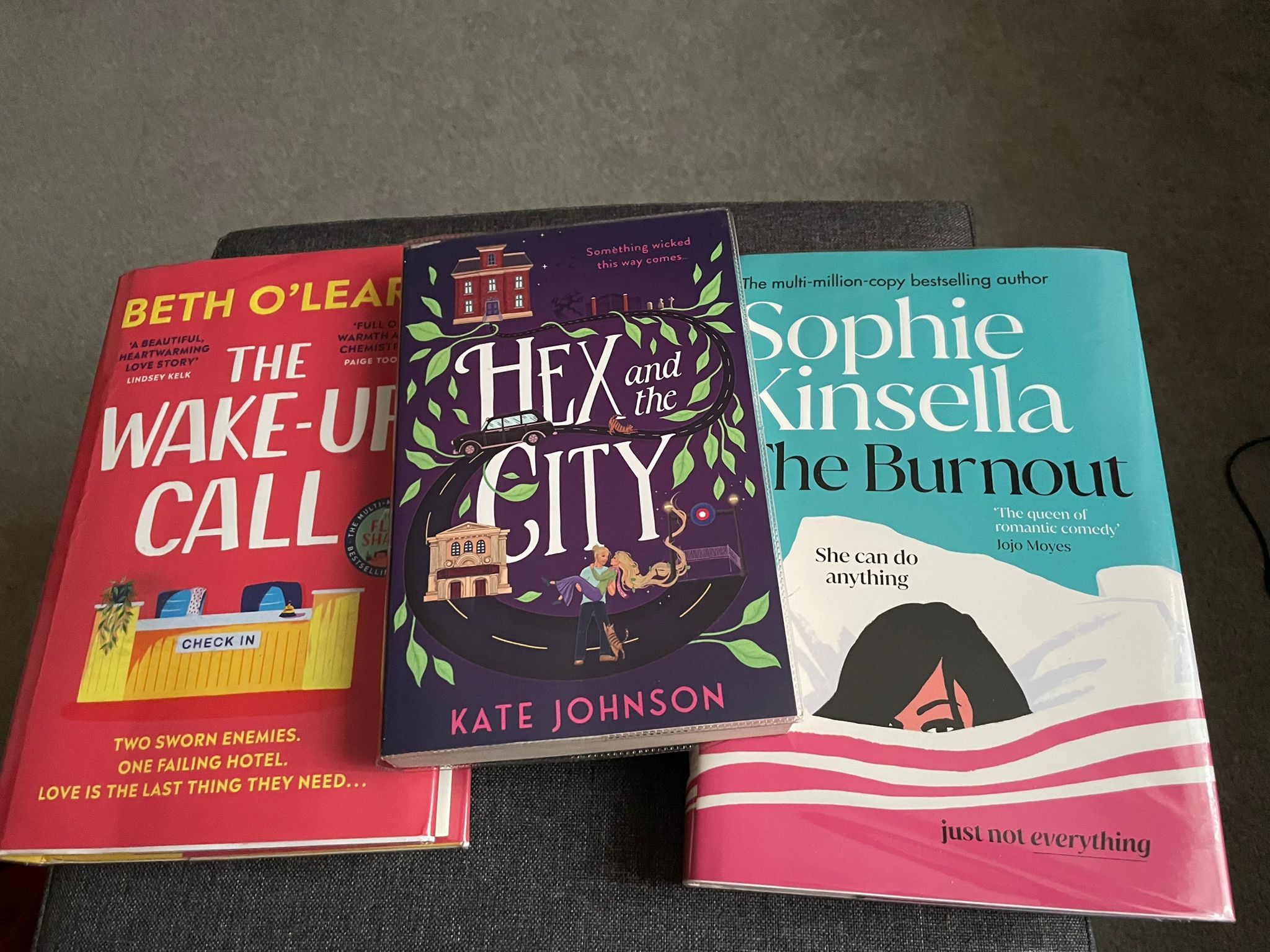
I hit my goal of 100 books read in September but of course I just kept on reading. As it was Halloween in October I picked a few witchy-themed books.

What I have read:

  • The Accidental Investigator (Heather Bay Romance #3) – Amber Eve
  • Hex Appeal – Kate Johnston
  • The Last Devil to Die (Thursday Murder Club #4) – Richard Osman
  • Abby the Bad Sport (Baby-Sitters Club #110) – Ann M Martin
  • The Impostor Bride (Heather Bay Romance #4) – Amber Eve
  • Five Go to Smuggler’s Top 
  • A Change of Heart for the Cornish Midwife (Cornish Midwife #7) – Jo Bartlett
  • The Case of the Missing Books (Mobile Library Mystery #1) – Ian Sansom
  • The Holiday Bookshop – Lucy Dickens
  • Anne Of Green Gables (Anne of Green Gables #1) – L M Montgomery
  • Five Go Off in a Caravan
  • Something Wicked – Gretchen Rue
  • All Things Bright and Beautiful – James Herriot

And I’m still working on:

  • The Secret Island – review part one, part two, part three and part four
  • Carry On (Simon Snow #1) – Rainbow Rowell
  • Five on Kirrin Island Again
    The Wake-Up Call
    – Beth O’Leary
  • Sorcery & Stories (Library Witch Mystery #3) Elle Adams

What I have watched

  • Our regular shows were The Simpsons (we are up to season 10 now), Only Connect and Taskmaster.
  • Tuesday night movies were The Devil Wears Prada and, because we were looking for something Halloween-ish but not scary, Edward Scissorhands.
  • Brodie had a sleepover with his auntie one weekend so we had time to watch Lord of the Rings: The Two Towers extended edition, (it’s about 3 hours 45 and requires two discs).
  • I also finished off the Hack My Home TV series.

What I have done

  • Visited the Transport Museum for the last event of the year – Military Vehicle Day.
  • Did the Scotty Dog trail in Fife
  • Visited the Frigate Unicorn (an 1824 training ship and one of the six oldest ships in the world) and explored the waterfront
  • We had a mid-week break to Stirling so we visited the Wallace Monument, took a train through to Glasgow for the Riverside Museum (another transport one) and the Lego Store, and visited Blair Drummond Safari Park. We had planned to visit Stirling Castle on our last day but we just drove straight home due to the weather warnings. Brodie’s favourite part of the holiday was riding the Clockwork Orange, Glasgow’s subway.
  • At the Lego Store I had bought The Lego Brand Store (40574) so I spent an afternoon building that during the red weather warning.

How was your October?

Posted in Personal Experiences | Tagged , , , , , | 1 Comment

Monday #551

We are enjoying a break in the rain today, though it is really rather cold, and also dark as the clocks went back at the weekend. Wednesday is the start of November, and the return of the rain.

October round up

and

The Secret Island part 6 (hopefully the final part!)

A seasonally-appropriate post from 2016, detailing some of Blyton’s Guy Fawkes’ night content.

Blyton’s Bonfires, Guys and Fireworks


Posted in Blog talk | Tagged , | Leave a comment

The Secret Island part 6: Hiding from visitors

So far I have written about the ways in which the children have arranged accommodation, food supplies and other essentials for living on the island. The intended permanence of their stay on the island has made their efforts different to anything we’ve seen in any of Blyton’s other books. But there’s still one major element that I haven’t covered – their need to stay hidden.


Running away forever

There are plenty of Blyton’s stories where children have a need to stay hidden from enemies – but again, one difference is the length of time this is necessary. For example the Mannering-Trents must hide in the valley from Juan and Pepi, and the Adventurous four must hide from their enemies on various islands, but both are short-term, only until escape or rescue is possible.

While the Arnolds and Jack only (I say only but it really is a significant amount of time for a group of children) spend five or six months on the island, their intention is to live there potentially forever. (I imagine, though, that had their parents not returned and found them, that they would have moved on once they were old enough to no longer be legally in the care of their relatives, and could find jobs).

The other difference is that whilst most children are hiding from enemies such as smugglers, thieves and other crooks, the Arnolds live in fear of being found and returned to their aunt and uncle. To be honest I’m half-surprised that the aunt and uncle even bother to start a search – they obviously care not one jot for the children. As they think that the parents are dead they have no concerns about being accused of anything by them. I can only imagine that they decided that their slave labour was worth more than the cost of feeding them. That, or, they worried that someone locally would notice the children’s absence and it would look bad on them for not reporting it…

“Is Aunt Harriet very upset?” asked Peggy.

“Very!” grinned Jack. “She’s got no one to wash and scrub and cook for her now! But that’s all she cares, I expect!”


The secret of not attracting attention

While the Arnolds perhaps considered themselves escaped and free, Jack is obviously constantly aware of the need to stay hidden. It is he who stamps out their fire soon after they’ve eaten on their first evening –

People may be looking for us to-night, you know, and a spire of smoke from this island would give our hiding-place away nicely!

Willow House is naturally rather well-hidden as it is in a tight thicket of trees, and so Jack thinks it will be difficult for grown-ups to squeeze their way in to find it.

On their second full day on the island Jack returns in the evening from his chicken-collecting trip and has news for the other regarding the search.

“Everyone is wondering where we’ve all gone! They’ve searched everywhere for us—in all the nearby towns and villages, and in all the country round about!”

He reiterates his concern about the smoke from their fire giving the game away, but acknowledges that it’s a problem they’ll have to deal with when it comes. After all – they have to be able to cook.

The police are involved at this stage, too.

“They’ve searched barns and stacks and ditches, and gone to every town for twenty miles round, thinking we might have run away on a lorry. They don’t guess how near we are!”

So they all know that it’s really important that they are careful about staying hidden. The position of the island, far from shores which are densely treed and unpopulated, is really key here. But it doesn’t stop the trippers from coming.


A trial run

Initially, the trippers seem like a bit of a disaster. Although they are not looking for the children they could well stumble upon them by accident. It’s also a real disruption to the children’s well-ordered routine.

And yet, it also proves to be extremely useful. Although unprepared the children are able to not only hide themselves, but also most signs of their presence. It’s all done in a somewhat haphazard manner, but it does work, and it helps to better prepare them for any visits from people who are actually looking for them.

They stamp out the fire, scatter the burnt wood in the bushes and spread fresh sand over the site.

They collect up all their belongings and hide them. They stuff the cave-larder up with heather and bracken (though I’d have taken the things out, to be safe!).

They put the hens into a sack and taken to the caves, but the hen-yard is left in place.

They take the boat around the island a little and hide it under overhanging brambles.

Daisy is on the far side of the island from the best landing-place, so they decide she is probably safe unless the trippers go exploring fully.

The children themselves plan to keep lookout from the bracken on the hill.

Although the children are feeling very afraid the trippers’ conversation is quite amusing for the readers, as poor Eddie hears and sees things that are absolutely signs of the island being inhabited but his companions just laugh at him.

“Do you hear that noise?” said one of the trippers. “Sounds like a hen to me!”

“Don’t be silly, Eddie,” said a woman’s voice scornfully. “How could a hen be on an island like this! That must have been a blackbird or something.”

“Can you hear that cow mooing somewhere?” said one of the trippers, in surprise.

“I expect it’s a cow in a field on the mainland,” said another lazily. “You don’t suppose there is a cow wandering loose on this tiny island, do you, Eddie?”

Eddie also spots a footprint in the sand and finds a piece of string. The others put this down to other trippers having been to the island before.

As usual it is Jack who is thinking ahead once the trippers leave, thanks to bats and dark clouds.

“I hope that man called Eddie doesn’t read anywhere about four runaway children and think we might be here because of what he heard and found. We must be prepared for that, you know. We must make some plans to prevent being found if anyone comes again to look for us.”


Best laid plans

When the children discover the mess the trippers left the day before it is, of course, Jack who suggests they might use some of the rubbish.

“If we keep the tin and a carton and the empty cigarette packet in our cave-cupboard, we might put them out on the beach if anyone else ever comes—and then, if they happen to find the remains of our fire, or a bit of string or anything like that—why, they won’t think of looking for us—they’ll just think trippers have been here!”

This is ingenious, as although of course they wouldn’t intend to leave any clues to their presence lying around should anyone else come to the island, there’s always a chance that something would be missed.

Jack decides that the boat should stay hidden now, and only got out when they need it. It takes him some time, however, to decide that they should make more serious plans for hiding. The fact that trippers found the island does of course mean that others might, or others might even already know of it.

“If anyone does come here to look for us, and it’s quite likely,” he said, “we must really have all our plans made as to what to do, and know exactly where to hide. People who are really looking for us won’t just sit about on that beach as the trippers did, you know—they will hunt all over the island.”

The caves are judged the best place to hide, and explored.

Though we know that they also intend to live in them come the winter.

Possibly the best part of their hiding plans is Jack practicing walking Daisy through the narrow tunnel and into the inner cave. They can’t rely on her being on the far side of the island if people are going to search the whole place. And so he entices her along with the promise of a juicy turnip, and soon she quite happily makes the journey.

Should anyone come looking for them Jack will then be able to quickly and easily hide Daisy away. Mike’s job will be to get the hens to the caves. Peggy is to stamp out the fire and hide the remains, then put out the trippers’ rubbish and cover up the cave-larder. Nora is to collect the pail of milk and scatter heather over the seed patches.

Jack even thinks to make sure they avoid traipsing in and out of the larger cave entrance in case they leave too many marks there.


Waiting for the searchers

As they have anticipated, searchers do come for them. Jack, having nearly been caught by a policeman at the market, knows it’s only a matter of time.

Immediately he decides that one of them must keep watch from the top of the hill all though the day. He guesses that they will start searching around the lake first, before coming to the island, and he is right.

Mike, getting a chance to shine for a brief moment, suggests making a hole in the boat and letting it sink.

Jack orders Peggy to make sure every last thing is cleared away, down to any snippets of wool. Despite having the trippers’ rubbish, he’s not taking any chances. Their belongings, with the exception of a few essentials, are to be tidied away to the caves. This time the hen-yard is to be dismantled, and heather thrown over the bare, chicken-scratched ground. Their fires are to be lit for the minimum amount of time they can get away with for cooking.

After five days of watching, and living on edge, they spot a boat coming towards their island.

The children hurried off. Jack went to get Daisy. Mike went to see to the hens and the hen-yard. Peggy scattered the dead remains of the fire, and caught up the kettle and the saucepan and any odds and ends of food on the beach to take to the cave. Nora ran to cover up their patches of growing seeds with bits of heather.

As they are so organised everything goes like clockwork. Daisy goes into the caves quietly, the hens are collected, everything and everyone is hidden in the cave.

Except that Mike realises that he hasn’t got his hat. This adds a nice bit of tension as he goes off to try to find it, as the searchers approach the island. Turns out it was beside Willow House all along, and was quite safe.

He returns to the caves and helps the others pile some rocks in the inner cave passage to simulate a rockfall, just in case the men find it.


What the searchers find

In a somewhat similar manner to the trippers, the men do find a few things on the island, but dismiss most of them.

They find evidence of a fire, and the trampled area around the spring, but thanks to the trippers’ rubbish they attribute them to trippers.

The hen-yard is found, making them sure that someone has been there, and been up to something, but what? (No mention of chicken droppings, or later, cow-pats, as those would have been a dead give-away!)

The runner-beans make them think the children have been there (though later they suggest they could have been dropped by birds), but because there’s no boat, they begin to convince themselves that if they were there, they aren’t any longer. But they think they’d better check the caves just in case.

They do find the “rock fall” and one man is about to try to force his way through when another points out that if they can’t get through, the children couldn’t have.

And then Daisy begins to moo and cough. Much like with the trippers one man declares it sounds like a cow and is laughed at.

“It sounded like a cow,” said another voice.

“A cow!” cried the first man, “what next? Do you mean to say you think there’s a cow in the middle of this hill, Tom?”

Daisy doesn’t send the men away in terror, but they are somewhat spooked and decide the children would be scared by such noises and give up the search. It’s quite a funny moment but it’s almost a shame that a few noises are what truly ends the search, and not all the tremendous effort the children have gone to in hiding every element of their life on the island. I wonder how the men rationalised the strange sounds to themselves.


And with that, they are safe on the island once more – there isn’t any reason for anyone to come searching again.

Posted in Blog talk | Tagged , | 6 Comments

Letters to Enid part 43: From volume 3 issue 5

Previous letters pages can be found here.


Letters page from Volume 3, issue 5. March 2nd – 15th, 1955

OUR

LETTER PAGE

A letter from Yolande Bristow, B.A.O.R. 15.
Dear Enid Blyton,
I am sending you two postal orders for 15s. 6d. I saved this money in three different countries – in Hong Kong, and in England when we were on leave – and since then in Germany. I have had drops in my eyes and couldn’t see very well, and it made me realise how dreadful it would be not to see anything . at all.
Love from
Yolande (Sunbeam).

(Thank you very much, Yolande. I have never had money sent to me collected in three countries before !)

A letter from Helen Roberton, Adcockvale, Port Elizabeth.
Dear Enid Blyton,
I want to thank you very much for my Magazine Club Badge. When I saw the important-looking envelope I thought it must be for Mummy or Daddy, but when I looked at the name I discovered it was for me. With a thrill I pulled out my badge. I wear it everywhere and everyone admires it.
Much love from
Helen Roberton.

(I am so glad you like your badge, Helen. You did write me a nice letter.)

A letter from Gillian Mason, Linthorpe, Middlesbrough.
Dear Enid Blyton,
I thought I would write to tell you about my young brother, Colin. He pretends to be Noddy. My Grandad is Big-Ears, and Mummy is Mrs. Tubby Bear. I am Tessie Bear, and Daddy is Mr. Plod because he is a policeman. If ever Colin gets into trouble he runs to Big-Ears and tells him all about it. Colin is only four and he has been pretending he is Noddy since he was one.
Love from
Gillian Mason.

(Give your little Noddy my love and tell him I’m glad he has a kind Big-Ears!)

A letter from Jill Dryburgh, Bangor, N. Ireland.
Dear Enid Blyton,
I have read your remarks about snowdrops in your letter, and I am surprised that you have not seen any yet. We have hundreds in our garden which have been in full bloom for the past few weeks. I am enclosing a few Irish snowdrops with my love.
Jill Dryburgh.

(Thank you very much for your snowdrops, Jill, it was kind of you to send them to me!)


Four letters this week – all from girls, so no illustration required to fill the space.

It’s a money-raising letter in first place again. A generous amount of money, even if it’s not as much as those recent huge amounts. But coming from three different countries does make it stand out.

I remember what it was like to be young and excited when post came with my name on it. Sadly as an adult it’s mostly bills or junk! I’d much rather have something sent from a favourite author.

Colin’s game sounds sweet, but poor Mummy having to being called Mrs Tubby Bear. (Mine only had to endure a brief phase of me calling her Madame Mishurely which I think was me trying to say Madame Cholet – from the Wombles.)

And lastly, You’ve got to love Jill for sending snowdrops all the way from Northern Ireland because Blyton hadn’t seen any yet. I wonder what state they arrived in? Perhaps she dried them before posting them.


Posted in Magazines | Tagged , , | 1 Comment

Monday #550

We had a few days away last week – returning just before the weather turned truly nasty – which is why there were no posts. But it’s back to the regularly scheduled content this week. I’m starting to think about this year’s Christmas content too, but rest assured you won’t see any until at least November.

Letters to Enid part 43

and

The Secret Island part 6

Five Go Off In a Caravan has already been book of the week back in 2019. But there’s no rule that says I can’t have it again. This is what we are reading at bedtime at the moment, Brodie having climbed up the back of the sofa to get it the very next night after finishing Smuggler’s Top.

So far he is loving how funny Pongo is (shaking Timmy’s tail, in particular) and has made some pretty accurate guesses as to what’s going to happen in the story. He hasn’t yet demanded a caravan holiday, which is just as well, because I know that if we did it could never compete with the one the Five have.


Posted in Blog talk | Tagged , , | 1 Comment

The Secret Island part 5: Collecting, buying and selling

The children really have been industrious up until now; turning various parts of the island into comfortable accommodation and tending to their livestock and crops.

Yet the island can’t provide everything they need and so it’s time to start looking at the Secret Island commerce!


They only steal what they can’t afford (that’s everything!)

I’m misquoting Aladdin there – and I think that the children’s stealing is justified. Normally stealing is confined to the baddies in any Blyton tale, but if the children were properly looked after by their relations then they’d be getting fed and clothed anyway.

There is a great deal of making-do on the island, which the children are happy with. Using an old sack as a towel is preferable to having to live with their cruel relatives with their proper towels.

Some things they are able to source from either Uncle Henry’s farm or Jacks granddad’s farm.

When Jack goes to fetch his cow he finds his granddad has left, and so he is able to check for anything useful left in the house. That amounts to a couple of old, dirty roller towels, and all of Jack’s remaining (and rather ragged) clothes.

Three shirts, a few vests, an odd pair of trousers, an overcoat, a pair of old shoes, and a ragged blanket!

Though when they get up the next morning they remember that they have no pail – this means that they have to milk Daisy into saucepans, the kettle, their bowls and jugs. An old pail has to then be fetched from the barn on Uncle Henry’s farm.

Various other trips are made – risky business, but obviously necessary.

Clothes being a second difficulty after food – as island life must be tough on clothes. Keeping them clean and mended with only one outfit each, especially so. Thus Mike collects some of his and the girls’ clothes from their old rooms (note that this will be mentioned in a later nitpicks post!).

two or three dresses for the girls, and a coat and shorts for
himself

In addition to the foodstuffs – mostly vegetables – I mentioned them collecting in the last post, Jack also gathers turnips for Daisy, and later can pick wild mushrooms from the mainland. More corn is needed for the hens,

It’s just as well that Jack’s granddad’s farm stays empty for so long (it all sounds rather dilapidated and shabby, so not an enticing prospect for many buyers) enabling them to pinch thing as needed. Perhaps Aunt Harriet and Uncle Henry have noticed things going missing, though, as they buy a new dog which bites a hole in Mike’s shorts. Perhaps it’s just a regular working dog, but it wouldn’t surprise me if it was also there as a guard dog. I very much doubt they are thinking it’s the children who are helping themselves to things on the farm, though!


Jack the salesman

There’s a limit to what they can steal from the farms – there’s never any suggestion they could or should take anything from inside Aunt Harriet’s house except the clothes which already belong to them.

I expect it’s mostly for moral reasons, but of course if they started taking food or candles or other supplies it would likely be noticed even more than an old pail and crops. It might even end up with the police involved.

So, they have to come up with another idea when the colder weather starts and their essentials start to run out. There’s only one candle left, and a few matches.

Jack points out that they’ll want a better light in the evenings, and another blanket.

Peggy says she really needs some more wool and thread, having had to already mend grey trousers with blue wool. She’d also love some flour so she could make rolls.

The corn for the hens is running low, says Nora.

Jack’s response surprises them:

Don’t you think it would be a good idea if I took the boat and went to the village at the other end of the lake and bought some of the things we badly need?

With what money? the children (and probably the reader) ask.

The idea is one that Blyton will reuse in Hollow Tree House seven years later – selling produce in pretty little woven baskets.

They’ve already been making little basket out of willow – Peggy having taught the others how to do this – and so Jack’s plan is to fill them with the wild mushrooms, sell them at a market and then use the money to buy supplies.

It’s a pretty good idea, actually. The only other idea I could think of would be for him to go to the mainland and offer to do odd jobs, but that would be more risky and possibly less profitable.

With that plan sorted the shopping list quickly grows.

“I wish we could have a book or two,” said Peggy.
“And a pencil would be nice,” said Nora. “I like drawing things.”
“And a new kettle,” said Peggy. “Ours leaks a bit now.”
“And a few more nails,” said Mike.
“And the flour and the wool and the black cotton,” said Peggy.

Later Peggy adds soap to Jack’s list – bringing it to 21 items.

On Jack’s first trip he ends up selling mushrooms in willow baskets, and strawberries in rush baskets. It doesn’t say how many baskets of mushrooms he takes, or what he sells them for, but there are 12 baskets of strawberries which the girls suggest are worth sixpence each. The strawberries alone would earn them six shillings that way.

He sells everything, thanks, in part, to the attractive presentation of the baskets.

He spends all the money on:

  • A very large bag of flour.
  • Wool and cotton for Peggy.
  • Scores of candles and plenty of matches.
  • A new kettle and two enamel plates.
  • Some storybooks, and two pencils and a rubber.
  • A drawing-book
  • Some nails, soap, butter for a treat
  • Some bars of chocolate, some tins of cocoa, tea and rice.
  • Corn
  • Tins of treacle and sugar

I found this handy chart on the government website which details 1938 prices for a number of foodstuffs. For example, flour was 1s 2 ¼d for 7lbs. Jack’s ‘very large bag’ could have been a 7lb bag, or perhaps smaller as that’s pretty heavy along with all his other purchases. Butter was 1s 4½d per lb, and sugar only 2½d per lb. Tea was more expensive, at 2s 4¼d per lb, but Jack may well have been buying things in smaller amounts.

Regardless, he has to stagger back under the weight of it all when he is done.

The storybooks were Robinson Crusoe, Stories from the Bible, Animals of the World and The Boy’s Book of Aeroplanes. The first edition of The Secret Island was priced at 3s 6d, but a year later a cheaper edition was produced at 2s. I assume that the books Jack has bought are either second-hand or from cheaper print runs.

I think Jack and the others get a bit over-confident about this, though. While it has been successful his statement that we needn’t be too careful now of all our things because I can go each week and sell mushrooms and strawberries and earn money to buy more seems a bit foolish.

Peggy points out that the mushrooms and strawberries will run out, but Jack plans to sell blackberries and nuts instead. He acknowledges that these won’t fetch as much money, but added up it will be fine.

I can get enough to store up plenty of things for the winter. If we can get flour, potatoes, rice, cocoa, and things like that, we shall be quite all right. Daisy can always give us milk and cream, and we get lots of eggs from the hens, fish from the lake, and a rabbit or two.

In all, it’s not a bad plan. Gathering free wild foods, making baskets, and selling the produce to buy essentials they can’t grow themselves is pretty sensible. Stocking up for winter is a very good idea.

Maybe it’s because I know what happens later on when Jack’s at the market, but I think they should carry on being careful with their supplies. Any number of things could happen – Jack could be recognised, the boat could become unrepairable, the weather could become too bad to get to the mainland, the sellable goods could run out…

Jack goes to market each Wednesday for several weeks, selling the strawberries and mushrooms, then the hazelnuts and blackberries, coming back with sacks of goods to stockpile.

And then, of, course, it does all go wrong. Jack comes back with a little money – but money’s no use on the island.

This is the end of my marketing, he says. But it’s more than that – it’s the beginning of the end of their island life.


Next time – moving on from survival skills I’ll look at their hiding skills.

Posted in Blog talk | Tagged , | 3 Comments

Letters to Enid part 42: From volume 3 issue 4

Previous letters pages can be found here.


Letters page from Volume 3, issue 4.
February 16th – March 1st, 1955.

OUR

LETTER PAGE


A letter from Sheila Johnson, Alexandra, Singapore 5.
Dear Enid Blyton,
Today is my birthday. I’ve had a lovely party with 14 guests. As guests usually bring gifts to a birthday party, Mummy thought 14 gifts would be too many just for me, so we asked that guests should not bring personal gifts, but something for my Sunbeam Box instead. How delighted we were to get 45 Malayan dollars, which is 5 whole guineas in English money! Wasn’t everybody generous? A friend is exchanging the dollars for an English cheque, which I will send you for the Sunbeams.
Love and New Year greetings from
Sheila Johnson.

(Thank you, Sheila – and please thank your mother too. I was very touched by your generous letter.)

A letter from Carol Browne, Clonmel, Co. Tipperary, Ireland.
Dear Miss Blyton,
I wish to tell you that I am very pleased with the pen-friend Beverley Cooper got for me. I am sure that all the other children who wrote to Beverley are pleased too. Beverley has run her pen-friend club very well, I think.
Yours sincerely,
Carol Browne.

(I, too, think Beverley ran the little club very well, Carol – she has stopped it now, because she has to work hard for an exam.)

This letter, which was sent to the Secretary of the Sunbeam Society, was forwarded to me. It is from Pamela Auriole Loweth, Studham, Beds.
Dear Secretary,
I am Sunbeam No. 5294, and I have always wanted to help the blind babies. So last Saturday all the children in my road did a Pantomime, “Cinderella,” at our Village Hall. My Mummy produced it, and she was the wicked stepmother. My sister Janet was Cinderella, and I was a fairy. It was a wonderful success and everyone loved it. I am sending you the money we made, which is £10 15S.
With love from
Pamela Loweth.

(Wonderful, Pamela! I am so glad I saw your letter. I really do congratulate you all.)


More maths for me to do this week!

Sheila’s friends really were very generous. Of course I had to look all this up and I’m still not sure I quite have it straight… but a guinea was £1 1s. While there had been a one guinea coin in the past they stopped in 1814, but up until decimalisation in 1971 prices of some products were still given in guineas. And apparently today race horses are still sold in guineas!

Anyway, that makes 5 guineas 105 shillings, or £5 5s. That means the party guests brought 7s 6d each (or the Malayan equivalent, on average).

I don’t recall seeing such a high amount raised and donated in any letter in the magazine before.

And then of course Pamela went and blew that out of the water with her £10 15s. But then again there were probably far more than 14 audience members attending their pantomime. Still, it’s a very impressive amount of money – around the average weekly wage for a man in 1955.

Interesting that although Blyton often features money-donating letters, particularly in the winning spot, she obviously doesn’t award purely based on the monetary amount.

The other letter is equally interesting – if you remember the letter from volume 2 issue 20 where Beverley gave her address and encouraged readers to write to her as a penfriend, and if she got too many she would pass them on to some of the other 1,000 girls at her school. In that post I wondered how many letters she got, and while there’s no answer to that, it’s nice to see a follow up (and that Blyton has been kept in the loop by Beverley!).


Posted in Magazines | Tagged , , | Leave a comment

Monday #548

It has been a very soggy weekend for most of us in Scotland. Lots of disruption due to flooded roads and railway lines. Luckily I was able to stay home mostly, and read while listening to the rain battering off the windows.

Letters to Enid part 42

and

The Secret Island part 5

The rain went on pouring down, and soon people began to say that there would be floods in Toytown. Such a thing had never happened before!
The river overflowed and joined the pond on which the duck swam. Then what a great stretch of water there was for the duck to swim on! The water spread right up to the farmhouse, and the farmer’s wife rushed upstairs in fright, for it poured in at her kitchen door!
” We shall have to live in the bedrooms!” she cried. ” Oh dear, oh dear! What a dreadful thing! All my kitchen chairs are floating about! “

An apt quote given the weather in Scotland at the moment. This is from Rain in Toytown from the first Holiday Book. Of course the story has a happy ending with the giant rubber duck making himself useful floating to the shops and helping people.


Posted in Blog talk | Tagged , , , | 3 Comments