
If I want to finish this series of posts by Christmas day I have to post one each week, and cover at least four stories in each. Part one and part two are already up meaning I’m on track so far…
A Family Christmas Part Three: The Curious Mistletoe
Having gathered the holly it’s now time for the ivy… no, sorry, the mistletoe. Ann, being the youngest, is the one not to know so much, and so she asks the questions which allows Blyton to educate the reader via Daddy – though the others ask questions, too. Much like Bets needs things explained to her by Fatty, and sometimes Anne by Julian.
I expect many readers learned from this book that mistletoe is a parasite which grows on other trees. And that mistletoe was once dedicated to the goddess of love, hence kissing under it. The nature element isn’t forgotten either, with talk of the mistletoe’s sinkers stealing sap from the tree, and the sticky seeds being planted by the mistle-thrush.

Daddy then gets to show off his knowledge talking about how Christians took over older customs, such as from pagans. Druids once worshipped oak trees and mistletoe -along with other “odd” things like the sun, moon, stars, trees, animals, idols of stone and wood. It’s a bit judgemental but Daddy does say that people believe what they are taught no matter what century they live in.
There are very few people who are strong enough to think out everything for themselves, so nearly all of us believe what we are told to believe, worship what we see other people worshipping, and follow the customs we have known from childhood.
This is an interesting point from an author who retold many Christian tales. Whilst you can choose to infer that people who did work it all out for themselves would come to the same conclusions as the masses, pairing it with the information about people worshipping “odd” things in the past, you could equally infer that Blyton is suggesting today’s religion is no more correct than any older one.
Then it’s back to how strange it is to believe that the life of the oak – whose leaves die off in winter – then lives in the mistletoe which stays green. Science would not back up that hypothesis, but then it also wouldn’t agree with a lot of Christian beliefs, so calling it queer is a bit of a double-standard. As is calling people ignorant for believing that mistletoe could open locks – considering that Daddy then portrays it as fact that mistletoe once killed a god called Balder and since has had to grow high up, out of reach…
Another quote from Walter Scott was at the start of this chapter, from Old Christmastide again.
Forth to the wood did merry-men go
To gather in the mistletoe– Walter Scott
Not much is changed – though it might have been nice if they’d changed ignorant to something milder.
Oak-tree, apple-tree etc lose their hyphens, the three queers all become strange and one use of Mother becomes Mummy.
When Daddy calls the Druids priests of the folk this has been changed to priests of the people. Strange change to make, is that supposed to be more respectful or something, despite having just called them ignorant?
Lastly one which might be an error – Daddy is paraphrasing what the pagans would have said – the life of the oak has gone into the mistletoe but it now reads the life of the oak had gone into the mistletoe which is the wrong tense.
The Christmas Tree Aeroplane
First published in Sunny Stories 153 in 1939 this was illustrated by Hilda McGavin. The version I have is from The Second Holiday Book, 1947, which has uncredited illustrations. You can also find it in Fireside Tales (1972) and two versions of The Pig With Green Spots (1993 and 2015).
The lady who lives at the Big House has invited all the children to a Christmas party. There are crackers, balloons and a toy for each child. Yet Harry – who is poor and has an ill mother, and is probably more deserving of a little happiness than any of them – ends up with nothing has he either misses out on getting things, or he gives them away to children who have lost, burst, or not been given things themselves. (Badly organised party, if you ask me – only enough for one balloon per child, and not enough presents for them all!)
When Mrs Lee notices, Harry is given the Aeroplane from the top of the tree, some cakes and jelly, and given a lift home in her car.
This was one of the stories where a few things needed explaining to Brodie. He’s not familiar with real candles on trees, or putting presents on trees to cut off and give away. I’ve never not had the toy out of my own cracker because whoever I’ve pulled one with has passed it back to me (and vice-versa, or we’ve swapped depending on what was inside) – and Brodie’s experienced the same.
We also had to have a few words about he couldn’t wear a bonnet because he’s a boy. Fine if he doesn’t like the hat or want to wear it but if you’re insisting on making updates anyway that’s the kind of line we don’t really need.
Most of the changes that were made are of the style-guide kind. So ENORMOUS becomes enormous – yes, I know, they added italics! But they also removed some elsewhere. The apostrophe from ‘plane is also removed as it’s not needed nowadays.
The only ‘significant’ change is to the wording of one sentence, which actually seems to make it clumsier when it was perfectly clear to begin with.
There was not another balloon left for her to have (original) versus There was no balloon left for her to have another (new).

A Family Christmas Part Four: Balder the Bright and Beautiful
Almost the entire chapter is Daddy telling the story of Balder – though it is told in such a way that you rather forget it’s Daddy and not just Blyton! There are no interruptions, no pauses to remember anything, and it’s a very detailed story full of dialogue.
For those who haven’t read it – Balder is a god, the son of Frigga and Odin. He had a terrible dream that he would die, so Frigga made all the things on earth promise never to harm him. Believing he was therefore invulnerable the gods devise a new game of throwing spears at Balder, slashing at him with swords, and so on. And every object be it made of wood or metal is deflected and Balder is untouched. Until Loki comes along… dressed as an old woman he gets Frigga to admit she didn’t bother asking the mistletoe to make a promise as it was too weak to worry about. So Loki gets some mistletoe, forms it into a spear and has Balder’s blind brother, Hodor, throw it, killing Balder.

The quote at the beginning of the chapter is –
Twixt heaven and earth hangs mistletoe
Since Balder fell beneath its blow.
This is not attributed to anyone, suggesting that Blyton wrote it herself. The only matching result on Google is an ebook of The Christmas Book.
Not an awful lot of changes. A few stylistic ones – no-one becomes no one, Ringhorn, Balder’s ship gets italicised in the new version, but only for its first mention, and two paragraphs get combined into one.
In the original Daddy tells them the title of the story he is about to tell, and this is made into a centred, all caps heading. The new version just has it as part of his speech.
The speech marks are handled differently in the new version, too. Through the book the original has double speech marks for all speech, the new one uses single. For this story, as Daddy is telling it, we need speech marks to indicate he is speaking, then speech marks for the dialogue within.
The original has a set of double speech marks to indicate Daddy has begun talking – though interestingly they are missed off at the end!
The new version has a single speech mark to begin Daddy’s story, a single speech mark at the beginning of every paragraph, then double marks for the dialogue, and a single speech mark at the end. All the style guides online say that a speech mark should be placed at the start of each paragraph – though this was perhaps not the case 80 years ago. It’s unfortunate, perhaps, that so many of the paragraphs start with dialogue, meaning there’s a single then double speech mark cluttering up the start of every line.
Anyway, enough boring speech mark talk. The only other change is they no longer talk about dressing the Christmas tree, but decorating it instead.
A few things are left which, in other books, I’d expect to have been changed, but this one seems to have slightly less modernisation than some others. Daddy still has a pipe and a tobacco pouch, for example (whereas Jeremiah Boogle gets sweets, I believe, rather than tobacco) and there’s still a giantess rather than a giant.
A Hole in Santa’s Sack
I have a copy of this in The Magic Knitting Needles and Other Stories (1950) which was illustrated by Eileen Soper. It was first published in Sunny Stories 49 in 1937 and illustrated by E.H. Davie. It has also been used in Enid Blyton Readers 11 also with illustrations by Eileen Soper. You can also find it in two editions of The Wishing Jug – 1996 and 2015.
I feel like this is not one of Blyton’s best Christmas tales. Although it is Christmas-themed, Santa is only there briefly, and the rest takes place in a goblin-cave and could be any time of year.
Some goblins fly their aeroplane to land on a roof beside Santa’s sleigh, where they cut a hole in the sack. They only get one box before Santa notices and repairs it with a safety-pin. Back at their lair they open it up to find it’s a jack-in-the-box which gives them a fright. We don’t see Santa again as he hasn’t missed the present (or if he has, he hasn’t figured out where it went) but a rabbit offers the jack-in-the-box a new home with her baby bunnies.
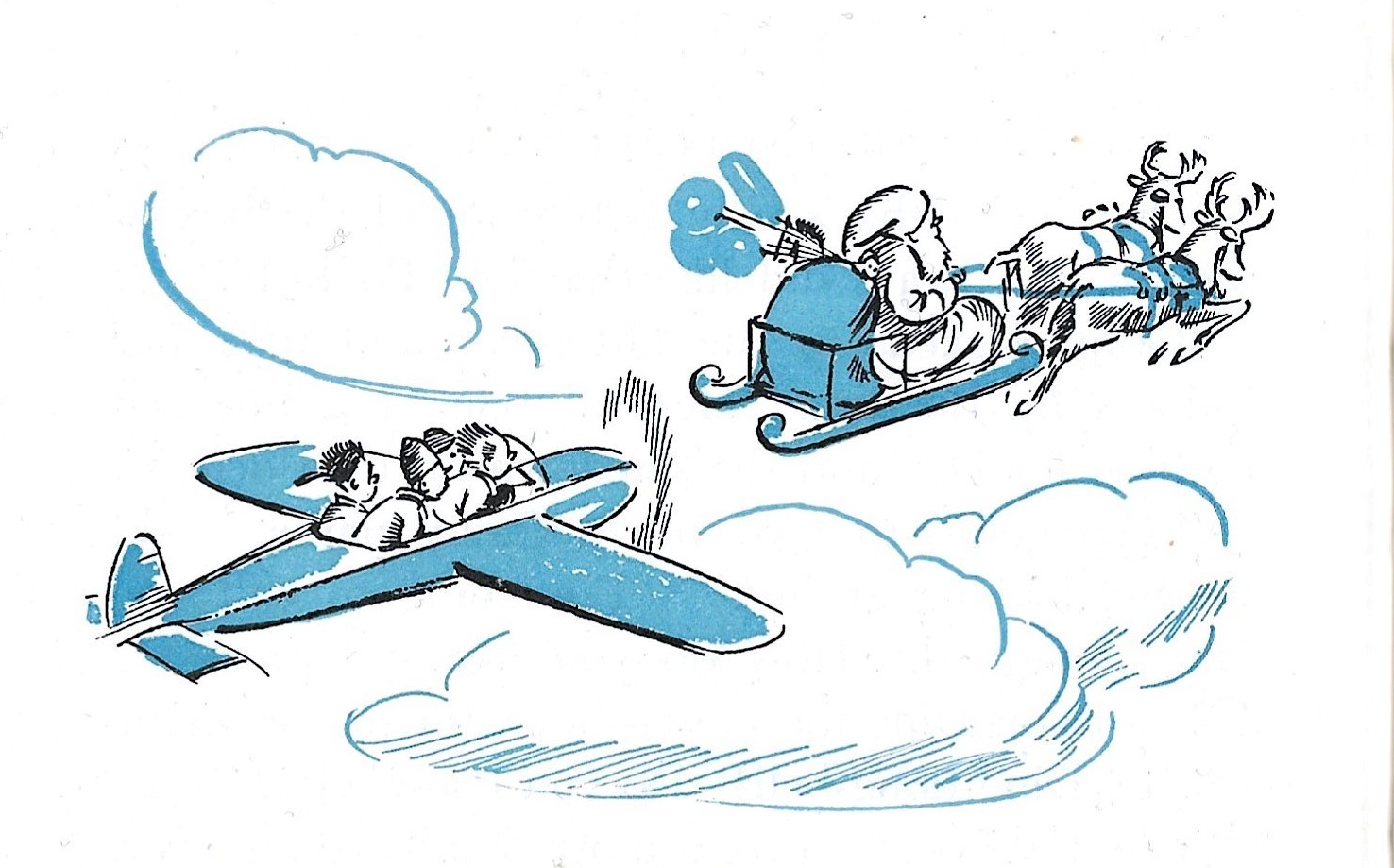
For a shorter story this one has a surprising number of changes.
Wireless is updated to television, though I’d be surprised if many people still said television today rather than TV or telly. The jack-in-the-box wanted to live in a nursery to amuse the children, now it is in a house. No doubt the original meant a nursery in a house, but modern children would think of a nursery school – not that it would matter in the slightest as nursery schools are full of children.
The green box which falls out of the sack is now a red box. I was baffled by this initially but then realised that the goblins are called green goblins and perhaps the editors thought that it was too much green – though the box’s colour is only mentioned once. (And, oddly, the colour added to one picture of the goblins in my copy is orange!)
To continue the petty meaningless changes, slit a hole is now cut a hole, and to see what had fallen is now to see what had fallen out.
A few style changes were made including one use of italics being removed. One of Blyton’s paragraphs is divided into two paragraphs which is unusual, I’ve rarely seen that done before. Lastly, the final use of jack-in-the-box has been given a capital J, possibly because the author is speaking to the jack and it is more of a name then.
One final thing – I’ve left this for last because I’ve been searching the dictionaries for evidence!
Originally Santa sings a rollicking song. He now sings a rollocking song. I can’t decide if this is simply a typing error or not, as rollocking is a variant (though uncommon) of rollicking. My browser spell-checker doesn’t like rollocking, though it also doesn’t like various other genuine words.
The Collins online dictionary defines rollicking as boisterously carefree. As a secondary definition it can mean a scolding.
Collins has rollocking also, (but Cambridge doesn’t) and its only definition is a scolding, in informal British English – possibly derived from a ruder, rhyming word beginning with B.
Santa singing a rollocking song, therefore, is just incorrect as far as I can work out!

 Fiona
Fiona pippastef
 worldofblyton


 World of Blyton
So it would appear to be a question of balderdash rather than Balder.
LikeLike