Letters to Enid part 41: From volume 3 issue 3

Previous letters pages can be found here.


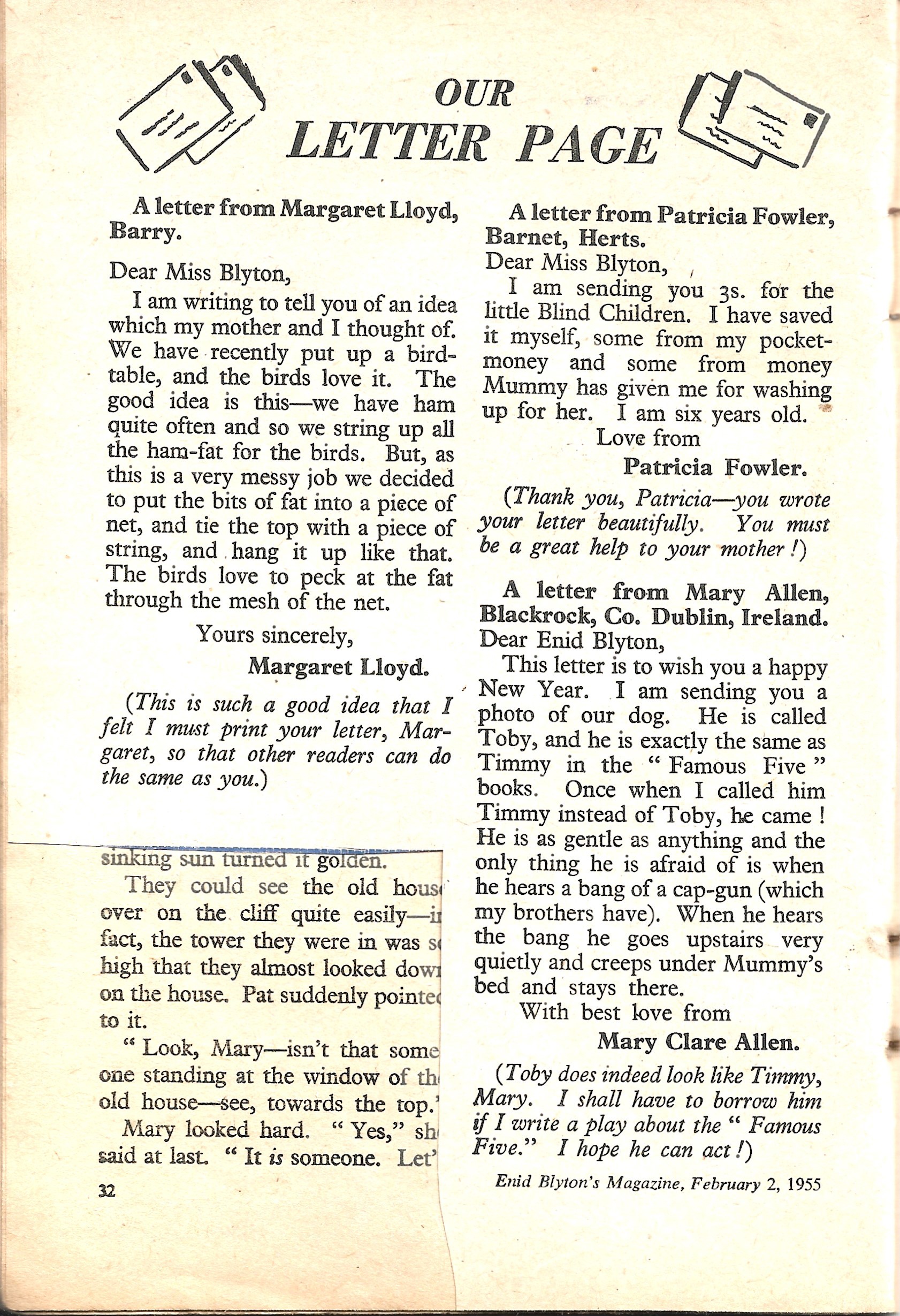
Letters page from Volume 3, issue 3.
February 2nd – 15th, 1955.

OUR

LETTER PAGE


A letter from Margaret Lloyd, Barry.
Dear Miss Blyton,
I am writing to tell you of an idea which my mother and I thought of. We have recently put up a bird-table, and the birds love it. The good idea is this – we have ham quite often and so we string up all the ham-fat for the birds. But, as this is a very messy job we decided to put the bits of fat into a piece of net, and tie the top with a piece of string, and hang it up like that. The birds love to peck at the fat through the mesh of the net.
Yours sincerely,
Margaret Lloyd.

(This is such a good idea that I felt I must print your letter, Margaret, so that other readers can do the same as you.)

A letter from Patricia Fowler, Barnet, Herts.
Dear Miss Blyton,
I am sending you 3s. for the little Blind Children. I have saved it myself, some from my pocket-money and some from money Mummy has given me for washing up for her. I am six years old.
Love from
Patricia Fowler.

(Thank you, Patricia – you wrote your letter beautifully. You must be a great help to your mother!)

A letter from Mary Allen, Blackrock, Co. Dublin, Ireland.
Dear Enid Blyton,
This letter is to wish you a happy New Year. I am sending you a photo of our dog. He is called Toby, and he is exactly the same as Timmy in the “Famous Five” books. Once when I called him Timmy instead of Toby, he came! He is as gentle as anything and the only thing he is afraid of is when he hears a bang of a cap-gun (which my brothers have). When he hears the bang he goes upstairs very quietly and creeps under Mummy’s bed and stays there.
With best love from
Mary Clare Allen.

(Toby does indeed look like Timmy, Mary. I shall have to borrow him if I write a play about the “Famous Five.” I hope he can act!)


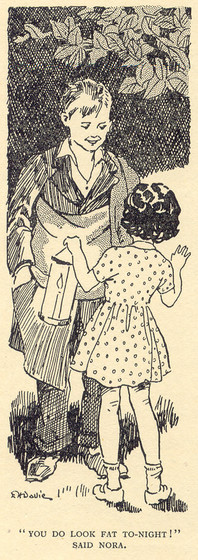
There’s a bit cut out of this page again – but luckily I think it’s just the illustration we have lost. A letter as short as Patricia’s would just fit in that space, but the amount of blank space below the response to Margaret suggests not.

It sounds like Margaret and her mother have invented what are essentially fat balls for birds – most seem to come unwrapped but you can buy them in little net bags to hang too. Impressive enough to knock a money-raising letter into second place.

How I wish they had included Mary’s picture of Toby. I wonder what kind of dog he was? Perhaps Blyton was just being nice in her reply, when she said Toby does look like Timmy. But imagine if he did – I’d love to see a real-life dog that matches Blyton’s mental picture of Timmy.


Posted in Magazines | Tagged , , | 3 Comments

September 2023 round up

We are into October, so it’s time for September’s round up.


What I have read

I hit my goal of 100 books in September – though book 100 was a somewhat fluffy/cosy magical mystery rather than something to show off about!

What I have read:

  • The Invisible Dog – Dick King-Smith
  • The Sword in the Stone (Once and Future King #1) – T H White
  • The Sinister Omen (Nancy Drew #67)
  • A Catalogue of Catastrophe (Chronicles of St Mary’s #13) – Jodi Taylor
  • Mistletoe and Magic for the Cornish Midwife (Cornish Midwife #6) – Jo Bartlett
  • Lessons in Chemistry – Bonnie Garmus
  • Because of Winn-Dixie – Kate DiCamillo
  • Spells & Shelves (Library Witch Mystery #1) – Elle Adams
  • Beyond the Wand – Tom Felton
  • Five Go Adventuring Again
  • Charms & Chapters (Library Witch Mystery #2) – Elle Adams
  • The Accidental Impostor (Heather Bay Romance #1) – Amber Eve
  • The Nothing Girl (Frogmorton #1) – Jodi Taylor
  • Don’t Give Up, Mallory (Baby-Sitters Club #108) – Ann M Martin
  • Five Run Away Together
  • The Accidental Actress (Heather Bay Romance #2) – Amber Eve
  • Mary-Ann to the Rescue (Baby-Sitters Club #109) – Ann M Martin

And I’m still working on:

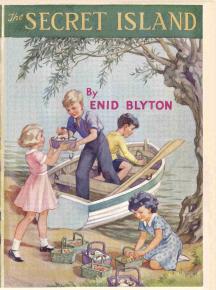
  • The Secret Island – review part one, part two, part three and part four
  • Anne Of Green Gables (Anne of Green Gables #1) – L M Montgomery
  • Hex Appeal – Kate Johnston
  • Five Go to Smuggler’s Top 
  • The Accidental Investigator (Heather Bay Romance #3) – Amber Eve

What I have watched

  • I finished Murder She Wrote and then watched two of the TV movies that came after the series. I’ve read that there is to be a new Murder She Wrote movie – but it just won’t be the same without Angela Lansbury!
  • I finally got around to watching Brigadoon which was rather a let-down.
  • Ewan and I have been watching the third season of Only Murders In the Building, Only Connect and The Simpsons (we’re on season 6 already but there are 33 on Disney+!) We also watched a few episodes of House of Games but then discovered we had watched every episode they had on iPlayer.
  • On Tuesdays my sister and I watched (and finished) Is it Cake Too? We also watched one episode of Making Fun – a bunch of guys building strange ideas dreamed up by children but it was awful and we will be looking for something else to watch next time.
  • I also squeezed in a couple of episodes of Hack My Home.

What I have done

Not a very busy month as we’ve all had the cold at one point or another.

  • Went to the award ceremony for Brodie completing his summer reading challenge, and celebrated with a Nando’s afterwards.
  • Completed the Tayport history trail, and as it was very got we had ice-creams. Stupidly I didn’t take any photos of the views from the top of the small hill we climbed in the process – it was so clear we could see all the way out to the Bell Rock Lighthouse.
  • Completed a slightly tricky bookshop jigsaw – the brick part took ages.
  • Got stung by a wasp for the first time in my entire life – I do not recommend it!
  • Took a walk to gather blackberries (and Brodie got stung by wasp for the first time, too!)
  • Did some home-schooling due to the three day strikes which closed or partially closed a lot of the city’s schools

What did your September look like?

Posted in Personal Experiences | Tagged , , , , , | 2 Comments

Monday #547

We are on the first post of October now. September’s mini heat-wave is a thing of the past, and the heating is on now!

Brodie and I are on to Five Go to Smuggler’s Top now, my favourite book ever, and I’m glad to say he seems to be liking it so far.

September round up

and

Letters to Enid 41

They had a fine breakfast of tongue, tinned peaches, bread and butter, golden syrup and ginger-beer.

This quote, from Five Run Away Together is a great example of the strange things that the Five enjoy eating on their adventures.

What’s possibly better is Brodie’s horrified response to this.

Brodie: What, HUMAN tongues?

Me (after I stopped laughing): No, tongue from a cow or a pig

Brodie (Perhaps even more disgusted): Did it still have saliva on it?

I’ve been making a note of the things he’s been saying as we read the Famous Five so I’ll be putting together a post or two with his thoughts at some point.


Posted in Blog talk | Tagged , , | Leave a comment

The Secret Island part 4: Feeding the runaways

Until now I have only briefly mentioned one of the most important elements of the book (and indeed most of Blyton’s books) – the food!

It is first on an characters’ mind when planning a day away from home, let alone months. Even the Find-Outers who rarely stray more than a few miles from Peterswood are regularly found in one of the highstreets establishments refuelling their brains with copious numbers of macaroons.

The usual methods don’t really apply in this case though, as they are a) pack enough food for a few days-a week and/or b) make a note of the farms in the area and buy fresh bread, cheese, milk, and so on there (along with the inevitable free gift of a jar of honey or packet of sweets).


This food question is going to be a difficult one

Right from the start food was on the children’s minds and indeed they take as much as they can away with them (I listed most of this in part 2, but other foodstuff keeps getting mentioned in meals, so I am adding those as I go.)

But as that comprises:

Half a sack of potatoes
Peas, broad beans, radishes, carrots, cherries, lettuce.
Six eggs
Tea, cocoa
Currants, rice and bread
A few cakes
Margarine
Cheese
Whatever Jack managed to buy to put in the tins, such as sugar

Their first meals are the strange combinations you only seem to find in Enid Blyton adventures. Carrots and cake, or bread and peas, or mashed potatoes with boiled eggs, cherries and raw carrots.

It’s not surprising that on their first night on the island Jack is already talking about doing some fishing the next day. That means their first breakfast on the island is fish fried in margarine with potatoes baked in their skins. Sounds like a pretty good meal, but perhaps not for breakfast.

On their second day he is thinking about rowing back to his granddad’s farm occasionally, so he can get more potatoes and eggs. Very risky for someone who’s run away, but the other risk is possibly starvation!

That evening when there are no fish on the line, Peggy sums up their meal options thus:

“There’s some bread left and a packet of currants. And some lettuces and margarine. Shall we have those?”

This is when Jack decided they’ll have to start catching rabbits for their meat. The girls are reluctant, but as Jack says, they’ve had rabbit pie before.

Breakfast the next day is fish and lettuce, with little more than potatoes left in the larder, and potatoes alone don’t make for a very good meal.

By my calculations it’s only day three of their escape but Jack is off to the mainland that night for more food. It’s just as well that they are living somewhere close enough to do that! I hesitate to accuse them of not thinking ahead more because they simply didn’t have access to any more food or money, and Jack at least does have plans for fish and rabbits, but they come exceptionally close to having to call the whole thing off and return home, tails well down.

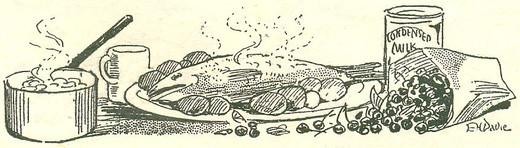
He brings:

Seeds to plant
Tins of milk
Bread (rather stale)
More vegetables
Cherries

On a second trip, later, to fetch a pail, they bring more vegetables and fill the pail with plums.

Anyway, Jack brings back more than food on that first trip – he brings his hens (and corn for them). This means they should have eggs when they want them.

And so begins the Secret Island Farm.


Runaway farmers

With trips to the mainland being somewhat risky, it only makes sense for the children to do as much as they can to limit those by being self-sufficient.

The first job is to create a yard using willow-cuttings, to contain their hens and where they lay their eggs.

With their first livestock venture being a success, Jack heads off a few nights later to fetch his cow, Daisy. With a cow, they have milk. (It has just occurred to me, though, for the first time, that the milk would not be a permanent supply. Cows only produce milk for about 10 months after having a calf and then would have to have another calf before producing more. Obviously this is enough for Blyton’s needs, as she doesn’t intend the children to stay for more than five months, but it would be a problem should they have stayed longer.)

Milk makes their tea and cocoa taste better (though of course those will run out faster than the milk.) They can drink the milk on its own (hot or cold), Nora makes custard, the cream is skimmed off the top for desserts, it really does make a difference to their diet.

There’s no mention of them making butter – but it should have been possible to put the cream from the milk into a jar or other lidded container and shake it until butter is formed. (I watched Nancy Birtwistle doing this with double cream recently, it only took about ten minutes, though there may be a difference between shop-bought double cream and cream skimmed from fresh milk.)

Dairy and poultry aside, the seeds that Jack has brought back get planted up. Although it would have made a pretty mental image for them to have dug up a neat little allotment, this would make it far too obvious that the island is inhabited, should someone visit.

So instead they sow the seeds in small patches, here and there, which can easily be covered with heather.

The seeds are:

Lettuce
Radish
Mustard
Cress
Runner beans

Their seeds grew quickly. It was a proud day when Peggy was able to cut the first batch of mustard and cress and the first lettuce and mix it up into a salad to eat with hard-boiled eggs! The radishes, too, tasted very good, and were so hot that even Jack’s eyes watered when he ate them! Things grew amazingly well and quickly on the island.

Not necessarily the most useful crops, but any additional food is surely welcome, and the radish, mustard and cress would add a lot of flavour to the otherwise plain fish and rabbit.

In addition to these the island has its own crops of wild raspberries, strawberries and blackberries, and hazelnuts.

The children spend time tending these crops, pulling weeds, watering them, picking them, and also stuffing berries in their mouths every time they pass.

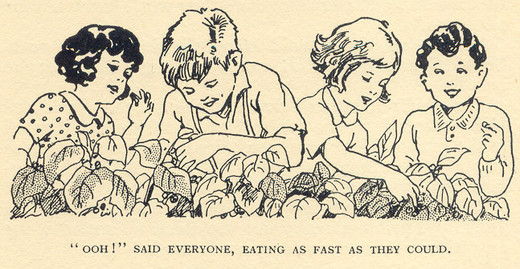
The wild raspberries ripened by the hundred. Wild strawberries began to appear in the shady parts of the island—not tiny ones, such as the children had often found round about the farm, but big, sweet, juicy ones, even nicer than garden ones. They tasted most delicious with cream. The blackberries grew ripe on the bushes that rambled all over the place, and the children’s mouths were always stained with them, for they picked them as they went about their various jobs.

So they are staving off scurvy, at the very least. But despite their odd meals they seem to be perfectly healthy – perhaps healthier than they were at home. Peggy, Mike and Nora were certainly under-fed at times, but it’s not clear how Jack fared. The below quote suggests they were all on the thin side before running away:

The children were fat, too, for although their food was a queer mixture, they had a great deal of creamy milk.

The island, in fact, is so bountiful that they turn to picking berries to sell on the mainland, and use the money to buy things the island can’t provide. But Jack’s business and his shopping lists are a topic for another post!

Posted in Blog talk | Tagged , , , | 3 Comments

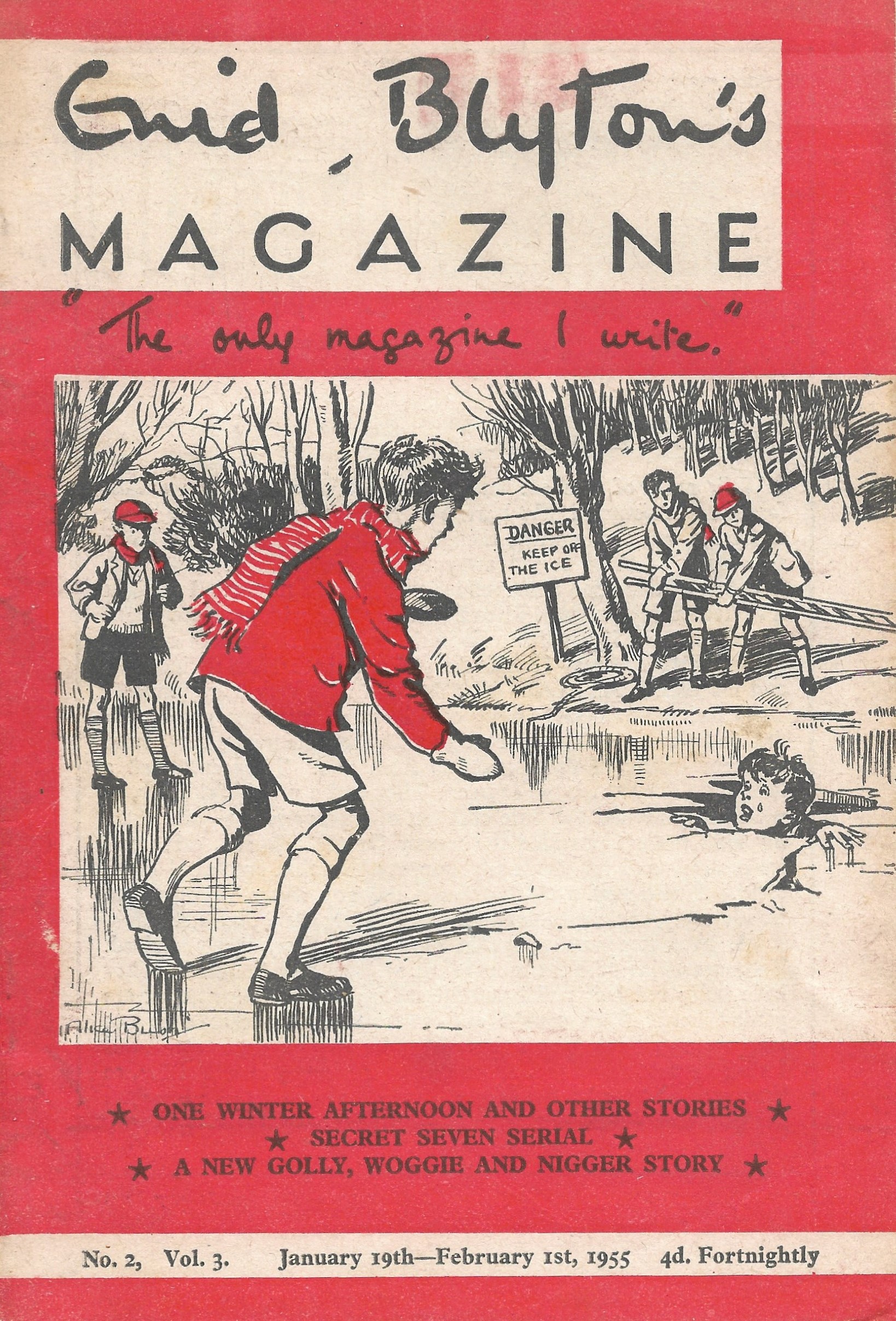
Letters to Enid part 40: From volume 3 issue 2

Previous letters pages can be found here.


Letters page from Volume 3, issue 2.
January 19th – February 1st, 1955.

OUR

LETTER PAGE

A letter from Pararajasingham, Colombo, Ceylon.
Dear Enid Blyton,
At our school we have a Club, which is made up by seven young lads. We have a meeting at a secret place every Friday. We have games, puzzles, stories on that day. We also have a library which holds almost all your books. We are still going on happily, by having a jolly time.
Yours sincerely,
Pararajasingham.

(Thank you very much for your interesting letter. Perhaps some day I will visit your lovely country.)

A letter from Frances Flowerday, Durban, S.A.
Dear Enid Blyton,
I had ten silkworms which are now changed into cocoons. Each moth will lay about 100 eggs, so don’t you think it would be a good idea to sell these at the rate of 100 for a shilling, and give the money to the Busy Bees? We have changed the name of our Cast (of which I am leader) to Green Meadows Cast, as we all love that story.
With best wishes from,
Frances Flowerday.

(I enjoyed your letter very much, Frances. I hope you can sell the eggs.)

A letter from Margaret Heywood, Radcliffe.
Dear Enid Blyton,
I am the winner of our magazine Birthday Cake. Thank you very much for it and for the letter you sent me. It is a very beautiful cake and I am very proud of it. I am going to save the icing-badge to remember it by. Thank you very much.
With lots of love, from
Margaret Heywood.

(It is always nice when a child has good manners and writes a thank-you letter. I am pleased with yours, Margaret.)


I always like to see letters from around the world and this week there’s one all the way from Ceylon – now called Sri Lanka. I wonder how many Enid Blyton inspired clubs there were around the world at any one time? I particularly like the bit where they meet somewhere so secret even Blyton isn’t allowed to know!

Not only the first letter has come a long way, but the second one, too. This one’s from South Africa. I read Blyton’s response to the second letter before the letter itself, and naturally my mind went to hen’s eggs. I was rather surprised to see a letter about silkworms (I hadn’t looked at the illustration yet either!). I’m not entirely sure what the average person would do with 100 silkworm eggs, though. I suppose the buyer could hatch 100 silkworms who would lay 1,000 eggs, and then sell those eggs…

I assume the Cast referred to in the second letter is a club of some kind, but does anyone know what a Cast refers to, more specifically?

The last letter (which has only travelled from near Manchester) has me questioning the Magazine Birthday Cake. I suspect all will be have been explained in one of the editorials previously. A cake to celebrate the magazine’s second birthday? Lucky Margaret getting a cake and letter from Blyton, anyway!


Posted in Magazines | Tagged , , | 4 Comments

Monday #546

Monday posts feel a bit repetitive at the moment. I did think about taking a break from the Secret Island and doing something else, but I think I should try and keep up the momentum and get on with it.

Letters to Enid part 40

and

The Secret Island, part 4

Inconveniently far from me, but looking wonderful all the same is Rixbux, a newly-opened ‘book nook’ selling vintage children’s books – most of them Blytons. From what I’ve seen the prices are very reasonable, too.

The proprietor, Bruce, says

My little Book Nook, in Browsers Bazaar, at Lady Hayes, in Frodsham, Cheshire, open from 10am to FAMOUS FIVE pm, SECRET SEVEN days a week!!


Posted in Blog talk | Tagged , , | Leave a comment

The Secret Island part 3: Making homes

I have managed two write two full posts about this book, without having read past the first two chapters. In an attempt to not make it a post per chapter and be here for 21 posts, this time I’m going to look at the homes the children make on the island.


Changing homes on the island

Although setting up a camp or temporary home is a common theme in Blyton’s adventure stories, The Secret Island stands out as having three separate and well-used accommodations. Each of the three is well also well thought out and carefully created for maximum comfort (or at least, as much as the primitive setting allows!).

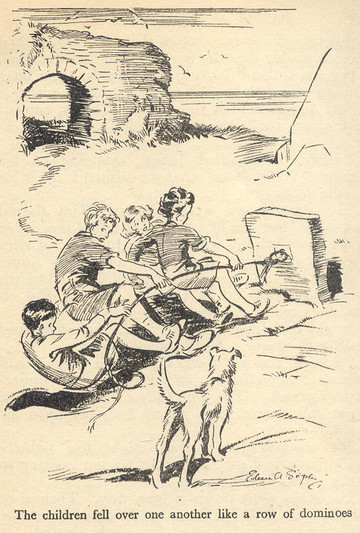
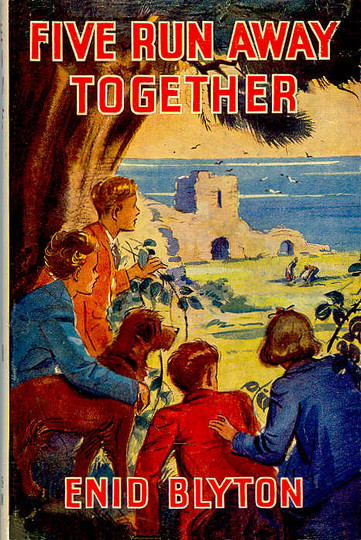
Normally there might be one example in a story of children making temporary accommodation – though sometimes children also spend a night under a tree, rock, or puffin burrow in cases of dire emergencies. The properly-set-up living spaces could be for fun – like the Five spending a few nights in the remaining room in Kirrin Castle during Five On a Treasure Island, or camping on the moors in Five Go Off to Camp, or out of necessity – like Kirrin Island’s previously unknown cave in Five Run Away Together, and the fern-cave in The Valley of Adventure.

As the Arnold children plus Jack intend to live on the island for the foreseeable future their living-spaces were created with a sort of permanence in mind – as opposed to the more usual temporary accommodation, designed to keep children safe and comfortable until rescue or escape was possible, until a mystery was solved, or until runaways could return home. This means that more work needed to be put into furnishings, storage etc as well as repairing and maintaining things.

The only other home intended to be permanent I can think of is the hollow tree in Hollow Tree House – though the Mannering/Trents certainly worried that their fern cave would end up being permanent if they couldn’t escape the valley.


The outdoor bedroom

Unlike many others I have never really had a desire to sleep out-of-doors. I like my comfortable bed and solid roof. Yet Blyton manages to make a completely outdoor bedroom sound perfectly comfortable.

This is the first sleeping-place the children arrange as it is quick and easy, though only suitable for fine weather.

Although the weather is to be settled they decide they ought to have some sort of shelter – this is provided by two large oak trees. Wind protection comes from some gorse bushes.

Do you see this little place here, almost surrounded by gorse, and carpeted with heather? The girls could sleep here, and we could sleep just outside their cosy spot, to protect them. The oak trees would shelter us nicely overhead.

Nora describes it as a green heathery bedroom, and claims the heather to be as soft as can be. I’m always a it doubtful of this as I’ve tramped through a lot of heather and it can be rather scratchy! They do (as Blyton’s children often do) recognise that the heather will get flat with use and add armfuls of bracken. I don’t think I knew what bracken was as a child – I always pictured it as brown and wiry. But it’s actually ferns – which are often full of ticks. They then dry out the bracken/ferns until they are brown. Perhaps ticks don’t like dry ferns.

Anyway, as an additional bonus there’s wild thyme growing in their outdoor bedroom, making it smell nice.

As Jack says:

Heyho for a starry night and a heathery bed!

Although this bedroom isn’t mentioned a great deal – there’s too much else going on – it’s implied they use it each night for their first weeks and months on the island.

July passed into August. The weather was thundery and hot. Two or three thunderstorms came along, and the children slept in Willow House for a few nights.

And then one nice description of it;

It was a warm night, so they slept in their outdoor bedroom among the gorse bushes, lying cosily on their heather beds. Nothing ever woke them now, as it had done at first. A hedgehog could crawl over Jack’s legs and he wouldn’t stir! A bat could flick Mike’s face and he didn’t even move. Once a little spider had made a web from Peggy’s nose to her shoulder, and when Nora awoke and saw it there she called the boys. How they laughed to see a web stretching from Peggy’s nose, and a little spider in the middle of it!


Willow tree house

With an outdoor bedroom which won’t be suitable for really rainy or cold nights, Jack soon turns his attention to building some better accommodations.

Unlike most tree houses, this one is at ground level. I know that my brain has produced a completely inaccurate picture of this house as I picture it as a rectangular cabin with pretty straight walls and 90° corners. I also see the walls made primarily of thin upright sticks/branches driven into the ground. Merely the roof and a few offshoots grow leaves in my mental picture, and the house stands freely, not attached to any others…

“Do you see these little willow-trees here—one there—one there—two there—and two there. Well, I think you will find that if we climb up and bend down the top branches, they will meet each other nicely in the centre, and we can weave them into one another. That will make the beginning of a roof. With my axe I shall chop down some other young willow-trees, and use the trunk and thicker branches for walls. We can drive the trunks and branches into the ground between the six willow-trees we are using, and fill up any cracks with smaller branches woven across. Then, if we stuff every corner and crevice with bracken and heather, we shall have a fine big house, with a splendid roof, wind-proof and rain-proof. What do you think of that?
The reality is quite different, as the above plan from Jack shows. I think that although I read that my mind couldn’t quite picture how it would all come together, and so made up my own picture of a fairly normal cabin with a few willowy features.

I’m not sure how realistic the whole thing is, actually. You can absolutely put Willow cuttings into the ground and bend them into little huts – there are some good instructions and images on this website. But for best results it requires the right soil, planting in late winter or early spring, and enough sunshine. So making one under a roof of willow in high summer doesn’t sound ideal though perhaps not impossible. I didn’t search extensively but it doesn’t seem like many people try to make a willow structure for anything more than an attractive garden feature so it’s hard to tell if one would actually work.

The closest I could find was some willow sculptures by Patrick Dougherty. If you search Google images for his work at the Santa Barbara Botanic gardens there are other image of it showing the willow partly covered in fresh green leaf growth.

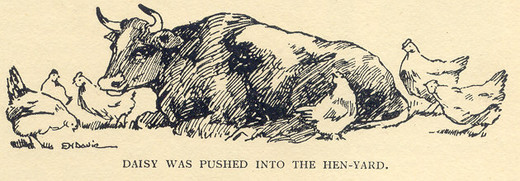
Sadly there are not any great illustrations of the house in the book. There’s one of them beginning to bend and tie together the willow branches for the roof.

And then this is probably the best one of the interior, showing the woven walls.
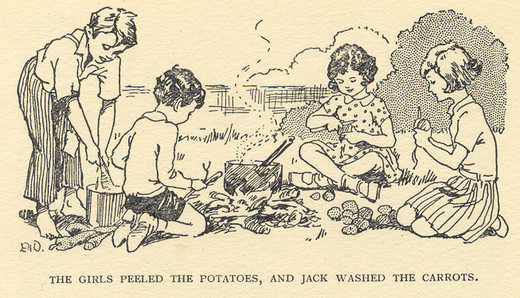
As it’s for long-term use a lot of work goes into the building. Not only a sound roof but tightly packed walls, which require regular maintenance to keep the gaps stuffed up.

Although the intent is for them to sleep in their outdoor bedroom as much as possible, come the autumn Willow House gets rather a lot more use.

“We’ll live in the open air mostly, I expect,” said Jack, “but it will be a good place to sleep in when the nights are cold and rainy, and a fine shelter on bad days. It’s our sort of home.”
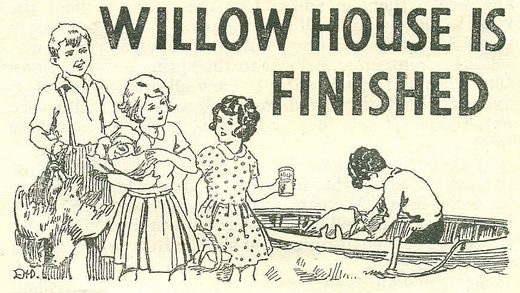
Before walls are quite finished they add a door on a hinge, and later they build a dividing wall to make a bedroom and a living room.

Mike thought it would be a good idea to make two rooms inside Willow House, instead of one big room. The front part could be a sort of living-room, with the larder in a corner, and the back part could be a bedroom, piled with heather and bracken to make soft lying. So they worked at a partition made of willow, and put it up to make two rooms. They left a doorway between, but did not make a door. It was nice to have a two-roomed house!

Later they rig up shelves for their books and games and put up a hook to hang a lantern on. By all accounts it’s a proper little house, and they appreciate it, though it isn’t always the most fun when the weather is bad.

They were rather bored when they had to keep indoors in Willow House when it rained. They had read all their books and papers by that time, and although it was fun to play games for a while, they couldn’t do it all day long. Peggy didn’t mind—she had always plenty of mending to do.


The caves

Before they even decide to run away Jack has already thought about needing a warm place for the winter.

“We shall build a house of wood,” said Jack. “I know how to. That will do finely for the summer, and for the winter we will have to find a cave, I think.”

Within the first week or two on the island he is thinking about it again.

“It’s all right now it’s warm weather,” said Jack. “It won’t be quite so glorious when the cold winds begin to blow! But winter is a long way off yet.”

The first use of the caves is as a hiding-place rather than a living-space. They bundle the hens and then themselves into the smaller one when trippers come to the island.

This makes them realise that they should have a better plan for hiding should anyone else come to the island. And so they explore the caves, and this is where we get our first proper description of them.

The children had found three openings into the hillside—one where the hens had been put, another larger one, and a third very tiny one through which they could hardly crawl.

The one they used for the hens is just a smallish cave that doesn’t lead anywhere.

Initially the bigger cave seems just like a larger version of the small cave, and no use for hiding in. But, well-hidden in the rocky wall at the back is a passage.

At first it seemed as if the crack simply showed rock behind it—but it didn’t. There was a narrow, winding passage there, half hidden by a jutting-out piece of rock.

I always picture this as one of those optical illusions, a bit like in the movie Labyrinth, where Sarah thinks she is trapped in a never-ending path between two walls. Then a worm tells her there’s an opening right across from her.

Anyway, 80s movies aside, the passage is much longer and windier in the text than I can make my mind picture it. It comes out into a much larger cave deep inside the hill. And yet there’s daylight, and fresh air. This cave is perhaps a predecessor of the one on Kirrin Island as there’s a handy skylight courtesy of the rabbits.

From that cave a low passage leads to the the third, and smallest, opening they had found earlier.

Leaving aside their hiding-plans for another post, Peggy turns her thoughts to the winter ahead.

“Those caves will be cosy to live in in the wintertime,” said Peggy. “We could live in the outer one, and store our things in the inner one. We should be quite protected from bad weather.”

It is some point in autumn, after the leaves have started to change and fall that they move into the caves. A period of bad weather has meant the children have been wet and cold is the deciding factor – a long with a leak in Willow House’s bedroom.

“We’ll make this outer cave our living-room and bedroom!” Jack said, “and the inner one shall be our storeroom. We’ll always have a fire burning at the entrance, and that will warm us and cook our food. This is going to be rather fun! We shall be cave-people this winter!”

With Peggy in charge of the renovations, the cave is quickly turned into a very homely place.

“You two boys must make a few shelves to put round the cave,” she said. “You can weave them out of stout twigs, and put them up somehow. We will keep our books and games there, and any odd things we want. You must somehow manage to hang the lantern from the middle of the roof. Then, in the corner over here we will have our beds of heather and bracken.

I’m not sure how they managed to put up shelves in a cave, hammering nails into rock doesn’t sound at all practical – and if they did somehow manage then they’d surely be difficult to remove in a hurry should they need to move everything into the inner cave to hide – but orders from Peggy seem to get obeyed!

There are various moments when the real domesticity of their living situation is highlighted – such as having a proper door on Willow House. Peggy sweeping the floor of the cave with a brush they have made of heather twigs is another. The floor they cover with sand- the Kirrins’ cave already had a sandy floor, but the children have to bring sand up from the island’s beach.

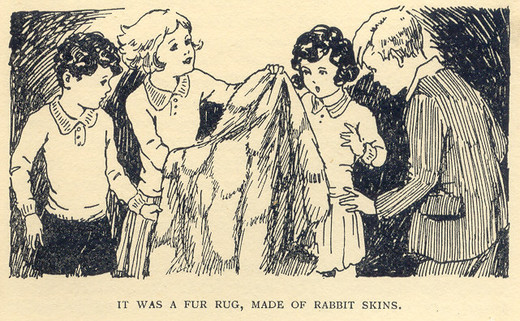
There were only three blankets but hard-working Peggy has created a rabbit-skin blanket they can take turns at having.

But she’s not the only craft one. Soon they have a little table made by Jack, with tree-branch legs and a plank top. It’s a little wobbly, but it’s actual furniture! Stools are formed from a tree trunk, sawn into sections.

They even have their own version of a fragrance diffuser – putting pine cones on the fire!

They manage in this way until the middle of December when Jack brings the Arnolds’ parents to the island and their island life is ended.

There was a bright fire crackling just outside, and the cave was warm and cosy. Jack hung the lantern up and placed two wooden stools for the children’s parents. Peggy flew to heat some milk, and put out rolls of bread and some potted meat she had been saving up for Christmas. She did so want her mother to see how nicely she could do things, even though they all lived in a cave!

“What a lovely home!” said Mrs. Arnold, as she looked round and saw the shelves, the stools, the table, the beds, and everything. The cave was very neat and tidy, and looked so cosy and friendly.

As happy as I am for the children at this point, I, like them, am rather sad that the adventure and island-living has to come to an end.

Saying that, I’m not convinced it is that realistic. Even with a fire outside the cave they’d probably be miserably cold in December.


Other bits of domesticity

While there are definitely those three distinct parts of the island which they used for living and sleeping, the whole island was really their home.

The beach – in the warmer months – was their kitchen, where they lit the fire and cooked their meals. Initially they kept their food stores in the tree-trunk larder there, but due to ants that ended up being just used for non-edible items.

The spring was their fridge, Jack making a circular space where the cold water could run around their bucket of milk to keep it cool.

And the lake was their bath and their wash-tub.


I said I won’t go on for 21 posts but we might still be here a while. There are lots of topics still to cover!

Posted in Blog talk | Tagged , , , | 5 Comments

Letters to Enid part 39: From volume 3, issue 1

Previous letters pages can be found here.

I’m now on to volume 3, I think I have the full run of these but we will see!


Letters page from Volume 3, issue 1.
January 5th to 19th, 1955.

OUR

LETTER PAGE

 A letter from Margaret Whittall, Reigate.
Dear Enid Blyton,
I had a birthday party some time ago, and I invited Jill, Judith, Rosemary and Susan, Gay, Sandra and Carolyn. I asked them each to bring me a threepenny piece instead of a present. We collected five shillings altogether, and I am sending this money to buy Christmas presents for your little children at the Home.
Love from
Margaret Whittall

(I think you are very kind, Margaret, to go without presents for the sake of others. But I am going to give you one, because you have won my letter prize-and deserve to!)

A letter from Elaine Sykes, Chadderton, Lancs.
Dear Enid Blyton,
My Christmas tree is 35 years old and some of the glass decorations are 46 years old. It was first my aunty’s and then it was given to me when I was born. Do you think any other reader can beat this record?
Love from
Elaine Sykes
(F.F. member).

(Well, we’ll see if anyone has an even older tree, Elaine. But I should hardly think so!)

A letter from Katharine Thorburn, Lahore, Pakistan.
Dear Enid Blyton,
Thank you very much for the F.F. badges that you sent me some time ago. Our Club is getting on very well. We have a proper enrolment and enrol each other. We have our meetings in a squash court, and each week each one of us brings money for something- perhaps for the Bengal Flood Relief or something like that. I am coming to England to go to boarding school next March. Love from
Katharine Thorburn.
(F.F. member).

(It is fun to hear news from F.F. members overseas, and we are glad to have yours, Katharine. I hope you will love England when you come here.)


Back to three letters this week – and a Christmas tree picture even though it’s January! I feel like I recognise it, from one of the stories about children making a Christmas tree for the birds. There are at least three of those that I know of…

Having checked, it’s from Enid Blyton’s Book of the Year, the story of What they did at Miss Brown’s School in December. I’ve included a scan here (its the second Soper bird Christmas-tree) where you can see additional birds flying around it.

I hadn’t given these illustrations much thought before. They usually relate to something said in one of the letters, but are presumably there just to fill up extra space on the pace. It does make sense that they would use works they already had, and crop them to fit rather than paying someone to draw something new!

I’ll have to pay more attention to them now, and see if I can recognise any others.

As for the letters the prize-winner is another fund-raiser. Warning – I’m going to do some maths again! If Margaret invited seven people, and they brought threepence each that’s 21 pence, or 1 shilling and 9 pence. Even if Margaret added her own thruppence that’s only two shillings total so either some children brought rather a lot more, or they did some other fundraising that was not put in the letter, for them to reach 5s.

My Christmas tree is only about 8 years old but I have several decorations which had been my Gran’s, and must date to at least the 70s, so they are as old as Elaine’s. I wonder how many letters Blyton got from children telling her about their old trees and decorations after this one?

And finally a letter from Pakistan. It is difficult to glean much from short letters like these but my guess is that Katharine is from a British family living in Pakistan – though this is after Pakistan achieved independence from Britain in 1947. She was perhaps born there, as she doesn’t say ‘back’ to England.

Posted in Magazines | Tagged , , | 3 Comments

Monday #545

Despite sometimes struggling with the concept of time passing I do know that it is Tuesday, not Monday. I caught another nasty viral thing last week (hence the missing post) and I’m just getting back on track now.

I have run out of scans of the letters pages so this week I’ll have to get the scanner back out and do another batch (I’m just ust making a note of that here for accountability’s sake!) so that I can continue the series with pages from volume 3.

I at least have half of my Secret Island post done as I was working on it last week when the lurgy took me down.

Letters to Enid 38

and

The Secret Island part 3

Just over a year ago I managed to write an entire post about blackberries, and now it’s blackberry season again. For all their jaggy tendrils the back garden blackberry bushes had almost nothing worth picking on them. Instead we went for a walk through a local nature reserve (a narrow mile-long strip in the middle of the city which used to be a railway line) and found that there were blackberries practically all the way along.

We picked a whole tub full (there was a guy doing the same, only instead of a small tupperware box he had a large biscuit tin – I wonder how many he’d found?) and did porridge bars again. We had so many that I left out the banana. That might have been a slight mistake as they are lacking a bit of sweetness despite the chocolate chips we added. But Brodie likes them, and I think they look really good!

Blackberries

Posted in Blog talk | Tagged , , | 1 Comment

Letters to Enid part 38: From volume 2 issue 26

Previous letters pages can be found here.


Letters page from Volume 2, issue 26.
December 22nd, 1954 – January 4th, 1955.

OUR

LETTER PAGE

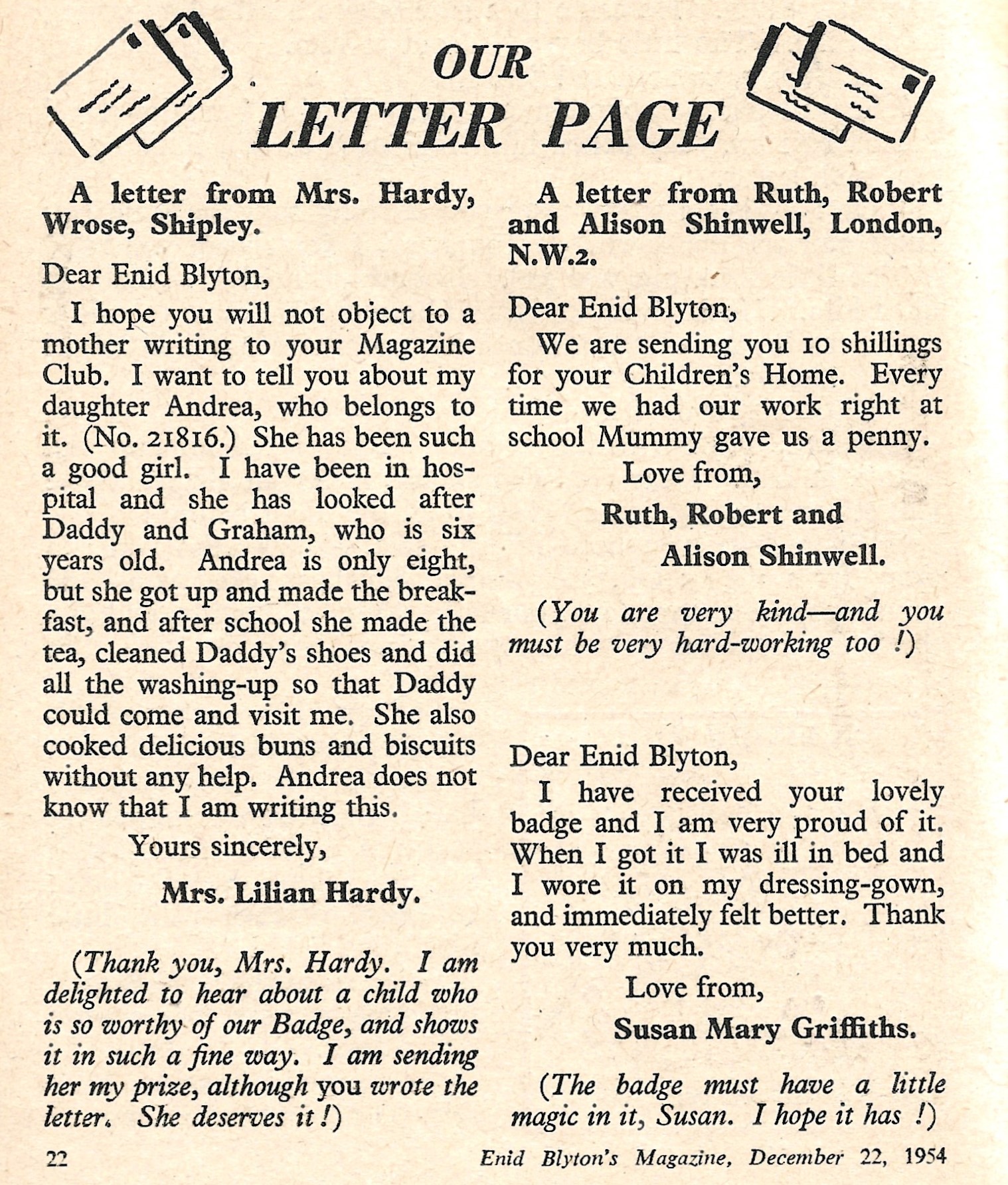
A letter from Mrs. Hardy, Wrose, Shipley.
Dear Enid Blyton,
I hope you will not object to a mother writing to your Magazine Club. I want to tell you about my daughter Andrea, who belongs to it. (No. 21816.) She has been such a good girl. I have been in hospital and she has looked after Daddy and Graham, who is six years old. Andrea is only eight, but she got up and made the breakfast, and after school she made the tea, cleaned Daddy’s shoes and did all the washing-up so that Daddy could come and visit me. She also cooked delicious buns and biscuits without any help. Andrea does not know that I am writing this.
Yours sincerely,
Mrs. Lilian Hardy.

(Thank you, Mrs. Hardy. I am delighted to hear about a child who is so worthy of our Badge, and shows it in such a fine way. I am sending her my prize, although you wrote the letter. She deserves it!)

A letter from Ruth, Robert and Alison Shinwell, London, N.W.2.
Dear Enid Blyton,
We are sending you 10 shillings for your Children’s Home. Every time we had our work right at school Mummy gave us a penny. Love from,
Ruth, Robert and Alison Shinwell.

(You are very kind-and you must be very hard-working too!)

Dear Enid Blyton,
I have received your lovely badge and I am very proud of it. When I got it I was ill in bed and I wore it on my dressing-gown, and immediately felt better. Thank you very much.
Love from,
Susan Mary Griffiths.

(The badge must have a little magic in it, Susan. I hope it has!)


Another letter from a mother, this week. Mothers always seem to preface their letters with ‘I hope you don’t mind a mother writing’ or words to that effect, obviously they haven’t seen Blyton’s comment that lots of mothers do write in, or where she has published their letters.

While I’m all for children having jobs around the house and taking on age-appropriate responsibilities I think it’s a little sad that when mum is in hospital an eight year old has to step up and make breakfast and tea for her father and brother. But that’s the 1950s for you, I suppose.

A little maths for Ruth, Robert and Alison’s letter – 10 shillings was 120 pennies, or 40 pennies each if they were equal in their abilities to get their work right!

Posted in Magazines | Tagged , , | 2 Comments

Monday #544

Our Indian Summer has come, with a mini September heatwave which is honestly hotter than most of July or August was. I’m not ready for autumn or winter yet, so I’m not wishing away this bit of sunshine even it if has been a bit too hot at times!

Letters to Enid part 38

and

The Secret Island part 3

Somewhere I love and would absolutely love to go again is Old Thatch, Blyton’s home in Bourne End. Stef tried to put into words how it felt to visit the magical gardens there, back in 2013.

The feelings of Old Thatch from 4th August 2013

Fiona and Stef outside Old Thatch, May 2012

Posted in Blog talk | Tagged , , | 5 Comments

August 2023 round up

August is over and the hopes of an Indian Summer are fading, as is the light in the evening!


What I have read

I am now at 92/100 books read, having slogged through a few more dud titles as I find it almost impossible to abandon a book completely.

What I have read:

  • The Wisteria Society of Lady Scoundrels (Dangerous Damsels #1) – India Holton
  • Silver and Goldreviewed here
  • Confusion (Cazalet Chronicles #3) – Elizabeth Jane Howard
  • The Secret Midwife – Soraya M Lane
  • Reading Allowed: True Stories and Curious Incidents from a Provincial Library – Chris Paling
  • My Double Life – Angela Pearse
  • Five on a Treasure Island (Brodie’s bedtime story)
  • A Ration Book Childhood (East End Ration #3) – Jean Fullerton
  • Casting Off (Cazalet Chronicles #4) – Elizabeth Jane Howard
  • All Change (Cazalet Chronicles #5) – Elizabeth Jane Howard
  • Dinosaur Trouble – Dick King-Smith
  • The Librarian (Librarian Chronicles #1) – Christy Sloat

And I’m still working on:

  • A Catalogue of Catastrophe (Chronicles of St Mary’s #13) – Jodi Taylor
  • The Invisible Dog – Dick King-Smith
  • The Sword in the Stone (Once and Future King #1) – T H White (the book that the Disney movie is loosely based on.)
  • Mistletoe and Magic for the Cornish Midwife (Cornish Midwife #6) – Jo Bartlett
  • The Secret Island – review part one and part two

What I have watched

  • We finished Lego Masters NZ, so we are all out of Lego Masters until the next Australian series airs early next year.  In the mean-time we watched Good Omens series 2 and have begun Only Murders in the Building season 3.
  • We’ve also watched Only Connect – the first round has seemed very hard this time! – and some House of Games.
  • On Tuesdays my sister and I have been watching Is It Cake Too? We are getting pretty good at guessing which are the cakes but we don’t always get it right.
  • I went back and finished Good Witch – or so I thought, but annoyingly Netflix doesn’t have the last couple of seasons. I then went back to Murder She Wrote and watched season 11 and some of 12.
  • I also watched National Treasure and the sequel, then the first episode of the TV show that followed.
  • We put on The Goonies to watch with Brodie and he loved it, though he did get a bit scared at times.

What I have done

  • Visited Auchingarrich to see the animals, and accidentally let the goats escape.
  • Ticked off the remaining libraries in the challenge and got a bonus one over in Tayport.
  • Visited Cairnie Fruit Farm to play, beat the maze and pick a load of fruit.
  • Brodie turned six (!) and we had a party for him, then he went back to school and into primary 2.
  • Visited a model railway club on its open day and rode the trains.

What did your August look like?

Posted in Personal Experiences | Tagged , , , , , | 3 Comments

Letters to Enid part 37: From volume 2 issue 25

Previous letters pages can be found here.


Letters page from Volume 2, issue 25.
December 8th – 21st, 1954.

OUR

LETTER PAGE

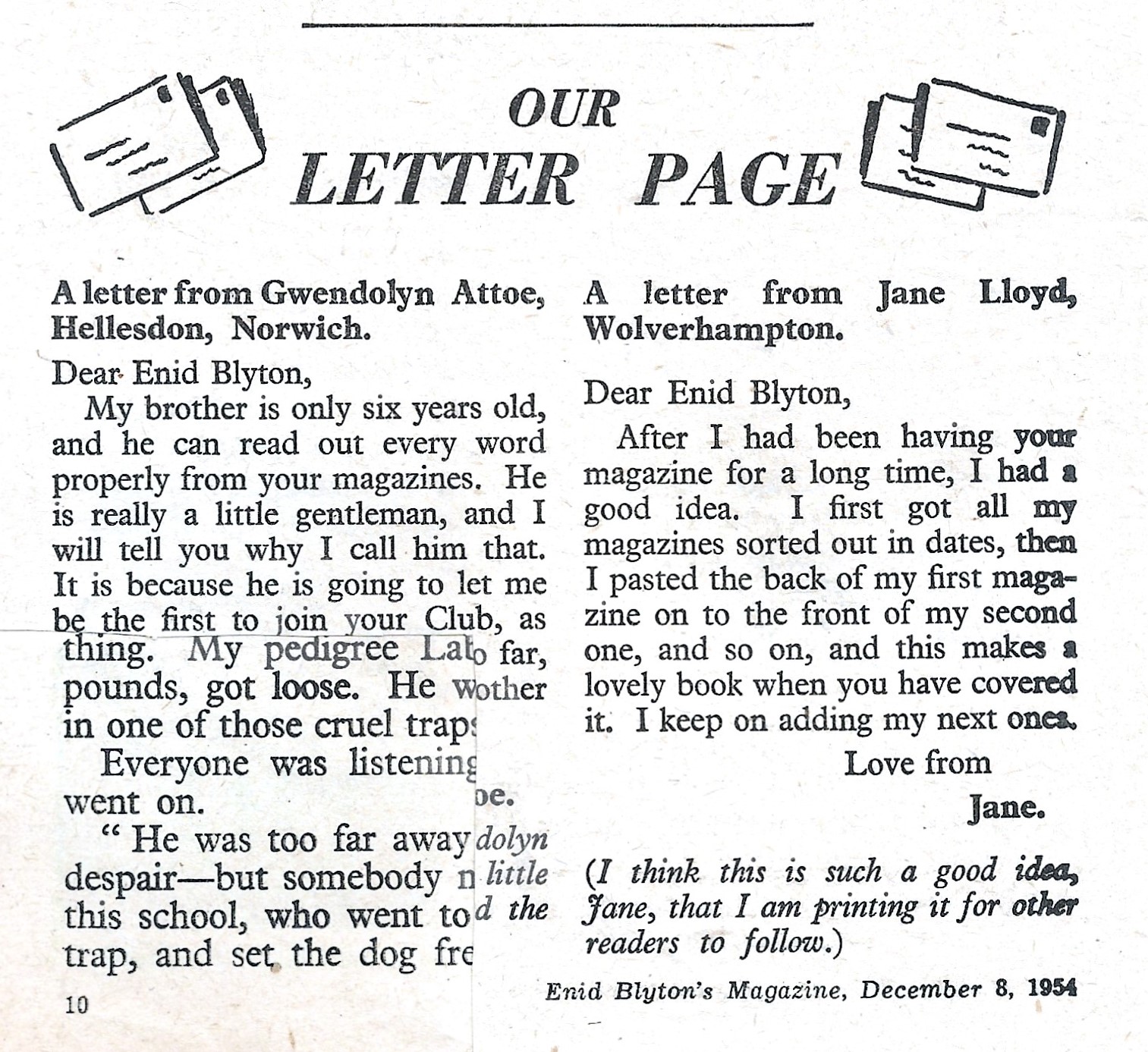
 A letter from Gwendolyn Attoe, Hellesdon, Norwich.
Dear Enid Blyton,
My brother is only six years old, and he can read out every word properly from your magazines. He is really a little gentleman, and I  will tell you why I call him that. It is because he is going to let me be the first to join your club as —
Gwendolyne Attoe

A letter from Jane Lloyd, Wolverhampton
Dear Enid Blyton,
After I had been having your magazine for a long time, I had a good idea. I first got all my magazines sorted out in dates, then I pasted the back of my first magazine on to the front of my second one, and so on, and this makes a lovely book when you have covered it. I keep on adding my new ones.
Love from
Jane

(I think this is such a good idea, Jane, that I am printing it for other readers to follow.)


Only space for two letters this week, and unfortunately only one-and-a-half have survived. The other side had a coupon or competition entry which has been clipped out, taking half of Gwendolyn’s letter with it. So we may never know why her brother is letting her be the first to join the club.

I’m not sure I entirely approve of Jane gluing her magazines together. You would lose all the front covers for a start! But I bet she never thought that seventy years later adult collectors would be buying up the magazines.

Posted in Magazines | Tagged , , | 1 Comment

Monday #542

Welcome to your weekly dose of me being shocked at the passage of time, and complaining about the weather.

It is the end of August already. How?

The weather has not improved and now I think we can safely say that summer has just skipped us entirely this year.

To quote Monty Python (because why not?):

A year passed: winter changed into spring, spring changed into summer, summer changed back into winter, and winter gave spring and summer a miss and went straight on into autumn…

At least no branches have fallen on anyone. Yet.

Letters to Enid part 37

and

August round up

“I’m jolly glad,” said Mike. “Every time I get back to that hollow tree I expect to find Aunt or Uncle hidden inside it, ready to pop out at us!”

Every time I read this my brain supplies the image of a cardboard-cut-out of Aunt Harriet and Uncle Henry (looking a bit like the pair from the painting American Gothic) popping out of the hollow tree. It’s so vivid I’m often half-surprised that it is not, in fact, an illustration from the book.

Posted in Blog talk | Tagged , , , | 1 Comment

The Secret Island part 2: Planning to run away

Last time I wrote an entire post about how awful Aunt Harriet and Uncle Henry are. But now on to happier things!


Deciding to run away

As is often the case in real life a careless, throwaway remark turns into a serious decision (for example joking about naming your child after Chief Brody from Jaws).

On page 4 (actually page 14, but the story starts on page 11) Jack says If only we could all run away together but Mike remarks that they would surely be caught and returned in the same way other children had been. If there was a place that they wouldn’t be found, though, that would be a different matter.

To their surprise – and probably the reader’s (if it’s their first reading and not their tenth or twentieth, of course) – Jack says he knows somewhere.

“Now listen to me. If I tell you a very great secret will you promise never to say a word about it to anyone?… I know a place where nobody could find us—if we ran away!

This is slightly curious as Jack, being the great friend to the children that he is, has never told them of this place, nor of his boat. Clearly they have never talked of running away before, either, else surely it would have come up? But of course this is all necessary for the story, and means we are not bogged down with explanations of how he has only recently got a boat and so on.

Anyway, Jack doesn’t tell them anything other than to meet him at the lakeside that evening, leaving everyone wondering what the secret will be, for at least a few pages.

The children are so excited about Jack’s secret that they are careless at their chores that afternoon. But come eight o’clock they are at the lakeside (being sent to bed hasn’t stopped them as they just snuck out anyway) eager to know where they might run away to.

Jack tells them it is an island, and leads them around the lake until they find a place where they can see it. In some of her most poetic writing Blyton paints the view for us.

The little island seemed to float on the dark lake-waters. Trees grew on it, and a little hill rose in the middle of it. It was a mysterious island, lonely and beautiful. All the children
stood and gazed at it, loving it and longing to go to it. It looked so secret—almost magic.

And just like that, by the end of chapter one they have decided they’ll run away.


The planning

The decision to run away is made so quickly that you’d be forgiven for expecting the children to be off the next morning. But, being really rather sensible, they take a few days to make their plans and gather everything they think that they will need.

I always enjoy a good planning-to-run-away chapter, be it the Five raiding Aunt Fanny’s tin cupboard or Peter Frost making sure he takes his little clock. Somehow it’s more fun than just packing for a holiday, as it’s all done in secret.

First they do sit down and have a talk, to make sure they are all certain they want to live on the island. Irritatingly Mike takes on the role of the most responsible – despite being a year younger than Peggy.

Mike scratched his curly black head. He felt old and worried. He wanted to go very badly—but would the two girls really be able to stand a wild life like that? No proper beds to sleep in—perhaps no proper food to eat—and suppose one of them was ill?

I hardly feel that he is any more qualified for rough-sleeping and forging than his sisters!

Anyway, they decide to visit the island on Sunday – their only time off – to check it out. It’s a very quick visit, but we get a glimpse of all the places which will become important later in the story. The little beach, the spring, the caves, the hill, and so on. The children love it, and settle with their meal to make a list of all the things that they will need.

I never tried to run away as a child so I have no stories of having packed a strange assortment of items into a bag. We did sometimes play at running away, however (when we weren’t acting out Seven Brides for Seven Brothers, with our very limited cast of two). The bottom bunk would be a train carriage, the top a boat. I remember playing at fleeing Russia, a princess and her nanny/maid probably inspired by the 90s movie Anastasia. I don’t remember what we packed but it was quite difficult to pack a realistic case with what you could find in a bedroom – I don’t think my mum would have let us take the pots and pans from the kitchen!

Their initial list is quite short. Jack suggests that they won’t need all that much as they can make beds out of heather and bracken. Blyton’s runaways/campers often make beds out of heather and I can’t see it being very comfortable! Certainly not as a long-term arrangement.

Enamel mugs, plates and knives
An axe and a sharp woodman’s knife
Matches
Fishing-line
Frying-pan, saucepan and a kettle

Definitely all essential but definitely not enough to sustain them – there’s no food for one!


The preparations

With their running-away-date set as the following Sunday the children begin secreting things in the handy hollow tree near the lake.

They are so excited about their plan that they cannot be upset, not even by the slappings and scoldings that would normally bring them to tears.

By the day they are to leave the tree contains:

All the clothes they possessed
Enamel mugs, plates and dishes
Saucepan, an axe, sharp knife
Small knives and forks and spoons
Empty tins to store things in
Matches
Magnifying glass
Peggy’s work-basket
A box of mixed nails and an old hammer
Snap cards, ludo and our dominoes
Some books
Plank of wood
Half a sack of potatoes
Old and ragged rug
Long iron cooking spoon
Packet of candles
Old lantern

This is probably not an exhaustive list as you’ll note that there is no food! Jack does say that he plans to buy some things like sugar, which is to go in the empty tins.

On their final morning they take:

Basket of peas
As many ripe broad beans as they could find
Bunch of young carrots
Some radishes
Six new-laid eggs
Some tea
Tin of cocoa
Packet of currants
Tin of rice
New loaf
A few cakes from the cake tin

It looks like they won’t starve, at least, though it doesn’t seem as if there’s enough food to last long. Jack’s plan to buy things must include food.

Having been told they must stay home as punishment – Aunt Harriet has noticed the missing cakes (but nothing else apparently!) – there is a tense few paragraphs as the children arrange to sneak off instead of going off for their usual picnic. They manage to grab some last-minute things, however, in a manner that reminds me of myself as I leave for a holiday and grab anything I spot that I suddenly think I might need.

For the girls those last-minute grabs are

Bar of soap
Slab of margarine

While Jack has also grabbed

Rope
An old mackintosh
Two books
Some newspapers
And some other things

Once on the island cheese is part of their first meal, so there must have been other food packed that isn’t mentioned. I am not a light packer by any means, so to me, that list seems rather short – but they probably didn’t have much else to bring! I’d definitely want more toiletries but the children probably only had soap! If I could I’d have been taking as much bedlinen, blankets and towels as I could manage, and some cleaning supplies. Very grown-up of me.


We will see how well the children did in their preparations once they settle into island life next time.

Posted in Book reviews | Tagged , | 1 Comment

Letters to Enid part 36: From volume 2 issue 24

Previous letters pages can be found here.


Letters page from Volume 2, issue 24.
November 24th – December 7th, 1954.

OUR

LETTER PAGE

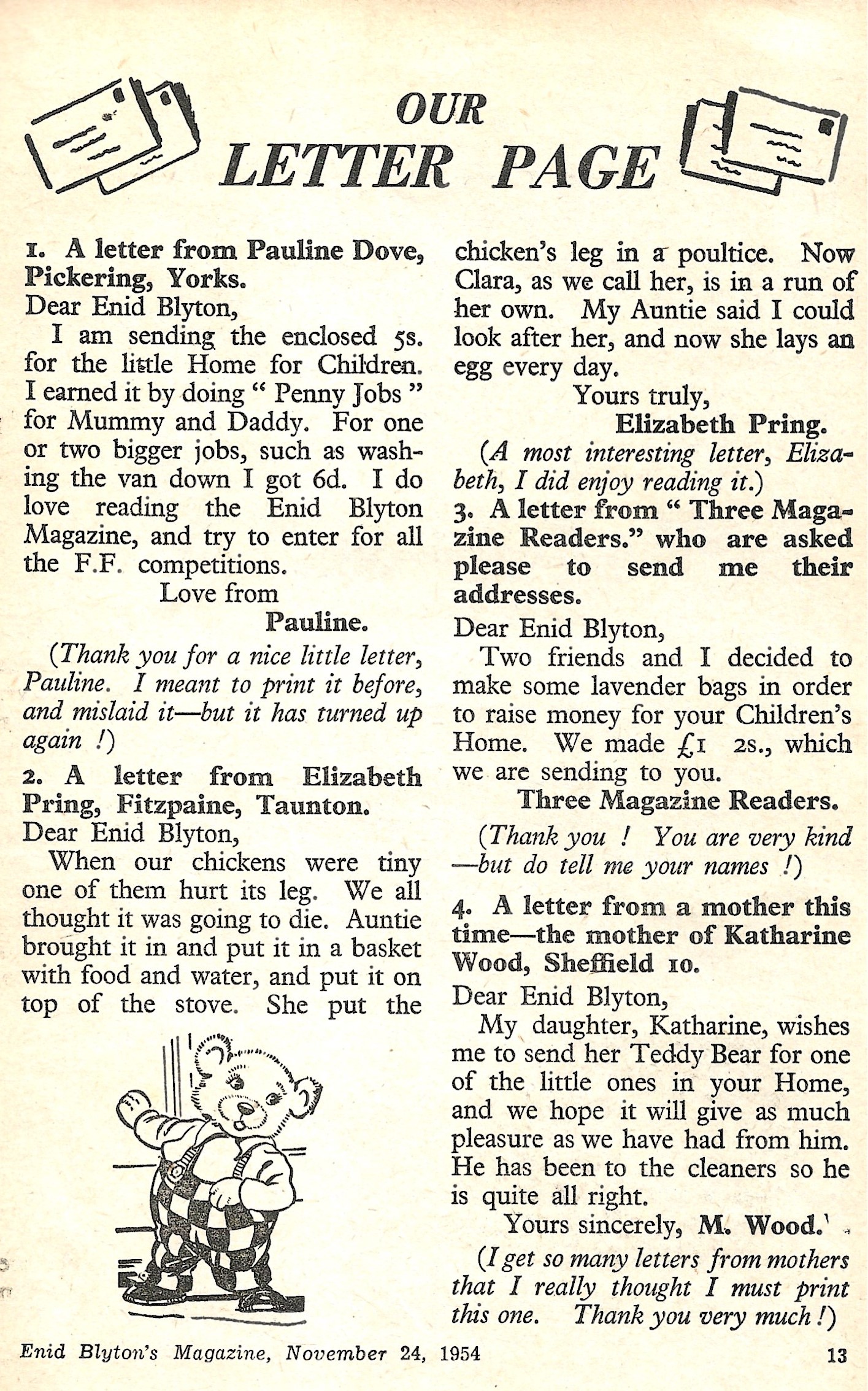
 1. A letter from Pauline Dove, Pickering, York.
Dear Enid Blyton,
I am sending the enclosed 5s. for the little Home for Children. I earned it by doing “Penny Jobs” for Mummy and Daddy. For one or two bigger jobs, such as washing the van down I got 6d. I do love reading the Enid Blyton Magazine, and try to enter for all the F.F. competitions
Love from
Pauline

(Thank you for a nice little letter, Pauline. I meant to print it before, and mislaid it – but it has turned up again!)

2. A letter from Elizabeth Pring, Fitzpaine, Taunton.
Dear Enid Blyton,
When our chickens were tiny one of them hurt its leg. We all thought it was going to die. Auntie brought it in and put it in a basket with food and water, and put it on top of the stove. She put the chicken’s leg in a poultice. Now Clara, as we call her, is in a run of her own. My Auntie said I could look after her, and now she lays an egg every day.
Yours truly,
Elizabeth Pring

(A most interesting letter, Elizabeth, I did enjoy reading it.)

3. A letter from “The Three Magazine Readers,” who are asked please to send me their addresses.
Dear Enid Blyton,
Two friends and I decided to make some lavender bags in order to raise money for your Children’s Home. We made £1 2s., which we are sending to you.
Three Magazine Readers

(Thank you! You are very kind – but do tell me your names!)

4. A letter from a mother this time – the mother of Katharine Wood, Sheffield 10.
Dear Enid Blyton,
My daughter, Katharine, wishes me to send her Teddy Bear for one of the little ones in your Home, and we hope it will give as much pleasure as we have had from him. He has been to the cleaners so he is quite all right.
Yours sincerely,
M. Wood

(I get so many letters from mothers that I thought I must print this one. Thank you very much!)


Another week with four letters – which have gone back to being numbered!

Another money-raising letter in the top spot but it is Blyton’s reply that is most interesting. A tiny glimpse into her life as magazine author/editor. It implies that she did indeed receive and read the letters sent to her – she did publicise her home address openly after all! (I can’t imagine many authors doing that today.) I can just picture her looking for the letter she had chosen, but not being able to find it, only for it to turn up again later. Perhaps in a drawer? In amongst another pile of letters? Fallen down the back of a desk? We will never know but it somehow makes her seem even more real as a person.

I admit Elizabeth’s letter did not go the way I thought it was – I was skim reading and Auntie put the chicken on the stove top with water… I was picturing her boiling it and serving it for dinner!

I wonder why Blyton wants the names and addresses of the three anonymous readers – did she send thank you notes or badges to everyone who sent her funds? (Oh to have been alive at the right time so that I could have written into her magazine!)

And lastly a letter from a mother. There was another a few weeks back – but Blyton says she gets a lot of them. That could be a whole separate letters page – I wonder what they wrote about. Did they ask for advice about their children? Or ask her to stop writing so much as they are going bankrupt trying to keep up with buying all the books?

Posted in Magazines | Tagged , , | Leave a comment

Monday #541

Guilty admission of the week – I wrote part one of my Secret Island review having only read about three pages, plus flicking through to check a few details. I will have to get reading this week as I don’t think I can get away with that again.

Letters to Enid part 36

and

The Secret Island part 2

In 2014 Laura provided us with this list of all the underground places that the Five encounter across the 21 books. Have a guess before you click the link – how many of the 21 books do you think have an underground element?

Five Go Underground by Laura

I’ll give you a clue, there’s dungeons in the first book!

Posted in Blog talk | Tagged , | Leave a comment

The Secret Island part 1: The evil aunt and uncle

As I have noted before, for an Enid Blyton blogger I don’t actually read as many Enid Blyton books as you might expect. In turn that means that I haven’t review as many as I could. Last week as I was looking for inspiration for things to add to my 126 Years of Blyton post I became more aware of the various gaps in the reviews. And I have decided to start remedying that with immediate effect!

I actually read The Secret Island recently way back in 2014(!) when I compared the text to a newer edition. That’s not a fun way to read, though, reading every sentence twice and constantly putting the books down to make note of (and mutter complaints about) the changes. I also didn’t review it at the time, though I had compared it to Hollow Tree House in 2013. That means that the list of Secret Series reviews comprises a brief post when it was Poppy’s book of the month, and a more in-depth review of Moon Castle by Chris. (I’m not counting the reviews of the TV series of course.)


The most hated of all Blyton’s characters?

Everyone’s going to have characters they like and dislike, and not everyone will agree on them. Generally the baddies are written to be disliked – though you can also still like them in a love to hate sort of way. For example Goon is awful and infuriating but I still love to read about him. Aunt Harriet and Uncle Henry are probably two of the worst characters Blyton wrote about. They hardy feature in the book – they are only around in the first three chapters and have relatively little page-time at that – and yet they are so, so awful that I absolutely despise them.

When we meet Peggy, Mike and Nora for the first time Nora is crying as she has been slapped six times by her aunt, for not washing the curtains well enough. This alone isn’t that shocking for 1938 as children were regularly smacked by parents (and teachers) for misbehaviour. From that alone you could perhaps imagine that life is mostly OK for them, except for the odd bit of punishment. By page two, however, we have had a very succinct description of the children’s lives. Their father built an aeroplane and then he and their mother never returned from a flight to Australia.

There’s a touch of exposition in these early pages as Mike tells Jack about their parents’ disappearance, with a level detail unlikely to be required by a boy who has known them since it happened. But it gets the information out there quickly so that we can move on with more important details, and child readers won’t mind this.

So from the lost parents we can move on to the effect this has had. As Nora says,

I know Aunt Harriet and Uncle Henry think they will never come back again, or they would never treat us as they do.

What she means by that is the three children have been taken out of school and now have to work in the fields and house. Again, this is not particularly shocking for 1938. Schooling was compulsory between 5 and 14, but despite the authorities’ attempts to deal with truancy many children fell through the gaps and were kept home to cook, clean, care for younger siblings, or go out to work. It’s perhaps less easy to believe that three well-to-do children were removed from school and never sent back, but if they had been in school in one area, then the authorities might well assume that they were attending a new school near their aunt and uncle. Things weren’t as joined-up then as they are today – and things still get missed today.

Anyway, having to help at home instead of getting an education is not great. But then, to look on the aunt and uncle’s side for a moment, they haven’t had a very fair deal, either. They’ve agreed to look after the children for a few months and have then found themselves as permanent carers, with the additional costs that that entails. So, perhaps the only way they can manage is with having them help out.  If the aunt and uncle were kind and cheerful, perhaps it wouldn’t be so bad. But they are not. They take three children whose parents are missing, and, as soon as it looks like the parents are dead, they turn those grieving children into servants.

Mike works dawn to dusk in the fields, Nora does all the washing, and Peggy does all the cooking. It sounds as if Uncle Henry still works, but Aunt Harriet has given all the household duties to the girls.  And then there’s the slappings, scoldings and shakings. The children seem very hard-working and conscientious, yet are punished severely for small mistakes and things that are out of their control – like Peggy here,

Yesterday I burnt a cake because the oven got too hot, and Aunt Harriet sent me to bed for the rest of the day without anything to eat at all.

And Mike, for his attempt at kindness in bringing her some bread and cheese, was caught and shaken

so hard that I couldn’t stand up afterwards. I had to go without my supper, and my breakfast this morning was only a small piece of bread.

In addition to these – which are presented as not out of the ordinary for the children – they are certainly underfed. The meals mentioned are mostly bread and cheese, which they sneakily supplement with things from the garden. As with all good Blytonian children they are scrupulously fair, and only take what they feel is owed to them as they are not given enough food for all their hard work. They are also lacking in clothes for the coming winter and are certain that they won’t be bought anything new.

So, over a few pages (though mentions of the cruelty are also made in later pages and chapters) we’ve got pretty strong reasons to hate Aunt Harriet and Uncle Henry. Aunt Harriet the most, I suppose, as she seems to sit back and do nothing whilst the girls slave, and are then slapped for the slightest mistake.

They have lost their parents and not only are they then not given any care or love, but in fact the opposite. They are shouted at and made to feel stupid and worthless, as well as being slapped and shaken. Maybe it’s the fact that I’m a parent now but I definitely feel a lot of rage about how Aunt Harriet and Uncle Henry act.

It probably isn’t a good idea to think too much about the workings of it all, but I have to wonder at the aunt and uncle’s motivations. Did they take in the children with the promise of payment, as they certainly wouldn’t have done it out of the goodness of their hearts? Did the parents have a good relationship with the aunt and uncle? Were the aunt and uncle decent people until their outrage at being left with three children (and they lost the money coming in) turned them cruel? Are they hoping that once Mr and Mrs Arnold are declared dead they can profit from the estate? Did they consider handing the children off to a children’s home but decided they’d rather keep them as unpaid servants?

I can’t imagine that Mr and Mrs Arnold would have left the children with anyone they thought could behave in such a way, so either they were good actors beforehand on they changed significantly along the way.

So many questions!

They are, though, essential to the story. Despite only appearing sporadically in the first thirty or so pages, they are the catalyst for the remainder of the novel. If it weren’t for their cruelty the children would not have run away and there would have been no story. If they hadn’t been so awful the children wouldn’t have been so desperate not to be found when the searchers are out looking for them. So Blyton had to write them as awful as they are, in order to make the story work.

Posted in Book reviews | Tagged , | 2 Comments

Letters to Enid part 35: From volume 2 issue 23

Previous letters pages can be found here.


Letters page from Volume 2, issue 23.
November 10th – 23rd, 1954.

OUR

LETTER PAGE

 1. A letter from Elizabeth Stronach, Delgany, Ireland.
Dear Enid Blyton,
Here is some money we saved up for your poor children. My sister and I had a shop out in our field, and we had a bookstall, a toy stall and some amusements. We gave rides on our pony, too. We ran this stall all by ourselves. We do love the Famous Five Books, and the Adventure books, too.
Love from
Elizabeth Stronach.

(I am sending you the letter-prize, Elizabeth – and please give your pony a thank-you pat from me!)

2. A letter from Jean Roe, Wirral, Cheshire.
Dear Enid Blyton,
I throw titbits out for the birds. Whenever there is a quarrel between the sparrows, a big starling comes down and chases them away. We call him Mr. Plod because he behaves so like a policeman!
With lots of love from
Jean Roe.

(Your letter will give everyone a laugh, Jean – most amusing!)

A letter from Rosemary Mott, Watton-at-Stone, Herts.
Dear Enid Blyton,
A little while ago I was one winner of the three winners for the Enid Blyton’s Magazine, November 10, Famous Five Club Competition. I was simply thrilled when “Five on Kirrin Island Again” arrived one Saturday morning. I do the puzzles for the fun of them, and I never dreamed I would win a “Five” book for a prize.
With lots of love from
Rosemary Mott.

(I’m glad you had such a nice surprise, Rosemary!)

A card from Valerie Waddy, Cardiff.
Dear Enid Blyton,
Thank you very, very much indeed, for the very lovely badge. I am very proud to be a member of your club, and wear my badge with a great puffing-out of the chest!
With best wishes and thank you very much, from
Valerie Waddy.

(I have had many thank-you cards from readers, but Valerie’s was the first. Thank you, Valerie!)


Four letters again this week.

I noticed the other week that while the magazine had slightly changed the format of the printing of the letters I had not updated my template for these posts. I went back and changed the relevant posts and the template – then this week I see that the editor has got muddled themselves, with the first two letters being numbered (as they used to be) and the last two are unnumbered like the more recent pages (also the letters also used to be in italics then recently swapped to Blyton’s replies in italics instead.)

Formatting aside – the winning letter is another money-raising one, easier to do if you are wealthy enough to own a pony I bet!

One of the greatest disappointments in my young life was realising that Enid Blyton was not still alive and writing more books. I knew the books were “old” but in my head she could have been writing them aged 20 in 1950, and therefore still going well into the 1990s. It wasn’t only the fact that she was gone and would not write any more books but also that our lives would never intersect in any small way, such as joining her clubs or writing into her magazine like the girls have above. I don’t know why but Rosemary’s letter in particular reminded me of that moment of realisation.


Posted in Magazines | Tagged , , | 1 Comment

Monday #540

School goes back tomorrow! The past six weeks have just flown by.

Letters to Enid part 34

and

The Secret Island

It must be fun to live in a house
That runs on wheels all the day;
And when you’re tired of standing still,
Just put in the horse and drive over the hill,
Dozens of miles away!

The first paragraph from the poem titled My Caravan, from Silver and Gold. It’s clear that Blyton’s affection for writing about caravans goes way back to 1925 (and possibly earlier). This poem puts me in mind of the Caravan Family in particular, but caravans appeared in various other titles including Five Go Off in a Caravan and the Galliano’s Circus books.


Posted in Blog talk, Poetry | Tagged , , , , | Leave a comment