
As I said in my previous post not every girl at Malory Towers is a success, though there have only been two real failures.
GWENDOLINE MARY LACY
Gwen is Malory Towers longest-lasting non-success and unfortunately she doesn’t turn things around before she leaves.
She is not good academically and she comes up with excuses as to why she hasn’t done well in tests and is bottom of the form (often blaming her governess for not teaching her better when she was younger), instead of knuckling down and studying. She is even worse at sports and does not endear herself by moaning constantly about even the least strenuous forms of exercise.
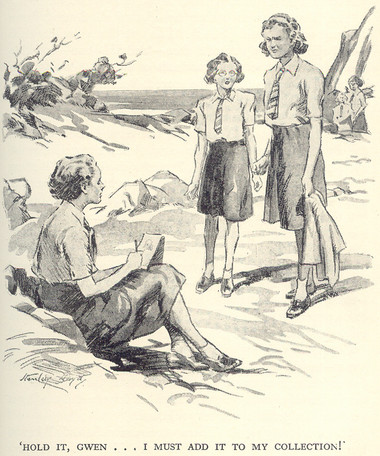
On top of that she is not a pleasant person to be around. She believes herself to be quite wonderful, and stuffs up her parents with tall tales of being the most popular and the best at tennis and swimming (her mother laps it all up and makes it all ten times worse of course).
She manages to carry on like this for almost the entire series. I think one of her worst pieces of behaviour is when she fakes heart palpitations in order to get out of sports. She doesn’t just have one funny turn during a run, she deliberately feigns a several little moments of a fluttering heart and feeling ill – only when sympathetic adults or pupils are around of course – and worries her family sick.
Her second-worst is probably from her first year where she secretly bullied Mary-Lou by damaging and stealing her belongings, so that Mary-Lou would come to her for consolation and support, with the added bonus that she could blame girls like Darrell for it.
Gwen does eventually turn herself around a bit, but too late for most purposes including being thought of well at Malory Towers. She starts her final year without the usual histrionics at being parted from the family, in fact she is very cold towards her father. This is because he tried to stop her from going to a Swiss finishing school and instead has told her a few hard truths about herself, telling her she should get a job when she finishes school. This had led to a blazing row where by all accounts Gwen and her mother were horrible to her father, and in the end he gave in.
It was true that Gwen had said some very cruel things to her father during the last holidays, backed up by her mother. Mrs Lacy had been so set on sending Gwen to a finishing school where she could make ‘nice friends’, that she had used every single means in her power to back Gwen up. Tears and more tears, Reproaches. Sulks. Cruel words. Mrs Lacy had brought them all out, and Gwen added to them…
“I said to my father, ‘aren’t I your only daughter? Do you grudge me one more year’s happiness? You don’t love me. You never did! If you did, you would let me have this one small thing I want – that mother wants too.’ I went on till I got my way. I stayed in bed one whole day and Mother told him I’d be really ill if I went on like that.”
Miss Winter is a voice of reason, reminding Gwen that her father is tired and has felt ill for some time, but neither Gwen nor Mrs Lacy listen. Gwen goes on and on about this back at school, telling everyone everything that was said and how unkind her father is. Darrell has words with her (as asked by Miss Grayling) and Gwen refuses to believe that her father might have been telling the truth about not being able to afford a finishing school. She insists he was just being cruel, and she is glad she had made him miserable.
She is glad when he doesn’t come at half-term, and dismisses Miss Winter’s report that her father is unwell by saying you can’t always tell whether Daddy isn’t well, or is just bad-tempered.
Then the worst happens, her father is taken seriously ill. He is so ill he may not survive, and Gwen is devastated. All of a sudden her world is crumbling, and a point in her favour is that she doesn’t think of Switzerland once – she is consumed by the guilt of how she left things with her father, that she didn’t write to him all term.
Miss Grayling is tactful, but impresses on Gwen one thing: you haven’t always been all that you should be. Now is your chance to show that there is something more in you than we guess. In private Miss Grayling thinks that people reap what they sow, and also says to Darrell that this could be the making of Gwen.
Gwen’s father does survive his illness, but he is to be an invalid for life. Gwendoline is forced to leave Malory Towers to take a job, with him an invalid there is no money for schooling of any kind.
She writes to Darrell to tell her the news, and is stoic about her change of circumstance. She adds that she finds her mother’s weakness and weeping intolerable, and I suppose I can only say it is a positive about Gwen that she seems to roll her sleeves up at this point and do her best.
I think she had a real shock, after the huge row with her father, the idea that she might lose him without ever having been able to make up with him must have been awful.
She admits her self that she might have turned out like her mother had she not had such a great shock. She seems to have grown up a great deal and realises she has a fresh chance now.
JOSEPHINE JONES
Josephine, usually known as Jo, in second year in the final Malory Towers book. Immediately Darrell and Felicity tell us how awful she is, loud and bad mannered. Her father then almost forces them off the road with his terrible driving. As he drops her off he shows off that he is quite an idiot:
Well, good-bye, Jo. Mind you’re bottom of the form. I always was! And don’t you stand any nonsense from the mistresses, ha ha! You do what you like and have a good time.
Jo’s problems mostly seem to stem from her parents. Her father’s attitude is clear from the quote above, and we the readers are also privy to a telephone conversation between Mr Jones and Miss Grayling where he demands that Jo doesn’t take swimming lessons because she doesn’t like swimming, and his say so should be enough. Miss Grayling doesn’t allow him, or Jo, to have his way.
Jo also gets sent a lot of money and food, and doesn’t seem to understand that she can’t buy the other girls’ friendship with fancy cakes and chocolates. She seems to think that she is better, more generous, as she has more to share. She doesn’t stop to think that a poorer girl who only gets one small cake and still shares it is more generous than one who gets more than she could possibly eat.
Felicity puzzles over this contradiction.
It was puzzling that some parents backed up their children properly, and some didn’t. Surely if you loved your children you did try to bring them up to be decent in every way? And yet Jo’s father seemed to love her. If he really did love her, how could he encourage her to break rules, to be lazy, to do all the wrong things? How could he laugh when he read disapproving remarks on Jo’s reports?
Jo said he clapped her on the back and roared with laughter when he read what Miss Parker had written at the bottom of her report last term. What was it she wrote now? ‘Jo has not yet learned the first lesson of all – the difference between plain right and wrong. She will not get very far until she faces up to this lesson.’
At one point she has five pounds in her knicker-elastic, sent by an aunt. The younger girls are supposed to hand over any money to matron so she can distribute it as pocket money, but Jo refuses hence keeping it in her knickers. She takes out the notes so often to show them off that the elastic breaks and the notes drop out. Matron finds them (realising they are Jo’s) and puts up a sign asking the owner to collect them. Jo is too afraid to admit that they are hers – she is sure she will get into trouble and have the money doled out a shilling or two at a time so she doesn’t admit it.
At half term we see more of her parents and her father in particular doesn’t come across at all well (but we are not surprised). He is very loud and interrupts both Miss Parker’s and Miss Grayling’s conversations with other parents He ‘regales’ them both with what he thinks of as amusing anecdotes about how he was called Cheeky Charlie and school and was always getting into trouble.

Miss Grayling then – in what seems a rather unprofessional moment – says to another parent that it was an experiment taking on Jo, and it isn’t working out well. She adds that they have taken on other experiments, taking girls who don’t fit in but who always learn to fit in later, but Jo hasn’t as any good the school does, her father undoes. I know that there weren’t so many laws about privacy and confidentiality in the 1940s (unless we are talking about war efforts) but it still seems inappropriate and I can only imagine Blyton includes it so that the readers are privy to this information.
Anyway, Jo and Mrs Jones are starting to become aware by this point that Mr Jones is quite embarrassing but Jo dismisses it as unimportant as he is still her father and she loves him.
She can’t admit to her parents that she’s lost her aunt’s money so after half-term she sneaks into matron’s office and snatches up her money. She accidentally takes too much, however, and comes away with nine pounds. She knows her father will pay it back so she keeps it “borrows it” as she says, and spends it on running away with a first former called Deirdre. She also won’t admit to being the one who has taken a first-former into the town against the rules, and her whole form is punished for it.
So Jo has committed quite a lot of crimes by now. Firstly, she breaks the rules on having pocket money. Then she takes her money back from matron in secret, and not only takes other money but keeps it too. She won’t own up to breaking a rule and gets her whole form punished, then she persuades a much weaker girl to run away with her, potentially putting them both in danger.
Miss Grayling takes this all very seriously, so seriously that she calls Mr Jones to see her as soon as Jo is returned to the school. Mr Jones doesn’t take it at all seriously. He thinks is has all been a great laugh, all a bit of fun. His Jo, she’s a high spirited girl. He is only shocked when Miss Grayling tells him Jo has stolen money. He offers to pay it back, to double it, anything so that Jo doesn’t get expelled. But get expelled she does, as she’s a bad influence.
She doesn’t ask Jo for any explanations or apologies, but she does point out that Jo had a great chance at Malory Towers but didn’t take it, and that her parents are partly to blame.
Jo realises she is right:
You said it didn’t matter if I was bottom of the form – YOU always were! You said I needn’t bother about rules, I could break them all if I liked. You said so long as I had a good time, that was the only thing that mattered. And it wasn’t, it wasn’t.
It’s quite heart-breaking as she realises her father isn’t the hero she thinks he is and that he has let her down very badly. Mr Jones realises the same, and has a brief moment of dignity as he takes Jo home.
Like Gwen, she writes a letter later, her is to Deirdre. In it she says that her father is trying to find her another school but it won’t be as good as Malory Towers. She adds that her father is ‘awfully cut up’ and keeps blaming himself but her mother is fed up and says that Jo has let down the family name.
She apologises for letting the second form take a punishment and admits that Malory Towers is a splendid school, and I think she has learned a lot and grown as a result of being expelled. I actually hope she does well somewhere else because, despite her faults, she didn’t have the best chance before.
Jo and Gwen are similar in a lot of ways. They both hate swimming, for a start! Neither are popular at school, or do well in lessons. They are lazy, boastful and manipulative. They come from privileged homes though they lack support from their parents.
They both leave the school under a dark cloud, and although they both ‘failed’ at Malory Towers, their great shocks mean they both dramatically adjust their attitudes and have a good chance at succeeding elsewhere.

 Fiona
Fiona pippastef
 worldofblyton


 World of Blyton
Without too many spoilers – it is fair to say that we hear again from Gwen and Jo in the sequels written by Pamela Cox – Secrets at Malory Towers and Goodbye Malory Towers !
LikeLike
Ah, interesting! I do keep meaning to read the sequels. Maybe I will get around to it after I’ve written the rest of these blog posts.
LikeLike
fiona, thanks a lot for the post.Really thank you! Much obliged.
LikeLike
Didn’t Jo take 45 pounds, not 9?
LikeLike
In the original pre-decimal book she took nine pound notes which was a lot of money at the time.
LikeLike
Ohhh, ok.
LikeLike
Gwendoline? We were meant to hate her, she was sly and deceitful and I thought it was disgusting that she pretended to have a heart problem in Utter Forth to try and get out of her exams. However, I do hate the way that the books were negative towards any of the girls not enjoying team sports. I utterly hated hockey when I was at school and I was hopeless at swimming (although not afraid of water so i think I would have enjoyed the Malory Towers swimming pool) and I love horses and would have enjoyed going on walks too. On re-reading the books, Gwen does actually have some good insights on why she’s so unpopular, she just isn’t that great on acting upon then
LikeLike
I hated sports at school as well, at least I did as soon as we got to an age where the other children picked on me for not being as fast/coordinated and so on. I hope that I would have fared OK at Malory Towers, though, as they were generally kind enough as long as someone tried.
LikeLike
I think you’re right Fiona. The M.T girls would be kind, so long as you didn’t dislike sports because you are lazy.
For example, Mary-Lou. She didn’t dislike swimming because she was lazy like Gwen, she simply didn’t like the water. But she tried anyhow.
So I agree with you, it was more about being lazy or vain about sports than not being good at them.
LikeLike
Jo and Gwen are very alike indeed… I do, however, wish that they had opened up a little more about Jo’s life outside of (and possibly before arriving at) school, as we find out a lot more about Gwen… There are similarities from what we do learn (both are spoiled at home), although there are some huge differences visible – Gwen adored her mother but didn’t get on with her father, whilst Jo adored and was doted on by her father, but whilst seemingly on friendly terms with her mother their relationship seemed a bit more muted… Gwen is also typecast as being very self-centred and hostile (and entitled), whereas it seemed Jo was actually trying much harder to fit in and actually make herself liked – xu just went about it the wrong way… The dynamics of their home lives were likely to be different anyway as Gwen was an only child, whilst in Last Term, whilst Jo reveals in one scene that she has a brother, in one of her speeches about how well-off her family are (she says “my brother’s got…”, although no further information is given about her brother besides the fact that he exists) – Gwen may not have been so self-centred if she had had to share things with a sibling… In some ways I almost feel that both were doomed to fail from the outset – Gwen was written off by the other girls and Miss Potts before she even got on the train, whilst no one in Jo’s form actually made any attempt to be nice to her or tell her that she may have fitted in better if she had toned down a bit… Looking back now, I do wonder if perhaps, with similar faults derived from different roots, if (unlike Gwen, who was repeatedly kept on despite some pretty nasty behaviour, but generally never stood a chance because the others didn’t give her one) Jo wasn’t given enough time, or a fair chance, to redeem herself?
LikeLike
This little ramble will principally concern Miss Josephine Jones, so if you absolutely can’t stand the chubby little cry-baby, I’ll take no offence if you skip it.
I suppose it’s pretty irrelevant for a girls’ school story, but it’s occured to me, re-reading Last Term, to wonder exactly how Charles Jones made his millions… or perhaps hundreds of thousands. Here is a man who did dreadfully at school and seems proud of it. He seems to me totally lacking in any work ethic, so I can’t imagine him going to university, even if he’d had the qualifications which he certainly wouldn’t have, or working hard to build up a business. I doubt he was born to money, this quote seems to suggest otherwise…
“he was always at the bottom of the form, and yet now he’s rolling in money”
I realise now that this is Felicity thinking though, so perhaps it’s not so strong an implication. Still, I think if he’d been born into a rich family he would have lost the money through his attitude. Of course, he could be in the process of doing that, another shock coming for poor Jo. He might have inherited it I suppose, but again my instinct rejects the notion haha.
So how could a man like that, living in that era, have made a vast amount of money? The age of the 20,000-a-week footballer or national lottery winner were decades away, and the pools would only land you about a hundred thousand—not enough I think to live the Jones’ lifestyle. Perhaps he struck lucky with an investment, or a mining venture, or bought the rights to something which later took off.
Now on to Jo herself. I’m a confirmed oddball, and so despite her rudeness and somewhat obnoxious ways, I can’t help sort of liking Jo Jones. Perhaps it’s because I’m a bit… Ok, a lot on the tubby side and hate sports haha. But I think in a way it’s because she’s loudly and proudly everything that Malory Towers teaches its pupils to despize.
As a rule I like Darrell and chums, and I think Blyton’s schools do mostly teach a good ethos; teamwork and decency and hard work and so-on. Yet there are those times when I so long for someone to tell all those oh so jolly, marvellous, games-adoring, honourable and totally-not-snobbish little misses to go and… sure you get the idea haha.
So in contrast to dear Gwendoline Mary, who in my opinion is a pathetic, mean, deceitful, spiteful, snobbish, social-climbing little bully, I can’t help feeling quite a bit of sympathy for Jo. Firstly I think that she never actually set out to annoy or be unkind to anyone, and secondly the other girls were… I.M.N.S.H.O, much more unkind to Jo than she deserved.
I’m sure her ‘showing off’ about her many posessions got intensely aggravating, but it doesn’t seem to me that Jo meant to ‘rub it in’. I’m sure her father has always valued people purely based on their material assets, or at least has expected that others do this, and so Jo expects to be judged in this way too. It’s to her credit that she doesn’t do this herself. (Deirdre is very poor, but Jo doesn’t look down on her for this.) She is perhaps a little obtuse not to realise that she’s putting people off her, but she is only about fourteen.
She is also generous with the gifts she is sent, though unfortunately this increases the others’ dislike for her. Again this is part of being taught that others will judge her based on her wealth. Nevertheless, she did give, when she might not have done.
A quick note on Jo’s parcels. This seems something of a plot-hole for me. In most girls’ ‘public’ schools of the period, I think if post wasn’t actually opened before the girls received it, contraband sweets and money would quickly be confiscated. But not a few things happen in school stories that would be unlikely in most actual boarding schools of the time.
I certainly don’t think it’s unfair to say that Jo was actually bullied a little at Malory Towers. June’s remark about her father’s dropped “H’s” was pretty nasty. (Though it was a time when people did make judgements much more readily about people based on how they spoke and comported themselves.) Much worse though is the way she was pushed into the pool and her legs grabbed. For people who can swim that may be all fun and games, but when you know someone can’t, it’s both unkind and of course dangerous.
Now I’m not trying to paint Jo as some kind of mis-understood angel, at the start I called her a cry-baby, and she is a bit. She’s also rude… though I’d argue she had some justification to tell Amanda where to go, given the scare Amanda had give Jo… and Amanda’s own short-comings. Yes Jo stole, and failed to own up to wrong-doing, but I think there were extenuating circumstances in both cases. (She took what she saw as her own money in order to provide a birthday feast to share with her form; and I can understand her not caring much if they got punished, given how unkind they often were to her.)
I do think something was lacking a bit in the attitude of the upper formers towards Jo.
““That kid wants taking in hand,” said Sally.”
I agree that she did, but perhaps in a different way than Sally meant. Given Sally’s own bumpy start at Malory Towers, you’d have thought she might try and take Jo aside and explain some of the ways in which she, Jo, was making life more difficult for herself, and to explain the importance of politeness and so-on. I agree with Mary-Lou that Jo doesn’t fit in at Malory Towers, and even that she’s “a little idiot”, but I don’t think that’s all her fault by a long chalk.
I think she deserved a friend who would both offer her sympathy and work to improve her… in a kind way. Certainly I don’t think she deserved to be ‘sent away’ half as much as Gwen did.
LikeLike
I never for a moment stopped to wonder how Charlie Jones made his money! He’s certainly “nouveau riche”, and it’s actually a bit of a shame that he’s so awful as I can’t think of many other boarding school characters who weren’t born rich or are still poor(ish) and on a scholarship. I think that a win on the pools plus a lucky investment is a likely possibility – or an inheritance from a distant relative?
I feel a bit sorry for Jo too, as she’s not had any preparation for being rich and coming to a boarding school. She doesn’t know the etiquette and has only her boastful father as a role model. I agree that expelling her was harsh – but perhaps it was the shock that she and her father needed and she would do better with a fresh start at a new school.
LikeLike
There are similarities between Gwen and Jo from what we do learn (both are spoiled at home), although there are some huge differences visible – Gwen adored her mother but didn’t get on with her father, whilst Jo adored and was doted on by her father, but whilst seemingly on friendly terms with her mother their relationship seemed a bit more muted… Gwen is also typecast as being very self-centred and hostile (and entitled), whereas it seemed Jo was actually trying much harder to fit in and actually make herself liked – whereas Gwen did nothing to try and make herself more likeable to the others, Jo actually went all-out to try and be popular – she just went about it the wrong way… The dynamics of their home lives were likely to be different anyway as Gwen was an only child, whilst in Last Term, whilst Jo reveals in one scene that she has a brother, in one of her speeches about how well-off her family are (she says “my brother’s got…”, although no further information is given about her brother besides the fact that he exists) – as Jo has a brother, she obviously knows, and understands the importance of sharing with others, whilst Gwen may not have been so self-centred if she had had to share things with a sibling… In some ways I almost feel that both were doomed to fail from the outset, albeit for different reasons – Gwen was written off by the other girls and Miss Potts before she even got on the train because she cried (forgiveable as it was her first time away from home at age 12), whilst Jo didn’t seem to be homesick or have any such issues and made a huge effort to try andbe friendly, yet no one in Jo’s form actually made any real attempt to be nice to her or tell her that she may have fitted in better if she had toned down a bit… Looking back now, I do wonder if perhaps, with similar faults derived from different roots, if perhaps (unlike Gwen, who was repeatedly kept on despite some pretty nasty behaviour) Jo simply wasn’t given enough time, or a fair chance, to redeem herself?
LikeLike