Last time Bill returned from his first day of investigating and comforted Allie.
Chapter 12
Allie stirred the next morning, and was surprised to feel something warm and breathing beside her. She opened her eyes and allowed herself a small smile and buried herself a little closer to him, enjoying the feeling of being close to someone. She hadn’t been close in bed with anyone since her husband died and it felt nice.
Bill lifted an arm and draped it over her, a small hum of contentment escaping his lips. He pressed himself closer to her, too, and then as he woke more fully he realised that things were starting to veer towards the exact impropriety he had been trying to avoid. The sun was creeping around the curtains enough that he knew it wasn’t particularly early, so he cleared his throat noisily as he carefully put a little space between them again.
Allie stretched out, and rolled over, “Bill?” she blinked sleepily, reaching over to him.
“Who else were you expecting to find in your bed?” he asked with a laugh.
“I thought you’d slip back to your room,” she murmured. She sat up a little. “Did you get any sleep? I didn’t many your arm go numb did I?”
“Well, I did plan to,” he admitted, answering her first question first. “But I fell asleep and I slept quite soundly, I think.” He lifted his arm and tested it out. “No, I can still feel it. I don’t think you were lying on it all night.”
Allie smiled shyly and reached for her dressing gown, making a move to start getting dressed. “I hope you don’t think I was too forward asking you to be here last night?”
“No, I think that your reputation is still intact,” he assured her with a smile. “I didn’t mind.” He got up and retrieved his shoes. “I’ll see you at breakfast.” He returned to his own room where he quickly messed up the bed to make it look slept in and then went to the little bathroom to wash and shave before dressing in fresh clothes for breakfast.
Breakfast was plentiful and fresh like every other morning, and Mrs Evans catered for the masses, even if she was only feeding two. Bill was down first and was swotting up on his map, having skimmed the morning papers before Allie came down, clean and presentable as always. He winked at her as she set down and Mrs Evans bustled in to see if Allie wanted a cooked breakfast and what the plan was for Bill today.
There had been nothing in the papers about the children – not that he expected there to be, he had kept it quiet – and nothing about any funny business with helicopters. Newspapers, as a general rule, didn’t arrive at the farm until later in the day or sometimes later in the week, as they came whenever there were other things to be delivered, or Effans made a trip down into Merthyr. However Bill liked to keep up to date with current events, and had asked for the local paper as well as one or two national ones to be delivered daily, in the morning, at no little cost.
He was gratified to see that Allie accepted Mrs Evans’ offer of a cooked breakfast. “Not a big one,” she added, though it would be a hopeless request.
Mrs Evans then dished up what she clearly considered to be a dainty breakfast, there being only two sausages, two eggs, two slices of toast and so on.
Allie smiled wryly at Bill as he lit his pipe. “Small isn’t a word Mrs Evans knows is it?” she said with an understanding smile. She felt that Mrs Evans was very kind but wished she didn’t have to serve up such big portions.
He smiled back in a conspiratorial way. “Apparently not.” He wanted to add that she could probably do with eating a good meal but thought it wouldn’t be wise, it would probably out her off eating more than anything. “I’d offer to take some of that for my lunch but I think she’s already filled a basket for me.”
“She was very worried when you left your lunch yesterday, she wouldn’t stop wringing her hands,” Allie teased him gently. “She’s probably wanting to make sure you have enough food today!”
“She probably thought I would starve to death,” he joked, folding the map and tucking it into his pocket. “Anyway, I’d best be off. I’ve got a fair bit of ground to cover today.”
Allie nodded and swallowed her mouthful of food. “Take care,” she said as he lent over to kiss her. “And good luck!”
Bill grabbed the basket Mrs Evans was preparing for him and made a hasty exit, calling a thank you over his shoulder before she could put anything else in. It weighed a ton already. He slung the basket onto the passenger seat and carefully drove down the rutted farm road towards the bigger road that connected Merthyr in the south to the towns and villages on the other side of the Brecons. Instead of turning towards Merthyr today, he turned northwards, in the direction of Abergavenny.
I’m sure that few Enid Blyton fans have missed the furore over the past week about English Heritage’s website update regarding Enid Blyton. I have seen countless online newspaper articles, individual’s posts and comments and it’s on a couple of forums I frequent, too.
Has Blyton been cancelled?
Well, if you read some of the headlines – and the commentaries that go with them on social media – you’d believe that yes, Blyton was being cancelled and her blue plaque removed (She actually has several blue plaques that I’m aware of but it seems only one was placed by English Heritage).
Have a look at these two Facebook posts, from the Daily Express and Daily Mail, respectively. While both, I suspect, are employing hyperbole (the first with Five Get Cancelled is obviously a joke on some level), these are just two examples I could find doing a quick search on Facebook. I saw dozens of posts like like these last week, some using careful language about English Heritage reviewing blue plaques to suggest that Blyton’s might be removed.
(Incidentally the Daily Express article has inexplicably chosen an illustration from the Ruth Palmer cover of First Term at Malory Towers to go along with their Famous Five-based joke.)
What these posts have done is whipped up a massive defence of Blyton. While that’s not a bad thing in itself, I mean, I frequently defend her myself, these comments seem to use words like woke and snowflake in every other sentence, along with cries of I read Blyton’s books and I didn’t turn out to be a racist.
I’m normally proud to be a part of the world-wide Enid Blyton fan club. But this week… I can’t help feeling that people are missing the point.
an on-going programme of updating the online entry for each blue plaque recipient… includ[ing] actor and playwright Noël Coward and the social reformer Annie Besant. Our website entries aim to provide a fuller picture of each person’s life, including aspects that people may find troubling.
Without having seen the original versions of these pages it’s hard to know what has been added. Noel Coward’s page doesn’t contain anything critical but Annie Besant’s page does call her controversial and talks about her stance on birth control and abortion – along with a quote that more or less accuses her of supporting eugenics.
Last week it was Blyton’s turn, and they added two paragraphs under the heading Racism in Blyton’s work. Those paragraphs are as follows:
Blyton’s work has been criticised during her lifetime and after for its racism, xenophobia and lack of literary merit. A 1966 Guardian article noted the racism of The Little Black Doll (1966), in which the doll of the title, Sambo, is only accepted by his owner once his ‘ugly black face’ is washed ‘clean’ by rain. In 1960 the publisher Macmillan refused to publish her story The Mystery That Never Was for what it called its ‘faint but unattractive touch of old-fashioned xenophobia’. The book, however, was later published by William Collins.
In 2016, Blyton was rejected by the Royal Mint for commemoration on a 50p coin because, the advisory committee minutes record, she was ‘a racist, sexist, homophobe and not a very well-regarded writer’. Others have argued that while these charges can’t be dismissed, her work still played a vital role in encouraging a generation of children to read.
They have also made it clear that they are not removing anyone’s plaques.
Are English Heritage the bad guys?
I’ll admit – I wish that English Heritage had done this a little differently. Blyton only has a short bio as it is (425 words) and now around a third (130 words) are negative.
Annie Besant, arguably a more complicated character, has just over 800 words. The majority is in very neutral language – including the controversies, with just a few phrases identifying her as controversial.
The addition of two critical paragraphs to Blyton’s page is clumsy, I think. To give a page with only two previous headings (The foundations of my success, and Early Inspiration) a third which is Racism in Blyton’s Work gives an undue level of prominence to the criticism in that final section. Blyton had a phenomenal writing career, multiple TV adaptations of her work, headed up dozens of charities, wrote teaching guides, poetry, songs and stories and is still relevant today, not that you’d know that from what English Heritage has to say about her. I think I’d find their page lacking even without the last two paragraphs.
To be clear, I’m not saying this information shouldn’t have been included – I actually think there is nothing wrong with highlighting the problematic areas of Blyton’s writing.
The English Heritage blue plaque
I think that what English Heritage wrote is fair. They do not actually call Blyton racist or xenophobic themselves, instead they quote from other sources who have made those criticism. Of course by repeating them the way they have they imply that these are not unfounded criticisms and are criticisms that are accepted by English Heritage.
The last sentence Others have argued that while these charges can’t be dismissed, her work still played a vital role in encouraging a generation of children to read clearly attempts to balance out the criticism but it’s rather weak for me.
Over all, though, I have no issue with this information being included. I also don’t object to minor updates to the books to make remove offensive content where race is concerned. I think that allowing children of colour to pick up a book and read it without seeing a racist caricature of themselves, however innocently meant, is more important than preserving the original language and illustrations in perpetuity. (Obviously the vast majority of updates to Blytons’ books don’t fall into that category and remain frustrating and pointless).
I also don’t think there’s anything to gain by pretending that these problematic bits don’t exist, or that any and all objections are unfounded.
So, was Enid Blyton a racist?
Enid Blyton is not here today to defend herself or to tell us what she was thinking when she wrote her books.
What we do know is that she valued her child readers all around the world and made mention of this many times in her magazines.
We know that she included positive (if sometimes stereotypical) characters of colour in her books.
We know that she used popular toys of the day which included Golliwogs.
So was she racist? Well, of course I prefer to think that she wasn’t – not really. I think that she was a product of her time. She lived in an era when Britain dominated a significant proportion of the world with colonies were spread across the globe, a fact that made it easy for white British people have a false sense of superiority over people from other countries.
Blyton subscribed to this belief at least on some level, there is a divide in expected behaviours between her English school girls and teachers compared to her French ones (the three Mam’zelles between Malory Tower and St Clare’s, Antoinette and Claudine from St Clare’s), the Americans (The Hennings in Five Go to Finniston Farm and Zerelda Brass from Malory Towers) and the Spanish (Carlotta Brown from St Clare’s), and some of these young women did buck up and learn to behave in accordance with British expectations. I never sensed any malice with these scenarios, however. Blyton certainly shows none of the attitudes unfortunately prevalent today about immigrants taking British jobs and houses, or being benefit scroungers.
However she did use the fact that a person could look suspicious purely because they were foreign and her baddies were, on several occasions, swarthy. (As a child I didn’t know what that word meant and assumed it to mean well-built). Given the various wars that Britain was involved in in the periods before and during Blyton’s life foreigners were often given a second look.
This is something that hasn’t gone away even now. It’s disheartening to read that Chinese (and other Asian people) are being abused in the streets because of Coronavirus, or that Muslim communities are attacked for the actions of a militant minority. We shouldn’t be defending these attitudes, and I don’t object to reprints phasing out the more obvious xenophobia that appears, but some understanding of the period of Blyton’s writing is needed.
In conclusion
Blyton is not being cancelled. A large number of her books are still in print and her multiple blue plaques are still in place. English Heritage have not suggested that reading Blyton books causes racism in readers, they’ve just acknowledged that they’re aware of the problems in her works.
A blue plaque on 95 Chaffinch Road, Beckenham
I don’t think there’s any point in trying to cancel English Heritage and all the good work they do by refusing to renew or take out a membership over this. (It’s ironic that those who bemoan cancel culture are so quick to try to cancel the perceived offenders).
I won’t go into a lengthy story here but Brodie has started to take an interest in both Noddy stories and Amelia Jane stories (which he calls the naughty stories) and I’ve felt far more uncomfortable than I expected reading them to him from the original texts – primarily because of the gollies. I doubt that Blyton meant any offense with those, she perceived them to simply be beloved nursery toys, but today, I just can’t do it.
But it means that I’m feeling more aware of the problematic bits of Blyton’s writings which is probably why I’m taking a middle road here. I can see faults on both sides, but I will defend both Blyton and English Heritage as their positives outweigh their mistakes.
In defence of woke
This isn’t directly related to the situation above, but it’s something related that I felt I just had to say.
I despise the word woke used as an insult and the number of times I’ve seen it in response to English Heritage really frustrates me. Knowing better and doing better are never bad things. Being considerate of others – especially minorities who are striving for equality – is never a bad thing. Being woke is not a bad thing.
The idea of being woke, or awakened potentially goes as far back as Abraham Lincoln, when the phrase wide awake was used by those who opposed slavery.
From what I’ve read the first uses of woke specifically were by African-Americans as they talked about the prejudices they faced, but now it has developed a more general meaning of being aware of any sort of prejudice or inequality. By that standard the Suffragettes were woke and Martin Luthor King was definitely woke.
If the these people were woke, then I’m ok with being woke too.
In a similar vein snowflake, cancel culture, PC brigade and political correctness are just words and phrases used to try to shut down debate. 1900s equivalents were shouted at Emmeline Pankurst – the term Suffragette was actually a slur based on the original name Suffragist! – so it’s a good thing that those brave women didn’t listen.
Please keep any comments civil – I’ve made my feelings on words like woke perfectly clear and I will remove any comments where they are used as insults.
I’m sure none of you have missed the furore over what English Heritage said about Blyton this week, but I thought I would express my thoughts on it this week anyway, which means it’s going to be a bumper week here with three posts.
English Heritage vs Enid Blyton,
Cunningham and Petrov: The Mystery of the Missing Children chapter 12
and
Hollow Tree House – a reality
A classic from Eileen Soper, my favourite Blyton illustrator, for the first illustration of the week. This one is from Five on a Treasure Island. I love how she has captured George’s haughty face and stiff walk, as well as the surprise on the other three’s faces.
Last time Bill visited a couple of airstrips, looking for evidence of any funny goings on that might be related to the mysterious helicopter that the children saw.
Chapter 11
Mrs Evans was still talking as Bill was beginning to eat when Allie appeared from the living room. “Hello, Bill,” she said, sitting down opposite him. She was ringing her hands and looked very tired. “Did you find anything?”
Mrs Evans gave the counter top one last wipe with a cloth then quietly left them to it. Bill swallowed a mouthful of the soup Mrs Evans had made with what had been left of the ham. There were a couple of thick slices of bread, thickly spread with butter on the plate beside his bowl, but he refrained from picking it up. It was hard to have a serious conversation with your mouth full of bread.
“Not today, I’m afraid,” he said. “I visited bunch of airfields. It’s mind-boggling how many there are around this area, most doomed to failure without a doubt. All I found out was the same things I already knew.”
Allie sighed and flexed her good hand again. “How many airfields have you got left?” she asked, trying to refrain from nagging him for not trying harder. She knew he was trying his best and he was on his own without his team of agents and he was one man.
“Two or three which are at the top of my list, and then there are quite a lot further afield,” he said. “I’ll be heading to the north-east tomorrow. Hopefully I’ll have more luck. If not, I’ll have to pull some strings and bring in back-up.”
“Will you be allowed back-up?” she asked hopefully. “I’m so worried about the children, Bill. Do you think they are all right?” she was a strong and independent woman who didn’t like to show weakness but she wasn’t sleeping well with her hurt wrist as she couldn’t get comfortable, so she was more fraught and tired than usual. She was grateful for Bill and his hard work but she wanted her children back where she could keep an eye on them.
“They’ve survived worse,” he said, with slightly false cheeriness. “I imagine whatever is going on in that mountain, they don’t want the children running off and telling tales. They’ll be being held somewhere to keep them out of the way, and I wouldn’t even be surprised if they are released before I get to them. The folk in there may know that someone’s on to them by now and be planning to move on already.”
“You don’t think they will hurt them, then?” Allie voiced her concern, she was aware that the men her children ended getting into trouble with.
Bill lowered a spoonful of soup. “They’re just kids, Allie. It takes a special kind of monster to hurt children, and I don’t think that’s what we’re dealing with here. I’m not saying that one of the boys isn’t going to get a smack for mouthing off, or that they’ll be kept in five-star luxury, but I don’t think they’ll come to any serious harm.”
“Why don’t you go up and get ready for bed? You look exhausted. I’m going to eat this and then head to bed myself.”
“I couldn’t sleep, even if I wanted to,” she said tiredly. “And this wrist means I can’t get comfortable,” she added, almost in tears.
“I’ve got some pills in my case that might help. I always carry them in case of emergency,” he said, wishing he’d thought of that before. “They’ll help with the pain and hopefully knock you out a bit. So on you go, upstairs,” he said firmly. “I’m not fussing, I’m bossing,” he added at her look.
“Same thing,” she shot back, a little feistily. She still got to her feet and stifled a yawn. “Will you be long?”
“Not unless Mrs Evans forces other courses on me,” he said, making a weak joke. Mrs Evans did in fact try to make him have more soup and a dessert but he was firm in his refusal, stating that he needed to get to bed – as did she, as she would be rising with the dawn to see to the farm. He made his escape from her and hurried upstairs to his room where he rifled through his suitcase for the little bottle of pills. With those in his hand he went back into the hall and knocked lightly on Allie’s door.
“Come in, Bill,” Allie’s voice called from behind the door. Her voice sounded thick and muffled as if she had been crying. She was sat on the edge of her bed in her night things and a dressing gown, face in a tissue as Bill entered. She looked a little sheepish that he had caught her in a moment of weakness.
He cleared his throat awkwardly. As often as he wished he could avoid Allie when she was furious with him he could deal with her then, he could take her anger. Her tears were another matter. “I brought you the pills,” he said. He fetched a glass from the dresser and poured water into it from the pitcher there, then handed her the glass and one pill.
She nodded and put the pill in her mouth and then took a drink of water. “Thank you, Bill,” she said quietly. “I don’t know what’s got into me, I’m just dreadfully worried about the children and I’m being perfectly rotten to you, aren’t I? Especially when you are doing such a wonderful job trying to find them.”
Bill put the glass on the bedside table where she would be able to reach it later, then sat on the bed beside her. “I wish there was more I could do,” he said. “I don’t like to think of them, trapped in that mountain. I know they’ll be putting a brave face on, but they can’t be having a good time. I can’t imagine how it feels for you.”
“I don’t know that I would be able to put into words how I’m feeling right now,” Allie admitted. She wrapped her dressing gown up as tight as she could with her good hand. “I’m just sick to death with worry and keep thinking that I will never see them again!”
A joke about bad pennies and always turning up was on the tip of his tongue but he swallowed the words. “You should try to get some sleep. Hopefully tomorrow will bring better news.”
Allie swallowed and nodded. “Yes that will help.” She paused, reached for Bill’s hand and asked, “Will you stay close?”
It wasn’t how he had imagined that she might first invite him into her bed, but he understood her not wanting to be alone. Reaching over, he quickly untied his shoe-laces and eased his feet free. He waited as Allie carefully moved under the covers, her dressing gown being tossed out to land on the chair by the bed, but when she lifted the covers for him he shook his head and patted them down. He lay on top of the covers and put his arm around her so that her head rested on his shoulder. “Wouldn’t want anyone to think there was any sort of impropriety going on,” he said gruffly.
She giggled a little, “I’m sure Mrs Evans will be very disapproving in the morning.” She nestled into him and closed her eyes as she breathed in his smell. She felt calmer as she lay next to him. She hadn’t wanted to admit it, but his absence had been part of what was making her jumpy. She hated him being gone so long.
Privately, Bill had planned to return to his room after Allie fell asleep. If the pill she had taken hit her like he thought it would, she would be deeply asleep within fifteen minutes and would be unlikely to stir until morning. However, with his arm under her he would have to do some manoeuvring to free himself. Perhaps he would just sleep where he was, and sneak back to his room in the morning. He doubted he would wake before Mrs Evans rose at dawn, but it wouldn’t be too hard to return to his room before she announced breakfast. The feeling of Allie in his arms had nothing to do with his decision, of course. It was merely the practicalities of not disturbing her, even though she’d be in a drug-induced slumber.
“Mr Cunningham, in your bed, look you,” he murmured in a poor attempt at a Welsh accent, and heard a sleepy laugh from Allie before her breathing grew deep and slow and he knew she’d fallen asleep.
Stef and I have both reviewed the first Laura Marlin mystery: Dead Man’s Cove. I borrowed the second book in the series, Kidnap in the Caribbean, ages ago and have finally read it so I thought I would review it as well.
A reminder of the first book
Honestly, I can’t remember much about the first book, but then I have a terrible memory when it comes to books. I can read the same who-done-it several times as long as it’s a few years apart and still not remember who done it.
What I do remember (reading my review helped…) is that Laura Marlin is an orphan who was living in an orphanage until she was sent to live with her uncle Calvin Redfern who lives in Cornwall.
Calvin turns out to be a rather mysterious person who says he works for the fisheries department, investigating fishermen who over fish etc, but Laura soon works out that there is more to his job and life than he lets on.
She makes friends with Tariq who is also an orphan, though at first he is living with two people who claim to be his parents. They are in fact entirely unrelated to him, and have bought him as a slave as he is skilled in tapestry making. These people then get involved with the Straight As gang who Laura, Tariq and Calvin are working against, and as the story has a happy ending Tariq is freed from his slavery and he ends up being fostered by a nice couple in St Ives. (I had to look through the first book to check most of those details…) Laura also ends up with a three-legged husky called Skye.
And so for their second adventure
Under slightly strange circumstances Laura has won a cruise for two to the Caribbean and after some hard work persuading her uncle that is is a good idea, the two pack their suitcases. Tariq and Skye come along to say goodbye, and after having a sneaky tour of the ship end up accidentally staying on board when the ship sets sail!
This would be a big enough problem to deal with if Uncle Calvin could help them, but he can’t as he somehow fell down the stairs on board and is laid up in his cabin on strong pain medication.
Kidnappers in the Caribbean
Laura, Tariq and Skye manage to look after themselves for a few days on board the cruise ship. They avail themselves of the many kinds of entertainment and of the food, of course.
There is the slight worry that Uncle Calvin thought Laura had been sneaking around his room in the night, but she knows it wasn’t her, so who was it? And there’s some hooks at the side of the stairs Uncle Calvin fell down, but no carpet or anything loose he could have tripped over.
Then a group of actors, performing as pirates, board the Ocean Empress and Laura thinks they were serious about stuffing her into a chest, though she’s rescued by Tariq However, that’s not the kidnap that the book’s title refers to.
In fact it’s ambiguous, as there are two kidnaps that occur. First Uncle Calvin disappears – and all his belongings, too, and worse the ship’s staff refuse to believe he was even there as they’ve never seen him!
So when a flashy couple board the ship and announce themselves as Laura and Tariq’s parents, the ship’s staff easily believe them. Especially as the cabins were booked by the couple’s travel company. Laura and Tariq are then rather stuck. Do they insist they’ve never met these people in their lives, and hope the ship staff believe them – but then that leaves them accused of being illegal stowaways. Or do they go with their false parents to get off the ship, and hope to find Uncle Calvin?
I think you can guess what they do.
Kidnap on the Caribbean Ship of Adventure
I found some similarities between this book and The Ship of Adventure. Nothing major, but just a couple of parallels that could be drawn.
First up is the fact that Skye and Tariq shouldn’t be on board at all. But with the help of a few kindle staff members, their needs are taken care of. Tariq is safe to wander the ship, but Skye needs food brought to the cabin and a way of exercising. This is not dissimilar to the fact that Kiki, and later Mikey, should not be on the Viking Star, yet the steward and stewardess for the children’s cabins keep their secret.
Then there’s Jimmy. In The Ship of Adventure the children get stuck with Lucian as they’re the only children of a similar age on the ship. They don’t particularly like him but they mostly tolerate him. They very much dislike his uncle, though.
Laura and Tariq get saddle with Jimmy, who although is loud and overconfident compared to Lucian’s gawky awkwardness, is still a bit of an unwelcome addition. His parents are similarly loud and annoying. The difference here is that Jimmy is putting on a front and becomes more likeable as the book goes on.
My thoughts
I don’t think this was as good as the first in the series but I still enjoyed it.
The plot can be a bit silly at times – the free holiday and everything that happens after at was a carefully orchestrated plan by the baddies, which relied on so so many things going exactly to plan, so it’s all a bit over the top. (For example if Uncle Calvin had refused the holiday, or agreed to see the ship’s doctor after his fall it would all have fallen apart.)
The portion on the ship was probably best, I enjoyed as the tension slowly rose with every strange occurrence, though it was nicely interspersed with some lighter moments.
What happens after they leave the ship isn’t necessarily bad – there’s an escape, some hiding out and the oft-used breaking into the dangerous place in order to affect a rescue. The end scenes resemble a children’s version of a particularly cheesy Bond-movie, down to the threat of poisonous sea snails, plus the bumbling presence of Jimmy and his family, but it’s still fun all the same.
This is worth reading if you’ve already started the series (though I wouldn’t start with it) and I plan to continue with the Laura Marlin Mysteries.
We are halfway through June now which in Scotland means the schools come off for the summer holidays in two weeks. The weather now actually resembles summer at least some of the time, which is a good sign.
If you like Blyton: Kidnap in the Caribbean by Lauren St John
and
Cunningham and Petrov: The Mystery of the Missing Children chapter 11
This week I’m taking the opportunity to promote a new book – one inspired by Blyton rather than written by Blyton.
The Mystery of Tully Hall is a children’s mystery/adventure story written by Zöe Billings who is a big Enid Blyton fan. Set in Wales it features four children who go up against a dangerous band of antiques thieves at the rambling Tully Hall.
It just came out last month (on Amazon) but I read it in draft form a few years ago. I plan to reread it and review it soon.
Last time Bill travelled down to Cardiff to meet with an inspector about the suspicious helicopter activity.
Chapter 10
The next morning, Bill set out in his car to the first airstrip on his list to do some investigations into the helicopters’ origins. He had got back from Cardiff late last night and had filled a worried Allie in with everything he had found out the day before. She had been disappointed that he hadn’t yet found the children but appreciated his progress. She let him go the next day looking brave but forlorn, hoping that he would have some luck today.
He drove down to Merthyr, already feeling fed up of what had seemed a quaint little town just the week before, and then took the road to the east, which ran somewhat parallel to the road to the Evans’ farm, but continued much further North on the other side of a ridge of mountains. This road took him up to Sennybridge in under an hour, the location of an RAF airfield in the later war years. Wales was dotted with these abandoned airfields, most of which only operated for two or three years at most. Several, according to the files he had read in Inspector Morgan’s office, had been taken over by various enterprising folk who were trying to make a living out of ferrying goods and passengers by light aircraft or helicopter, whilst a few others were now private and for the use of an individual or business.
The base at Sennybridge didn’t turn out to be anything to do with the mountain. The chaps there were simply flying cargo between Wales and Ireland. Posing as an inspector from the Air Registration Board, Bill checked their paper work and work practices. He allowed them an hour of his time to prove his legitimacy and make sure that he wasn’t dismissing the airstrip out of hand. He got back in his car and looked at his list of airstrips and chose to head north to Llandovery and search there.
Llandovery had reported one or two of the discrepancies which had been flagged up when the Cardiff police had been contacting airfields to ask about such things. They had kept meticulous records, detailing the air-planes and other aircraft which had used their airfield, most of which were not owned or employed by the business itself. As the owner, an older man with a shock of white hair, explained, anyone could request a ‘runway slot’ in advance and land there. Of course they checked licences and so on, and everything checked out, apart from one or two flight plans that didn’t match with the times the helicopters had been gone for. As they weren’t paying the pilots or hiring the equipment they hadn’t thought anything of it. The beauty of helicopters, after all, was you could land them just about anywhere as long as it was a wide open space. If someone was behaving criminally, they’d hardly be likely to file flight plans and land at an established airfield.
Bill wasn’t so sure he agreed. The airfields were a good way to make an operation look legitimate, plus you could hardly refuel a helicopter at a roadside petrol station. Helicopters taking off and landing in fields would be highly noticeable to anyone within a mile or two.
He made some notes anyway, and thanked the owner for his time. After that he decided to head back south. There were other airfields further north and east but none had reported anything amiss, and most were at the farther edges of what was likely for a helicopter return trip. He couldn’t rule them out entirely but he liked his plan of starting in the centre and working out in increasing circles. That took him back towards Cardiff, but near enough to Merthyr to be able to head home whenever he was ready. He realised fairly quickly that he was unlikely to have any luck in the Cardiff area. The two airfields there, private ones this time, were much more professional affairs, and had been established businesses before the Second World War.
Still, he went through the motions of his false role and spent some time chatting with employees of both businesses. As the afternoon shadows grew long Bill decided that it was time to call it quits for the day and inform Allie of what little progress he has made. He knew she wouldn’t be happy but there was only so much one man could do on his own. Yawning he drove back to the Evans farm, hoping that there would be a decent meal to be had when he got in.
Mrs Evans began fussing around him as soon as he walked in the door. “You’ve been out all day, look you,” she said, ushering him into a chair at the well-scrubbed kitchen table. “And you didn’t even take the lunch I made up for you!”
“Oh… I got some lunch from a little place near Llandovery,” he said. “You needn’t worry about me. I’m sorry about forgetting your lunch, though. I hope it didn’t go to waste.”
Mrs Evans sniffed, putting a pot of something onto the top of the range to heat up. “No, that it didn’t. I made sure we ate it with our lunch, not that poor Mrs Mannering really touched anything I put in front of her. It was a fine ham, too, and the bread was baked fresh yesterday evening. The raspberries were picked this morning, and the cream made fresh, too.”
Bill let her chatter wash over him as she expounded the fresh quality of all the things she had tried to tempt Allie with at lunch time and again for dinner. He would need to speak to Allie again, before he turned in.
Some time ago I had an email asking if I would give permission for a photo of Elfin Cottage to appear in a new book about Enid Blyton. After checking with Stef who had taken the photo, I replied saying yes, they could use the photo and I’d love to read the book when it was published.
Fast forward to earlier this year and I got another email, this time with a link to download a digital copy of the now-finished book. That book is Enid Blyton: The Untold Story by Brian Carter.
I now also have a physical copy of the book, both that and the digital edition having been given to me free of charge in exchange for a review. As always my review will be completely honest.
What Enid Blyton: The Untold Story is not
Often I start a review, especially of non-fiction books with an overview of what sort of book I am talking about. However, today I will start with what sort of book this is not.
Although the title is accurate, it could be misconstrued if you are used to the sorts of things that are written about Blyton these days. This book is not a salacious account of her life. It does not drag out tired accusations of naked tennis and lesbian affairs. Thanks goodness! There’s more than enough of that nonsense out there.
What The Untold Story actually is
As the title says, this is an untold story. While perhaps many of the bare facts are available out there especially now that so much information is online, I don’t believe that anyone has taken that information, analysed it and turned it into a readable account before.
It’s hard to describe this book in a snappy sentence or two, so here I will quote from Brian Carter’s website:
This new biography of Enid Blyton will open your eyes to little known facts about her professional life that have never been fully revealed before.
You’ll be thrilled when you discover how she used her little known artistic and literary endowments and her amazing photographic memory in her work as a professional storyteller and universal teacher.
More than this, you’ll see that, apart from writing over seven hundred storybooks for children, she was also a naturalist, poet, columnist & feature writer, editor of educational books, universal teacher, prolific songwriter (over 300 songs), professional storyteller, playwright, artist & illustrator and a passionate gardener.
The contents
The book is nicely divided into chapters, each covering a different area of Blyton’s professional career. Those chapters are:
Enid the naturalist
Enid the poet
Enid the columnist and feature writer
Enid the editor
Enid the universal teacher
Enid the prolific songwriter
Enid the professional storyteller
Enid the playwright
Enid the artist and illustrator
Enid the passionate gardener
Those make up part one of the book which is the largest part. Part two then contains several short articles:
Why some of Enid Blyton’s stories are not up to standard
A brief history of The Teachers World
The Sunny Stories Magazine – A phenomenal success
A short history of Darrell Waters Ltd – Enid Blyton’s own company
A short history of Enid Blyton’s Literary Estate
A short history of The Enid Blyton Trust
A brief history of The Enid Blyton’s Magazine
A short treatment of clairvoyance
Phrenology & physiognomy
Then at the end are a huge number of appendices taken from the various magazines, books and other publications to which the early chapters refer to. As well as that there are photographs and scans through part one.
Did I learn anything?
I did, actually. So often when you read about Blyton you will read the same thing over and over. Prolific writer… over 700 books… The Famous Five and Secret Seven… controversy… banned from libraries and schools…
Brian Carter has focussed on some of her lesser-known skills. Most of these subjects I had some knowledge on but phrases from his book such as Enid Blyton, artist and illustrator or qualifications in zoology and botany gave me a momentary pause. But of course they are both entirely accurate, if often forgotten facets of Blyton’s life and career.
I was already aware of her work for Teachers World, if not in great detail, and of her magazines, periodical contributions and various non-fiction books, but the way these are all laid out in The Untold Story brings fresh understanding. Although the book is not presented in chronological order there is enough sense of time and progression that I came away with a much better understanding of how her writing career developed.
There are, of course, various things that have had to be assumed or inferred as the full details are not known. On the whole I found The Untold Story to stick to sensible and natural conclusions and is generally clear when a piece of information is an assumption.
For example
As time went by it must have dawned on Enid that writing songs for schools was not as profitable as writing storybooks. It was probably for this reason she took a clear break from writing songs outright to using some of her own poems as the basis for songs.
There are only two real exceptions to this. The first is a strong assertion that Blyton truly believed in fairies – she may have done but there isn’t the evidence there to say for sure.
Another hint she gave of how strong her belief in these folks can be seen in a passage from an article she wrote for The Teachers World… to introduce her new home, Elfin Cottage, to her fans: “…Flowers “belong” to Elfin Cottage. They look at home there – and that confirms me in my secret belief that fairies and elves, brownies and gnomes, have visited the house and left some of their flower-loving, sunshiny personalities behind.”
Indeed, so strong was her belief in fairies that bits and pieces slipped out unexpectedly in unusual places, as shown in the following extracts from her ‘Enid Blyton’s Nature Lessons’ in The Teachers World: …There are ten stamens hidden away, and each has at its tip a bag of pollen – fine golden dust fit for a fairy’s baking powder…
Given that she was writing to and for children in both these Teachers World examples it’s not surprising that she would say she believes in fairies.
The other inference that goes too far for me is the matter of clairvoyance.
This then is evidence to substantiate the theory that the stories written by Enid Blyton could have been the work of some supernatural agent, such as the soul of someone who lived on this earth before. A hypothetical case could be that of a storyteller whose ambition to have her novels, poems and so on published was thwarted when some untoward event cut short her life. Could her soul have come back, like the souls of Charles Dickens and Patience Worth, to get Enid Blyton to fulfil her ambition? Before coming to such a conclusion, let us turn our attention to the second theory to be considered, namely, that the stories could have been culled from the vast storehouse of material locked away in her subconscious mind and put together spontaneously through the process of the Association of Ideas.
Blyton has talked about the cinema screen in her mind, and so we all know that she doesn’t write using what we would think of as a conventional method. I don’t pretend to understand the human mind – it is fabulous and complex and no two minds think or work in the same way, but to jump to the supernatural is a jump too far for me.
This idea is developed through a whole chapter and referred to elsewhere in the book, however at least at the end of the main chapter the least outlandish of the theories is selected as the most likely.
The writing style
I don’t usually comment on the writing style of books specifically but I thought it deserved a mention here.
The subject matter here could become very dry and academic, but Brian Carter ha managed to keep it engaging and interesting. The small suppositions ‘Enid must have…’ and so on help as does the chatty conversational sentences that pepper the chapters amongst the facts.
There’s a touch of the way Enid used to talk to her readers at the end of some chapters about it. You can find an two such examples below:
Five years after her last commission to write nature lessons for The Teachers World, we find her working assiduously on another commission to write a comprehensive nature and gardening course.
Here we are in 1918 – the year that witnessed the end of the First World War (1914 – 1918) – and it was during this year she began working for the first time…
All in all I found this an excellent book. I don’t believe in clairvoyance or anything like it so I admit I read those parts with a bit of a roll to my eyes, but there’s more than enough real facts through the rest of the book to make up for that.
At the moment the only place to get a copy is eBay – the listing can be found here. The price – £20 plus p&p – may seem a little high but this book has been twenty years in the making and is a clear labour of love. It has also been self-published, however the finished product is of excellent quality. It’s a hefty book, nearing 400 pages, and the cover, pages and dustjacket are all of good quality. The pictures are well reproduced as are the 70+ appendices.
I’m very pleased to have this book on my shelf alongside my other Blyton biographies.
It is now June and finally some sunshine and warmth has arrived!
Enid Blyton: The Untold Story by Brian Carter
and
Cunningham and Petrov: The Mystery of the Missing Children chapter 10
‘So boys are ham-handed, are they?’ said Dick, pretending to be offended. ‘When have I ever broken anything, I’d like to know? I’m as careful as any girl, when I handle crockery!’
Alas for Dick! The glass he was holding suddenly slipped from his hand, fell to the floor, and broke!
Famous last words from Dick in Five Have a Mystery to Solve.
Last time Bill headed into Merthyr Tydfil to have a talk with the local police.
Chapter 9
Bill was soon in his car and on his way to Cardiff. The drive took less time than he had expected it to, and soon he was trying to locate the main police station with what turned out to be an out-of-date map that had been left in the car. Soon he had gotten fed up of driving in circles, parked the car and went into a corner shop to ask directions from the friendly woman behind the counter who was all to happy to tell him he was only five minutes away, but it was best that he walked as she only knew the way on foot.
He was a little puzzled by this, but politely listened to her directions, and by way of thanks bought a few bars of chocolate which he stowed in the glove compartment of the car. He considered just driving anyway, but if it really was only five minutes to the police headquarters it couldn’t hurt to stretch his legs and walk along. As he expected, he arrived having walked a route he could easily have navigated in the car, but at least the woman had got him there. He checked the correct ID was at the forefront of his wallet – nothing worse than announcing yourself as a Chief Inspector and flashing the badge of a constable – and walked through the imposing double doors.
The desk sergeant looked up as Bill approached, looking uninterested until Bill was right in front of him and flashing his badge. The man stood up and saluted hurriedly. “How can I help you, sir?” the sergeant asked as Bill signed his false identity into the visitor’s book.
“Inspector Morgan, I telephoned ahead,” Bill said. The sergeant was treating him with respect now that he knew who he apparently was, but he could see that he wouldn’t get the same awe and reverence as in the little station at Merthyr.
The sergeant phoned through to Inspector Morgan and the inspector came down to the lobby himself. “It’s a pleasure to have you,” Morgan said, shaking Bill’s hand. “Let’s go to my office and we can compare notes.”
Inspector Morgan turned out to be quite a young man, the type Bill supposed might have had some sort of radical idea or great success which had propelled him through the ranks at speed. He exuded confidence that seemed to belie his youth, and a charisma that helped explain his high rank. Bill settled himself into a comfortable chair in the inspector’s well-appointed office and waited politely for the inspector to be seated himself, and to speak first. He might have outranked the other police man (both in his fictitious persona and his real one) but when on another man’s turf it was polite to allow him the pretence of being in charge.
Inspector Morgan settled into his own chair and cleared his throat. “If you are able to fill me in more fully with what you know, then I can see where I can help,” Morgan began carefully, not wanting to give out more then he was being asked for.
Bill had already gone over at least some of the story on the telephone but it was easier to start afresh so he began at the beginning of his story. “So, you only have the children’s note that asserts that anything is going on?” the inspector asked as he finished his tale. “The lake in the cave is peculiar, I’ll grant you, and I’m just as concerned as you about your missing children, but…” he tailed off for a moment, wanting to choose his words carefully as to not cause offence. “Is it possible that they have exaggerated some part of their story?”
Bill smiled grimly. “No, but I can understand why you would want to consider that possibility. I suppose you’ve heard of the discovery of the treasures in that Austrian cave a few years back?
The inspector looked nonplussed at the sudden change of topic, but nodded. “Yes, I remember it was being guarded by an elderly couple who had no idea the war was over.”
“That’s right,” Bill agreed. “It just so happens that the treasure was discovered by the children I’ve just lost. The same children who helped rumble a gun-running operation last summer in Scotland, and a counterfeit money scheme off the coast of Cornwall the year before that. So if they say one of them has been kidnapped, and that a helicopter has been landing atop a Welsh mountain, then it’s the absolute truth.”
Morgan gave a low whistle, “Good heavens. With all respect, sir, I never for one moment expected children to get involved in such things. I had heard rumours of some plucky kids being involved in those cases, but I didn’t know it was the same group. They must have the most horrible luck to keep running across these things!”
Bill barked a sudden laugh. “I never expected such a thing either, and then I ran into the Mannering and Trent children. They could stumble across criminal activity in the middle of a nunnery.”
“So a Welsh mountain is nothing to them then,” Morgan shook his head, laughing a little. “Well, what is it that I can do to help you?”
“If I may, I’d like to look through your intel on the helicopters that have been disappearing in the area,” Bill said. “The Merthyr lot let me look at their files, but I imagine yours are far more comprehensive. I want to know where the helicopter comes from, and you’re wanting to know where it’s going so it seems we might be able to help each other out here.”
“There isn’t a great deal,” Morgan said, shuffling through the files on his desk to find the one on the helicopters. “Ah, here it is,” he said handing over a manila file to Bill. “This is what we have found out so far.”
Bill thanked him and opened the file, idly wondering if this was everything or a carefully selected set of documents for him to look at. Some police forces liked to look like they were fully cooperating while really keeping their cards – or indeed telling files – close to their chests. Yet when he looked through it seemed quite comprehensive. The investigation centred on three or four airstrips who were reporting suspicious behaviour from some of their pilots. Helicopter flight plans which didn’t tally with the time really taken for the flights, helicopters being refuelled after apparently only flying a few miles, helicopters flying off and not returning for hours – or in one or two cases for days – for no apparent reason. Unfortunately several of the pilots involved had already been fired for their refusal to explain the discrepancies, and had disappeared entirely.
Well, it was all very interesting. Bill took out his notepad and after checking with Morgan that it was all right, he started making notes about these airstrips. The Cardiff police had obviously been looking to see if the helicopters which were temporarily going missing were turning up at other airstrips, or if any had been seen landing anywhere unexpected. It was hardly unsurprising. then, that they had not found anything if the helicopters were landing on a mountain top in the middle of nowhere.
After an hour or so Bill finished his meeting with Inspector Morgan. He tucked his notebook on his jacket pocket and stood up. “Well thank you, Inspector, you have been very helpful!”
Inspector Morgan stood too. “Pleased to be of assistance,” he said. “I trust you will keep me informed on your progress?”
“I will,” Bill agreed. “I’ll be in touch, and would you let me know if you come across anything new, especially about the children I’m looking for?”
“Yes, I’ll send word to the boys at the Merthyr station, they’ll be quicker than a telegram,” he agreed. “I hope you find them safe.”
“So do I,” Bill said grimly, thinking of just what he would do to anyone who may have caused them harm.
Last month I predicted that the weather would turn sunny just as we were allowed to meet indoors again. I was wrong. Not only was it not sunny, it rained. And hailstoned. And rained some more.
What I have read
This has been a bit of a slow month, reading wise. I can’t even think of a good excuse! I’m still 15 books ahead of my target, though, so I can afford a few slow months.
The Da Vinci Code (Robert Langdon #2) – Dan Brown
Around the World in 80 Puzzles – Aleksandra Artymowska
Enid Blyton the Untold Story – Brian Carter (review coming soon)
What Abigail Did That Summer (Rivers of London #5.3) – Ben Aaronovitch
Five on a Secret Trail – Reviewed here, here and here.
Dilly’s Sacrifice (Dilly’s Story #1) – Rosie Goodwin
Why I’m No Longer Talking to White People About Race – Reni Eddo-Lodge
The Island of Adventure (TV tie in novel) – Hugh Morgan (review coming soon)
And I’m currently reading:
Dark Light (Elizabeth Cage #2) – Jodi Taylor
Soulless (The Parasol Protectorate #1) – Gail Carriger
Confessions of a Curious Bookseller – Elizabeth Green
What I have watched
Hollyoaks, as usual.
Richard Osmond’s House of Games and the new series of Taskmaster.
A whole lot of the Vampire Diaries, I’m on the last season now and trying to decide what I’ll watch next.
Bring It On: All Or Nothing – I resumed my re-watch of the Bring It On series with my sister now that we’re allowed in each others’ houses again. This is the third film, with Solange Knowles and Hayden Panettierre.
Olympus Has Fallen and the sequel London Has Fallen
What I have done
Despite the rain we’ve managed to visit a few different beaches, and new parks.
We’ve started geocaching – looking for little containers hidden in parks, woods, on paths and streets using a GPS app.
Been out for lunch for the first time this year, and out for cake too!
Visited the local zoo for the first time this year
Visited the Beatrix Potter garden in Birnam, and a 500 year old hollow tree that reminded me of the tree in Hollow Tree House.
Completed another jigsaw (apart from the two missing pieces!)
Enjoyed the sunshine that finally arrived at the end of the month and have had some al fresco meals – much more comfortably and warmly than the ones we had around Christmas and New Year!
And perhaps most importantly I’ve had my first Covid vaccination!
With June almost upon us we have finally seen some warm weather this weekend – though a haar somewhat spoiled the sunshine in coastal areas, typical!
May round up
and
Cunningham and Petrov: The Mystery of the Missing Children chapter 9
Dinah, Philip’s sister was hoovering the gallery floor and listening to music on her Walkman at the same time.
I think this quite shows about how well modernising Blyton’s books works! This is a quote from the novelisation of the 90s TV series episode, The Island of Adventure. Of course it’s horrendously outdated now and needs to be changed to refer to Spotify and AirPods.
Last time Bill investigated inside the mountain but had to turn back to the Evans’ farm empty handed.
Chapter 8
The next morning, although Allie had urged him to go the previous evening, Bill took the car and drove to the police station in Merthyr Tydfil. It was further south than the hospital, set in Graham Street, just off the high street where he was able to park the car.
He took a moment in the car to flick through his wallet and pull out the ID card he wanted to show the local plod, to give him a cover for asking the questions he wanted to ask and hopefully making use of the phone in the policeman’s office.
The young constable on desk duty greeted him in a pleasant Welsh voice, and listened intently as Bill explained who he was – a Chief Inspector from the Kent Police – and that he had run into some funny business he’d like a little help with.
“What can we do for you, Chief Inspector Cunningham?” the man asked, looking a little awed. The police station although probably purpose built was at least a hundred years old and beginning to look a little shabby. He wondered how often anyone above the rank of inspector visited them here.
“Well, I’m looking for information on any helicopters in the area. Who owns them, and so on,” he said pleasantly.
The young constables eyes were like saucers as he listened to the story. He cleared his throat and shuffled some papers, ” We don’t strictly keep records on helicopters, you understand, but I can help you with who might have access to helicopters, sir?”
Not strictly keeping records was an interesting way to phrase it, Bill thought. That meant they did have some sort of records, even if they weren’t typical ones. “Anything you can tell me would be helpful,” he responded.
“I believe that Constable Jones knows more than I do,” the constable said, reaching for the telephone on his desk.
As Bill waited for Jones to be summoned he noted from the half filled in paperwork on the desk that the constable’s name was Evans. Idly he wondered if he was a relative of Mr and Mrs Evans. He doubted it, though. Evans was probably a common Welsh name and Mrs Evans would surely have told him if she knew someone working in the station.
Evans spoke into the telephone in Welsh at first and then, perhaps realising that might seem rude, he switched to English. “I have an Inspector Cunningham from the Kent Constabulary,” he said. “He’s asking about helicopters in the area…” He looked up at Bill. “Constable Jones will be with you in just a moment.”
Constable Jones appeared swiftly and shook Bill’s hand. “If you’d like to follow me, sir, we can speak in private.”
“Thank you, Jones, much appreciated,” Bill said, accepting his invitation through to the rear of the station. He and Jones ended up in a small, cluttered office that obviously provided desk space for half a dozen constables. Uniform jackets with shiny buttons were draped over the backs of chairs to signify ownership – however temporary – and stacks of paperwork threatened to spill from several surfaces.
Jones grabbed a jacket off one chair and offered it to Bill, then sat in another chair himself. “I’m sorry about the facilities,” he said, hurriedly tidying his bit of desk. “Normally Inspector Griffiths would see you, in his office, but he’s off on holiday and…” he trailed off, perhaps realising he oughtn’t to say any more.
“It’s not a problem,” Bill assured him. “Now, what do you know about helicopters in the areas, specifically, any that are involved in what you might call funny business.”
“Well, it’s funny you should ask,” Jones said. “We had an inspector from Cardiff asking questions about airstrips and helicopters not too long ago, apparently they’ve got some big investigation going on.”
“Really,” Bill said, pleasantly surprised. Well, that was helpful. If the police were already looking at strange goings-on with helicopters then the information he needed may just be a telephone call away.
Jones opened his mouth to reply but was interrupted as two other constables entered the room, talking in Welsh. Bill knew but a few basic words in Welsh but even he could tell that the conversation was lewd.
Jones snapped something at them in Welsh and they paused to look at him with open curiosity. “Who’s this, then?” one of them asked, or at least that’s what Bill assumed he was saying.
He stood up. “Chief Inspector Cunningham of the Kent Constabulary. I hope I’m not in your way here?”
“No, not at all,” they stammered, looking so much like deer in the headlights that Bill had to suppress a laugh.
“Go eat your lunch somewhere else,” Jones said to them, jerking his head meaningfully at the door, and they fled.
“Sorry, sir,” Jones stammered, as he went to the ancient filing cabinet to retrieve the information they has gathered for the Cardiff police.
“We kept copies of everything we sent to Cardiff,” he said. Bill took the file with thanks and leafed through it. There was a list of airstrips, airports and helipads operating within a 50 mile radius; much of which overlapped with Cardiff anyway as it was only 25 miles away, a map with the airstrips marked, lists of names and addresses. The file was in a mixture of Welsh and English which hampered him slightly, but Jones was happy to translate. “Those are the details of the inspector we passed all this on to,” he said. “Would you like me to see if I can get him on the telephone for you?”
“That would be extremely helpful Jones, thank you,” Bill nodded, scanning the file, trying to take in as much information as possible. He wondered if the constable would object if he made some notes. He would ask shortly. If the inspector in Cardiff allowed him access to the police files there, he might not need to take notes now and the bigger police station would indeed be able to make him copies, whereas the small station here lacked the man power to do so.
He sat, looking through the file as Jones dialled through to the Cardiff constabulary and asked to be put through to Inspector Morgan.
It didn’t take too long before he was handed the receiver, and Jones excused himself to give Bill privacy. Bill had a really very interesting talk with Inspector Morgan, all about helicopters which disappeared off all all hours, with nobody knowing where they went or why. Bill also gave a brief summary of what he had discovered from Jack’s note and his own explorations.
“If it’s not an inconvenience,” Morgan said when he was done, “might I ask you to come down to Cardiff? I can have a car sent for you, sir.”
“No need, I have my own,” Bill said. “I can be with you in, say, an hour if that suits?” He was glad that he had opted for the Chief Inspector ID, he thought as he put the receiver down. It put him just enough above Inspector Morgan that information could flow the way he wanted it to. Of course, he would help them all he could, but he preferred having the upper hand. Jones hadn’t returned yet so he placed a call of his own, to his headquarters. He wanted to appraise them of his situation as he knew he might need their help later, whether that be man power, a helicopter, or a presence to lean on the Cardiff police. He spoke with Bennett who said he’d pass the information on, and they’d be on standby to offer assistance when needed. He also inquired after Anatoly, wondering if he would want to join him for what could end up being a rescue mission, but Bennett told him that Petrov was out in the field and wouldn’t be back for some time.
Yet again a Famous Five review has run to three parts – and that’s without dedicating a whole post to one character! Here you’ll finally find the comments and nitpicks.
Some general comments
I’ve decided that this one isn’t a nitpick, more of an observation, but I have questions about Timmy’s collar.
Firstly, is it really SO funny that everyone in Kirrin seems to stop and stare and make jokes?
Secondly, it don’t look like I would imagine it to in the illustrations. I thought the collars for dogs (and cats) were generally a sort of cone shape (just put cone collar into Google images to see what I mean). I imagine Aunt Fanny didn’t have a big enough piece of cardboard but the illustrations seems to show a very small cardboard circle sticking straight out which I’m not at all sure would keep Timmy’s long legs away from his ear.
In fact he often looks like a saint whose halo has slipped!
There isn’t very much George-as-a-boy content this time around.
Interestingly the twins don’t fall for George being a boy. They both refer to them as girls and although George is irritated with them it’s because they’re denying just having seen each other and not because of the use of girls.
George doesn’t make a fuss when the boys make fun of Timmy. George could never bear to look small in front of Julian and Dick. She prided herself on being just like a boy – and she was suddenly certain that her two cousins would think she was “just like a girl” if they heard of the fuss she had made about people laughing a Timmy’s collar.”
Julian suggests taking the girls home and he and Dick would stay to investigate. “Anne might go, but George wouldn’t,” said Dick. “You know what old George is – good as any boy, and as full of courage as any boy, too.”
And now for all the rest. Some of these are slightly nit-picky but really they’re just observations, not plot holes or other ‘mistakes’.
This is set in August – the previous book was summer, but George says she hasn’t seen Julian and Dick these hols, so it must be a year later than Five Have Plenty of Fun.
Chapter one is headed George is rather difficult – I instantly thought isn’t she always
George ‘runs away’ to get away from people laughing at Timmy. She tries to run away, just her and Timmy, in Five Run Away Together but Julian catches her and insists they all go, and in Five on Kirrin Island Again she sets off alone to check on Timmy on her island (not quite running away, but similar).
Anyway, if she had been patient enough to wait just one day Anne would have arrived and been able to go off with her (there’s also no real reason for sneaking off – I’m sure her mother would have let her go camping anyway!)
For those who criticize the overuse of queer in the books I spotted at least six uses of crazy by page 70 – all between the girls and the twins.
Anne goes for night time drink without a torch and gets lost, you’d think she should know better. Also relevant is the illustration shows her fully dressed – did they always sleep in their clothes while camping?
Also related is the fact George only brought one mug. That’s why they have to go refill it all the time, including in the night so it’s a bit of a plot point. The one mug gets mentioned rather a lot – it means they all sit by the spring to eat so they can drink, though the mug gets replaced by the pineapple tin later as it holds more!
Regarding the night-time flit to the cottage – this is due to them having a non waterproof tent – so a pretty useless tent, then. They leave their bags behind but collect them for pillows once the rain stops, surely they’d be pretty wet?
I like how George insists that the people seen at a distance in the night must be up to no good, as why else would they be on the common? Of course it’s not possible that it could be grown-up campers who have a non-waterproof tent.
Random capitals – the girls play the Alphabet game with Animals.
Julian shows more of his suspicious side after Mystery Moor, he suspects the mad boy and one-eyed dog will raid their camp for food.
They go a bit FFO-ish with the footprint they find, as Dick sketches it. “You’re quite a detective, Dick,” said Anne, admiringly, and he laughed. “Oh, anyone can copy foot-prints!” he said. “The thing is to match them up with the owner!” Unfortunately they don’t make use of the sketch other than handing it to the police, but as they’ve trapped the men in the underground passage it’s not really useful.
Both George and Anne sleep through the boys discussing whether or not to take the girls home.
Anne is the Bets of the story when the others have to explain why the ‘country woman’ is not a real country woman. Our description of her makes her seem country-ish enough, but after they reveal she had gold fillings, dyed hair and soft white hands. Anne even adds that her accent changes. I get irrationally annoyed at this bit as I take people at face-value too, especially when only given half the information!
Like Jack in The Castle of Adventure they sleep in a hollow gorse bush. It’s even harder to believe – Jack and Kiki wrapped in a rug, maybe, but two girls and a dog, then four children and a dog? No chance.
Guy rides George’s bike back only using one foot, I’m struggling to picture how that works as surely the second pedal would just whack the injured foot unless he could somehow hold it out of the way? I can’t even ride a bike, so it’s really not my area of expertise!
Quentin barely features but I love how he opens the door in a temper only to backtrack quickly when he realises it is the inspector.
Half past 8 is almost afternoon, according to Dick
Lastly, I just have to comment on the cover. I’ve never really paid that much attention to it before. I now realise it shows the Five near the end of the book after they’ve trapped the men underground. I can tell this as Julian has the rope wound around his waist! Blyton mentions ropes around the waist quite a lot but I can’t recall seeing it illustrated before. Somehow I always pictured it under the clothes, but over would probably be more comfortable.
And finally, the real nitpicks.
Bear in mind I’ve already mentioned Dick’s magic hanky, the exceptionally fast police response and the dog/injured boy climbing issues.
A stone has been lifted in the stables but no others. As we see them back another night there are other stones of similar size so why not lift them all instead of giving up and coming back later?
They say there were no slabs of the right size at the Roman camp, but they lifted some anyway, ahead of the ones that were the right size at the cottage.
Timmy is somehow unable to find a person who is up a tree, surely he would be able to smell them and would paw at the trunk indicating to Julian that someone was up there?
It’s not a nitpick that they give up very quickly and plan to return to Kirrin to call the police, but it is very un-Fiveish behaviour. What is a bit of a nitpick is that they’re all convinced that Guy has been taken away somewhere, gotten out of the way, and yet they a) stop for breakfast as ten minutes won’t hurt and b) after spying a slab that might fit spend quite some time lifting it, then decide to explore underground despite having no conviction that they’ll find Guy there.
Julian thinks that having had some first aid training he can tell just by looking/feeling if Guy’s ankle is broken. When I went over my ankle (at 35 weeks pregnant, no less) I had x-rays done and even then they weren’t sure at first!
The police say they get all three men but there’s no mention of the woman, Jess. Earlier she stayed in the Roman camp and watched out, was she there this time and just too well hidden? If so, why didn’t she get another rope to help the men out again? If she wasn’t there are the police just that disinterested in arresting her?
Final thoughts?
Do I still feel that this ranks as 18th place? Well, I haven’t read all the books yet on this re-read but yes, I still think this would rank quite lowly.
First, the Guy/Harry thing is overdone. Too many meetings where the same things are said, then the explanation is given by Harry, repeated by the others, then several times after that they repeat how surprised they were that it was twins and not just one boy! OK, we get it!
The enemies are a bit lacking – the Five are never in any danger and never go up against them. The lights/wailing sounds are also a bit silly. The whole idea that Paul has both hidden the blueprints underground in a hard to reach place, but is also so ill that he can’t write a clear map baffles me – given Quentin’s reaction at the end it seems as if the plans went missing fairly recently too. It does say that he half-died escaping with the blueprints but it still doesn’t make a lot of sense.
There are some good moments but overall its one of the weaker books.
Last time Bill and David headed off into the valleys to collect the children, but only found Dapple.
Chapter 7
The things that concerned him in the note were that Philip had been marched off by force, as well as the fact they had seen a helicopter apparently land on the top of the mountain. Why would there be a helicopter in these mountains? It didn’t make sense.
He forced himself to slow down and read the letter for a third time, though it did not yield any more useful information, other than physical descriptions of the two men. Ape-like and hawk-faced. Well, that was something to go on.
He turned to David who was watching him anxiously, and told him what had happened in a few simple words. “Those wolves you saw were Alsatian dogs,” he added.
David looked confused. “Wolves, yes,” he said after a minute and bared his teeth and growled as if to prove to Bill they had been scary.
“Not wolves, dogs,” Bill said half-heartedly, not really interested in arguing the point. He was looking at the mountain that Jack had described in his note. The mountain which Philip had entered under duress, the rest of the children had apparently followed him into, and upon which a helicopter had landed. He was glad he had brought his revolver along after all.
“First things first,” he muttered to himself. “See what’s in that mountain.”
David seemed to understand his intentions and pulled on his arm, “No, no! Bad place!”
“That’s what I’m worried about,” he replied. “The children, or at least, Philip, is in there. I need to go and take a look so I know what I’m dealing with. I’m not asking you to come.”
David looked a little concerned. “I stay, donkeys?” he asked, clearly very afraid.
“Yes. You stay with the donkeys,” Bill said. Normally he would welcome back-up but he didn’t think David would be of much help in this situation. He left his rucksack with David, tucking his gun into the back of his trousers and keeping a torch in his hand. He walked slowly from the clearing they were in, picking out the easiest route towards the sheer rocky bottom of the mountain.
“I don’t suppose saying open sesame will work,” he said to himself as he stood looking up at the mountain from deep in its shadow.
Jack had given the best description he could, but one sheer rocky wall looked very much like another sheer rocky wall, and Bill spend quite a time scrambling around the mountainside looking for some sort of cave or hole into which two men, one boy, one young goat and ten large dogs could vanish.
He found the secret quite by accident when his foot slipped on a loose rock. He reached out to grab some of the tangled creepers and brambles that trailed down the rocks just there, and they swung out as he applied his weight. He righted himself and looked at the vines he held in his hand, giving them an experimental tug. The whole lot moved. He found the far edge and pulled that away from the rocks to reveal a tall crack in the rock. “Oh-ho,” he said quietly to himself.
Taking out his pocket torch he edged into the tunnel that had been revealed. He wondered how far into the mountain this went and how far the children may have made it before either being caught or being forced to stop. He went slowly, wishing he didn’t have to use his torch as that was a sure way for him to get discovered very quickly.
The light reflecting off the body of water that almost filled the cave warned him to stop before he fell in. Not sensing anyone else in the vicinity he flashed his torch around quickly, and then more slowly. The cave seemed to have no top, the roof so high his torch couldn’t pick it out. He turned his attention to the walls, examining them for any holes, levers, buttons, niches, anything that would reveal a way out, and found nothing. Round he went again, and a third time, starting to feel as if he was in some sort of queer dream. At last he had to admit defeat. The walls were solid, there was no way through or up them. He shone his torch up again. Perhaps a rope or platform was lowered down from above to let people in. Or perhaps the men had simply hidden Philip in this cave until dark, and had smuggled him out in the night. If the other children had gone looking for Philip, had they found this cave? If so, where were they? And if not, the same question applied – where on earth were they?
He had a lot of questions and not a single answer.
Dejected and annoyed by his lack of success, Bill headed back to David. He directed the man to head back down the mountain. He mounted his own donkey and followed, all the time formulating a plan.
Allie, bless her, she had so much faith in him. When the donkeys carried them into the farmyard just three days after they’d left, she rushed out, all smiles, obviously expecting to see the four children accompanying he and David. He felt an ache in his heart, as well as a deep shame, as her face fell.
“Allie…” he began, dismounting his donkey clumsily in his haste.
“Bill, where are they? What’s happened?” Allie asked, trying to keep the resentment out of her voice.
“Let’s go inside and we can sit down,” he said.
“I don’t want to go and sit down, I want you to tell me why you’ve come back without the children,” she said, only the slightest wobble in her voice.
“It’s going to be all right,” he said first, and then, he told her everything he knew. The note from Jack, and his exploration of the mountain cave.
Allie was trying not to flap but she expressed her panic to Bill when he had finished his story. “But how are you going to rescue them Bill?” she said, worriedly. “Are you going to call in your friends?”
“I’m going to find out what I can about that helicopter,” he told her, holding her good hand in his. “I can’t find my way into the mountain from the bottom… but maybe I can get in from the top.”
The first part of this review covered my confusion over Harry/Guy, and that will probably continue as I cannot get it into my head which one’s kidnapped and which one isn’t.
Going deeper underground
I have said before that I find it hard to make accurate mental images when it comes to islands/caves/tunnels and so on. I also find it hard to remember where events occur when it comes to underground adventures and get confused easily.
For Secret Trail I remembered that they found an entrance to the tunnels by the spring, that there was a very narrow tunnel behind where they find the bag, and that Guy (I had to stop and think if I meant Guy or not, but I did) is found at the bottom of the big hole in the Roman camp.
I got 2/3 right, Guy is found someway along a tunnel after the big hole and before a rock fall.
I forgot; the Five taking the wrong tunnel even after realising Paul has left arrows, Julian thinking a tunnel is a dead end having not looked for the arrow that points up; them climbing up using niches in the tunnel wall and the rock fall that Guy is behind.
I have some questions about the practicalities of this all so I’ll address those now instead of having a lengthy(ier) nitpick section.
It’s said that Timmy was the most difficult of all to heave through. George gets boosted up by Julian but also climbs using the ledges, and gets one more push to hoist herself through the hole, so it seems like it would be very difficult to lift a heavy dog like Timmy above their heads and then for whoever was above to haul him through.
George puts her torch between her teeth to climb but then calls to Julian that one more boost and I’ll be through. She doesn’t even drop the torch!
I wonder how Guy climbed a rope with a badly sprained ankle which he can barely walk on. I can’t climb a rope to save my lift but don’t you need to use your feet to hold on and push yourself up?
This time Timmy and Jet get tied in the boys’ shirts as makeshift harnesses which is actually quite smart – they could have done this the other times there are questions about how on earth they got Timmy up/down into a cave/tunnel etc.
All’s well that ends well
Of course they all escape the underground passages – with the bag of loot – and make their way back to the safety of Kirrin.
Aunt Fanny is supremely unconcerned about their adventure – she’s too busy fussing over Guy’s ankle.
“Mother, you don’t seem at all interested in our adventure,” complained George.
“Oh, I am, dear,” said her mother. “But you do have such a lot, you know.”
The police, though, are much more interested and arrive at warp speed. Seriously – Julian goes to telephone and comes out to ask if he should phone the doctor. He goes in, George and her mother have the dialogue above plus about two other sentences and before George could do more than begin the inspector is at the front door!
On that subject, do inspectors normally race over for reports of funny business coming from children? I know the Kirrins generally get a lot of respect from the police but that seems overkill when a couple of constables normally attend for thefts and kidnappings!
Anyway, the inspector takes their story, discovers the blueprints hidden in the bottom of the bag, and then hears about the men which the Five have neatly trapped in the Roman camp (maybe they should have led with that, instead of wasting time and giving the men time where they could have escaped?) and everything is resolved nicely.
The food
George didn’t pack very well for her camping trip – all she has is a loaf of bread, some tins and dog biscuits. Thankfully Anne brought more and they eat ham sandwiches with bites of tomatoes (I suppose as Aunt Fanny made dozens and dozens of sandwiches she didn’t put tomatoes on in case they went soggy).
When Julian and Dick arrive at half-past twelve they say they haven’t eaten since 6am (bit poor of Aunt Fanny not to feed them when they stopped by!), but it could be worse. They had been in France and they didn’t like the food! It’s said that Dick came out in spots and Julian was sick, but it’s not clear if that was due to the food or the heat.
Their first meal together is ham sandwiches with mustard, eaten with ripe red tomatoes and lettuce hearts from a damp cloth. This a good way to stop Timmy eating them as he hates mustard (incidentally the quiz book So you think you know Enid Blyton’s Famous Five? has an incorrect question about this – it asks which of the Five doesn’t like mustard and fails to give Timmy as a possible answer, they say it’s Julian! I think this is because Dick says You can’t bear mustard can you? Ju, where’s the meat we brought for Tim? He’s talking to Timmy in the first sentence though!)
Later nobody is hungry for supper so they just have cake, biscuits and juice
One of their teas is fruit cake, shortbread biscuits and canned pine-apple on bread. I like tinned pine-apple, but as a sandwich? They dilute the pineapple juice in the tin with spring water to drink.
When the ham’s almost finished there are still a few tomatoes and plenty of cake. Julian opens the last tin of sardines to make sandwiches for he and Dick on their late-night watch – that left me hoping the enemy wouldn’t sniff them out!
The girls look forward to returning to Kirrin for the bathing etc but also for Joan’s marvellous cooking. Sausages and mash – and tomatoes with it (George) and Fried plaice fresh from the sea with Joan’s best chipped potatoes (Anne).
Their triumphant final meal is Home-made veal-and-ham-pie! Stuffed tomatoes! And what a salad – what’s in it, Joan? Radishes, cucumber, carrot, beetroot, hard-boiled eggs, tomatoes, peas – Joan, you’re a marvel. Yet without even a paragraph break the next words are What is the pudding?
The Famous Five
The Five are rarely referred to as The Famous Five in the books (its interesting as Famous isn’t in any of the book titles either!) but they use the moniker three times in this one.
We shan’t be the Five – The Famous Five – if they [Julian and Dick] don’t come (George)
Quite Famous Five-ish, in fact (Julian)
The Famous Five are off again, and who knows what will happen! (Julian)
The hail seems to have stopped now, as the temperature has finally risen to a more acceptable 8 or 10 degrees most days. It hasn’t stopped raining, but then this is Scotland! From today we can meet people indoors and – even better – we don’t have to socially distance from family and friends indoors. It will almost feel like normal life again!
Five on a Secret Trail part 2
and
Cunningham and Petrov: The Mystery of the Missing Children chapter 7
“Please don’t disturb me, I’m reading.”
– Guy, or is it Harry? I’ve already forgotten.
In Five on a Secret Trail Guy and Harry get annoyed with the girls, and then also the boys for ‘bothering’ them at various times. I can get behind this one, though, nobody wants to be interrupted in the middle of a good book!
The illustration below doesn’t actually show the scene in the quote, this is earlier in the book before the boys arrive. But it shows Guy-or-Harry reading, so it will do!
Last time David made his excuses as to why he abandoned the children in the Welsh valleys, and needless to say Bill and Allie were not impressed.
Chapter 6
Bill went to David and Effans and told them of his plan to take David and the donkeys back up the mountain to find the children, and when David had eventually agreed, Bill went upstairs to re-pack his rucksack. As he went through his suitcase his hand touched his service revolver and he wondered if he should take it with him. The children were known to get into scrapes and maybe his weapon would be handy, there was also the man David claimed to have seen which had sent him scurrying down the mountain without the children.
In the end he decided to take it, if he did and didn’t use it then there was no problem. If he didn’t take it and they ran into bother, then he’d regret not having the back-up of the small metal object. He would just be careful to pack it so that Allie didn’t see it. If she knew he was taking a gun it would only worry her unnecessarily. He wouldn’t need much else; Mrs Evans would pack the donkeys’ panniers with food, Effans was supplying another tent, so all he needed was a couple of spare items of clothing and his toothbrush, really.
“How long do you think you might be gone?” Allie asked anxiously when he came down into their sitting room after packing. “How long do you think it will take you to find the children?”
“Well,” Bill said thoughtfully. “It took David a little over a day to get back here, so I expect it will take us a bit longer to get back, maybe two full days as we won’t be fleeing from danger and will want to stop properly overnight to rest. Then we’ll help the children pack up, and start back. So I’d say about four or five days, give or take.”
“I wish I could come with you,” Allie sighed. “This silly hand, why did it have to happen now?”
“Just bad luck,” he said. “There’s no use worrying, Allie. They’ll be camping out in the valleys, they’ve got plenty of food and they know that I’ll be coming to get them. In fact I expect they’ll be disappointed to have their trip cut short like this, but it can’t be helped. Once your hand’s recovered then we can all go for a trip later, we’ve got plenty of holiday left, still.”
Allie sighed and crossed her arms and winced at the pain in her hand. “I wouldn’t worry so much if they weren’t so prone to falling into trouble!”
“Still, it doesn’t do anyone any good to worry too much. Just sit back and enjoy the peace for a few days – you’ll soon be wishing them lost again!”
With the donkeys rested overnight and the map placed carefully in Bill’s rucksack, he and David set off after a hearty breakfast. There wasn’t much conversation to be had with David as he spoke very little English, but now and again Bill would enquire about something amongst the trees and hills and David would try to answer. They made camp that evening, David seemed to indicate that they weren’t too far from where he thought he’d left the children, but there was no point in carrying on in the gathering dark. With the high mountains shading them from the setting sun it grew dark earlier than it otherwise would.
A few hours before they stopped they had left the path they should have taken to the Valley of Butterflies. Bill, following the map, had wanted to carry on, but David had insisted that they hadn’t gone that way. He had tried to explain about the clouds, and at last Bill had come to understand that a fog had come across the valley and caused them to lose their way.
Bill’s heart had sank a little at the realisation that there had been a fog, that meant the children might not be so easy to find after all. He really wished he hadn’t have played the gallant boyfriend to Allie, but had stuck to the original plan and gone with the children. At least then he would know where they were.
Once they had eaten, Bill took out their map and began to mark down the way they had come, to track their way home, and to see how far off route David had brought the children.
David had been reasonably easy-going on the ride back, it had seemed to Bill. He was ashamed of his foolishness at running away, and clearly wished to make amends, and yet the next morning as the headed off again David suddenly seemed reticent. He tried to give Bill directions, pointing with his arms as if Bill was to go collect the children alone, but Bill wasn’t having it.
“Look, if you’re scared of someone, or something, then you’re best sticking with me, see,” he said slowly so that David could take in his meaning. “You don’t want to be out here alone, surely, if something untoward comes along!”
David thought for a moment and obviously decided that Bill was right as his donkey’s nose practically brushed the tail of Bill’s donkey for the rest of their ride.
Keeping his eyes peeled for any signs of life, Bill tried to ignore David riding so close behind him. Idly he wondered if he would soon have Kiki flying towards him, he really would have been overjoyed to have Kiki flutter down and screech in his ear. He’d even have been glad to be subjected to her express-engine-in-a-tunnel squawk.
But it wasn’t Kiki that they found, it was Dapple. The donkey was wading in some shallow water, tied to a long bit of rope. Bill pulled his donkey up and dismounted, leaving David to keep an eye on it. If the missing donkey was here then the children couldn’t be far off.
Dapple was pleased to see Bill and came over, nuzzling at him as if looking for a treat. “I haven’t got anything for you,” Bill said, patting her head. “Now, where are the children?” he asked Dapple. “I don’t suppose you can tell me.”
Then he spotted the piece of paper wedged in Dapple’s harness and plucked it out. He smiled, glad the children were considerate enough to consider that if they’d gone for a walk that he might turn up and worry. His smile soon faded, however, as a few key words jumped out at him.
He turned away from Dapple who returned to nibbling at the long grass that grew along the banks of the stream and sat on a rock to read the note properly.
This is one of my lesser favourites, in fact it comes in at 18/21 in my ranking of the series. This is the first time I’ve read it since I wrote that list, so it will be interesting to see if I’d still rank it so lowly once I’m finished.
A story in many parts
Due to the fact that the Five take quite a while to come together, you could divide this into quite a few parts.
Just George and Timmy
Anne joins George and they discover some odd goings on
The boys join them and more strange things happen
Guy goes missing – and everything hots up
The building blocks of the Five
The Five are, well, the Five, and I always prefer it when they are together. At least two books suffer from a lack of key members, in my opinion, such as when George is kidnapped in Five Fall Into Adventure and Five Have Plenty of Fun. However there are times when it adds to the book, such as when George has an adventure of her own in Five Go Off to Camp.
It’s rare, though for books to start without the Five coming together quickly – obviously Five on a Treasure Island they have to meet for the first time, and Five Have a WonderfulTime has Julian, Dick and Anne for a short time before George and Timmy join them, plus a few have the boys travelling to meet the girls in chapter one.
Secret Trail has the longest period between page one and the Five being together, as far as I can see. It begins with just George and Timmy, then Anne joins them on page 19, but the boys (who have been in France) don’t show up until page 69!
More characters = more excitement
Timmy has a mishap with some barbed wire just before the book starts so George’s time as the main character is mostly about her fussing over him and being furious that people are laughing at his carboard collar. She decides to run away – not far, though, just to Kirrin Common.
Anne arrives the next day and heads to the common too, and they have a dull (by George’s standards) time at first. The only interest is a completely mad boy who is friendly one minute and then cross the next, appearing and reappearing in different places and denying all knowledge of past conversations. More about him, later.
Things are suddenly not dull when they seek shelter from the rain in an old cottage one night, and the first of the strange happenings, well, happen. More about that, also later.
Then the boys show up and things escalate – stone slabs lifted for no obvious reason, wailing noises in the night, strange lights. It sounds like the plot of a Scooby Doo episode, so it’s clear someone’s trying to scare them off. Then there’s the watcher on the hills with the field glasses, the faux country woman, the gang searching the cottage in the dead of night… and the boy who is hysterically claiming that Guy is gone… so it takes the full might of the Five together to sort it all out.
The conundrum of the mad boy
George and Anne meet the boy at the cottage, and find him to be a bit of an annoying joker. He makes a load of (apparently convincing) animal noises and ties a ribbon to Timmy’s tail. But he also tells them not to visit the Roman camp he’s camping in, as he doesn’t like being bothered.
Later that day the boy* appears at the girls’ camp, and when they call him out for bothering them when they’re banned from his camp he denies all knowledge.
The next day go to the dig site and the boy is annoyed that they’ve broken their promise about leaving him alone.
On their way back to camp they stumble across the boy* reading under a tree and he denies having seen them at the dig camp.
The next time they see the boy he acknowledges their agreement not to bother each other, but when they see the boy* at the pool just a few minutes later he says they’re barmy as usual.
After the storm the boy (and his dog) visit the cottage to check they’re OK, but soon after the boy* comes to their camp and denies already having seen them that morning.
Once the Five are together they find the boy* reading, and he denies having been with the dog in the morning. Then at the Roman dig, a few minutes later, they find the boy again. There are also two shelves of small finds, one of which the boy insists they don’t touch. He does, however, introduce himself as Guy Lawdler.
They see the boy* later in the day and he says his name is not Guy, but when they see the boy at the pool after that, he says he is Guy.
They next see the boy* at a distance and he ignores them. Then finally, they find the boy* at his camp and discover the truth.
“Twins! Why on earth didn’t we think of that before?” – Julian
Why indeed, Julian? Did they really have completely identical clothing on? Wasn’t it a clue that they appeared some distance apart within minutes without appearing out of breath? Haven’t you met any identical twins before?
I’m being harsh but it’s pretty silly. It’s all carefully orchestrated, yet implausible. It relies on the fact they’ve fallen out and won’t acknowledge each others’ existence, them looking completely identical in every last way, the girls/the Five never seeing one up close and one in the distance, the fact that unlike in any other book none of them introduce themselves.
(Spoiler – * denotes all the interactions with Harry rather than Guy, as far as I can work out!)
Since when did Enid Blyton write horror stories?
I don’t think there is any scarier moment in an Enid Blyton book. There are plenty of tense moments – the tide coming into the underground passages at Demon’s Rocks, or into the mines in The Island of Adventure, Tiger Dan waving his gun around in Five Go Off to Camp, or other similar scenes, but this one is by far the scariest.
It’s not far off the sort of scenes you might see in a horror movie – though of course the people would turn out to be monsters or axe murders, not petty criminals intent on finding some blueprints.
I can just picture the lightening flashing and the two or three figures in the distance showing up clearly. Then, another flash, and a face is looking in the window. Truly creepy!
And on that scary note, I’m going to end the review for now. Next time I will look at the last six chapters where the more serious adventuring happens, plus there will be all the usual nitpicks, a look at the food they eat and George’s I’m as good as a boy moments etc.

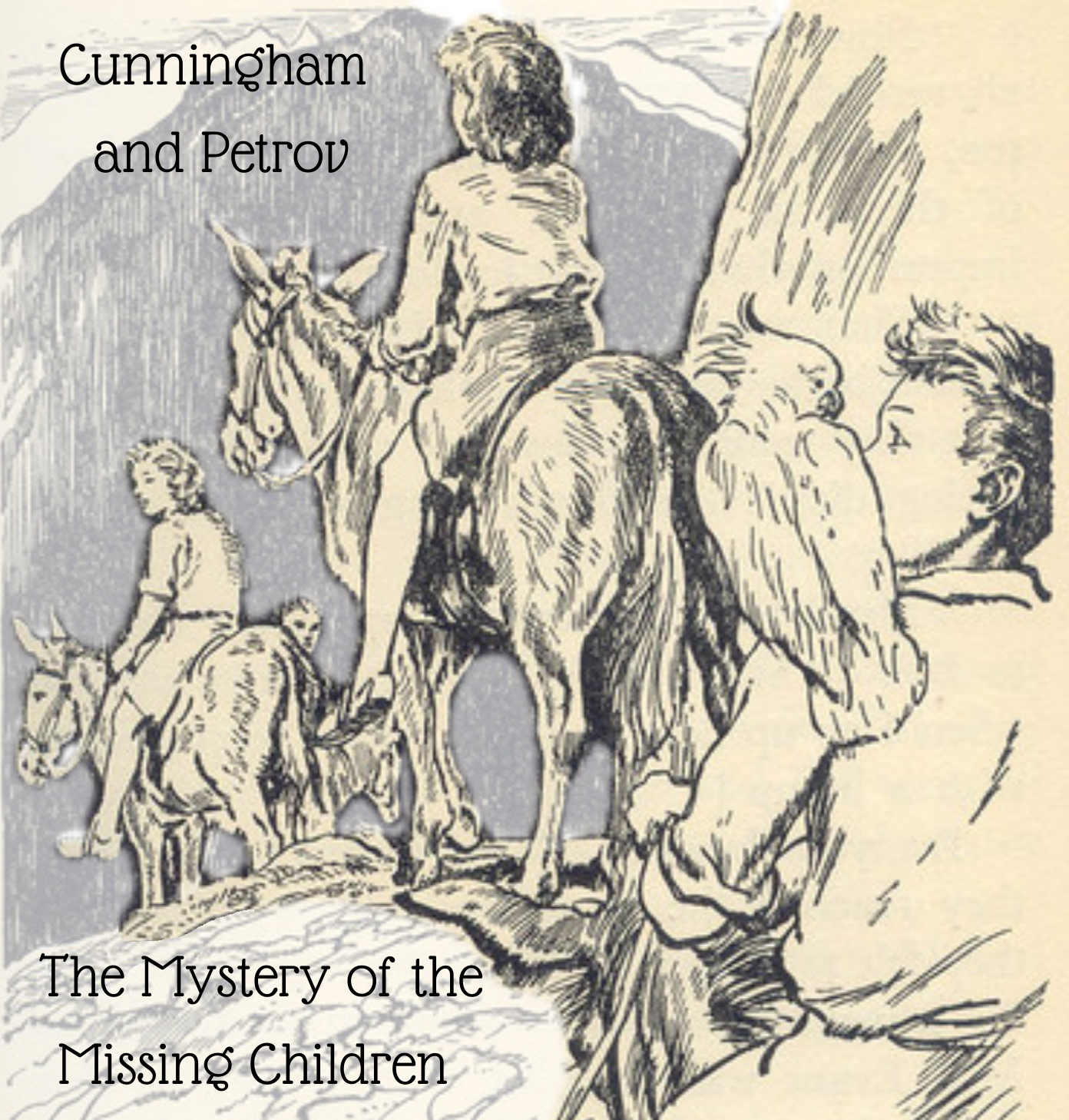






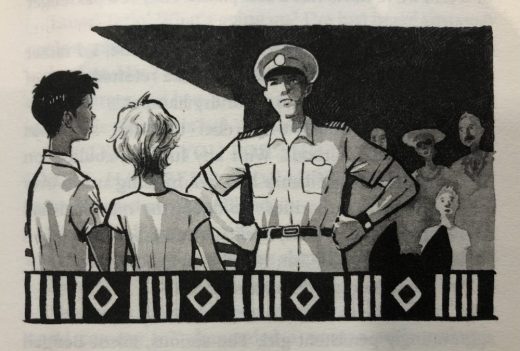


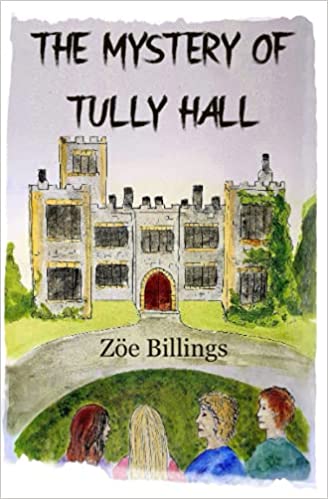


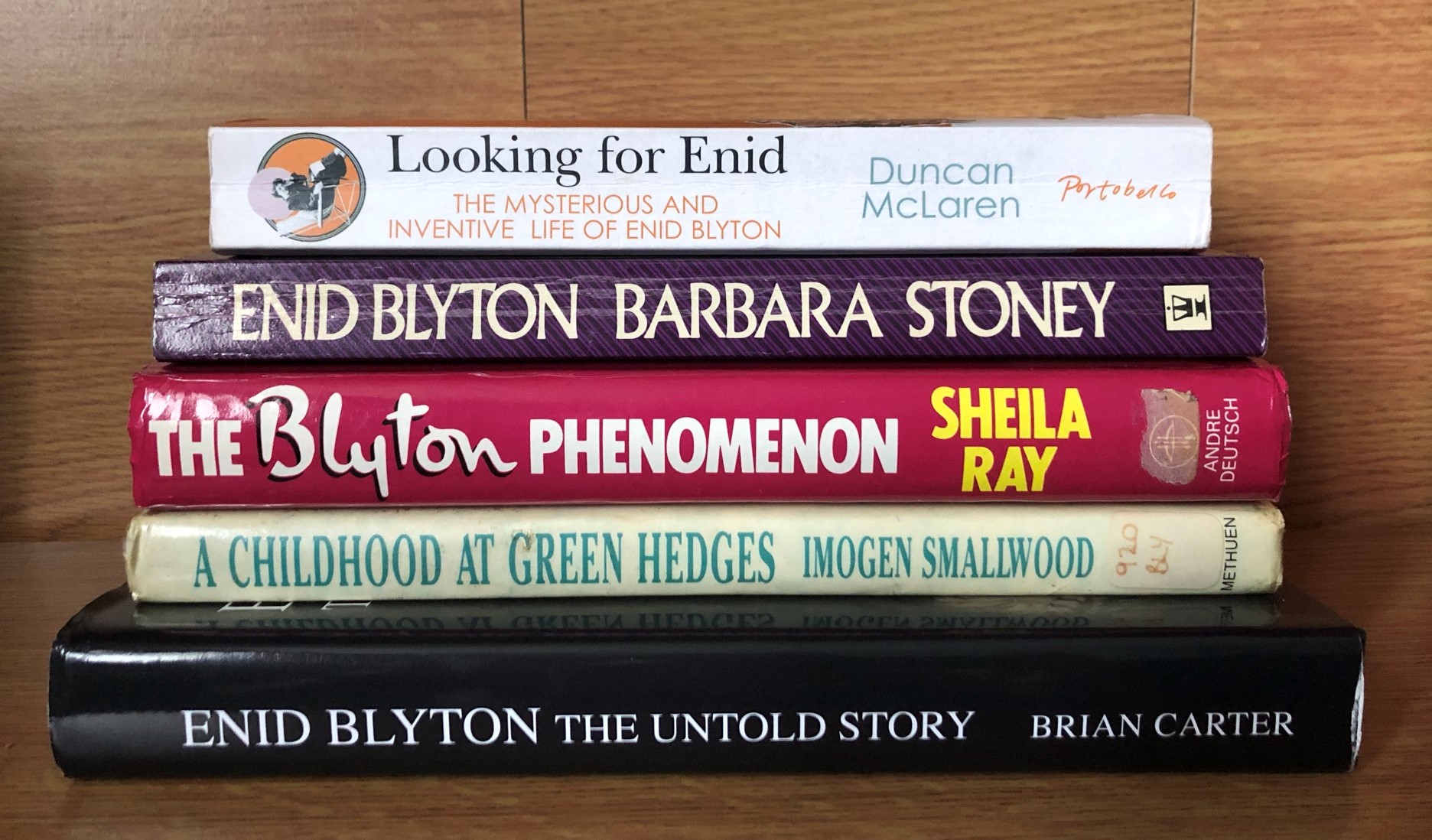


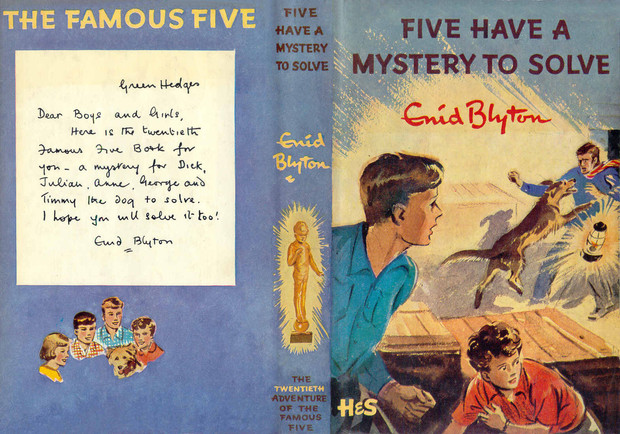


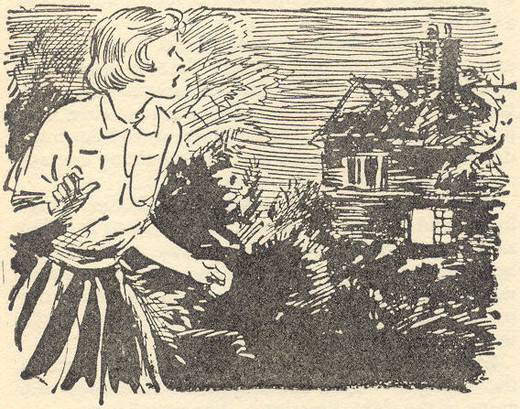


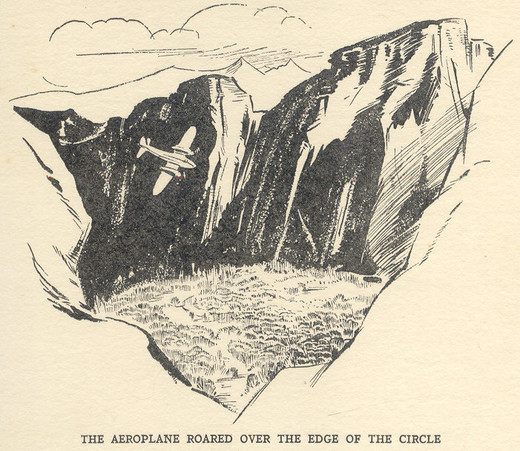


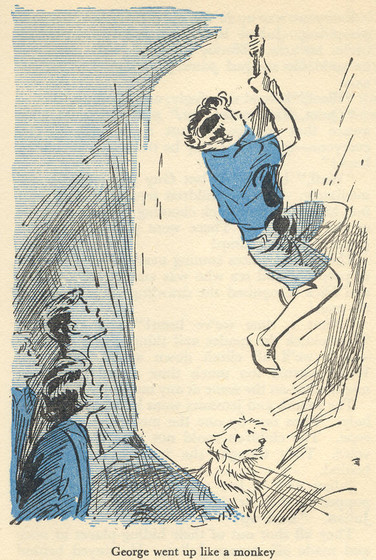


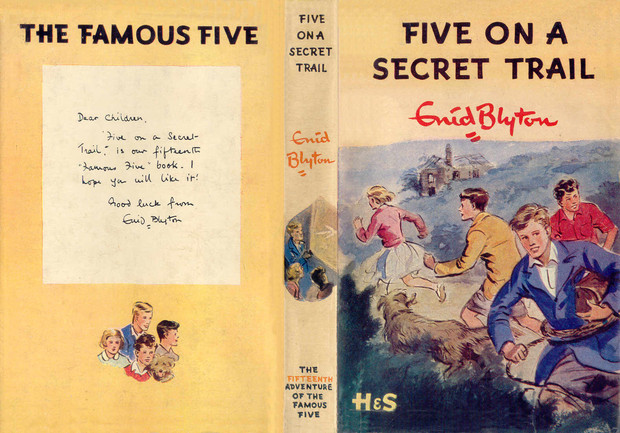


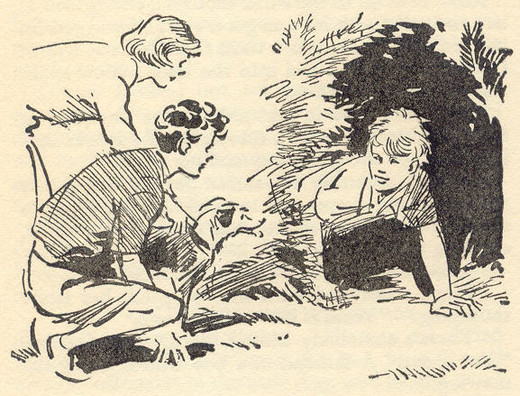
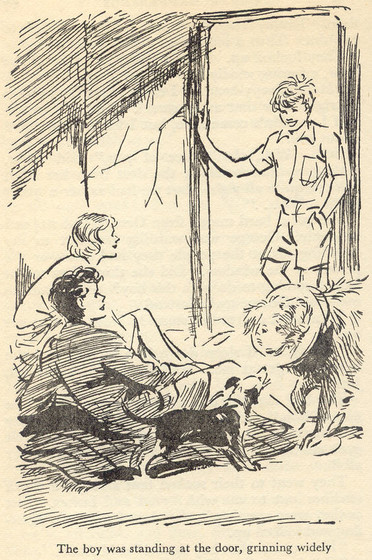
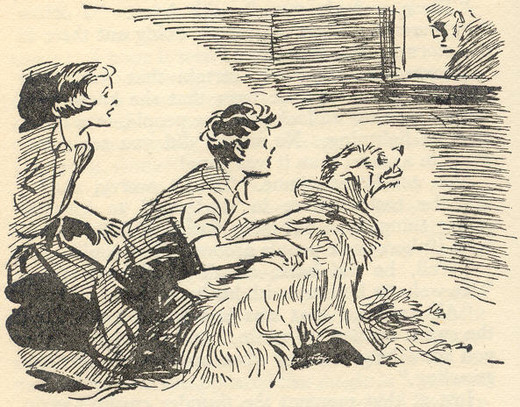

 Fiona
Fiona pippastef
 worldofblyton
 World of Blyton