Famous Five 70s Style: Five Get Into Trouble, part 2

So here we are looking at the second part of Five Get Into Trouble, and I feel safe in saying that this two-parter has to be one of the best. Now, grab some ginger beer, a sandwich and read on while I try to explain why!

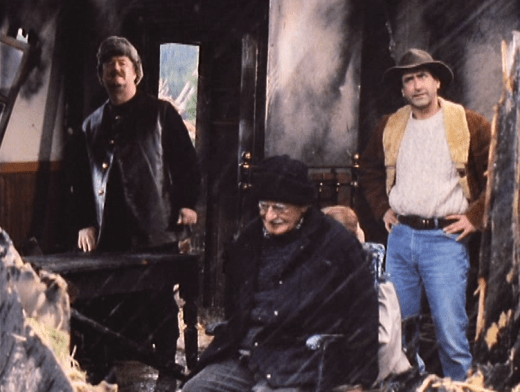
Dick (Gary Russell), Timmy (Toddy), George (Michele Gallagher) and Richard Kent (Grant Bardsley) on their bikes in Five Get Into Trouble.

Dick (Gary Russell), Timmy (Toddy), George (Michele Gallagher) and Richard Kent (Grant Bardsley) on their bikes in Five Get Into Trouble.

The Bad Guys

After the ending of the last episode, we’re brought smack bang back into the middle of Owl’s Dene and the mysteries that are overflowing. The Five are reunited, as in they are all under the same roof. Dick is still being kept prisoner  and the others have tagged along with Richard Kent. The smooth talking Mr Perton in my mind is one of the most dangerous criminals the Five ever face because he is a calculated criminal with real brains (even though in the book he is called the cat’s paw – but let’s just assume that he is the brains behind this operation). In fact this is closer to the way things are in the book than the 90s series because Perton is the brains, in control, calm in both this adaptation and the book, whereas in the 90s version, he’s more a bumbling idiot and Rooky is the one who’s seen to be in charge and the brains.

Another thing that is interesting to see how he, Perton, deals with Rooky, Hunchy and Ted and the difference in his attitude between them and the escaped criminal Solomon Weston, aka Solly. Perton (Stephan Chase) does his best to keep Solly sweet as the criminal knows the whereabouts of the valuable Culpepper diamonds that he had stolen.

An interesting fact that I noted from this episode is that Solomon Western is played by Walter Sparrow who has another part in the 90s series of the Famous Five; when he plays the kindly, yet strong minded Great Granddad from Five on Finniston Farm. Just an interesting titbit for you. Both performances are fantastic and he completely nails the two different personas. Walter Sparrow was truly a magnificent actor.

The Contemporary Feel

So first off, it’s clear to see the big changes in the show; the updated clothes, bikes, food, transport, but there are some bits and pieces that make you stop, rewind and reconsider. One thing I hadn’t noticed before from this series is that Marcus Harris, is wearing a necklace. I know, an actual necklace! I felt this was a bit much for our straight laced Julian, but I wonder if it was something that had been agreed by the creative team or whether Harris just decided to add it to the part or forgot to take it off! I would love to know!

One big thing I noticed when watching the second episode is during one scene where the Five and Richard are stopped from leaving because Rooky has spotted Richard underneath his hat, glasses and sooty hair. The children are all lined up in the kitchen being talked at by Perton and Rooky, when Julian starts standing up to Rooky he receives a punishment for his smart mouthed nature. As Rooky walks past Julian, he elbows him hard into the ribs. Now this is something we never see in the book, or in the 90s version – in fact no one lays a finger on anyone really in the 90s version – but in the 70s, there is much more rough and tumble with the cast and the baddies. I think it might have something to do with the changing times as well as the fact that the bad guys could be seen to be more violent, even towards children. However it isn’t just Julian who receives some violent treatment: in fact Richard Kent is manhandled quite horribly when Rooky is washing the soot out of his hair and Dick is brought down from the attic in quite a tight grip by the looks of things. The boys certainly have more to deal with in this series.

The Plot

Now down to the nitty gritty, the plot. Last week I said I wasn’t sure how the show would cram so much of the book into a 25 minute slot, and surprisingly it did really well. There are some key elements that are left out, giving Aggie the money, feeding the chickens, getting secret food parcels from Aggie in the garden, but the time constraints are never friendly in these cases. It’s a secondary story really that doesn’t really add or take away from the main one. However, all the key parts were there, the children discovering the boot was big enough to hide Richard in, Julian exploring the house at night and finding the secret room where Western was hiding so that he could put the others in there for safety, and not to mention Richard making a dash for it out of the car and running away from Perton, straight into the police station.

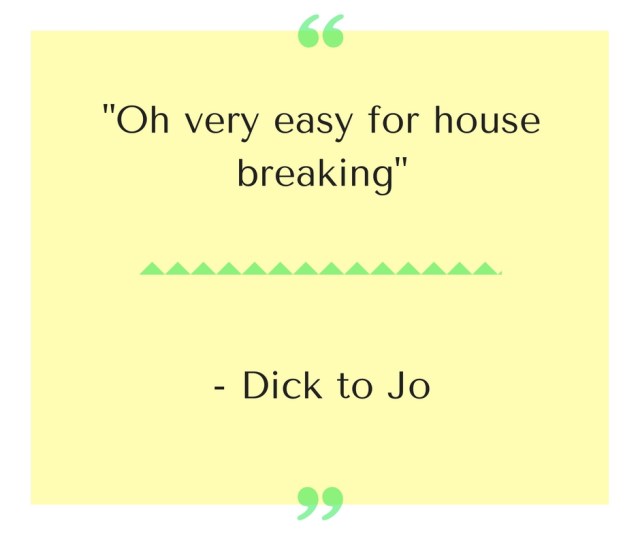
Another thing I like about this adaptation is some of the dialogue that comes out at the end. A bemused Perton, trying to work out how he had been outsmarted by a bunch of kids, and ultimately blaming Julian, threatens him only to receive such a sharp quip in return: ^E310DF688A24B5BB8F5A142B53F0341EFCAEDB0029DE375918^pimgpsh_fullsize_distr

Its just that moment of pure cheek that comes out of Julian, knowing that he has outsmarted this man, and done the right thing. Cool as a cucumber, aren’t you Ju?

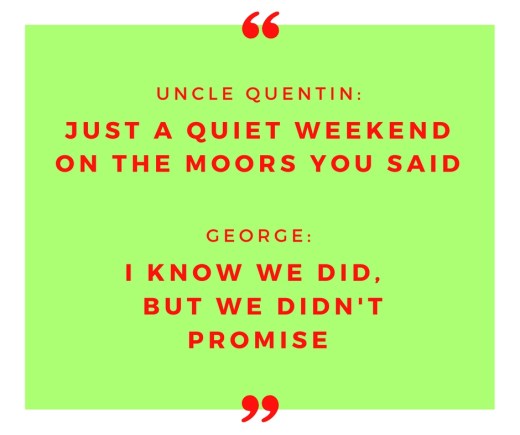
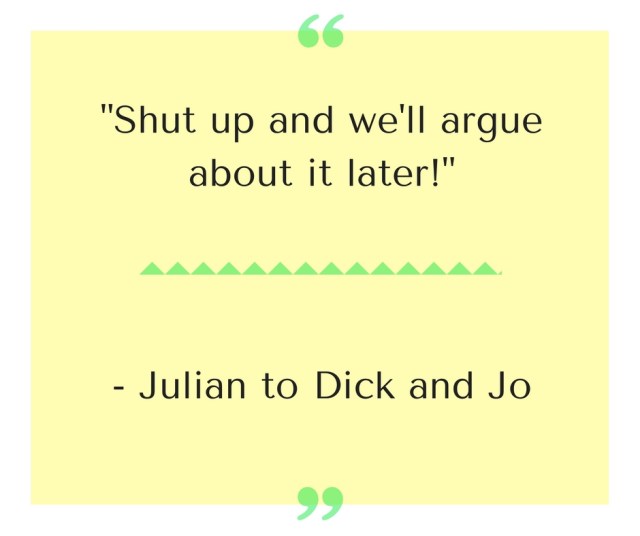
Another good quote I enjoyed came from all of them really, the characters working together to create such an enjoyable last scene, that ends in the usual laughter. The inclusion of Uncle Quentin just tops off the scene as you can see he just doesn’t believe a word the children are saying and is just one of those ultra magic moments that charms you into the series, and keeps you there.

^FFBAD2C6C1B1F49A7157488502E0DE6F41DB0C24DD31BE296F^pimgpsh_fullsize_distr

I think that has got to be a contender for the ultimate Famous Five TV series quote. What do you think?

Anyway, Five Get Into Trouble did its job wonderfully, and provided great story telling and viewing to make a damn near perfect episode, or two. These two episodes truly deserve five whole stars!


Posted in Blyton on TV | Tagged , , , , , , , , , , , , | 3 Comments

Real Fairies borrowed from Dundee Free Libraries

This is the gem of a book that I discovered in the secondary stock of my library. As I said in my previous post I truly didn’t expect the book to be the one I was thinking of. It would have been too easy for it to have been a mistake in the catalogue record, or a later reprint that I didn’t know of. And yet – it turned out to be exactly what it seemed. Somehow, in a library system where the majority of children’s books date from the 80s or later it seemed unlikely I would get hold of a rare – and somewhat obscure for Blyton – 1920s poetry collection.

The editions of Malory Towers etc that I borrowed from my community library in the 90s are no longer part of the library’s collection. Children’s books naturally get grubby and damaged more quickly than those from adult lending, and therefore get replaced sooner too. (They also seem to get lost and never returned more often too!) Perhaps it’s the relative obscurity of Real Fairies that has let it remain part of the collection for all these years.


DUNDEE FREE LIBRARIES

Dundee Free Libraries (Now Leisure and Culture Dundee, though it has gone through several incarnations including Dundee Public Libraries, Dundee City Council and Dundee District Libraries) acquired the book for its Central Lending Department on the 20th of February 1926, so it has been in their possession for ninety years now!

DSCN6409

Inside the front cover is a pasted in sheet headed Dundee Free Libraries, which details the specifics of the lending policy.

Fourteen Days allowed for reading this Work.

A Fine of One Penny for every week or part of a week it is kept beyond that time.

Should the Librarian or his Assistants find that a Book has been damaged or destroyed when in the possession of a reader, they are instructed to exact a payment equal to the amount of the injury – if that be repairable – or compel the reader to procure a new copy of equal value.

The Committee requests the Readers to give notice to the Librarian when they observe the margin of the leaves or other parts of the Book to have been written upon, the plates or leaves torn or abstracted, or the Book otherwise mutilated or damaged.

Borrowers in whose homes there is an infectious disease must deliver books and tickets in their possession to the Sanitary Authority of the City and not return them to the Library.

I’m assuming that dates from when the book was first acquired by the library (clearly in an age when librarians were mostly men!).

DSCN6410

The date due page is headed Dundee District Libraries and has only one date stamped on it – 7 Feb 2000. That is presumably the last time this book was borrowed, though I don’t know how many times it was issued before that. I should have checked Spydus (the computer software for the library catalogue) but that record would probably only go back as far as whenever it was installed.

The due date page also carries some lending information – though it’s much briefer.

Damage to books and fines according to the scale laid down for overdue books, will be charged to the borrower.

If a notifiable infectious disease occurs in the home, return the books to the Public Health Department, not the Library.

That must be quite an old insert, though, suggesting the book wasn’t borrowed through the 90s. I’m saying that because I’ve got a couple of Gillian Cross paperbacks which have 19 Feb 2000 and 28 Dec 2002 as their first date stamps, and they have much newer inserts which don’t mention infectious diseases.

The Real Fairies due date page also has a folded pocket – which still contains the issuing card. I’m not sure if I remember using those cards to borrow books, but I certainly remember playing with old ones belonging to my parents.


REAL FAIRIES

Real Fairies is a short poetry collection, and one of Blyton’s earliest works. Child Whispers (1922), another collection of poems, was the first book she wrote. Responsive Singing Games then came out in early 1923, making Real Fairies her third published work.

It contains thirty poems, though not all of them are about fairies. The majority do feature fairies, elves and pixies but there are other childhood topics in there as well.

DSCN6413

There is also an interesting introduction from Blyton at the start.

The welcome which was accorded to Child Whispers, the forerunner of this book, lead me to hope that not only will my friends, the children, equally welcome this one, but also those “grown-ups” who love childhood in all its moods. A little child, with his wondering, sensitive mind, is the loveliest thing in creation. This book is for him, and for the pleasure in glimpsing the ingenuous workings of his mind, and are helped thereby to a better understanding of childhood.

The first poem is entitled Real Fairies too, and puts me in mind of the Cottingley Fairies hoax of 1917. It is about a child who sees fairies in the garden, yet her parents, Nannie, Cook and gardener never see them.

It was interesting to read such an early collection of poems and I do feel that her writing style (at least in poetry) did develop over time. I can’t put my finger on it, but these poems seem a little differently written from those in The Enid Blyton Poetry Book (1934). It is perhaps that almost every poem is written in the first person. Some in the EB Poetry Book are, but not nearly as many.

The poem that stood out the most to me is the very last one, called Little-Place, about a child who finds a secret, special place to play.

This summer I went out alone, to play in Cuckoo Wood,
For now that I am eight years old, my Mummy said I could;
And, oh! I found a lovely place, all carpeted with moss,
And through the middle flowed a brook that I could jump across.

It goes on to how the child played there every day, seeing robins and rabbits and butterflies.

And then, one summer’s day, I found some other people there,
And orange peel and paper bags were scattered everywhere.
My little brook was muddy brown, the buttercups were dead;
And all the birds and butterflies had taken flight and fled.

The child tries to reclaim the special place, burying the rubbish and so on, but to no avail.

It looked the same, but oh! it had a different feel
The feel those people left behind, with paper bags and peel.

And then I knew that Little-Place belonged to me no more,
For never would it feel again as it had felt before.
And when I said good-bye and went, the tears ran down my face,
Because I knew I’d never come again to Little-Place.

 It’s such a sad little poem! The ‘other people’ may well have gone on to be the trippers to the Secret Island, I suspect. It just struck me as a very sad poem to end on, with that little child having lost their special little place.

To Nurse is another one that stands out, as it has perhaps more attitude than I would say is common. It is from a child’s perspective, arguing that she can’t be slow when the wind is blowing her about, that she can’t be quick when the bread and butter is thick, and she cannot be good when the nursery is hot and she is bored. It ends

When I’m dressed in Sunday’s frock,
And my best shoes slip just like ice,
When both my garters hurt at once,
I simply CAN’T be nice!


I’m so glad I found this and was able to borrow it. I probably would never have come across a copy otherwise. I only wish I could keep it now!

It also provides a fascinating glimpse into libraries of old. I thoroughly intend to look at other old titles still in the collection to see what I can learn.

Posted in Poetry | Tagged , | 3 Comments

Monday #180

Bank Holiday Monday has come upon us and it’s the last one of the year before we get drawn into that autumn feeling. Still I hope that you’ll sit back and enjoy our blogs this week.

Fiona is planning to review Blyton’s Real Fairies book which she found in her library last week from where it was hiding in her overflow shelves. I’m sure we’re all looking forward to what she’s got to say about it.

I will be reviewing the second part of Five Get Into Trouble from the 1970s series. It’ll be interesting to look at how the rest of the story is done after such a successful first half.

One last thing before I go; as of this week we have recieved 2000 comments on the blog, across our various posts. Our 2000th blog comment was made by Chrissie. So we just wanted to say a huge thank you to everyone who reads and takes the time to comment on the blog. You guys are the reason we keep writing.

Hope you’ll join us this week for the blogs.

Posted in Blog talk | Tagged , | 5 Comments

Best of Blyton at the library

I’ve started my new job in a library now, and I’ve been taking full advantage of my access to all those books! In a quieter moment I ran a catalogue search for Enid Blyton and it came up with 264 hits over the 14 libraries.

I’ve listed the ones I’m most interested in below.


ADVENTURE SERIES TV TIE-INS

Written by Hugh Morgan, these are novelizations of the 90s TV series. All eight were published, but my library has just the two. Seeing as I just watched the Island of Adventure episode, I’d be interested to see if the novelization adds anything to the overall story.

the-island-of-adventure-tv


MALORY TOWERS AUDIO ADAPTATIONS

I think these are the same adaptations that Stef has reviewed, but I would like to listen to them myself and see what I think.


MALORY TOWERS CONTINUATION NOVELS by PAMELA COX

I’m not sure that there’s anyone who could really and truly capture Blyton’s characters and writing well enough to convince me they are worthy of having her name on the front of a book.Yet, I’d still like to read these continuations. These books pick up after Darrell, Sally and co’s last term at Malory Towers, then seem to focus on Felicity who is in her third year to start with. The blurbs make them sound rather like repeats of the original books – a new girl with a secret, a thief in the fifth form and so on, but the last one sounds interesting at least.

After taking their Higher Certificate, the sixth formers want to relax this term. But the Head has a surprise: a finishing school course, with old girl Gwendoline Lacey as teacher. Yet someone is determined to drive her out — and it takes the return of Darrell to solve the mystery.


ST CLARE’S CONTINUATION NOVELS also by PAMELA COX

There are three of these, filling in the gaps in the St Clare’s series, and my library has two. I think, potentially, these would be harder to believe in than the Malory Towers books as they slot in-between other titles and presumably feature all the main characters. That requires an even bigger skill in capturing personalities and atmosphere.

kitty-at-st-clares


THE NAUGHTIEST GIRL CONTINUATION NOVELS by ANNE DIGBY

The library has the first four novels out of the six that have been written. Some of them sound rather modern – girls called Kerry and Emma, waterpistol fights, a campaign to save a tree in the school grounds – but the first few sound closer to the sort of things Blyton wrote about.


ALSO OF INTEREST 


enid-blytons-holiday-stories

Enid Blyton’s Holiday Stories. This is one of the new themed collections that have been published by Hachette recently (including Christmas Stories and Summer Stories amongst others) and contains a host of short stories from publications such as Sunny Stories for Little Folk. It also contains At Seaside Cottage, which is a story about Janet and Peter before they formed the Secret Seven. That’s something I’d like to read, but it would be nicer in its (hard to find) original form.


the-riddle-that-never-was


The Riddle that Never Was – formerly known as The Mystery that Never Was – is part of a six book series created from stand-alone titles. Gillian Baverstock (Blyton’s elder daughter) edited each of them to form a series about the same children. I have read the original, so it would be interesting to see how it has been changed.


AND A FEW THINGS I’M PROBABLY BETTER AVOIDING

The first Famous Five Adventure Game I read/played the second in the series and didn’t think it was particularly good, however, my need to ‘complete’ series is making me want to borrow this too.

The Case of the Bogus Banknotes just one of several Famous Five on the Case titles the library has. I don’t think I could stomach a ‘Blyton’ story about bogus anythings.

Bizzy and the Bedtime Bear is another crazy continuation, this time of the Faraway Tree series. There are seven sickening-sounding titles in total. How revolting does this sound?

Recovering the Bedtime Bear from the Sleepeez who live there won’t be easy. Especially when the Faraway Fairies are accused of being ‘party poopers’. They need to put this adventure to bed quickly when Talon the Troll is ready to take advantage of any mistake.

The Island of Surprises is a Wishing-Chair follow up (one of six). These feature Jack and Jessica, and a Pixie called Wishler. They sound marginally better than the Faraway Tree continuations, but that’s not saying much!


AND THE ICING ON THE CAKE

real-fairies

I didn’t truly believe that this Spydus record would turn out to be true. It doesn’t exactly contain much detail, and at the time I viewed it it was apparently in transit from the Children’s Centre to Leisure Reading. It turned out to be amongst the other Blytons in the secondary stock area (where all the books that don’t fit out on the shelves have to live) and amazingly, it is indeed a 1923 copy! I’m going to do a proper blog about it later, so I won’t say anything more about it now.


I can see that I’m going to be very busy borrowing books now – thankfully as a staff member I can borrow up to 30 books and don’t get fined if I bring them back late!

  • Does your library have any good Blytons in its stock?
  • What gem would you love to discover on your library’s shelves?
  • Would you borrow any of these if you had the chance?


Posted in Other Authors, Reading Recommendations | Tagged , , , , , , , | 4 Comments

Famous Five 70s Style: Five Get into Trouble, part 1

Five Get into Trouble is one of my favourite books; the complex plot, the danger, the really really bad crooks – plus all the mystery – makes it one super adventure. So I have to say that the rushed twenty-five minute adaptation of it in the 90s is not my favourite. We lose a lot of the mystery and back story, which is why I may prefer the 70s version where it’s split into two parts.

First of all we are treated to a nice friendly scene where the Five are about to set off and Aunt Fanny is fussing around George to make sure that she hasn’t left anything behind. Uncle Quentin is doing something mysterious to Anne’s bike, something that looks a bit like checking the tire pressure. Well fair enough, it needs to be done, but what’s the point? In the book Uncle Quentin only shows a passing interest in the Five and their trip only because he remembered that he had always had a puncture when he was younger.

So off we set with a lot of fussing from Aunt Fanny, and Timmy on the back of George’s bike on a special saddle. This is a completely new invention in the scheme of things; I wonder if Uncle Quentin thought of it. Anyway, off they go and its not long til we’re treated to that nights camp and the morning after. George is steadfastly still asleep with her head poking out of the tent, Anne is cooking and the boys are swimming in a lake, and complaining that the water is cold.

Enter Richard Kent.

Now I hate his character at the best of time, but Grant Bardsley makes for a very very arrogant, annoying, self entitled git of Richard Kent. Now, that is fair play to Bardsley because there isn’t much scope with a character like Richard Kent, but it makes the arrogance seem really real, and yet by the end of the episode he is beginning to shift and crumble into the scared little boy we know him to be. To begin with however, Bardsley makes Kent try to appear larger than life, inviting himself along with the Five without so much as a please, or my name is.

Bardsley works well to bring the arrogance of Richard Kent to the screen and not to mention there is something about him that you just don’t trust. The way he evades questions about his mother and his aunt is suspicious to say the least and quite frankly I don’t trust the little rascal. Julian gives him more than enough chances, more than I would that’s for sure, especially if this particular person had been the reason my brother had been kidnapped. I suppose we shall what happens to Richard in the next episode, and we shall find out if Bardsley manages to pull it off.

Character Development

Its nice to see Marcus Harris’ Julian interpretation come into its own here. The fact that Trouble is in the second series just demonstrates how much the cast has grown. Harris is beginning to demand a larger role in screen time, and is beginning to have  a mustache. He puts Bardsley’s Kent in place without needing to raise his voice, the presence he is now demanding is quite impressive. You know he’s in charge and this is a Julian who is not to be meddled with. Harris proves this later on in the episode when the Five find their way in Owl’s Dene where Dick is being held prisoner and he starts to talk to George, driving the ghastly Hunchy to get even more angers and threats to beat the children. Harris provides a strong, in control Julian that the rest can get behind and back up. This is completely different to Marco Williamson’s Julian who comes across as more of a caricature and the others undermine and argue with. The difference is phenomenal.

The dynamic between Harris and Gary Russell at this point is much more brotherly and in fact less awkward than the first series where Russell was simply following orders. Like Harris, Russell demands an on screen presence that really brings Dick to life. However this isn’t a Dick like Paul Child’s over compensating characterization, this is a Dick who’s growing up with respect for his brother, and fewer less noticible issues. In fact the boys are more like friends here than brothers, which helps the dynamic. Harris and Russell aren’t relying on each other as much now and are less of a double act but still work in a near perfect balance.  As a side note, can I just say that you can really see the shift in the times between the 70s and 90s adaptations, the change in dynamic between the fives and the focus on the story and characterization. For a sociology graduate, its utterly fascinating.

Overall

I quite like this episode, and the attention to detail is outstanding and actually the slow start to establish the story is effective and doesn’t feel drawn out. Its a wonderful adapation of the book and I like it not being rushed, drawing the characters out and showing us how they’ve changed and developed. I hope this follows though into the next episode and it isn’t too rushed with the storyline as they’ve got a lot to happen in that episode. Fingers crossed eh?

maxresdefault

Dick (Gary Russell), Timmy (Toddy), George (Michele Gallagher) and Richard Kent (Grant Bardsley) on their bikes in Five Get into Trouble.

Posted in Blyton on TV | Tagged , , , , , , , , , | Leave a comment

The Mystery of the Burnt Cottage: How has Blyton’s original text fared in a modern edition? part 2

This week I’m back with the Five Find-Outers to see what else has changed. The first post can be seen here.

To remind you – my personal copy is a Methuen from 1957 – the 12th reprint/impression of the original edition. The new copy is the most modern of any paperbacks I have used so far, an Egmont copy from 2014.


CHAPTER THREE: THE FIRST MEETING

Nothing too major to report for this chapter.

As per usual, hyphens are being removed from phrases. Summer-house is now summerhouse (except for the first time it is used, when it’s left with its hyphen).

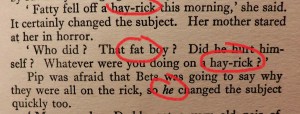
When Bets is enjoying being one of the gang it is referred to as being one of the Big Ones. Generally random capitals are frowned upon – especially by me – but in this case changing that to one of the big ones means it loses some of its impact.

DSCN6302

Like the previous chapter fire it has been changed to set fire to it. 

Previous books have taken out a lot of the italics Blyton used for emphasis – and it happened twice in chapter two of this one as well. In this chapter we had it’s his mystery which has now lost the added emphasis.

Lastly something that will carry over into the next chapter too. Larry plans to drop a shilling so that they can pretend to be hunting for it in Mr Hick’s garden. This has been changed to drop a coin on both occasions it is mentioned.


CHAPTER FOUR: CLUES – AND CLEAR-ORF!

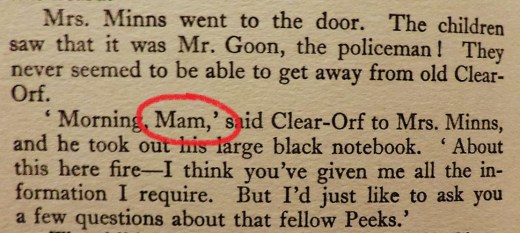
The shilling/coin change becomes silly in chapter four. Larry now says look for my coin, all of you, answers my coin to Clear-Orf’s question of what they are looking for, then Ah! My coin! when he finds it, and lastly, I’ve got my coin now. 

DSCN6301

Nobody drops a pound or fifty pence and says I’ve lost my coin (unless, I suppose the coin was of some historical value – but then you’d say I’ve lost my ancient Roman coin. Sometimes using a vague reference to coins or money works in updating, but in this case it doesn’t at all. If he had said my money it wouldn’t have sounded so silly, or he could have been specific and said a pound.

When looking for footprints in the garden it is said that There were none on the path, which was made of cinders, and showed no footmarks at all, of course. The 2014 book only says There were none on the path. I can’t understand why, unless they think that children will be stumped by a cinder path. It could easily have become gravel, which wouldn’t show footprints either.

In the original text Fatty says he won a prize for Art. School subjects always seem to be capitalised in Blyton’s books but are lower-cased in the modern reprints including this one.

While Fatty hasn’t been called fat in these chapters (not even when squeezing through a gap in the hedge) Larry’s joke about the art of  [Fatty] eating too much has been removed.

DSCN6300 circled

The hyphen is also lost from tea-time, but instead of the more common tea time they have rendered it as teatime.

And lastly – they have clearly decided all italics must be abolished.

  • You haven’t found a thing
  • This must be the print must
  • Yes he is clever
  • I would not have said
  • You nearly made me go green
  • You’d say we had been looking

Perhaps Blyton did use rather a lot of italics for emphasis, but I can’t see the harm in that. It’s all in direct speech from the children and it’s only natural, when speaking, to emphasise important words. Without the emphasis many of these lines fall rather flat.

Strangely, the reference to Mr Hick having a man-servant hasn’t been changed. Most references to servants and maids have been changed to staff or other more modern terms.


CHAPTER FIVE: FATTY AND LARRY LEARN A FEW THINGS

This chapter is surprisingly light in changes.

Italics are removed from two further phrases:

  • What about me?
  • She simply could not remember

Th only other changes are where Fatty talks about Horace Peeks. Thomas, the chauffeur talks about him as Peeks, and Larry asks who is Peeks? Fatty calls him Mr Peeks on all subsequent occasions, and he is also Mr Peeks in the ‘thoughts’ of the two boys.

DSCN6312


Seeing as many of these changes are just repetitions of earlier ones, the count is only 15 for these four chapters. Adding that to the previous ones we get a total of 37.

And – disclaimer! I haven’t drawn on any books, promise!

Posted in Updating Blyton's Books | Tagged , , | 7 Comments

Monday #179

OUR NEWS

This week our blog reached the magic number of 200,000 views. This may seem like small change to all those big professional bloggers out there, but we’re thrilled that we have built a small but steady readership for our admittedly niche blog. Our yearly views have continued to increase and we are on track for our best year yet.


COMING UP THIS WEEK

wedfrisun (1)

As you can see, we have an extra post this week! I had an evening of inspiration and couldn’t wait to write about the Blyton books at my library.


HAVE A GREAT WEEK!

Posted in Blog talk | Tagged , | 1 Comment

The Mystery of the Disappearing Cat

The Mystery of the Disappearing Cat

The Mystery of the Disappearing Cat

Well it’s safe to say I found my copy of the book, and as I had the day off on Monday due to my tootling up and down the country during the weekend I thought I would get on and read my copy of The Five Find-Outers and Dog; The Mystery of the Disappearing Cat. First of all I had to find the book, I knew it was somewhere, but as I have three possible places for Blyton books, I was going to have to search. Let’s just say by a stroke of luck it was in the second place I looked. Thank gosh it wasn’t the third otherwise I would have been ‘most put out’.

Now my first thoughts when I sat down to read this I couldn’t help thinking what a wishy-washy title it was, it doesn’t sound exciting at all and I hate to say it, I was right. What a let down! Fiona thinks this is weird but if the book is well written but I don’t like the story, I will still read it, and in good time. Now with the Disappearing Cat, the writing is Blyton at her best, the words carry you along and you want to gobble up the story but the actual plot is disappointing.

From the off I could have told you who the crook was, and that Goon was being an idjit and couldn’t see beyond his hatred for the children and their friend Luke. I know no one likes Goon, you’re not supposed to, but why isn’t he disciplined better- he shouldn’t be so dismissive of members of the public and disparaging of the children. If he behaved more like Inspector Jenks then he would get further in his inquiries. I have a hunch it is to show the difference between the educated and uneducated, Goon being the latter and Jenks the former.

You know what – I could go on the clear differences of class for the whole blog if I could, I mean it’s very obvious and even more so in the Find-Outers books than some of the others, I think. If you think about it the fact that the children are smarter than the police constable it’s quite a giveaway. However I should actually go over the story for you.

As with all good adventures it is almost the holidays and Bets is excited for her brother Pip to come home from school, as well as the arrival of Larry, Daisy and Fatty. She has been interested in the young boy next door, who is older than all the find outers, but still a child really. Luke is his name as I’ve mentioned before and he is the gardener’s boy for Mr Tupping who is employed by Lady Candling. Lady Candling is a collector of Siamese cats and has some that make  a lot of money in shows. Her most prized is a cat called Dark Queen who can be identified by having a ring of white fur around her tail where another cat bit her and thus is immediately recognisable. It is Dark Queen as you can guess who goes missing, not once but twice.

Now the way the cat ‘disappears’ under the gardener’s boy’s nose is remarkable, both times, and the children are ingenious at trying to work out how it occurred. Fittingly through all the teasing she endures Bets is the one who finds the main ‘glues’ and helps wrap up the mystery wonderfully well. She notices the smell of turpentine, and that its on a cat that isn’t Dark Queen.

Fatty of course puts it all together before anyone else, and seems to be edging out as the natural leader in this book, even though Larry tries to pull rank by reminding Fatty that he is the oldest. The dynamic of the children has changed from the first book, Fatty is no longer the big outsider, but a settled member of the group now. He is still occasionally boastful and the others tell him to shush, but its not as forceful as before, and as I mentioned he is beginning to take the lead away from Larry. Speaking of Larry, and naturally Daisy, they don’t seem to have much to do with this adventure it is mostly down to Pip, Bets and Fatty – not forgetting Buster  – solve a lot of this mystery without the Daykins having much input.

As someone said in the comments of the Monday post, it doesn’t appear to have a lot of atmosphere, and I have to agree with Chrissie, this is a very flat mystery. It’s all done in back gardens and feels much younger than I suppose it is. Given the age for the target audience is the same as the Famous Five, the Disappearing Cat seems woefully under developed.

Still a good read and I suppose it has decent character development, but the plot is thin, I hope the Mystery of the Secret Room is a stronger story, because its unusal for a series of Blyton’s to lose its spark so quickly.

Anyway, let me know what you think in the comments! Do you like the Disappearing Cat? Am I totally wrong? Let me know!

Next review: The Mystery of the Secret Room

Posted in Book reviews | Tagged , | 6 Comments

The Adventure Series on TV – The Island of Adventure

Several people have told me that The Adventure Series got a better adaptation than The Secret Series did, so here I am about to test that theory.

adventure series dvd


FIRST UP: THE THEME SONG

This sounds like it should be part of a classic 80s film montage, but it is actually quite catchy too. It makes marginally more sense than the one from the Secret Series as well. (My boyfriend did complain about the lack of secret encoooounters!)

Wherever we go only the brave will follow.
Together we stand, that’s what friends are for.
Forever we try, we know the final sacrifice.
Whatever the price,
And when the night falls – don’t be afraid.
But whisper that forever you’ll stay,
Whatever the danger you gotta be strong
So trust in your heart
You can’t go wrong, be true
I’ll always stand by you x 2
I’ll always be true
I’ll always stand by you


THE PRE-CREDIT SCENE

As with all the Secret Series episodes this one opens with a short dramatic scene. A man runs along dark, dramatic cliffs carrying a bag. Hulk Hogan, with grey hair badly in need of a cut, is chasing him. The man trips, his bag explodes sending money flying everywhere. Hulk Hogan laughs.

Can't you just tell this is a baddie? adventure series tv dvd

Can’t you just tell this is a baddie?


MEETING THE CHILDREN

They are playing paintball in the woods when we first see them. Kiki startles them and Jack falls from the tree to get shot at. Jack, Lucy-Ann and Philip already know each other from being at this summer activity camp together.

As a token nod to Philip’s animal taming abilities he rescues a ferret from those plastic rings you get on beer cans. “Careful – it’s liable to bite!” Jack warns in a lovely piece of stiff dialogue, but Philip says he’s good with animals. Not that he encounters another animal for the entire episode.

Lucy-Ann is played by the same actress as Laura from the Secret Series, so if I start talking about Laura, I mean Lucy-Ann. Jack is faintly red-haired and so Lucy-Ann is nothing like him – she also doesn’t look any younger than he is.

The reason for the Trents not being able to go home is that their Uncle Peter has chicken pox and can’t fly home, their Auntie Steph is stuck in quarantine with him. I suppose that’s sort of Blytonesque. He could just have broken his leg, though!

Philip has ‘just moved into a massive house’ so instead of the Trents being stuck with an awful neighbour he invites them to stay with him.

Over at Craggy Tops is a blonde woman who must be Mrs Mannering. I suspect there will be no Uncle Jocelyn and no poor Aunt Polly, then. Joe is a pleasant seeming white man who even offers to pick Philip up from the station, and is helping with the opening of the Mannering gallery.

Philip phones and Mrs M is disconcerted to know he’s bringing ‘two orphans and a parrot’. Joe asks, jokingly, if he won the raffle. And there in an uncle – ‘ancient’ Uncle Joss! I suppose there has to be someone to produce old maps still, unless Jack could have downloaded them to the tablet-type device he has. Uncle Joss is British and a war veteran who is always talking about what fever he had in Rangoon (a little Blyton reference?) and so on. He’s described as seeming grumpy but a good laugh, really.

Surprisingly Dinah runs and hugs Philip – his lack of animals clearly means she likes him more. A somewhat conspicuous open top roadster has been following the Mannerings around – could this be a full-head-of-haired Bill Smugs?


CRAGGY TOPS

Craggy Tops is naturally a bit of a let-down. OK, it’s by the sea but it’s a regular large house – extremely similar to Spiggy Holes. It may actually be the exact same house. It’s neither crumbling nor built into the rocks. I suspect there will be no mattress on the floor of a window-less tower. There IS a cellar at least, which was supposed to be an old smuggler’s house.

"Craggy Tops" and a less than gloomy island. adventure series dvd

“Craggy Tops” and a less than gloomy island.

The Isle of Gloom is rather long and near, and only slightly obscured by fog. Joe openly tells them that it’s no longer inhabited, but there were copper mines over there. He does decline to take them over, though, saying the tides and rocks are too dangerous. I really can’t figure him out. Is he a criminal mastermind? Is he a good guy? Is he a good guy who is being forced into doing bad things?


“BILL SMUGS”

So Bill comes to the gallery opening and introduces himself as Bill Cunningham – not very good secret agent behaviour! He wants to buy a painting of the Isle of Gloom, but Joe tries to tell him it isn’t for sale. Bill charms Mrs M into having the painting now, instead of at the end of the month after the gallery display ends. He takes it back to his shack and lifts the back to reveal… a load of banknotes! I think I see Joe’s part in the illicit goings on now.

Bill, Joe and Allie

Bill, Joe and Allie

Oh Bill… what sort of secret agent opens the front door in the dark and lets himself get cracked over the head? And then lets all the money get stolen! Uncle Joss apparently went out in the night mysteriously… but as I suspected the person who attacked Bill was a woman.

Mrs M takes Bill into town to see about repairing his broken painting frame, but he arouses Jack’s suspicions by coming up with a bird that doesn’t exist. Why he didn’t just say ‘a lot of gulls’ or something… in the book they don’t figure out he’s not a real ornithologist for ages.

Bill and Mrs M are getting on very well, their romance seems to have started already. It’s a real shame they have chosen to make it seem like he could be the bad guy as we then miss out on his natural friendship with the children.

Jake – aka Hulk Hogan – is the framer. The mystery deepens.


SECRET PASSAGES AND THINGS ON THE CLIFFS

The children then do some cave exploring, in a cave that has seaweed six feet long hanging from the ceiling. They also use torches despite it being very bright inside. The hole which is extremely well-hidden in the book could not be more obvious here – it’s the size of a Mini. The boys still manage to blunder into it. At least we get a bit of Dinah/Philip arguing here.

The boys follow the tunnel and end up in the cellars of Craggy Tops.

Uncle Joss goes out wandering at night for some reason and the boys go out as well and see Jake unloading boxes from a boat. He chases them into the caves where they are able to escape to the house. This rather falls flat on screen as unlike in the book he just laughs and leaves them. In the book Jo-Jo sits and waits all day then is horrified that they got past him and back to the house without him knowing.


THE ADVENTURE REALLY STARTS

The children are so suspicious of Bill they want to tell Joe all about it, but Bill then takes them out in his boat. He has a huge motor-boat with a cabin, sat-nav and sonar. This wins the children over a little, though they suspect the sonar-lure they have dropped for him is so he can go back to the island alone and do something nefarious.

I suppose it’s fairly clever – making Bill very suspicious and later having Joe seem suss. I’m sure children who hadn’t read the books wouldn’t know who was up to what. But why does Bill use children he hardly knows to set up the sonar? It seems very foolish.

After the trip Dinah overhears Bill on his radio and sees a gun through the window. The children steal his boat (they feel justified as they “know” he is up to no good) and go to the island. In the mines they all see money being printed and get caught by Jake/Hulk Hogan.

High-tech forgery

High-tech forgery

The mines seem very modern – all brick walls and proper lighting. They don’t seem at all like old under-sea mines. Jack is the only one to get locked in a room.

"Undersea mines"

“Undersea mines”

The others end up in a mine cart and take a dramatic ride out into the open. The enormous boat is not at all visible or suspicious in broad daylight… no surprise Joe sees them coming back without Jack.

Joe cuts the phone wires at Craggy Tops to stop anyone calling for help. Philip goes off to use Bill’s radio (in the book he goes to get Bill’s help as they trust him, and comes acros the radio by chance). Uncle Joss has been tied up and gagged, and Bill drops bombshell that Joe’s a forger.


THE RESCUE

So, how to rescue Jack? Joe has stolen Bill’s boat. Nobody has to pore over old maps, and there is no sense of history at all. Dinah just glances at a framed map on the wall (a really bland detail-less one which had been left by previous owners) and sees a dotted line between the island and the house. Then they easily find an enormous trap door in the cellars.

Bill is a poor secret agent again and is very loud in the tunnels, allowing them all to be caught. There is lots more pointless torch pointing in perfectly well-lit areas.

Too little night-filter

Too little night-filter

Mrs M returns home to find Uncle Joss alone. “You’d better have a ginger nut, my dear,” he says before breaking the news.

The ?army have been drafted in via helicopter to come to the rescue, and the men do plan to blow up the mines. Bill picks the lock and they get out of the room, while Mrs M bravely goes to head down the tunnel. It’s rather late, though, as the explosives have already gone off causing an atrocious CGI flood to rush through the tunnels.

They escape without having to float their way up a mine shaft, to find that most of the men have been caught by the army. Only Joe is missing and he shoots Kiki then runs away and Bill’s first in pursuit… but Joe falls off a cliff in a clumsy moment (think Gaston at the end of Beauty and the Beast).

Don’t worry, by the way, Kiki was fine.


FINAL THOUGHTS

So. That was… ok, really? It was certainly interesting throughout, and enjoyable.

The downside:

It’s a real pity Bill’s role has been messed with so much, I think that is my biggest problem. I don’t mind having Mrs M in it so much, her gallery being used to hide the forged money was a clever tie-in. Philip’s lack of animals and Dinah’s lack of temper are also disappointing. I may have missed a few details but I was left wondering about the identity of the woman who attacked Bill, and whether Uncle Joss ever did go wandering at night.

The up-side:

The acting was better and there were no creepy monks or strange magics. They did retain a great deal of the original characters and plots even if they had to change them around a fair bit.


Posted in Blyton on TV | Tagged , , | 9 Comments

Monday #178

It has been a busy weekend for me, back and forth to Derby for my goddaughter’s christening has really left me worn out. Luckily Fiona knows what blog she’s bringing you this week and it’s a review for the first episode of the Adventure Series TV show for Wednesday. I’m sure we’re all dying to find out what its like!

I don’t know what I’ll do yet, I shall have a proper think when I’ve had some sleep and see if I can find some books I should read and review. In fact, I shall try and review the second Find-Outers book, as it has been quite a while since I looked at the first one.

I shall leave you with some meadow flowers and blue skies I took some pictures of some time ago in the sun. Hope it brings our sunny weather about once more!

Posted in Blog talk | Tagged , | 1 Comment

The Famous Five 70s Style: Five Go Off to Camp, part 2

L_Dvm140003dLast week I brought you part one of Five Go off to Camp, and this week it’s time for part two.

I suppose the question we’re asking this week is: can the second part of the adventure be as true to the book as the first? Shall we find out?

The start is strong, with a recap of the previous episode and then we start with the boys heading back to camp with Jock after they have been to spot the spook train for the first time. The nighttime filter at this point isn’t too bad, and you can see all three boys clearly as if the scenes were being shot at night, or at least early evening. I suspect by this point the idea is that it’s early the next morning and in the summer things might be getting lighter.

The row between the boys and George kicked off in the last episode, and comes to a head in this episode when Julian, Dick and Jock decide to give the string George has tied across the entrance to their tent a quick tug to wake her up. Poor George is furious unsurprisingly when she realises the boys have been and gone without her. Unlike the 90s episode we are not privy to the row that happens  between them, which is one of my favourite parts. Anyway George goes off in a huff and spectacularly manages to find herself in the tunnel with the spook train!

This second episode feels a bit rushed, as if the producers suddenly realised all they had to fit in, Jock for example is barely given any screen time, or lines, and just follows Julian and Dick around like a young kid brother – in fact the height difference does rather suggest that he was younger than the other two.

Most the the bits and pieces in the tunnel are hard to make out, I don’t know where they filmed that, whether it was actually in tunnels or a set, but the pitch black really doesn’t help the filming. However we do have some good acting from the cast, really working to make themselves look and appear afraid when the men come pouncing out of the tunnel. There isn’t a lot of actual interest in the train, as in the book they get on board to see what the gang are smuggling. That doesn’t happen here, almost immediately after the boys are captured, George frees them and the hunt to get out of the tunnel is on. As I’ve said before its almost as if the producers realised how much they had left to put in and just rushed through the ‘exciting’ stuff.

Overall its a neat little episode, some of the content however could have been used to better effect in the first episode, had some of the faffing around been taken out, but close to the book still, but none of the real excitement and tension you get from the book when the train is discovered and the boys are walking the railway tracks. Some of Enid Blyton’s best scenes (in my humble opinion) are in this book and they don’t seem to have made their way into this adaptation. Maybe it didn’t translate onto the screen, maybe it just wasn’t possible to recreate some of these bits and pieces, which is a shame.

Overall it’s a solid episode but not as good as the first part, which took it’s time, used the best scenes but may have just dallied a little bit when more important pieces of the story could have been used. Anyway, as I say, a solid episode, just a shame it felt so rushed.

Posted in Blyton on TV | Tagged , , , , , , , | 1 Comment

The Ragamuffin Mystery

And so I have reached the final book in the series. As with many of Blyton’s series the last book seems to be thought of as the weakest, yet I’m sure there will be some people who will hold this as their favourite.

the ragamuffin mystery


A CARAVANNING HOLIDAY

Roger, Diana and their mother along with Miss Pepper are going caravanning for three weeks. Mr Lynton was supposed to be joining them but had to go off to America instead (amazing how often parents and relatives have to rush off to the United States when it’s convenient to the plot) and his place has been taken by Miss Pepper. Surprisingly the children are actually disappointed by their father’s absence as apparently he’s ‘so much fun on holiday’. I can only imagine that for holidays Mr Lynton is replaced with a much more pleasant person, as he has only ever seemed grumpy, cross, impatient and, as Diana would put it – mouldy.

Anyway, man or no man, the holiday is on. Mrs Lynton and Miss Pepper are to share the driving. There is only enough room in the caravan for three, so poor Roger will have to sleep in the back of the car. They only manage a brief period of idyllic hols, eating, bathing, and so on before it’s rather spoiled. Mrs Lynton’s sister has been taken ill, and Mrs Lynton has to rush off to her. That leaves Miss Pepper, Diana and Roger with a caravan but no car.

Here the ‘girl power’ of Miss Pepper fails us entirely. We are used to her being no-nonsense and quite capable but now she quite falls apart. While she does make some contingency plans, the only reach as far as hiring a car and taking the caravan back to her own home for the remainder of the three weeks. They can’t go back to the Lynton home as it is shut up and – shock horror – cook’s away so they would have to fend for themselves. Probably one of the most upper-middle class bits of any Blyton story when a nanny can’t fathom taking care of herself and two children without hired help.

Then, Mr Martin (Barney’s father) steps in and Miss Pepper practically swoons at her knight in shining armour. He has a car. He will boldly and bravely drive them to a peaceful sea-side location for their holiday and then collect them at the end of it. He even makes telephone calls to check on Mrs Lynton and her sister, and gets everything organised.

As you may have noticed, someone, or rather two someones are missing. Barney and Miranda turn up with Mr Martin of course, but where are Snubby and Loony? For once they are not with the Lyntons for the hols. Don’t worry, though, Mr Martin even has Snubby and Loony’s whereabouts in hand.


PENRHYNDENDRAITH

He takes the three stranded carvanners into Wales and to a little place called Penrhyndendraith (which I cannot even try to pronounce) where there is an old, half-ruined inn (think Craggy Tops except less wind-swept) an ice-cream shop and lots of golden sand.

The inn is run by Mr and Mrs Jones (look you, whateffer… sorry, wrong book). Mr Jones is a very good cook, his cooking is very good. Very good cooking, he trained in London, he is a very good cook. Mrs Jones is hard to shut up, but eventually she lets them upstairs to pick rooms. Miss Pepper wants the one with the best view, but Mrs Jones is quite insistent that they take their Best Room.

Here’s the next strangeness. Miss Pepper has now regained enough of her peppery-ness to argue with the owner of the inn. She demands to have the room she wants. To be fair, Mrs Jones’ arguments are not the most convincing (why she didn’t just say that room was reserved… well, we know why. It would have ruined the mystery.)

So by now we know there is something up with Miss Pepper and Diana’s room. Mr Jones tells them there are noises to be heard. (Twang dongs, perhaps?)

Barney and Roger are camping in the caravan outside, and soon Snubby arrives by train. Snubby had been staying with the aunt who was taken ill – and needed to be out of the way. Like his first arrival in The Rockingdown Mystery he gets a different train and arrives early. This time he arrives looking even more like  a dirty ragamuffin as he has travelled the rest of the way by hay cart.

And here, at last, the true mystery begins. His clothes are yet to be sent on and the ones he is wearing need washed so he goes to the shop and buys second hand fisher-boy clothing. Thus clothed like another boy in the area, who also happens to have a small black dog, he is ready to be involved in a case of mistaken identity.

Dai, the fisher-boy in question has been asked by his uncle – the terribly un-pc Morgan the Cripple – to pass on a coded letter to someone else.  This someone else is a bearded man who finds Snubby trying to decipher a perfectly innocent coded message from a school chum. Naturally he assumes Snubby is Dai and snatches the letter away.

Snubby is only baffled until he spots Dai and they work out what has happened. It’s all a little too easily worked out, and Snubby getting the letter from Dai is similarly overly easy.

By now two famous and important men are staying at the inn – one of them being the coded-letter recipient. Snubby manages to hide from him for a day or two but is finally spotted. The two men seem shady, and are proved to be so when the famous ornithologist is easily tricked by a few questions about made-up birds.

The two men also hold very loud conversations with Morgan about the missing letter which explains what will happen on Friday night. It’s all far too easy for the children to overhear this and go exploring on Friday night. In a scene almost straight out of Spiggy Holes they go into a cave and up tunnels, then get trapped by the tide. Going the other way, they find a trap door and end up back in the inn.


FINAL THOUGHTS

I think as my review/synopsis shows, there’s a great deal of inconsequential fluff at the start, then the actual mystery is quit short and lacking in depth. There are no real twists or turns. There was scope for the decoding of the letter perhaps or at least some sort of obstacle thrown in their way.

Barney has lost some of what made him different, too. He is now as bland as Roger unfortunately, a little too sensible and ready to squash Snubby’s enthusiasms. He also telephones his father very quickly to ask for help investigating the two men at the inn.

There are also little things clearly re-used from previous Barney books without anyone noticing. The little shop that sells everything is just like the one from Rockingdown, and not too dissimilar from the one at Ring ‘O Bells also, yet they are all amazed. Diana even makes her witches and fairytale comments, without any real merit.

Something I haven’t even mentioned is Dafydd – the little boy at the inn. He and his goose add little to the story other than to pad it out with scenes of Miranda and Loony chasing the goose. He does let Loony out of the caravan, making Snubby identifiable to the men, but Loony could have escaped due to a faulty lock. He also shows them where the tunnel is from the cave – but that’s something they were more than capable of doing themselves given the opportunity.

So yes, unfortunately this is rather a weak end to the series. It’s not a particulary satisfying mystery, it lacks a lot of the humour of earlier titles (Loony doesn’t steal a single mat, brush or towel at the inn) and it is padded out a great deal with the early caravanning to-ing and fro-ing and then the silliness with Dafydd and his goose.

Posted in Book reviews | Tagged , , | 3 Comments

Monday #177

So here’s what we’ve got coming up this week:

wedfri4 (2)

P.S. Is it wrong that I want to print off some of these Enid Blyton activities and do them myself?

Posted in Blog talk | Tagged , | 1 Comment

Famous Five 70s Style: Five Go Off to Camp, part 1

L_Dvm140003d

Famous Five DVD cover part one.

Five Go Off to Camp has been split into two parts – good! I say. It’s one of the more mysterious mysteries, and one that I cannot help but be drawn to. The 90s take on the book was unfortunately short because of the time restraints but there are so many levels to it that some were neglected, such as Anne thinking she’s sitting on a volcano. This is why I am so delighted that the 70s adaptations decided to make it a two parter, written by the very talented Gail Renard, who I have had the pleasure to meet on an Enid Blyton Society Day.

The detail in this episode is next to perfect, there are all the signs of a proper Blyton mystery, Mr Luffy being late to pick up the children, the funny old car that he drives with the trailer attached. Its all very true the book. We don’t see much of the jounrey but when they arrive the children get to camp a little way away from Mr Luffy and their adventuring really begins.

Very quickly the Five discover the deserted railway yard with the bricked up tunnel. They also meet the one-legged watchman, Wooden Legged Sam. He is quite a bit more like the description in the book, being tall and gangly, whereas the 90s series casting doesn’t do him justice. John Barrett was a superb piece of casting. Barrett only makes two brief appearances in the first part of Camp, but they’re enough to get the story moving and make an impression. Wooden Leg Sam is the one to tell the children about the spook trains and that starts the adventure.

I enjoy this story a lot because of the ghostly element to it; the feeling that there could be something completely un-explainable about these trains. I mean the first time I heard the story as a child. I was completely entranced in the ghostliness of it. I wanted to go hunting for the spook trains with the Five.

We meet Jock, who in the books I always assume is older than he appears in the episode. In fact he even looks younger than Jennifer Thanisch who plays Anne, but I am pretty sure in the book that he comes across at least as old as Dick. Jock shows them around the farm and they come across the vans in a barn when one of the puppies decides to run inside. This, as avid readers know, has masses to do with the trains but they are rather forgotten by the Five, especially when the idea of food comes into their heads. Over dinner, when telling Jock about the spook trains Mr Andrews turns up. Now he is very much like he appears in the book, but I found that he didn’t have the gravitas of the character. He is supposed to be the ‘cat’s paw’ but still the man is organizing men, he needs to have a spark. It’s not there unfortunately.

Last but not least (as we have another episode to look at next week) the blow up between George and Julian about George accompanying the boys to the railway yard at night and leaving Anne behind on her own. It’s handled well by Marcus Harris and Michele Gallagher who both know how to act out an argument convincingly. The only thing I didn’t like about this argument is that it took place at the lunch table, and I’m pretty sure in the book it takes place without the possibility of grownups overhearing. Its always an argument that bugs me because common sense dictates that really, they should either pair off, or all go. Now Anne won’t go, and that’s fine, but George could really do with being gracious enough to realize that. However without her hot temper and attempts to follow the boys we wouldn’t have the second part of the adventure really.

Overall, it’s a positive adaptation from the book for Camp, well the first part anyway. We shall see what happens with the next part next week, but so far the 70s series is really coming off as the better adaption of Blyton’s books than the 90s series. Let’s hope the praise continues.


Posted in Blyton on TV | Tagged , , , , , , | 1 Comment

Noddy at the V&A Museum of Childhood

Two weeks ago on my trip to London, I visited the Victoria and Albert Museum of Childhood at Bethnal Green. I had hoped to see one or two Blyton-related items, and I was not disappointed.


The first thing I found was a double jack-in-the-box toy, in the moving toys gallery. It has Noddy and Big Ears as the jacks.

According to their website it was made around 1960, by Lyons. There isn’t a traditional handle on this, instead there are two catches on the front. The red oval reads press down catches one and two, up pops Noddy – Big Ears too.


Also amongst the moving toys was a Noddy friction car.

noddy friction car


Then I spotted a 1961 Noddy kaleidoscope in what is called the ‘look see’ gallery.


In amongst the soft toys and dolls was another Noddy.

This soft toy doll is by Merrythought in the 1960s.


I couldn’t get a good picture of the next Noddy toy I spotted, as it was in between other items, but there is a boxed Stick Picks game.

DSCN5760

Another game I saw was Little Noddy’s Train Game.

little noddy's train game

2006AU3748_jpg_l

This was made by Bestime in 1958 (though the card in the museum reads 1957).


The only non-Noddy Blyton item was this jigsaw:

DSCN5769

It didn’t have any information beside it in the display, but you can’t fail to recognise it as Eileen Soper’s work. The museum clearly haven’t read anything illustrated by Eileen Soper, as they have this in their archive, with artist unknown!


On browsing the museum archives, they have a lot more Blyton items than they have out. There are cards, posters, books, games, jigsaws and more.

From top left: Noddy in Toyland poster, Noddy lotto game, Noddy stereoscopic slide set, Famous Five poster, Noddy jigsaw, Noddy xylophone. 

If you’re ever in London, I would definitely recommend the Museum of Childhood. It’s free and it will give you at least a couple of hours of fun as you recognise your  childhood favourites and spot some weird and wonderful items you weren’t lucky enough to have.


Posted in Personal Experiences, Toys and Games | Tagged , , , , | 4 Comments

Monday #176

Back to another Monday and another exciting week here at World of Blyton. Fiona’s back from her trip as you know and she’s sorted her pictures and because of this she will be bringing you a piece about the Museum of Childhood, with a look at the Noddy exhibition pieces. I’m certainly looking forward to that blog!

I will be looking at Five Go Off to Camp 70s style as my blog this week, specifically part one because it was split into two parts. Lets hope its as good as Five Go Off in a Caravan was.

I shall leave you with some more of my pictures of Stonehaven and Dunottar castle this week, as once again I’ve not managed to get round to editing any others.

I hope you like them!

Posted in Blog talk | Tagged , , , , | 1 Comment

If you like Blyton: Dead Man’s Cove by Lauren St John

Dead-Mans-Cove-HBB31-403x600I swear I had been planning to review this book a while ago, and by a while, I mean almost two years ago! I certainly have read it before, but I think I just never got around to it.

It doesn’t matter anyway, because I’m going to do it now. So, working in a library gives me the scope of finding these children’s gem’s without necessarily paying to get my own copy. This comes in handy when you’re just not sure how much you’re going to enjoy the book you’re thinking of reading.

In fact, just generally I need to be better all together and remember to check at work for a book before I buy it, but I digress.

Lauren St John is a fantastic children’s author and writes a huge breadth of material, appealing to all children and age groups. The Laura Marlin Mysteries is a series that was born in 2010 and won the title “Favourite Story” in the Blue Peter Book Awards 2011. Now if that’s not a recommendation enough, on the front cover there is a quote from a review from The Times which says “Dead Man’s Cove will delight fans of Enid Blyton.” That was what caught my attention the first time around and I brought it home, read it and clearly forgot to blog about it. How silly of me! Let’s get on then and have a look at the story and characters involved.

Laura Marlin is an eleven year old orphan; her mother died when she was born, and she never knew who her father was – it’s hinted at him being an American soldier who is not likely to know that Laura even exists.  We join Laura on the morning of her moving out of her orphanage to go and live with a long lost uncle who has agreed to adopt her. She gets driven down to St Ives in Cornwall to meet her uncle, Calvin Redfern. He is a bit of a mystery and claims to work for the fishery department keeping an eye out for people bringing in too many fish over their quota, but as you’d expect it doesn’t quite work out that way.  You’re left guessing as to what exactly Calvin is doing for a job and even at one point if he is the baddie in the story, but that’s all part of the classic children’s mysteries that Blyton gave us.

St John gives us plenty of characters in Dead Man’s Cove to keep us guessing as to the actual bad guys. You’re lead to believe that it could be Laura’s Uncle Calvin, the sulky housekeeper Mrs Webb (who reminds me of Mrs Stick in Five Run Away Together,  as in she can cook exceptionally well but has the blackest of moods and is generally very grumpy), and then there are the Mukhtars who run the local store in St Ives.

The Mukhtars are supposed to be the parents of the only friend Laura makes in St Ives when she arrives, Tariq but thanks to the village gossip, Mrs Crabtree, Laura finds out that Tariq is probably adopted and may really be their nephew. Laura also believes quite strongly that they are abusing Tariq and there is something under the apparently innocent facade that is putting her friend in danger. However before she can delve deeper into that situation, Tariq supposedly changes his mind about being friends with Laura and asks his ‘uncle’ to get rid of her for him. Now we’re heart broken for Laura who really needed Tariq’s friendship. After this, secret messages start appearing for Laura and we begin to get embroiled in this massive adventure around the corner.

Without giving everything away I can’t say much more, but all you need to know, World of Blyton readers, is that you need to read this book. It’s a little more modern than I would usually recommend but oh boy, The Times was right, Dead Man’s Cove WILL delight fans of Blyton. You have the absent parents/guardians, a self sufficient heroine, the loyal sidekick in the form of her adopted dog Skye, and plenty of twists and turns. You will never guess the ending and to be honest, given the time between reads I had forgotten what the ultimate ending was. I am tempted now to go and find the second book and carry on reading about Laura and what she gets up to. Just like I did with Helen Moss’ Adventure Island series I now own the whole set and was lucky enough to find most of them in a charity shop in Alton when out with a friend once. Will I be adding Laura Marlin to the collection? I think its a very high possibility.  Please do check it out and let me know what you think!

Posted in Book reviews, Other Authors, Reading Recommendations | Tagged , , , , , | 1 Comment

The Mystery of the Burnt Cottage: How has Blyton’s original text fared in a modern edition?

On Monday I said that I would be comparing The Twins at St Clare’s. Only I discovered, at the last minute, that I had in fact already completed that back in May. I spent about five minutes going what am I going to do instead? as well as saying you idiot to myself. After that, I searched the spare room and found a very modern copy of The Mystery of the Burnt Cottage, kindly donated to the cause by Stef. So that is what I am going to look at instead!

My own copy is a Methuen from 1957, and is the 12th reprint/impression of the original edition. The new copy is the most modern of any paperbacks I have used so far, and is an Egmont copy from 2014.


CHAPTER ONE: THE BURNING COTTAGE

Unusually there is no chapter list in the Methuen edition so I will just have to wait and see if any of the chapter headings are altered as I go along.

As with all previous books I have compared, hyphens have disappeared from a large number of phrases including half-past. Other separate words are joined – some one to someone. I’ve rarely see some one as two words.

Hallo is changed to hello each time, which makes their greetings sound awkwardly formal at times. Hallo sounds jolly and friendly, while hello can sound quite stiff. Lighted becomes lit (again this is usually the case, though both are correct).

Efforts seem to have been made to make the parents look less negligent. Larry and Daisy sneak out to see the cottage on fire, saying Mummy and Daddy are out, so they won’t notice their absence. It doesn’t say, however, that the children are home alone. Presumably the house-parlourmaid or cook would be there, given what we know about the Daykins from other books. Modern children would probably assume that there is a babysitter there.The Egmont edition reads Mummy and Daddy are busy, with the same line about them not noticing the children have gone out. To me, that sounds even worse! If your parents are home and yet don’t know that their two children have wandered off into the night…

DSCN6306

After that, they wonder if Mummy and Daddy are back yet. This has become if Mummy and Daddy are looking for us yet. Again, what’s wrong with two adults going out for a meal or a trip to the theatre? It never states the children were alone in the house.

Likewise, Fatty’s words about his parents have been ‘updated’ too. He said I’m all alone at that hotel originally, meaning that during the day he didn’t have any company. That’s become just I’ll be in the hotel. He also tells the others that his mother and father are out golfing all day. To ‘improve’ that, they have changed it to my mother and father will be out playing golf. So they are still leaving him; but only for some of the day. That’s better, isn’t it?

A couple of references to being fat have been removed (I suspect this will be a common theme). Mr Hick’s cook is originally described as  poor, fat, trembling, and the fat has been removed for the paperback. Fatty is also just a conceited creature, not a conceited fat creature now.

DSCN6307

Lastly, the inn that Fatty’s staying in has been changed to hotel – though it is called a hotel by Fatty in both editions.


CHAPTER TWO: THE FIVE FIND-OUTERS – AND DOG

I was right about the fat issue. The children thought it was a shame that Buster had such a silly fat sausage for a master, now they think it’s a shame he had such a silly master.

 A couple of other lines are cut entirely :

  • the dog’s young master did look rather sausagey and fat.
  •  “I am rather fat, aren’t I?” he said. “I’ve an awful appetite , and I expect I eat too much.”
  •  He had already been Tubby and Sausage at school – now he would be Fatty in the holidays. 

Also, Daisy remarks that F-A-T describes you [Fatty] rather well. This is now it could be a nickname. When Fatty is called plump, conceited and stupid, it is changed to conceited and the rest.

DSCN6308

I’m somewhat torn over all this. On one hand, I hate the amount of ‘body shaming’ that goes on in the media and amongst everyday people. It may not be healthy to be overweight, but that doesn’t mean we should go around shouting fatty at people. Saying that, children can be unkind and will find something horrible to say about other children no matter what. It is also clear that the first unkind references are more because they just don’t like Fatty’s conceited attitude, and are therefore acting as children will and calling him names.

On the whole I would have to come down on the side of leaving the books as they are, as I don’t feel the fat references amount to bullying. Nor at any point is it suggested by the children or the narrative that his weight makes him bad or worth less as a person. He’s simply fat, the same way someone is tall or red-headed.

Incidentally, one reference to the plump boy and one to the fat boy have been left alone. If you’re going to go on a mission to eradicate fat-talk, at least be consistent! From the ones that have been left in it’s clear enough that Fatty as a nickname isn’t just about his initials.

Moving on, the annoying habit of removing italicised emphases is back. The children are shocked that someone would set a fire on purpose. Something is lost when the italics are removed. Consider (not a quote) He did it on purpose? and He did it on purpose? The second conveys much more surprise and disbelief. Likewise, Bets insists that Pip gets Buster a bone and a biscuit. Without the italics, you lose her emphasis on him having to bring both.

In a similar move, some text has been made lower-case. Daisy says that they should set ourselves to find out “WHO BURNT THE COTTAGE”. The capitalised text becomes almost a book-title, it’s certainly an important question. The Egmont edition simply reads
to find out who burnt the cottage. No emphasis whatsoever, and it becomes bland and flat.

Lastly, there are a few minor changes and one correction. Fatty calls Buster sir from time to time, and the one instance in this chapter is removed. I do find it odd that anyone would say come here, sir to a dog, but it clearly did happen at some point in the past. Continuing that line of thought – Fatty is still Buster’s master in the Egmont edition. I’m surprised that isn’t owner now, and Mr Hicks is still the cook’s master, and not employer or somesuch.

Fired, in the sense of some one having fired that work-room on purpose is updated to having set fire. I can’t say I have seen or heard anyone using fired in that context in recent years but it’s clear enough what it means.

The small correction is made to why should be do it? which should of course be why should he do it? It would be interesting to know if that mistake appears in other Methuen editions also.


There was certainly plenty to write about in those two opening chapters. I make that twenty-two changes. As with previous series, I won’t count every time a hyphen or other small change is made, but I will try to only count ‘new’ and ‘unique’ alterations. The only exception to that rule is I will count every time fat/plump etc are removed or replaced, out of interest to see how often they are actually used. I did the same with references to Jo-Jo being black.

Posted in Updating Blyton's Books | Tagged , , | 4 Comments

Monday #175

I’m back from my holiday, so we’re back to our usual schedule again this week. I haven’t yet sorted through all the photos I took, but I will perhaps share some on my next Monday post.

wedfri3

Posted in Blog talk | Tagged , | 2 Comments

Famous Five 70s Style: Five Go Off in a Caravan

Five Go Off in a Caravan is one of my favourite stories; I love the magic of the circus and it feels like a proper adventure mystery, the characters are full of charm, wit and villainy. Tiger Dan and Lou are two of Blyton’s scariest creations, clever with an air of bumbling about them which makes it possible for them to be under estimated.

Now both adaptations of the  book onto screen do the adventure part fairly well, apart from in the 90s version Marco Williamson had a broken leg (see here). Marcus Harris does not have one in this version which is good because we get to see some of the heroic jumping about that Julian gets to do in the book. Unfortunately Harris still doesn’t get to throw himself off the top of a caravan to help Nobby, but then given that the production wouldn’t let them film at nighttime, you can hardly blame them for not wanting one of their stars up on the roof of a caravan.

We start half way through the first half of the book in this adaptation, with the Five already on the road in their caravans. This time they have two, one for the girls and one for the boys each drawn by a horse. The introduction to Nobby comes when they spot an elephant bathing in the stream. In the book as you probably know the elephant plays a big role because it’s the first thing they see of the circus passing their house so it ties up quite nicely to the book in that respect.

I know i have viewed the series backwards in effect because I watched the 90s TV series first, but the 70s version seems much less cringe worthy. Mostly because the lines weren’t being hammed up and laced with double meanings. The actions seem very smooth and genuine and there’s a great big gripping story line to work with as well, which always helps.

As I said earlier the two villans in Caravan are by far same of the best ones Blyton created, up there with Rooky and Perton in my humble opinion, and Brian Glover and Sean Lynch give very good page to screen translations as Tiger Dan and Lou the Acrobat respectively. They have the right edge of nasty and cunning, even if Glover’s Dan can come off a little bit thick sometimes when you consider that in the book he’s the brains behind it all. At least they weren’t made into a comedic duo by the writer Richard Sparks which is a trap that some of the writers, especially twenty years later, fell into. The rogues aren’t meant to be funny, they are meant to be deadly and scary, so this is a very well written episode.

There are a few slip ups from the cast when it comes to the names of the animals. Gary Dundavin has two that I noticed clearly. First of all he calls his dogs Barker and Growler by different names when he wants them to do a trick to impress the Five when they first come to the camp, and secondly he calls the chimp playing Pongo a “lucky girl”. Now I know in reality the chimp was probably a girl which is why he said “lucky girl” and this assumption of mine might be wrong but I always assume that Pongo is a boy! Now it’s late and I haven’t got my copy handy so feel free to correct me if you have a copy at hand to check, but I just feel that is something that could have been picked up on.

I rate this episode quite highly in the scheme of the series, it’s good, thorough and sticks to the storyline really well. A few over sights and bits cut off and moved around but only because they had that silly twenty-five minute episode length to work with but this episode really works, all the key components are there and the cast are on top form. Lets see if its the same story for Five Go Off to Camp next time!

ffcaravano

Posted in Blyton on TV | Tagged , , , , , , , , , | 1 Comment