A Song of July – A poem by Enid Blyton

To fill in the gap as we have no contributor today, I’ve chosen to bring you one of Blyton’s Poems called A Song of July.

Softly the river goes swaying along,
Dreamily singing its rippling song,
Round by the mill, and away by the trees,
Caressing the little boats lying at ease,
Lazily murm’ring a lullaby,
Drowsily wrapped in the heat of July.

Tall is the corn, a-curtseying low,
Whenever the breezes begin to blow,
Whispering secrets, innocent, sweet,
Half-asleep in the shimmering heat
That quivers and trembles all the day through,
Wrapping the hills in mist of blue.

Roses droop on the wayside hedge,
White ducks drowse by the water’s edge.
Birds are silent among the trees,
And only the brook and the breeze,
Croon a soon as they go their way,
For the poppies dance to, lissom and gay.

"Tall is the Corn, a-curtseying low"

“Tall is the Corn, a-curtseying low”

Posted in Poetry | Tagged , , , , , , , , | Leave a comment

Making the most of Monday

Well Fiona and I have both had busy weekends, having both been working  a six day week, and Monday seems to be the only day we’ve both got off. I think we’re both about to collapse in a heap, but I know for one I’m busy still. I’m off up to London to see the Infinite Monkey Cage be recorded for BBC Radio today, so its not all relaxing.

Anyway this week we don’t have a contributor, so if someone wants to send us in a piece before Tuesday evening, we’d be most obliged, but otherwise it might be a poem or a reblog.

Fiona will treat you to another chapter analysis of The Island of Adventure, which I’m sure we cannot wait to see what other changes have been made to our beloved text. I shall be trying to review another 90s TV episode. I’m onto Five Get into Trouble now, and I think we’ve got a lot to look at.

I’ll just leave you with a few choice pictures from my visit with Fiona to Arbroath Abbey in Scotland.

Posted in Blog talk | Tagged , | Leave a comment

My seventeenth Noddy book: Noddy and the Bunkey

I’ve gone and gotten it wrong again this week I’m afraid. I said I would review Noddy Has an Adventure, but as anyone with half a brain (i.e. clearly not me) will know, I reviewed that two Noddys ago. So, the next book in the series for me is Noddy and the Bunkey. I didn’t realise I had already done Adventure until I picked it up and looked at the cover. That’s the problem with a lot of Blytons – very vague titles. I can hardly tell one Secret Seven from another as they’re all about Puzzles, Adventures, Mysteries… and entirely interchangeable. At least this Noddy can’t be confused with any other!

520wide+4321898

I started the book immediately wondering what on earth a bunkey was. Obviously the creature on the front cover, but what was it? It looked like a monkey with donkey ears and for a moment I thought I’d cracked it – it’s part monkey part donkey! A donk… oh. Back to the drawing board then.

I soon began to expect that the mysterious bunkey would have something to do with the circus that was to pass through Toy Village. The story opens with it raining (and Noddy doesn’t get any milk delivered which is unusual) so Noddy goes off in his car, expecting to be busy. He is, but he still has time to go see the circus passing by. As he does so a figure is thrown from a caravan and lands in the road. Its a… part monkey and part BUNNY. A bunkey! It’s also rather hurt and miserable so Noddy takes him to Big Ears’ house for a bit.

Neither Noddy or Big Ears have ever heard of a bunkey before and the bunkey tells them how he has been mistreated by the circus (unusual for a Blyton tale) and gets jeered at by regular toys too. Noddy’s all for taking care of this curious creature but he scares Big Ears’ cat and so can’t stay in the toadstool house. Naturally Noddy ends up taking him home instead.

I got a rather bad feeling about the bunkey from the start. He’s so, so complimentary to Noddy for one thing. An an adult I read that and think ulterior motive! It seemed like a bit of emotional blackmail earlier as well, when Big Ears didn’t want him to stay and the bunkey did a whole routine of preparing to go out into the cold and rain and be all alone. Anyway, he’s super nice to Noddy and extremely helpful too. I was just waiting for the other shoe to drop and things to go wrong.

I didn’t have to wait long! The bunkey persuades Noddy to teach him how to drive and then goes off in the night to steal lampposts. Why? Because Tessie Bear wished for a light at her gate so her Uncle Bear could see where he was going, and Tessie Bear is a dear friend of Noddy’s.

As usual Mr Plod turns up and blames Noddy – a car was heard in the night and it appears Noddy is the only car owner in the whole of Toyland. Mr Plod doesn’t take things any further but he does incur the wrath of the bunkey who is furious that anyone would be unkind to his dear beloved Noddy. Tessie and Noddy do discover who was responsible for the lampposts being stolen and they seem to find it rather amusing, as they feel the bunkey’s heart was in the right place.

The bunkey continues to be very over-protective of Noddy and when Bumpy-Dog jumps over the wall into the garden he gets into a fight with the dog. They manage to wreck Noddy’s flowers and his bench and Noddy is very cross with them both.

The bunkey’s solution is to steal flowers and benches from the park to put Noddy’s garden right, and then to polish Mr Tubby Bear’s shoes with gravy so that dogs will follow him (he complained that Bumpy-Dog didn’t come when called.)

Noddy and Tessie take the bunkey to the police station when they find out what he’s done, and on the way Noddy makes a flippant remark about wishing for a fire engine to come along, to point out how silly it is for the bunkey to try to grant everything Noddy wants.

Well of course, he then blocks a chimney at the police station and brings a fire engine there. Mr Plod reveals the bunkey is in fact only a monkey – the ears are stitched to his hat! – and the circus threw him out for being so troublesome. With that, while Noddy and Tessie are clearing up the mess the bunkey does a bunk and runs off with some clothes he’s taken from Noddy and the Tubby Bears.

I’m not sure how I feel about all that. Are we supposed to feel, like Noddy does, that the bunkey is essentially kind-hearted and therefore to be pitied that no-one understands him? Or is he supposed to be an incurable trouble maker? There’s no satisfying ending, really as we don’t know which and he doesn’t get any comeuppance for his actions.

Posted in Book reviews | Tagged , | Leave a comment

Making Blyton’s Food: Gingerbread by Katie Stewart

Its been a while since I did you a recipe blog, but I’m making up for that now. I know I’ve done ginger biscuits, but at the same time I’m sure gingerbread comes into the stories quite a lot.

As I was baking any last weekend, I decided that I would try a gingerbread, a sticky gingerbread in fact from a recipe book my mother has. We have used it throughout the years to make a wonderful honey cake, which everyone agrees with me, I’ve manged to perfect. However we’re not here to talk about the honey cake, but the ginger cake.

The book is simply called the Katie Stewart’s Cookbook and is a book I adore cooking from. This is the second time I’ve made this gingerbread and it it got very good results. A man came to do some work in our garden today and I let him have a slice  (or three) and he said it was amazing. I’m hoping that it gets the same reaction elsewhere.

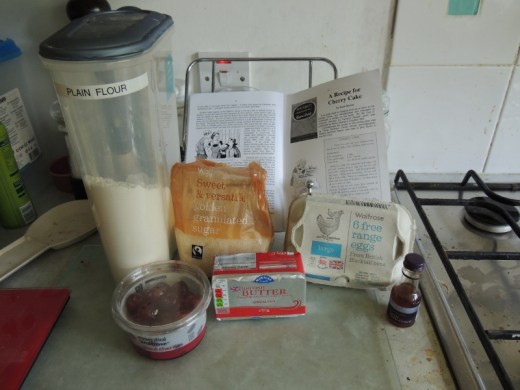
So to make this cake you will need:

  • 8oz or 225g of plain flour
  • 1 level tablespoon bicarbonate soda
  • 1/2 level teaspoon of salt
  • 3 level teaspoon of ground ginger
  • 1 level teaspoon of ground cinnamon
    (I also added 1 teaspoon of ground nutmeg as well)
  • 3oz or 75g of white cooking fat – I used butter. Seemed to work as well
  • 4oz or 100g of caster sugar
  • 4oz, 100g or 2 rounded tablespoons of golden syrup
  • 4oz, 100g or 2 rounded tablespoons of black treacle
  • 2 eggs
  • 5 tablespoons of milk
  • 4oz or 100g sultanas (I didn’t use these. We don’t go much into dried fruit in things in our house– but you can add them if you wish!)

Now the method, I’m going to lay it out in simple bullet points for you.

  1. Heat the oven to 350 degrees Fahrenheit, 180 degrees Celsius or gas mark 4.
  2. Grease a 7 inch (17.5 cm) square baking tin and line the base and two opposite sides with a strip of greased greaseproof paper long enough to overlap the sides.
  3. Sift the flour, bicarbonate of soda, salt, ginger, cinnamon and the nutmeg (if you’re copying me) into a mixing bowl and set aside.
  4. Gently heat the cooking fat (or butter), sugar, golden syrup and treacle in a saucepan until the fat has melted, then blend together.
  5. Allow to cool until the hand can be comfortingly held against the side of the pan.
  6. Lightly mix the eggs and milk and stir into the melted mixture.
  7. Add the mixture to the sifted flower and beat with a wooden spoon until batter is smooth. (Then stir in the Sultanas if you’re choosing to add them!)
  8. Pour the mixture into the prepared tin and spread level (This should happen naturally in the tin).
  9. Place in the centre of a preheated oven and bake for 50 – 60 minutes until well risen and firm to the touch.
  10. Allow to cool in the tin for 30 minutes.
  11. Loosen unlined sides and, holding the paper ends, lift out cake and place on a wire rack to cool completely.
  12. Wrap cake in kitchen foil and store for 2 days before serving, or store for 1 week if you prefer a sticky gingerbread.

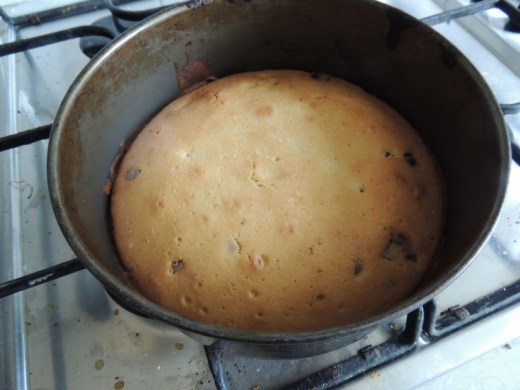
So there we are, that’s how to make the perfect gingerbread. Lots of people have tried this cake and loved it. If you have a big enough cake tin for bake it in, and the mixture is fairly shallow it might take less time to bake. Mine took half the time.

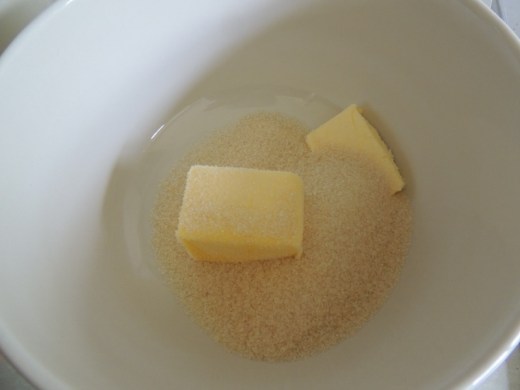
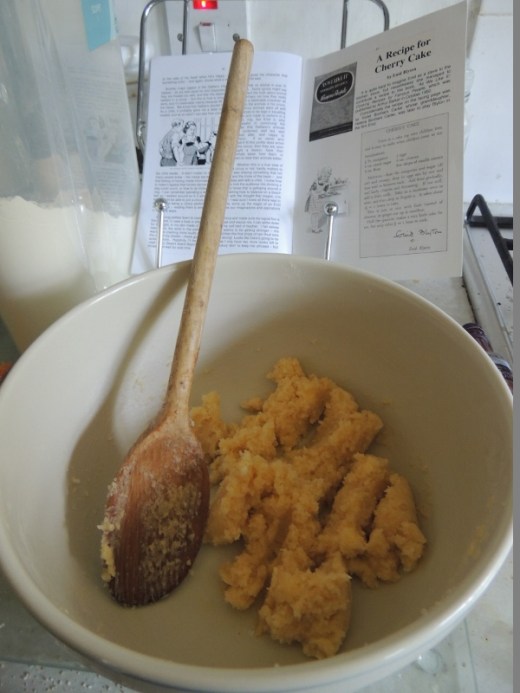
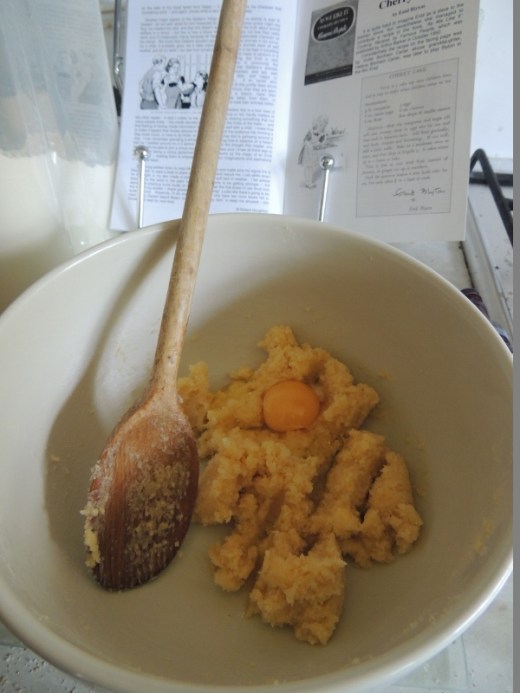
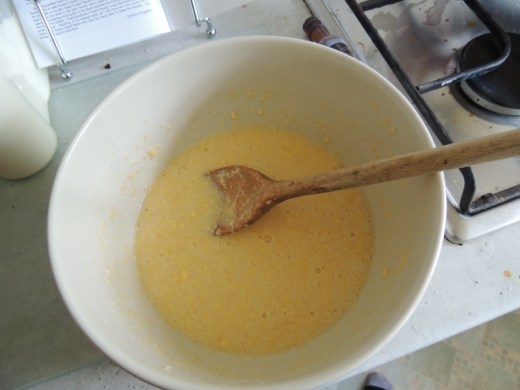
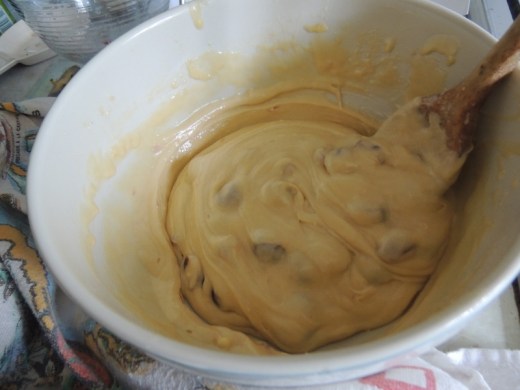
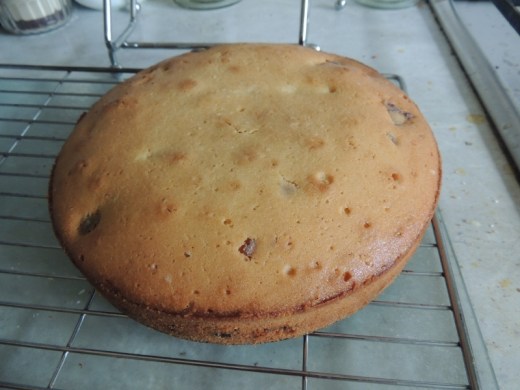
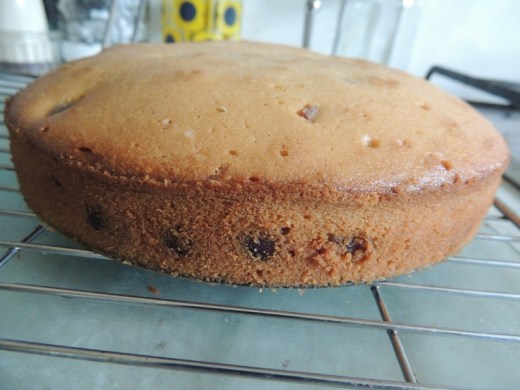
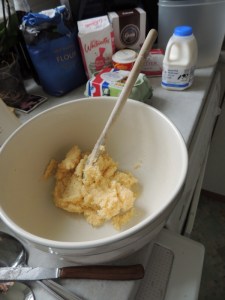
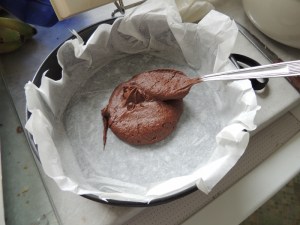
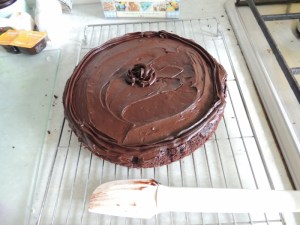
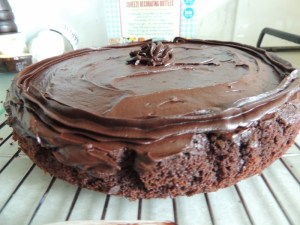
So here are some pictures of the baking of the cake. And a big Thank you to Katie Stewart and her cookbook for giving me this fabulous recipe. Let me know if you have a go!

Posted in Food and recipes | Tagged , , , | 1 Comment

The Valley of Adventure by Chris

In this final discussion of my top three Adventures I look at my number one choice, The Valley of Adventure. First published by Macmillan in 1947, it is the third of the series. The first edition dustjacket, by the ever-excellent Stuart Tresilian, looks like this:

valley of adventure

First edition dustjacket by Stuart Tresilian

My edition is a hardback without dustjacket, and is the 1957 reprint of the first edition:

The cloth board cover

As with the others in my top three (and the rest of the series) there are already many reviews of Valley: Keith Robinson’s on Enidblyton.net, Anita Bensoussane’s on the Enid Blyton Society site, from where the illustrations in the post are taken and on this site reviews by Fiona and by Stef. So I won’t give a plot summary but, in brief, the children are inadvertently flown to a valley in central Europe where they discover that a group of baddies are trying to recover looted art from the Second World War. This is hidden in subterranean caverns, guarded by elderly caretakers. Because access to the valley has been blocked by bombing, these caretakers do not know that the war is over. Philip manages to escape and alerts Bill Smugs, who flies his men to the valley, captures the baddies and reclaims the stolen artworks.

So here I focus on the positives and negatives of Valley. As regards negatives, that is easy: there really aren’t any. Well, perhaps there is one, but it is picky and is wrapped up inside what is undoubtedly a positive. That positive is that this Adventure has the strongest location in real events of any in the series, and perhaps any in the Blyton oeuvre apart from The Adventurous Four which I reviewed last year. It is set in ravaged post-war Europe (specifically Austria) and relates to a documented historical event, namely the Nazi looting of art. The picky negative is that Austria was not conquered militarily by the Nazis and so the bombing of the valley must have been the work of the Soviet army that liberated Austria at the end of the war, but in the story the earlier looting and the later bombing are depicted as having been by one and the same enemy. That the enemy were Nazis is confirmed by the fact that towards the end Bill says that the baddies – Juan, Luis and Pepi – are South Americans who had gained knowledge of the treasure from the many Nazis who fled there, again a documented historical fact.

Never mind, this is not a history textbook and at all events the baddies are more than plausible. What matters to us is the adventure and unlike other books in the series, Valley gets almost straight into it. The setup is very rapid, just enough to explain why the children are at an airfield and why they have plenty of clothes and blankets. Quickly they are stranded in the valley with only their own resources to rely on. True, the baddies have a huge supply of tinned food for the children to raid and so there is no need to worry on that score – Blyton always makes sure that meals are catered for – but otherwise things look grim.

Another positive is the absence of a negative. In the others in my top three the plot has in part relied on Philip’s taming of animals. Here, although his abilities are briefly mentioned, they do not form part of the plot. This is a real adventure, in which the children have no one to rely on but themselves. That is compounded by the fact that the sense of isolation in the valley is very strong, and the war-damaged buildings make for an eery setting. Again, this is a real adventure. And the nastiness of the villains is tangible, especially in the mistreatment of their prisoner, Otto, who gives the children crucial information. But the crowning glory of Valley is the fantastic description of the network of caves. Some of these give shelter the children and allow them access to a ledge behind a waterfall. Others turn out to house the treasure and its stay-behind guardians:

As in Castle and Mountain it is Philip who is the hero. He hides himself in the baddies’ aeroplane and in some of the best passages in the book finds himself in a remote Scottish village where he reports to an incredulous policeman, thus bringing Bill Smugs to the rescue. As with all Tresilian’s illustrations, this is a masterpiece. Look at the shocked expression on the policeman’s face, Philip’s dishevelled hair from the journey, but also the background detail of the notice about cattle behind the policeman and the Bakelite phone (which he presumably uses to call ‘the authorities’) at his right hand:

Philip reporting to the police

Philip reporting to the police

This is a densely-plotted, realistic, page-turning adventure. Even when re-read as an adult (as I did in preparing this post) it has genuine drama. But re-reading has also prompted another thought which is how much of my memory of the Adventures is bound up with the evocative quality of the illustrations. I don’t know if this is true for others but for me it seems to be the case.

Anyway, without any caveats at all Valley is by some way my favourite of the Adventure series, which are in turn my favourite Blyton books – with just one exception: the magnificent, yet overlooked, The Land of Far-Beyond which I hope to review in the future. It’s interesting that the other reviewers, mentioned above, all place Valley as their favourite or one of their favourites in the series. Using the same system of public school marking of the era that I used for the others in this review series, it is unquestionably alpha plus.

Posted in Book reviews | Tagged , , | 2 Comments

Whoops… it’s Tuesday.

We had a much needed blogging break last week, and I then totally forgot to start back up again! We’ll get back into the swing of things I’m sure, though. We’ve got our schedule sorted for this week at any rate.

schedule


We’re trying to be better with our other blog too, and Stef posted something there yesterday. I’m hoping to add something myself this week too, so here’s a sneak preview.


Posted in Blog talk | Tagged , , | 1 Comment

Last Monday in June

Here we are at the end of another month, and in fact we’ve had a smashing week here at the blog! Our best ever day happened on the 25th June, when a Spanish food blog El Comidista shared a link to our recipes and we reached an all time high of 653 views in one day! How fabulous is that? Speaking of which, if you’d like to return the favour, El Comidista has lots of fabulous goodies to go and ogle at!

Our best view day since starting the blog

Our best view day since starting the blog

Apart from that we don’t have much more news, apart from the fact that I made it home from Scotland in mostly one piece (I did twist my ankle pretty badly at the beginning of the holiday and at the moment its still bruised, swollen and complaining) but yes, it was a good holiday and lovely to catch up with my Blytonite in crime (or should that be blogging), Fiona.

The only other thing I’ve got to say before I leave you with some pictures is that this week, Fiona and I will be taking a break from blogging. No need to fret, we shall be back next week, but Fiona has a particularly busy week, and my week isn’t much better either. Not to mention I’m no way near geared up and organised enough to write two blogs a week to fill in. So we shall have a break and be back with our usual Monday post next week on the 6th of July.

As this is the first break we’ve taken from the blog in two and a half years, I hope you can forgive us!

Anyway Blytontonians, go out and have some adventures to blog about for us, and we shall see you in a weeks time! For now I shall leave you with some pictures of Monikie Country Park from the first day of my stay.

Stef

Posted in Blog talk | Tagged , , | 1 Comment

Famous Five 90s Style: Five Go Off to Camp

Five Go Off to Camp is one of my favourite adaptations of the books. Overall it doesn’t leave too much out and the acting is very good. There is the fact that Jock is probably older than I would have preferred, looking like he’s older than Julian rather than around Dick’s age, but that is perfectly minor. Again 25 minutes isn’t enough to make this as good as it could be: some of the history is missed out and so is the bit where Anne thinks she’s sitting on a volcano, but we’ll look into those in more detail a little bit later.

We start off quite atmospherically, with Wooden-Legged Sam walking the deserted railyard in the dead of night, with very creepy music to tell us that something is going to happen. Sam spots the light from the train coming out of the disused tunnel and rushes to hide. This has to be one of the best openings for the series as it sets you up to know there is a mystery going on, and when you’re small it is actually quite scary. I remember watching this when it first came out in the nineties and I was genuinely terrified of it. I think it is one of the better openings as I’ve said, and its one of the better books, within that first ten where Blyton was at the top of her game with the Famous Five.

Then we jump to the Five and Mr Luffy, walking the moors, looking for somewhere to set up camp. On the way they come across the farm where they will get their supplies for the holiday and if you’ve read the books, you’ll know how much the Five can eat, so a farmhouse with enough food to feed four starving children and a dog is essential.

I feel as though I need to mention this now, Dick has a new favourite word this adventure “smashing” it becomes a bit tiresome, and eventually gets put a stop to when Jock pinches it from him at the end of the adventure. The others get to tease him for it, so it’s not all bad.

Not only to go with the mysterious lights down by the railway track, there is also a mystery at the farm. The farmer has a brand new car that puzzles the children when Mr Luffy tells Mrs Andrews that the couple who lived on the farm before her could barely scrape a living out of the place. She seems momentarily stumped but then replies that her husband makes sure they all work very hard. You can see the adventure antenae twitching for Julian, Dick and George, though Anne doesn’t seem that bothered. I mean we all know Anne wishes for a quiet life.

The children then head off to set up camp, and Mr Luffy decides to pitch his tent a little way away from the children so they can be a little noisy and not have to worry about bothering him. Of course this means that later on when the adventure starts in earnest the children and sneak out in the night and not disturb him.

After a meeting with Jock’s stepfather, Mr Andrews, Julian and Dick are determined to go and visit the old rail yard that they have discovered and been warned off of by the watchman, Wooden-Legged Sam and then again by Mr Andrews. George is determined to go too, but as Anne doesn’t want to go, Julian forbids George to come along with them, causing one of the bigger arguements between them. Julian hardly covers himself in glory as he and Dick sneak out without George, and then tries to pull rank.

George is fuming that she’s been left out, especially as the boys start to include Jock, and storms off in a huff, with Timmy, determined to have her own adventure without them. In the meantime, Anne, Dick, Julian and Jock decide to explore the tunnel. Unfortunately they’re seen by Wooden Leg- Sam who calls the “gang” led by none other than Mr Andrews!

The gang corner  the children just as they find the spook train and are leaving the tunnel where it hides. Dick, Julian and Jock get caught but Anne, who didn’t walk back through the tunnel with them, is left waiting at the other side and sees the ruffians approaching. She then runs off to find Mr Luffy because she thinks something has gone wrong.

In the meantime, George has found her way into the tunnel through the air vents with Timmy and discovers the train first. Then she witnesses the boys being dragged into the secret hiding place and when the men have gone, she rescues them. The boys are glad to see her and she shows them everything on the train, which mostly seems to contain boxes of tea. (This is a children’s programme after all.)

Anne eventually finds Mr Luffy and then everyone is rescued by the policemen and the children (even Anne) get covered in soot. We end the episode on the traditional way in peals of laughter.

Overall I do think that this episode is very accurately adapted, and there isn’t much I would change. Again it comes down to it not having long enough to go through all the ins and outs of the details a bit more. I do commend them for keeping the short bit with Cecil Dearlove in, the son of Mr Andrews’ friend who is made to come and play with Jock to keep him away from the Kirrins, but only succeeds in pushing Jock more towards them and resenting his step-father more.

Overall, if recommend this episode as one of the strongest in the 90s catalogue. So if you only watch one episode, make it this one! As the acting all around is quite strong, even Marco’s facial expressions aren’t as bad as usual, and the boys teasing of George when she sets her trap to catch them when they go out to watch for spook trains, is easily one of the more memorable. A good strong episode.

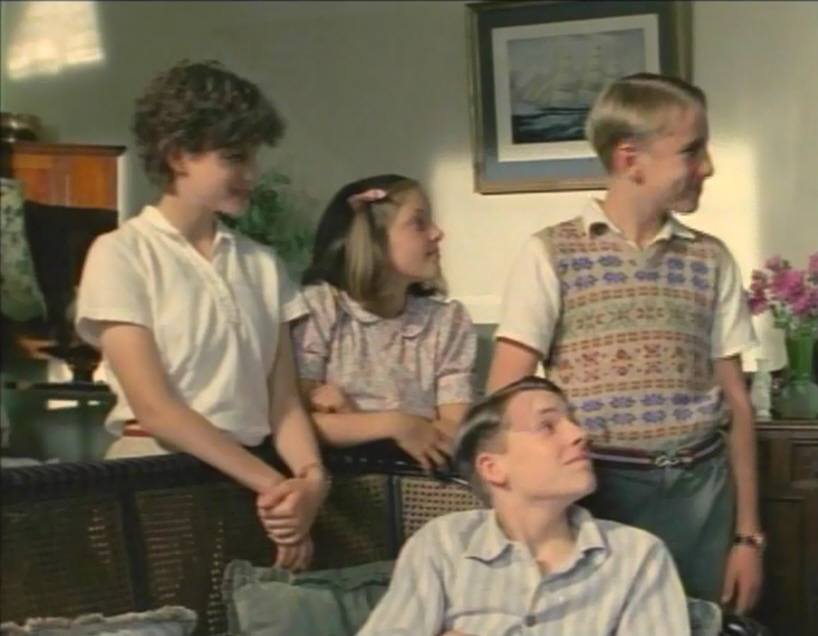
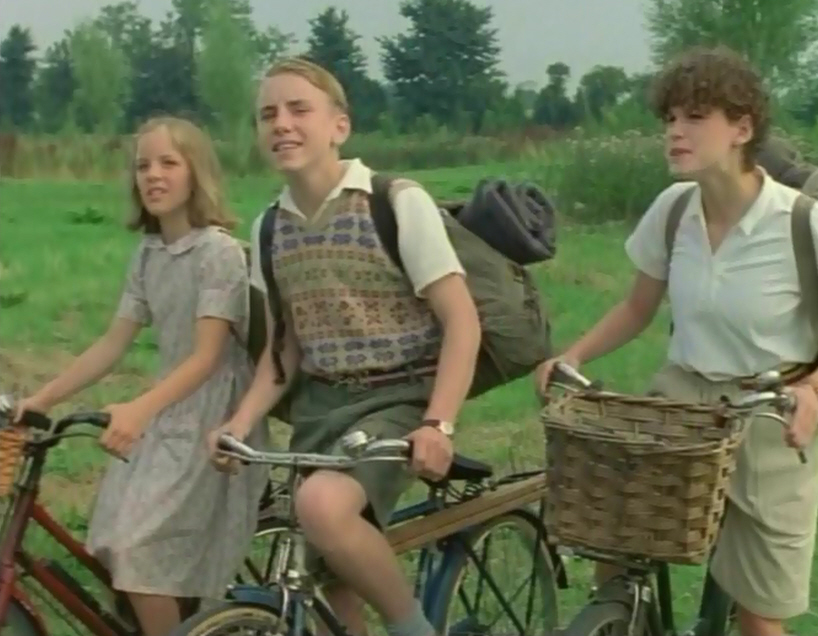
The children plus Jock at the end of their adventure

The children plus Jock at the end of their adventure

Posted in Blyton on Screen | Tagged , , , , , , , | 2 Comments

8 Exciting dramatised adventures: the Short Story Collection, part 2

I reviewed part one some time ago and I’ve discovered that I’ve since misplaced that disk as it isn’t in the case. Oh dear. Disk two was there thankfully, so I can get on tonight. For some strange reason Windows Media Player has decided that the first two “tracks” are Five go adventuring again: Track 1, and Five Go Adventuring Again [Track 2] with the rest being just Track 3, 4 and 5 by an unknown artist. Very strange. I’ll just have to listen on to see what order the stories come in.

The cover which is from Five Go to Demon's Rocks

The cover which is from Five Go to Demon’s Rocks

CD one had Five Have A Puzzling Time (the title of the Red Fox paperback collection), When Timmy Chased the Cat! and George’s Hair is Too Long.

This CD then has Good Old Timmy!, A Lazy Afternoon, Well Done, Famous Five! Five and a Half-term Adventure and Happy Christmas, Famous Five.

As I said last time these must all be quite short to fit into the one hour running time. Nick McArdle is still the narrator and thankfully (given how often he barks) we still have the more convincing Timmy from CD1.


Good Old Timmy! This is a pretty weak story to begin with and it isn’t improved by the voice actor for Julian (same as in CD1). George is fine but we barely hear Dick or Anne that I could notice. Dick sounds far too similar to Julian to pick him out when he does speak. I noticed George called Quentin Daddy, but that is how it appears in the Red Fox paperback. I’m not sure what was in the original as I don’t have that. Reading along, the audio is almost word for word what’s in the book. Things like “said Julian” aren’t there and a few lines come in a different order but it’s much closer to the text than the full novel ones.

Well Done Famous Five. This isn’t the second story on the CD but it happens to be the second one I’ve listened to as I forgot to turn the shuffle off. This falls a little flat as an audio as it’s almost all naratted. Not just Nick McArdle but the Five describing what they see the runaway horse doing. “Oh he’s jumped a stream…” “Now he’s going slowly…” and so on. At least we get a good piece of voice acting from the angry farmer and the stable grooms man as well as some nice horse noises.

Back to the second story which is A Lazy Afternoon. Anne finally gets to speak a bit! This is a more enjoyable tale but then again I think it’s a stronger story in the first place. I admit I got distracted by getting organised for tomorrow while I was listening but I did pause to laugh at Mcardle’s immitation of the yellowhammer singing Little bit of bread and no cheese. The additional voices in this story come from the baddies who sound suitably menacing and the policemen towards the end as well. All I’d add is that the ‘very noisy motorbike’ wasn’t very noisy at all!

Five and a Half-Term Adventure. Anne suddenly sounds rather hoarse again for this story (after I forgot to skip Well Done Famous Five and listened to the start again…) I’m finding it slightly annoying having to listen to the rather lengthy musical into at the start of every story. It’s fine in the novel audios as then it’s at the beginning and I think a shorter version plays in between chapters (often with some narration over the top).

This one has some good train sounds (steam train, of course!) The chap with the baby has a strong Scottish accent – something that isn’t mentioned in the text. Aunt Fanny also gets a nice long speech – she sounds just like Aunt Fanny should.

Happy Christmas, Five! is the last of the short stories and I found that it rather dragged. Not a lot seems to happen in it, or it might just have been that it has gotten rather late in the evening.

Turns out that CD 2 runs for more than an hour, it’s more like an hour and a quarter.


If anyone’s interested I’ve written synopsis of the short stories here and here.

Posted in Audio Books and Audio Dramatisations | Tagged , , , , , , , | Leave a comment

The Mountain of Adventure reviewed by Chris

This is the second of my reviews of my top three in the Adventure series. At number three was Castle and here I discuss my number two – The Mountain of Adventure. As before, I won’t summarise the plot in detail because there are several reviews available. On this site, it has been reviewed by Fiona and by Stef, in two parts (part one is here and part two is here). There are also reviews by Keith Robinson on EnidBlyton.net and Anita Bensoussane on the Enid Blyton Society site from which the illustrations in this review are taken. In brief, the children are in holiday in Wales, and whilst on a donkey trek get lost and discover that inside a remote mountain a strange experiment is underway. A mad scientist has supposedly invented some wings that allow people to fly, and under the control of some foreign agents is testing them using ex-paratroopers. Snoopers are discouraged by a pack of vicious dogs. The children discover what is going on and get imprisoned in the mountain. But with the help of Bill Smugs’ they escape and the baddies are rounded up.

Mountain is the fifth of the eight volume Adventure series that appeared between 1942 and 1955, and was first published by Macmillan in 1949. The jacket illustration is here:

the mountain of adventure


The excellent illustrations, as for the rest of the series, are by Stuart Tresilian. I have the first edition, but without dustjacket unfortunately, with the hardcover exactly as here:

The book that started the love affair: Mountain of Adventure, Illustrated boards by Stuart Tresillian.

So what are the strong and weak parts of this story? I’ll start with the weaknesses. It’s really not clear why a mountain in Wales would be chosen as the site for these experiments. Perhaps there is some special feature of the geology, but if so it is not explained. I also think that the way the Welsh people are depicted is rather derogatory or at least clichéd – there’s a lot of ‘Look you, whateffer-ing’. Evans, the family with whom the children stay, is always rendered as ‘Effans’, and David, who takes the children on the donkey trek, is treated pretty patronizingly as an illiterate coward. Then we have – gosh – a black man, Sam, described as “a negro”, who is one of the paratroopers and is portrayed as a gibbering imbecile. It’s the kind of thing that gives Blyton a bad name but, in a way, given the climate of the time, I think that the depictions of the Welsh are the more reprehensible. Published just after the Second World War, my guess is that Blyton had in mind that Sam was a black American, something still very exotic in Britain.

On the positive side, Mountain is first and foremost a science fiction adventure, of a sort fairly unusual in the Blyton oeuvre, comparable perhaps to The Secret of Moon Castle which I reviewed last year. There are some memorable descriptions of the strange machines inside the mountain, and some fantastic illustrations of this, including one that looks remarkably like a nuclear reactor:

the mountain of adventure


In fact, I think that Mountain should be read as a novel about the fears of the nuclear weapon age, and about the potential dangers of science, or at least the subversion of science. The genius is depicted as not bad but mad, and taken advantage of by unscrupulous villains. In fact, the villains are quite excellent, in the form of “thin-lipped” Meier and “ape-like” Erlick. As in Castle (with Mannheim) the names are Germanic, which would make sense in post-war Britain. And their assistants, “soft-footed” and “nasty little slinky” Japanese, adept in the martial arts, also spoke to the period, even if it is rather hard to understand why a German-Japanese axis would be at work in Wales four years after the war had ended. Never mind, they are creepy and convincing and, as Bill understatedly remarks at the end, “probably had bad records”. What’s more, they chime with contemporaneous ideas about totalitarianism (George Orwell’s Nineteen Eighty-Four was published the same year as Mountain), most obviously in the illustration of the workers in the scientific plant, which has an almost Soviet Realist look to it:
560high+4385732

Back to less weighty matters. Mountain is also great because – depictions of the Welsh notwithstanding – it does have a very strong sense of place and of remoteness. I think this is one of the great strengths of Blyton: she conjures up the kind of place where we might imagine having a holiday, and the kind of place where an adventure might happen. We also have some fantastic Blyton food. For example on their first night there is this extraordinary spread:

“A great ham sat ready to be carved. A big tongue garnished round with bright green parsley sat by its side. An enormous salad with hard-boiled eggs sprinkled generously all over it was in the middle of the table. Two cold roast chickens were on the table too, with curly bits of bacon set round … scones and cakes! The jams and the pure yellow honey! The jugs of creamy milk!”

Imagine reading that in 1949, when there was still rationing in Britain! Even now it seems sumptuous.

One of the hallmarks of the Adventure series (the same is true in the Five, but it is less strongly drawn) is a series of transitions from an idyllic holiday, to an exciting holiday, to an adventure. In Mountain the idyllic holiday quickly moves to the excitement of a donkey trek to see the Vale of Butterflies. The adults are quickly dispatched, with Mrs Mannering slamming her hand in a barn door (but reacting with commendable stoicism) and Bill having to look after her. Once on the trek David disappears in a panic as the adventure starts, and we are away.

There are some beautiful moments as the children discover the secret entrance to the mountain laboratory, and encounter the mad inventor, styled a King by his exploiters. As in Castle, Philip plays a starring, heroic role when, captured by the baddies, he is forced to try the peculiar wings. Fortunately the helicopter pilot who conducts the trials gets cold feet, and Bill and his men are able to take over the helicopter, rescue the children and rout the baddies.

I remarked in my review of Castle that I find Philip’s way with animals is somewhat implausible as a plot device. But in Mountain, although this does apply to his taming of Snowy the goat, it is much better with respect to the dogs. Initially appearing to be a pack of wolves they are in fact Alsations, and Philip’s ability to control them is crucial both to the children escaping capture and also to the round-up of Meier (who ends up “white with rage”) and Erlick (who is “almost weeping with panic”). It’s very pleasing to see the bullies laid low and it is not at all difficult to accept that these brutally trained dogs would respond well to Philip’s care.

Mountain is quite densely plotted, with a considerable amount of incidental detail and explanation of events. Even read as an adult it has genuine drama. There is a strong sense of place, good villains, a plausible plot and a serious science fiction theme. Against that, the adults are dispatched in a contrived way and the treatment of the Evans and of David is a bit irritating. It is certainly one of the finest of the Adventures, but does not quite make it to number one. Adopting the scoring system of public schools of the time that I used for Castle, I would rate The Mountain of Adventure as an alpha-minus-query-alpha-minus-plus, if only by comparison with my number one choice which I will review next time.

Posted in Book reviews | Tagged , , | 7 Comments

Monday

June is racing away from us now although often it seems that summer is yet to arrive. Stef’s back home again after spending the week up in Scotland with me, so there will be plenty of photos to show you all over the coming weeks.

As for what’s coming up this week…

THE WEDDING OF


I can’t think of any blogging news to share with you this week, so I’ll just add a couple of photos from this past week (I’ve barely sorted through any of them!) and get off to bed.

Posted in Blog talk | Tagged , | 1 Comment

The Mystery of the Burnt Cottage

The Mystery of the Burnt Cottage 2015 edition.

The Mystery of the Burnt Cottage 2015 edition.

As you may know, I’m not very good at bringing you the blogs I promise, but this week I have been super good, even though I’ve been on holiday with Fiona, and re-read the first Five Find-Outers book The Mystery of the Burnt Cottage. In fact there was a moment or two in which it wasn’t looking likely that I would finish the book, so I had to go out and buy a copy of it (I was borrowing Fiona’s at the time). So I started off with a wonderful 12th impression first edition and had to end on the most recent 2015 edition. I didn’t bother with trying to find all the changes in the book, just so you know. I thought I would leave that to Fiona – I’ll be sending the book back up North when I’m finished with the review (well Monday) so she can line it up for a chapter comparison.

Now some of you will already know about my feelings towards the “darling” of the group, Fatty. Hands down, I do not like it. The rest of the characters I can get on with; Larry, Daisy, Pip and Bets are fine and in fact are very similar to the rest of the Blyton’s quartet’s which I suppose is why Fatty stands out so much and makes such an impression on people, because he is that little bit more ‘in-your-face’ and different from the others. He has flaws if you will, boastfulness being a very key one in the first book; Larry and Pip are always telling him off for boasting. Fatty’s nickname isn’t a co-incidence either, not only do his initials spell FAT (Frederick Algernon Trotterville), he is a fairly robust round shape by all descriptions. Dear Frederick doesn’t like this very much, but puts up with it for the sake of being a Find-Outer. I just can’t stand him I’m afraid, he doesn’t make a very good impression with me, and not to mention the fact that he gets compared to my beloved Julian all the time. I’ve said it before and I shall say it again, it is not a fair comparison.

Spose I better get on with the book now, hadn’t I? Well the book starts out with Dairy, Larry, Pip and Bets coming across the fire in Mr Hicks back garden as his workroom goes up in flames. His workroom houses all his precious documents and naturally when he gets back to the house after an afternoon in London he is furious. In front of the burning cottage is when Larry, Daisy, Pip and Bets all encounter Fatty as he tries to help put the fire out, much to the local constable’s displeasure.

Mr Goon (who I’m almost certain should be called Constable Goon, not mister) doesn’t like children or dogs, so is very angry when the children turn up and Fatty appears with his little dog Buster. He uses a phrase “Clear-Orf” to shoo the children away and they decide to nickname him that and they think of him quite scornfully. In fact the children don’t think Mr Goon has much brain at all!

Slowly, once they realise that the cottage had been deliberately set on fire, the Five children and dog agree to become the Five Find-Outers and try and find out before the police who set fire to the cottage.

They collect a series of clues quite quickly, a footprint, a scrap of grey material and  list of suspects that seems to always be getting longer. There’s Mr Smellie, a absent minded academic who is friends with Mr Hicks but has had a row with him on the day of the cottage burning; Horace Peeks, the valet who leaves on that day, Mrs Minns the house keeper because Mr Hicks doesn’t like her cats and a Tramp who was caught trying to steal eggs by Mr Hicks.

Methodically, and almost one step ahead of old Clear-Orf, the find-outers go through their list and try and cross people off. Larry takes charge for this adventure, discussing with the others what they should do, and how is best to do it. They get quite far in their investigation, eliminating people until Bets unfortunately gets carried away.

Being the youngest of the group, she is a little more excitable and more inclined to believe the best in people. As she and Fatty both get singled out for teasing by the others, I believe a bit of a bond forms between them more readily than the others. Bets finds a trail of the footprints they found in Mr Hicks garden and follows them back to Mr Hicks house. She mistakenly tells the man everything, thinking she is helping and makes him promise not to tell on them.

Unfortunately Mr Hicks very clearly doesn’t keep his promise to Bets because in the next chapter Mr Goon visits all the children’s parents to “tell on” them. The children are then banned from interfering just as they solve the mystery.

Luckily they find someone to help them and the mystery gets solved. I won’t tell you who helps them or who the culprit was, because they would just be mean. But I can tell you that when I pushed my dislike of Fatty to one side, the book is actually quite enjoyable. Its a neat little mystery that in a way is very Agatha Christie like, but for children. Quite a clever book in fact. I do prefer the more dramatic storylines of the Adventure series and the Famous Five however, but there is something to be said for making the “little grey cells” work as Poriot would say.

Overall, I think I should encourage you to read this book, or re-read in many cases and see if you can figure out who fired the cottage before the children can. Go on, get those brains working! It’ll be a jolly good work out if nothing else!

Next review: The Mystery of the Disappearing Cat

Posted in Book reviews | Tagged , | 2 Comments

The Island of Adventure – How has Blyton’s original text fared in a modern edition? part 10

I managed to get through three chapters this week, 19, 20 and 21. Earlier chapters are here, in posts one, two, three, four, five, six, seven, eight and nine.

My copy of the book is an 8th impression from 1955 (it was my mum’s before it was mine) and the modern copy I’m comparing it to is a Macmillan one from 2001 (one I borrowed from Stef).


CHAPTER NINETEEN: DOWN IN THE COPPER-MINES

Several of the changes made to this chapter seem to be trying to put the boys and girls on a more even footing. The girls didn’t want to [go down the mines] becomes The girls didn’t like the look of it. Which is pretty much saying the same thing, to me. Then Philip no longer asks You girls all right? but instead Everyone all right? 

In the original text Dinah is described as more like a boy in her daring and strength, while Lucy-Ann was small compared to her. For some reason this now reads Dinah was as big and strong as any boy, but Lucy-Ann was not. Again this seems like the same thing just in different words.

As in previous chapters several phrases lose their hyphens and become single words – air-ways, half-way and far-away I noticed but coal-mines bucks the trend and becomes coal mines.

As with quite a few instances already in the book queer has been left untouched.


CHAPTER TWENTY: PRISONERS UNDERGROUND

I could only spot one change in this chapter (which is why I did three chapters, as the blog would have been even shorter than it is, otherwise!)

Building on the notion that Philip and Dinah don’t always get along the original has He never had much use for Dinah’s ideas, which, as a rule, were rather far-fetched. This has been changed to Dinah’s ideas were rather farfetched as a rule. My spell checker doesn’t like farfetched as one word, incidentally. I can’t see why they needed to change this at all. Surely lots of boys have little time for their younger sisters’ ideas?

Again queer appears once in the chapter and isn’t updated.


CHAPTER TWENTY-ONE: ESCAPE – BUT WHAT ABOUT JACK?

There isn’t much to write about this chapter either. It’s almost as if the editor got bored and skipped a lot of it. 

A shower of tiny stones came down and hit them becomes just A shower of stones. Why they couldn’t be tiny is beyond me. 

Queer appears twice and both times it does get changed. Firstly to strange, and the second time Aunt Polly says I really feel faint.

After the earlier changes to the boys vs girls texts it’s funny to see lines like I’ve got to get you girls away safely being left.


That’s actually only four new/unique changes across four chapters. Clearly the editor were having a snooze! but it takes us to 105 in total. 


Posted in Updating Blyton's Books | Tagged , , | 4 Comments

Literary Love Letters: Dear Enid Blyton, From Samantha Tonge – Reblogged from Novelicious

I’ve had this bookmarked for a while, but haven’t needed to use it as we’ve had plenty of material from contributors lately. Rather than having Chris’ Adventure Series posts back to back we thought we’d break things up a little and finally share this letter from Samantha Tongue to Enid Blyton.

Dear Enid Blyton,

I’m not sure where to start, in thanking you for inspiring a life-long love of books. Nor could I mention just one of your many stories. I grew up devouring tales of the Famous Five, Brer Rabbit and St Clare’s … I still have many of these novels in my loft, brown and warped from the hours, as a child, I used to read them whilst soaking in the bath. Sometimes they would fall in and I’d dry them in the airing cupboard…

To read the rest, head over to the Novelicious blog.

I’ve never dropped a book in the bath, but my sister once dropped a school library copy of The River of Adventure in the toilet. It never was the same after that.

Photo credit: Julie Edgley / Foter / CC BY-SA

Photo credit: Julie Edgley / Foter / CC BY-SA

Posted in Enid Blyton, Personal Experiences | Tagged | 2 Comments

Mid-month Monday

Hello everyone, we’re half way through the month of June today because we have five Mondays in the month.

This week I’m staying with Fiona in Scotland so we’re working on making sure we keep each other on track for blogging.This week we plan to bring you Fiona’s next update reviews from The Island of Adventure, what will she find this week? I hope to start a run of reviews about the Five Find Outers starting with The Mystery of the Burnt Cottage.

As we brought you a wonderful review from Chris last week and he has already sent us another blog to put up, to break it up a bit we shall be doing a reblog on Wednesday.

I haven’t got any pictures for you this week but will make it up to you when I’m back from Scotland. Hope you all have a good  week and like what blogs we mange to bring you!

😀


Posted in Blog talk | Tagged , | 2 Comments

The Famous Five Card Game played by Fiona

I didn’t get around to listening to an audio drama for the blog this week (I think that was what I was meant to have done, at least!) so as Stef has arrived in Dundee tonight we decided to play the card game I got for Christmas. Unfortunately it is missing the instructions, but those are available to view on the Enid Blyton Society website so it’s not a disaster.


GAMEPLAY

The instructions are fairly complicated for what isn’t that complicated a game and the first time we played I think we played wrong. We were drawing a card with every turn and thus always having seven cards in our hand. It came to score up after Stef won – the winner gets 20 points minus the number of cards they hold and all the others get 10 minus the cards they have. As you can see, there’s no point in that if everyone always has seven cards.

So we started again and played five rounds to see who would end up with the most points. Whenever Stef shuffled she seemed to end up with all the #1 cards which have to be played first! And when I shuffled I ended up with dreadful hands like this one

DSCN2617


THE CARDS

The cards themselves are beautiful Eileen Soper full colour illustrations, showing the stories from Five on a Treasure Island, Five Go to Smuggler’s Top, Five Go Off in a Caravan and Five Get Into Trouble. The goal is to lay them out in order, and the winner is whoever places the eighth card – the happy ending – in any storyline. Roadblocks can be thrown up in the form of danger cards, either general danger ones which can be played on any story or one of the four dangers specific to each story. For Treasure Island the danger is the men after the ingots, in Smuggler’s Top it is a watching enemy (Block), Caravan has poisoned meat for Timmy and Trouble has the gates of Owl’s Dene closing on the Five. To continue the story after one of these has been played an All-Safe card must the added to the sequence.

DSCN2615


It was a fun game anyway, once we figured out what we were meant to be doing! Some rounds took longer than others depending on what order the cards came out in. One round was very short as we completed the storyline to Smuggler’s Top without starting any of the others.

DSCN2618


THE ILLUSTRATIONS

After we played we got to talking about the illustrations and decided to compare them to those in the books.

It turns out some of them aren’t from the books. It would appear that all are brand-new despite having a passing similarity to those in the books. There are also a few that appear to have been drawn purely for the game. For example, the below illustration of the Five on their bikes doesn’t appear in Trouble.

280high+8743633These two from Smuggler’s Top show the differences between the versions.


ONE NITPICK!

Lastly, I can rarely write a blog without pointing out a mistake.

280high+8733740

The caption reads Richard, when really, it should be Dick.


AND THE FINAL SCORES

As I’m sure Stef will want me to mention, she won!
DSCN2620

Posted in Personal Experiences | Tagged , , , , , , , , | 11 Comments

The Twinniest Twins: The O’Sullivan Twins from St Clare’s

Egmont Front Cover of The Twins at St Clare's.

Egmont front cover of The Twins at St Clare’s.

This week’s Twinniest twins is all about the O’Sullivan twins from the St Clare’s series. They are the second lot of female twins we’ve looked at, but the first set of identical girl twins.

The O’Sullivan twins, Isabel and Pat start off their series and their time at St Clare’s around fourteen years old, and have become rather spoilt and lazy. They assume that they are going to be sent off to a posh and expensive big private school with their friends, and are disappointed when their parents inform them that they are going to St Clare’s to get their corners rubbed off ( I don’t think this is actually said so bluntly, but their father implies it!) So the twins are sent off to St Clare’s and vow to be so bad that they are sent home and have to go to the other school (I think its called Red Roofs or something similar, I can’t be sure!)

The twins do make for interesting reading, especially with the first book because they feature in it so much. They are absolutely identical which means that they can play tricks on people by pretending to be the other twin, which is the complete contrast to the Batton Twins of Malory Towers who aren’t alike enough for tricks like that. Part of the story involves Pat pretending to be Isabel.  Pat doesn’t believe she should have to run around after the bigger girls, but Isabel isn’t so sure that disobeying them isn’t wrong and so answers the summons. She is then allowed down to the town to visit the shops while Pat isn’t. They hatch the plan that as long as only one goes at a time, Pat can go too, pretending to be Isabel.

To begin with you’re not really supposed to like the twins, at least I don’t think so. They’re fairly arrogant and rude, and dismissive of anyone apart from themselves. I think this is a little more true of Pat than Isabel, and she does seem to be the more dominant twin throughout the series. I do feel that Isabel gets left behind somewhat, and is perhaps the nicer twin.

The girls play a big part in the first two stories and then seem to waver in and out of the others, finally ending up as joint head girls of St Clare’s, but beyond them deciding that they quite liked St Clare’s really and wanting to stay, the stories become less about them and more about the other girls in the form. Like many other sets of twins in Blyton’s series they seem to get left behind somewhat, at least that’s how I see it.

They are never quite the same strong female leads in  twins throughout the rest of the books I’ve read by Blyton, and its a shame to see Pat and Isabel fall by the way-side so much. They have a rival of kind in Darrell Rivers of Malory Towers as she’s a strong female lead but the added mysticism of twins is hard to pick up again in any other female based story by Blyton.

The twins, when they settle down, become likeable, funny and intelligent, as well as very no-nonsense. They are always in the background of the books, providing some stability to the story, and the basis, but we don’t visit them so much. Partly due to this and partly because I read these books in my early twenties, they are probably my least favourite set of twins. There’s no connection with them for me, and even though they are superb characters for children to be reading about, they just don’t connect with me.

I have yet to read Pamela Cox’s Sixth Form at St Clare’s to see what the twins are like when they’re in charge of the whole school, but as by the fifth book, they’re around but somewhat invisible, perhaps they come into their own again in the sixth form, I don’t know. I shall just have to read the book and find out!

Read about more Twinniest Twins here.

Posted in Characters | Tagged , , , , , | 3 Comments

The Castle of Adventure reviewed by Chris

Having recently reviewed my top three ‘Famous Fives’, I’m now beginning a series on my top three of the ‘Adventure’ series, of which the first, at number three in my ranking, is The Castle of Adventure. The series are very different: there were some twenty-one Fives, published between 1942 and 1964, and only eight Adventures, published between 1944 and 1955. In general, the Adventures have more detailed and complex plots, and I assume were aimed at slightly older readers.

Both series feature four children, two boys and two girls, but in the Adventures these are two pairs of siblings whereas in the Five they are three siblings and a cousin. As so often in Blyton there is a weird family set up. In the Adventures, one pair of orphaned siblings (Jack and Lucy-Ann Trent) are adopted by the widowed mother of the other pair (Philip and Dinah Mannering). There is no father or uncle in the Adventures, but instead Bill Smugs (Cunningham) is the male adult, who later in the series marries Mrs Mannering. Unlike Uncle Quentin, Bill joins in rather than gets in the way of the adventures, partly because he is a policeman or even, it’s sometimes implied, an intelligence officer.

In both series there is a fifth member of the team: Timmy the dog for the Five, Kiki the parrot for the Adventures. And here I have to make a declaration: I think that Kiki spoils the Adventures (whereas Timmy adds to the Five) because I find her completely implausible both in the range of her language and her capacity to make sense in context. Timmy is believable and wonderful; Kiki is absurd and ludicrous. There – I have said it and won’t repeat it in my future reviews.

So, now, to Castle. It is the second in the series and was first published in 1946 by Macmillan. I have the 1953 reprint of the first edition, in hardback but sadly without its dustjacket. Illustrations are by the wonderful Stuart Tresilian. The first edition dustjacket is pictured below (all images in this review taken from the Enid Blyton Society website).

First edition dustjacket by Stuart Tresilian

First edition dustjacket by Stuart Tresilian

My unjacketed cover is exactly as depicted here:

Illustrated boards by Stuart Tresilian

Illustrated boards by Stuart Tresilian

There are other reviews of the book on this site, by Fiona and by Stef, two reviews on the EnidBlyton.net site and another on the Enid Blyton Society site. So, unlike my reviews of the Fives, I am not going to summarise the plot in detail. Briefly, the children discover that in a ruined castle near their holiday home there is a gang of foreign agents using it as a base to spy on an adjacent secret military research site (so secret that even Bill does not know what goes on there). Instead of a plot summary I will identify the good and bad aspects, as I see them.

Chief amongst the bad aspects is Tassie. Described as a “gypsy”, she is the usual stereotypical Blyton outsider who is dirty, dressed in rags, can’t speak English properly, and lives like a semi-wild animal. She does aid the children in the Adventure but she is also presented in pretty demeaning ways. Another negative to me is the device, used often in the series, of having Philip’s uncanny ability to tame wild animals play a part in the plot. Here, Button the fox plays a key role in carrying messages. As with Kiki the parrot I just don’t find that realistic (if you disagree, just try taming a fox cub to carry messages for you).

But there are so many good things in this story! First and foremost, the castle itself. The idea of finding a remote and semi-ruined castle – with secret rooms, old suits of armour and underground passages – is exciting for children and still has an appeal for adults. Later in the series we are told that the setting is Scotland, but there is no particular sense of that in the book. Even so, the picturesque rural location, including an archetypal cottage, do give Castle a classic holiday feel. At the same time, the mundane details in the background, such as trains and lunch in a country hotel (see illustrations) make for a cosy atmosphere.

But we want more than cosiness, we want an adventure – and we get it! There is a gradual build up as the castle is explored and Jack has the adventure – but not Adventure – of trying to photograph the eagles nesting there. Soon mysterious lights and traces of human occupants in the castle herald the beginning of the adventure proper, and events begin to move more quickly. Key moments of excitement include Philip very bravely standing up to the baddies (see illustration), even in the face of genuinely vicious treatment.

The chief baddy, called Mannheim but known as Scar-Neck, is a great villain, indeed even his nom de guerre is perfectly chosen. And the denouement, with a wild thunderstorm breaking out right on top of the castle could hardly be bettered. In a splendid example of the literary device of ‘pathetic fallacy’ the next day brings “clear morning sunlight”, a resolution to the adventure and, even, reference to those Blyton perennials the “burly policemen”. The castle, alas, is all but destroyed but it will always be for us as Jack describes it in the closing sentence – the Castle of Adventure!

Overall, a fine story and easily in my top three Adventures. But compared with my top two (which I will cover in future reviews) the plot is a shade more simplistic and the sense of place a little less strong. With marks knocked off for Tassie and Button as well, Castle gets what Dick and Ju’s schoolmasters might have described as ‘beta-plus-query-alpha-minus’.

Posted in Book reviews | Tagged , , | 7 Comments

Just Another Manic Monday

Here we are again, another Monday, and another manic one for me as I have to work when I don’t usually. At the end of this week, I also get the joy of going up to Bonnie Scotland to see Miss Fiona for a week of frolics! Hopefully we’ll have some pictures, stories and new blogs ready for you when we’ve had chance for a chat.

Our contributor this week will be Chris with the Castle of Adventure, in which he looks at why it is one of his top three Adventure books.

Fiona will be comparing chapters from the Island of Adventure for the text updates, and I will be bringing you the Twinniest twins that I failed to bring you yesterday. Failing that for a second week running, I shall try for another 90’s TV series episode.

Happy reading! I’ll leave you with a few pictures from my recent trip to Kew Gardens with Corinna, one of our past contributors. I hope you like them! The rest will, in time be found on Two Points of View.


Posted in Blog talk | Tagged , , | 1 Comment

An Evening of June – A poem by Enid Blyton

Today I bring you another of Blyton’s poems from The Enid Blyton Poetry Book called An Evening of June, which is somewhat appropriate for we have just entered the month of June. I hope you enjoy it!

Slowly the sun slips over the hill,
The Shadows of the trees are long,
The blackbird opens his gleaming bill,
And whistles an evensong,
And slowly lumbering down the lane
The hay-wagon comes with its load again.

The hedges look on a the horses pass
And fling out a mischievous spray,
They catch at the burden of scented grass,
And pull little pieces away.
And by all their booty ’tis easy to know,
The way that the lumbering hay-wagons go.

Past the wild roses, delicate, frail,
Whose petals fall soft on the breeze,
Down the long hillside and into the vale
Beneath all the shadowy tress,
Past all the poppies that dance by the road
The hay-wagon carries its very last load.

Its a shame you don’t really get hay-wagons anymore isn’t it, but you do get the same thing with tractors almost when they move the hay!

Posted in Poetry | Tagged , , , | 1 Comment