First Term at Malory Towers

First Term at Malory Towers is the first of six Malory Towers books by Enid Blyton. Malory Towers is the third school series written by Blyton, and was started the year after she finished the St Clare’s series. Malory Towers was inspired by Blyton’s oldest daughter Gillian going to boarding school.

In the books we follow the heroine, Darrell Rivers, through her school life which include her ups and downs, friends and enemies. It has to be my favourite school series and has always made me want to attend Malory Towers.

Malory Towers by illustrator Stanley Lloyd.

We meet an excited Darrell ready to set off to school in her brand new uniform. It’s nice to have a book start with someone being excited to go off to school and even though the idea of a brown and orange uniform sounds quite unappealing, I do think it could look very nice if matched properly.

We follow Darrell from her home to the station to catch the train for Cornwall, where Malory Towers is located. Naturally Darrell is nervous about her new school, wondering what it will be like and if she’ll make friends. Blyton makes it very easy for the reader to relate to Darrell from the beginning, and these nerves that Darrell experience make her more human. The fun really begins when Darrell is plunged into the world of Malory Towers at the station. First she is introduced to the sensible Miss Potts who is to be her form mistress and head of North Tower where Darrell is to sleep.

From the formidable Miss Potts we are then introduced to Alicia Johns, a girl in Darrell’s form who has been at Malory Towers for some time (though we are not told how many terms Alicia has been at the school). Darrell takes an instant liking to Alicia, hoping that this older girl will be her special friend.

Alicia comes across as a hard character from the start and I’ve always wondered why Darrell so wants her as a friend when it’s easy for the reader identify her as a a class clown and a bit of a bully. Alicia does get a little better, but I’ve never really ‘warmed’ to Alicia or understood why you would want her as  friend. She reminds me of the ‘popular’ girls at school who would bully you without a thought to your feelings if you got on their wrong side.

Gwendoline Lacey is also a new girl, however she has none of the characteristics Darrell has which make her so instantly likeable. Gwendoline is painted as a cry baby, spoilt and worst of all in the sporty world of Malory Towers, overweight. The girls  don’t make Gwendoline’s life easy, and Alicia especially says some quite spiteful things to Gwendoline over the course of the book.

The only other new girl to join them is quiet Sally Hope who seems the complete opposite to everyone else in the train carriage.

So on to Malory Towers, with its four towers North, South, East and West which hold the girls’ dormitories and common rooms. Darrell, Sally and Gwendoline are all in North Tower together, with a stern matron and Miss Potts to keep an eye on them.

Alicia pretending to be deaf by illustrator Stanley Lloyd.

The term begins quite calmly with lots of fun but hard work as well. Alicia plays a trick where she pretends to be deaf to tease Mam’zelle Dupont but it backfires when Miss Potts discovers the trick, and later on in the story (but I won’t give that away!).

Soon Gwendoline’s spiteful nature becomes apparent, as she starts being mean towards the smallest member of the form, Mary-Lou, and playing nasty tricks on her. The tricks escalate after Darrell snaps at Mary-Lou for following her around. Gwendoline’s truly spiteful nature shows just how wicked a person can be, especially to vulnerable younger  girls.

Darrell also behaves appallingly towards Mary-Lou at the beginning of the book, and she doesn’t seem to realise that she’s almost as bad as Gwendoline in that respect. After Sally’s illness, when she explains to Darrell that she’s been trying to buck Mary-Lou up the wrong way, Darrell’s whole attitude towards Mary-Lou does suddenly seem to do a complete 180 degree turn.

Darrell pushes Sally by illustrator Stanley Lloyd.

The real drama starts during half term weekend, when Darrell’s parents come to see her, and her mother spots Sally Hope in the distance and would like to have a word with her because she knows Sally’s mother. Sally behaves quite rudely towards Darrell, insulting her parents when Darrell tries to give Sally the message, and Darrell’s temper gets the  better of her. She sends Sally flying across the room, and causes her great pain. I shan’t give away what the cause is, you’ll have to read it yourself to find out!
Sally’s brief illness acts as a catalyst for a complete change of character. After being a very closed off character who often fades into the background, Sally’s persona changes and she becomes a very lovely person very quickly and  she becomes like an open flower instead of a closed one. The new Sally is instantly likeable. I think you see more of Sally’s personality in those last few chapters than you ever do in the rest of the books, except in the 3rd form where Sally’s jealousy gets the better of her, but at the same time she does fade into the background a lot of the time.

I hope I haven’t given too much away from First Form at Malory Towers, but I don’t want to ruin the book for you. Personally I love this book. The ups and the downs of the term make it such a thrilling read, for instance when  Darrell is nicer to Mary-Lou and the spiteful tricks Gwendoline plays.

If you like Blyton’s other school series, Malory Towers is one not to miss. Trust me, you won’t regret picking up these gorgeous books!

Wraparound dustjacket from the 1957 reprint of Malory Towers by illustrator Lilian Buchanan.

Next review: Second Form at Malory Towers

Or read a review of the audio adaptation of First Term here.

Posted in Book reviews | Tagged , | Leave a comment

Sunskriti’s Animal Character Exploration: Buster from the Five Find-Outers Series

By Sunskriti, age 10.

You might wonder why I haven’t chosen Timmy for my first blog post. The reason is simple, while Timmy seems an extremely intelligent dog; Buster is an excited little Scottie who often stumbles upon the right clues just by chance. This seems more natural to me, somehow, than good old Timmy. Of course, I’ll be writing soon about Timmy for the blog. For now though let’s focus on Buster.

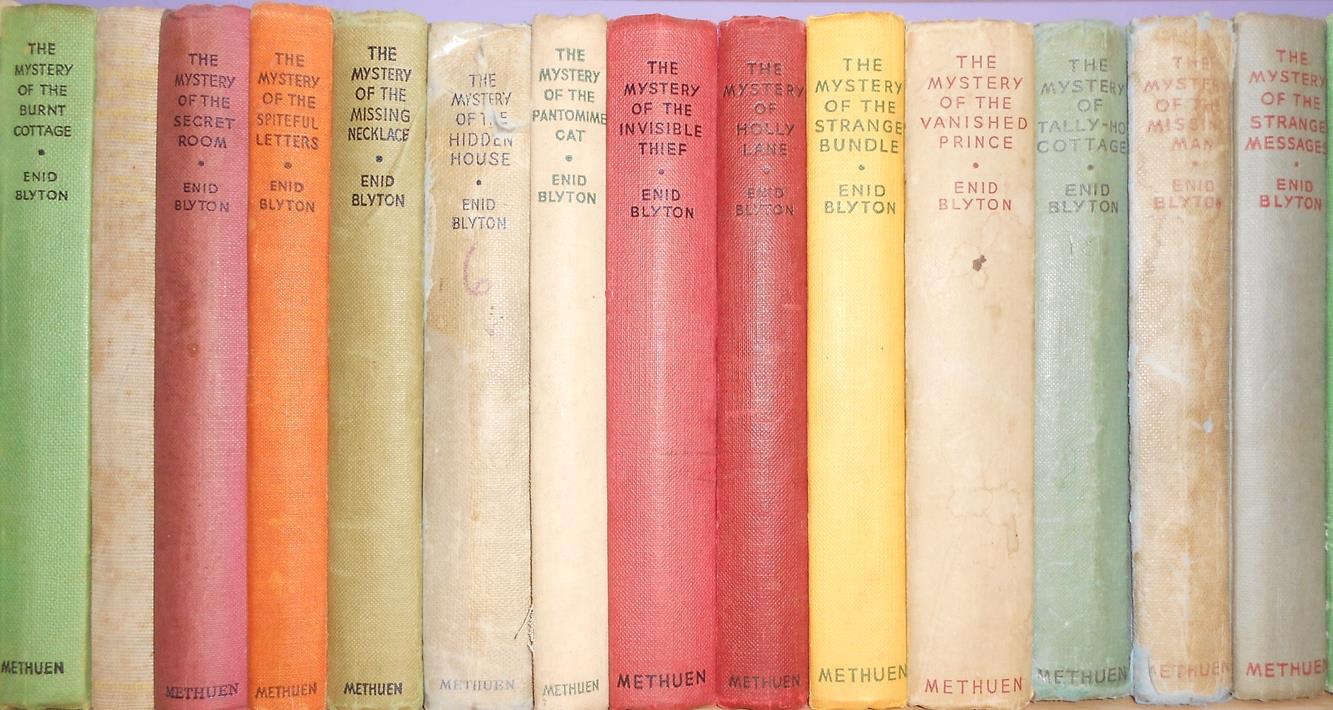
Buster seems still like a little puppy. He is overly excitable, and loves his master more than anything. Buster wouldn’t live without Fatty if he was paid to. In The Mystery of the Invisible Thief, we see Buster as a sad little puppy when Fatty is downcast. This shows the bond of emotions between dog and master. Also Buster is shown to frequently dance around snapping at Mr Goon’s ankles and basically annoy him. I think that the reason he does this might be that Buster knows Mr Goon detests Fatty and vice-versa. As well as not liking Goon himself he probably wants to please Fatty by annoying Mr Goon. Mr Goon tries to get Buster into serious trouble by blaming him for killing sheep in The Mystery of Holly Lane. This shows that Mr Goon doesn’t like Buster either, trying to blame him for something he doesn’t do.

Buster annoying Goon on the front cover of “The Mystery of the Invisible Thief”, drawn by Jean Main.

The Five Find-Outers Series is a series with suspenseful yet humour filled mysteries that a group of children solve, largely thanks to Fatty, their intelligent and big-headed leader. Most of the time the Five Find-Outers and Dog are not in dangerous situations needing their brawn, but their brains are needed quite a lot to solve the mysteries they stumble upon. Buster rarely barks or growls at the villains, giving the children time to run, but he is quite useful in sniffing out clues! Like turps, yuck! In The Mystery of the Disappearing Cat, little Bets sniffs out the smell of turpentine in the cats’ cage, and Fatty thinks it might be a clue. Indeed, it does turn out to be, but I won’t disclose how! The Find-Outers wouldn’t have been able to crack the case if it wasn’t for old Buster, as he sniffs out the bottle of turps and a few other essential clues too.

I wouldn’t classify Buster as ‘intelligent’ that would be Timmy. In her stories, Enid Blyton sketches this little Scottie’s nature beautifully. At times, we see him as someone who accidentally gives away things, affecting the Find-Outers badly. For example, in The Mystery of the Secret Room, while Larry, Daisy, Bets and Pip are snooping around a house, Mr Goon happens to sail by on his bicycle. The children hide in bushes, hoping he’ll go right past. But Buster, who is on guard outside, gives the game away by barking at the policeman. He then comes to investigate which sets him on the track of a mystery the children themselves are trying to solve. But at times he proves useful finding things with his doggy-sense that the Find-Outers wouldn’t have otherwise found. The children don’t have quite as good noses, though Bets might have come quite close in The Mystery of the Disappearing Cat.

When Buster does something wrong, Enid Blyton makes us feel sad for him, and we yearn to comfort him. Though he isn’t as praised as the popular Timmy, Buster is an important character in the series, and readers feel for him.

Basically, I would sum up Buster as a lovable little Scottie who loves his master and is loyal towards him. He doesn’t have much of an intelligent brain, but he proves useful in mysteries, and is an active member of the group. Lovable and excitable he is happy just where he is, surrounded by people who love him. I can’t imagine this innocent creature any other way!

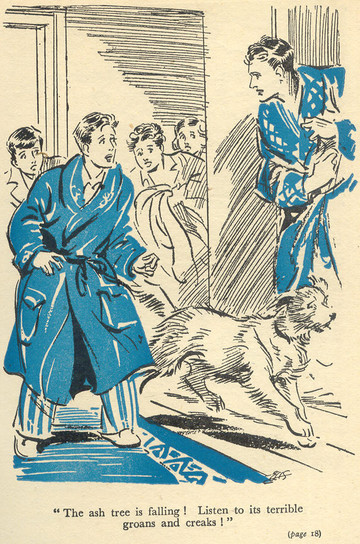
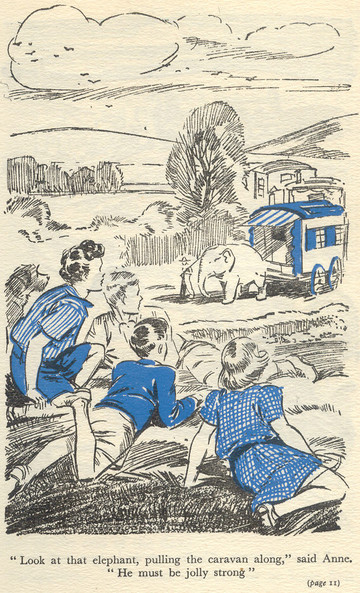
Buster presents a clue in “The Mystery of the Strange Bundle” illustrated by Treyer Evans, Buster and the Find-Outers in “The Mystery of the Burnt Cottage”, illustrated by Joseph Abbey and Buster chases a Tramp in “The Mystery of the Missing Man” illustrated by Lillian Buchanan.

You can click on any of the images to see them larger. All images are taken from the ‘Cave of Books’ at http://www.enidblytonsociety.co.uk.

More of Sunskriti’s animal explorations can be found here, or posts about Blyton’s animals in general are here.

Posted in Characters | Tagged , , , , | 3 Comments

Poppy’s Book of the Month: The Secret Island

By Poppy Hutchinson age 11

Title: The Secret Island
Series: The Secret Series
Main Characters: Jack, Peggy, Mike & Nora
Published: 1938
First Published by: Basil Blackwell Ltd
Rating (out of 5) : 5 out of 5

The Secret Island (the first book in the Secret Series) is a marvellous read, packed with action and adventure. It was the first adventure novel Blyton ever wrote and what a great job of it she made! The story is based on four children who are all very unhappy due to being mistreated by relatives. Jack is an only child and his grandfather wants rid of him, and Mike, Peggy and Nora are all brothers and sisters being mistreated by a horrid aunt and uncle. Their parents were believed to have been killed in a plane crash. They long to run away, so when Jack shows them a secret place he knows of: The Secret Island, the plans begin to hatch. The children finally run away to the Secret Island taking with them all the things they could possibly want. They avoid searchers, and live a happy, adventure packed life until… I’ll leave you to find that out for yourself. I would recommend this book to 7+ boys or girls.

I gave this book a 5 star rating (the best you could possibly get!) because it is such a fun, exciting book, suitable for almost every age and very enjoyable. It even has humour included such as Daisy the cow swimming all the way from the main land to the Secret Island and Jack hiding in a hen house! I loved this book and am raring to read the rest of this magnificent series.

Happy reading all!

Frontis from the 1st edition, illustrated by E.H. Davie. Taken from ‘The Cave of Books’ at http://www.enidblytonsociety.co.uk

Posted in Book reviews | Tagged , , , | 4 Comments

My three favourite characters

In this post I’m going to talk about my three favourite characters from Enid Blyton and the reasons why they are my favourites.

Sally Hope

Series: Malory Towers.

Reason:
In First Term at Malory Towers, Sally Hope starts off as a rather sullen character, with none of the spark that surrounds the series main protagonist, Darrell Rivers. However, this is only the beginning of Malory Towers and first appearances and perceptions can be deceiving. In Sally’s case this is true and without giving away too much of the plot, by the end she is a completely different character.

Sally gains a reputation amongst readers and other Malory Towers characters of being sensible and steady so she rather gets overshadowed by the brasher characters, such as Alicia, and even Darrell at times. Sally is always described as ‘Darrell’s steadying influence’, and the opposite to Alicia (so much so that the two often come to blows!)

The main reason that sensible and steady Sally Hope appeals to me over the other characters (bar one – but we’ll talk about her later!) is because I can relate to Sally where I couldn’t relate to the others characters so well. I will always be the steady (mostly) sensible one, and Sally’s sometimes two dimensional personality appeals to me. I also believe that she has a wealth of untapped potential such as; flashes of jealousy (Third Term at Malory Towers), sparks of humour (Second Term at Malory Towers; Third Form at Malory Towers and Upper Fourth at Malory Towers), intelligence, and, above all else, loyalty to her friends (First Term at Malory Towers and Upper Fourth at Malory Towers).

There is something about Sally’s unseen character that appeals me as well, which could be why I’ve written her as a central character in my very own Blyton Adventure. I think that Sally Hope deserves a lot more credit than people give her, because she’s that best friend who we all love so dearly!

Wilhelmina ‘Bill’ Robinson

Series: Malory Towers

Reason:

Wilhelmina Robinson doesn’t want to be at Malory Towers if it means missing out on her time with her beloved horse Thunder and throughout her first term at Malory Towers which is the Third Term at Malory Towers she is disobedient to her form tutor’s wishes and goes out to see her horse, regardless.

Wilhelmina is a tomboy, having seven brothers, and she likes to be called Bill. The logic is simple, boys called William, get called Bill, and why can’t Wilhelmina be shortened to Bill?

The reason I find Bill, as a character so appealing is that she has a basic form of rebellion that is so effective. She doesn’t want to be a girl, so she gets called Bill and accidently ignores her teachers when they try to call her Wilhelmina. I also enjoy Bill’s solid, practical nature. There is a feel of simplicity about Bill that stems from her practicality rather than a lack of intelligence, especially in In the Fifth at Malory Towers after a particularly spiteful incident, she is the first to try and restore normality.

Another part of my reason for favouring Bill is that she was always the tomboy I was never able to be! By the time you’ve finished reading this you may be wondering why I picked Bill over Georgina ‘George’ Kirrin, and the answer is that when I was younger, I never really warmed to George with her spiky temper, but Bill with her easy going, laid back nature and humour was far more appealing than a sulky George could ever be. So when it comes to the fight of the tomboys, Bill wins hands down.

My third and final favourite character seems to take on the “You either love him, or you hate him” banner. Ladies and Gents, I give you;

Julian Kirrin

Series: The Famous Five

Reason:

Julian Kirrin is the undisputed leader of the Famous Five and divides opinion in this modern day and age with a lot of people disliking him and his attitude, but some (like myself) like him. Many people dislike Julian’s ‘pompous’ manner, so related to the attitude of men at the time.  Julian assumes natural leadership and responsibility over the five because of his age.

Julian comes in for a lot of stick, but from my point of view, I do believe he’s the perfect gentleman. He takes on a serious amount of responsibility when he leads the five; would you like to tell George what she can and can’t do? I know I wouldn’t.

Julian Kirrin has great strength of character, he has a clear line of right and wrong when it comes to adventures, and will always come down firmly on the side of right. He cares greatly for his sister Anne, even though some see this as part of his pompous attitude because he automatically assumes that Anne is happy to “play house” while they’re on their adventures. Even though these actions highlight the clear gender divide of the time, they are in a way playing towards Anne’s strengths and help greatly when she can focus on feeding her brothers and cousins if she’s getting scared about the adventure in hand.

Part of Julian’s appeal for me, is not just how the other members of the Famous Five respond to him, but the characters that the Five make friends with respond to Julian with a level of respect. Two of my favourite interactions that Julian has are with some of the younger characters, such as Aily from Five get into a Fix and Jennifer Mary Armstrong in Five Runaway Together. In these books the little girls respond to his kindness and trust him to keep them safe. Julian is certainly the kind of boy who appeals to my sense of old time charm.

Now to find the 21st Century Julian! *wink*I hope you’ve enjoyed reading about my favourite Blyton characters, and that you understand my reasons for liking them so much.

Why don’t you leave us a comment on your favourite character? Of even better write us a blog to post on your favourite three!


Posted in Characters | Tagged , , , , , , , | 3 Comments

Series Synopsis: Famous Five Books 1-3

A short guide to the first three Famous Five adventures. There are some spoilers if you haven’t read the books yet.

Treasure Island, Adventuring Again, Run Away Together

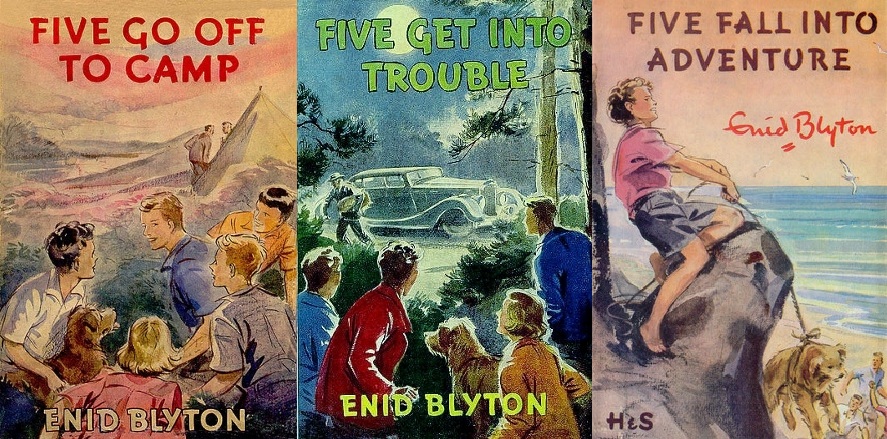
Dustjackets from the first editions of “Five on a Treasure Island”, “Five Go Adventuring Again” and “Five Run Away Together” all illustrated by Eileen Soper.


FIVE ON A TREASURE ISLAND, 1942

The Location: Kirrin Bay. The Kirrin Bay area has belonged to Aunt Fanny’s family for hundreds of years though much has been sold off; leaving just Kirrin Cottage where Fanny, Quentin and George live, Kirrin Island and a farm a little way off. Kirrin Bay has a lovely beach and many fishermen live and work in the area. Kirrin Island features a mostly ruined castle and a sunken shipwreck that had been captained by a Kirrin ancestor.

The ‘Baddies’: An un-named man who calls himself an antiques collector who tries to trick the Kirrin family out of their island in order to discover the treasure for himself. He has at least one friend helping him out.

Significant other characters: Uncle Quentin and Aunt Fanny who are initially taken in by the antiques collector, and Alf the fisher boy who had been taking care of Timmy for George.

The Plot: This is the first time that Julian, Dick and Anne have been to Kirrin and at first George is not pleased to see them. By making friends with Timmy and showing generosity and kindness the three are able win over George. The five visit Kirrin Island, and on one visit a fierce storm throws up the old wreck. An exciting treasure map of the island’s dungeon is found, but the antiques collector manages to buy this from Uncle Quentin. It’s then a race for the five to find the treasure before the men do. It’s only thanks to George’s cleverness and Dick’s bravery that this story has a happy ending.

 My favourite parts: Julian’s kindness in offering to share ice-cream with George if only she will share Timmy and her island with them, as well as the excitement of exploring the wreck and the dungeons.

timmy five on a treasure island

George introduces the others to Timmy


FIVE GO ADVENTURING AGAIN, 1943

The Locations: Mostly set in Kirrin Cottage, as it is winter-time and there is a lot of snow. Also important is Kirrin Farm, the farm still owned by the Kirrin family.

 The ‘Baddies’: The four children have a holiday Tutor, Mr Roland who takes an interest in Uncle Quentin’s work. George hates him from the outset – he doesn’t like her beloved Timmy for a start! Mr Roland is aided by two so-called artists, Mr Wilton and Mr Thomas.

Significant other characters: Uncle Quentin and Aunt Fanny who are again taken in by the bad guys. Mr and Mrs Sanders are an older couple who live at Kirrin Farm, and provide rooms for the two artists.

The Plot: While exploring Kirrin Farm House Dick finds an old parchment which looks like a treasure map. Julian shows Mr Roland the map, as some of it is in Latin, and infuriates George. Uncle Quentin bans Timmy from the house to punish George for her behaviour towards Mr Roland. After Christmas they plan to visit Kirrin Farm to look for the secret way but George refuses to go with Mr Roland. They don’t find anything, though the two artists help after being introduced to Mr Roland. When the group return to Kirrin cottage, George claims the tutor had lied about not knowing the artists. Timmy starts coughing at night, and as he is outside in a snow covered kennel George sneaks him into her father’s study to warm up. That same night some of Uncle Quentin’s papers are stolen, and some of his test tubes smashed. While George is being interrogated in her father’s study she realises that the entrance to the secret way begins in Kirrin Cottage. She is sent to bed for the rest of the day, but Julian follows Mr Roland and sees him handing papers to the two artists. Kirrin Cottage is snowed in, and Mr Roland is ill in bed so the five decide to explore the secret way. It takes them to Kirrin Farm where they find the papers in one of the artist’s rooms, but the artists take chase. Thank goodness for good old Timmy!

My favourite parts: George being proved right about Mr Roland, and the secret spaces and passages at Kirrin Farm.

The Five warm themselves by the fire


FIVE RUN AWAY TOGETHER, 1944

The Locations: Another Kirrin-based story taking place at Kirrin Cottage and on Kirrin Island.

The ‘Bad Guys’: The Stick Family. Mrs ‘Ma’ Clara Stick is temporarily hired as a cook at Kirrin cottage and soon the shifty Mr ‘Pa’ Stick shows up too. An unseen relative Sarah Stick is also implicated in the Stick’s bad deeds.

Significant other Characters: Aunt Fanny and Uncle Quentin – though Fanny takes ill and is taken to hospital by Uncle Quentin, so they are absent for most of the story. Edgar Stick, the annoying son of Mr and Mrs Stick. And one other who I won’t mention as it will give too much away!

The Plot: The dour Mrs Stick, slovenly Mr Stick, immature Edgar and nasty dog Tinker make the Five’s life very uncomfortable at Kirrin Cottage, even going as far as trying to poison Timmy. George tries to run away to her island, but Julian catches her, and they all decide to go. While looking for a place to stay on Kirrin Island they find a trunk full of unexpected items on the wreck. Soon they realise they are not alone on the island – the Sticks have turned up, bringing with them luxuries from Kirrin Cottage. The Five take Edgar prisoner, and when they figure out what the Sticks have been up to they need to navigate their way through the dungeons to make a daring rescue.

My Favourite parts: The highly amusing scene where the children frighten Edgar to reclaim some of the things from Kirrin Cottage, as well as when they capture him from right under his parents’ noses. Also, there are some great moments where Julian stands up to the Sticks before they ‘run away’.

five run away together

George drops into their cave


Part two of the Famous Five synopsis will be coming soon, and as always let us know what you think of this post!

Next post: Books 4-6

Posted in Book reviews | Tagged , , , , | 7 Comments

Firework Night – A poem by Enid Blyton

(By your dog and mine)

BANG!
What's that?
Bang-Bang! Oh, Hark,
The guns are shooting in the dark!
Little guns and big ones too,
Bang–bang-bang!
What shall I do?
Mistress, Master, hear me yelp,
I'm out-of-doors, I want your help.
Let me in-oh, LET ME IN
Before those fireworks begin
To shoot again-I can't bear that;
My tail is down, my ears are flat,
I'm trembling here outside the door,
Oh, don't you love me anymore?
BANG!
I think I'll die with fright
Unless you let me in to-night.
 (Shall we let him in, children?)
Ah, now the door is opened wide,
I'm rushing through, I'm safe inside,
The lights are on, it's warm and grand-
Mistress, let me lick your hand
Before I slip behind the couch.
There I'll hide myself and crouch
In safety till the BANGS are done-
Then to my kennel I will run
And guard you safely all the night
Because you understood my fright.

The Poem “Firework Night” by Enid Blyton, has been copied above as it is written in the book “The Enid Blyton Poetry Book” (School Edition) published in 1934.

This particular poem focuses on a dog being scared by the fireworks on Bonfire Night. Blyton was a great lover of animals so this poem is from the dog’s point of view at being left outside on bonfire night. So just a friendly reminder and warning to all you out there with pets;

Please remember to bring your pets inside tonight and make them feel safe and secure!

Happy Bonfire night all!

fireworks

Posted in Poetry | Tagged , , | 10 Comments

Who are the Famous Five? a short guide
Here’s a short guide to who makes up the Famous Five and the grown-ups who are responsible for them during the adventure-filled school holidays.


JULIAN

Older brother to Dick and Anne, cousin to George. Julian is generally in charge of the Five as he is the oldest and most responsible (some might even call him bossy!)

520wide+5185092


DICK

Dick: Younger brother to Julian, older brother to Anne and cousin to George. Dick is always hungry and injects humour into their adventures.

360wide+4505897


GEORGE

George: Cousin to Julian, Dick and Anne. George’s real name is Georgina but she wants so badly to be a boy that she dresses as one and won’t answer to Georgina. George can be sulky and displays a magnificent scowl on regular occasions. George dotes on her dog Timmy and dislikes anyone who doesn’t like him.

five go to smuggler's top


ANNE

Younger sister to Julian and Dick, cousin to George. Anne is the youngest of the group and usually more easily scared than the others. She is usually the one to keep house, caravan or cave for the others, and takes charge when it comes to preparing meals and the like. Has been known to turn into a tiger on the odd occasion.

anne, five go off to camp


TIMMY

George’s dog. Timmy is a large, brown cross-breed loved by the four human members of the Five. He has proved invaluable when facing off with enemies, and truly seems to understand everything that the children say.

timmyposture


UNCLE QUENTIN AND AUNT FANNY

George’s parents. Uncle Quentin and Aunt Fanny live in Kirrin Cottage on Kirrin Bay. Uncle Quentin is a world famous scientist, very short tempered and very forgetful. He is as known for his angry outbursts when anyone dares to slam a door when he is working, as he is for absent-mindedly putting mustard on his toast or custard on his fish. The children love Aunt Fanny as she is very kind to them and always provides a good spread at meal times.

quentin and fanny


JOAN/JOANNA

The Kirrins’ Cook. Always on hand to provide a sumptuous meal or fantastic picnic. Has to protect the larder with a rolling pin on occasion if Timmy or Dick feels like an impromptu snack.

joan joanna


The Five had 21 thrilling  full-length adventures:

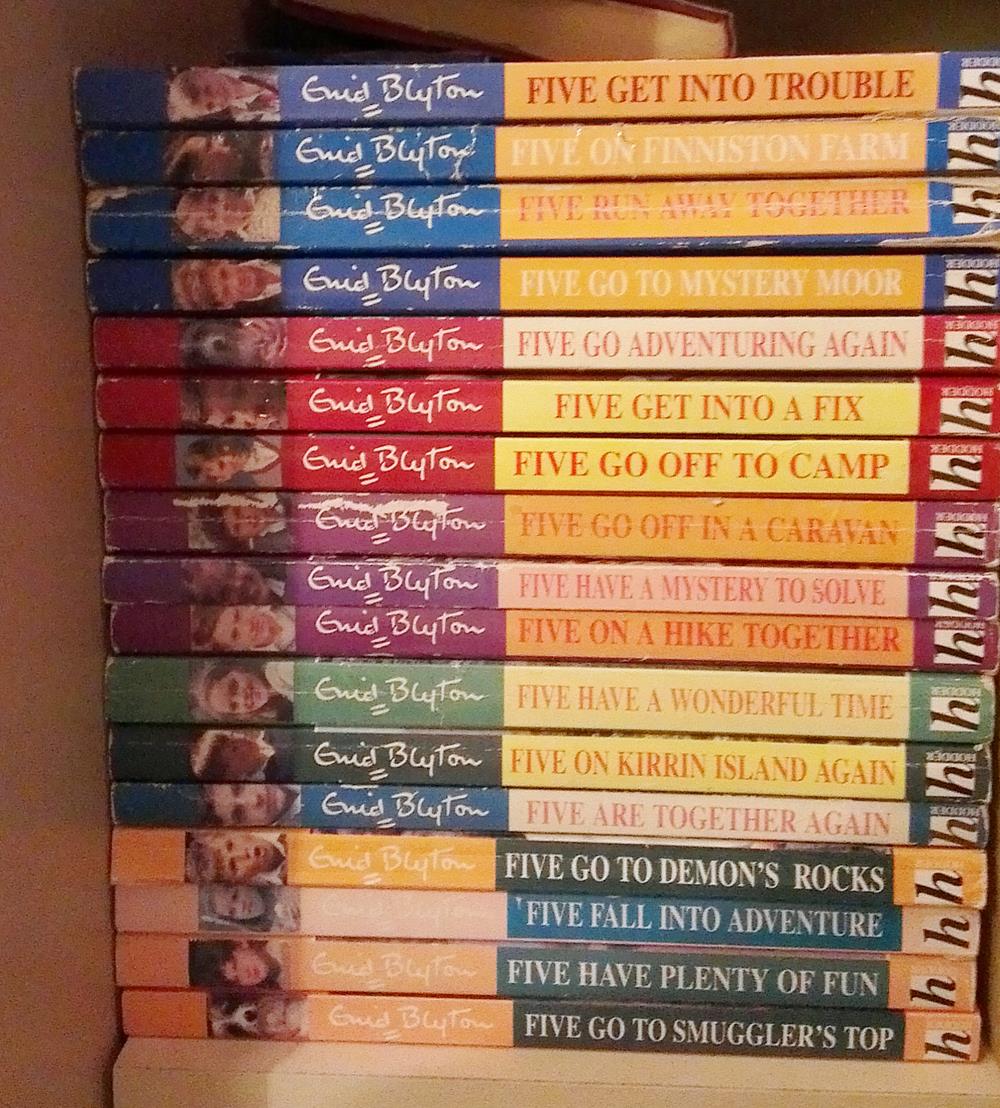
Five on a Treasure Island • Five Go Adventuring Again • Five Run Away Together •Five Go to Smuggler’s Top • Five Go Off in a Caravan • Five on Kirrin Island Again • Five Go Off to Camp • Five get into Trouble • Five Fall into Adventure • Five on a Hike Together • Five Have a Wonderful Time • Five Go Down to the Sea • Five Go to Mystery Moor • Five Have Plenty of Fun • Five on a Secret Trail • Five Get Into a Fix • Five Go to Billycock Hill • Five on Finniston Farm • Five Go to Demon’s Rocks • Five Have a Mystery to Solve • Five Are Together Again.

And eight shorter ones:

George’s Hair is Too Long • Well Done Famous Five! • Good Old Timmy! • A Lazy Afternoon • Five Have a Puzzling Time • Five and a Half-Term Adventure • Happy Christmas, Five • When Timmy Chased the Cat.


The Five met many interesting characters on these adventures and you will be introduced to them in our upcoming summaries of all 21 books and the short stories.

Image from the cover of 'Five on Finniston Farm', taken from the Cave of Books at www.enidblytonsociety.co.uk

Image from the cover of Five on Finniston Farm

Posted in Characters | Tagged , , , , | 2 Comments

Enid Blyton: A summary of her writing career

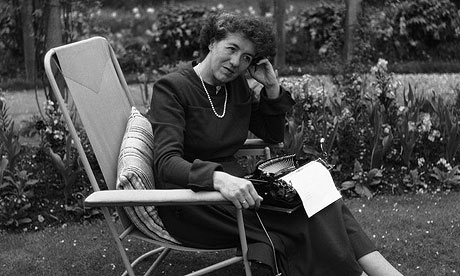
Enid Mary Blyton was born in 1897 and from a young age loved telling stories to her younger brothers, Hanly and Carey.

She qualified as a teacher in 1918, and in 1921 won a writing competition and after her writing was accepted in major children’s magazines. In 1922 her first book Child Whispers was published and by 1923 she was writing a regular column for the teachers’ magazine Teachers World as well as publishing her second book Responsive Singing Games.

1925 brought with it a wealth of material from Blyton including Silver and Gold, and The Tales of Brer Rabbit (retold).

Enid had been writing for the magazine Sunny Stories for Little Folks since 1927, and in 1937 it was renamed Enid Blyton’s Sunny Stories Magazine with a change of format, where full length stories could be serialised over many weeks. The first was Adventures of the Wishing Chair which was  then published as a proper novel at the end of the year. Mr Galliano’s Circus and The Secret Island were serialised and then published in 1938 and still remain popular today.

Blyton continued to write popular books in 1939 like The Enchanted Wood and Naughty Amelia Jane, followed by several in 1940 such as Mister Meddle’s Mischief, The Secret of Spiggy Holes, The Treasure Hunters, The Naughtiest Girl in the School and The Children of Cherry Tree Farm.

In 1941 Blyton started her second school series with The Twins at St Clare’s, as well as continuing the Secret Series with The Secret Mountain and writing The Adventurous Four.

1942 was to be an important year for Blyton as she launched the series that almost everybody would remember her for years to come. That series is of course The Famous Five with their first adventure Five on a Treasure Island. The Famous Five went on to have a grand total of 21 full-length adventures as well as several short story exploits. A Famous Five book was published every year from 1942 until 1963, with the exception of 1959.

Blyton also wrote new instalments for Mr Galliano’s Circus, Naughtiest Girl, St Clare’s and the next book in the Farm Series, The Children of Willow Farm in 1942.

Another major series of Blyton’s arrived in 1943. The Five Find-Outers burst on to the scene in their first adventure The Mystery of the Burnt Cottage and had solved fourteen more mysteries by 1961. Frederick Algernon Trotteville aka Fatty, a larger than life personality who leads the Find-Outers in a majority of their adventures is arguably one of Blyton’s most unique characters. Sequels to the St Clare’s and Secret Series were also published in 1943.

The Adventure Series was the next of Blyton’s series to be launched with The Island of Adventure in 1944. Seven more adventures featuring Jack, Philip, Dinah, Lucy-Ann and Kiki the Parrot were written between 1946 and 1955.

Two St Clare’s books were released in 1944, The Second Form at St Clare’s and Claudine at St Clare’s. The final St Clare’s book was then published in 1945. The next year Blyton’s most famous school series, Malory Towers was published.

1945 saw Blyton’s library extend even more, with several popular stand-alone books published. Hollow Tree House was one of the more popular stand-alone titles. The Caravan Family was also published this year as the first of six books of family stories for younger readers.

Skipping forward through Blyton’s wealth of books to 1949 where another of her popular stand-alones comes to light in the form of Those Dreadful Children alongside two new series appearing in 1949; The Secret Seven and The Barney Mystery Series.

The Secret Seven series ran for 15 adventures from 1949 until 1963 and was aimed at younger children. Today a lot of people see the Secret Seven as a starter for children before they read the Famous Five. The Secret Seven solve mysteries in their local community, and meet in the shed at the bottom of Peter and Janet’s garden. The Seven children have their own S.S. badges and a password to get into the shed.


The Barney Mystery Series which also appeared in 1949, introduced Barney, Snubby and Roger and Diana Lynton as well as their pets Looney the dog and Barney’s monkey, Miranda. Barney is a circus boy who has been trying to find his father since the death of his mother. Like many other of Blyton’s books, mysteries are the main focus of the stories. There were six Barney Mysteries written, starting in 1949 with The Rockingdown Mystery and ending in 1959. Interestingly the Barney’s Mysteries are sometimes referred to by a different name; The “R” Series, because each of the six book titles begin with that letter.

One other series that has not been mentioned so far, is that chap with the bell on his hat from Toy Town, Noddy. He is the character that is most associated with Enid Blyton since his creation 60 years ago.  Noddy is extremely popular and has a great wealth of merchandise attached to his name. Blyton originally wrote only 24 Noddy books, but he had the greatest timespan of all of her series. The first Noddy book was written in 1942 and the series continued until 1963.

This is an only an overview of Enid Blyton’s best known books and series. Blyton is known to have written over seven hundred books in her time, including six under the name Mary Pollock, though no one is quite sure what her overall total was.


For more information on these books as well as everything else Enid was known to have written, you can delve into the wonderful Cave of Books at http://www.enidblytonsociety.co.uk/cave-of-books.php.

Now only one question remains: What is your favourite book or series from Enid Blyton?

Posted in Enid Blyton | Tagged , , , , , , , , , , , , , , , , , , , , , | 10 Comments