Enid Blyton’s Holiday Stories then and now, part 9

Stories 19 and 20 in today’s post, leaving just 5 more!

Previous parts look at story 1, stories 2 and 3, stories 4 and 5, stories 6 and 7, stories 8 to 10stories 11 to 13stories 14 to 16 and stories 17 to 18.

enid-blytons-holiday-stories


Lazy Lenny

Originally titled Lazy Leonard this was first published in Sunny Stories #310 in 1943. It was first reprinted in the Fifth Holiday Book in 1950, and then four further times starting in 1970, with the shortened title.

A brief review

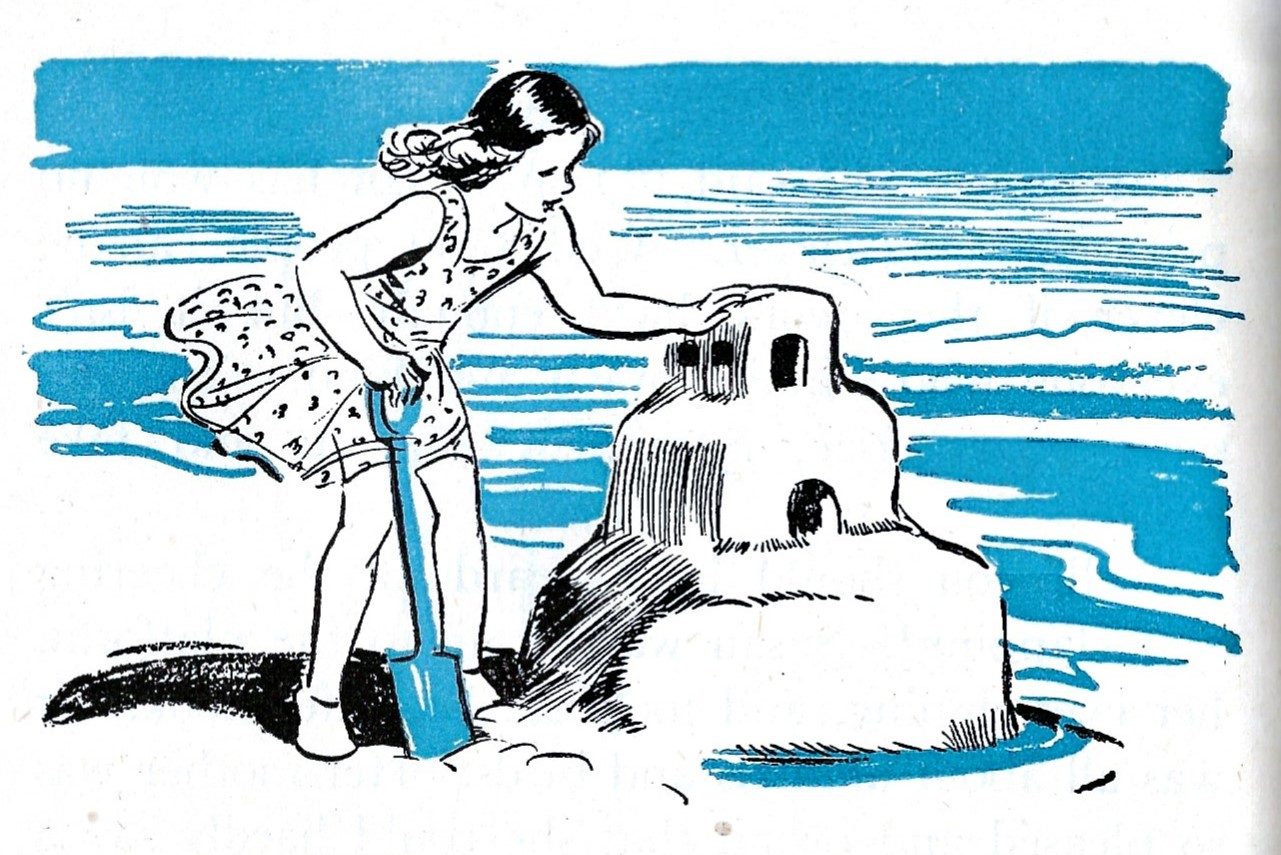
Lenny is on holiday by the beach with his cousins, and as the title suggests, he is lazy. His cousins do all the digging and water carrying but he gets to enjoy the finished work. Well, his cousins have had enough! But Lenny has a slew of excuses which he pulls out until there are none left and he has to get up. He needs to buy a new spade, only he’s dropped his money in the sand… there’s only one way to find it and that is to do a whole lot of digging…

Seeing as this is a warm, summer’s day on the beach, during the holiday, this one definitely belongs in the collection.

The updates

The first – as above – is that Leonard has become Lenny. Which is short for Leonard anyway… In the one instance that Leonard is called Len, the new version keeps it as Lenny and thus loses the little sign of implied affection that his cousin using a nickname gave.

The girls also get their names changed from Joan to Karen and Sheila to Rachel. I don’t know any Karens or Rachels under 30!

The money is the thing that is changed the most. Originally it was a shilling, and has now become a pound. Inflation calculators are not always reliable when it come to working out how much money would be worth now, as there are so many variables, but I worked out that 1 shilling should be around £2 in 1015 (and £3 now!)

Most of the shilling-pound changes were a straight swap of one word for the other (12 times, if you were wondering). However on other occasions a shilling became some money, his silver shilling became his money, the shilling became the money, the shilling became it, and he couldn’t find his shilling became find anything (even though he was specifically looking for the coin!).

The word shilling was used rather a lot of times – but it was a short story with half of it being about losing a shilling!

The change to a pound creates bigger problems when Lenny uses it to buy small gifts for his cousins by way of apology.

Originally the gifts cost fourpence, threepence-ha’penny and fourpence-ha’penny, adding up to exactly one shilling. They now cost forty pence, fifteen pence and forty-five pence. I think you’d have to go back a long way further than 2015 to be able to buy toy boats and fish at beach-side shops for that amount of money! Originally the amounts spent are fairy even, also. Now one child gets far less spent on them than the other two!

I can appreciate the difficulty, though. A £2 coin would have been slightly better, but spending 65p, 60p and 75p still seems unreasonably cheap. Beyond that it would have to be multiple coins or a note, which would mean making even more changes to the text. If only there was a really simple method, like not updating the currency to begin with?

One more update is made to the money – originally Leonard sees something round and flat and shining, which turns out to be his shilling, whereas Lenny sees something round. Pound coins in 2015 could still be shiny and they were also pretty flat!

A few other minor changes – fine fun becomes great fun, and the apostrophe in ‘planes is lost. Italics are removed twice, but left on three other uses.

Not changes is shan’t, he’s too fat and Lenny’s iron spade.

The illustrations

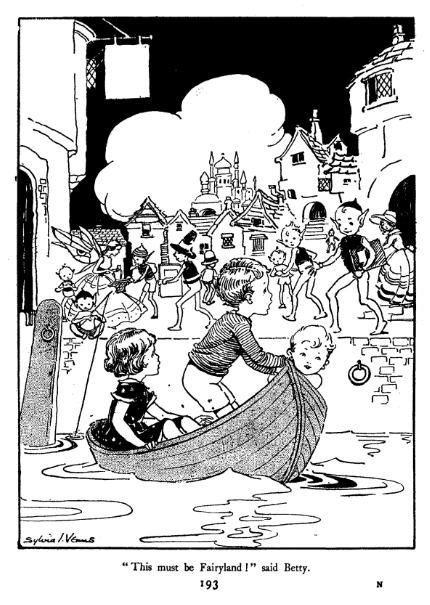
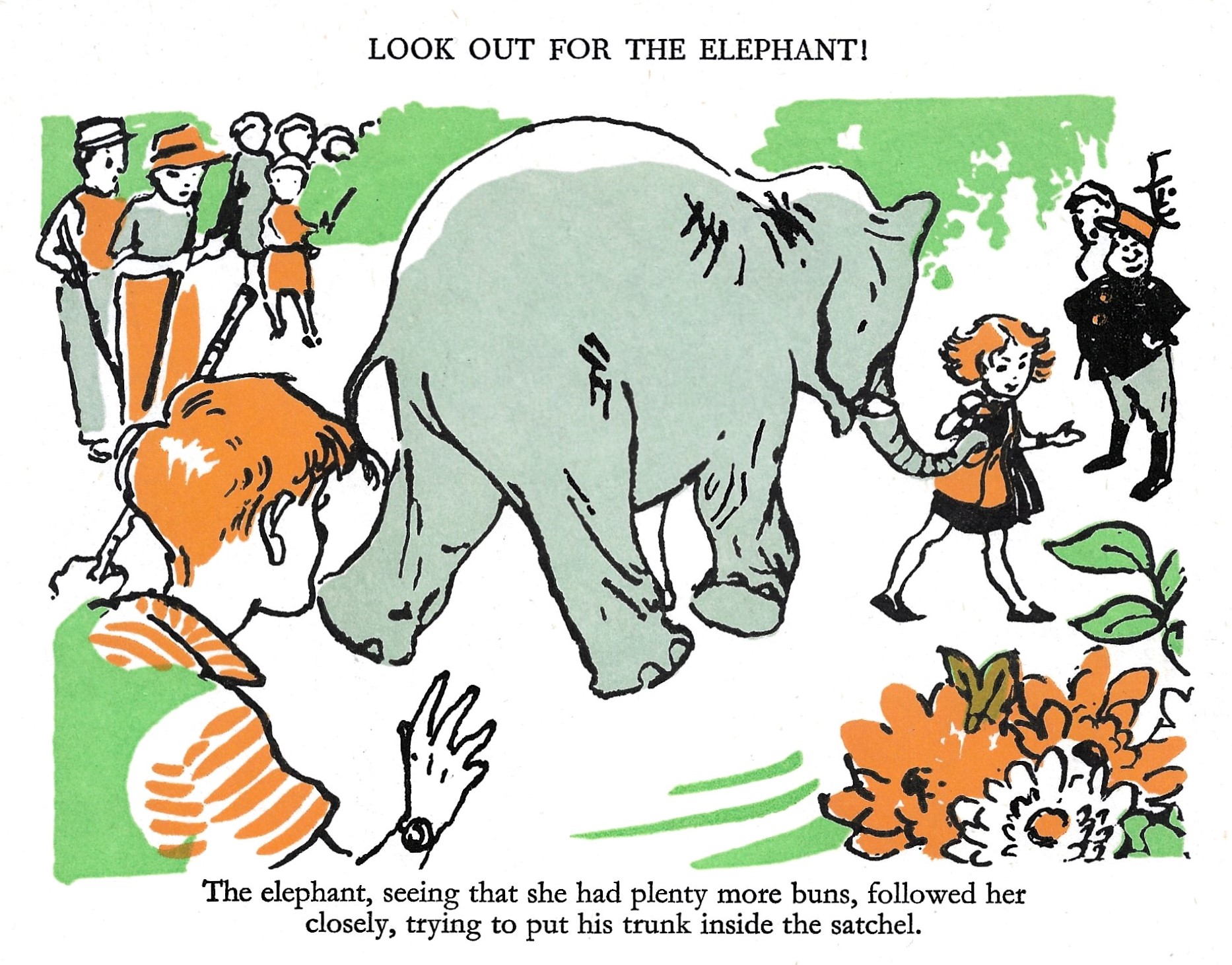
Sylvia I Venus provided the illustrations for the original magazine printing while Valerie Sweet provided six lovely three-coloured illustrations for the Fifth Holiday book.


Pink Paint for a Pixie

First published in Sunny Stories #303 in 1943, it was first reprinted in A Story Party at Green Hedges. That feels a bit dishonest somehow – the book is presented as a truthful account of a party so I’d have expected Blyton to have written something especially for it! As it turns out all the stories had been printed in Sunny Stories before. If the party was real, I hope those children hadn’t already read them! Anyway, it wasn’t reprinted again during Blyton’s life but has appeared four times since 1980.

A brief review

Linda finds a little pixie painting a tiny tea-set in the field by her garden. Unfortunately the pixie has run out of pink paint, but Linda brings out her tube of red paint which when mixed with water makes pink. (I’m no artist – but I’d have thought you’d need white paint to make pink?)

He’s most grateful and although he hasn’t the power to grant a wish for Linda he does try to show her ways she can make a wish. But there are no four-leafed clovers, the foxgloves aren’t out yet, and there are no pink-tipped daisies in the field either.

But the pixie does have his pink paint…

When Linda comes back after her afternoon rest there is no pixie but there are a load of pink-tipped daisies! Linda takes the 13 she was told to, makes a chain for around her neck and makes her wish 13 times in the hour. Her wish is for her soldier brother to come back from far away, and he does!

I know about four leaf clovers being lucky, so wishing on them makes sense. I haven’t heard of putting a fallen foxglove bell on your thumb to make a wish – possibly that has died out because touching foxgloves can cause allergic reactions, and they are extremely toxic if ingested. I wonder if this is a genuine old myth, or something Blyton randomly came up with? The same goes for the pink daisies, as I haven’t heard that one before, though I always liked finding them when I was younger.

The pixie was painting the tea-set for Princess Peronel – who appeared in story #6 in this collection. Is it always the same character when Blyton uses that name?

Not a very summer holiday tale. Foxgloves start coming out in June so it’s likely it’s only May or very early June anyway.

The updates

Not many in this one. Linda is still Linda.

Hullo becomes Hallo and to-morrow becomes tomorrow.

A Story Party for Green Hedges includes a little bit in between each story where Blyton talks to the children about the stories (reported in the first person which is rare for Blyton). These are not repeated in the collection.

At the end of the previous story Peter makes a comment about his story, then Daisy begins talking.

“We’ve only got three more stories,” says Daisy. “Oh, dear it sounded so lovely to have fourteen but the time just rushes by when we’re listening. Can I have my story now, please, Enid Blyton? I know just what I want.”

“What do you want, Daisy?” I say.

“I’d like a story about a pixie and a little girl and some magic,” says Daisy. “A really nice one, please.”

They all look at me and wait. A pixie a – little girl – and some magic. Yes – I know a story with all those in!

“I know just the story for you, Daisy,” I say. “And what is more it’s got daisies in, so it’s just exactly right for a little girl called Daisy – which. is you!”

“I shall like that,” says Daisy, and she pulls her chair as close as she can. “Do begin.”

“It’s about a pixie and a little girl called Linda,” I say. “And it’s called Pink Paint for a Pixie.”

Between the title and the body of the story is then the subheading A Tale for Daisy.

Following the story there is more from Daisy.

“Oh can we go out and look for some pink tipped daisies this very minute!” cries Daisy, as soon as I have finished the story. “Do let’s! Oh, I’d so love to find some and make a daisy-chain, and wish thirteen times!”

“No – don’t let’s go yet,” says Jack. “I haven’t had my story and it will soon be time to go home! We can look for daisies when we have to go.”

“Yes, you can,” I say. “I’m afraid I shall soon have to send you all home, and certainly Jack mustn’t miss his story!”

The illustrations

Marjorie Thorp illustrated the story in Sunny Stories, and Grace Lodge provided five illustrations in A Story Party at Green Hedges.


Posted in Book reviews, Updating Blyton's Books | Tagged , , , , , , | Leave a comment

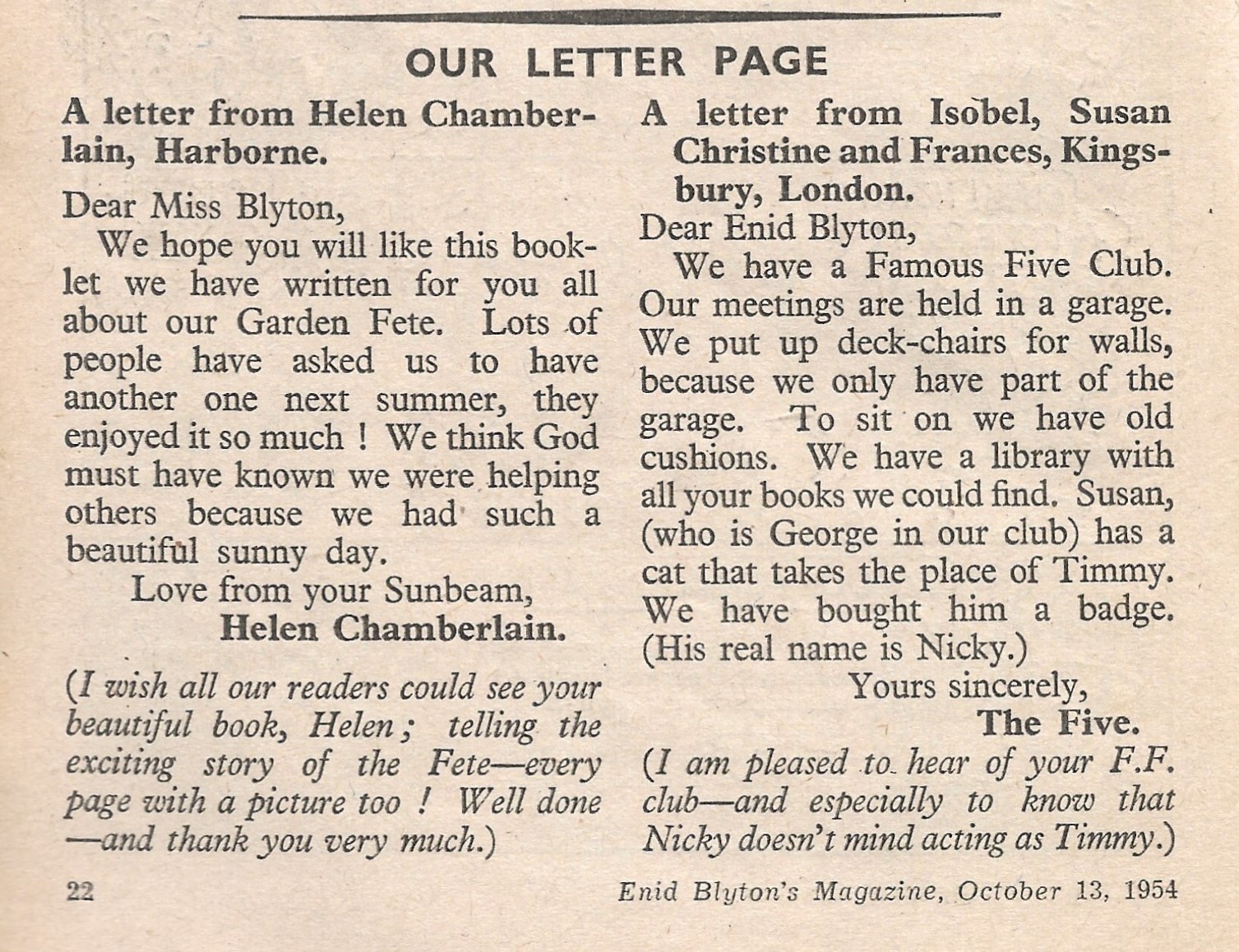
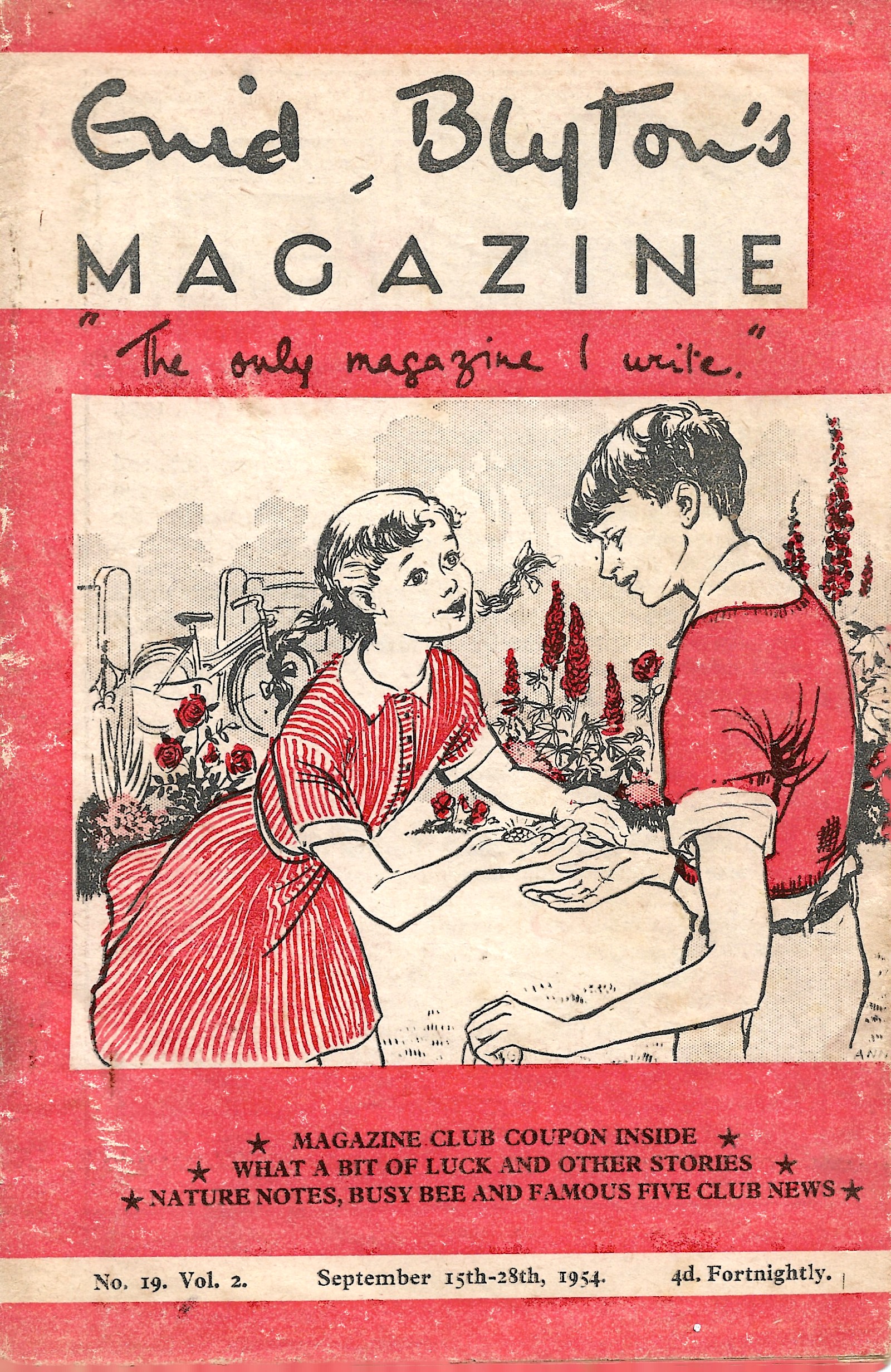
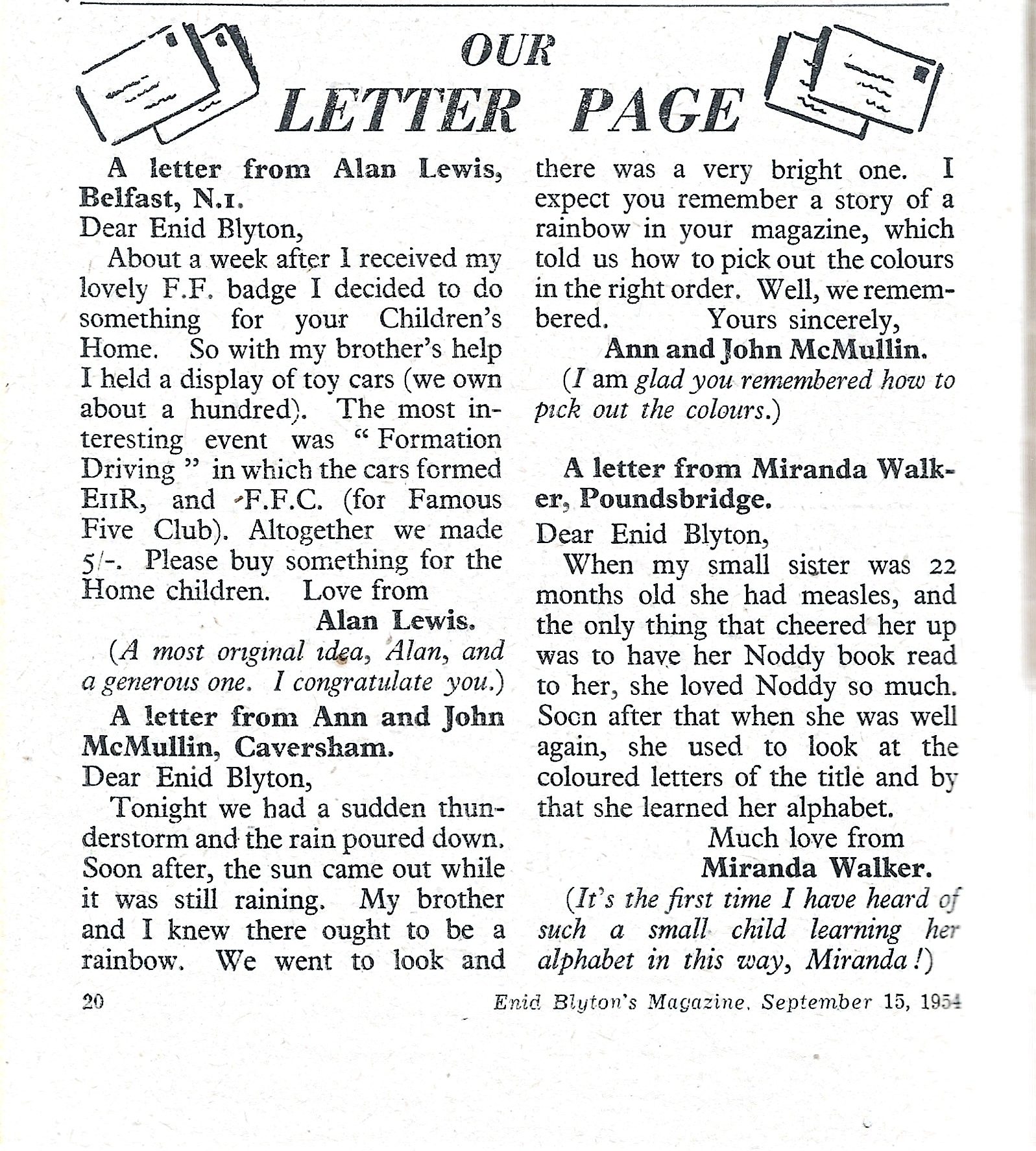
Letters to Enid part 30: From volume 2 issue 18

Previous letters pages can be found here.


Letters page from Volume 2, issue 18.
September 1st – 14th, 1954.

OUR

LETTER PAGE

 A letter from Pat Hemming, R.A.F. Station, St. Athan.
Dear Enid Blyton,
Last year in the summer a little hedgehog came to visit us. Every night we put some milk out for it, and every night he came and drank it. In the winter months didn’t see him again, so we waited until it was time for him to awake from hibernating. A few days ago we saw him again, drinking the cat’s milk in a saucer.
Yours,
Pat Hemming (A Busy Bee)

(A well-written and interesting letter, Pat. You win the letter prize!)

Part of a letter from Mary Bowles, Loftus.
Dear Enid Blyton,
I read your magazine. Best of all I like the News-Page and your Letter. I love that! Those three things make me feel closer to those who read our magazine and who work for our three Societies.
Yours sincerely,
Mary Bowles.

(I know exactly what you mean, Mary. It is the News-Sheet and the Letter that makes us all friends together they are what I like best too!)

A letter from Joyce Craggs
Dear Enid Blyton,
My friends and I who are members of the F.F. Club have been exchanging our “Fives” books with one another, at the price of a penny for each book. In this way we have made the sum of two shillings and sixpence for your Children’s Home. We all love reading about the little children on the News-Sheet in your magazine.
Yours sincerely,
Joyce Craggs

(Your letter contained such a good idea, Joyce, that I had to print it in case other children liked to follow it. Well done!)


A nice letter from Pat, but obviously they didn’t know in the 50s that milk is  bad for hedgehogs!

Interesting that Mary’s letter was cut down – that’s the first time I’ve seen that on a letters page. Perhaps Mary’s letter was a very long one, too long to be printed.

Lastly, I do like the idea in Joyce’s letter. You’d have to increase it quite a bit to make it worthwhile now – one inflation calculator suggests that 1p would now be worth 35p today. Even at 50p it’s still affordable for most children and the money could go to a good cause, even if Blyton’s specific charities are no longer running.


Posted in Magazines | Tagged , , | Leave a comment

Monday #531

We are experiencing a bit of a heatwave in Scotland this week – that’ll teach me to complain about cold weather! Where I am it has also coincided with a major bus strike, so Sunday service on every route and no buses after about 6pm. I can only imagine how hot it will be on the crowded buses that are running! I support the workers who are striking – my annoyance is with the company who has let things get this far.

Letters to Enid 30

and

Enid Blyton’s Holiday Stories then and now, part 9

Something different this week – I thought I’d highlight one of the older posts on the blog that newer readers may have missed.

I chose a random page from the archive of posts and spotted this –

The Trials of Aunt Fanny – Feeding the Five (and Quentin)

I had great fun writing these tongue-in cheek excerpts from Aunt Fanny’s 1956 diary – all about her troubles in keeping the Five well-fed.


Posted in Blog talk | Tagged , | 4 Comments

May 2023 round up

May is upon us, but spring seems to be dragging its heels. It feels like it’s getting colder instead of warmer… – I wrote that earlier in May when I drafted this post, but at least by the end we’d had some really warm and sunny days!


What I have read

I finally finished two books that had been on my reading pile for months, so that was a relief. 

What I have read:

  • The Sinister Booksellers of Bath (Left-Handed Booksellers of London #2) – Garth Nix
  • All Creatures Great and Small – James Herriot
  • A Room of One’s Own – Virginia Woolf
  • Treasure Island – Robert Louis Stevenson
  • Hidden Figures – Margot Shetterly Lee 
  • The Echo of Old Books – Barbara Davis
  • Boy – Roald Dahl
  • A Leap of Faith for the Cornish Midwife (Cornish Midwife #5)
  • The Reading List – Sara Nisha Adams
  • The Dragon in the Library (Dragon in the Library #1) 

And I’m still working on:

  • Going Solo – Roald Dahl
  • Tilly and the Lost Fairytales (Pages & Co #2) – Anna James
  • What Was Hidden at Ardhmor (Ardhmor #3) – Lea Booth

What I have watched

  • We’ve watched the odd episode of Richard Osman’s House of Games, but mostly we’ve been watching Lego Masters Australia as Ewan got into that at the end of season 3. We’ve then started the American version which isn’t as good, and have watched Taskmaster each week too.
  • As the Harry Potter movies are on netflix I’ve watched the second through to the sixth, having watched the first a few months ago on DVD. 
  • I also watched all three Night at the Museum movies, having only seen the first before, and the fantastically creepy Return to Oz.
  • My sister and I watched Anastasia, the non-Disney movie which is now on Disney+, as well as two episodes of Motel Makeover and were baffled by the choices made by the two businesswomen in charge of the renovations. 
  • Having read Treasure Island I watched the 1950 Disney movie – I thought it fascinating how R L Stevenson’s pirates so heavily influenced pirates in fiction ever since, and then Robert Newton’s portrayal of Long John Silver then massively influenced how pirates talked on screen post 1950.
  • We introduced Brodie to Star Wars with Episode IV, and he loved it. 
  • Stef and I watched The Princess and the Frog as she’d never seen it before.

What I have done

  • Having finally found all the pieces I built the Lego pirate ship (Black Seas Barracuda (US) / The Dark Shark (UK) – 6285) that belongs to the same theme as the fortress and the pirate island I have built in the past few months. This one was a big build – over 900 pieces so it took a few evenings, then a delay as I waited for a couple of replacement parts to arrive. It’s still missing a couple of little pieces but nothing too important!
  • We had a couple of visits to different beaches, collecting some pottery and glass (me) stones and shells (Brodie). 
  • Brodie had his sports day and we were very relieved that there weren’t any parents’ races!
  • We visited the Botanic Gardens on an event day and learned about bees, and spotted the stick insects in the greenhouses for the first time ever.
  • We upgraded to a newer car – this one has digital radio, USB slots, electric window openers in the back and many other things we didn’t have in our old car.
  • Then Stef arrived at the end of the month and we visited Beveridge Park in Kirkcaldy, and the beach there, then the next day we met in Edinburgh for the Lego store, lunch at The Real Greek and an open-top bus tour.


What did your May look like?

Posted in Personal Experiences | Tagged , , , , , | 5 Comments

Letters to Enid part 29: From volume 2 issue 17

Previous letters pages can be found here.


Letters page from Volume 2, issue 17.
August 18th-31st, 1954.

OUR

LETTER PAGE

 A letter from John Scott, Lowestoft.  
Dear Enid Blyton,
In the story “The Children at Green Meadows,” I read about the P.D.S.A. Van and I thought I would love to see one of the vans, as I love animals. Then when I went to the “Royal Norfolk Show ” I saw one of these vans. The gentleman in charge showed us round the van, and we saw the big bottles of medicine and boxes of pills, the special operating table and all the surgical instruments. So I am now a Busy Bee!
Yours sincerely,
John Scott.

(I am glad you saw the van, John. I do wish we could have a special Busy Bee Van, don’t you?)

A letter from Jane Lloyd, Wolverhampton
Dear Enid Blyton,
I have some very exciting news to tell you. It began when there was a programme about cats on the wireless. I wrote to the B.B.C. telling them all about Timmy, our cat. So down came the B.B.C. man and we were recorded with Timmy that very afternoon. Will you please listen to the wireless on July 13th?
Love from
Jane Lloyd.

(That really was an exciting bit of news, Jane. I wonder how many of our readers heard you and Timmy on the programme!)

A letter from Patrick, F.F. member 043312, who gave no name and address.
Dear Enid Blyton,
I can’t go to school because I walked on a piece of glass on the beach and cut my foot on it, and I had to have two stitches. I said to the doctor, when are you going to take the stitches out? And he said, I’ve taken them out already!
Love from
Patrick.

(I’m sorry about your foot, Patrick. It really is unkind to throw stones at bottles on the beach and leave glass about.)


An interesting mix of letters this week – and two of the three are from boys.


Posted in Magazines | Tagged , , | Leave a comment

Monday #530

We have just slipped into June and Stef has headed home now, but we had a great week together. The sun shone (mostly) and we made it to five different beaches and almost as many cafes.

We also made a start on our next fan fiction, so look out for that coming soon!

May round up

amd

Letter to Enid 29

This house in Crail which has a puffin gate which made me think of Huffin and Puffin, of course! Arrrr!


Posted in Blog talk | Tagged , , , | 3 Comments

Monday #529

Nothing coming up this week as Stef is visiting for the first time in three years! Hopefully we will do some things that will spark some new blog ideas. We will be visiting St Andrews – we always do – so maybe we will even come up with a new story idea, who knows!

Today we were in Kirkcaldy at Beveridge Park and one of the beaches. The park had a family of swans so we took some photos of the fluffy cygnets.


Posted in Blog talk | Tagged , | 5 Comments

Enid Blyton’s Holiday Stories then and now, part 8

This series was seeming to drag for a bit, but suddenly I’ve only got ten stories left to do!

Previous parts look at story 1, stories 2 and 3, stories 4 and 5, stories 6 and 7, stories 8 to 10, stories 11 to 13 and stories 14 to 16.

enid-blytons-holiday-stories


Adventures Under the Sea

One of the few stories in this collection that hasn’t come from a magazine, this was actually first published in the Merry Moments Annual of 1923, making it the oldest included story. Its only other printing in Blyton’s lifetime is in a collection I had never heard of before – Tarrydiddle Town and Other Stories, which comprises 8 stories all taken from Merry Moments. It has been reprinted a few times in more recent years as well.

A brief review

I found this a bit of a strange story, though it had some fun elements. Dick is woken by a fairy one night and, as he was kind enough to rescue a star fish on the beach earlier, she takes him under the sea to meet Neptune as a reward.

Blyton has written many, many stories where a good deed is rewarded, but usually we read about the good deed first. This just has the fairy ask Are you the little boy who picked up a jellyfish…

Anyway, Dick heads off with this fairy and goes under the sea where he meets Neptune and gets a tour. He sees a merman who catches the reflections of the stars with his net, the small ones are for the baby sea fairies to play with while the bigger ones are turned loose and becomes star fish. Jellyfish are really underwater balloons that don’t pop, and a more well-known idea is that the foaming waves are really the manes of water horses.

So its quite amusing and clever, but still a bit odd. It’s quite abrupt in throwing us into the under water world and equally abrupt in Dick riding a horse back home to bed.

The updates

As I don’t have the original so my comments here will be limited but it does appear that in the Merry Moments Annual the title was just Under the Sea.

One thing I can say is that I’m surprised they didn’t change the boy’s name. Dick in the Faraway Tree books has had his name changed to Rick, and various other names have already been modernised in this collection so this seems an odd one to leave.

The illustrations

Tarrydiddle Town and Other Stories has illustrations by Rosa C. Petherick, while it looks like the Merry Moments print had different illustrators, with Lola Onslow providing illustrations for Under the Sea. I would liked to have seen either’s artwork as the wording does bring up some very vivid images in my mind!


An Exciting Afternoon

Originally published in Sunny Stories #417 in 1947, this was first reprinted in The Water-Lily Story Book in 1953. After that it has had seven further reprints between 1965 and 2015.

A brief review

Tom (or Desmond depending on which version you are reading) is a keen bird watcher. Only his bike is stolen while he’s busy watching a yellowhammer. As he begins to walk home a police car passes and he gets a lift. To everyone’s astonishment they see the man on the stolen bike and from there it’s a simple matter to stop him and recover the bike.

It is a straightforward story relying on coincidence, or luck, but then it is a short story which doesn’t leave room for much toing and froing.

The updates

After several barely updated stories this one has been hacked to pieces.

As above, Desmond has become Tom. Desmond is pretty old-fashioned, but then so is Dick these days…

There are the usual changes to the style, some exclamation marks are removed, and also italics and hyphens. As is always the case it is a much flatter read without the emphasis.

Field glasses are updated to binoculars which is a shame as I like the old name. Likewise a trice becomes a flash, and cigarette boxes become gold boxes. That last one is odd because a previous story hinged on the kind of cigarettes and matches men were using. Yet bicycle is always bicycle, and not the common, modern, bike – the single usage of bike in the original is actually lost in the cuts made to the reprint!

A number of small and very random changes are made to bits of wording.

With these he could see birds a long way away / He could see a long way with them

He could never catch up the man / He could never catch the man up

After a bit a car came along / After a while a car came along

A tale becomes a story, sonny becomes lad in one instance and is left as sonny on the second usage.

One of the policemen caught the handlebars / One of the policemen caught hold of the handlebars

A correction, I suppose, as it was a question – said the policeman becomes asked the policeman.

pedalling quickly home / as he pedalled quickly home

Lady Landley’s goods become her property

An unknown Somebody / becomes just a somebody

Forty miles an hour becomes thirty miles an hour – perhaps forty miles an hour is a bit fast for a guy on a 1940s bike? It’s not my area of expertise (I can’t actually ride a bike…) but Google tells me that 25-30 is a speed that professional racers can maintain – so maybe they could hit 40 at a sprint? But these would be on fancy bikes with lots of gears and with the riders wearing lycra I bet. Could an average man in average 1940s clothes do that? Downhill, maybe? Was the editor here a keen cyclist who could only dream of hitting 40?

Moving on from bikes we get to the most hacked up part of the story. I can understand at least some of this.

Perhaps he could get a lift in a car. He could try is removed. This I can understand as you don’t want to be encouraging children to get in strangers cars. Yet this could also be dealt with by explaining at the start or end of the story that these were different times.

A car does come along and originally Desmond wondered if it could give him a lift, so he put up his hand to see if it would stop. It did stop – and then the boy got a shock. He had stopped a police-car! This is changed to just It was a police car. It stops, entirely unprompted, and in both versions the policemen still look Desmond/Tom up and down.

If you stop a police car you probably expect to be looked at, but the car stopping on its own accord to examine a boy seems unwarranted.

Back to the original text –

“What do you want?” asked the driver.

“I’m so sorry to stop you – I wouldn’t have if I’d seen this was a police-car,” said Desmond. “I just wanted a lift.”

“Now, look here – why can’t you youngsters stretch your legs a bit?” said the driver. “In my young days we walked and liked it.” Desmond went red. “It’s only because I’ve had my bike stolen,” he said. “I’ve never asked for a lift before, sir; I like walking and bicycling. I’m not lazy.” 

Again, I can see how this might seem problematic. First off, you don’t want children thinking that police aren’t approachable with that What do you want? – but that could easily have been changed to What’s the problem? or something. Secondly, you don’t want them to think they shouldn’t flag down the police – with Desmond saying he wouldn’t if he’d known, and again, suggesting he’d not stop a police car but would stop a stranger. It’s difficult to change this text without cutting a lot of it, which is why making any changes becomes a slippery slope. More text could have been salvaged if, say, Tom deliberately stopped a police car, said sorry, but then asked for a lift, with the policeman interrupting with his rant before Tom can say because my bike was stolen. 

All of the above is replaced with –

“What are you doing walking out here on your own?” asked the driver.

Tom went red “I’ve had my bike stolen,” he said. “And now I have to walk home.”

The police’s response still seems OTT, and it’s surprising that Tom is embarrassed and doesn’t ask for help.

Both versions have the next line “Oh, so you’ve had your bicycle stolen, have you?” seems a more unnecessary repetition in the reprint as it is directly after Tom says it.

And lastly That’s rather different is removed as it’s no longer needed given the police aren’t chastising Tom for being lazy.

The illustrations

Jessie Land (The Adventurous Four) did the original illustrations, but Marjorie L Davies provided them for the reprint I have. There are only four of them, but with the exception of the bike being stolen they could pretty much tell the story without any words!


Posted in Book reviews, Updating Blyton's Books | Tagged , , , , | 1 Comment

Letters to Enid part 28: From volume 2 issue 16

Previous letters pages can be found here.


Letters page from Volume 2, issue 16.
August 4th – 17th, 1954.

OUR

LETTER PAGE

 A letter from Elspeth Adcock, Berkshire
Dear Enid Blyton,
The Rooks are a small club of about 15 children. Together we collected 10s. since Easter. We wish it to go to the Sunshine Homes. We all live in the small village of Dorney. We meet every other Sunday, and have Bible stories, play games and sing songs. Then we are dismissed. Our badge is the Windsor Crest because we are supposed to be Castles of God, and there is a Castle on the crest. In the game of chess a castle is called a Rook and we get our name from that.
Yours sincerely,
Elspeth Adcock

(This is one of the most interesting letters I have ever had, Elspeth. What a fine club you have!)

A letter from Felicity Roe, Leiston, Suffolk.
Dear Enid Blyton,
I am writing to tell you about a blackbird that comes in a tree near our house. He sings the rhythm of the first line of “Bobby Shaftoe,” though sometimes he only gets as far as “Bobby Shaftoe’s gone.” When he can manage the whole line, he sings it over and over again.
Yours sincerely,
Felicity Roe.

(It must be amusing to listen to your blackbird, Felicity. I wish I could hear him!)

A letter from Carol and Michael Prime, Worthing.
Dear Enid Blyton,
I am sending the enclosed £3 1s. 6d. which I made by my sale for the dear little blind children. Will you please send it to the treasurer? I ran the sale with the help of my brother, who is four, and my friend and myself, who are both seven years old. And Mummy helped us. With all my love to the blind children.
Yours sincerely,
Carol and Michael Prime.

(Thank you, Carol and Michael and friend. It is not often that two seven-year-olds and a four-year-old can run such a successful sale!)


Two fundraisers in today’s letters, not surprising as those are often picked.

I haven’t heard of the The Rooks before, but from the letter I assume it is something arranged by the church as they are dismissed at the end of the session. I wonder if it’s something that was just done by the Dorney church or is it a club for members of a particular denomination?

I had to look up the Bobby Shaftoe song. I have seen it written but never heard it sung. I’m not very good at identifying bird songs, or what they supposedly sound like. I have heard the yellowhammer’s little bit of bread and no cheese, but I don’t think I’ve ever heard a thrush sing mind how you do it. Now I’ll have to listen for Bobby Shaftoe too!

Posted in Magazines | Tagged , , | Leave a comment

Monday #528

The pile of books on my side table is slowly getting smaller as I work through the Holiday Stories each week. As I’m back to working on transcribing the letters pages, though, I expect I’ll end up with magazines added to the pile for a while.

Letters to Enid 28

and

Enid Blyton’s Holiday Stories part 8

This is not an April Fool’s! That really is a biscuit tree, grown from biscuit crumbs. The story is The Biscuit Tree, and this Helen Jacobs illustration is the one accompanying the story in the Third Holiday Book.


Posted in Blog talk | Tagged , , , , | Leave a comment

Enid Blyton’s Holiday Stories then and now, part 7

I am at the half-way point!

Previous parts look at story 1, stories 2 and 3, stories 4 and 5, stories 6 and 7, stories 8 to 10 and stories 11 to 13.

enid-blytons-holiday-stories


The Smugglers’ Caves

Originally published in Sunny Stories #386 in 1946, the only reprint of this title in Blyton’s lifetime was inn the Sixth Holiday Book. It has appeared 5 times since then, including twice in 2015 – in this collection and another, shorter, collection by Bounty.

A brief review

This is more summer-holidayish than many of the other stories. Two boys are staying with their grandparents by the sea and go off to explore some caves. They bump into a scout troupe who aren’t very welcoming, and then find some bags and boxes in one of the caves. Noticing that the tide is on the turn they decide to hide the ‘treasure’ in a hole higher in the cave wall, then just manage to get out before the tide comes in.

When they return later to have a better look at their find, the boxes contain crockery and food, and the bags sporting gear…

I think any grown-up reading it could make a guess as to who the things belong to, and the boys aren’t too slow in working it out either, and everything is sorted out in the end.

While I like a god smuggler’s cave story, and am happy to see it subverted here, it doesn’t really make all that much sense.

The scouts do say they should have set up camp when they arrived instead of messing around, but the question is – why did the lug a bunch of (presumably) heavy boxes and bags through a narrow cave entrance in the first place? And then why did they leave them there? They could just have put them in a big pile on the beach. But then of course there would have been no story!

The updates

Rather few changes were made to this story. The brothers were Bill and Denis, now they are Bill and David. David has at least been in the top 60 names since the 90s, where it had been in the top ten, while both Denis and Dennis disappear from the top 100 by the 70s. Though I feel that Bill is quite old-fashioned too, there are at least a lot of boys still being named William these days.

Their Granpa is also changed, to Grandpa. I suppose technically that’s the ‘correct’ spelling, but people do use different versions. Grandfather, Grandad, Granddad, Grandpa, Granpa, Grampa, Pa, Gramps, and so on, so was it necessary to change it? I remember disagreeing with my mum when writing Christmas cards one year. I had wanted to write Granma and Granpa as that’s how we pronounce it, but Mum insisted there should be Ds in them. I can’t remember who won, but it was probably me because I was (still am) very stubborn.

Golly has been changed to gosh. Gosh is probably just as old-fashioned as golly, and in fact is often put with it as golly gosh! I can only imagine this was changed in case anyone thought it referred to gollywogs.

Lastly, you want a good hiding has become you want a good telling off. This change always sounds silly as it’s not really much of a threat, is it? It’s not even being carried out, or properly threatened, it’s just someone saying they deserve something. It seems a bit odd when just before the boys think that they’ll skin us alive.

The illustrations

Originally this had 9 illustrations by William J. Gale, all in a three-colour palette which is so common in the Holiday books. Happily the colour choice is a bit less garish than in some of the other stories.


Mr Gobo’s Green Grass

First published in Sunny Stories #179, 1940, this was then published in the Third Holiday Book. Excluding its use in this collection it has had only one other reprint, in 1970.

A brief review

Mr Gobo has a lawn which he is very proud of. He keeps it in perfect condition – or, rather, his servant does. It is rolled and mown daily, and no daisies, clover or wildlife of any kind are allowed to sully it. Obviously Mr Gobo doesn’t know how important worms are to soil health as he will even kill any worms he sees.

So all in all he’s a thoroughly unpleasant person. He’s so obsessed  with his lawn, and the idea of showing it off to a visiting prince that he even drags a woman from it after she is injured in a car accident outside his gate.

This is the last straw for his neighbour who goes off to a local woman who can talk to animals, and he has her send some moles to spoil the lawn and punish Mr Gobo.

This is one of those odd half-fantasy and half normal-life stories. The names are all odd – Gobo, Jinks, Prince of Ho-Ho, Mother Tickles, and so on, but nobody is referred to as a gnome or pixie or anything else magical. It’s not until Tibby Lickle is sent for, to talk to the moles, that the world is confirmed as a fantasy one. It’s also odd that there are cars in this fantasy world, as gnomes and pixies don’t normally have vehicles in Blyton’s stories.

I would have liked to see Mr Gobo be responsible for his own downfall more directly – perhaps by destroying the soil quality by killing all the worms or something.

The story has almost no relevance to holidays at all. It is likely summer as that’s when lawns at at their best, but that’s about it!

The updates

Again, very few edits were made to the story. Mister Gobo has become Mr Gobo, both in the title and within the story, and queer has been changed to funny.

Oddly Mister/Mr Gobo still whipped his dog till the poor thing cried. If, in the above story, we couldn’t have even the threat of violence, why is this OK?

The illustrations

The illustrations in the original clearly show its a fantasy world with Gobo and his neighbour looking like pixies of some sort with their pointed ears. The 7 Grace Lodge illustrations were mainly either yellow or orange, leaving the wonderful green lawn white! In the two that had green in them the lawn is still mostly white.


Smokey and the Seagull

One of the few titles not to come from one of the Sunny Stories magazines, this was first printed in Enid Blyton’s Magazine, volume 4, issue 15, 1956. That makes it the only story I have in its first printing, all the others come from their first inclusion in a story book collection. This has had a few reprints – the first retaining the hyphen in Sea-gull in 1975, the remining four, from 1991 onwards with Seagull in the title.

A brief review

Smokey the cat is tired of losing his dinner to a big seagull. Every day it flies down and steals his fish. His friend, Sooty, tells him there’s only one thing to do – pounce on the seagull and scare it off.

He does so – but he gets more than he bargained for when the seagull takes off with him still hanging on!

This has about as much to do with summer holidays as the story above does. They suggest that they are nearish to the sea as Smokey says he doesn’t like walking on sand, and of course there are seagulls around, but that’s it!

The updates

As above, the sea-gull loses his hyphen in the title, and in the text. Except for one occasion when they forgot to remove it.

Hyphens are also taken out of some other words/phrases like out-stretched (outstretched), and hiding-place (hiding place), but are left in others.

Most of the hyphens for emphasis are removed, but not all. One use of all capitals for ENORMOUS is made lowercase.

Smokey’s Mistress loses her capital letter, and queer becomes strange.

It seemed like whoever edited this was looking at grammar and style rather than content! Animals in books these days don’t have mistresses, capital M or not. And their not-mistresses probably open a tin of cat food rather than cooking them fresh fish every day.

But then they decided to make one random change –

The big sea-gull glided down on out-stretched wings. It landed on the lawn and closed them.

The big seagull glided down on outstretched wings. It landed on the lawn and closed its wings. 

I think it was perfectly obvious that them meant wings, it’s not as if a seagull (or anyone for that matter) can close a lawn!

Not so much an update but the magazine print has a little aside from Blyton at the end, giving us the origin of the story, and this doesn’t appear in the reprint.

(I wonder if Christine of Inverness is reading this story? It was she who told me how her cat pounced on a sea-gull and was carried up into the air – and so I have put it into a story!)

The illustrations

The magazine illustrations are uncredited, but there were 4 of them, two in black and white, one with green background and one with blue.


Posted in Book reviews, Updating Blyton's Books | Tagged , , , , , , , , | 1 Comment

Letters to Enid part 27: From volume 2 issue 15

I thought I was going to have to put this series back on pause until I could find the next issue (doing them out of order just seemed wrong!) but a friend has very kindly sent me photos of the cover and letters page so I can continue on for quite a while.

Pete, you’re a brick!

Previous letters pages can be found here.


Letters page from Volume 2, issue 15.
July 21st – August 3rd, 1954.

OUR

LETTER PAGE

 A letter from Billie Bloss, Greenhithe, Kent.
Dear Miss Blyton,
I am writing to tell you about some goldfish. We keep these goldfish in our school. There are about six fish altogether. We have four in our class and two in another. We all helped to buy the fish tank. The way we bought the tank was to have a tin with a hole punched in the top, and we all bought pennies and saved up till we had enough to buy the tank. I hope I have not bored you with my letter.
Yours truly,
Billie Bloss.

(Indeed you haven’t bored me, Billie – you have won my letter prize! I hope other schools will do the same as yours did.)

A letter from Rita Watkinson, New Road, Ingleton.
Dear Enid Blyton,
A few weeks ago my friend and I gave a concert. We invited some friends and they each paid 6d., and altogether we got 6s. We want you to give it to the Children’s Home, please, because we have all reserved a place in our hearts for them and we are thankful that we have a mummy and daddy to love us.
Yours truly,
Rita Watkinson.

(Thank you, Rita, yours is a kind and generous letter.)

A letter from Christine Shaw, Stanbridge, Beds.
Dear Enid Blyton,
I put my bird-box on a tree in the garden and I hung a bone underneath. One day I saw a great-tit go into the box. I put some sheep’s wool into a net bag, and some fluff, and hung it up. The birds came to it, and after another week I looked in the box and saw a lovely nest made of wool and fluff. Next time I looked there were eight eggs. Now there are babies there, but they will soon be leaving because they are covered in black fluff. I am waiting to see them get out of the nest.
Yours sincerely,
Christine Shaw.

(How very interesting, Christine. You are lucky to have a family of tits in your box.)


A nice mixed-bag of letters this week. Of course there’s a fund-raising one, and often they win, but not this time. I’d loved to have heard more details of the concert, like what sort of music they played, or songs they sang. Was it popular hits of the day, or classical pieces?

Likewise I’d liked to have known more about the fish, as despite the letter being quite long not a lot was said about them!

Posted in Magazines | Tagged , , | Leave a comment

Monday #527

Halfway through May now and there still hasn’t been much of an improvement in the weather. Came out of a solid week of mist to have one mild and sunny day before the rain returned. At least you don’t need good weather to read books and then write about them online!

Letters to Enid part 27

and

Enid Blyton’s Holiday Stories then and now, part 7

While I’ve been going through Enid Blyton’s Holiday Stories lately, I’ve been using several of the original Holiday Books as they contain many of the stories which were reprinted. There are 12 in total and I’ve only just bought myself the first one.

So, The Enid Blyton Holiday Book, the first and original Holiday Book, the one that started them all.

Published in 1946 by Sampson Low it has 42 stories, plays and poems mostly collected from Sunny Stories, plus crafts, puzzles and more, rounding it out to 58 entries in all. It’s a fairly hefty book, the largest of my 12 holiday books, with 288 pages – a hundred more than are in the Third Holiday Book.


Posted in Blog talk | Tagged , , , | 3 Comments

Letters to Enid part 26: From volume 2 issue 14

Previous letters pages can be found here.

I have been hunting for this issue for ages so I could continue this series. I still need volume 2, issue 15 though, so this series will need to go back on pause until I can find that one as well.


Letters page from Volume 2, issue 14.
July 7th – 20th, 1954.

OUR

LETTER PAGE

 A letter from Charles Stewart, Co. Down, Ireland.
Dear Enid Blyton,
One day I read your story about “Bedrooms in the Bushes,” so I tried the idea. I took an old flower-pot and stuffed hay and straw in it. Then I put the pot in the hedge, hoping the birds would roost inside on cold nights. I did not go at night to see if any were there, but I did go in the daytime. Week after week passed, but still no bird was in it. Then one evening I went to the flower-pot, and I found a nearly finished nest there. After five days where were four eggs in it. It was a thrush’s nest.
Love from
Charles Stewart

(What a very interesting letter, Charles! Your pot was a house for the birds, not just a bedroom!)

A letter from Ann and Doreen Gray, Castle Douglas.
Dear Enid Blyton,
We have a pet lamb, its mother died. We have grand fun with it. It runs up and down the stairs and follows us all over the place. Mummy has to hold it fast when I go to school in case t follows me. That is all for now.
With love from
Ann and Doreen Gray

(Your pet lamb must the related to the one in the rhyme “Mary had a little lamb”! I think you are very lucky.)

A letter from Patricia Johnson, Debden Green, Essex.
Dear Miss Enid Blyton,
I have a small brother, and my mother reads Noddy to him My brother thinks he is lovely, and you’ll never guess what he does! He takes an imaginary Noddy about with him! He takes him on his bike and helps him upstairs and even puts him to bed. Christopher is 3 and I am 13, and we both love your magazine.
Yours sincerely,
Patricia Johnson

(How I would love to see Christopher with his imaginary Noddy, Patricia! Thank you so much for telling me.)


The children’s letters always make me laugh.

Ann and Doreen ending their missive with that is all for now is priceless. It’s interesting, though, that the letter begins with we, and then becomes I. I suspect the older of the two girls wrote it on behalf of them both – perhaps at Mummy’s prompting to include the sibling!

I love Patricia’s story about the imaginary Noddy. I think that’s a much more interesting letter than the one about the nest which did rather drag on! Then again Patricia is 13 while Charles is probably much younger. It’s great that a 13-year old and a 3-year old both enjoy the magazine as well.

Posted in Magazines | Tagged , , | 1 Comment

April 2023 round up

May is upon us, but spring seems to be dragging its heels. It feels like it’s getting colder instead of warmer… 


What I have read

I mostly stuck to the theme of bookshops and libraries with my reading in April, with a few other things thrown in for variety!

What I have read:

  • The Library of Lost and Found – Phaedra Patrick
  • Elodie’s Library of Second Chances – Rebecca Raisin 
  • Tilly and the Bookwanderers (Pages & Co #1) – Anna James
  • The Bookshop that Floated Away – Sarah Henshaw
  • The Cornish Cream Tea Bookshop – Cressida McLaughlin
  • A Spring Surprise for the Cornish Midwife – Jo Bartlett
  • The Holiday at Ardmhor (Ardmhor #1) – Lea Booth
  • The Haunted Bookshop (Parnassus #2) – Christopher Morley
  • Murder by the Book (Beyond the Page Bookstore Mystery #1) – Lauren Elliott
  • Always, Ardmhor (Ardmhor #2) – Lea Booth
  • Prologue to Murder (Beyond the Page Bookstore Mystery #2) – Lauren Elliott

And I’m still working on:

  • All Creatures Great and Small – James Herriot
  • Boy – Roald Dahl
  • The Sinister Booksellers of Bath (Left-Handed Booksellers of London #2) – Garth Nix

Fun fact – the red book held by the woman on the cover of The Holiday at Ardmhor is the author’s hardback copy of Five Get Into Trouble!


What I have watched

  • I’ve carried on with Richard Osman’s House of Games, including the Christmas Specials despite it being the wrong time of year!
  • I watched some more of The Good Witch but my interest waned a bit and I moved onto Lego Masters Australia instead!
  • We watched a couple of episodes of iZombie but have discovered it’s about to leave Netflix, it’s not all on DVD and it will likely go to HBO Max which isn’t even available in the UK. So that’s very annoying! We haven’t settled on anything new yet so we returned to old episodes of Mythbusters.
  • Tuesday nights films were Miss Congeniality 1 and 2, plus Cool Runnings

What I have done

  • I’ve sorted out all my Lego, while watching Lego Masters. It was all in two very large boxes but is now in a four drawer unit, and all the fiddly little pieces that are hard-to-find are sorted into little boxes. It makes building things much easier! Brodie’s really into Lego now so we have already built a house and garden, some shops, and he’s always making little vehicles as well.
  • I’ve been doing a load of 3D printing for an event at work – a local castle and multiple pin badges in different colours.
  • Despite it being the school holidays we had relatively few days out as the weather has been so bad but we did go up to Arbroath where we had a very cold and windy picnic at the park, then headed to their indoor funfair/amusement arcade. After that we braved a walk along the waterfront where we looked at the Signal Tower Museum, just from outside though as it was closed.
  • We went to the Transport Museum for the first time this year (it’s closed over winter) and saw their new vehicles, then we went back again for a Terrific Tractors event. Sadly there were only three tractors at it though. 
  • We also visited the Deer Centre where we fed the deer and saw their elusive haggis in its enclosure.
  • And we managed one walk on the beach, hopefully we will get back to more of that soon.
  • I held April’s online book group for a friend’s Facebook group – my book choice was The Library of Lost and Found.
  • I was called for jury service one week as well, but thankfully did not have to attend. It’s all done by phone now so I didn’t even have to go hang around the court buildings waiting to see if I was needed.

What I have bought

I treated myself to the first Holiday Book as it was the only one of the 12 I didn’t have. I didn’t need it for anything I was working on, but I saw a copy for sale and it reminded me I didn’t have it. It can be quite tricky to make sure you’re buying the genuine first Holiday Book as a mix of stories from the first and second holiday books were later reprinted and titled The Holiday Book. The best clue is if the seller has listed or photographed the contents which you can then match up to the ones listed in the Cave.


What did your March look like?


Posted in Personal Experiences | Tagged , , , , , | 3 Comments

Monday #526

Last week I was called for jury duty, though I didn’t end up serving thankfully. That’s why I didn’t commit to writing anything – I didn’t know how much time or energy I would have. It’s over now, though – and I can be excused for the next two years, but I hope my next call is much, much further away than that (or that I just don’t ever get called again, to be honest).

April round up

and

Letters to Enid #26

A date was fixed for the six boys to attend the Juvenile Court in the district, and for their parents to attend too. Len and Fred were frightened, and Jack was very upset. Patrick was defiant. What did he care! He’d do it all again if he could. But secretly he was afraid too. What exactly would the magistrate do to him?

Sticking with the court-theme, here’s a quote from The Six Bad Boys. There was no jury in the Juvenile Court as featured in the story, but it must have been frightening for the children regardless.

Posted in Blog talk | Tagged , , | Leave a comment

Enid Blyton’s Holiday Stories then and now, part 6

Nearly half-way through, now.

Previous parts look at story 1, stories 2 and 3, stories 4 and 5, stories 6 and 7, and stories 8 to 10.

enid-blytons-holiday-stories


The Donkey on the Sands

Originally published in Sunny Stories #192 in 1940. It has been reprinted three times in Jolly Tales, with editions in 1948, 1952 and 1961. The stories are the same in each but the publishers and covers are different. It has also been printed in a few other story collections more recently.

A brief review

This is what you might call a comeuppance story, as in, someone gets their comeuppance. Blyton was very fond of these. There are some where a child learns a hard lesson through the natural consequences of their behaviour and strives to do better after. Then there are others where a child gets a punishment from an external source leaving them fearful of misbehaving again. This story is the latter kind.

The donkeys of the title are there on the beach for children to ride. Jim, and some other boys, like to dig their heels in and make the donkeys gallop faster along the sand. Nora, on the other hand, thinks that’s cruel and remonstrates with the boys about it. She also brings treats for the donkeys to eat.

Because of this the ‘donkey-boy’ – as in the boy in charge of the donkeys, not, presumably, a half-donkey half-boy creature, lets Nora have much longer rides than the boys. Jim in particular is not happy about this and turns the other boys and girls against Nora, leading to them trying to duck her while swimming in the sea.

There’s no-one around but the donkey-boy and the donkeys, and Nora’s rescuer is perhaps the more surprising of the two choices – Neddy the donkey! He pulls her from the water and then takes Jim and another boy and drops them in the mud.

As this takes place on the beach, and the suggestion is the children go regularly this is probably set during the summer holidays.

The updates

I don’t have the original, so I can’t compare, but there are a couple of surprising things about this version.

Firstly – the money. Rides are either a penny or two pence, so definitely not decimalised.

If the names are updated then they’ve gone for some odd choices – Jim, John, Helen, Nora, Peter and Neddy.

The fact that the single, brief, reference to riding a donkey is removed from Wagger Goes to the Show earlier in the book is even odder when you then read this one. Is donkey-riding OK or not? (You can still ride donkeys on some British beaches today anyway).


In the Middle of the Night

I go walking in my sleep. I can’t read that story title without my brain immediately starting to play the Billy Joel song The River of Dreams, which has absolutely nothing to do with anything.

The story was first published in Sunny Stories for Little Folks #245, 1936. I thought for certain I’d have a copy of it already as I have two books –  The Red Story Book and Tricky The Goblin and Other Stories – with stories listed with that title. It turns out, though, that not only are neither of them the same story as in the Holiday collection, but they are different to each other, too.

The one we are wanting was reprinted in Mr Icy-Cold in 1948, a stand-alone collection of short stories, and then not again until 1996.

A brief review

Harry is off to stay with his aunt and uncle and while he is there, the house is broken into. The thieves steal Uncle Peter’s silver cups and trophies, but nobody witnesses it. The house-painters saw nothing, the gardener and his helper saw nothing, and nobody saw anyone coming or going along the road either.

It’s not until later, after Harry has rescued a rabbit from a trap, that the mystery is solved. It’s entirely accidental, as rabbits do like to dig!

The mystery isn’t really all that mysterious. I think it’s fairly obvious that certain people who were at the house on the day of the robbery must have been involved, and if the stolen items hadn’t been taken away from the house they must have been hidden pretty near by.

Brodie, being far more the target audience than me, however, was entirely baffled and surprised by the mystery. He was also a bit frightened by it all and woke up in the night scared that someone was going to come and steal his toys!

The updates

As I don’t have the original I can’t compare. From what I can tell from other reviews the names haven’t changed at least.


A Bit of Blue Sky

This was first published in Sunny Stories #150, 1939. Its only reprint during Blyton’s life was in The Happy Story Book, though it has appeared a few times later on, twice in the 1980s and twice in the 2010s.

A brief review

This is one of those strange stories where you think you are in one of Blyton’s perfectly ordinary worlds, but then it turns out that you aren’t at all.

Harry and Joan want to go out to play and ask old Nannie Wimple if the weather will stay fine. She tells them it will, if there’s enough blue sky to make a sailor a pair of trousers. I’ve never heard that phrase before but the internet tells me it’s real. It can also be to make a Dutchman a pair of trousers. Both traditionally wore (or wear?) bell-bottom trousers so it has to be enough sky to make those, not a pair of skinny jeans clearly.

Anyone who has even been to Scotland will know that there can be enough blue sky for several pairs of trousers, or indeed, boat sails and yet it can also be pouring with rain at the same time… but Nannie Wimple is certain about her weather predictions. The children don’t know how to measure trousers out of sky so Nannie Wimple simply waves her scissors out the window, mutters a few magic words and down falls the bit of blue sky.

Even carefully arranged and folded, it isn’t quite enough, however. This means that the weather won’t be fine later in the day. But Harry presses that it might be enough for a small sailor, and after thinking about it, Nannie agrees. It will be good weather after all. So back the bit of sky goes.

After lunch the weather is indeed much brighter and there are hardly any clouds in the sky at all. It makes me wonder how Nannie, with all her magic, got it wrong to begin with. If she’s magic, though, maybe she’s controlling the weather? Who knows.

The updates

There is actually only one edit to this story and that is changing queer to strange.

The lack of consistency in editing these books really annoys me. I don’t approve of the vast majority of the changes. But if you are going to change Joan to Suzie in an earlier story, why is Joan still Joan in this book? Either Joan’s so old-fashioned you need to modernise it, or it’s not.

Little bits of more old-fashioned language like whilst and all the afternoon and the italics are left alone.

What’s most surprising is that the children want it to be nice so the can go out and play Red Indians – complete with feathered headdress. This was a popular game when the story was written, with cowboys and indians being very popular in books, magazines, movies, advertising and so on. Nowadays the term is Native  or Indigenous Americans and you’d be hard pressed to find children playing at cowboys these days (in the UK, at any rate). They would be playing superheroes, or maybe soldiers instead.

I don’t think it’s something that is necessary to change, so I’m happy it was left alone. I’m just surprised that amongst all the strange edits to modernise the book they haven’t changed one that’s a) very dated and b) often considered to be offensive.

The illustrations

There is only one but it is an Eileen Soper one, so worth a hundred of the unrelated scribbles provided at the start of the stories in the modern collection.


Posted in Book reviews, Updating Blyton's Books | Tagged , , , , , | Leave a comment

If you like Blyton: The Secret of Flittermouse Cliffs by Zöe Billings

Two years ago I reviewed The Mystery of Tully Hall by Zöe Billings. This was followed up by the second book last year – The Secret of Flittermouse Cliffs. My first and only reading of this one (so far) was when I proof read it for Zoe, but I do have it in paperback now as well.

With the release of Flittermouse Cliffs, Tully Hall becomes book one of a series – the Great Friends from Grey Owls series. It features the same children but in a new location.


Flittermouse Cliffs

While the first book was set in Wales, this time the group are off to Northumberland on a school trip to an outward bound centre.

As its a school trip the whole class is going, along with some teachers, and then of course there are the centre’s instructors. You’re thinking that surely the Grey Owls friends can’t get in all that much trouble with that many people around? Well, yes, they can!

It all begins as they do some climbing and abseiling of the Flittermouse Cliffs of the title. The centre instructors – David and Morton (not an intentional Lone Pine series reference – that was about the first thing I asked!)  – explain that flittermice are bats and the cliffs used to be home to a massive bat colony. There are still some bats around but nowhere near as many.

On his abseil back down Barrie notices some bolts in the rocks – an old route down that passed near where some bats started roosting, so it was no longer useable. And yet, there is a shiny new carabiner hanging from one of the bolts…


The mystery deepens

As with the previous book modern technology and particularly mobile phones are cleverly woven into the story without taking over. Although the kids message each other, and phones end up being vital to solving the mystery they are not in constant use – and there’s absolutely no Tik Tok or Instagram!

In fact, as the class are off doing a lot of physical activity the class are supposed to all leave their phones in the accommodation block. Barrie misses hearing about this rule on the first day and brings his phone to the cliffs where Morton puts it in his backpack for safe keeping.

That evening Barrie wants to retrieve his phone but David tells him that Morton has gone off to visit his sick grandmother. Yet when James tracks Barrie’s phone’s location it is back at Flittermouse Cliffs – and it’s moving…

In between taking part in archery, dam building, rafting and all sorts of other outdoor activities the kids keep an eye on Morton and try to figure out what is going on. He seems such a nice, genuine person, so why is he lying about what he’s doing in the evenings?

It all comes to a head when the children plant Barrie’s phone back in the backpack and head off for a late-night adventure to the cliffs, though they are nearly undone by a troll.


Not that kind of troll

Going back to the opening chapters of the book, the kids are still at Grey Owls and discover some nasty messages left on the school website about themselves, and particularly Liz. It’s not hard for them to work out who it is and although the school get involved the culprit is still allowed on the school trip where they show their obvious distain for the group. In fact they probably dislike them even more for catching them and getting them into trouble.

That means that the group are not just trying to keep their investigations secret from the adults, but also from the prying eyes of the troll who would just love to catch them doing something they shouldn’t. With that in mind the troll follows them to the cliffs on the final night of their investigations and nearly messes everything up for them. All I can say is that the friends are far more understanding than I would have been!

I enjoyed this sub-plot as trolling and online bullying are experienced by so many children these days and it fitted in very well as a background to the main story.


This was a great second installment in the series, showing that the friends can find mystery and adventure wherever they go!

Posted in Book reviews, Other Authors | Tagged , , , | Leave a comment

Monday #524

Last week I did sit down, more than once, to write about Blyton’s best holiday locations. But somehow I just couldn’t get it written. I got myself a bit tied up trying to work out how much the locations could have changed in the past 70 years (for better, or worse!) and I ran out of inspiration. I think I need to rethink the focus of that post before I attempt a re-write.


If you like Blyton: The Mystery of Flittermouse Cliffs by Zoe Billings

and

Enid Blyton’s Holiday Stories then and now, part 6.


Jock goes close to the bonfire – against his mother’s instructions – in What a Pity!. As the name of the story suggests he has a bad time of it, but hopefully learns a lesson! I probably don’t have to say it but this is an Eileen Soper illustration, and I found it in Tales After Tea.

Posted in Blog talk | Tagged , , , | Leave a comment

Enid Blyton’s Holiday Stories then and now, part 5

Here we are, already at story 8 of 26!

Previous parts look at story 1, stories 2 and 3, stories 4 and 5, and stories 6 and 7.


John’s Hanky

It looks like this was originally published under a different name – Dan Loses His Hanky, and was one a few stories about Dan and Daisy. Its first publication was in a 1947 edition of Good Housekeeping. Its only reprint during Blyton’s life was in The Big Bedtime Book from Woolworths 1951 – at which point it changed to John’s Hanky – and that’s one I don’t have. It is then reprinted a few times in 1975 and later.

A brief review

This is a very short story, taking up less than three pages in the paperback – and that’s with reasonably large print and line spacing.

It’s about John and his twin Alice. It’s very hot and mother has told them to wear their sun-hats in the garden, but John is lazy and makes a hat out of his hanky. He then scratches his hand on a thorn, and looks for his hanky, but can’t find it… I can totally relate to this, but it’s a shame he then pummels his sister when she tells him he does indeed have his hanky.

As the story takes place on a hot, sunny day that is how it ties in with the theme of the collection.

The updates

Without the original edition I can’t really say anything about the updates, other than they’ve left in John smacking Alice, pulling her off the seat, her pulling him down, them rolling around pummeling each other and John ending up sitting on Alice. It’s possible that they’ve softened some of the language there, but I can’t tell. It’s also possible that the twins were John (or possibly even Jack!) and Joan or something as Blyton likes to alliterate.

The illustrations

Again, without the original I can’t say much other than it was originally illustrated by Stanley Jackson, and then Dorothy Hall in the Bedtime Book.

What I can show you is the entirely unrelated illustration that the paperback gives us on the title page of the story. I haven’t brought these up before because they fail to ever relate to the stories – in fact they are all elements from the front and back cover of the book, and are repeated at random for the stories within.


The Magic Watering-Can

Although I don’t have a copy of this story I thought I was going to be able to do a full review and updates check on this one, but I’ve made an error somewhere along the way.

The story is from Sunny Stories For Little Folk #227 (1930). However there is also a story titled The Magic Watering Can (note the lack of hyphen) in Sunny Stories for Little Folk #87. Unfortunately after that the hyphens are inconsistent and I’ve gotten muddled. A friend kindly sent me a scan of News Chronicle Boys’ and Girls’ Story Book No. 4 from 1936 – but it’s actually the story from SSfLF #87.

A brief review

Despite having two different publications (and a differing choice of hyphenation) both stories are actually very similar. I’ll review the version in the paperback, though.

Tweeky, a lazy pixie, has a garden badly in need of watering but instead of doing it himself he intends to ask a neighbour for a spell to help. As she is out when he visits he steals a spell instead and has the can do the work itself. In a plot recognisable from many other stories, the can just goes on and on, until the garden is flooded and everything inside the house is wet. The original owner of the spell is kind enough to stop it, but it leaves Tweeky with a lot of work to do to undo all the damage.

The link to the theme of the collection is that the weather is hot.

Blyton herself has written other variations of this – often about magic ice-cream that won’t stop flowing, but it’s also similar to the Sorcerer’s Apprentice and the magic brooms. (I know this as a disney piece from 1940’s Fantasia with Mickey Mouse, but the original idea is from an 1832 poem by Goethe titled Der Zauberlehrling which translates to The Sorcerer’s Apprentice.

Her other Magic Watering Can story is about a Brownie gardener who is too lazy to water his employers’ garden. Upon seeing a neighbour using a magic can he steals the can itself (much more a premeditated crime, rather than an opportunistic one as in the version above). Of course the result is very similar, with the can watering everything in sight, including the brownie and his employers’ house. The neighbour stops the spell, gives the brownie a smack, and then the brownie has to sort out all the mess that has been left.

The updates

I can’t see anything obvious, but no doubt they’ve slipped a few in somewhere.

The illustrations

The Sunny Stories illustrator is not credited. The Daily Mail annual’s illustrator was Leslie Illingworth – but the Cave has the illustrations for all Blyton’s entries in it credited to Spot. 


Peppermint Rock

Ok, on to one I actually do have! This was first published in Sunny Stories #468  (1949) and  was first reprinted in The Eleventh Holiday Book in 1956. There is also a story titled The Peppermint Rock from Teachers World, and reprinted elsewhere later.

A brief review

Sue and Robin are off to their Auntie Ellen’s at the seaside for the day. Instead of having a lovely time with their cousin Jim they spoil it with their quarreling. They begin the story with a lot of squabbling, each blaming the other for being the squabbler, but intend to keep a lid on it in front of their big cousin.

It doesn’t last long, of course, and comes to a head when they get sixpence from Auntie Ellen and buy a piece of peppermint rock, and immediately start fighting about how to share it. Robin breaks it in half, but Sue insists he got the bigger piece.

Jim comes along and says he can fix the problem, by taking a bite of Robin’s piece. Only it was a big bite and now Sue’s piece is larger. I’m sure you can see where this is going. Of course they end up with nothing, and have learned  hard lesson.

Honestly none of the children come out well from this story, they are all unlikeable! Jim doesn’t come across as someone trying to help by teaching them a hard lesson – rather he delights in not only upsetting his younger cousins but also in getting to eat all the rock!

This one is at least a clear summer holiday story, even if it is only a day trip. It’s a short tale so there isn’t any time to spend on the beach but knowing they’ve gone off on the train to the seaside is enough, and the buying of rock is such a quintessential British summer holiday thing to do.

The updates

No names are changed this time, but I’m no longer surprised by the inconsistent changes.

Jerseys become sweaters, though I’ve never used either word as I’d call it a jumper! I think that sweater is a more common term in the USA rather than the UK.

Of course the money is changed. Sixpence becomes fifty pence, and threepence is twenty-five pence. Somehow fifty pence seems a very stingy amount for an aunt to two children to share. How much do you think you could buy for fifty pence in Margate in 2015?

And lastly half a sentence is cut for no obvious reason

they were polite to each other and didn’t quarrel at all becomes just they were polite to each other.

What’s not changed is the children getting the bus alone to the seaside town where Aunt Ellen lives.

The illustrations

In Sunny Stories the illustrator is credited as Beattie, while in The Eleventh Holiday Book they are by Mary Brooks – one of the illustrators from the Noddy series, and who has also done illustrations stories in six of the Holiday Books.

The colours are again very, er, vibrant, in red, yellow and green. Brooks has drawn the twins – and Jim – looking rather young – maybe too young to be going on a bus alone to the seaside?

Posted in Book reviews, Updating Blyton's Books | Tagged , , , , | Leave a comment