The Rilloby Fair Mystery

I did much better in reading the second book in the series, and read it over a couple of days this time. Again, I had picked it up quite naturally to read for myself and not for blogging which I think helped.

Last time I wrote The Barney Mysteries (or R Mysteries as they’re also known) are of a similar nature to The Famous Five, The Adventure Series and the Secret Series. They never venture too far afield but each book takes place somewhere new, during a holiday. And it turns out I wasn’t quite right. I had entirely forgotten that Rilloby Fair takes place within cycling distance of Roger and Diana’s home village. It’s also a bit more like a Find-Outers story, as it’s investigating crimes rather than falling into an adventure.

620wide+4498325


THE MAIN STORY

The basic premise is that there have been several unusual burglaries in the local newspaper. They are unusual as it is old papers and letters that have been taken, and there’s no apparent way a thief could have gotten in or out  – a series of locked-room mysteries. Roger, Diana and Snubby get involved because Great-Uncle Robert is staying with the Lyntons and he is an expert in old papers.

It’s Diana that has the big brainwave, about a fair being near the locations of the thefts and so they begin their ‘find-outing’ by visiting the fair and generally snooping around. Barney just so happens to be working with that fair, which helps! They’re even clever enough to predict the next burglaries, and are able to visit Marloes Castle before the crime is committed to do their research.

They also do Blyton-worthy midnight trips to the castle to try to catch the criminals in action, though in the end it is only Snubby and Looney who manage this as the others are laid up from eating dodgy fair sausages.

487wide+7728234


AND THE SECONDARY STORY

Running through the story is a sub-plot whereby Snubby, having met Great-Uncle Robert on a train and having no clue who he was, weaves a story about being on the run from the Green Hands Gang. Great-Uncle, being exceptionally clever about old documents and apparently very stupid about everything else, believes every word and so when green gloves do turn up amongst the clues he is most shocked. This makes it even more Find-Outerish as it is very like Fatty to stuff up Mr Goon with nonsense about red-headed delivery boys and such like. It’s also a little like the Find-Outers putting out fake clues for PC Pippin, then realising they have created confusion with a real crime. Snubby implies the made-up Green Hands Gang has something to do with the crimes, when the green gloves have an entirely different origin.


MY THOUGHTS

I’m sure I read this when I was much younger and I didn’t work out who-dunnit or indeed how-dunnit then. Reading it this time I knew who the actual thief was (but I couldn’t remember exactly who was or was not the mastermind) so I could see the careful laying of clues and hints along the way. Blyton may get a bad rap for her writing, but you can’t accuse her of presenting a solution to a mystery without having laid the plans for it first.

I remember spotting it first when the children talk to Barney about the fair-folk, and if anyone would have the knowledge to steal valuable documents. They also ask him if anyone collects things, like antiques, for example, and he tells them someone collects toy animals. He doesn’t believe this to be of any consequence, it’s a throw-away comment as it’s a laughable notion that the collector could be a thief, and yet it turns out to be an important clue later on.

Spoilers! Spoilers! Spoilers! Spoilers! Spoilers! Spoilers! Spoilers! Spoilers! Spoilers! 

I won’t tell you who the thief is, but if you want a clue and don’t mind a spoiler: the thief and solution are also used in Five Are Together Again. (But not half as well!)

Spoilers! Spoilers! Spoilers! Spoilers! Spoilers! Spoilers! Spoilers! Spoilers! Spoilers! 

I wouldn’t say we see much in the way of character development again. Diana at least gets to be the clever one on occasion, and Roger makes the most of a Julian-like tendency of ordering her to go/stay home and be out of the way of any danger. Snubby is the same as ever and is quite lucky that his silly stories don’t reach Mr Lyton as he is a surly character prone to thrashing children who don’t behave! It’s very 1940s but I find him quite unlikeable, really. Uncle Quentin at least had a scientific temperament as an excuse – he would blow up and then forget all about it. Mr Lynton is much colder and more calculating, and doesn’t seem to relish his own children’s presence half the time!

We get a little more insight into Barney’s life during the book, as he thinks about how he doesn’t really belong anywhere. He knows that he and Snubby both have lost their parents, but he feels that at least Snubby ‘belongs’ with the Lytons, where as he has nowhere he can call home.

I enjoyed re-reading this one. It’s a clever mystery with a satisfying solution, and while the characters are not always hugely memorable they are generally likeable.

Next review: The Rubadub Mystery

Posted in Book reviews | Tagged , | 2 Comments

The Mondays Keep Coming

So we’re speeding through April already, and we’re into the second week! Oh gosh!

This week Fiona will be bringing you the review of The Rilloby Fair Mystery, which I’m sure we’re all looking forward to.

I hope to have a better week this week, but I shall review the final Famous Five episode from the 90s – Five are Together Again for Friday. Hope that’s enough to whet your appetites!

Here are some pictures of spring flowers to help you get into that fresh mood for the week! Enjoy!

Posted in Blog talk | Tagged , | 1 Comment

35 Things We Learned From the Famous Five a reblog from Forever Amber

Amber, of Forever Amber, has come up with a list of things we learn from the Famous Five, including:

1. All underground caves have a stream running through them. If you find yourself trapped in one (by smugglers, natch), all you have to do is follow the stream to the place where it breaks ground, and you will be freed.

2. You will almost always end up trapped in an underground cave during the “hols”, so you better have been paying attention to point 1.

3. Don’t worry, though – your faithful dog or other animal friend will guide you through the dark, winding tunnels to safety if the underground stream thing doesn’t work out.

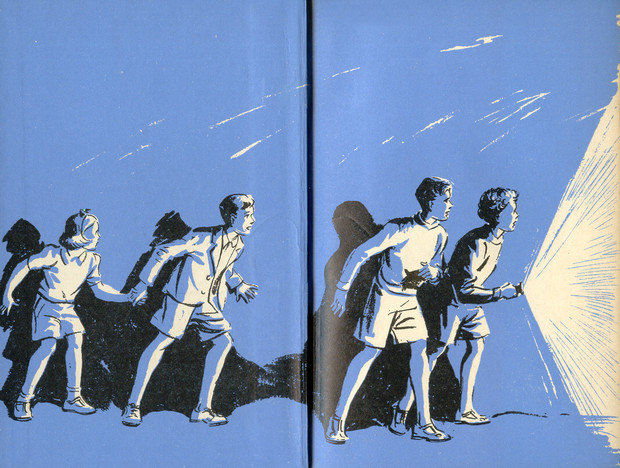
Endpapers of Five Run Away Together, 1944 Hodder & Stoughton 1st Edition, by Eileen Soper. Oh for a torch like that!

There are another 32 things she has learned which can be read here.

And this all got me thinking. What else could we say we have learned from Blyton’s books in general?

  • Tutors are not to be trusted – they are either wrong doers or undercover policemen.
  • If a burglary has taken place locally you and your friends will be best placed to solve the crime. People chat to children and will tell them all sorts of incriminating things.
  • Midnight feasts WILL lead to stomach aches the next day.
  • If a locked room has been ransacked for papers, it was probably the work of a highly-trained chimp and you should look into nearby circuses or fairs.

Anything else?

Posted in Personal Experiences | Tagged , | 2 Comments

Child April – A poem by Enid Blyton

Today I’m bringing you a poem from Blyton’s Poetry Book.

I hope you like it.

Child April

Oh, April is a fairy child, a fairy child is she,
As wayward as the little winds a-blowing,
For will she smile or will she cry, for all the world to see,
There’s never, oh, there’s never any knowing!
So pelt her with apple-blossom, scatter her with daises,
Cool her feet with pearly drops of dew,
Call upon the little birds to sing her pretty praises,
And bid the sky bedeck itself in blue!

Oh, Cuckoo, are you coming now, for April wants to hear
Your pretty double-note among the trees?
You mustn’t disappoint her, or she’ll cry a little tear,
And send it silver-splashing on the breeze.
She’ll weep until a rainbow about the sky is glowing,
And then she’ll laugh and gaily dance away,
And by the springing bluebells you’ll know the way she’s going,
To see the cuckoo, singing loud and gay!

Its rather a good metaphor for spring and the weather we have in April isn’t it? What do you think of this April poem? I wish I could hear a cuckoo, I don’t think I’ve heard one before! I also wish the weather was a little kinder, but it does put me in mind of a toddler having a tantrum and not knowing what it wants!

I also quite enjoy the idea of April dancing through the land leaving bluebells in her wake. They are one of my favourite flowers by far. I do love bluebells. My gran used to tell me that if you picked one, a pixie would follow you home and cause havoc, so you mustn’t pick them. I never have; however now I suspect it had more to do with them being protected than any magical creature. I may be wrong, its not impossible!

Posted in Poetry | Tagged , , , , | 3 Comments

The Secret Series on TV : The Secret of Killimooin

I’m going to break this post down into two headings: Things that are like the book and Things that are not like the book. I highly suspect that the second one will produce many more points.


THINGS THAT ARE LIKE THE BOOK

The children fly to Baronia to stay with Prince Paul, and after visiting the castle they go off to the mountains.

There’s a statue in a cave, and the ear is used to open a secret tunnel.

There is a “secret” forest.

And that’s all I can think of.


THINGS THAT ARE NOT LIKE THE BOOK

Ruby goes along for the ride. Her main role appears to be falling for silly pranks (believing Paul that the Baronian tradition is to remove the king’s shoe, throw it over your shoulder and shout “the king’s feet go everywhere”) and getting lost in the mountains for a whole night. She does eventually reach the palace to summon help, though.

Charlotte and Thaddeus manage to get themselves tied up in the adventure yet again. Charlotte gets herself kidnapped by an old enemy and Thaddeus trails after them, both of them ending up in Baronia exactly where the children are.

The main plot is no longer about mysterious robbers who live in a forest no-one else has ever found a way into. Instead, it’s about an insane scientist who is trying to create a race of ‘living dead’ using spider venom. (He calls it poison all the way through but Ewan informs me spiders are venomous, not poisonous). So this crazy scientist has set up a network of underground tunnels and labs under the forest of Killimooin to carry out these important works. And naturally, when he and his henchmen discover Charlotte has seen them stealing a spider they kidnap her and bring her directly to their base of operations.

The main plot contains a huge amount of bad science. So bad I’m going to have a subheading.


Bad science

Venom (or poison) is drawn from a spider’s back using a large pipette. No needle or anything, just a pipette.

A henchman is bitten by a spider (as a punishment for trying to defect, of course) and has a near instantaneous collapse. He is then given the extracted venom from another spider orally and recovers within seconds, just as our crazy scientist predicted. The idea of using one venom as an antidote is ridiculous in its own right (here’s how anti-venoms are really made) and the idea that swallowing a mouthful of any anti-venom would cure you immediately is just as stupid.

Despite our henchman screaming in pain as soon as he’s bitten, and being affected right away, both Thaddeus and Mike take much longer to be affected. Mike feels dizzy soon after and spends the rest of the episode in bed (unaware he’s even been bitten), with Thaddeus races around rescuing Charlotte, passing out, losing Charlotte, rescuing her again, over and over it seems. He only collapses fully in the last ten minutes or so. Oh, and he’s saved when Charlotte gives him both the venom and anti-venom orally, not knowing which is which. (He doesn’t turn into the living-dead, incidentally.) Mike is cured by the housekeeper’s medicinal soup.

The scientist’s goal is to use the venom and the antidote together, somehow creating a race of people who are both living and dead at the same time. Literally, as he says, the living dead. Ewan believes this is where the  zombies in The Walking Dead may have come from, as he was watching that in the other room at the time.

Charlotte is to be his first test and is sealed in a pod that looks like it came from a bad sci-fi show. They don’t want to kill her, beyond her being the living dead I mean, so they pump ‘life-preserving gas’ into the pod.

There’s also talk of these living-dead people being “reactivated” with more anti-venom…

Laura and Peggy do their usual ‘scream as loud as you can’ performance right near the end, which causes each and every spider tank to shatter. I don’t know about you, but if I was going to keep deadly spiders I’d have them in some pretty sturdy tanks. Not the sort that would smash from an elbow bump or a human scream. Incidentally, it has been proven possible for an un-augmented human voice to smash glass, but only under certain circumstances. A professional singer who can sing at over 100 decibels (louder than a jack hammer), using the correct frequency and directing it at a fragile wine glass may shatter it. Two silly girls shrieking in a room full of spider tanks… not so much.

Their screams are also sufficient to have the crazy scientist and his henchmen all incapacitated and clutching their heads. The boys are perfectly fine, though.


And now back to the regularly scheduled criticisms:

There’s no mountain palace, no Yamen or Tooku. Instead we have an old wooden cabin and a housekeeper who looks like a stereotypical Scandinavian milkmaid. The children have to hike up to the cabin (no donkeys).

There’s also no Ranni or Pilescu. They are replaced by Barney Stokes, an ex secret service agent from the states. He acts as Paul’s bodyguard from the trip and it’s evident from early on that he’s up to something. He’s supposed to have called in the palace guard when Laura goes missing, but when they don’t turn up he says “it takes them some time to get organised.” We’re proven right later when he ties up Ruby. He then saves her after she rescues herself with the help of a rope-chewing goat, and admits he has been blackmailed into helping the crazy scientist keep people away from the mountains.

We should have known there was something not right just by his outfit: tartan trousers and a Butlin’s style blazer.

There’s no underground river fraught with danger, just miles of tunnels with one or two gates that need passwords to open.


I think we can conclude that this bears almost no resemblance to the original book. It’s less like the book than Spiggly Holes and Secret Island put together. I don’t know why they got rid of every single interesting element and replaced it all with crazy science and about an hour of people running about high-tech tunnels and woods full of CCTV cameras.

Our baddies aren’t even convincing. OK, scientist guy is absolutely NUTS. But his key henchman (I think his name was Block) is laughable. He looks like Gestapo officer Toht from Indiana Jones and the Raiders of the Lost Ark, but without an inch of menace (or a really cool travel coat-hanger). He’s clever enough to go to kidnap Charlotte and destroy any photos she has of him, yet stupid enough to take an open bag of secret documents with him. Naturally he leaves behind a document with an address on it which allows Thaddeus to find Charlotte. He also calls the scientist “master” and whimpers and cowers in his presence.

Most of the other henchmen look like soldiers, in full camo gear and balaclavas which they never take off, even inside the complex. They’re easily taken out by a) Thaddeus in a weakened spider-bite state and b) two girls screaming. The only two not in army garb are dressed like bikers (one even has a hideous curly mullet) and they can’t keep a woman in a sealed wooden crate long enough to transport her to Baronia without her escaping twice.

There are several other plot holes and illogical sequences but I think I’ve written enough to put you all off already.

The last thing I’ll mention is Laura (who is a queen of sulking in captivity) tells the scientist that she is Laura Arnold and she is from ENGLAND. In that snotty way that British people seem to always say, as in “I’m British – you can’t do anything to me.” Only problem is, she says it in the strongest New Zealand accent possible, and it’s fairly clear throughout that they have never set foot in England at any point.

To summarise: nothing like the book. No stars.

Posted in Blyton on Screen | Tagged , , , , , | 5 Comments

First Monday of April

Easter is now over, and I have no chocolate left. I will just have to hope that I don’t get trapped in any caves now, as I will have nothing for sustenance. Not that I tend to carry chocolate in my pocket, that is, so I’ve realistically got no hope. I also fail to carry a torch, rope, pencil, chalk or any other useful stuck-in-a-cave items. This is rather the topic of the post we’ve got for Sunday so I won’t say any more about it now. Yes – we have another week with a Sunday post!

Wednesday3


Posted in Blog talk | Tagged , | 1 Comment

The Land of Far-Beyond, reviewed by Chris

I have been planning for a while to write about The Land of Far-Beyond, but have been held back by no longer having a copy. It seems to be out of print and second hand copies are often eye-wateringly expensive. But I have taken the plunge and for a ‘mere’ £26 have acquired a late reprint of the 1970 Dragon paperback edition (since doing so I have discovered that a new edition comes out in October 2016). The edition I have is the one shown here (this and all other images taken from the Enid Blyton Society website):

the-land-of-far-beyond-2 (1)

This book is not much discussed on Blyton sites, including this one, although there is one excellent review by Anita Bensoussane on the Enid Blyton Society website. I have always remembered it as being an unusual book and it has been interesting to re-read it now for the first time since I was, perhaps, 10 or 12. First published by Methuen in 1942, it is indeed very different to the other Blyton books, or the ones that I know, anyway. It is a loose re-interpretation of John Bunyan’s 1678 religious allegory The Pilgrim’s Progress. Whilst Blyton’s story are often ‘moralistic’, sometimes gratingly so, The Land of Far-Beyond is a morality tale, with explicitly religious themes.

The book starts with a depiction of children running wild in the City of Turmoil, playing cruel tricks, stealing, and sadistically throwing stones at animals. A mysterious stranger makes ‘burdens’ appear on their backs which represent all their cruelty, flaws and sins. What used to be carried in their hearts and souls is now externalised to be part of their bodies. These burdens appear in the illustrations to look like large, rough rucksacks but they are physically unmovable and, of course, heavy and painful to carry. The only way to be rid of them is to travel the arduous journey to the Land of Far-Beyond and enter the City of Happiness (the Celestial City in Bunyan). This they can only do by following the narrow path and not departing from it.

The children are joined by five adults who have also had burdens placed on them by the stranger. They are Sarah Simple, Mr Fearful, Gracie Grumble, Dick Cowardly and Mr Scornful. As in Bunyan, the characters have names to express their characteristics. Actually, the children are the exception as they are called John, Lily, Anna, Peter and Patience, but it is explained that Anna means ‘merciful’, Peter ‘rock-like’ and Patience, well, patient (John and Lily alone are omitted from the general pattern). So the ten characters set off on their journey.

Although the details are different to Bunyan’s story, the basic principle is the same. The path to salvation is a narrow one and the problems arise from being tempted off that path. These temptations are represented by characters such as Mr Doubt, the Demons of Boredom or Lord Arrogance; or by hazards such as the river of Hate, the house of Lies or the tunnel of Disgust. On the other hand, along the way there are some allies such as Comfort, Courage and Mr Industrious.

Mostly, there is an internal logic to all this – Miss Flatter leads the travellers into the Meadows of Conceit, for example. But they only end up in the Castle of Giant Cruelty because they are helping Temper, Rage and Wrath who have injured each other fighting. It is not that the travellers themselves have exhibited these failings. At all events, gradually they all fall by the wayside or go back to the City of Turmoil, and only Anna, Peter and Patience enter the City of Happiness and lose their burdens. The book ends very abruptly at this point.

Mr Scornful does reach the City of Happiness, but is turned away at the gates because he has not lost all of his scorn or learnt all the lessons of the journey. However, an alternative route is offered to him so he may lose his burden eventually, although we are not told. He is the only one of the characters with any depth, and he does show himself often to be both brave and sensible, and acts as the leader, and the children value this. Other characters are rather hard done by, I felt. Miss Simple gives up the journey because she believes the warnings of Mr Doubt, but being simple is hardly a sin and she is kind and good-natured so it seems harsh to imply that salvation is reserved for the intelligent.

Despite being very different to Blyton’s other books, as I re-read it I thought that it was in a way slightly similar to the Faraway Tree stories and the Wishing Chair stories in that it is a series of mini-adventures, with each encounter with a new set of characters being like, say, a new land at the top of the Faraway Tree. As with Bunyan, the descriptions of the landscape of the journey are very evocative, and have an eery, dream-like quality. There is also a sense, not intended by Blyton of course, of the kind of computer games where you have to navigate various rooms or hazards to progress to the ultimate goal. I’ve since read that some computer game designers are indeed influenced by the Pilgrim’s Progress.

Finally, re-reading the book what was most instantly recognizable and striking was not the story, although it is engaging, but the extraordinary illustrations by Horace Knowles. These are the same as in the original edition and they have a strange, mediaeval character that is most haunting. Blyton was very well-served by her illustrators. For those alone I think my £26 was well spent, but in fact reading the story again was also rewarding. It is as entertaining and thought-provoking as I remembered.

Posted in Book reviews | Tagged , , , | 11 Comments

Making Blyton’s Food: Mrs Glump’s melt-in-the-mouth shortbread

We are having a bit of a ‘Barney Mysteries’ week as Fiona has reviewed The Rockingdown Mystery for us this week and I’m going to tell you about the shortbread from our favourite Jane Brocket book Cherry Cake and Ginger Beer.

This recipe is based on the cook Mrs Glump’s melt in the mouth shortbread, clear by the title of the recipe, that is supposed to be the best recipe that Ms Brocket had found. I know I have reviewed a shortbread recipe before but I thought I would give you a comparison between the recipes and the final product.

Now you will recall from the previous blog that I have been making the other recipe from childhood so you can suspect that I would be a bit biased. However this recipe does make very nice shortbread biscuits, even if the beginning takes a lot of elbow grease if you’re like me, and forget to take the butter out of the fridge.

Anyway, simple ingredients and a simple method. So let me share it with you.

The ingredients are as follows;

  • 170g butter, softened
  • 85g caster sugar, plus extra for sprinkling.
  • 230g plain flour
  • 30g cornflour

Now I’ve never used the cornflour in the recipe before so this is new to me. I must say I haven’t quite worked out what it does, but the biscuits turned out well, so I won’t knock it.

Now for the method;

  1. Preheat the oven to 180c or gas mark 4
  2. In a mixing bowl, beat the butter until creamy with a wooden spoon or electric mixer (the amount of times I had to remove the butter from the electric mixer is ridiculous!)
  3. Add the the sugar and beat until pale and fluffy. (For me the butter creamed a lot better when the sugar was added).
  4. Sift in the flour and cornflour and work into the mix with a wooden spoon or your hands until it comes together.
  5. Place dough on a floured surface and knead gently a few times to make smooth and rollable.
  6. Using a wooden rolling pin, roll out of the dough to a thickness of about 5mm then cut out rounds with a biscuit cutter.
  7. Place the rounds slightly apart on a baking tray.
  8. Knead the remains back into a ball and repeat point 6.
  9. Prick biscuits with a fork and sprinkle with sugar
  10. Bake for 12-15 mins (I needed 15 mins) or until the shortbread is firm but still pale. Do not let them go golden or worse brown.
  11. Transfer onto wire rack and leave biscuits to cool.

So there you have it, how to make really good, Blyton approved biscuits! Please give them a go and tell us what you think?


Posted in Food and recipes | Tagged , , , | 1 Comment

The Rockingdown Mystery

Some considerable time ago – so long ago it was in 2015 – I started reading The Rockingdown Mystery for a read-a-thon on the Enid Blyton Society forums. I think I got about as far as page 29 before my interest trailed off and it got put to the side. I always find that reading for the purpose of dissecting, commenting or reviewing can spoil the enjoyment as you are forever looking for flaws or interesting details. And, if you’re me, you’re forever setting the book down to write a note before you forget.

1956 edition, Gilbert Dunlop

1956 edition, Gilbert Dunlop

So this week I found myself in-between books (well actually I had half a dozen on the go, but finished one and wasn’t in a mood for the others) so I ended up picking up The Rockingdown Mystery again and read the rest of it over two days. I read it without deliberate thought, without nitpicking or fact checking, and it wasn’t until I was almost finished it that I thought I might well review it for the blog. I finished it off in bed that night and jotted down a few points I wanted to remember, just a few key words to remind me later.

This may make for a different sort of review from me as I tend to (perhaps unfortunately) end up writing a lengthy description of all the events in a book with some opinions thrown in along the way. This time, having read the book a few days ago I don’t remember nearly enough detail to do that sort of thing.


THE STORY

Roger, Diana and their cousin Snubby (plus his dog Loony) go to stay with Miss Pepper (a governess-type figure who they already know). They are staying in Rockingdown Village which boasts an old abandoned mansion by the same name. During their stay they meet a circus boy called Barney who owns a small monkey by the name of Miranda. Together they start exploring the house, and Barney even stays there a few nights to save money on lodgings. During his stay he hears loud banging in the night which of course has to be investigated. Only, the children aren’t the only ones to be hunting around Rockingdown Manor – their tutor, Mr King, seems all too interested as well.

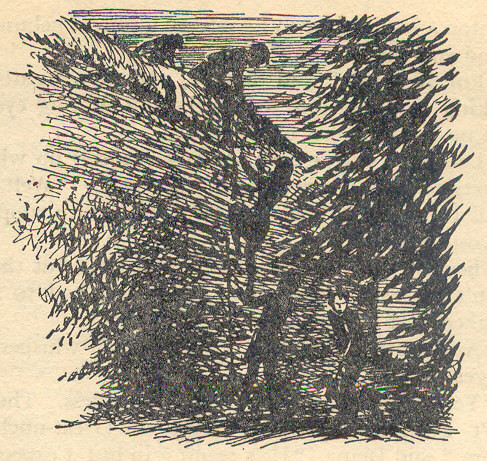
Barney manages to get himself into a rather troublesome situation, trapped under the house in a tunnel/cave formation which just so happens to be used by smugglers. I won’t give the details of the ending away, but naturally he does eventually get out and the baddies are neatly dealt with by the police.


A FEW THOUGHTS ON THE SERIES AND CHARACTERS

The Barney Mysteries (or R Mysteries as they’re also known) are of a similar nature to The Famous Five, The Adventure Series and the Secret Series. They never venture too far afield but each book takes place somewhere new, during a holiday. The characters aren’t perhaps as well-developed, however. Roger is rather bland, and Diana doesn’t have a particularly strong personality either. You could liken her to Anne at least as far as being lumped with the cleaning goes, but she doesn’t have that sweet, sunny personality. She’s a little stroppy, but not on a George or Dinah scale.

The other two boys are of more interest, though. Snubby would drive me mad should I be forced to share a holiday home with him, but he is amusing to read about. (For example, instead of remaining on the planned train and meeting his cousins at the arranged point, he gets off and catches a different connection thus arriving at the house and having a large lunch while Roger and Diana are still waiting for him.) Loony is also interesting as he has a has a habit of stealing hair brushes, rugs, mats, cleaning cloths, shoes and anything else that he can pile up in the hall. He’s not a dog of Timmy’s calibre but he is smart enough to turn his back on Mr King while the children are on the outs with the tutor.

He had gotten half-way over the grounds when he discovered that Loony was carrying Miss Pepper’s hair-brush. So back he went and stood beneath Miss Pepper’s bedroom window. He threw the brush up and it went straight in at the window.

There was an agonised yell, and Snubby took to his heels. “Well, how was I to know what she was standing in the way…”

He looked down at Loony who was again at his heels. This time he was carrying Mrs. Round’s old shoe-cleaning brush. Snubby stopped and addressed Loony fiercely. “What do you think you’re doing? Do you suppose I’m going to spend half-the day taking back your silly brushes?… Take it back!…”

Loony wagged his tail and darted off. Snubby was pleased… He petted Loony when he came back. “Good dog. Took it all the way back to the kitchen and dropped it at Roundy’s feet, I bet. Cleverest dog in the world.”

Loony was very pleased. He had just dropped the brush down the nearest rabbit-hole. Well – if Snubby was so delighted with him, he’d drop plenty of other things down the rabbit-hole too.

Shows how perfect the two of them are for each other, I think!

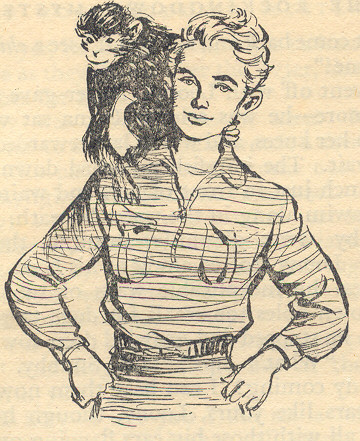
Barney is of interest as a circus boy with a monkey, naturally. But also because he is well-read and has a love of Shakespearian literature. We don’t get to know an awful lot about him in this first book, but his story unfolds throughout the series.

Barney and Miranda

Barney and Miranda


THE MYSTERY PLOT

As for the plot, it has similarities to many Blyton books. That’s not a surprise as she used plot devices, similar locations and situations many times along with new elements and yet still always managed to create an engaging story. The cave/tunnel features an underground stream and hidden entrance somewhat like in Five Go Off in a Caravan. There’s even the same idea of sending an animal (Miranda/Pongo) off with a note to bring rescuers (though it seems to take Barney a lot longer to come up with the idea). Underground rivers also feature in The Secret Mountain and The Secret of Killimooin. The lighting in the cave brings to mind the hiding place of the ‘spook train’ in Five Go Off to Camp. Also, the illegal underground operation has similarities to the one in The Island of Adventure, the similarity only compounded by the suspicions held of Mr King and his involvement.

One or two things I did wonder about were the mechanics of the smuggling operation. Suddenly, mid-page I suddenly thought “huh, hang on. The stream is completely blocked at the other end. How do they then winch the boxes up it?” I was so perturbed I demanded this of my partner who was also sat in bed reading. Having no clue as to what I was talking about, he was of no help. I then had the realisation – having adjusted my mental picture of the underground setup a page or two later – that maybe they dropped the boxes down the hole into the stream and went from there. I announced this out loud, just in case Ewan was sitting worrying away, and later found out I was right.

That then led me to the ‘whys’ of the situation. Large boxes of smuggled goods are brought up the river, lugged across a farm, dropped down a hole, winched along an underground stream, lifted out, unpackaged, sorted into smaller bundles and then sent back the other way. It seems like an awful lot of complicated machinery and effort when it could have been done in a barn, especially when the goods seemed to be repackaged and sent out the same night. But if they had done it all in the barn the children would never have stumbled upon it and there would have been no mystery to Rockingdown.

Not long before that I had been pondering the use/reason for the cellar room in Rockingdown Manor having a secret door into this underground area. It only worked one way, hence Barney getting through but not back, so it couldn’t possibly be of much use. It’s later said that it was for the owners of Rockingdown Manor to get rid of unwanted people. Quite dark for Blyton!


FINAL THOUGHTS

The Barney Mysteries have a few of the most chilling and perhaps even macabre situations amongst the Blyton books. The story of Ring o’ Bells is even more so, but the nursery at Rockingdown is still chilling in its own way. Death rarely features in a Blyton book, and if it does it’s always a long-ago event with little emotional impact. Lots of children are orphans, but beyond “his/her parents died many years ago,” it’s not often brought up. The deaths of the Rockingdown children are discussed, though. How sad it must have been that little Arabella fell out of the window and died, and then Master Robert caught scarlet fever and died too. The shut off nurseries, left exactly as they were right after Robert died, are quite poignant and yet the children say that they feel happier than the rest of the old house.

So apparently even if I don’t give you a blow by blow account of a book I still ramble on for far too long.

All in all this is a good book that (once you stop nitpicking at every page) draws you in and makes you want to keep reading to find out what happens next. The children are likeable enough, and Snubby, Barney and Loony have enough personality to carry the others along with them. Mr King is no Bill Smugs, (though he seems to be somewhat popular amongst readers) though he adds a layer of mistrust if not actual fear or danger. Miss Pepper is suitable strict, yet friendly, in the vein of Miss Dimity perhaps. There are funny bits, sad bits, scary bits and mysterious bits to be found, with a satisfying mystery (especially if you are under 12 and don’t try to pick apart the hows and whys) and the promise of more to come.

The suspicious Mr King

The suspicious Mr King

Next review: The Ring ‘O Bells Mystery


Posted in Book reviews | Tagged , , | 5 Comments

Bank Holiday Easter Monday!

Well wow oh wow, in less than two weeks I’ve had my birthday and easter! How bizarre this is! I honestly don’t think they have ever been so close together!

I know you’re all dying to hear what I got for my birthday, but you know, I can’t take about it all! I got a surprising lack of Blyton this year, but then I think its because I have most of the stuff I want. Still there will be a time when I come across some more and I won’t be able to stop blogging about it!

Anyway, once again we have managed to forget to put up Chris’ post AGAIN! Oh dear we are very bad, and we promise, promise promise to have his blog up for you on Sunday. In fact we’re going to make sure its ready to go for Sunday right now! (Chris, we are so sorry!)

Fiona’s blog will be Wednesday this week and she will be reviewing the Rockingdown Mystery for you all! I will be blogging for Friday and as of yet I don’t know what I shall do exactly, either another audio or a short story review. You shall just have to wait and see!

And there we are, this week’s blogs! Hope you’re looking forward to them as much as I am!

Here are some pictures I took before Christmas when I went to Cliveden in Buckinghamshire, a national trust property. HOpefully when the weather clears up and more flowers come out I’ll go again and take some more! For now I shall leave you with these!

Posted in Blog talk | Tagged , | 2 Comments

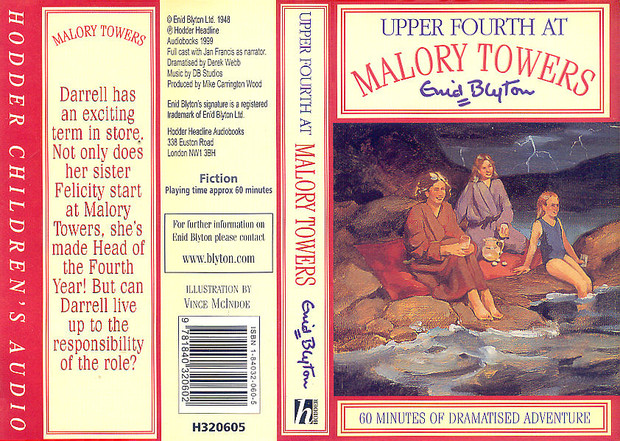
Upper Fourth at Malory Towers: Audio Adaptation

The Upper Fourth at Malory Towers is the one that made the biggest impression on me when I was younger and the cassette that I had listened to, had filled me full of dread for failure. The crux of the story is that pride comes before a fall, and that hard work really really pays off. As a small girl, these messages became ingrained in me, like Blyton had intended. The moral message of her stories was a huge part of her writing, and it has stuck with me to this day.

Another reason for this being one of my least favourite Malory Towers stories is because since the Second Form, Alicia has taken a back seat in the Third Year and then because of Darrell being made head girl, begins to bring out her sharp tongue and does her best to wind up Darrell and create a bad atmosphere.

The chopping and changing of scenes once more brings about a stark lack of continuity to the story, and some of the best bits, especially the descriptions of the food are left out and not to mention the hilarity of Belinda following Gwendoline around trying to catch her scowls. However there is a lot of atmosphere in the end of side one where Darrell confronts Alicia’s little cousin June about wanting to sneak on the Upper Fourth’s midnight feast. Now I know we are not supposed to like June, and this is because she is not presented to us in a very nice way, and with the adaptation, she is voiced along the same vein as Gwendoline; that is to say, arrogant and annoyingly nasal! Now I have never ever warmed to June, like I never warned to Gwen, and this audio only serves to cement that dislike. Unlike Alicia who can occasionally see she is wrong, and can admit it, June appears to have little, if any, redeeming qualities.

I better stop myself there on the subject of June, as I could quite easily write a whole blog on her, maybe I will someday! However on with the adaptation, and back to the point.

Darrell confronting June about her sudden piety of wanting to own up at being at a midnight feast was staged very well, I really could feel the foreshadowing as a child, and even now as an adult, that Darrell was going to lose her precious temper thanks to this Alicia 2.0. Alicia’s jibes throughout the rest of the book and the audio about pride coming before a fall all congregate at this moment, and Darrell loses her temper and in a similar set up to how she loses her temper with Sally way back in the first form, June starts to get the same treatment. I do feel very sorry for Darrell here because it’s not her fault, not entirely. I know first hand how easy it is the fly off the rails in anger because of someone or something that can’t be reasoned with or controlled. When I was younger I never was able just to leave the recording on the cliff hanger of Miss Potts bursting in on the ‘fight’ and even if it was my bedtime listening, I sneaked out of bed and turned the cassette over so that my over active imagination wouldn’t worry too much about Darrell during the night.

Carrying on, the downside of Miss Potts finding out about this fight is that she finally uncovers the truth about the midnight feast and Darrell is stripped of her head of form post. She suffers the punishment like a champion because I suppose in a way she does deserve it. However later on in the story she earns it back.

The Clarissa Carter and Gwendoline Lacey  part of the story is played down in the audio, mostly to save time again it would seem, time that can be filled with idle music. The part of the story where Gwen pretends to have a weak heart takes up quite a lot of the book and underlines a major character flaw in Gwen, her weakness and self belief. We would believe that this is the turning point in Gwen’s character but alas, we are wrong. It will take another two books before we see the real making of Gwen.

Again with this audio we find a lot of things are left out from the book, things that in the end come to be quite a large part of the story, especially the things with Gwen, Clarissa and Bill, as well as the new twins Connie and Ruth. Again it’s the inserted music that takes up more time than it needs and doesn’t allow to the story to flow as naturally as it could. I think its the same for these six Malory Towers adaptations, and as an adult now I realise that, but when I was a child and hadn’t read the book it didn’t matter so much.

So there we are, my thoughts on The Upper Fourth at Malory Towers, let me know what you think?

620wide+3530130

Next review: In the Fifth at Malory Towers: Audio adaptation

Or read a review of the Upper Fourth novel here.

Posted in Audio Books and Audio Dramatisations | Tagged , , , , | 1 Comment

The Secret Series on TV – The Secret of Spiggy Holes

I have been told that the Secret Series episodes get better as the show progresses, and I’m glad to say I can agree with that – but only just! The Secret of Spiggy Holes is an improvement on The Secret Island, but not by a huge margin. The biggest improvement is there is no crazy monk with magical/technical tracking abilities.

My partner half-watched while he was playing the PlayStation and at the end commented “Well, that wasn’t very Blyton, was it?” And I think he summed it up quite well.
51nd6wA4OiL._SY300_


THE OPENING SCENES

The episode opens with a pair of baddies making some trial runs to see how fast they can drive, and then we return to the children at home with their father. I assumed Jack would be there as he would have been adopted by the Arnolds at the end of the last episode. However we soon cut to Jack alone, fishing. He cuts his finger and then heads to a shack to eat scraps from a tin can, so we can assume he is fending for himself in the wild now. (I really wonder why, and how, as this is set in the nineties and surely social services would have been involved.) Not to worry, though as Thaddeus takes the children to rescue ‘Wild Jack’, who hides from them at first. Thaddeus is awfully joky about a young boy living rough actually, and I thought perhaps he wasn’t really in any trouble but the other children don’t find it funny and I doubt Jack would hide when he heard people unless he really was a runaway.


NANNIES AND TRESSPASSING

Anyway, he’s restored to the family and then we see Lord Foggo arguing with the Scoop magazine editor again. I still don’t think it’s explained who Lord F is, but he fights for Thaddeus anyway, arguing against him having to go off on a book tour. Charlotte is also back and she’s all for the tour, in fact she advertises for a nanny to take care of the children.

While Thaddeus is meeting with one prospective nanny – a woman reminiscent of the Trunchbull from Matilda – the children are exploring an abandoned monastery nearby. This is rather where the whole story falls down as the girls reveal they’ve been there lots of times before. In the book Peep-Hole, the old house, and the whole area is new to them.

The car racing baddies from earlier are at the monastery, and they chase the children off because they have rented the place. Much later I discovered the man’s name to be Diaz (like in the book) but there’s no Mrs Diaz or Luis, but we do have a man called Bert instead.

Thaddeus wasn’t sure about the Trunchbull, but as no other nanny applied the children might be stuck with her. That is, until a young woman rides up on a scooter. She doesn’t like to clean and admittedly she isn’t much of a cook, but she can dance! Therefore she will make the perfect nanny and Thaddeus and Charlotte head off for the book tour.

Ruby, it turns out her name is, and she is certainly no cook. She even burns toast. Miss Dimmity she ain’t.


THE ADVENTURE

The adventure then starts when Prince Paul is brought in by boat at night. I had half-thought he wouldn’t be appearing as I have a vague recollection of some discussion about him being absent from some adaptation or other, presumably for politically correct reasons. But no, there he was, being smuggled in clear view of the children at their window. Prince Paul’s father – still the King of Baronia – is warned he must abdicate and pass the thrown to his brother should he wish to see his son again. The King has a perfect English accent, as do most Baronians except Prince Paul who sounds more New Zealander, but not as strongly as the other children.

And then we cut to Charlotte and Thaddeus, as this episode proves to the like the last in that it jumps between two narratives. The still-bickering couple are forced to share a hotel room as their second room has been taken by someone else. It seems that this other party is none other than the King of Baronia, who checks in during the night. Sensing a scoop, Charlotte spies on him but is seen heading back to her room. The Baronians then sneak into the room and kidnap Thaddeus, assuming him to be the spy. In doing so they drop a great big stinking clue in the form of a hankie with a monogrammed Baronian symbol.

Unfortunately Charlotte misses the obvious clue and assumes Thaddeus has simply run off home to avoid the book tour.

Back to the children and they are sneaking out of the house in the noisiest possible fashion, and end up hiding in the caves to watch for smugglers. They then think ‘hey, maybe there is a secret passage from here to the monastery’, find it within minutes, and head inside. Jack sneaks upstairs and hears Bert taking food to Prince Paul, but when he and the others try to leave they find the cave has filled with the tide.

Given enough time, Charlotte has finally found the clue and is desperate to get to Baronia, as she rightfully believes that the king has kidnapped Thaddeus and taken him there.

So let’s take a moment to think about that. You are sure your son is in Australia, having been kidnapped there, so you fly there. You think a man has spied on you, and is therefore connected to the kidnapping. So you then fly all the way home with this man to question him. Logical? No. A waste of time, not to mention fuel? Yes. A risky decision, which may antagonise the Australian government? Quite possibly. I think it just goes to show that they shouldn’t have tried to pad out the story with their own extras.

Ridiculous trips halfway across the world aside, the children communicate with Prince Paul by climbing a tree near the monastery and shouting loudly at him to get his attention. He then draws letters in the air to tell them that he is a prisoner.

They tell Ruby all about it, but she believes that the boy is Mr Diaz’s son, and heads over there to tell him off for playing tricks. Mr Diaz, in a very creepy way, invites her inside to prove there is no boy, and she somehow believes then that the children dreamed up the prisoner all by themselves.

In the next ridiculous turn in the Charlotte/Thaddeus sub-plot, Charlotte has made it to Baronia and walks right up the the palace gates. There she cries “what’s that?” and distracts the lone guard by pointing over his shoulder. She then karate chops him in the back of the neck and drags him off. The next time we see her she has donned his perfectly fitting uniform and made her way inside and down to the dungeon to free Thaddeus. Together they simply walk out of the palace and start walking through the woods to the border, a mere ten miles away.

The children are also planning a daring rescue at this time. They take their burnt burgers to feed the dogs, and have a rope ladder at the ready too. As in the book Prince Paul gets caught before he can climb down, and Mike too when he goes up. The girls are spotted by Bert with the dog and make an unconvincing act of freezing to the spot before they run away.

Now Ruby has to believe them, but the policeman doesn’t. Very conveniently Laura then suddenly remembers that there’s a tunnel between their house and the monastery. I just about gave up watching at that point! How could you forget something like that? Finding it is just as contrived. They sit down to think – perhaps there’s something in one of their father’s old books? But before they can do anything as clever as research, Ruby suggests lighting a fire. No, that’s no good, the fireplace in that room smokes terrible. It must be blocked or something. Can you see where this is going?

Yes. Ruby then says that it can’t be blocked as she felt an awful draft coming from it earlier. The children look at each other. Bingo! The secret passage is in the fireplace! They find it in about two seconds and are off. With no roof-falls to contend with they get over to the monastery in record time and rescue the two boys. Meanwhile, Ruby shows us how stupid she is by shouting at her own echo down the tunnel. Dimmy had a good reason not to go with the children, being an elderly woman (and the book tunnel involved steel ladders and a great deal more danger,) what is Ruby’s excuse?

Jumping over to the imprisoned boys they do manage to untie each others’ hands, but Mike’s genius idea is then to pick the lock using a large nail. Thankfully for him, the tunnel comes out directly into the tower room and he’s spared from having to keep trying. Mr Diaz immediately finds that the boys are missing and somehow knows it was via the secret passage even though it has shut behind them. He and Bert head over to Peep-Hole, and Ruby and the children then steal their car to escape. Only Ruby waits until they are in, seatbelts on before she reveals she doesn’t know how to drive a car, only a scooter…

Thaddeus and Charlotte are having similarly bad luck as they awake in the woods to find themselves surrounded by Baronian soldiers, and are taken back to the palace.

The children and Ruby, who has managed to get the car moving, are chased by Mr Diaz and Bert on Ruby’s scooter in a rather silly car chase. As they are running out of petrol Ruby drops them at the edge of the lake and, leaving her with the car, the children head over to their island. Being not in the least bit secret, Mr Diaz spots them over there as soon as he arrives and heads after them in a motor-boat.

Having managed to prove their identities via the internet, Charlotte and Thaddeus have returned by plane with the Baronians – in about thirty minutes or less. They turn up in Jeeps just in time to listen to the girls screaming incessantly as the baddies drive round them in circles on the water. All ends well, however as they manage to disable the baddies’ boat and row back to safety.


MY THOUGHTS

Well, there you are then. It was better than the first one, but it lacked a great deal of what made the book so wonderful. Instead of a new area to explore, one steeped in history, we had a bunch of children exploring their backyard. The subplot with Thaddeus and Charlotte was even more ridiculous than the last one and reduced the grand, clever King of Baronia into a bumbling fool who cared more about free trade than his son’s welfare. I’m glad to have seen that Charlotte won’t appear in the remaining episodes, though unfortunately Ruby will. It will be a good while before I can summon up the courage to watch the next episode to find out what happens next.

Posted in Blyton on Screen | Tagged , , | 7 Comments

First Monday of Spring

Yes, spring is finally with us in the northern hemisphere. Temperatures have risen by around two degrees and sunglasses have been deployed on at least one occasion. Long may it continue!

I rather messed up last week, I’m afraid. I ended up blogging for Saturday instead of Friday, which then caused me to get confused about what day it was and in the end I forgot to get Chris’s review uploaded. I will try harder this week!

Wednesday2 (3)

Having a third post of the week meant having to make a brand new template for this post, but it was worth it!

And for the first times in a while, I’ve actually made it out with my camera. A few times, in fact.
Posted in Blog talk | Tagged , , | 10 Comments

The Twins at St Clare’s – How has Blyton’s original text fared in a modern edition? part 5

I have read through another three chapters this week (or really, six as I’ve got to read each twice). Earlier posts are in parts one, two, three and four.


CHAPTER TWELVE: A BROKEN WINDOW – AND A PUNISHMENT

As I’m sure I mentioned in the first post, this chapter title has been shortened for the Egmont edition. It is now just A broken window. 

The circus appears in this chapter and not surprisingly that means there are some reasonably substantial changes. In the original text the girls see the horses being galloped round, and five clumsy-looking bears ambling along with their trainer. Egmont have removed the bears so the sentence reads horses being galloped round with their trainer. Funnily enough it’s apparently acceptable to use chimpanzees in a circus, but not bears, as Sammy is still in the book.

A few minor changes have been made, the girls formerly leaned over the gate, now it is written that they leant over. The circus times were given as 6.30 to 8.30 and they are now expressed as six-thirty to eight-thirty. The vita-glass in the classroom window is now called special glass, and the cost has changed from 20 shillings to 20 pounds. I think the money updates rather fall down here. Twenty pounds seems like a rather small amount to a) replace a windowpane and b) for an entire class to go to the circus. It’s clearly said that it would cost one shilling for each girl to go to the circus, which is believable, yet when that is modernised to one pound per ticket it becomes silly. Even at a special discounted rate for a school you couldn’t get a ticket for a pound.


CHAPTER THIRTEEN: THE FOUR TRUANTS

There is only one major edit in this chapter – where a short paragraph about the bears is removed.

Everyone was intent on watching the five bears, who were now playing ring-a-ring-of-roses with their trainer. ‘All fall down’ chanted their trainer, and just as the four girls went out, down fell the five bears in the ring, for all the world as if they were children.

It’s a pity as we skip from the girls getting up from their seats right to them collecting their bikes now.

The only other new change is that Mr Galliano’s moustaches have become his moustache. A moustache these days is almost exclusively referred to in the singular, and it does sound rather strange to hear about a man’s moustaches (as if he may have one above his lip and another on his forehead, perhaps).

We also see a couple of continuing changes like maids to staff and lino to floor.


CHAPTER FOURTEEN: A GREAT DISAPPOINTMENT

I could barely spot anything altered in this chapter. We do have sick-room updated to sickbay but that’s already appeared before. The only other thing is the addition of a question mark to a rather rhetorical question, weren’t we idiots to rush off like that the other night.

Returning to the circus for a moment you may also think it strange that bears are cut from the text, but Jumbo the elephant still makes an appearance! Surely it is more cruel to shut an elephant in a cage and transport him around the country than it is a few small bears?


That’s just ten changes across those three chapters. Though if you counted every word they had cut (instead of each sentence) it would be an awful lot more. We are now at 63 changes for the book so far.

Posted in Updating Blyton's Books | Tagged , , | 2 Comments

Famous Five 90s Style: Five Have a Mystery to Solve

Five have a Mystery Solve is somewhere in the middle of my rankings of the Famous Five stories. Its neither one thing or the other. It signals the end of the series and the downward curve it takes from there. The idea of the hidden treasure on the island has rather been done to death now and the characters are beginning to tire a little.

The TV adaptation is the same. The 1970s version didn’t do Mystery Island becuase of its simularity to other plotlines. I do like the fact that the 1990s production team did take on Mystery Island because its not the easiest to do and make it stand out, which they achieved.

Unfortunately it wasn’t in the best way. Although the script wasn’t too bad, the acting was below par from both Marco Williamson and Paul Child (both of whom I assume had grown out of their roles by this time). Their acting is very over the top, and almost a parody of their original characters. Lines are repeated by Child particularly in the form of “I’m starving” and “He always goes first”, seemingly portraying the fact that Dick hasn’t grown up at all and very much reverts to a younger version of himself which shows the character up when Jemima Rooper’s George is being particularly mature and even Laura Petela’s Anne is finding new ways of breaking through her character barrier.

Speaking directly of Petela and Anne, this is the one book and episode where you really see a change in Anne and her character so significantly it makes you stop and think. When she turns from a ‘mouse’ into a ‘tiger’ during her drenching of Wilfred after his trick on her, not to mention how she handles the bad guys on the island is extraordinary. There is a difference in the story arcs of both these events. In the book Anne soaks Wilfred when she’s left alone with him and he threatens to show her some of his less plesent animals and in the adaptation he just rudely thrusts a white rat under her nose while she is fetching water. Anne clearly makes her mark by calling him a “horrible boy” in the TV episode and stamps her foot at the others when she says “I know you all think I’m a mouse!” to her brothers and cousin. The looks on their faces is brilliant however, one of the better moments.

When she attacks the two bad guys in the episode she manages to trip them up and then starts kicking sand in their face which is a very un-Anne like thing to do, and she gives as good as she gets against two full grown men. They do grab hold of her at one point but she keeps kicking; the disappointing thing is that the boys and George didn’t rush to help her like we’re conditioned to expect from ‘big’ brothers.

The main story humour through the episode due to Christopher Good’s barmy Uncle Quentin who has once again lost some valuable papers. The children are being sent away with someone they don’t know, Mrs Leyman, so that Unce Q can work in peace however like a bull in a china shop he accuses the children of losing his precious papers and tries to take the boys homework as a subsitute.

We see a lovely little domestic scene between Good’s Uncle Quention and Mary Waterhouse’s Aunt Frances where she reprimands him for accusing the children and asks him to phone them and apologise. He does so with bad grace and when she asks him whether he remembers he snaps “Frances the number is 12345, even I can remember that!” and she just sighs and rolls her eyes heavenward looking for strength.

I do think that Waterhouse and Good are two of the best bits of this series and especially this episode as  they have a lot more screen time together than previous episodes.

Overall then the episode isn’t a huge success but is very watchable and enjoyable. I remember as  child I used to watch this back to back on video cassette and love every moment of the mystery. If that doesn’t tell you how much of a cycnic I’ve become I don’t know what will! So what do you think?

Let me know in the comments!

12

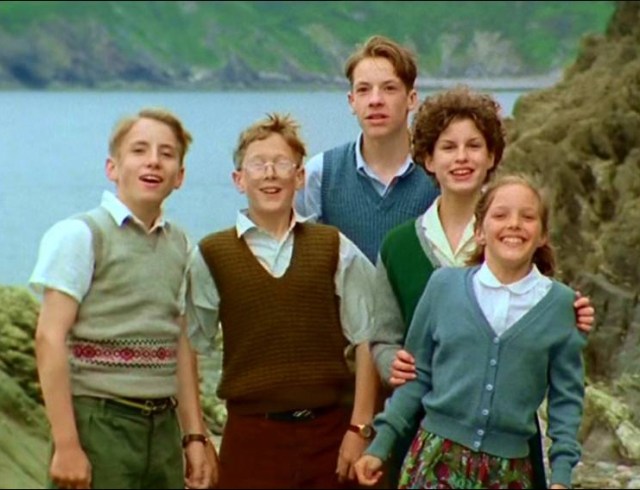
From Left to Right: Paul Child as Dick, Alex Thomas as Wilfred, Marco Williamson as Julian, Jemima Rooper as George and Laura Petela as Anne

Posted in Blyton on Screen | Tagged , , , , , , , , | 2 Comments

March of the Mondays

Half-way through March already and the year is flying by! So fast in fact I am having trouble remembering that it’s my birthday this week!

I hope to get some Blyton things to write about for you, so I’ll keep you posted. I’ll be blogging on Wednesday this week, and I’ve going to do Famous Five 90s Style: Five Have a Mystery to Solve. Fiona will be going back to St Clare’s to review the changes and we have a guest blogger this week in the form of Chris!

Chris has written us a review of The Land of Far Beyond! How exciting is that? Chris’ blog will be up on Sunday for those of you who can’t wait for a treat!

Please don’t forget that we are accepting contributions still, just email us and everything is considered!

I shall leave you with a sunny picture of a crocus that popped up in the garden recently. It’s nice to see some colour after the winter!

Have a good week all!

IMG_20160223_115100

Posted in Blog talk | Tagged , | 3 Comments

Well Done, Noddy! – How has Blyton’s original text fared in a modern edition?

This will be the last in this series as Well Done, Noddy! is the final book included in the treasury.

The others:
Noddy Goes to Toyland
Hurrah for Little Noddy!
Noddy and His Car
Here Comes Noddy Again


A FEW CHANGES THAT ARE ALSO MADE IN OTHER BOOKS

  • Queer is replaced with strange (though later queer is left alone!)
  • Hyphens are removed from some phrases such as top-hat
  • Mr and Mrs have no full stop
  • Very very rich has a comma added to become very, very rich

SOME CHANGES SO MINOR YOU WONDER WHY THEY BOTHERED

Words are replaced

  • Look after him till he’s better is now until he is better, and till is changed to until a further few times.
  • Jumbo is no longer grumbling hard, instead he is grumbling bitterly.
  • Originally Noddy drives carefully so that Big Ears isn’t jerked about. This has been changed to jolted about. 
  • Mr Tubby thinks Noddy’s song makes it sound as if I was a bit fat. It has been changed to am a bit fat. 
  • Noddy’s money box began to get full, now it began to fill up. 
  • Big Ears no longer rides his bike with Noddy on his back, he now does it with him on his shoulders

Words are removed

  • Noddy’s little gate becomes just a gate. (Having noted that I now am aware that Blyton has used little in seemingly every other sentence. Little Noddy, little gate, little car… I don’t suspect that was why it was removed that once, though. It almost seems like it was removed to make the text fit nicely on one page!
  • Sally Skittle’s tiny house becomes just her house. 
  • A little red goblin becomes a little goblin, perhaps to make it less obvious that a red goblin had Mr Sailor Doll’s sacks sent to Red Goblin Corner.

Words are added

If only his peppermint seeds would grow, and his bull’s eyes and toffees, what a lot of money he would have gets a too inserted in the middle, If only his peppermint seeds would grow, and his bull’s eyes and toffees, too, what a lot of money he would have.

Whole lines are rewritten

  • They soon settled in and Sally Skittle set her children to work to weed the garden, clean the windows and beat the mats ends up with the tense changed to set her children to work weeding the garden, cleaning the windows and beating the mats. 
  • Noddy has said I’ve given every penny of my money and it becomes given all my money

One correction is made

  • Noddy is given a new line when he speaks to the milkman, correcting the original which had the two of them speaking in the same paragraph. New speaker needs new line was drummed into me at school.

One mistake has crept in

  • Noddy’s song should read You won’t hear a single mew, but now it reads You won’t heard a single mew, which is clearly wrong.

AND THE LARGER CHANGES

Whole sentences are removed

  • Sally Skittle stays by the scene of the accident and looks at the broken pieces of Big-Ears’ bike. She threw them into the ditch, out of the way has been removed in the treasury, and isn’t replaced with anything. I see no problem with the bike being cleared off the road, surely that’s safer than leaving bits of it strewn where it could cause another accident.
  • I could charge sixpence a time Noddy says to himself, but not in the treasury. This line has been cut, and coincidentally would have pushed the text onto a new page.

And strangely

  • Big Ears says he wants to give Sly the Goblin one or two spanks for luck and this is left exactly alone in the treasury!

Not an awful lot of changes for the last book. In fact there was hardly anything to notice in the last few chapters. Maybe the editor gave up or fell asleep!

That’s only 20 changes in this one, then. There weren’t any gollies in the pictures, or very many Toytown crowds so none of them have been altered either.

Posted in Updating Blyton's Books | Tagged , , | 2 Comments

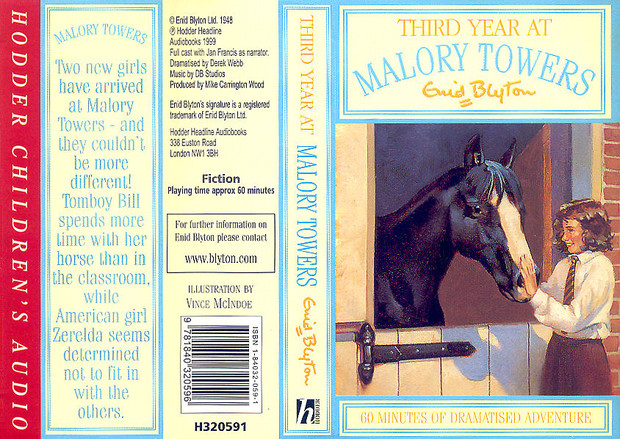
Third Year at Malory Towers: Audio Adaptation

The third Malory Towers book happens to be one of my favourites, tied with In the Fifth, but re-listning to the audio cassette today made me realize that even though its one of my favourite books, it is not one of my favourite audio adaptations.

Now until my teens I had only listened to the Third Year on cassette and hadn’t read the book, big mistake. When I read the book in my early teens I was transported not just to the wonderful world of Malory Towers but into situations that I could identify with as a teenage girl in the early 21st century. The friendships, the ambition and the jealously. You may wonder why I am saying this now instead of my review from a few years ago, but in all honesty until I revisited the tapes this afternoon I had not realised how much had been cut from the book, and how much my favourite characters were lacking in “oomph” (for want of a better word).

Bill, aka Wilhelmina Robinson, doesn’t have the depth that you get from the book, she comes across as a lot more spoilt in the audio, in an attempt at being earnest! In the book, because of the added detail, the disobedience she shows towards Miss Peters rules regarding her horse Thunder are clear, explained and justifiable. Without these details the audio just makes her sound unreasonable and childish.

The lack of Sally is frustrating because even though she comes back late because she’s  been in quarantine for Mumps. Her arrival isn’t climatic, and her stance on Alicia’s trick isn’t made clear. It appears that all the form is involved when actually in the book, Sally is the only one to  remove herself from agreeing the play the trick and is the only one who isn’t punished. She even offers to swap her half holiday with Darrell so she can play in the lacrosse team, but none of this is mentioned. The musical interludes take up so much time that we do not get the whole story.

There is a whole story line where Sally and Alicia compete for Darrell’s attention which is largely ignored. Then there is the friendship between Zerelda and Mavis seems to come out of nowhere and never really gets resolved as to the two staying friends. There are lots of things in this adaptation that just do not do justice to the book I fell in love with. There is too much cut from the story which when you are getting to know the series or trying to introduce a child to it, its fine, but when you’re a seasoned Blytonite you find rather disappointing.

The voices I can’t fault, there are some very strong performances in this cast and they deliver for the whole six episodes. The naming of characters is a little vague and you’re not even sure sometimes who is talking. If you have a keen ear you can here a change but a lot of the girls do have the same sort of tone of voice which makes it hard to distinguish.

I think my main problem with these adaptations is the script editing and the length of the musical interludes. If there wasn’t so much music, surely the script wouldn’t have had to have been so mutilated? Not that the music isn’t catchy, because it is, but its just over used.

I wish I had a cast list however, as I recognized the voices from some of the other Blyton audios and it would be nice to know who crossed over between series. I think the girl playing Darrell Rivers plays Anne in the Famous Five, but without a list I can’t be sure. If anyone does have one could you send it to me please? I would love to put names to voices.

So there we are, my look at the Third Year at Malory Towers audio; not glowing as you can see and have just read but when you love that book and it gets made into a substandard version of itself, in any media, you find it hard to love anything but the book. Am I right?

620wide+1833463

Next review Upper Fourth at Malory Towers: Audio adaptation

Or read a review of the Third Year novel here.

Posted in Audio Books and Audio Dramatisations | Tagged , | 1 Comment

First Monday of March

I shouldn’t have mentioned spring in my last post as winter has made a come-back where I am. It’s very cold! I’m so ready for warm(er) weather.

In the mean time we will be mostly indoors which will give us time to blog. Here’s what we will be writing this week.

Ristorante5

And so there you have it!

Posted in Blog talk | Tagged , | 1 Comment

The Famous Five Adventures Card Game played by Fiona

I persuaded Ewan to play this with me last night, and we fell into the same trap as Stef and I did. We drew a card on every turn (the instructions are not quite clear!) and made it pointless to score the rounds. I became the winner by default as I was the first to finish a story set.

The game is essentially identical to the 1950s version, but with updated illustrations and rather brighter colours used.


THE BOX

The box has a different design, the Five on the front clearly being modelled on the cast of the 70s TV series.

DSCN4648

It also mentions the TV series on the side.

DSCN4651

Side of the 50s box above the 70s one

The back however, and the backs of the cards are very similar. The children are in the exact same position.


THE CARDS

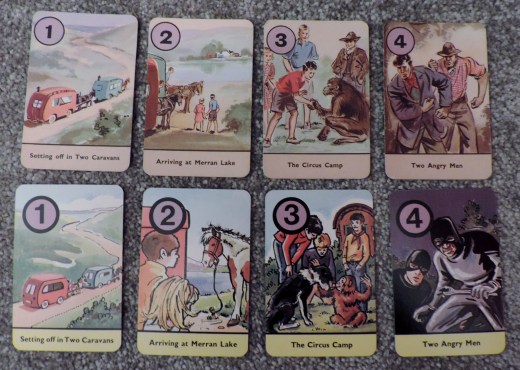
The four stories are the same, as are the colours representing them on the cards. A vast majority of the cards feature the same scene, but a new illustration like below. I don’t think the Five look particularly like the 70s cast on the actual cards actually. Anne is the most similar but that’s probably because she has the iconic hair and alice-band of Jennifer Thanisch. The illustrator was uncredited but I think it’s safe to say it isn’t Betty Maxey. The jeans are too tight in the leg (and nobody is missing any limbs!).

DSCN4635

The Five discover a secret room at Owl’s Dene

There are a few cases where the illustration is quite different, or indeed, swapped for a different scene.

In the Five on a Treasure Island set you can see that the 70s game skips Setting off in the boat, and goes straight to arriving on Kirrin Island. To make up for this, a card where Timmy rescues the map from the water has been added.

DSCN4645

Likewise in Five Go Off in a Caravan’s set, Julian’s hiding place has been replaced with Pongo to the rescue.

Also in this set the Two Angry Men have suddenly become burglars in face masks. Card #1 probably the most identical to any of the originals though.

DSCN4655

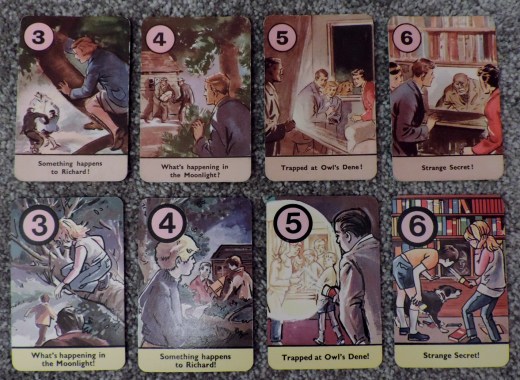
Then in the set for Five Get into Trouble two of the titles are switched.

DSCN4652

As I noted last time card #3 should have read Something happens to Dick, not Richard. The 70s set has switched that title to card #4, but that scene is where the escaped prisoner changes his clothes and throws the prison uniform down the well. So card #3 makes more sense, but card #4 makes less sense. Irritatingly the annoying random capitals have been kept. Either capitalise all words like in a book title, or don’t capitalise at all. Don’t Capitalise only the Words that you think are Important! That was horribly to type and I apologise to you all for making you read it.

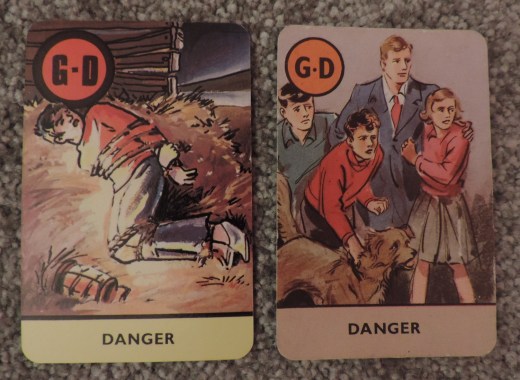
The General Danger card has also been changed. The danger is now being tied up and thrown in a barn rather than just having to look afraid.

DSCN4657

The new set rather lacks the charm the original had, but clearly it was a clever move to tie it in with the TV series and re-release it for a generation of new fans.

Posted in Personal Experiences, Toys and Games | Tagged , , , , , , , , , | 1 Comment