
Jack’s sister Susie is given a fantastic model aeroplane by an American cousin and the Secret Seven want to fly it. Annoying Susie agrees to let Jack show her how to use the aeroplane, a beauty with retractable wheels, on the agreement she can have a picnic with the seven in a field at the back of her house. What a fine feast it is. The children tuck into a huge spread consisting of some rock buns, chunks of gingerbread, a huge bar of nut chocolate, jam tarts, two bottles of lemonade and a bag of toffees. Soon it is time to fly Susie’s aeroplane. Jack shows his sister how to use the aeroplane before raising it in the air. The aeroplane circles around seemingly peacefully before suddenly jetting off in the direction of the wall of a nearby house.
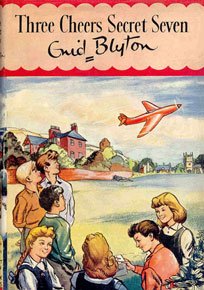
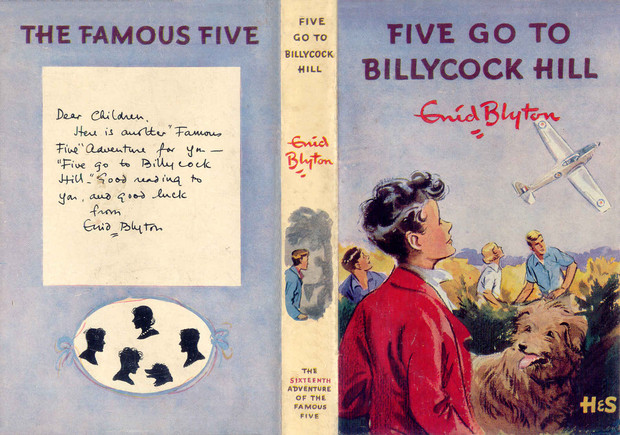
Dust jacket from the first edition by Burgess Sharrocks
Susie is devastated and demands Jack get it back. In desperation, Jack is helped up the wall of the house by Colin, George and Peter before he calls out to the gardener who works at the large and forlorn Bartlett Lodge, which has been shut up by its owners for a long time. However, Georgie Grim, the fierce and bad tempered gardener refuses to let Jack look for the aeroplane and threatens to knock poor Jack off the wall if he does not go.
Determined, Jack and Peter decide to return to Bartlett Lodge when Grim goes for his lunch. Through the field the pair go and down the little lane leading to the house. It is when Jack and Peter get to the house that Peter catches sight of the model aeroplane sitting on the ledge of the balcony. In excitement, Peter darts up a tree near to the balcony and carefully grabs the aeroplane. But just as Peter is about to go back down the tree, something strange catches his eye. It is a light in the house. Peter jumps back on to the balcony and when he looks in a gap through the curtains of a room, he sees a gas fire blazing merrily away.

Rescuing the plane
In astonishment, Peter carefully makes his way back down from the balcony and tells Jack about the aeroplane. It is agreed that the seven hold a meeting in the afternoon about Peter’s strange discovery. At the meeting, the seven decide to speak to Alice, a woman who did some cleaning for the owners of Bartlett Lodge to ask her if she had turned the gas off. Alice is not very well so the children go round with some peppermints. During their visit, the kindly Alice gives the seven some gingerbread and insists she turned all the gas off before the house was shut down. This revelation leads the seven to wonder how the gas fire had turned itself on.
In curiosity, Jack and Peter say they will go back to Bartlett Lodge during the night to see if Peter really had seen the gas fire on. The night soon comes and Jack and Peter walk cautiously through the first drive gate and straight into some nearby hedges, desperate not to be seen. However, when the pair take their chance and sprint across the yard, they bump into Georgie Grim and an unknown man. The angry and surprised pair demand an explanation and threaten to phone the police. But Peter and Jack tell their tale and convince Georgie Grim and Mr Frampton from the bank, who had the keys to Bartlett Lodge to investigate.
Mr Frampton opens the house and Jack, Peter and Grim follow him into the house. It is when the group get inside that they notice the gas is still switched off and when they make their way to the room where Peter saw the gas fire, it isn’t on. At this point, Mr Frampton is livid and threatens to tell Jack and Peter’s parents as well as phone the police. Angry Peter is having none of it. In his belief that he saw the gas fire on, Peter shouts at Mr Frampton and slams the door of the house. In shock, Jack races after his friend who tells him that he saw other mysterious items in the room. A Primula plant, in good condition and an eight-day clock which was working. Someone simply had to be in the house and the excited boys arrange a meeting for the next morning.

Checking out the house
This is the part where the girls come into it. Pam is sent off to her gran to ask about Grim’s character as the seven suspects him while Janet and Barbara are tasked with going to Grim’s house and finding out where he is at night. Soon, Pam is off questioning her granny and does well to find out Grim is perfectly honest and has a lovely wife. While Janet and Barbara discover that Grim and his wife live in a horrible damp house level which has a damaged roof and is next to a near-by canal, which flooded the house after a prolonged bout of rain. The girls also find to their surprise that Grim helped his ill wife with the shopping in his dinner-hour from work and cooks a meal at night.
All this unlikely news leaves the seven confused and wondering where to go in the adventure. The seven all thought Grim was a fierce, bad tempered man when in fact he is kind and helps his wife. There was only thing left to do and that is to watch the house at night to see who comes in and out. So during the night, the four boys go back to Bartlett Lodge to keep a look-out. Colin is to stand near the gates, George behind the tree near the balcony and Jack and Peter to go up the tree to see if anyone comes through the window of the mysterious room. Hardly daring to breath, the boys finally hear something. A man is slowly creeping up on the tree. The man knocks a couple of times on the window and the curtains are opened. A huge burst of light suddenly comes through. To the astonishment of Jack and Peter, the man is Georgie Grim. How could it be? The seven were convinced of his honesty and now he was breaking into a house where a potential burglar was staying! But is this all it appears to be? Read Three Cheers, Secret Seven to find out!
Three Cheers, Secret Seven is definitely the best and most heart-wrenching book I have read so far in this wonderful series. The manner in which Enid Blyton constructs the plot is masterful as the reader is left wondering a number of things. Is anyone in the house? Did Peter really see a gas fire? Is Georgie Grim really up to no good? Blyton cleverly creates the suspense needed with a complex plot designed to entice the reader to carry on flicking through each page. It certainly worked with me and the excitement eventually leads to an unexpected ending.
The seven children end up being very charitable in this book, showing all the qualities of compassion and decency you would expect from any Blyton character. Blyton also shows in this book her understanding to the most vulnerable and that sometimes desperate things must be done to help them in their hour of need. The only criticism is the usual lack of action from the girls in the most dangerous parts of the mystery and the usual domination around Jack and Peter as best friends and the two main characters throughout the series. But this isn’t enough to take away from what is arguably one of the best Secret Seven books Blyton wrote.
Although not the last book in the series, this is the last review we have.
For more Secret Seven reading, however, we have The Secret Seven books at McDonald’s or a review of The Mystery of the Skull – Pamela Butchart’s continuation to the series.




















 Fiona
Fiona pippastef
 worldofblyton


 World of Blyton