The Mystery of the Pantomime Cat

the-mystery-of-the-pantomime-cat-14I know you’ve had a lot of Five Find-Outers and Dog reviews recently, but I’ve had the books on my library card for a while now, and thought it was about time I got round to reading them. As I had an eight hour journey back from Dundee I thought that was the perfect time to get on and read them. I mean what else was I going to do on a train for eight hours?! So I packed my bag with the book and knew that at least I wouldn’t be bored on the train.  So let’s take a look at what this FFO has in store for us!


Goon on holiday

Like the last book, we start the story at the train station, where Larry, Daisy, Pip and Bets are waiting for Fatty, and they spot Mr Goon there as well.  Mr Goon is about to go on holiday and the new constable, P.C Pippin (who is still a bit wet behind the ears), is brought over to Petersfield to take his place while he is on holiday. Both Fatty and P.C. Pippin are on the same train but do not meet until they leave the train.

Mr Goon then decides to tell Pippin what he thinks of the five children and Buster. This rather shocks P.C Pippin because Inspector Jenks has spoken so highly of them, and Mr Goon is saying nothing but horrible things, warning Pippin away from them. Pippin is a little in awe of Mr Goon to begin with, so he takes the warning to heart and doesn’t allow himself to anything to do with the children.

Mr Goon goes off on his holiday and the Find-Outers decide that as they’re not in pursuit of a mystery they’re going to make one up for P.C Pippin. Hmm, haven’t we seen this storyline before? Could Blyton be going a little stale with her ideas, a little bit like she did in the middle of the Famous Five series? We have literally only just had an FFO book start off with a false mystery to start.

Like Ern in Hidden House Pippin is completely taken in by the false clues, the red headed gentlemen in the village and the mysterious ‘ruffians’ (Larry and Fatty all dressed up!). Pippin doesn’t stand a chance as the children set about that the bad guys are meeting around the back of the local theatre. Unluckily for the children this puts Pippin right in front of a real crime as it happens – the manager of the theatre gets knocked out and his safe broken into. Naturally this brings Goon running back in the hope of solving the mystery before Fatty and the gang, but he unfortunately uses the ‘clues’ that the children dropped for Pippin in their fake mystery. I think if you weren’t convinced that Goon was a fool by now, you should know it by this book. He did exactly the same thing with Ern in the last book, and seemingly hasn’t learnt from his mistakes. What a idjit!

Been there, read that, solved the mystery!

I’m going to be honest here, when we were introduced to all of the suspects, and the two characters that Mr Goon thought were the culprits of the crime, I knew it was a double buff. I knew straight away that the person dressed up as a cat was not the person acting the cat in the stage show. Boysie is a singularly slow boy but utterly devoted to his life in the theatre and to Zoe Markham, the lead in the Dick Whittington show the theatre are performing over the Easter holidays.

Goon thinks that because Boysie is slow and stupid, he would do anything for Zoe and so they must have committed the crime together. However the children befriend Zoe and Boysie and know this deep down to be untrue, but alas, they are unable to prove it.

It begins to look like the mystery that got away from them, until one of Bets’ little innocent remarks gives Fatty’s brain a boost. Again, how many more times have we had this scene from Enid Blyton? I know that children reading the books would probably not mind in the slightest, but for a grown up reading the book, it’s obvious way before Bets’ comment. Fatty then races around, getting information from P.C. Pippin and then asking  to be driven over to see Inspector Jenks and solve the mystery. Huzzah Fatty and his friends have done it again. Whatever will happen next?

All about Fatty

Oh my Blyton! If the Famous Five books had been so centred on Julian, or George for example, people wouldn’t like them nearly half as much, so why is it different for Fatty? I do not understand why people love his character, he drives me nuts! He is such a know-it-all, too-good-to-be-true, marty-stu who can never do anything wrong and must be worshipped by all. It drives me insane. At least with Julian and George they recognise their faults, but Fatty? No. Someone please tell me he gets his comeuppance soon and the rest of the FFO get a fair chance in the mysteries? I just don’t like him! Sorry but it’s true!

Thoughts

I preferred this book to Hidden House by miles, possibly because I’m much better acquainted to the world of theatre than that of mysteries, and had the answer been much more devilish, I would have really ranked it highly. Unfortunately using the same plot at the beginning of the novel rather ruins it, especially so close to the last time that trick was used. If they were a few books apart I could have forgiven it, because as we know, Blyton wrote a phenomenal amount of words a day/week/month/year and some errors were bound to slip in, but back to back same plot device just doesn’t sit right.

I liked the way P.C. Pippin was well placed to see the crime taking place and immediately be on the scene, and it’s book’s saving grace that the main story takes off quickly and in Blyton’s excellent style, but the format of the beginning and the end feels old and tired. I just hope that The Mystery of the Invisible Thief  has a better start and finish. A proper detective novel!

Oh well, I can live in hope!

What do you think of The Mystery of the Pantomime Cat? Have I been too harsh? Let me know in the comments.

Next review: The Mystery of the Invisible Thief

Posted in Book reviews | Tagged , , , | 10 Comments

Monday #225

Well, it’s Monday again! I feel like every Monday could be my last for a while, but then again I could be around for many weeks to come.

Here’s what we’ve got planned for the blog this week:

And if you’re the crafty type I’ve spotted a competition by The Book People. All you have to do is share a picture of your Noddy related craft and you could win a load of books.

Posted in Blog talk | Tagged , | 1 Comment

The Saucy Jane Family: How has Blyton’s original text fared in a modern edition? part 4

Last time we saw quite a bit of text cut out of one chapter plus some other more minor changes, so let’s see what we get this time.

I am comparing the first edition (Lutterworth Press, 1947) to an omnibus edition containing four of the six books (Egmont, 2014).


CHAPTER NINE : A DAY ON THE HAPPY TED

Most of the changes here revolve around gay and queer. 

  • gay castles – pretty castles
  • gay and neat – bright and tidy
  • gay – bright
  • what a queer, lovely, gay little place – bright, lovely, little place

As you can see they’ve not exactly widened the vocabulary as they’ve mostly used bright as a replacement. Also, I don’t know why neat had to become tidy?

Black Sambo became Stella in the previous chapter and so now references to him ie he have become she. 

And lastly, the somewhat deferential titles for the children have been removed. Ann and Belinda had been called Missy three times between them, and Mike Little Master once.


CHAPTER TEN : UPHILL IN A BOAT!

A second chapter without anything changed!


CHAPTER ELEVEN : A STRANGE ADVENTURE

A queer chapter indeed. Blyton has overused queer just a bit!

  • dark and damp and queer – dark and damp
  • queer – strange
  • queerly loud – oddly loud
  • the queer call – the call
  • queer trumpet – strange trumpet

A mix of replacing it with alternatives and just removing the adjective altogether.

As with the previous chapter missy is removed, well once it is, the other time it is (presumably accidentally) left in.


CHAPTER TWELVE : GOOD-BYE TO THE SAUCY JANE

There are three gays in this chapter to be edited.

Daddy and Mike repaint the Saucy Jane’s rowing boat and made her very bright and gay. In the new edition the quoted part is just deleted, when they could easily have put bright and fresh or just left it at bright.

The two gay caravans are now just two caravans, and clean and gay becomes clean and bright. 

The children are no longer described as brown and fat and strong they are just brown and strong. It’s an odd one as Blyton seemed to use fat both positively (as in this case) and negatively (think Gwendoline Lacey etc). As this is a positive use I don’t see so much of a problem, especially as they are described as sturdy in the next sentence.

And a last one that made me laugh. In winter at the caravans the children enjoy games and books and wireless. Now they enjoy games and books and television.

Let’s just think about that for a moment. Television. In a wooden gypsy caravan parked in a field. A caravan pulled by horses because it’s 1947! Six years before TVs became even moderately common-place thanks to the coronation. They can’t possible expect it to seem realistic that there are horse-drawn coal-barges tootling up the canal taking days at a time but there are also TVs in caravans!


And a final 7 changes there, and that brings the final total to 25. That doesn’t sound like very much perhaps but it is a very short book. It’s not that much longer than a Noddy for example.

Most of the changes are absolutely expected, for example the removal/replacement of queer and gay, and many other changes really are minimal. I like that they kept the italics exactly as they were, too.

However, some nice old-fashioned touches are lost in the effort to make the book seem modern and current, but the modern feel is ‘ruined’ as soon as the horse-drawn coal-barges make an appearance. Just another example of how futile it is to try to make what is essentially now a period piece into a modern one without rewriting it entirely.


Posted in Updating Blyton's Books | Tagged , , | 1 Comment

If you like Blyton: The Mystery of Wickworth Manor by Elen Caldecott

wickworthmanorIn our quest to find books that could be considered similar to Enid Blyton’s novels for you to try yourselves, I have discovered another book by Elen Caldecott, an author I reviewed a few months ago (The Mysteries of Marsh Road, Diamonds and Daggers). While I was researching her books on my library system and discovered that one, the Mystery of Wickworth Manor popped up on the list and I thought it was worth a go. So shall we take a look at it?

What it’s all about

Wickworth Manor is one of those old houses that has been converted by the family into a week retreat for school children in year six who are about to leave for their secondary school (for more information on the English school system, see here) and they are there to meet all their new school mates. One of our main characters, Paige, arrives at Wickworth manor with her two best friends, planning on not needing to make any more friends. She does feel as though she doesn’t need to make friends with anyone else because she already has her best friends, however, circumstances are not her friend and she finds herself separated from them  and partnered with Curtis, a strangely behaving boy, without any other people from his school present. There appears to be some sort of back story to Curtis, that we’re not immediately aware of.

Curtis is dropped off at Wickworth Manor by his mum in a rented car and not on a bus like the other children. Paige picks him out on entry to the building and stares him down, and they both hate each other on sight. Unfortunately for the both of them, they end up being partnered together for the week of activities, and really can’t wait to shake each other off.

Anyway, Curtis makes himself at home in an old attic and finds an oil painting of a young black slave who was part of the house’s staff and Curtis wants to know all he can about it. Elen Caldecott puts in her authors note at the end of the book that this painting is based on a real one, which is currently held in Wrexham, England. You can see a photograph of the painting here.

Paige finds out about the painting and tells Curtis its a portrait of a ghost who roams the halls of Wickworth Manor. As she is interested in being a psychic, Paige wants to told a seance to try and contact the boy, but they manage to anger the manager of the manor and get told off in the morning.

This makes Paige and Curtis all the more determined to find out what happened to the boy in the painting, even though they both want to go about it different ways and don’t want help from one another. However, thrown together as they are, they manage to solve a nearly two hundred year old mystery and become quite good friends. Its quite a roller coaster of a book, and gathers pace towards the end of the novel.

How is it like Blyton?

Simple, the mystery. All right its not considered a ‘current’ mystery, as in it’s not happening to the characters as they go through the book. Its something they have to research and deal with historical facts to find out what’s happened. We get a little bit of this in some of Blyton’s books; a little bit in the Famous Five, occasionally in the Adventure series, and tiny bits and pieces in the Five Find-Outers to name just three of her many series that have a bit of ‘historical’ digging to them.

The characters, although there are only two of them, manage to rub along together and make a good pairing at the end , even though they didn’t like each other in the start. We see them go from strength to strength and find the clues they’re looking for and finally solve the mystery. It’s a good read, especially for younger children as it’s short, and the descriptions Caldecott gives are very Blytonian. They certainly manage to give you the chills and wonder what’s going to happen next. She’s very good at weaving her story and her magic around the story just like Blyton did, and I think that makes her a good author. Anyone who can capture the spirit of Blyton, while writing something that doesn’t quite compare to any of Blyton’s own books is a phenomenal talent. I managed to read this book in one setting which allowed me to get immersed in the story and the characters.

The modernness of the book doesn’t really show too much. The kids are in a place where there isn’t any phone signal really, and there’s only one computer and its old, cranky and hidden away in the library. They do have to resort to more ‘traditional’ sleuthing methods, such as looking through books and interviewing people to get their information, all with the added bonus of the teachers watching over them to keep them under control.

Final thoughts 

I wasn’t too convinced when I did take the book home to read from work, only because I didn’t really think it was going to be well done, or not what I was expecting. I was pleasantly surprised though as it turned out to be quite a gripping adventure, and had some nice historical elements added to it, context for the history and good social economical present day threads through it all.

I would very much recommend this book if you like Blyton, because its sort of different to things we’ve been looking before but it contains the best parts of a Enid Blyton mystery. If you read it, or have read it, let me know in the comments below of what you think of the book!

Posted in Book reviews, Other Authors, Reading Recommendations | Tagged , , | Leave a comment

Monday #224

Monday_224

Posted in Blog talk | Tagged , | Leave a comment

June 2017 round up

Somehow it is July, and we have reached what will probably be my last monthly round up for a while.

I’ll be taking over from now on! – Stef


WHAT I READ 

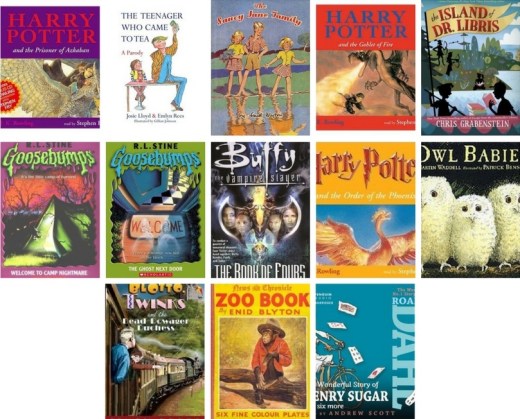
  • Harry Potter and the Prisoner of Azkaban – audiobook narrated by Stephen Fry
  • The Teenager Who Came to Tea – Emlyn Rees
  • The Saucy Jane Family – which I have just finished comparing the text in
  • Harry Potter and the Goblet of Fire – audiobook narrated by Stephen Fry
  • The Island of Dr. Libris – Chris Grabenstein
  • Welcome to Camp Nightmare (Goosebumps #9) – R. L. Stein
  • The Ghost Next Door (Goosebumps #10) – R. L. Stein
  • The Book of Fours (Buffy TV tie in) – Nancy Holder
  • Harry Potter and the Order of the Phoenix – audiobook narrated by Stephen Fry

For the baby:

  • Owl Babies – Martin Wadell

And still on the go (most of the ones from last month I haven’t picked up again lately):

  • Blotto, Twinks and the Dead Dowager Duchess (Blotto and Twinks #2) – Simon Brett
  • The Zoo Book (which I wrote about here and here)
  • The Wonderful Story of Henry Sugar – a Roald Dahl audiobook

And perhaps unsuprisingly I still haven’t started that pile of library books I have. Maybe I’ll get through them on my maternity leave before the baby comes!


WHAT I’VE WATCHED

  • More One Born Every Minute including the tough episodes where things didn’t go entirely to plan
  • Hollyoaks, as always
  • Taskmaster
  • Murder She Wrote. I’m on season 2 of 12 now!
  • The OA – a really weird series on Netflix
  • The Castle of Adventure – I’ve been reviewing episodes for the blog

WHAT I’VE DONE 

  • Packed my hospital bag and the baby’s too, and done a lot of washing of his things.
  • Organised the nursery a bit more.
  • Supported my mum, sister and two cousins doing the Pretty Muddy challenge.
  • Gone to aquanatal aerobics weekly, and swimming some weeks as well.
  • Stepped awkwardly off a pavement and ended up in A&E with a sprained ankle and bruised knee. Thanks to this I started my maternity leave a few days early!
  • Welcomed Stef to Dundee (as much as I could from the sofa) as she’s up to stay for a few days.

WHAT STEF HAS READ

  • Everything, everything – Nicole Yoon
  • Street Cat Bob – James Bowen
  • Empty Vessels – Marina Pascoe
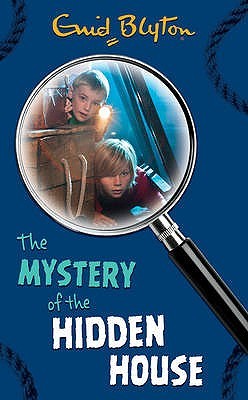
  • The Mystery of the Hidden House – reviewed here and here [links]

Current reads:

  • Peggy and Me – Miranda Hart
  • Gena/Finn – Hannah Moskowitz
  • Raven Girl – Audrey Niffenegger


WHAT STEF HAS WATCHED

  • One Born Every Minute –  I’ve been watching along with Fiona. It’s quite informative.
  • Taskmaster – I have binged watched series four on catch up because I didn’t realise it was airing, so I went through and watched it on catch up.
  • Red Dwarf – My other half and I have been watching the show from the beginning, so it’s fun to go through the episodes from the start.

WHAT STEF HAS DONE

What have  I done? Good question!

  •  Traveled to Dundee – for Fiona’s baby shower at the end of June.
  • Walking –  I have done a lot of walking this month, to try and offset my weight management.
  • Went to a foam party – I went out with my other half and enjoyed a foam party. However I did swallow some and we ended up heading home early.
  • Bought a paddling pool – In that really hot weathered period, I managed to get my hands on a suitable paddling pool to enjoy in lieu of being anywhere near a beach.
  • And last but not least, A Trip down to Bournemouth Beach – Me and my other half went down to Bournemouth and spent some time enjoying the sun, sand and sea.

I think that’s all from me now! Lets hope I have more to tell you about next month!

Posted in Personal Experiences | Tagged , , , , , | 2 Comments

The Adventure Series on TV: The Castle of Adventure, part 4

Yet again the previous episode ended with a cliff-hanger, or perhaps I should say tower-hanger, as Jack was hanging from the ivy on the castle’s tower while the eagle swooped down at him.

And we find out that Jack fell in the last episode because of the castle casting its evil spell. Well, according to the narrator anyway.


DOES JACK SURVIVE? WELL OF COURSE HE DOES…

Kiki scares off the eagle with a bit of eagle-screaming and Jack keeps climbing… then he half-falls and dangles a bit for extra drama. Previous angles had made him look high up but he’s low enough for Philip to grab his foot and help him out.

At this point I was saying Give up for goodness sake! to Jack, as it was clear the eagle could come back at any moment or the ivy could give way again.

But he ignored me and kept on going, finally got up safely and finds an eagle chick in the nest. Philip joins him (without any drama), and while they’re looking at the chick and taking photo the eagle’s stealing from their picnic.


THE TRUTH ABOUT SAM

Every episode reveals a little bit more about this strange new character. This time it’s that Sam buys his eggs from a chap in a butcher’s apron. Who sits by the side of the road waiting for him (which is weird), but they’re clearly not as country-fresh as Sam implies. He then arranges them in his hat with straw to make them look more ‘authentic’. Clearly he can’t be turning a profit on this, so his motives lie elsewhere.

Trading standards would have something to say about all that I bet.

Allie thinks his motives are all about food – you’re too late for breakfast, too late for lunch and too early for dinner, but that’s a red herring really. She at least seems a tad suspicious when he interrogates her about the children and Tassie and isn’t willing to say too much.

He also builds on the sinister side he shows to Tassie’s mother, with more threatening behaviour about where Tassie has been and who she’s hanging out with. She had hidden the fresh clothes from Allie in a bag in the woods, to stop her mother or Sam, or both, knowing about them, but Sam finds them and is not happy (even though he knew about them already as he mentions them to Allie).

And then he cements his character as truly evil in my opinion. Not only does he shop in a supermarket and pass the goods off as fresh country produce – but he also doesn’t return his trolley!!

Instead he gives it a shove and hits a traffic warden with it. She looks like she’s going to write him a ticket (for an out of control trolley?). He charms her with a story of orphans and how he’s using the few bob he made selling their junk to buy food for them. Except she spots he’s bought wine and issues a ticket which she tucks into the horse’s saddle. All without saying a word.

Edited to add: skimming through to get screen caps I now understand better. A previous ‘scene’ shows some sort of meter ticking over to an excess charge. It’s very quick though and it’s not at all clear that it’s a parking meter. So the traffic warden has clearly been stood waiting for him to return so she can issue a ticket. Now if only they’d afforded her a speaking part it might have made sense initially…


THE CASTLE IS ONLY SOMEWHAT ADVENTUROUS SO FAR

The castle is a bit dull apart from the eagles. We the viewer see one or two henchmen in the vicinity but the kids are oblivious.

They do find a leaky water pump with a clean handle (just like in the book, but not in a daring middle-of-the-night trip for Jack) and there’s a loudly banging door which gives them a fright for a minute.

I think if you tried to align the book with the TV series you’d find Jack was already camping in the castle by now, and having his scary night-time experience. I suppose they’re waiting to get rid of Allie (who gets a pointless phone call to say her mother’s test results are clear today, but more are expected tomorrow) before Jack would dare to stay in the castle.

In fact Spring Cottage is more adventurous at one point, when Philip has snuck his hedgehog into Dinah’s bed, causing a fight.


LUCY-ANN IS VERY ANNOYING

Lucy-Ann continues to be the stupid one of the group. She asks of the castle inhabitants wouldn’t they have had gas? And then doesn’t know what a hide is – when she grew up with an ornithologist for a brother.

She also just blurts out everything. Tassie was with us! Jack wants to photograph the eagles at night! and not in an almost forgivable way like Anne Kirrin did in the first Famous Five book. The actress is not very good either, unfortunately. I really struggle to understand why they picked someone so much younger than the other three.


STRANGE MEN ABOUND

So Bill finally turns up again – driving past Allie in the village. Either he doesn’t see her though, or he deliberately blanks her. She then doesn’t believe it really was him.

Bill in a very snazzy jumper

The kids don’t seem to know who Bill is – or at least the Trents have never met him. Allie explains that Bill does the same as Philip and Dinah’s dad did, working for the government. That would sort of explain how she knows him at least. It doesn’t seem like the events of Island of Adventure exist in this universe, so it will be interesting to see how the children get to know Bill.

Then there’s also the suspicious chap from an earlier episode – who met Allie at the MOD event – and he asks her out for tea.

The episode ends with someone sneaking around Spring Cottage in the night. It could be Bill. It could be Sam. It could be MOD man. We’ll have to find out next time…


So that was another OK episode. Still feel like it’s being padded out far too much though. Nothing really happens apart from the kids discovering someone else has been inside the castle, and a fleeting glimpse of Bill.

Posted in Blyton on Screen | Tagged , , , | 1 Comment

The Mystery of the Hidden House, part 2

hiddenhouseLast week I failed spectacularly in my duty to provide you with a full review of The Mystery of the Hidden House as I failed in my speed reading skills. So, I have had to bring it to you in two parts. It has meant that I have been able to look at the book in a greater depth. I suppose it’s given me a chance to slow down and read the text properly.

Unfortunately this puts a spin on last week’s blog. Shall we take a look?

A mystery that isn’t

So we started with the fact that, the Hiltons and the Daykins have been told they are not allowed to participate in any mysteries that come their way these hols, and so they all invent one to pull Ern Goon into trouble and make fun of him.  Ern has not got the greatest brains so, we know that the others are laughing at him behind his back but when Ern accidentally stumbles on to a proper mystery in the nearby Bourne Woods (can you all make the location connection? Haha!) and the Five Find-Outers, aka mostly Fatty at this point, start to explore this new mystery involving someone called Holland.

The Hiltons and Daykins start to help by trying to find out about the people called Holland in the area, but once again are thwarted by Fatty who makes the biggest discovery, disguised as Ern. He finds out that Mr Holland is probably the man they want, because he starts at the mention of the house called Harry’s Folly in Bourne Woods. Unfortunately Fatty commits the biggest faux pas in the detective text book and tells Mr Holland his real name, and because he looks like Ern, when the bad guys catch up with the Find Outers, they end up capturing Ern. It is such a mess. We’ve got one proper mystery taking place, which is stumbled upon by accident and by the wrong person. The two become so intertwined that its frustrating to remember which clue belongs to which ‘mystery’.

It all works out in the end, but there is an overall feeling that this book is mostly about Fatty and Ern. It mostly feels as though its to prove Fatty is the main Find-Outer and with occasional help from the others can solve a mystery. He doesn’t even get told off by Inspector Jenks at the end, just gets told to grow up as fast as he can because the inspector needs a right hand man! How irresponsible is that, encouraging a child into danger just because your local copper, Clear Off Goon, is a shambles? Why not do something about Goon? I mean he’s the one who should be on top of all of these things! I know its a children’s story, but still, there is a limit to the imagination for an adult, isn’t there?

Let’s move on, there’s one more thing I want to consider before we round up!

Swatisaid – Ern Goon

Now as a child I have no qualms in saying that I would have had no patience for Ern at all. I had no patience with similar characters in the Famous Five and Malory Towers when I was growing up, mostly because the main characters were dismissive of these types of characters as well, and yes, I know it’s just the time they were living in, but still, now when I come across it in books, especially by my favourite, Enid Blyton, I wince. How could I have been so blase about attitudes like that? Sure these characters are not maybe the most fun, but they’re still people (in my head ok, but they are people!) I would never treat someone they way the Five Find-Outers treat Ern in this book. It’s appalling!

The thing is, he’s completely oblivious to it all. They lie to him, they get him into massive trouble with his uncle because Fatty wrote a rude ‘pome’ about Goon in Ern’s handwriting. It’s all really silly stuff, very childish, but its hard to read because it’s not fair on Ern, or nice to him.

As I commented in the last blog, Bet’s attitude towards Ern surprised me, because I didn’t think she would be so mean, but it does soften a little towards the end of the book, when she really realises that they’ve done wrong by him.

I’m not saying that I like Ern as a character very much, he’s clearly got a lot of lessons coming to him, but I think the way the Find-Outers treat him is rather harsh!

Did I like it?

Yes and no. I think that despite the confusing nature of the two mysteries, which then blur into one, it’s a clever plot, if not simplified and over saturated with Frederick Algeon Trotterville, but the interaction of the characters towards Ern is what really takes a lot of the liking I had for this book away. The children don’t really seem to learn anything from his kidnapping, or involvement in their fake mystery. I hope that improves and they are nicer to him next time.

What do you think of this book? Let me know in the comments!

Next review: The Mystery of the Pantomime Cat

Posted in Book reviews | Tagged , , | 4 Comments

Monday #223

June is nearly over, if you can believe it! We’ve had some pretty good weather lately (too much heat for me, though!) so we’ll have to see what July then brings.

Here’s what we’ve got lined up this week:

Enjoy!

Posted in Blog talk | Tagged , | 1 Comment

The Zoo Book, part 2

Here I am continuing to look at The Zoo Book, Blyton’s non-fiction book about London Zoo and its animals.

The first chapters covered the zoo’s history, how animals were caught for the zoo and some secrets of the keepers. It did not all make for pleasant reading!

Let’s see what the next few chapters bring though…


CHAPTER FOUR: APES AND MONKEYS

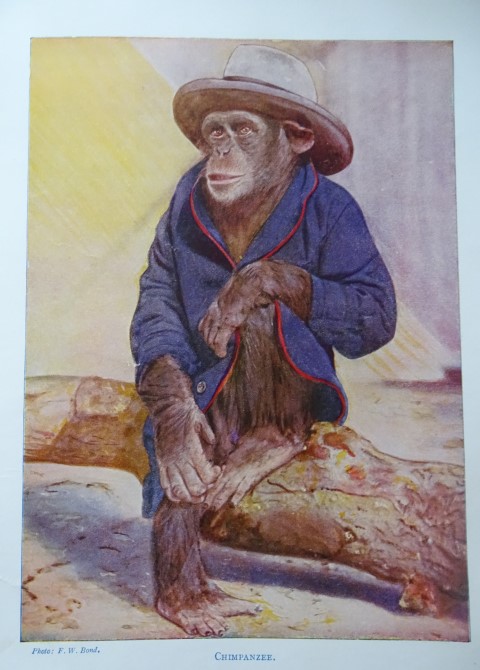
Lots of different monkeys and apes are covered here – Chimpanzees, orang-utans, gibbons, baboons, mandrill baboon, drills, guenons, mangabeys, macaques, American monkeys, marmosets and lemurs.

Primarily it gives a bit of a description of each type of monkey/ape, where they live, what they look like and their behaviour. I imagine loads of readers would never have seen half of these creatures before!

Interesting bits include:

  • Orang-utangs being hyphenated, and often referred to as just orangs.
  • Anatomy of chimps who have ‘hind hands’ not feet, as they have no soles which is why they walk so oddly when upright.
  • I learned a new term – guenons a genus of old world monkeys of which Enid’s example is the green monkey commonly (then!) seen with an organ grinder.
  • I’m not sure lemurs are technically monkeys or apes. They are primates though (as are humans!).

A couple of anecdotes are thrown in too, some nicer than others!

One of a signalman in Africa who lost his legs and trained a baboon to pull the levers and push the carts for him – certainly less usual than a golden retriever!

Then there was Sally, the chimp, who could count to five accurately and sometime higher. Quite different from zoo animals now who are encouraged to be as wild and natural as possible.

Also mentioned is an orang-utang who used to knock down the sign saying “do not feed” as he worked out he got far less from the public when it was up! Amusing, but then added on is the reminder that orang-utangs rarely lived long in captivity.


CHAPTER FIVE: BIG BEARS AND LITTLE BEARS

As with the last chapter this one gives details of the main bears – polar, brown, grizzly, black, bears of India and China (individual types aren’t mentioned, but sun bears perhaps?) racoons (now more commonly spelled raccoons, and which aren’t actually bears they are procyonidae), and the sloth bear.

The polar bear starts off with a cheery little anecdote (after describing him of course)

One of the polar bears will sit back and wave his hand at you if you will wave your hand to him. he will wave both his hands if he thinks you are going to give him a bun!

And then a truly horrible one:

Grown-up polar bears sometimes live for quite a long time in captivity. Sam and Barbara were at the London Zoo for many years. They had about twenty cubs, but none of them lived longer than three weeks. Sam ate them, and Barbara ate them. Then Barbara carried another lot into the cold air and left them to catch cold in a puddle. Another time the cubs were given to a collie dog to mother,but even these died. Our climate is too warm for them, and they catch cold so very easily that it is almost impossible to keep them for very long.

I mean this is a book for children. I know wild animals often eat their young but in the wild it’s more natural if they were under threat etc. It seems barbaric in a zoo to let an animal have so many young when they must have known they wouldn’t survive.

The tragic Sam and Barbara

Not so horrible but rather blasé about a dangerous event Blyton says it was All most thrilling when Barbara escaped on a foggy morning. Certainly would have the adrenaline going in the staff but it could hardly have been fun!

The brown bear is famous for its circus performances as described:

Have you ever seen a dancing bear led by a rope? He usually carries a pole and dances clumsily on his hind feet. He is almost always a brown bear who has been captured and trained to help his master earn his living.

Of course left out is how painful the rope-leading is. How a hole is made in their face for the rope, how their teeth are pulled out or filed down to make them safer… I can only hope that Blyton was being truly naïve here and didn’t know those sorts of details.


CHAPTER SIX: CATS – GREAT AND SMALL

Blyton starts by likening pet cats at home to lions etc, comparing their eyes, paws, whiskers and so on which is clever, as most readers would be familiar with a domestic cat.

Described are lions, tigers, leopards, jaguars, ocelots, lynx, caracal and the wild cat.

Lions, being the king of the cat family come first and get probably the most text. The are found in Africa and Persia (that dates the book just a little bit) and without manes in India. Having done the tiniest bit of research myself (ie Google and Wikipedia) it becomes clear that the Persian and Indian lions are the same type – Asiatic lions who have much smaller manes but manes are still visible.

Also seemingly inaccurate is the description of how the lion kills. All the way through he is used, and while I know that Blyton would use he to mean a whole species, it makes it sound like the male kills animals solo and drags them back to eat. However we all know that lions tend to live in packs, and in those cases the females do the hunting together. Obviously there are some male lions outwith packs who will do their own hunting but Blyton fails to mention lion packs or female lions at all.

Then there’s this rather nasty story:

Sometimes jackals find the half-eaten body and joyfully set to work to finish it. If the lion finds them there when he himself wants to eat he is very angry, and it is said that, to punish the jackals, he will catch one and bite off all its paws.

Is that really necessary for a children’s book? Again, animals hunt and kill each other in nature, that’s totally appropriate to describe educationally. That bit just seems unnecessarily gory especially when it’s all about revenge. I wonder if this is a true story or just a folk-tale. I would love to know her source for it anyway, as I couldn’t find any search results online to back it up (though I didn’t spend a long time looking.)

The tiger is stronger and braver than the lion (who got a bit of a hard time actually, being described as a coward etc!)

Some bad attitudes are exposed here as the tiger does a tremendous amount of mischief. He will steal cattle cay after day, and should he have the chance of tasting the blood of a man, he will become a man-eater, and watch and wait for chances to pounce upon and carry off any man, woman or child he sees. Some tigers have eaten dozens of natives and terrified whole villages for months.

I find the last part very hard to believe though it’s not unheard of for tigers to kill people. But tigers are not mischievous or bad… they are simply doing the smart thing and going after the easiest prey.

Tiger hunting is tremendously thrilling… says Blyton, and she describes ways of catching and killing tigers. These include blinding a tiger by covering the path with leaves covered in glue. And then putting him out of his misery, as if that negates the cruelty of the earlier acts!

Blyton does correctly say that panthers are actually just black leopards, something which doesn’t always seem to be commonly known today. But apparently these black leopards are very savage and almost impossible to tame. Surely all leopards, or indeed all wild cats, would be pretty hard to tame?

Another quite sad anecdote about zoo animals:

There are two  [leopards] at the Zoo now at the time of writing. One, the smaller of the two, ill-treats its companion terribly, as can be seen by the bare patches on various parts of the body and tail.

Really sad that they couldn’t think of separating the two or enriching their lives to reduce the bullying.

Also covered are:

  • the ounce (a name I hadn’t heard of for the snow leopard)
  • the jaguar
  • the puma (aka mountain lion)
  • the ocelot – the handsomest of the small cats, bloodthirsty and daring but known to be tamed at least once in captivity
  • the lynx, which is very much hunted for it’s soft thick fur and because it is a destructive creature who loves to kill sheep. Blyton predicts it is very likely to completely disappear from Europe. Happily she was wrong and the lynx is classed as least concern on the IUCN Red List currently – though their distribution has changed and areas that used to be well populated are no longer full of lynx.
  • the caracal – very savage, and sure to put back its ears and hit and spit and snarl at you if you see it in a zoo.
  • and lastly the wild cat of Scotland.

Not quite as depressing as the first chapters, really.

I would love to know some of the sources for the information given, though. It’s hard to tell if the information was considered common knowledge then, and has been corrected since, or whether she had bad sources.

One thing I continue to be surprised at is her pedalling of bad attitudes to wild animals. She frequently describes them as mischievous, destructive and implies they are basically trouble and deserve to be hunted (potentially to extinction) to protect human endeavour on farms etc. That doesn’t sound like the Enid Blyton I know and love.

Next post: The Zoo Book part 3

Posted in Book reviews | Tagged , , , , , , , | Leave a comment

The Mystery of the Hidden House, part 1

hiddenhouseHow much of a bad blogger am I? Having only decided on Sunday evening that I was going to review The Mystery of the Hidden House and committed to that on the Monday blog, things then got mad on Monday and I didn’t manage to do all the reading I planned and suddenly I had to write this blog. It’s going to have to be a two parter, I’m afraid.

I have managed to speed read through half of the book so we’re going to have a look at that, and maybe we’ll get a little more depth to the Five Find-Outers than my previous reviews. So shall we take a look?

A Mystery? No thanks!

We start with the winter holidays, and Fatty has been away and the others go to meet him at the station. Unfortunately and unbeknown to them Fatty has been delayed, so when the train they think he’s on arrives they suspect he may have disguised himself to trick them. They pick on a chap who they suspect Fatty could pull off as a disguise, and follow him out of the station and began to call him Fatty because they wanted him to break character. They are utterly confused when the boy doesn’t break ‘character’, accuses them of being rude for constantly calling him Fatty and then goes into Mr Goon’s house. This really confuses the Find-Outers until they meet Fatty’s mother and Buster the dog to discover that Fatty was due on the next train.

Mr Goon receives a report from the boy who entered his house, who turns out to be Ern, Goon’s nephew. As we progress into the first part of the book Ern becomes very enamoured with Fatty, even though the Find-Outers do not rate Ern very highly, especially as he tells his uncle about their ‘rudeness’ causing Goon to visit their mothers and ask them not to allow the children to lead Ern astray with their mysteries.

The parents of Larry and Daisy, and Pip and Bets, ban them from taking part in any mystery that pops up during the holidays and the children reluctantly agree, so they’re a little stuck when an adventure comes knocking. Let’s now take a little look at that.

Ern, pomes and mysteries

Ern Goon is what we would call a simple person. He’s not good at reading social cues and very good at being taken for a ride. The Find-Outers decide to make up a pretend mystery for Ern to help them with, because he told his uncle about their mistake.

Fatty however isn’t banned by his parents so he can take Ern for a ride with the help of the others, but while they’re on Christmas Hill setting up a mystery for him, he’s gone the wrong way and stumbles across a potential real mystery for the Find Outers to take on.

Another thing about Ern is that he likes to write sad poems because they make him feel ‘deliciously’ sad. His poems aren’t as amazing as he likes to think they are, but they seem to be a big part of his life. I don’t know whether it gets covered in the rest of the book but I would like to find out a bit more about Ern’s backstory as I’m sure it would be interesting.

I think that Ern is one of the only characters I can think of that is portrayed as being a little different from the rest of the children. Usually in Enid Blyton’s books you get evidence of class divides but not necessarily a character who might be a few slices short of a loaf. However I don’t think much of the Find-Outer’s  attitude towards him, even Bets isn’t particularly nice to him, but we shall see if that changes in time.

So far, so good?

Despite my failure to finish this book in time for this blog, it’s not looking like it’s going to be too bad of a book. Its maybe a bit slow to start because of the children being banned from solving mysteries but then you know they will find one anyway, the question is just how! It’s slightly different because a character outside of our main cast actually stumbles across the adventure, which means that they then have to be included in some way. I look forward to finding out what’s going to happen!

Next review: The Mystery of the Hidden House part 2

Posted in Book reviews | Tagged , , | 5 Comments

Monday #222

It has been so hot that I’m pretty sure that ice-cream for supper is perfectly acceptable! Either way, I had it, it was delicious and now time to tell you what’s coming up on the blog this week, assuming that we can combat the heat and actually write. I really feel for Fiona because she’s got the added task of growing a baby – it can’t be comfortable right now. Anyway, it’s hot, and here are your blogs for the week. Enjoy!

Monday#222

Posted in Blog talk | Tagged , | 1 Comment

The Saucy Jane Family: How has Blyton’s original text fared in a modern edition? part 3

So far this book seems to have had minimal editing, which is  a pleasant surprise. Shall we see if that continues?

I am comparing the first edition (Lutterworth Press, 1947) to an omnibus edition containing four of the six books (Egmont, 2014).


CHAPTER FIVE: BELINDA WAKES UP EARLY

I only found two edits in this chapter. Waked me is changed to woken me. As far as I can tell waken is still correct but it does sound a bit odd as it isn’t used much these days. I can imagine kids nowadays using it would be ‘corrected’ quickly to day woke/woken.

The other change is another gay being changed to bright.

Interestingly there are still horse-drawn boats in the new book – surely things like that make modernising other parts completely pointless? I’ve seen horse-drawn boats on Great Canal Journeys, but they are a tourist attraction, a novelty, not a regular way for goods to be transported down canals!


CHAPTER SIX : A MOST IMPORTANT LESSON

A little more is edited here – with a fair bit of text lost.

Belinda helped Mummy to wash up. This was very easy, because all that had to be done was to rinse the dishes in the canal. Here the entire second sentence is removed. I imagine they thought it was dirty and unhygienic to use canal-water to wash dishes in. I’d say it’s what they’d do in the 50s, just like having horses pull your boat so why not just leave well enough alone?

Also removed entirely is the following passage:

“We don’t need to change into bathing-suits, because we’ve got our sun-suits on already!” said Belinda, capering about the deck in her little red woolly sun-suit. “We can go into the water and come out and dry ourselves in the sun, Mummy. We shall be dry in a couple of minutes, it’s so hot.”

Now woolly sun-suits are very out-dated, I will concede. But as above it seems silly to leave some truly old-fashioned elements and remove others. If they had to update this I don’t see why she couldn’t have said because we’ve got them on already, and the have Belinda’s described as her little red swimming costume or words to that effect, rather than losing a whole paragraph.

Sticking with the swimming theme, a bathe is updated to a swim and Daddy’s bathing drawers become swimming trunks.


CHAPTER SEVEN : ANN HAS A DREADFUL SHOCK

The only thing to be changed in this chapter is the name of Ann’s doll. In the original he is Black Sambo, and so I don’t think many people would have a problem with that being changed. The doll becomes a female called Stella. It would have been nice if she had kept it as a boy doll called Sammy or something though, just to minimise the difference.


CHAPTER EIGHT : WHAT HAPPENED TO BEAUTY

And absolutely nothing was touched in this chapter, that has to be a first!?

And yet they leave in what is surely a bit of animal cruelty which would normally be quickly removed. The horse that pulls the Happy Ted is so exhausted he walks straight into the canal and hurts himself. And nobody bats an eyelid, other than to say he will have to have a rest for a few days. I’m amazed this got left in to be honest, rather than having the horse stand on a nail or have some other unavoidable accident that would have had the same result.


I make that another eight, though some of these have been bigger than previous ones. That makes 18 altogether.

Posted in Updating Blyton's Books | Tagged , , | Leave a comment

Famous Five 90s Style: Five on a Treasure Island, part 2

treasureislandLast week we looked into the first of the 1990s Famous Five episodes and actually it came out quite well  in the grand scheme of the episodes. So shall we have a look at how part two shapes up compared to the book.
Laurel and Hardy

Something came up on my Facebook memories the other day, which I feel is appropriate to mention here because it has to do with this particular episode. So a couple of years ago I was watching the Five on a Treasure Island part 2 and my mother must have wandered in and sat down to watch it with me.

I mention this because at some point, during our viewing  she likened the baddies in this episode to the comic duo of the silent films Laurel and Hardy because of their goofishness and tomfoolery.  Surprisingly she is right, the two villains, Phil and Carter are reminiscent of the old Carry On movies with their physical pranks, falling out of the boats and the physical  comedy between them is laughable and is very much for the younger children. The slapstick comedy comes from the Five Go Mad in Dorset and, thankfully, does not really carry through the whole series. There are some moments, mostly between Julian and Dick, but it’s not a major part of the adaptations.

It does make the episode slightly less credible than the first, the episode still does work but the seriousness that comes from the book is spoilt by the crooks tomfoolery. Let’s not dwell on that too much now, and look at the rest of the episode.

The plot

So we finished the last episode on a ‘cliffhanger’ with the box being taken away and George running off. We start with Julian sneaking into the study to get the box, and then the discovery of the map inside the box. We’re then treated to the whole scene of Uncle Quentin being interested in the island because it’s suddenly making him money.

The story goes on, fairly quick paced, because as you know we’ve only got twenty-five minutes to fill up, and it’s a fairly complex story. The long and the short of it is that we do follow the progression of the book, and the Five take to the island with their copy of the map to try and find the treasure.

Logically it all fits, it’s all done right; Julian and George being trapped, Dick getting injured, the rescue and trapping the bad guys in return. We do lose some of the magic of the first episode though because the first episode, though short, was slower paced, had more detail, more group interaction and more soul to it. Now we’re just down to adventure and all the little touching bits like being with Timmy, the big discoveries of the well and the entrance to the dungeons is skated over quickly so that we can get to the exciting part.

By the longest stretch of the imagination the adaptation isn’t bad, just rushed. As I ‘purist’ who would prefer that each book that’s being made into a TV show or a movie, include all one hundred percent of the written word, I know that’s just not physically possible. However, its nice to dream that one day we’ll get near perfect adaptations of books. Maybe when I become a millionaire?

Conclusion

Although we have notable performances from the main cast, Uncle Quentin, Aunt Fanny and the two villains the rushed format of Five on a Treasure Island Part 2 is what lets it down. Not having the option to look at the camping on Kirrin Island more carefully, the all too quick discovery of the well and then entrance to the dungeons and even the crooks’ own involvement just doesn’t allow for any depth to the story.

Its amazing really how two pieces of the same thing can be so differently distributed. I mean setting up the relationship between the Five in the first one, took up so much time that they had to rush the rest of the story just to fit it in. I suspect that you can’t really make children’s programs into three parters because the attention span just isn’t there, but the need for detail and a steady pace, for me, overwhelms what actually happened.

That isn’t to say that for a child it isn’t the most thrilling thing they’ve ever seen, (well in the 90s it was – not sure about kids today) and they don’t mind so much if all the details of the books aren’t there, they’re just getting caught up in the story which is the main thing, but part 2, after part 1, for me was so much of a let down. There are good bits, various interactions between Julian and George, Julian and Dick and Dick and Anne make it all worth watching, but its just the rushing that makes it hard to deal with because you feel like you miss out on half the story.

Anyway, those are my thoughts. Share yours in the comments!

Posted in Blyton on Screen | Tagged , , , , , , | 2 Comments

Monday #221

Well it’s Monday again, and this one marks 3 weeks until I come off work and 7 weeks until my baby is due (eek!). I’m going to try to finish my reviews of The Castle of Adventure on TV, reviewing The Zoo Book and my comparisons on The Saucy Jane Family before I go.

Posted in Blog talk | Tagged , | 1 Comment

Famous Five 90s Style: Five on a Treasure Island, part 1

treasureislandFor me, where it all began

For many, Enid Blyton’s books were the beginning of their journey into the world of Blyton’s Famous Five, Secret Seven, Five Find-Outers and Adventure series and, yes, I did read Five Go to Mystery Moor before I even realised as a five year old that there was a TV series, and a brand new one being filmed.

Naturally when I was informed that there was a TV series being aired – I think on CITV (channel three) because I remember adverts – I was desperate to watch it. A lot of the time it was videoed from the telly for me to watch it, as I was usually at my childminders after school so had no chance to watch them live.

However Five on a Treasure Island  was the first one I watched and I fell in love with the series, actors and stories. I must admit a lot of the details went over my head. Re-visiting it in my late teens and now, as an adult, the details are what makes this particular series so good. For a start it begins with the right story for a start, so shall we take a look at it properly this time?

The story

We start with a bit more of a back story to the Kirrin history, the story to the ship wreck and seeing the box being hidden in the captain’s cabin and then the ship going down. Then we are shown what life at Kirrin cottage is like before Julian, Dick and Anne arrive. It’s a little different from the book, because in the book we start off with Julian Dick and Anne and their parents talking about what they’re going to do for the holidays.

We have a glimpse of life at the three-way dynamic between Aunt Frances, Uncle Quentin, and George, not to mention Timmy. We are shown Uncle Quentin banishing him because he almost trips over Timmy in the house, when it’s really not Timmy’s fault.

The story is split up into two parts, probably to cover all the relevant details included in the book. The first part establishes the relationships between the Five, the secret of Timmy and the wreck being raised from the seabed and being thrown onto the beach on Kirrin Island.

It’s rather a slow beginning, I suppose, the action really doesn’t take off at all, with the exception of the wreck being lifted from the seabed and the box being found. We do not even get an introduction to the villains in this part of the story. So by all means its a slow starter, but given that its set in the ‘correct’ time frame it makes all the difference to the 70s version.

The fun bits

While the 90s version keeps closely to the book, the attention to detail is fantastic. We even have added extras, bits that make this series so hilarious, and maybe outdated now-a-days. The joshing between the siblings, the poking fun at Dick when he’s hungry, teasing Anne about her teddy bears. This quote below, is one of my all favourites, something that endears me to the young girl.

treasureisland90s1

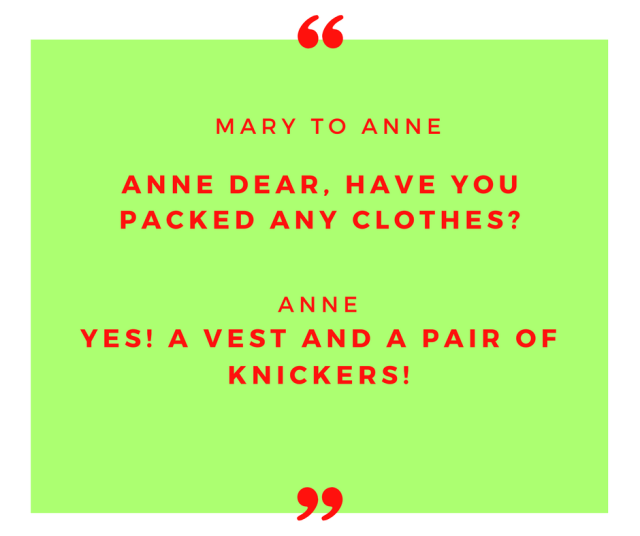
This exchange between Anne and her mother, not only makes an instant humorous situation, but also endears her to the audience. She’s instantly recognisable as the youngest, in the same way the Julian is recognised as the eldest.

Having been utterly devoted to this cast, and really believed that their portrayals were the definitive Famous Five, I can see now where others came from when they say they were a bit tongue in cheek. I honestly do not think its so bad with the first series when the actors were younger and suited their roles more, but in the second series we can absolutely see the more grownup side of things coming out of them and the writing got sillier and sillier.

Nevertheless, in this episode when we’re sitting comfortably on a bed of nostalgia, the wondering interweaving of light-hearted childish joking and teasing, accompanied by the strong emotions from all parties at one point or another really really make this episode one of the best. I forget how good Five on a Treasure Island is on TV, because it’s not one of my favourite books, but it’s pure. That’s what this adaptation seemingly started off as, it was pure, trying to move Blyton away from the Five Go Mad series that took Blyton’s work and made it into a very tongue in cheek thing to like, something to laugh at more like.

Actors

Once more with the 90’s series it’s our actors who really make the show. Christopher Good as Uncle Quentin, serious, brainy and stormy with his temper is quite the show stealer, and his interactions with Jemima Rooper as George are simply quite amazing. Even at the age she was during filming you could tell that Rooper was going on to amazing things!

Mary Waterhouse as Aunt Frances as well, is particularly gentle and contrasts the two strong characters of George and Quentin well. She does however, we later discover, have quite an amusing side, long eye rolls at her husband when he’s not listening to what she’s saying and revealing a temper of her own. Its a nice side of Aunt Fanny to see because she can somewhat fade into the background.

Paul Child, Marco Williamson and Laura Petela all work well as that functioning family unit, at least to begin with. The boys bicker, as boys should but most of all, they both look out for Anne. It doesn’t matter what they’re doing to each as long as she’s safe. I think many of you will agree that when they got older, Child and Williamson out grew their roles quite significantly and had to make their roles more grown up than was needed for a children’s show. However in this first episode they encapture the youth, liveliness and joy of the children to their best ability.

Conclusion

So do we like this episode? You can bet we do! Even though I had forgotten how brilliant it was, I can see it now, and it might also inspire me to watch all the others again. It has the added bonus of actually being the first Famous Five that Blyton wrote so the meeting of the Five is more natural. Yes there are a few iffy moments, that can’t really be explained, like the editing and where George is suddenly best buddies with her cousins, but in a 25 minute slot you can’t really go into the time and depth that it takes to have that sort of relationship.

That aside, the episode truly does work well and if you haven’t watched, I suggest you do!

Posted in Blyton on Screen | Tagged , , , , , , , , , | 5 Comments

The Adventure Series on TV: The Castle of Adventure, part 3

The previous episode ended on a cliff-hanger (almost literally) as Dinah plunged from a tree into the enormous moat around the castle. I’m fairly confident that she will be OK, however, given that she is unlikely to disappear from the rest of the episodes due to injury or death.


WHERE’S DINAH? WHERE’S DINAH?

Kiki is the first to react to Dinah’s fall, squawking the above before the two boys race to shimmy themselves across the tree too. Thankfully they don’t lunge off, and Dinah has not plummeted very far, she’s just hanging from a tree branch below.

Don’t just sit there grinning, get me out of here!


LYING IS NOT VERY BLYTONISH

Blyton’s children have always had that strange moral that as long as they don’t outright tell a lie then it’s ok. If asked are you going to the castle? they couldn’t lie and say no, but if asked where are you going? they could say out for a walk, and leave out the castle part quite easily.

We don’t always tell our mum what we do (Dinah)

You mean you tell her lies? (Tassie)

We don’t lie we just don’t tell her everything (Philip)

But later, they do tell what I think are actual lies. Lucy-Ann starts telling Mrs Mannering they are going for a walk because Jack thinks there are eagles nesting up in the ca. She is cut off by Dinah saying copse before she can finish saying castle. So that’s one outright lie!

Dinah then adds that they need rope for climbing trees which is not quite the full truth – they need it to help in getting from a tree into the castle.

I think it’s also Dinah who says we’re just going for a walk. Going for a walk is true but they’re not just, only or purely going for a walk are they?

Philip then lies that Tassie won’t be with them as her mother’s told her not to go… and they make a huge production of scrambling away from further questioning when all Allie wanted to know was if she had to make more sandwiches. But Philip has already seen Tassie and knows full well she is coming!


TALKING OF TASSIE

I don’t really like how the kids treat Tassie in this version. It seems like they are using her just to get near the castle against her wishes. There’s not really any play or chat between them to imply friendship. Somehow it seems nicer in the book, even though there Tassie is totally awestruck and follows them around! On TV they’re not even concerned when she disappears again at the castle, but later they say they looked for her for ages (which may be another untruth as it wasn’t shown to the audience).

Even Lucy-Ann gets in on the Tassie-bashing when she says Oh come on, Tassie, you’re so boring when it’s clear that Tassie isn’t comfortable going to the castle.

Jack’s a bit nicer to Tassie at least, he tries to get to the bottom of her fears about the castle in a considerate way.

The mystery around her does deepen in this episode, though.

There’s more gypsy magic as Tassie says her mum has ‘second sight’ and knows what’s about to happen. Philip says this must also be true for Tassie who must be able to “see” a way into the castle. (Another example of them being a bit mean to her).

And then there’s her relationship with Sam. She does declare that he’s not her father, she doesn’t have a father, but…


SECRETS AND LIES AND THREATS

Sam shows his true colours in this episode when he comes to ask Tassie’s mum where Tassie is. He is very aggressive and threatening towards her – I just knew he was up to no good. He goes on for quite a while about how Tassie shouldn’t be wandering about, espeically near the castle and how she is hanging out with those kids. Makes you think he’s putting on that friendly visitor face just to keep an eye on what the Mannering/Trents are doing.

Coincidence or not but Philip had started behaving more suspiciously of Sam earlier in the episode. He certainly didn’t want Sam to see him and Jack taking a plank and rope out of the shed at Spring Cottage but that might have been in case he told Mrs Mannering about it.


NOW FOR THE MAIN EVENTS OF THE EPISODE

This episode focuses on the challenge of getting inside the castle (finally!). Tassie uses her ‘second sight’ and finds another log across the moat behind a wall of ivy.

The castle doors have been recently oiled and there’s an apple core been dropped outside too. This is a bit of a shame as in book they’ve no idea other people are around until it’s too late. This lot seem to be willingly walking into danger.

Tassie finds a possible way in – up a small tree near a window, but disappears without a word while the other children were looking the other way.

Dinah and Philip argue about how to get in etc, meanwhile Sam is coming closer in his horse and carriage… and looking very suspicious though it’s not clear how close he gets to the castle.  Though it’s decided they’ll come back the next day with equipment.

They do come back and manage to get in at the window with a plank and rope, so fairly similar to the book really, and Dinah gets covered in cobwebs inside (but it’s Lucy-Ann who screams).

The girls then go to set up a picnic on the rather well manicured lawns, while Jack and Philip keep hunting for the nest.

And the inevitable cliffhanger: Jack is climbing up the ivy covered tower to see if there’s a nest at the top and is attacked by the eagle.


PADDING, EXTRAS AND COMEDY

This series has been slowed down by ‘going to look at castle’, ‘coming back the next day and walking up to castle’ ‘returning next day to get into castle’. It might have worked better as 6 episodes and a bit more pace, I think.

Then there’s the daft slap-stick moments. Philip sees Sam and thrusts the plank back into shed and – by the sound of it – knocks Jack flying. On their second attempt Sam comes along again and Philip pushes Jack back, Jack then pushes and pushes leaving Philip jerking back and forward at the door, to which Sam does a little dance. After lugging the plank up to ‘the witching tree’ Jack pretends to faint/collapse so he can then jump up and scare Philip.

And there’s another scene where the henchmen talk on their radios about whether or not it’s lunch time.

Of course not every part of Blyton’s books were high-action but the in-between bits here fall a bit flat. They certainly lack the charm of the original!


EXTREME CLUMSINESS

Then there’s the problem of the extremely clumsy children who seem lucky to be alive mostly. We had Lucy-Ann falling down a slope in the last episode, and here it is Jack’s turn. Yes it’s muddy and his foot slips but there was no reason for him to tumble all the way to the bottom.

And then their otherwise perfectly good version of  ‘plank through window’ access to the castle is spoiled by Philip half-falling off.

I wouldn’t say Jack being attacked by the eagle is exactly clumsy – but it’s a bit stupid to climb an exposed wall to a nesting bird surely?

They seem determined to add as much drama as possible to each episode anyway and unfortunately that seems to mostly involve people falling over for no good reason!


MODERN TIMES?

They are playing videogames at Spring Cottage! But interestingly it’s the girls who are playing, and Lucy-Ann is brandishing one of those gun-controllers.

But later there’s very much a boy/girl divide as the girls are at home making sandwiches while the boys get the equipment ready.


So there we go, third episode of eight and we’re finally in the castle. Some elements are good – I’m glad they’ve kept in the plank into the window for example and some good arguments between Dinah and Philip.

Saying that there’s a bit too much padding and delaying through all the episodes. The source material is so good so it is a shame to waste so much time on Sam and other nonsense.

Posted in Blyton on Screen | Tagged , , , | 1 Comment

Monday #220

Gosh we aren’t half getting through these Mondays! Can’t believe we’ve posted 220 Monday posts to-date!

We have a bit of a TV week for you this week once again, hope you don’t mind!

Posted in Blog talk | Tagged , | 2 Comments

May 2017 round up

We are into June now (how?) and so it is time to recap what we have been up to in May.


WHAT I READ IN MAY

I’ve had a lot going on this month so it hasn’t been a great one for books again.

  • Harry Potter and the Half-Blood Prince – audiobook narrated  by Stephen Fry
  • A Death in the Dales (Kate Shackleton #7) – Frances Brody
  • Harry Potter and the Deathly Hallows – audiobook narrated  by Stephen Fry
  • The Clothes-Horse and Other Stories – Janet and Allan Ahlberg
  • The Witches – Roald Dahl audiobook narrated by Miranda Richardson
  • Maisie Comes to Morningside (Maisie #1) – Aileen Paterson
  • Maisie Meets her Match (Maisie #4) – Aileen Paterson
  • What Maisie Did Next (Maisie #14) – Aileen Paterson
  • The Dragon in the Cupboard (Usborne Young Puzzle Adventure) – Karen Dolby
  • Harry Potter and the Philosopher’s Stone – audiobook narrated  by Stephen Fry
  • Harry Potter and the Chamber of Secrets – audiobook narrated  by Stephen Fry

A lot of audiobooks (around 100 hours worth in fact) which gives an insight into how badly I’ve slept this month as most of that has been night-time listening (some is afternoon napping to make up for lack of night-time sleep).

And I still have a few things on the go:

  • The Book of Fours (Buffy TV tie in) – Nancy Holder
  • Hey, Seymour! – Walter Wick
  • The Wonderful Story of Henry Sugar and Other Stories – Roald Dahl audiobook narrated by
  • The Saucy Jane Family – which I have been comparing the text in, here and here.
  • Harry Potter and the Prisoner of Azkaban – audiobook narrated by Stephen Fry
  • Mindful Birthing: Training the Mind, Body, and Heart for Childbirth and Beyond – Nancy Bardacke

I still have some library books to start:

  • Why Is This Night Different From all Other Nights? (All the Wrong Questions #4) – Lemony Snicket
  • Death at the Seaside – (Kate Shackleton #8) – Frances Brody
  • Blotto, Twinks and the dead Dowager Duchess – (Blotto & Twinks #2) – Simon Brett
  • Cream Buns and Crime (Wells and Wong Detective Agency) – Robin Stevens

WHAT I’VE WATCHED

  • More One Born Every Minute. I was very annoyed when it wasn’t on one week thanks to The Trial!
  • Hollyoaks, as usual
  • Taskmaster
  • Murder She Wrote. I have every episode (264 to be precise plus four TV movies…) and have started watching them from the start again.
  • The Fifteen Billion Pound Railway – about a new train line being built in central London

WHAT I’VE DONE IN MAY

  • Spent far too much time in hospital! I had an overnight stay at the start of the month and have had weekly (sometimes twice weekly) visits since then. Thankfully everything seems to be OK after an initial panic but it has caused a lot of stress and taken up a lot of time. And on the plus side it has meant extra scans so we’ve been able to see our little boy more often!

  • Been on holiday (and had to come back mid-week for my hospital check-up) near Aviemore. We had nice weather almost all week and managed some nice day trips.
  • Picked out the pram I want and a blind for the nursery (we will be prepared eventually!)
  • Bought some new books (I can always find a bookshop or two when I’m away!) I picked up two more of the Animals of Farthing Woods books for 50p each in a second-hand bookshop in Kingussie, and I also went up to Leakey’s in Inverness. I spent a good while browsing their big children’s section (full of things like Biggles, Rupert annuals, A.A. Milne, Elsie J Oxenham and of course Blyton. I had most of the Blytons they had but I got The Zoo Book (which I wrote about earlier this week) and also The Princess and the Goblin by George MacDonald. Avid Blytonites may recognise that title as it was one of Blyton’s most favourites when she was a little girl. I also bought The Troublesome Three (an unusual colour picture story book) on eBay.

WHAT STEF HAS READ


WHAT STEF HAS WATCHED

  • Death in Paradise – I’ve been rewatching the DVDs. Its very clever and I recommend it to anyone.
  • One Born Every Minute – Fiona and I have been watching this when its been on the telly. I swear she just wants to scare herself before she has her baby boy!
  • The Famous Five (1970s) –  As you know I had to go back and review the first episodes, so they go on my watching list for sure.

WHAT STEF HAS DONE

  • First of all, the most thrilling thing, I’ve been helping my parents sort out the kitchen so that our new one can be installed next month. Sounds amazing doesn’t it? Haha.
  • I started my new job. I’m now an assistant clerk for a local parish council as well as running my library. Its fun and something different, so it’s all good.
  • I’ve had a colleague’s retirement party, two colleagues in fact have left my library this month and I’ll miss both of them! So it was a sad fare well even though the sun was shining.
  • Me and my other half have been busy as well, we enjoyed an old fashioned steam fair which as always seems to defy health and safety regulations but always reminds me of what my favourite adventurers the Five would have experienced. Plus I loved looking at all the old fashioned caravans, even if they aren’t drawn by horses any more.
  • We also went for some lovely sunny walks along the River Thames, and enjoyed ourselves on a home made swing we found.
  • During the bank holiday we enjoyed a trip out to Longleat Safari park, about an hour and a half away. It was necessarily the sunniest of days but it was warm and we had a good time, even though we didn’t get to go into the house, the drive round safari was certainly a brilliant experience.
  • Last but not least we spend the rainy bank holiday (is there any other kind?!) in Winchester’s Science Centre and Planetarium. It was fun, but crowded. Worth a visit if you have children to take, but I warn you, it’ll be busy!

I think that’s all the notable moments from my month. Lets hope I have some more for June, but I can tell you one thing – I’ll probably be writing the June round up from Fiona’s house because I’m having a cheeky visit before her baby comes! I’m so so excited! I haven’t seen her in over a year and that’s really too long!

Posted in Personal Experiences | Tagged , , , , , | 2 Comments

The Zoo Book

I was away on holiday last week, and just so happened to be just 45 minutes away from Inverness. So naturally that meant a trip to one of my favourite places – Leakey’s Second Hand Bookshop (second largest in Scotland).

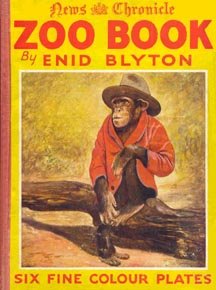
They have a great children’s section and as always some Blytons but I had most of them! I couldn’t resist The Zoo Book which was priced at £10. It’s a later reprint but it still has lots of black and white pictures plus six full colour plates (a big selling point in those days I bet!) Inside it reads profusely illustrated with six plates in full colour and forty-nine photo-reproductions in black and white. 

On the left is the first edition, George Newness 1924 – which didn’t have any colour pages. Then there’s two rather similar reprints. The middle one is from 1926, and I have the newer reprint (early 1930s) on the right.

So even though mine is the newest it is still at least eighty years old and one of the oldest books in my collection.


CHAPTER ONE: NOAK’S ARK IN LONDON

The animals aren’t quite in two by twos (hurrah) but there is a brief history of Londzon Zoo.

Far back in the nineteenth century, about a hundred years ago… people did not take nearly such interest in animals… often they were cruel to them because they did not understand them.

The zoo was already a hundred years old when this book was written, and it’s over a hundred and eighty now, so it’s interesting to see Blyton talking about old-fashioned attitudes etc, when the ‘current’ ones probably seem very out to date to us now.

A good example is this quote:

They [the ‘gardens’] are very different now from what they were when they were first opened. New ideas are always being thought of, and the animals are better cared for, better fed and better housed than they used to be.

and also, in particular this one:

Perhaps you sometimes think, when you see one or two animals pacing up and down their cages ‘how cruel to keep so many beasts caged up so that people may come and look at them!’ But you must remember that they are very well treated, are free from all danger of enemies, and have no fear of going hungry. Probably, most of them would say ‘We’d rather stay at the Zoo, thank you,’ if they were given the choice now, of staying to be looked after, or running wild again!

It shows a rather breath-taking amount of naivety and optimism! Certainly looking back at zoos in this time period (like Chester Zoo which was started in the garden of a large manor-house by a very conscientious and well-meaning family) modern eyes would be fairly horrified by the housing, feeding and care of the animals.

It’s not all positive remarks, though, and in fact a few are rather bizarrely negative and judgemental, written from Blyton’s perspective rather than a neutral one:

Some animals are disgusting to to watch when they are being fed, and some are not at all interesting to watch… The eagles are not very nice to watch, for they are so savage and fierce over their food… I think once or twice is enough to see the lions feed. The house is so crowded and hot, and the roaring is not a pleasant sound.

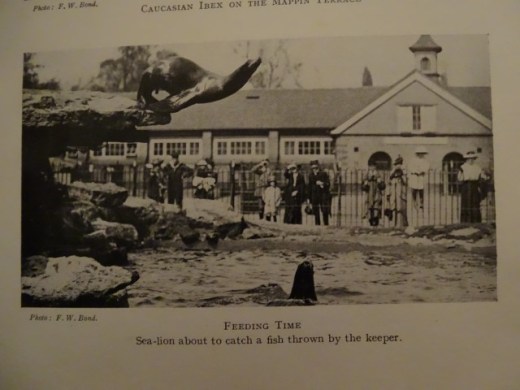
She  does say she prefers seeing the sea-lions and seals fed, and the description of that is instantly recognisable as something that really hasn’t changed in the intervening years. I’ve seen seals fed in that exact way very recently.

Other things are vastly different, for good reasons:

You can, of course, feed many of the animals yourself. Bananas, oranges, apples, bread, nuts, you will find most animals willing to take some of these… Some people feed the animals the wrong food and that makes them ill. And sometimes the animals get too much given them, and over-eat especially on bank holidays.

Could you imagine being allowed to feed zoo animals whatever you fancied these days? (OK my family may have fed otters cooked chicken on a few occasions… so I can’t claim to be entirely innocent here) It’s fairly shocking really, but I suppose it was less likely to be sausage rolls, crisps, donuts and pizzas back then. I can’t imagine sweets would have been very good for any animal, though.

And a last anecdote is presented as an amusing little tale but could have been disastrous – when a schoolboy fed an ostrich three whole oranges and they could be seen down his neck like giant beads on a string. Just as well he didn’t choke to death!


CHAPTER TWO: HOW ANIMALS ARE CAUGHT AND TAKEN TO THE ZOO

This chapter has some rather depressing facts – especially for a book for children.

  • Not one half of the animals caught live to be placed in a new home.
  • Rhinoceroses and elephants will fight for their young and usually the baby animals can be taken only after the old ones are killed.
  • After (reasonably humanely trapping baboons in a cage) : up come the hunters, and with forked sticks catch each baboon by the neck and pin him to the ground. Then the top of the cage is taken off, and the baboons are bound and muzzled. For a day or two they are terrified, but they soon recover, and get used to captivity. 
  • Holes are dug to catch baby hippos
  • Fires are set to flush out snakes into nets
  • Herds of goats taken along to feed the baby animals – and are fed to the meat eaters if they die.

There is also that same strain of ‘gosh, sounds awful but don’t worry they’re OK in the end’ which is patently not true if the first statement is true (and it probably is).

That fact is elaborated on later as well:

Many beasts die on the way. The heat kills a great many. Unsuitable food causes the death of others, and some die of fright and homesickness. But as the trader loses money on every animal that dies, every possible care is taken of them, and they are looked after and tended as if they were delicate babies!

What is interesting is how the animals are transported. I had pictures in my head of a long train like Indiana Jones encounters as a boy at the start of The Last Crusade.

But it’s more like:

Savage or small animals are carried in cages on the back of camels. Hippos are carried in cages slung on poles between two camels.

Also interesting is that a ‘ship’s butcher’ is in charge of the animals. To me that sounds a bit dodgy to say the least! ‘Whoops, this one died, it’s ostrich burgers for dinner, lads…”

Once on board the animals aren’t much safer though, despite best efforts:

  • Two cheetahs died from licking too much salt water from their fur.
  • The ship’s butcher lured an escaped bear back to his cage with a tin of treacle (a la Philip in The Circus of Adventure).
  • Giraffes can be valuable enough for the ship to dock and give them weeks on land to recover before resuming the journey should they become sick.

CHAPTER THREE: SECRETS OF THE KEEPERS

Some examples of ‘great innovations’ for the care and management of animals are given here – some are very clever but it’s a shame that many came too late to save animals from suffering or dying, and you get the impression that the keepers still didn’t understand their animals after it all.

  • Artificial sun (big lamps) for tropical birds to extend daylight hours and give them enough time to feed in the day, after a great many had died
  • A tin ruff for parrots to stop them pulling out their feathers (an unrecognised problem with stressed and unhappy parrots it would seem, but they are labelled as silly/daft in the book)
  • A bath for storks stained black by smoke and smog – not necessarily for the benefit of the birds but to appease the visitors who were disappointed in their grimy appearance.
  • Poles and irons – or a hose pipe – to separate fighting animals – though too late to save a female tiger being killed by her mate (the book really doesn’t shy away from death and disease!)
  • Animals with hoofs don’t get enough exercise in their small paddocks and need their hoofs filed… Well, that’s a solution I suppose. I wonder if it ever occurred to them to just give them bigger paddocks? (As an aside both hoofs and hooves are correct, but hoofs was more popular in the past while hooves is more prevalent today. Just another change in the last eighty years!)

I actually had to read this story out to my fiancé as it’s such a bizarre thing for a children’s book. I can see why Blyton didn’t want to gloss over the more negative happenings in a zoo but it’s told so blithely, as an amusing anecdote rather than a tragedy:

There was a polar bear who had a wife who sometimes irritated him dreadfully. She snarled at him and annoyed him, for she was a bad-tempered creature. He used to bear it as long as he could, and then he would suddenly turn on her and push her into the water. There he sat on her head until he thought she had been punished enough, when he would let her free again; but one day he sat too long on her head, and when he climbed out of the pond he found she did not follow him. She was drowned

He accidentally killed his mate! Isn’t that just awful? She is portrayed as ‘his wife’ in the story but I wonder if they were forced together as mates by zoo staff in hopes of bear cubs, or because they didn’t have space for two enclosures. Introductions of animals are handled so carefully these days it’s quite unthinkable for this sort of thing to happen.

Something I found very interesting is the back and forth changes in attitudes to the enclosures for monkeys and apes.

According to Blyton monkeys and apes were protected by glass to protect them from flu etc… but now it has been decided that it is really better for the animals to have fresh air and to be allowed to make friends with people.

So a big change there, and then now we are back to keeping the monkeys and people firmly apart (with glass, fencing, or large gaps between walls) for both parties’ safety. They certainly get the fresh air still, just not up close to people.

And lastly another ‘funny’ anecdote about the funniest sight in the world. Monkeys chasing each other around? Penguins falling clumsily into the water? No. It was a tapir with the mumps.


I’m really glad Blyton’s attitudes towards animals improved between this book and her ‘main canons’. It’s a very different world to the one she portrays in, for example, the Galliano’s Circus books. Could you imagine her casually having various circus animals die as ‘that’s what happened’?

It’s a very interesting piece of history, and I fully support zoos and wildlife parks today, but it does make for very uncomfortable reading. I just wish Blyton showed a little more humanity and distress or upset at so much suffering.

There are still another thirteen chapters to go, mind you, so she may redeem herself. I will leave those for another day (or several days).

Next post: The Zoo Book part 2

Posted in Book reviews | Tagged , , , | 1 Comment