Poppy’s Book of the Month: The Folk of the Faraway Tree

By Poppy Hutchinson

Series: The Faraway Tree series
Main Character/s: Jo, Bessie, Fanny and Connie.
Published: 1946
First Published By: George Newnes
Rating (out of 5) : 5/5

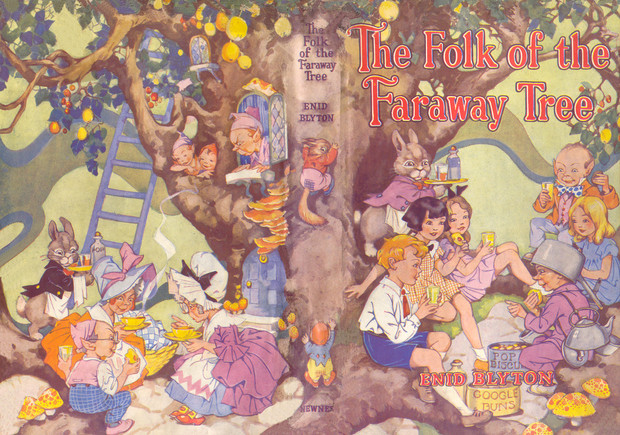
The Folk of the Faraway Tree, the third book in the fantastic Faraway Tree Series, and in my opinion the best, is an enchanting fantasy tale that has mystified children and adults of all ages since it was first published in 1946. The story is of an amazing tree that grows in the depth of an enchanting forest. A new land arrives at the top every so often and the children often get into trouble in which ever land they visit! Many strange folk live in the tree, whom Jo, Bessie and Fanny have made friends with throughout the previous two books. The main ones are Moon-Face, a kindly fellow whose face, of course, is moon shaped. I always remember Moon-Face because of The Slippery Slip, a slide that runs through the tree, right to the very bottom. Another is Sauce-Pan man, who is deaf. He adds a very comical touch to the book, and makes situations very entertaining. Silky is a fairy, who is always baking the most delicious things you ever thought of. Pop biscuits are my favourite invention. Wouldn’t I just love to try one of those! Dame Washalot is always throwing soapy water down the tree and drenching the children when they are climbing up to visit their friends. She is obsessed with washing, it seems. There are other characters too, but I’ll let you find that out for yourself. Ah, now let me tell you about Curious Connie. I can imagine her now, all prim and proper, a tiny little nose, dressed in a beautiful frock, and lovely golden hair. Although she sounds very pretty, her personality is the opposite. She is very high and mighty when she arrives to stay the children’s house. A visit to the Faraway Tree will put the girl right though! And that’s just what the other children intend to do! The children promise to take Connie up the Faraway Tree the day after she arrives. When the children tell her about it, she sticks her nose up about everything. That would soon change though! The book takes the reader through how Connie changes after spending a few weeks with the children. Soon she is desperate the help save The Faraway Tree and all the folk in it when a horrifying trouble meets them.

I gave the book a 5 star rating because you simply can’t fault it! It has a fantastic story line, beautifully written, and a pleasure to read! I would rate this book for boys or girls of the age 8+. Happy reading everyone!

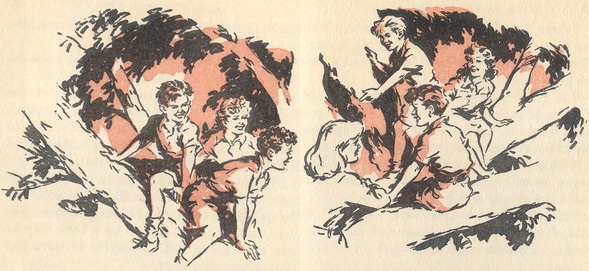
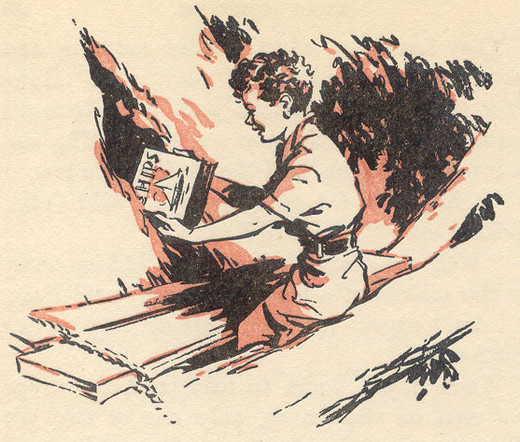
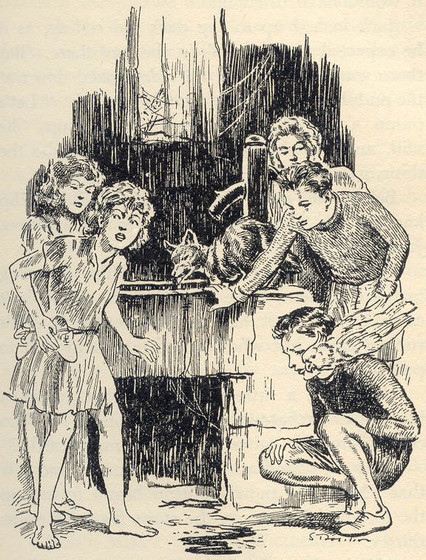
The Folk of the Faraway Tree illustrated by Dorothy M. Wheeler

The Folk of the Faraway Tree illustrated by Dorothy M. Wheeler

Image from the Cave of Books

Posted in Book reviews | Tagged , , , | 1 Comment

The Happy Monday

For once I’m pleased it’s Monday. The schools are off, and that means I’m off too!

Coming up on the blog this week is Poppy’s book of the month, my review of The Castle of Adventure, and most likely something from Stef too. Unfortunately I can’t tell you if it will be part 5 of her fan fic – I don’t even know if that’s been written yet. As desperate as everyone (including me) is to find out how Julian tells George his news we might have to wait a bit longer to find out!

As predicted by Stef in our last Monday post we did indeed hit 7,000 views last week. In fact we’re nearly at 7,500 now.

Our other news is that World of Blyton Blog is now on Twitter! If you’re on Twitter you can follow us and find out about new content as soon as it goes up!

P.S. today’s blog title is taken from the band, The Happy Mondays.


Posted in Blog talk | Tagged , | 1 Comment

Julian’s News, chapter 3

I know it’s been a long time coming, and I really hope that you think it’s worth it. This is the third part of my little venture into Kirrin, where Julian tells the rest of the Five about his girlfriend, Sally Hope, who he met while studying at university.

Just in case you need a refresher of the story line, the original fan fiction that inspired this all can be found here . This is the part where Sally and Julian meet at an open day in St Andrews before they start university. The first part of the piece set in Kirrin, can be found here.

I hope you enjoy this next instalment!


THE FIRST DAY

The next day was what Dick had once called the “getting into the feel of things” day. For the first time in months the Five were together again, free of school work and exam stress and able to enjoy themselves properly.

During breakfast they were asked to run some errands for Aunt Fanny.

“It would be really quite helpful if the four of you could help me and Joan around the house this morning.” Aunt Fanny said as they munched away on their toast and marmalade. “If two of you could go to the village and get me some supplies while the other two make the beds and help me move some things around to set up the Christmas tree it would be most appreciated.”

“Oh really, Mother? You want us to split up on our first morning together again?” George asked.
“It’s only for an hour or two George,” her mother said reproachfully. “And it would really be a help.”

“We would be pleased to help, Aunt Fanny,” said Julian, calming the troubled waters like he had so many times before.

“Come on now George. It’ll only be an hour or two. Do you and Anne want to stay and help tidy while Dick and I get the shopping?” Julian suggested.

“Why don’t you and George go to the shops,” Aunt Fanny suggested, looking visibly relieved that Julian had stepped in and taken control, “and Dick and Anne can help me around the house.”

Dick looked pained.

“But Aunty, you know I drop things! I’ll have Uncle bursting out of his study demanding to know what that noise is every five minutes!” he groaned.

“Surely you’re not so much of a butter fingers now are you, Dick?” his Aunt said with a wry smile. “I’m sure that you’ll be extra careful and not drop anything!”

Everyone laughed and Dick managed to look embarrassed.

“Now George, you and Julian go and get the list of things we need from Joan,” Aunt Fanny said, putting her cup down. “If you can take some of the crockery with you, then that speeds things up nicely!”

George grinned ruefully at her mother as Julian got up from his seat and started to collect the used dishes together.

After all the breakfast things had been taken out to Joan in the kitchen, Dick followed his brother upstairs as Julian fetched an extra jumper to wrap up against the cold winter wind.

“Are you going to tell George about Sally while you’re shopping? It might be the best time you know, while you’re out,” Dick said beginning to make his own bed. His style had not improved over the years, he still dragged the covers over his bed in a hap-hazard fashion.

“You mean so she can storm off without slamming a door,” Julian grinned at his brother.

“Well I just wanted to know if you were thinking about it. I would rather like to know if I need to fetch my tin hat out for when you two return!”

Continue reading

Posted in Fan fiction | Tagged , , , , , , , , | 7 Comments

The Island of Adventure

The Island of Adventure  was first published in 1944 and is the first book of the series. There will probably be some spoilers in this review, so you have been warned.

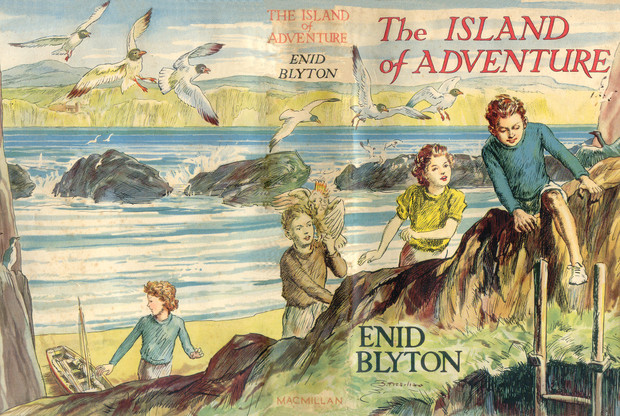
First edition dustjacket by Stuart Tresilian

The first edition dustjacket illustrated by Stuart Tresilian

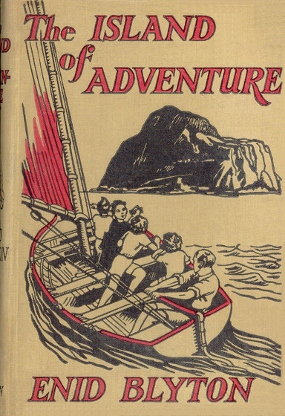
The illustrated boards on the first edition, by Stuart Tresilian

First edition boards, by Stuart Tresilian


THE LOCATION

The story opens around a fairly average semi-rural house, but quickly moves to  a much more interesting and memorable location. Craggy-Tops is a large house which hundreds of years old. It was built halfway up the cliffs on a wild and desolate part of the coast, so near the sea it is always drenched by the spray. It has no electricity or running water; instead they rely on the well outside and paraffin lamps. It is also half-ruined, with most of the rooms being too drafty for use. Just off the coast is the mysterious Isle of Gloom – constantly shrouded in mists it is completely uninhabited, and has been for a long time.

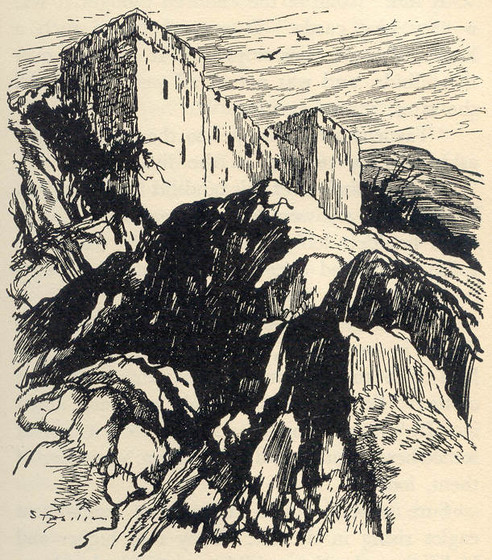
Craggy-Tops drawn by Stuart Tresilian

Craggy-Tops drawn by Stuart Tresilian


THE CHARACTERS

Being an Adventure Series book the main characters in it are Philip, Dinah, Jack, Lucy-Ann and Kiki the parrot (more info on these characters can be found here. Living at Craggy-Tops are Uncle Jocelyn – an absent-minded scholar obsessed with the history the local coastline, Aunt Polly – a hard-working woman struggling to run the old decrepit house and Jo-Jo their black handyman/servant. Holidaying in a shack a little way down the coast is Bill Smugs, who introduces himself as an ornithologist. Towards the end there are also some very unsavoury characters – the requisite ‘baddies’.

Jo-Jo, the 'baddies', Uncle Jocelyn and Aunt Polly drawn by Stuart Tresilian

Jo-Jo, the ‘baddies’, Uncle Jocelyn and Aunt Polly drawn by Stuart Tresilian (pictures of the main characters can be found alongside their descriptions in the link above)

Being the first book of the series, this is the first time we meet all the characters. A little like the start of the Famous Five – the main characters meet for the first time in the first few chapters. Philip Mannering meets Jack and Lucy-Ann at Mr Roy’s house where the boys are receiving extra tuition, and the three immediately become good friends. Jack and Lucy-Ann are unable to go home as their uncle has broken his leg, so Philip invites them to come and stay with him and his sister Dinah at Craggy-Tops. Dinah first meets the Trents on the station platform, and is very surprised to see them (as is Jo-Jo) as Philip had kept their arrival a secret.


Bill teaches the children to sail, by Stuart Tresilian

Bill teaches the children to sail, by Stuart Tresilian

THE STORY

After settling in at Craggy-Tops the children explore the beach and the caves along the coast, in the process managing to get on the  wrong side of Jo-Jo. They stumble upon a friendly chap called Bill Smugs who takes them out in his boat and teaches them to sail. As a bird enthusiast Jack is desperate to visit the Isle of Gloom, where he thinks he’s seen the extinct Great Auk, so the boys practice sailing Bill’s boat, and then secretly borrow Jo-Jo’s to sail to the island. They discover there are tumble-down shacks on the island, and lots of strange holes leading down into the ground. Even stranger is the pile of tins which look like they’ve been put there very recently.

Exploring the Isle of Gloom by Stuart Tresilian

Exploring the Isle of Gloom by Stuart Tresilian

They visit again, this time with the girls, and explore what turn out to be old copper mines. Down the tunnels they stumble upon some men they assume are friends of Bill’s, but they’re rather tough-looking and aren’t at all pleased to see them, despite their mention of the name Smugs. The men are clearly up to no good, and all of a sudden things start to get exciting. Three of the children get locked up in a cave (Jack’s not caught only because he is following Kiki who flew away down a passage). Cleverly the three escape and make it back to the mainland, but Jack is left in the mines and gets himself caught too. Bill reveals his true identity and is pressed into service leading a rescue mission which becomes even more dangerous than it sounds, thanks to the ruthlessness of Jo-Jo and his cronies.


PHILLIP’S PETS

Philip’s pets don’t play a particularly large role in this first book but he has a little brown mouse living in his jersey through the book, who makes several appearances. While at Mr Roy’s he also has a young rat who runs out his sleeve and up Mr Roy’s trouser leg. We don’t hear about the rat again so presumably it ran away (or was killed by Mr Roy!) It’s mentioned that the day before the ‘rat incident’ he had a large and peculiarly coloured caterpillar up his sleeve. Also at Mr Roy’s he has a grey squirrel in one pocket as well as a baby hedgehog and large snail in the other. In a letter to Philip, Dinah warns him not to bring any pets home reminding him of the bat he brought home one time, and the earwigs he trained the year before.

The rat incident, by Stuart Tresilian

The rat incident, by Stuart Tresilian


MY REVIEW

I love all the secret passages in this book (of course). Jo-Jo is so easy to hate which makes it all the more amusing when the children sneak down the secret passage and leave him sat on the beach all day. It’s also great when Bill takes them into town in his car and they bump into Jo-Jo who cannot fathom how they got there. Craggy Tops sounds a wonderful place too (if not very comfortable!), the old house built on the rugged cliffs so near the beach and caves.

Despite being an adventure story and not a family one, there is a fair bit of familial relationship building in the book, and through the series. We start off the book with two separate sets of children (not very happily) living with aunts and uncles. By the end of the book they’re firm friends and Mrs Mannering not only is able to set up a home for her two, but she takes in their friends as well. This happens right at the end, so apart from all the children being very pleased about the idea we don’t see anything more of their new set-up.

This book is sometimes criticised for being racist – Jo-Jo is black, and he’s also the bad guy. On top of that he is portrayed quite badly – believing in “things” wandering at night, being quite mad as well as slow, lazy, stupid and rolling his eyes a lot. However if you actually read the book properly through to the end you will see that it is all a very clever act! Jo-Jo is a cold, calculating and intelligent man who plays the ‘stupid servant’ role beautifully so he can stay at Craggy-Tops without anyone suspecting he is up to anything. In modern editions Jo-Jo has become plain old Joe, a white man.

What’s also interesting about this book is it is the only one that Blyton has won an award for. The award was given by the Boys’ Club of America, though in America the book was titled Mystery Island. 

The prize-winning American version of the book, cover by Stuart Tresilian

The prize-winning American version of the book, cover by Stuart Tresilian


Next review – The Castle of Adventure

Posted in Book reviews | Tagged , | 6 Comments

Sunskriti’s Animal Character Exploration: Scamper from the Secret Seven

Scamper from the Secret Seven series

Scamper drawn by Burgess Sharrocks in "Secret Seven Mystery"

Scamper drawn by Burgess Sharrocks in “Secret Seven Mystery”

A few days ago, I was debating between the names Timmy and Scamper for my new puppy. We decided on Scamper for two reasons:

1. It’s more original
2. I told dad, Timmy was a dog who saved the children from horrible fates all the time. Scamper, on the other hand, didn’t get any chance to do this. We have a Labrador  and they’re no use as guard dogs, and so my dad said, I guess our pup will be the more Scamper kind of dog. So then Scamper it was, and Scamper it stayed.

Scamper drawn by Bruno Kay in "Go Ahead Secret Seven"

Scamper drawn by Bruno Kay in “Go Ahead Secret Seven”

But that line of dad’s set me thinking. ” I guess our pup will be the more Scamper kind of dog.”  What’s a Scamper kind of dog? If the Secret Seven children got into as many adventures as the Famous Five, then would Scamper be as useful to the SS as Timmy was to the Famous Five? He would certainly be loyal and want, in his heart of hearts, to be as useful for his beloved SS, but would he be? Would he be as scary to bad guys as Timmy was? I don’t think so.

Scamper at a SS meeting in "The Secret Seven" drawn by George Brook

Scamper at a SS meeting in “The Secret Seven” drawn by George Brook

So to me, Scamper is a loveable, awesome dog, who loves the SS, but he’s just not like Timmy. Now you may ask, then what’s the difference between Scamper and Buster?  Buster DOES seem a little ferocious, who’ll be of some use to the Find Outers. His habit of nipping at everyone’s ankles will help Fatty & co. The SS in itself isn’t such a major series, so probably Scamper comes out this way. Scamper is not even a member of the SS, and he’s a fairly minor character in the series. He’s probably less important even than Susie. I mean, c’mon, a dog is not part of the main reason the series were created, and you call him a major character? Nah!

Scamper in a SS meeting in "Go Ahead Secret Seven" drawn by Bruno Kay

Scamper in a SS meeting in “Go Ahead Secret Seven” drawn by Bruno Kay

And what about attachment? Is Scamper as attached to Peter and Janet as George is to Tim and vice-versa? I don’t think so. Though both Peter and Janet will be willing to give their lives to save Scamper, there just isn’t the same relationship between them.

Oh well, on what I’ve seen of Scamper, that’s all I can say.

Scamper in "The Secret Seven" drawn by George Brook

Scamper in “The Secret Seven” drawn by George Brook

More of Sunskriti’s animal explorations can be found here, or posts about Blyton’s animals in general are here.

Posted in Characters | Tagged , , , , , | 3 Comments

Monday Comes Knocking

Once more another week has passed by, and Monday is upon us again. Also it’s the first Monday of February – just where did January go?

Coming up this week we have another blog from Sunskriti from her Animal Exploration series and probably a post each from Fiona and me.

The blog is still going strong and is well on its way to 7000 views in the three months we have been up and running! So thank you to all of you who keep coming back and welcome all our new visitors.

Don’t forget you can contribute to the blog by emailing us at : worldofblytonblog@hotmail.com

Happy Monday everyone!

Posted in Blog talk | Tagged , | 2 Comments

Upper Fourth at Malory Towers

The fourth book in the Malory Towers series sees the girls gearing up to sit their School Certificate (as far as I can work out an equivalent of O Levels and GSCEs). Once more we are treated to a lot of ups and down in the school term not only for Darrell and her friends, but with her young sister Felicity attending Malory Towers for the first time we catch a glimpse into life in the younger forms once more.

Illustration by Stanley Lloyd

Illustration by Stanley Lloyd

We start with the Rivers family leaving their house and driving to the train station where Darrell and Felicity will catch the train to Malory Towers in Cornwall. The  idea is that it will be good for Felicity so she can make friends on the train, but the only friend she seems to make is June, a girl in her form and Alicia John’s cousin. Almost immediately you are not supposed to like June, at least I never felt that she would be a good character. She prises Felicity away from Darrell almost immediately and is really quite an obnoxious child.

Part of June’s hard headedness and encouraging Felicity away from Darrell is because she believes that every older sister is like her cousin Alicia, who wants nothing to do with June. June interprets this as meaning that everyone in the upper forms is like Alicia; however Darrell was very much looking forward to being the one to show Felicity around Malory Towers. In contrast to Darrell, Felicity seems to be a fairly weak character because she lets herself be taken in by June but it is worth remembering that Darrell got taken in by Alicia when she first started.

Once at Malory Towers, we have the usual saga of Irene’s health certificate and where has she left it this time! At the same time we are treated to the introduction of two new girls, the Baton Twins, Ruth and Connie. The girls are disappointed that the twins are not identical because if they had been they could have played a few tricks on the mistresses.

The other new girl is one that Gwendoline Mary Lacey looks forward to meeting. The Honourable Clarissa Carter arrives the next day and dear old Gwen decides to be nice to her because she thinks that Clarissa will be the grand friend she has always wanted at Malory Towers!

The first big excitement for the Upper Fourth is who will be head girl is for the term. To everyone’s surprise, including her own, Darrell Rivers is made head girl of the Upper Fourth! It really is a moment of pride for the reader as well as Darrell because you truly feel that she deserves it and that you’re proud of her for getting that all important role at least once in her school life. However, things start getting a little tricky for Darrell as this is the book that I like to think of as ‘the Glint book’. Alicia is the first one to focus in on Darrell’s glint when she tells Betty off for interrupting the North Tower Girls’ prep. This glint is supposed to be something that happens to Darrell when she gets angry but this is the only book we see it.  It works in a way because it’s supposed to be used as a mechanism for Alicia and the others to wind Darrell up about her temper.

Each chapter in Upper Fourth includes a little event that culminates in the spectacular way that Darrell ends up losing her temper. I shan’t spoil too much for you, but it’s very dramatic.

The girls moving their Midnight feast indoors. Illustration by Stanley Lloyd.

The girls moving their midnight feast indoors. Illustration by Stanley Lloyd.

We are also treated to a Malory Tower’s midnight feast at last. The girls decide to have the thrilling meal down by the pool as it was so hot, but before they can get stuck in, the heavens open and they are driven inside, where things become difficult. They hear someone moving around upstairs as someone was taken ill, not to mention Alicia’s cousin June joins the party with Felicity.

After the big midnight feast in where even when it came to owning up, there was no punishment for any of the form except Darrell, we are treated to Gwendoline’s most underhand and nasty trick so far. She gets nervous about the exam and starts to put it about that she thinks she has a weak heart to try and get her taken out of school before the exam. She got the idea from Clarissa, who has a weak heart and which is why she was late on joining the year.

Naturally Gwendoline’s plans don’t wash with everybody, such as Darrell, Sally, Alicia, etc, all those who see through her pretence. However Mary-Lou, Clarissa, Bill and Mam’zelle Dupont all believe in Gwen’s weak heart. At half-term Gwen’s overprotective, silly mother hears of Gwen’s weak heart from Mam’zelle Dupont and Gwen is immediately taken home. A week later however, she is back in school with nothing wrong with her heart. Unfortunately the doctor has ordered Gwen to take part in a strict exercise regime to help ‘get her fat off’. Gwendoline hasn’t prepared for the exam either, so we assume she fails the School Cert.

During the School Cert Alicia develops measles and faints during the last exam. She  has not been feeling well all week and wonders if she is being punished because she is always so quick to learn and doesn’t really have to try at work. This is a comeuppance for her in a way, because of her attitude towards Darrell this term, her horridness to Sally in the second form, and her gloating over the work. Alicia starts off her recovery by realising that she needs to change her ways.

We near the end of the book with a big mystery. Who is stealing and damaging Connie’s things? Darrell takes it upon herself to find out with interesting consequences.

The term is rounded off with a magnificent trick on poor old Mam’zelle who always seems to be the target for ‘treeks’. Poor old Mam’zelle. Still this trick has to be one of my favourites because its so simple and engaging!

Overall I had forgotten how packed to the brim with little episodes Upper Fourth was, and my second edition is a rather slim volume and looks sad and thin against the other five novels. It is a brilliant read, and you can feel yourself once more going on a journey with Darrell through this term.

Altogether a brilliant read, and full of fun. Like with all the other Malory Towers books, I thoroughly recommend it!

Upper Fourth at Malory Towers 1957 reprint by Lilian Buchanan

Upper Fourth at Malory Towers 1957 reprint by Lilian Buchanan

Next review: In the Fifth at Malory Towers

Or read a review of the audio adaptation of Upper Fourth here.

Posted in Book reviews | Tagged , | 4 Comments

The Boy Next Door

by Corinna

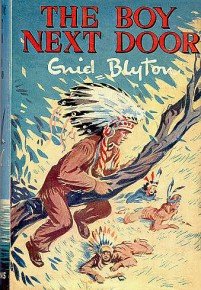
The Boy Next door, 1951 Collins illustrated by Gilbert Dunlop

The Boy Next Door, 1951 Collins illustrated by Gilbert Dunlop

This cover illustration caught my eye on a NZ auction site. I think I might have read this as a child but my recent cataloguing of all my Enid Blyton books (perhaps worthy of a post in itself) confirmed that I didn’t own a copy. So of course I bought it!

Here are my thoughts on this story.  Please beware that it may contain spoilers – I have tried to avoid it, but sometimes I needed to illustrate my points with specific examples from the book.

The story, on the surface, is a typical Blytonian kidnapping.  Three children, Betty, her older brother Robin, and cousin Lucy are excited to hear the empty house next door has been let, and Robin in particular is hoping for a new boy to play with.  They soon discover, by climbing a tree near the hedge, that there is indeed a boy, who happens to be an excellent Red Indian impersonator!  The children quickly befriend the boy, an American named Kit Anthony Armstrong.  The children are puzzled when after being caught crawling through the hedge by “the Dragon” (Kit’s guardian) she tells them in no uncertain terms “…there is NO BOY HERE!” However, the children make contact with Kit again (through the ingenious method of hiding a note in a torn ball, which the children throw to one another over the hedge) and it emerges that he is in hiding from a wicked uncle who is trying to steal his fortune, as his father has recently been reported dead in a plane crash (there is no mention of his mother, who presumably died when Kit was very young).   Of course, the children get into various scrapes and adventures with the kidnappers, and of course it all ends happily…

Kit the Red Indian illustrated by Gilbert Dunlop

Kit the Red Indian,  illustrated by Gilbert Dunlop

There are many Blyton stories which feature kidnappings: Five Run Away Together (where the kidnap victim is also called Armstrong!), The Secret of Spiggy Holes, The Circus of Adventure, The Mystery of the Vanished Prince to name just a few. However, I did really enjoy this story, and  think there are a few things which set it apart from the other kidnappings.

I think that in this book Blyton builds up some very interesting secondary characters, particularly “the Dragon”, or Jane Taylor. I like how her character is developed throughout the book – at the beginning she is very stern and fierce with the children when she tells them “there is NO BOY HERE”. She is also terribly strict and cross with Kit, although (certainly reading this book as an adult) you can understand why, given the circumstances with Kit at risk of being kidnapped.  Towards the end of the book the Dragon has tears in her eyes when she is told some frightening news, and praises the children for telling her: “I think you are very clever, brave children”.

Although the Dragon’s physical appearance is not described in any detail (in typical Blyton fashion, as a secondary character it would be a waste of words!) right at the beginning she is described several times as fierce-looking. You imagine a small, sharp, angular middle-aged woman, with a tight bun in her hair.  Actually, physically and in her sternness with the children masking the fact she obviously cares deeply for Kit (she cries over him as mentioned above, and she obviously also cares for his father, though this relationship is not explained) she puts me in mind a little of Miss Pepper, from the Barney Mysteries.

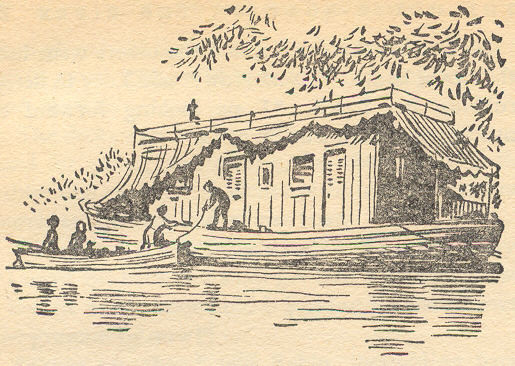
Another interesting secondary character who it would have been interesting to get to know better is Mr Cunningham, the owner of the houseboat.  He seems a most unusual man and it is a shame he is not developed further. When he is introduced as the owner of the houseboat, and kindly lets the children “rent” his boat for the price of a piece of Lucy’s birthday cake, the reader gets the feeling that he might be a pivotal part of future action. However, he only really comes in again at the end for the happy ending, renting the children the houseboat for a year in exchange for 52 visits!

At the houseboat illustrated by Gilbert Dunlop

At the houseboat, illustrated by Gilbert Dunlop

I wonder though if my feeling that he might be involved later in the plot, particularly in a rescue of Kit from the kidnappers is due to his name – another Mr Cunningham, in Blyton’s Adventure series, is always the hero of the hour!  In his physical appearance (described as a tall man with twinkling blue eyes) he reminds me of him too, but all this could just be due to my crush on Bill Cunningham, and I have to concede that all Blyton’s “good guys” are described as having twinkling eyes!

I think my very favourite part of the book though is the twist with Kit hiding in the very place that the kidnappers had picked out for him! I like how the story of the children finding the houseboat to play in (exciting enough in itself) is linked in with the main story of the kidnapping. This makes the whole book feel like a very tight story, with few loose ends (I think the non-development of the character of Mr Cunningham is a bit of a loose end). It also allows for some very tense times at the end, with several very tense scenes towards the end:  the children telling the Dragon what has happened, Mr Barton overhearing where Kit is, Kit tricking and trapping the would-be kidnappers, and then being “captured” in the dark by an unexpected rescuer!

Overall, I thought this was a very enjoyable read, with a few interesting characters and points of difference to other Blyton kidnapping stories.  I’m sure this is one that I will re-read many times, and if you haven’t read it, I can happily recommend it!

Posted in Book reviews | Tagged , , | 3 Comments

Adventure Preparation Land – Fan Fiction by Pete

The Famous Five ignore a ‘no through route except v.i.v.’ temporary road sign in a part of uncharted and unmapped Dorset…

They are on a cycling tour to buy each one of themselves the last ever bottle of ginger pop in a glass bottle. It means cycling over seventy miles per day to find this (in their eyes) magical item.

Unknown to the Five, the co-ordinates of the ‘no through route except v.i.v.’ sign have aligned perfectly with a tear in the fabric of time and space and their going through it on their bikes will take them unsuspectingly into hitherto unknown regions of a place known only in legend and myth as ‘Adventure Preparation Land’.

At first everything seems normal, but soon events occur in front of their youthful eyes that make them question their previously held beliefs on reality,consciousness and awareness itself.

It suddenly rains – and for the first time they see massive heavenly hands washing and cleaning the whole wide world to make everywhere seem ‘newly washed and clean after the rain’

Anne was the least surprised at this as she had always felt a close and silent communion with this marvellous provision. It was just that in Adventure Preparation Land she could actually see it happening!

The Five cycled on until they all felt unavoidably drawn to a large farm barn on the near horizon…

Nearer and nearer to it they cycled, Timmy keeping up easily beside them. They all seemed to know deep down what was in the large barn. They recognized the barn itself too. It was exactly the same as the barn they had seen in a number of their previous adventures.

Continue reading

Posted in Fan fiction | Tagged , , | 2 Comments

Many a Monday Makes a Muckle

Welcome to another week on the World of Blyton Blog. Another week has slipped away and we’re nearly at the end of January already.

Coming soon on the blog will be some more fanfiction, a new writer and further reviews of the Secret Seven, Adventure and Malory Towers books, and possibly a few other interesting bits and pieces assuming we ever get them finished.

We’ve not much other news so I thought I’d just leave you with a couple of photos I took over the weekend which put me in mind of Blyton.

This slideshow requires JavaScript.

These were taken at Loch Monzievaird which lies between Crieff and Comrie in Perth and Kinross. There was a boat-house on the loch but I forgot to take a photo of that!

Has anyone else seen any Blyton-y scenes with all the snow this weekend?

P.S. The title is a play-on a Scottish phrase “Mony a mickle maks a muckle” which is a variant of “Many a little makes a micle”, a phrase meaning many small amounts accumulate to make something larger.

Posted in Blog talk | Tagged , , | 2 Comments

A winter walk at Bourne End

When I mentioned my trip to Bourne end Fiona asked me: “Are you going to do a blog for each season?”

I said: “Maybe.”

I guess in a way I was telling the truth!

Last Monday I woke up to a layer of snow (possibly the most feeble layer of snow I have ever come across, but never mind) and I decided that a world all bathed *ahem* in white would be the perfect time to take my new Bridge camera out for a test run. So I thought to myself, where better to go in the snow to get some awesome pictures than Bourne End?

Some of you will remember my last trip to Bourne End, during autumn, where I walked along the bank of the Thames in possibly the only fog we had in 2012. This time I walked the length of Bourne End in the snow, once again with my friend Catherine.

When we got there we arrived to a flurry of snow flakes, and as I parked my car I regretted having not brought an umbrella. Not to keep me dry, but to keep my camera from getting too wet. To start our visit I dragged Catherine back up the way we had come to see what we could of Enid Blyton’s old home, Old Thatch.

The Old Lych Gate into Old Thatch

Old Thatch through a gap in the hedge, under snow.

The old Lych Gate was very picturesque with its thatch all covered in snow, and the evergreen hedge surrounding it. When we walked a little further up the lane, there once again was a gap in the hedge and we caught a glimpse of the lovely house and gardens under snow. The white snow covered thatch looked like something off of a Christmas card. I really wish that there had been a chance to look around the gardens, I am almost sure that they would have been thrilling whatever the weather. I do appreciate however, the choice not to open in the winter; I doubt it would be cost effective for one, and it’s lovely of Old Thatch’s owners to let people have a look around during the summer months. Still it would have been fabulous to wander around those charming gardens again. Anyway, after sneaking a look into the gardens at Old Thatch we ambled back along the road towards the river. The snow was practically raining down on us as we walked, and I was annoyed at myself that I had forgotten my umbrella – I was terribly afraid of my camera getting water damaged on the first day I took it out of the house. I must admit that I did take some very artsy shots with the camera, even trying to get a picture of a blue tit, but it came out blurry annoyingly enough.

The train passing the level crossing

Once we had passed the field and barn on the way to the river we were confronted with the railway track once more. We were lucky however as the train had just gone whizzing past us, but we still followed the advice of the sign: STOP, LOOK, LISTEN before we hurried across the tracks. It was a shame that we couldn’t really stop because with the verges covered in snow it would have made a very good picture.

On the other side of the train tracks the River Thames flowed on by, a steely grey, almost eerie as it felt very different to the busy river of the summer and autumn that I have gotten used to seeing. As we stood taking in the scene before us, the hills on the other side of the river shrouded in mist from the snow clouds,  no ducks quacking away in the water, my eye was drawn to the sight of a beautiful little red breasted robin bobbing up and down from the docking point in front of us. He stood out beautifully from the white and green boat.

The charming little robin who kindly stood for a picture.

We also encountered a flock of geese on the other side of the gate. We were going to head upstream, over the fields but decided that the geese looked a little irritable and I wasn’t sure that I could slip past them quickly enough without being mobbed for some bread.

So we headed up the little pathway that always makes me feel like we’re heading into a different world, a secret one even with the fences on each side and the trees overhead. The snow had eased off a little at this point, so out came the camera again for some more artsy snaps. I shan’t bore you with them because they are mostly of foliage.

We wandered up to the boat club, chatting idly, as I stopped periodically to capture the scene in front of my eyes. The briskness of the day reminded me of Blyton’s wintry novels, and I wondered how much had changed from her time. Had she seen the same scenes I was seeing? It is easy to guess and speculate about how much she was inspired by her surroundings.

Silent boats… Perfect for a bit of mystery if you’re lucky! Can anyone name a Blyton mystery with a boat as a key part of the plot?

The other thing I picked up from this visit to Bourne End was how quiet it actually was. There were few boats on the river and hardly anyone out, we didn’t even meet that many dog walkers. I did mention to Catherine that there is something about snow that makes a place quiet. I fancied at times that I could hear the hiss of the snow as it hit the ground and the creak as new flakes settled on top of fallen snow. In my mind’s eye I could see some of Blyton’s characters trotting along the banks, wrapped up warm against the cold, chasing clues and wondering where they were going to get their next hot drink from.

Walking steadily to escape the worst of the cold, we reached the marina. The boats stood cold and desolate on the river, no one bustling around them this time. There were a few men working here and there but none of the usual activity that I’ve seen before down there. Everyone must have been curled up inside or at work, warm.

The marina felt spooky as we passed by it, what with the absence of people and the claustrophic sky that bathed everything in lightest grey. After pausing to check the price of one of the boats on sale, we walked on, through another covered footpath, that was muddy underfoot, which led us to the bridge.

The view across the bridge.

We had to be careful climbing the steps as they were slippy; not so much because of the snow, but because they were wet. We couldn’t even hold on to the hand rail because that was horribly cold, and our gloves would have gotten soaked. Still we made it up on to the bridge in one piece and the world was white as far as the eye could see. There was a certainly an oppressive feel to the weather now.

The view from the bridge is certainly spectacular in any type of weather, and even last time in the fog you got some beautiful views and colours, but in the snow, it was certainly more of a monochrome view. There were less colours, with it being the middle of winter and all, and the low lying cloud made the world greyer than the fog had done in autumn. You could see the silhouettes of the trees for a good stretch of the river, but on a clear day you can see even further up stream. You can’t really get a good view of downstream from the bridge because of the railway bridge being in the way.

View from the bridge

As we crossed the bridge you couldn’t see the hills that usually are a green relief to the otherwise flat landscape that surrounds this walk (I promise that next time I shall try and walk a different way to give you some variety! I know it can be very boring reading about the same route over and over).

The last part of our walk was across the National Trust field called Cockmarsh (*ahem*), where the mud was sticky underfoot and every footfall could have meant going head first into the mud. That field is usually full of cows and dog walkers but this time it was blissfully void of both. I assume the cows had been herded into a barn or a different field. We walked sedately along the footpath enjoying the silence and the way the trees stood in a line along the path.

Our tree-lined route.

In fact at one point I was looking at the trees and noticed something I had never seen in the wild close up before. In one of the trees was a bunch of mistletoe. It didn’t have any berries on it, but there it sat in a big clump just above my head. I must admit not having seen it so closely before which meant that I stood there like a loony for a few moments just looking at it, taking in the shape of the leaves and the way it sat. I did wonder how mistletoe comes to grow on the trees it settles on. Which reminds me, I must check it out in one of my father’s gardening books tomorrow!

After I had gazed at the mistletoe long enough we realised how heavy the snow fall was becoming and decided that it was probably best to head back home, in case the roads became impassable and we got stuck in Bourne End. Not that it would have mattered too much, but we had no dry clothes to change into or anything to really keep us warm. So we turned back and headed back the way we had come rather swiftly. When we left the snow was still falling thickly but as we warmed up in the car we decided that it had been a good walk even though we were cold through from the snow.

The amazing (to me) mistletoe!

I do think that whatever time you manage to go to Bourne End there is such a magical quality to the place that you just can’t escape. This time, more than the others I could see Blyton’s characters wandering up and down the lanes with us, finding clues and solving mysteries. It was also lovely to see the place bathed in white, with a different atmosphere to the usual technicolour scene that greets visitors. I hope this blog has been interesting for you, and I can certainly recommend seeing Bourne End at different times of the year if you can. I think it gives you a better idea of why its such an inspirational place and meant so much to Blyton.

Posted in Nature, Personal Experiences | Tagged , , , | 1 Comment

An introduction to the Adventure Series

The eight books in the Adventure Series are about the Mannering/ Trent/ Cunningham/ Smugs children (not as confusing as it sounds – honest) and the thrilling adventures they tumble headlong into at every opportunity.

This lot are a bit more globe-trotting than the Famous Five – they only have one adventure in England! They have one in the mountains of Wales, one in the remote Scottish islands and one elsewhere in Scotland. They also manage to get into trouble in some European countries – Austria and Tauri-Hessia (that’s a made-up one I’m afraid), as well as in the Middle East and the Mediterranean. Their adventures also tend to be a little more hair-raising and dangerous as they deal with gun smugglers, forgers, Nazis and mad scientists as well as the more usual traitors and thieves.


THE BOOKS

The Island of Adventure
The Castle of Adventure
The Valley of Adventure
The Sea of Adventure
The Mountain of Adventure
The Ship of Adventure
The Circus of Adventure
The River of Adventure

Before we get to the adventures, though, I’ll explain who the characters are (and why there are so many names given to a single group!) There may be some spoilers ahead for those who haven’t read all the books as there’s a fair bit of character/family development in the series and I will be talking about that. The biggest spoiler is marked though, so you can try to avoid it!


THE CHILDREN

Philip Mannering is 13, and his sister Dinah is 12. They live with their Aunt Polly and Uncle Jocelyn in a huge tumble-down house called Craggy-Tops right on the coast. Their mother, Mrs Mannering, works in the city to earn enough money to support them. Philip and Dinah have the same dark hair with a tuft at the front and Philip is nicknamed Tufty by Jack. Philip has a love of animals and almost always has some sort of ‘pet’ secreted about his person or faithfully following at his heels. This is a bone of contention between the two Mannering siblings as Dinah is terrified of most small creatures, especially those with lots of legs, no legs at all, long tails, sharp teeth, furry bodies, scaly skin… Dinah also has a cracking temper and quarrels with Philip regularly – even coming to blows with him on several occasions. Thankfully her tempers don’t last long and the two forgive each other fairly quickly. She’s described in the books as a “strapping, confident girl, well able to hold her own” and who “stood no nonsense from anyone.”

Jack Trent is 14 and his sister Lucy-Ann is 11. They live with their uncle Geoffrey as their parents were killed in a plane crash. The Trents are very alike with freckled skin and red hair, and Philip immediately dubs Jack ‘Freckles’. Jack’s passion is ornithology and he spends all his time poring over bird books and watching birds outside. Lucy-Ann is quite content to sit quietly with Jack as she adores him – in fact she follows him about everywhere. Jack is very fond of Lucy-Ann and happily puts up with her constant presence at his side. Lucy-Ann is quite a timid, shy girl, but she can overcome that during adventures.

Jack has a pet parrot called Kiki who can be considered a character in her own right as she is a very intelligent and talkative bird with an enormous repertoire of amazing noises. She goes everywhere with Jack and joins in all the children’s conversations.

Kiki the parrot of the Adventure Series, drawn by Stuart Tresilian

Kiki the parrot


THE ADULTS

Alison Mannering is a widow who works very hard running an art agency in the city to earn enough money to send her children to boarding school and pay for their keep in the holidays. Philip says she’s a very good business woman, but is saddened by how tired she seems when she visits Dinah and him. In the second book it’s said she worked so hard that she had no time to make a home for them.

By the end of the first book she has enough money to give up her city job and make a home for Philip and Dinah. At this point she also takes in Jack and Lucy-Ann who call her ‘Aunt Allie’. Mrs Mannering hates the adventures the children get into and they leave her sick with fright. She is often cross with Bill for allowing the children to fall into danger, yet grateful to him for getting them out safely.

Bill Cunningham is a secret agent the children meet in their first adventure, though he’s going by the name of Smugs then. Bill gets caught up in (or causes) the children’s next seven adventures too and grows close to Mrs Mannering/Aunt Allie. Blyton said in her autobiography The Story of My Life that Bill is based on a man she met holidaying in Swanage.

***Spoilers***

Half-way through the series Bill and Allie get married and Bill becomes an official father to the children.

***End spoilers***

I hope that explains the Mannering/Trent/Cunningham/Smugs clan!


Here’s my first review – The Island of Adventure

Posted in Characters | Tagged , , , , , , , , | 13 Comments

Secret Seven Adventure – a review by Ben

The second book starts four weeks into the holidays there’s not been even a sniff of a mystery and the children are bored. To liven things up the Seven decide to dress up as Red Indians. It is agreed that Colin will be stalked as they only have six Red Indian costumes. After the usual assortment of home-made lemonade and biscuits and a lecture from Peter to Jack because his annoying sister Susie had his badge, the Seven go down to Thicket Hill.

At the hill, essentially an undergrowth of heather, bushes and trees, the children in their costumes with face paint, arrows and knives split up into groups of three. Peter with Janet and Jack are on one side of the hill, which is divided by a fence down the middle, whilst George, Pam and Barbara are on the other side. Colin is left helplessly in the middle, but to avoid being caught after Peter counted to 100, he decides to climb on to a branch of a thick tree.

George and the mystery man up the tree

George and the mystery man up a tree

Up the tree Colin gets the shock of his life as he sees a strange man sitting on and eventually jumping down from the wall of nearby Milton Manor.  Peter also hears a noise near some bushes and thinking it’s Colin he goes to investigate. But to his horror Peter sees the scared face of a man who quickly makes a run for it and climbs the same tree that Colin’s in. A disbelieving Colin sits silently, not daring to sneeze, until the dark-haired man finally gets away when the other children lose patience in their search and decide to go home. After this an understandably frightened Colin pegs it back to the shed where he tells the Seven his story.

In light of Colin’s revelations at first the Seven can’t see what they can do about this mystery. Then the children, except Colin and George, are stunned to hear on the news that Lady Lucy Thomas’s magnificent pearl necklace has been stolen from her bedroom at Milton Manor. In excitement, Peter and Colin realise that they had seen the thief and call a meeting the following morning.

Following the meeting, the Seven inform a very pleased police officer that they had seen the thief. With the adventure back on the Seven race down to Milton Manor where they are let into the grounds by the gardener John. There they make some exciting discoveries. First, some unusual round holes near the oak and holly tree, the part of the wall the thief climbed. On the wall, Janet discovers a piece of blue wool with a tiny thread of red in it. To add to the excitement Scamper finds a dirty old cap. After all these sudden clues, the Seven also wonder how the thief managed to climb up the wall and what caused the holes.

At the circus

At the circus

The Seven suspect an acrobat could have been the only person to climb such a high wall. Their luck is compounded when they see a poster advertising a circus that happens to have clowns, stilt walkers, and of course, acrobats. In a meeting after lunch they decide to visit the circus, with the aim of identifying the thief amongst the acrobats. After paying £3 to get in the Seven are treated to a wonderful circus full of elephants, bears, stilt men and acrobats. During the circus they are convinced they have found the thief as there’s an acrobat matching the description of the thief and who could climb rope ladders. Convinced he’s the thief the Seven ask him for an autograph. To their disappointment, the acrobat takes his wig off and he is bald which rules him out as the thief!

Trincolo the acrobat is a jolly chap and offers to show the Seven around the circus the next morning. Before they leave a bear comes up to them and a sullen looking boy called Louis roughly shakes him to Janet’s horror. George, Barbara and Jack don’t want to go back as they are downbeat about the mystery, leaving the other four children to go to the circus again. Trincolo keeps to his promise and shows the four children the animals. There are elephants, lions in a cage, and of course the bear who Janet has taken a liking to. Peter, Janet, Colin and Pam have a great time and it gets even better when the four are on their way out. They pass the circus folk’s caravans, and Pam spots a blue sock with a red thread on a washing line, leading the children to suspect that the thief does live in the circus.

The holes that turned out not to be a clue

The holes that turned out not to be a clue

The children then spot small round holes similar to the ones outside Milton Manor at the front of One-Leg William’s house, but the holes turnout to be too small. They also find a coat on a man seen near the lions’ cage and it matches the cap they found.  However, the most exciting clue is yet more round holes in the field next to the circus that match the holes the Seven found at Milton Manor. Enthralled, the Seven follow the holes to a caravan in the circus field. This discovery prompts Peter and Colin to watch the circus at night and to find out whether or not the magnificent pearl necklace is there. Unfortunately they choose the wrong caravan. What happens to them next? Who took the magnificent pearl necklace? It really is a mystery.

Secret Seven Adventure is the second book in the series.  The plot is exciting and gripped me from start to finish. I really did share the Seven’s frustration at finding so many clues which appeared to lead nowhere. Due to this, the reader is left wondering who the thief is right until the very end of the story, adding to the excitement.

Narratively, the story follows a similar pattern to the first book in the series. In the first book Jack realises he has lost his badge in the field after building snowmen, and he goes back in the night to find a mystery. This time, the seven play Red Indians, and it is Colin’s turn to become the spotter of the adventure. Similarly, Secret Seven Adventure follows the same pattern of the children finding clues and eventually solving the mystery. Again, this follows a similar style to the Find-Outer books.

In terms of characters Colin is probably the strongest in this book as he discovers the mystery up in the tree and along with Peter goes into the caravan where the thief could very well be. Again Blyton decides to give the most dangerous part of the mystery to the boys like in the first book.

Blyton also shows her love for animals. In the first book, the reader saw her portrayal of a mistreated horse. This time Janet takes a liking to a bear in the circus, and exclaims in horror when Louis shakes the bear. Of course, most people would do exactly the same, but Janet takes a real liking to the bear and she wants to keep it as a pet at the end of the story. Janet also thinks that lions should not be in the circus. Again, Blyton seems to use the character of Janet to express her commendable views against any ill-treatment of animals.

Overall a more exciting second book but it can get a little repetitive with all the clues and the constant visits back to the shed to have S.S.  meetings. I also wish the reader could be told more about the characters in the book as they are still difficult to warm to.  It would help if the Seven met some other children as well in the next few books. Still, it is great to see a bunch of children continually outwit the authorities, and long may it continue in the rest of the series!

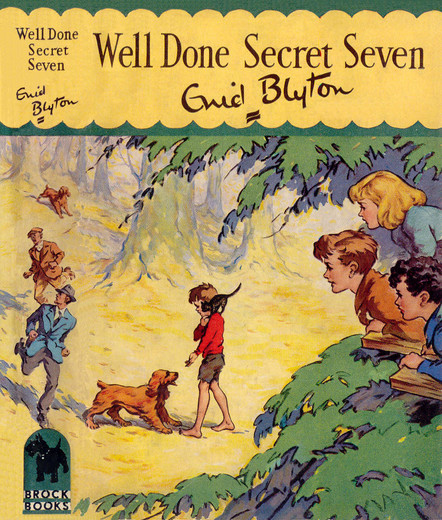
First edition dustjacket illustrated by George Brook

First edition dustjacket illustrated by George Brook

Next review: Well Done, Secret Seven

Posted in Book reviews | Tagged , , | 1 Comment

Monday Madness

So here we are, another Monday, another week.

Here in the UK we’re having some very wintry weather with lots of snow! So if you’re cold and stuck in doors may I suggest you check out this last weeks World of Blyton Posts, and check out Part One and Part Two of our winter reads that went up before Christmas? Check out our suggestions and decide which wintry Blyton you’d like to settle down with!

Last week, we received our 100th comment on the blogs and want to thank everyone who has stopped by and commented on our work; its nice to know we’re keeping everyone interested. We’re also sneaking up on the view counter as well so hopefully will pass our next milestone this week!

We have a load of blogs ready and waiting for you this week, including Ben’s next Secret Seven blog plus a blog each from Fiona and myself.

I leave you with an interesting fact about the two Famous Five TV series: in both the winter/snowy adventures Five go Adventuring Again and Five get into a Fix- were filmed without any snow!

Have a good week everyone! And don’t forget to check out our blogs!

P.S. The blog now has its own Facebook page so if you’re on Facebook you can check it out, and if you ‘like’ it you’ll be the first to know about new blogs.

Posted in Blog talk | Tagged , | 1 Comment

January Flowers

Like the December flowers list, I’m sure you’re once again wondering what flowers could be out in this cold dreary British January, well bear with me: we shall soon know which flowers can be found!

Once again, taken from “Enid Blyton’s Nature Lover’s Book”.

There are few flowers to be found in January, and the finding of even these few depends to a great extent on the weather. Four flowers only have been chosen for January. See if you can find them.

1.Common Chickweed: This is a common weed anywhere on waste ground or in our gardens. It has tiny white flowers with strap-shaped petals. Look at the small oval leaves growing in pairs up the stem. Notice the line of fine hairs running down one side of the stem. Break the stem, and you will see a thin green thread inside, which is very tough. The plant is rather feeble and straggling, and is usually found in an untidy tangle on the ground, for its stems are too weak to lift it up.

Common Chickweed

Common Chickweed

2. Shepherd’s Purse: A very common weed, found in any waste place. The tiny white flowers grow all together at the top of the spike. This plant has two kinds of leaves.  Those near the ground make a kind of rosette. Those further up the stalk are arrow-head-shaped. Look for the little green seed-vessels which are like tiny green wallets, set all down the stem – the little “shepherd’s purses”.  Open the little “purses” and find the “money” – many tiny seeds! You can always recognise the shepherd’s purse by its conspicuous seed-vessels.

Sheperd's Purse

Shepherd’s Purse

3. Groundsel: A common weed, growing in waste places and as a pest in our gardens. The flower is yellow and looks like a tiny golden shaving brush, and later on when the flower becomes a seed-head it looks like a grey-white shaving brush. The leaves are feather-shaped. Pick groundsel for your canary if you have one. You will be able to find the groundsel all the year round. It does not seem to mind any kind of weather – cold, hot, rainy or frosty.

Groundsel

Groundsel

4. Red Dead-Nettle: A very common garden and field weed. The flower is purple-red in the form of two lips, an upper and a lower. Look for the flowers at the base of the upper leaves. The leaves are oval-shaped, or heart-shaped. The stalk is square, weak, and rather straggling.

Red Dead-Nettle

Red Dead-Nettle

That concludes January’s list of flowers – although they mostly seem to be weeds, I’m sure most of us will have encountered these plants in our gardens or out and about!

Good luck finding these little gems!

Posted in Nature | Tagged , | 2 Comments

The Children of Cherry Tree Farm, part 1

by Aaron Bassett

The Children at Cherry Tree farm 1st Edition Dust-wrapper by Harry Rountree

The Children at Cherry Tree farm 1st Edition Dust-wrapper by Harry Rountree

The Children of Cherry Tree Farm was first published in 1940 by Country Life and was illustrated by Harry Rountree.The story opens up with three bored children, Rory, Sheila and Benjy, gazing out onto a busy London street. Penny, their younger sister, is downstairs. Rory is thirteen and Sheila is a year younger. Benjy is 10, a thin and quiet boy who spends most of his time reading about animals and nature; Penny is 7, the baby of the family, she hates being the youngest and is always trying to be included in what her older siblings are doing.

The four children have been sick from measles, then flu, and then two of them (Benjy and Penny) got a terrible cough. Penny is the first one to hear the Great News. While getting a cut finger bandaged she overhears a conversation between her parents and the doctor. She excitedly runs up the stairs to tell Rory, Sheila and Benjy about it. “… the doctor said that the only thing to do with us was to let us run wild down in the country, and Mummy said, ‘What about Cherry Tree Farm?’ and the doctor said ‘Splendid,’ and Daddy said ‘Just the thing’ …”

All of the children are thrilled at the thought of six months at Cherry Tree Farm. London was very dull and boring for them in the springtime and being allowed to run wild in the country far away from bustling streets was very exciting. It explains in Chapter II that they had never been allowed to have pets in London and that all they had been able to do was to make friends with the dogs in the park and feed the ducks there.

Mother comes into the room soon after Penny and tells the children when they are going but she can’t come with them as she and Daddy will be going to America. The next two days the children are in a great excitement packing their clothes and toys. They are going to the wild!

At the beginning of Chapter II the children are travelling by train to Cherry Tree Farm. After a long and exciting journey they finally reach their last stop – Cherry-Woods.  Auntie Bess and Uncle Tim are there to meet them in their pony and trap and very soon they are at Cherry Tree Farm. After High Tea they go to bed exhausted from their day’s journey.

On their first day at the farm the children make friends with all the animals. They explore everywhere, watching the cows being milked, and helping to feed the orphaned lambs.

1 st edition Illustration by Harry Rountree

1 st edition Illustration by Harry Rountree

It is on their second night on the farm that we get our first glimpse of the character that the rest of the story will be woven around – Tammylan the wild man. Uncle Tim tells the children that Tammylan lives wild in the fields and knows everything about animals worth knowing. The children are tantalized at the first mention of Tammylan and at the end of Chapter III they make up their minds to go hunting for him as soon as they possibly can.

A few days after that night the older children decide to look for Tammylan. Setting off with their lunch, leaving Penny behind, they search for the wild man. After a long time looking they finally eat their lunch – Rory giving the quite common ‘Anne’ (from The Famous Five) remark, “I wonder why food tastes so much nicer outdoors than indoors.” The children soon set off again when suddenly they hear a blood-curdling scream that sounds like Penny!

Penny feels quite sorry for herself and decides to set out all alone, without telling anybody, to find the others.  Soon she becomes hungry, tired, and worst of all lost and tries to climb a tree to get a view over the whole countryside and find out where the others are.  Being a town girl who has never climbed a tree in her life she finds herself hanging in mid-air when the branch she has been standing on breaks! She gives a loud scream but suddenly hears a voice beneath her. “Let yourself fall, little girl. I will catch you. You will be quite safe.” Her arms suddenly gave way but she finds herself in the arms of a man with long hair and queer eyes. The man carries her through the bracken and heather then he asks why she came so far all alone.

Tammylan catching Penny by Harry Rountree

Tammylan catching Penny by Harry Rountree

Penny answers him saying, “The others went off by themselves to look for Tammylan, the wild man.” Penny’s very surprised when she hears that the man she’s talking to actually is Tammylan! It always makes me laugh when she treats Tammylan more like an extinct animal rather than a human saying, “Oh, Tammylan – I’ve found you, and the others haven’t! Aren’t I lucky? Tammylan takes her into one of ‘his little hidey-holes’, a cave in the hillside and puts some strange ointment on her arm which she scraped on a branch when she fell and gives her some soup made of wild roots.

Meanwhile, the others are searching for Penny after hearing her scream.  They track her down to the cave where she is and plan to run in like Red Indians and rescue her. The result is quite funny. The three children run into the cave much to the surprise of Penny and Tammylan but the sudden darkness means they temporarily can’t see. All they can do is stand blinking.

The children ask Tammylan about stories they had heard about him.  It turns out that the reason he had thrown two boys into a river and shook one boy till his head nearly fell off was because they had been cruel to the animals they had owned or the animals that had lived in the forest.

A rabbit comes into the cave and sits down by the fire. It runs away when Shelia makes a sudden movement. Tammylan tells them that the rabbit, Bobtail, is one of his friends. When Benjy asks if other animals are his friends Tammylan tells him that all animals and birds are friends with him. Benjy begs Tammylan to let him come and meet them but he says no. He thinks that all children want to stone animals and take their eggs. Sheila objects saying that all children aren’t like that and he could at least give Benjy a chance. Tammylan finally agrees and says that Benjy can come as he has the low voice of those who love animals and that if the animals like him then maybe the others can come. Benjy is overjoyed. The children soon go home excited by their adventures in the forest. Nobody is more excited than Benjy. The chance to meet all of Tammylan’s friends! He could never have even dreamt of that.

On their next few visits to Tammylan the real excitement will start, taking the children on many adventures – to caves, forests, tree houses, and over hills – with the wild man!

I like the way Enid introduces all the characters to us at the very start (no lengthy beginnings with Blyton!) and as usual gets to the plot right away. I don’t really like the way that Penny is regularly left behind, but altogether I think it’s a beginning that certainly lives up to the rest of this very good book.

Next post: The Children of Cherry Tree Farm part 2

Posted in Book reviews, Nature | Tagged , , , , | Leave a comment

Article: “Granny, Noddy and Me” an interview with Sophie Smallwood

This evening I stumbled on an article in the Guardian Online which is based around an interview with Sophie Smallwood – Enid Blyton’s granddaughter. The article, titled ‘Granny, Noddy and Me’ seems to be to be a beautiful insight into how Blyton’s legacy affects her family even now.

At the previous two Enid Blyton days, held by the Enid Blyton Society in Loddon Hall Twyford, I have been lucky enough not only to come into contact with Sophie Smallwood but also her mother Imogen Smallwood. I must admit, I was always a little scared of approaching Imogen because in a way, I didn’t want to bother her. I haven’t read her book A Childhood at Green Hedges where she explained to the world what it was like growing up in the Blyton household for herself so always felt like I shouldn’t approach her until I had. In 2012 I did actually approach her, with Fiona, still without having read the book (but in my defence it is quite hard to get hold of) and she was lovely, very kind and gracious.

However the article, Granny, Noddy and Me is based on Sophie’s own handling of such an extensive legacy. She talks about how she doesn’t like to tell people about her famous ancestry because of the expectations it carries. Smallwood also talks about the way she sees her grandmother.

“Enid Blyton was a publicly owned figure, so there wasn’t a sense of connection. She’s a name rather than a person, and that’s how I viewed her as I was growing up.” 

To me, I can see perfect sense in that statement. I can understand the principle. Two of my own grandparents died before I was born, so there is no emotional attachment to them for me; I didn’t build a relationship with them and as Blyton died two years before Sophie Smallwood was even born, I can understand how Smallwood feels about her grandmother.

In the article we get a glimpse of Smallwood’s thinking towards her grandmother alongside the views of her mother, Imogen. You get the sense that Sophie’s own ideas about Blyton are very balanced and she explains why very well. There is no hint that she is swayed by some of her mother’s opinions towards Blyton, but that is neither here nor there. It is quite lovely to know that Imogen didn’t ban her children from reading Blyton’s stories and shared a love for Sophie’s favourite book The Secret Island.

The main point of the interview was to discuss Smallwood’s own foray into the literary world, because in 2009 it was the 60th birthday of one of Blyton’s most well known characters: Noddy. Smallwood wrote a new Noddy book for the celebration, called Noddy and the Farmyard Muddle. I haven’t read the book, I’m sorry to say, but I do remember being enthralled to hear about it at the Enid Blyton Day in 2010. Smallwood talked about how she created the story, using new and loved characters to bring the story together. We were also treated to Robert Tyndall sketching a wonderful little Noddy while Smallwood was talking (Tyndall illustrated Noddy and the Farmyard Muddle).

The Cover of Noddy and the Farmyard Muddle

The cover of  “Noddy and the Farmyard Muddle”

I have to admit Noddy doesn’t quite have the appeal to me as it does for some people. I remember watching Noddy as a child, when it was on TV, but I don’t remember much more than that. I know a lot of Noddy enthusiasts however will have snapped up this book with delight. Maybe I’ll get around to buying a copy one of these days!

I just thought I would share this article and my recollection of Smallwood’s talk at the Enid Blyton Day in 2010. I found the article to be very sensitively written, although it would have been nice to have a bit more talk about the book, but it was nice to have an insight into Sophie Smallwood’s own relationship with Blyton – even though she had never met her. I especially liked learning that Imogen and Sophie share a favourite Blyton story.

Image taken from the Cave of Books
Posted in Blyton in the media, Other Authors | Tagged , , , , | 3 Comments

Monday with milestones and maps

Monday has snuck up on us again, it feels like it was only yesterday I was writing about it being the first Monday of a new year.

Last week I listed some of what was to come on the blog and much of it is still yet-to-come. We did introduce the two new writers, though, and we’ve actually got another writer to introduce you to very soon.

Our big news this week though is that we’ve now passed 5,000 views! We’ve actually added a little ticker to the main page – it’s in the right side column near the bottom – under the category cloud and above the email link – right now it reads 5,375 hits. I posted a world map of our views in our 2,000 views post and here is an updated one:

Blog views by country

Blog views by country

There are quite a few new countries coloured in now perhaps most noticeably those in South America (Brazil, Venezuela, Panama and Ecuador) and Scandinavia (Norway and Sweden).

Thank you to everyone who’s ever stopped by to read what we’ve written, to all of our contributors without whom we’d sometimes not have anything to post and to the forumites who put up with our incessant blog-talk on the forums.

Posted in Blog talk, Personal Experiences | Tagged , | 1 Comment

My childhood books, part 5

I’ve now reached the last of Enid Byton’s series, or rather, the end of the ones I actually owned. I’ll talk about The Secret Seven, St Clare’s, The Farm Series and The Naughtiest Girl in this post.


THE SECRET SEVEN

I didn’t really read many Secret Seven books as a child mostly because I didn’t own many. I had three paperbacks all by Knight, though one was missing its cover. I think I left the Secret Seven a bit late, and didn’t read them until well after the Famous Five, Adventure Series etc, which would account for me being a bit disappointed by them – they’re definitely aimed at younger readers.

Knight paperbacks of "Secret Seven Win Through" and "Secret Seven Mystery"

Knight paperbacks of “Secret Seven Win Through” and “Secret Seven Mystery” with covers by Derek Lucas

I’ve also discovered another copy of Secret Seven Mystery – a Hodder paperback from 1992 – which was presented to my sister by Strathmartine Parish Church Sunday School. I’m pretty sure that wasn’t as early as 1992, as she was only two then. It must have been at least 1997, by which time I’d probably read the Knight version so didn’t bother with a shiny new one. Oh, and it was Well Done Secret Seven I had without a cover.

The Knights were also illustrated by Derek Lucas, and it looks like he’s got them in jeans and t-shirts. Most of the pictures are on the small side so it’s hard to tell. They’re not flares at least.


ST CLARE’S

Another series I didn’t really read as a child was the St Clare’s books. I think I was really put-off by the cover on the one title I had. (I might have had another – The O’Sullivan Twins but I’m not sure, if I did it might have been coverless like several other books I inherited.)

Dragon paperback of "Claudine at St Clare's", cover by Michael Johnson

Dragon paperback of “Claudine at St Clare’s”, cover by Michael Johnson

The cover is more like the modern Nancy Drew Files books than a Blyton one, and it just didn’t inspire me to pick it up at all. I think I did read it at some point and found it was nowhere near as good as Malory Towers or The Naughtiest Girl. It had illustrations by Jenny Chapple whose work I like on other series, but starting with the fifth book in a six book series obviously didn’t help me in liking the book.


THE NAUGHTIEST GIRL

The order I’ve examined books in this series has changed over the course of it. I started with what I’d read first then sort of moved on to other favourite series and then not-so-favourite ones, until I’ve now arrived at The Naughtiest Girl. This is so late in the series purely because I had an omnibus edition and there’s only one picture and not an awful lot to say about it. (If I’d had any word count left in earlier posts I might have snuck it in earlier, but alas, I rambled.)

Red Fox omnibus edition of the "Naughtiest Girl" series.

The Red Fox omnibus edition of the “Naughtiest Girl” series, cover uncredited.

The omnibus had illustrations by Gareth Floyd (and surprise surprise I can’t remember what they were like). I loved the series and read that omnibus over and over despite it being a bit uncomfortable to hold open due to the depth of the pages (but maybe I just hold books oddly).


THE FARM SERIES

I had only one of these (and I’m not even sure I knew it was from a series).

Merlin paperback of "The Children of Willow Farm"

Merlin paperback of “The Children of Willow Farm” cover by Clyde Pearson

I think I liked this book well enough, though I might have liked it better if I’d read the first in the series The Children of Cherry Tree Farm. It was illustrated by Clyde Pearson who –  as I’ve mentioned in a couple of these blogs – I’m not a big fan of. Sorry Clyde.


SERIES I DIDN’T HAVE

The Six Cousins, The Faraway Tree, The Wishing Chair, Noddy, The Caravan Family, The Happy House Children, Josie Click and Bun, Brer Rabbit, Mr Meddle, Mr Pink-Whistle and Mr Twiddle.

I’ve completed collections of most of these series as an adult though as yet I’ve not started The Faraway Tree, Noddy or Brer Rabbit, and I’m one book short on The Wishing Chair, and The Happy House Family.

I have now covered all of the Blyton series I wanted to, but this isn’t the end of this blog series, as I’ve still got to look at Blyton’s many stand-alone titles. Are any of these versions familiar to you?

Posted in Personal Experiences, Purchases | Tagged , , , , , , , , , , , , , , , | Leave a comment

The Secret Seven – a review by Ben

The thrill of the Christmas holidays had vanished and Peter and his sister Janet decide to restart The Secret Seven. This essentially being a group of seven members who each wore a badge with S.S. and had to remember a quite often quirky password.

The five other children in the S.S. are Jack, Colin, George, Pam and Barbara. There is also a dog called Scamper, who belongs to Peter and Janet. In this book, the first of 15 in the series, the children arrange an S.S. meeting in the shed in Peter and Janet’s back garden. The shed is next to the greenhouse boiler, giving it a warm feel. It contains five boxes and two flowerpots, with sacks as rugs and a shelf where biscuits and blackcurrant tea, a mix of blackcurrant jam, sugar and boiling water sit.

The Secret Seven's first meeting

The Secret Seven’s first meeting

During the S.S meeting, The Secret Seven agree that its members should actively search for a mystery or a good deed. The Seven then decide to build snowmen in a field. After doing this, The Seven come across a big empty house with an angry, deaf caretaker. It is after this encounter Jack realises he has lost his S.S. badge and may have left it in the field. Jack can only look for it at night as he was punished for accidentally kicking Miss Elly, his annoying sister’s nanny.

When Jack eventually sets off down the lane to the field and the empty house, he quickly finds his S.S. badge, but is soon given the shock of his life. A car pulls up near the gate and two mysterious men get out even though the lane leads to nothing and it is late at night. This was strange enough, but Jack then heard the sound of squealing and thudding in a mysterious van like carriage on the back of the car. In understandable horror, Jack runs back home and leaves a letter for Peter and Janet calling for an urgent S.S. meeting.

The Seven are all astonished by Jack’s adventure and decide to look further into the lively events of the previous night. Peter makes the orders, and it is agreed that himself, Colin and Jack would go down to the house to ask the caretaker if he had heard anything in the night, whilst Pam and George have to enquire about the owner of the big empty house. As for Janet and Barbara, they are given the task of following the tracks from the car and mysterious carriage.

The Seven are successful with all their tasks. Janet and Barbara find out that the tracks went exactly where Jack had been, whilst George and Pam find out that Mr J. Hollikoff lived in the big empty house. The three boys make the most exciting findings when they discover that the old caretaker had even heard the same squealing and thudding noise in the night.

Due to this revelation, the Seven come to the conclusion that the two men in the car and mysterious carriage went to the house and hid a prisoner. To see if their suspicions were true, they decide to dress up as snowmen on the field. Peter decides that only the four boys can go, with two staying with the snowmen the children had built in the field, and the other two boys going up to the house to find the prisoner. In their white overcoats, white skull caps and white face paint, Peter, Jack, Colin and George go to the field in the middle of the night.

The Boys dressing up as Snowmen

The boys dressing up as snowmen

The real excitement starts when Peter and Jack, the two that go off to the empty house,  hear the same squealing and thudding noise, which the follow down to the cellar. Before they have a chance to look the two men come back and in their anger lock the boys in the cellar. It is here that they are given an enormous shock as they come face to face with the prisoner. Appalled they cry for help and luckily Colin and George eventually come and rescue them.

The next morning the Seven phone the police and the two men are arrested. As a reward the children are given circus and pantomime tickets in a happy ending to the adventure!

In my view, the first book of Blyton’s Secret Seven series turns into a fairly strong mystery and story. It is clever how Blyton manages to disguise the identity of the prisoner. Not many readers would be able to figure it out, and I certainly got a surprise when it was revealed. Looking back, there were clues to this, such as the thudding noise, the footprints in the snow, and the carriage, but it is easy to say that once you have read the book.

My criticisms would be that it takes a while to get into the book. The sense of unpredictability and excitement does not really start until Peter, Jack, Colin and George dress up as snowmen. Even then, I find it a bit hard to believe that the four boys could really look like snowmen. The plot was a little far-fetched and followed a Find-Outer type theme. By this, I mean it was a case of identifying a mystery, finding clues and splitting up in pairs. And of course, the four boys in the Seven get to take part in the dangerous aspect of the adventure in the big empty house.
The book is very systematic and follows the typical codes and conventions you would expect from a mystery series. Personally, I find this harder to warm to than the Famous Five. In the Famous Five, the children do not seek to find a mystery. Instead, they enjoy seemingly innocent trips into the beautiful countryside, only to eventually find a mystery. I think the location and sense of innocence makes for a far more effective story. The Famous Five Series is really is unique in this sense.

The characters in Secret Seven are not as strong either as the Famous Five. In the Famous Five, they are all individuals, and the reader is given a strong insight into their personalities and relationships, whereas little is mentioned about the characters in this first book of the Secret Seven series. Peter is a poor version of Julian, to the point that he gets rude about the passwords and badges, and even shouts at the deaf old man. Jack is probably the strongest character, playing a huge part in discovering the mystery in the first place, and coming up with further bold ideas and a lot of bravery when he was in the house with Peter, who was also brave in this instance. But apart from this, there is not much, even Scamper is not the same as the loveable, courageous Timmy.

As a book, The Secret Seven was a good first mystery, but it is not a patch on Famous Five.

1954 dustwrapper drawn by George Brook

1954 dustwrapper illustrated by George Brook

Next review: Secret Seven Adventure

Posted in Book reviews | Tagged , | 3 Comments