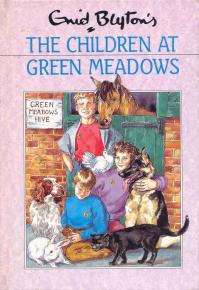
The Children at Green Meadows

The title of this book doesn’t give much away, and it could be a story about just about anything. It would probably be classed as one of her ‘family’ books, I have it on the shelf beside The Family at Red-Roofs and House-at-the-Corner.

It could also be considered as an animal book, as that is the other main theme. I like family books, but I’m one of those strange people who doesn’t particularly love animals. I mean I don’t go around kicking puppies but I wouldn’t want a cat or dog myself and if you ask me what my favourite animal is… well, I don’t really have one. I visit zoos and aquariums occasionally and I like to spot squirrels and buzzards when I’m out, but I really wouldn’t call myself an animal person.

Because this book is about the family and the animals I still enjoy it though, but Blyton has the ability to have you enjoy a book even if the subject isn’t something you would normally read.

I’m not sure if I’ve read this more than once before. I certainly had a 1992 Dean edition when I was younger, it’s possibly one I read later on when I had nothing else new by Blyton as the cover didn’t really appeal to me. I have a hardback now (second impression) but I’m not certain if I read that edition when I got it.
Before reading this week I jotted down my recollections just to see if I was right:

  • Family on hard times
  • Grandparent in wheelchair
  • They take in stray animals including pigeons and a rich man’s dog
  • They end up living in the stables

And that was about all!


CHAPTER ONE – A LOT OF EXPOSITION

It turns out that it was Daddy in the wheelchair, but they do live with Granny as it’s her house so I obviously muddled the two. The cause of Daddy’s disability – a back wound in the war – is explained, and how they came to live with Granny, how the house is run down and yet she won’t sell and so on. This is all explained by Francis, the eldest boy, and Mother having a conversation with a lot of ‘and you knows’ in it. It unfortunately does come across as exposition as there’s no need for two people who have lived through all that to stand and explain it all in great detail to each other.

Anyway, apart from the unfortunate exposition my lasting thought from this chapter is that Granny doesn’t seem very nice! OK, so she allowed the family to live in her house for a long time (while she was elsewhere it seemed) so that would have saved them money perhaps. But now she has moved back in and refuses to sell. No ‘decent’ daughter would move out and leave an older lady struggling in a large house so Mrs Marshall is forced into over working herself caring for an invalid husband, three children and a large house.

It’s honestly like a conversation you would read on Mumsnet.

“Am I being unreasonable?” asks MotherMeadows. “My mother let us live in her home free of charge for a long time, but now the house is too big and unmanageable. My husband is wheelchair-bound and we need a more accessible property but she won’t sell. Can I move out and leave her alone after all she’s done for us?”

There would be two distinct types of response,

YANBU (you are not being unreasonable). Yes your mother did you a kindness but you don’t owe it to her to stay forever somewhere that isn’t suitable for you. Have you made it clear she would be welcome to join you in a new house?

And on the flip-side,

Yes, you are being VU! (very unreasonable). Your mother let you live in her house free of charge for years and now you want to leave her in a house she can’t afford on her own?

I think I may have strayed into Duncan McLaren territory now – making up imaginary scenarios so I will move on.

Housing aside, Granny is the sort to pick faults with people and be quite difficult to get along with. It’s said a few times that she is really kindly though, and would do anything for anyone, but I don’t often find that having one good quality negates the effects of nastiness. She also wears ‘many chains’ and thus jingles when she walks. Very odd.

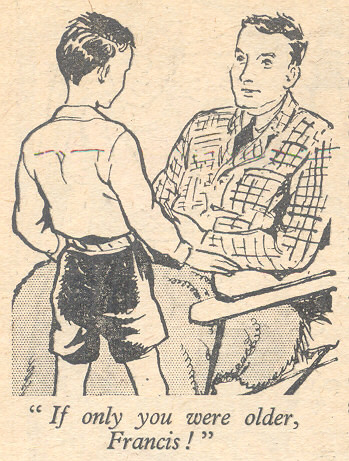
Mother does seem to work very hard though, and the poor children have quite a lot put on their shoulders too, and not just from Granny. Even Daddy wishes that Francis were older so he could act as the man of the house.

CHAPTER TWO – THE (DISHONOUR) OF SCOUTS AND CATS

A lot is made of the fact that all three children respectively belong to the Scouts (Francis) the Brownies (Clare) and the Cubs (Sam). For those of you unfamiliar with the idea, all three are groups inspired by Robert Baden-Powell who was involved in the Boys’ Brigade and then wrote his own books on Scouting. He trialled the first scout group in 1907 (on Brownsea Island no less, which may be why Scouts are the only folk allowed to camp there now) and then lots of others were modelled on his work, and in 1910 his sister began the Girl Guiding movement which includes Brownies and Guides.

They both instil the idea of doing a ‘good turn’ every day, and of putting others before yourself. It’s interesting as in many Blyton books the moral compass is defined by Christianity. They do pray a few times in this book but for the most part their good and selfless behaviour is attributed to their scout groups.

Francis lets the Scouting side down by allowing himself to be goaded into a fight with another boy. He had been wandering around pretending he had a dog (as he longs for one) and when this bigger boy teased him and tried to ‘steal’ the imaginary pet Francis ends up fighting.

Blackie (Granny’s cat) also gets himself into a fight in this chapter and it shows a slightly nicer side to Granny as she worries about him.


CHAPTER THREE – AN IRONIC DOG SWAP

After the fight Francis’ imaginary dog just won’t reappear for him, so it’s really somewhat ironic that the unkind boy from earlier then turns up at Green Hedges begging them to take his own (real) dog in.

This is because new blocks of flats have gone up near Green Hedges, on what used to be farm land, and the landlord has declared no pets are allowed. You would assume this would be made clear before any tenancies were signed, but no, everyone has a week to get rid of any animals. So the boy, Dan, wants Francis to allow Rex somewhere to stay but he will come over to feed and walk him.

Being a Scout and therefore a good person, Francis puts aside the fight and agrees. I’m always astonished how quickly Blyton’s children forgive and forget real nastiness.
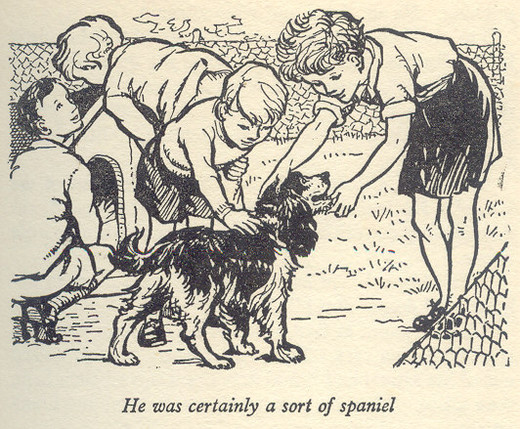

CHAPTER FOUR – ISN’T KEEPING SECRETS AS BAD AS LYING?

It’s not unusual for Blytonian children to keep a secret from their parents or whichever adults are responsible for them. However it is generally stated that they mustn’t outright lie, and you may only say “I don’t know where he is” if you genuinely don’t know his exact location because he carefully didn’t tell you before he went. It is also acceptable to say “I can’t tell you where we have been because it is a secret,” as long as you accept the punishment with grace.  Usually they get away with it as the parents never ask the right questions and not admitting something isn’t the same as lying.

Here, however, the children choose to keep the dog a secret as they believe that the adults would tell them they couldn’t keep him. They blatantly get asked where they have been after constantly disappearing to tend to Rex and they never seem to use the “I can’t say.” They just mysteriously manage to not answer.


CHAPTER FIVE – GRANNY BECOMES A LIAR

Considering they are keeping a reasonable-sized dog at the bottom of their garden it isn’t too surprising that Granny finds out. She is quite happy though – she misses a dog she had a long time ago – and agrees to keep it a secret from Mother and Daddy.

Mother still finds out though – when Dan’s mother, Mrs Oldham, comes to thank her for keeping Rex. Mrs Oldham then insists on doing something in return – by coming in a morning a week to clean and work around the house.

There are a few interesting insights like that in the book – showing us the differences to people’s lives when they moved out of older homes and into new flats with all the mod-cons. Mrs Oldham suddenly has a lot of time on her hands – perhaps she has a washing machine and tumble drier now, instead of having to hand wash and ring out all her clothing and linen. A small new flat would also be easier to keep clean and tidy.

Of course there were drawbacks at times, when close communities were separated and moved to different new homes where there wasn’t a community spirit at all.

This chapter also sees a kitten arrive. A little girl’s family have also moved into the new flats and her new birthday kitten has to go – again this seems slightly poor planning!


I think I have written enough for one day now! But so far we have a very promising menagerie and various problems still to be dealt with.

The Children at Green Meadows part 2

Posted in Book reviews | Tagged , , , , , , | 4 Comments

Famous Five 70s Style: Five Run Away Together

wp-1486510903961.gifAs we know, I managed to lose the track of which Famous Five episodes I had reviewed, which is why we have come back to Five Run Away Together. I completely skipped it for some reason! Anyway shall we get on and have a look at the episode?
What Changed?

Adapted by Gail Renard, Five Run Away Together starts with the arrival of Mrs Stick and Mr Stick and Timmy being less than pleased. Mrs Stick mentions that she’s usually quite good with animals and George doesn’t exactly trust his instincts which she usually does without a shadow of a doubt.

The reason that Uncle Quentin and Aunt Fanny are going away and taking Rogers with them is because Uncle Quentin’s mother has been taken ill so they need to look after her and Rogers will be tidying the garden –  a big difference from the book where Aunt Fanny has to go to hospital and have an operation and Joan the cook has a broken leg, I think. Anyway, the fact that Uncle Quentin is supposed to be the brother of Julian, Dick and Anne’s father rather begs the question that, if the Ju, Dick and Anne are being sent to Kirrin, doesn’t that mean that Quentin’s brother can go to their mother instead of Uncle Quentin rushing off? I know that would mean no adventure because the parents would be around to stop the Sticks in their dastardly work, but don’t you think that there’s something in that? I mean makes sense for them to take turns I suppose. We’re not actually told what is the matter with “Granny” only that she’s not very well but judging by the reactions of the cousins when Aunt Fanny apologies for leaving them so soon, they know what’s going on and are worrying as well. All very tricky!

Almost as soon as Aunt Fanny and Uncle Quentin have left Mrs Stick starts laying down the law and after Timmy has had an apple thrown at him by Mrs Stick’s son, Edgar, he is locked up in a shed and the key hidden. A midnight excursion sees Timmy set free and the decision to leave Kirrin cottage and live on the island is formed. We don’t have the wonderful build up of the Five packing and deciding to get the fresh bread from the bakers and piling the boat up high with rations. In fact the whole thing is rather less thrilling, and down to the discovery that Mr Stick is trying to move the boat and the decision to leave as soon as they find out that Timmy is going to spend the rest of Mrs Stick’s visit in the village.

The last change I want to share with you is the lack of a kidnapping, and little Jennifer Armstrong. We actually have a whole change of plot and its down to an escaped convict being housed on the island until the Sticks can get him away. So its a complete change of situation really, and I’m not entirely sure why!

What I liked

Without a doubt the special guests made it for this episode, especially when the gentleman playing Mr Stick turned out to be none other than the second Doctor himself, Patrick Troughton. Barely recognizable as the second Doctor, Troughton makes a perfect crook, though probably not the right kind of Mr Stick –  who is a sailor in the book, or at least thought to be one. Without a doubt, Troughton was one of the ones who could turn his hand to anything. Long ago in the dim and distant past, somewhere on the internet there was an article written by Gary Russell, who played Dick, talking about his memories of the time he spent filming and even though I can’t remember exactly what he said, I remember him talking about how much he liked having Patrick Troughton on set. I wonder whether this gave Russell the first big buzz to get into the Doctor Who production family – how I wish I could ask!

Anyway, moving on, I also liked the inclusion of Edgar –  the Stick’s son – who is thoroughly nasty and sings those horrible songs at George. He’s a much more lively Edgar than that of the 1990s TV series who always seems lethargic and bored. The fun part is finding out that Julian and Anne swapped Edgar for Dick and George, who had been imprisoned by the Sticks in the dungeon.

For such a slow beginning, all the adventure rushes to the end, and when the Five trap the Sticks and the convict in the dungeons and head for their boat once more, the unexpected appearance of a new boat on the shore and a figure no one can make out, puts them all into panic stations and they make to pounce on this new stranger. Who then turns out to be Uncle Quentin! Whoopsie!

Some of the dialogue that was inserted into the episode was very much in keeping with what we have come to expect from these Famous Five episodes. Renard’s adaptions don’t carry as much of this as some of Gloria Tors’ for example, but when she does insert it into her script it is amusing.

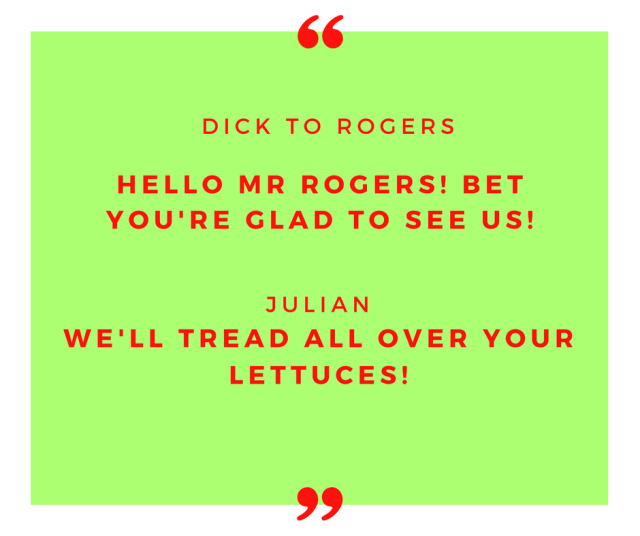
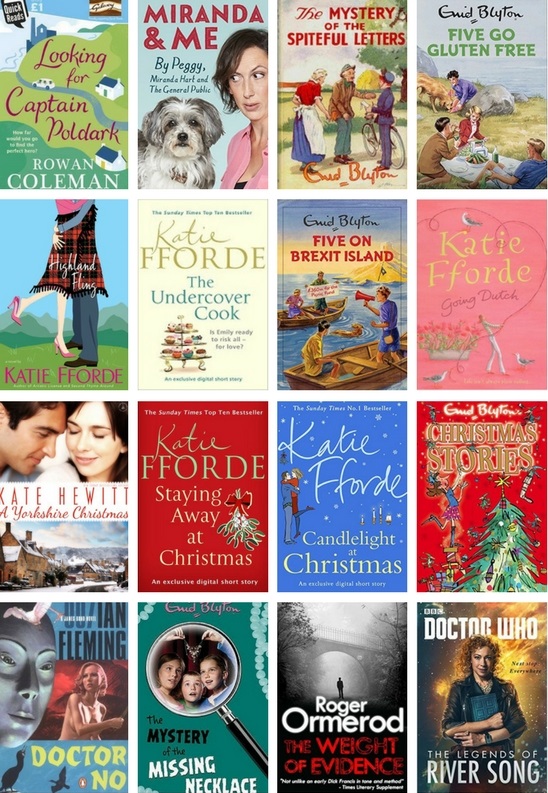
Upon their arrival at Kirrin station and Rogers picking them up in the car, Dick greets Rogers in a rather friendly way, knowing that the gardener is hardly ever happy to see them, where as Julian is the one who makes the silly comment. Rogers looks less than impressed but for me it is one of the only lines that stood out in the episode.

Runawaytogether1

Now tell me that’s not amusing!

Overall

So it’s not word for word what it is in the book, but show me a TV episode of either series that is. The problem with this one is that because it changes so much from the book, it’s trying to become its own story while being true to the original. As a stand-alone, it would have been a brilliant episode and I think whoever decided not to allow the writers of this TV series to write their own episodes for a third series shot themselves in the foot, because all the writers – even if I haven’t liked the episodes – did a wonderful job with their episode whatever they did to it. Renard’s Five Run Away Together would have been a very good stand alone story with a few names changed and maybe the odd plot tweak here and there but as a version of Run Away,  it doesn’t come anywhere near Enid Blyton’s original, which is a shame because its actually one of the stronger episodes!

Anyway, please let me know what you think of this episode!


Posted in Blyton on TV | Tagged , , , , , , , , , | 3 Comments

Monday #208

Once again, the week has gone sailing by and another set of blogs is called for! Fiona is one week closer to having her baby and I’m one week away from my 26th birthday (St Patrick’s day no less)!

With that all said, we’ve got a busy blog week for you, so I hope you’re looking forward to our work!

Monday#208 (1)


Posted in Blog talk | Tagged , | 1 Comment

Stef’s February 2017 (and more) round up

Whoops, as you probably gathered we have missed the last couple of round ups. Fiona has done her blog and now it’s my turn.


WHAT I HAVE READ IN THE PAST FEW MONTHS

February –

  • Looking for Captain Poldark – Rowan Coleman

January –

  • Miranda and Me – Peggy Hart
  • The Mystery of the Spiteful Letters (reviewed here)
  • Five Go Gluten Free – Bruno Vincent (reviewed here)
  • Highland Fling – Katie Fforde

December –

  • The Undercover Cook – Katie Fforde
  • Five on Brexit Island – Bruno Vincent (reviewed here)
  • Going Dutch – Katie Fforde
  • A Yorkshire Christmas – Kate Hewitt
  • Staying Away at Christmas – Katie Fforde
  • Candlelight at Christmas – Katie Fforde
  • Enid Blyton’s Christmas Stories (audiobook, reviewed here)

Current reads –

  • Dr No (James Bond #6) – Ian Flemming
  • The Mystery of the Missing Necklace
  • The Weight of Evidence – (David Mallin #11) – Roger Ormerod
  • Doctor Who: The Legends of River Song – Jenny T. Colgan


WHAT I HAVE WATCHED IN THE PAST FEW MONTHS

Now don’t ask me what I watched when, because I don’t think I could remember! However here we go:

  • Death in Paradise –  I love this TV show and have watched it avidly since series two! I can’t recommend it highly enough!
  • QI XL – with Sandi Toksvig. I love the new, fresh approach she brings to the show and even though you can feel the loss of Stephen Fry, Toksvig is a delight.
  • British History’s Biggest Fibs with Lucy Worsley – I adore this woman’s presenting style and her look into all the insights she gives to history and this series is just that as she looked at the myths around some of our most well known moments in British history.
  • Luisa Omielan’s What Would Beyonce Do?! – A female comdienne on the uppers, Luisa Omielan, is a fresh face and completely unapologetic look at love, life and relationships.
  • Call the Midwife – I have been watching this for a few years now, since Fiona told me how good it was and each January brings the new series around. We’re almost at the end of the more resent series and having to wait a year is so daunting!
  • Who Do You Think You Are? – I have been watching this for a while now, since I got interested in geneology. Its quite a fascinating program, and gives me a wider idea of world history.

WHAT I HAVE DONE IN THE PAST FEW MONTHS

  • I started training in January for a 5 km run to take place in the first weekend of April. I needed a new focus goal after losing my weight loss mojo, so I decided to push myself and start running. I’m getting good times and hopefully will be fitter when I’m done!
  • Last weekend my boyfriend and I had a day out down at Southsea in Portsmouth. It was a nice day even though it was blustery with the wind and we eventually got rained on, but it was nice to be somewhere new. We went around the aquariaum, walked the length of the beach to the pier and spent too much money on the 2p machines, though we didn’t come away empty handed which was fortunate!
  • We also went to see a performing duo called the AllStars down at the local social club, which was a very entertaining evening. The duo dressed up as different stars and sung songs by loads of people and had a such a lovely range of voices it was most enjoyable.
  • Then for my other half’s birthday we went to RHS Garden Wisley and enjoyed the spring sun, the beautifully laid out gardens and ventured into the tropical realms of the butterfly exhibit they had there. There were some tremendously  beautiful butterflies but it was very crowded which was a shame. However a lovely day was had by both of us!

I think that’s all from me really! However, hopefully as my birthday’s coming up in a week, I might be able to have plenty more things to tell you next month! Enjoy!


Posted in Personal Experiences | Tagged , , , , , , , , | 4 Comments

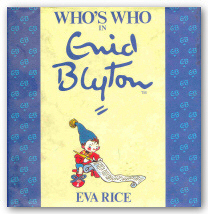
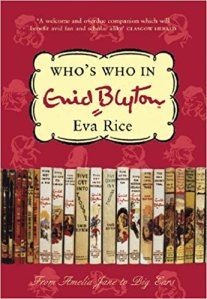
Who’s Who in Enid Blyton by Eva Rice, revisited

Some of you may remember that I have previously reviewed the original version of the Who’s Who book (it took three posts – Adventure StoriesSchool Stories, and Toys and Enchantment. You also may remember that I pretty much ripped it apart as it was riddled with errors and incredibly inconsistent. I am clearly a glutton for punishment, however, as here I am with the updated edition to see if it is any better. I have been reliably informed that previous mistakes have unfortunately not been corrected, so I just hope the new additions are worth having published a new version.


THE FOREWORD

This has been updated to reflect the fact it is a revised edition – and it says that the book has been expanded to include The Barney Mysteries and the Farm books. I don’t know which books the Farm books refer to as there are quite a few, but we shall see! In slightly different words it still states that it does not claim to cover every character which is just as well.


ADVENTURE BOOKS

The first section is still adventure books – and The Put-Em-Rights is still wrongly included. Interestingly, despite the list being changed from lowercase text to uppercase and an added illustration at the bottom of the page they have failed to include The Barney Mysteries to the list at the start of this chapter (it is there in the contents page at the start though).

This is a fairly good section, and it was definitely worth adding – it’s clear that Eva Rice has either read the books or done a decent amount of research here. There are very few characters I can see as missing – but I myself am not sure if they are ever given a name in the book and so their omission is quite reasonable (off the top of my head I came up with the woman in charge of Ring O Bells hall, the men – particularly the leader – from the underground portion of Rockingdown and a few shop keepers from different books.

There are however, two mistakes. One is using the name Sardine for the Lynton’s cat without mentioning she was originally called Snoek. The other is worse! In the opening description it tells us that the children are often looked after by Miss Hannah Pepper. This is incorrect. They are looked after by Rebecca Pepper, and her sister Hannah runs the guest house they stay at in Ring O Bells. Strangely they get them the right way round when they get their own sections later.


FARM STORIES

The Farm Stories are listed as – Cherry Tree Farm and Willow Farm, Six Cousins. This is slightly confusing as Cherry Tree Farm and Willow Farm are from the same series, the titles being The Children of Cherry Tree Farm, The Children of Willow Farm and More Adventures on Willow Farm, and they are usually known as just the The Farm Series.

The introduction to this section does a lot of comparing these books to the Six Cousins books, which is fine but as the reader hasn’t yet read the Six Cousins section it doesn’t necessarily make the most sense.

Likewise, some of the descriptive sections don’t make sense. Several donkeys are named individually (fine) but all but one read ‘see Hee-Haw’. A couple of them come first alphabetically and one afterwards. Hee-Haw’s section simply states which donkey belonged to which child so I can’t see why the section for each donkey couldn’t include that piece of information rather than referring the reader to another one. It also makes no sense to pick Hee-Haw as the one referred to being in the middle of the list.

This happens again with Hoppity and Jumpity. Hoppity’s section just reads see Jumpity. It would have made more sense to have it the other way around so that anyone reading it in order would know they didn’t have to go back.

The children’s father, for some reason, appears in two sections named as Father and John.

Apart from those niggles the Farm section is decent, many animals are included but they are quite important to the story.

The only problem I can see in the Six Cousins part is a few instances of very lazy, choppy sentences. I hesitate to even call them sentences in fact. Hazel the shepherd gets two proper sentences about him, followed by Has twinkling eyes. Old. Did Eva Rice forget to turn jotted notes into coherent sentences? Why could his age and eyes be worked into the earlier lines?
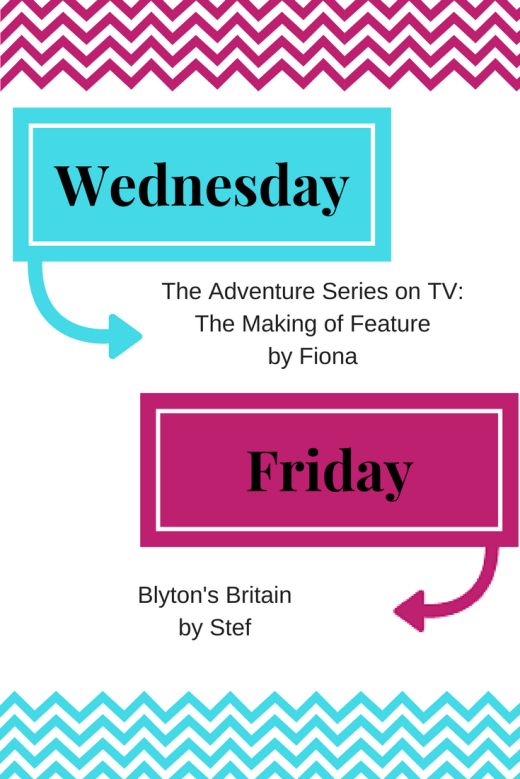
Otherwise, again, this is a good section and well worth having been added. Some good character analysis is given and examples from the books are well used.


OVERALL

I think it is fair to say that this is a revised book as there are two significant sections added  but it is not quite right to call it fully revised as the majority is remains untouched. They have, however, changed the illustrations. There are not more, I don’t think, but they are given half- and even full page prominence instead of being squashed into the margins as vignettes. They make use of some newer illustrations mixed in with the old as well.

It’s just a real shame that the original problems – major omissions and errors – are simply reprinted. For example, the Adventure Series has only the main cast, Bill, Uncle Jocelyn, Gus and Jake listed. I still can’t get over the fact it ignores Mrs Mannering. And possibly worse – the Secret Series is missed out entirely!


Posted in Other Authors | Tagged , , , , | 2 Comments

Blyton’s Britain, part 2

Last time I brought you a selection of destinations in London and Buckinghamshire where you could go and be close to our favourite authoress Enid Blyton. This week I’m going to start looking down by the coast, the south west of England and a mixture of locations that might have sparked Blyton’s imagination, places she visited and places used during the filming of the two TV series. I haven’t been to all of these places so I’m just going to explain to you what they’re related to in regards to Blyton.

So what are we waiting for? Full list of TV series locations can be found here, on the Enid Blyton Society Forums.

Corfe and Corfe Castle

Corfe and its ruined castle is a must see for Blytonites (I can’t believe I’ve never made it down there!) Poole and Dorset are places that we know Blyton used to visit on her own holidays, so we assume that a lot of her inspiration came from there and we can trace that with some of the places and descriptions she provides us with throughout her book. The Corfe Castle ruins may well have been the inspiration for the castle on Kirrin Island in the Famous Five, and the 1957 Children’s Film Foundation version of Five on a Treasure Island was even filmed there, so this castle is central to the Blyton experience.

OLYMPUS DIGITAL CAMERA

Bossington, Somerset

Bossington, for me is a central point of the 1990s Famous Five as the actual cottage they used as Kirrin Cottage – George’s home. A couple of years ago I was in Somerset with my Dad and we made a special trip to Bossington so I could soak up the 90s nostalgia. The whole small village is full of tasteful cottages, nestled in between woods and some stunning Somerset hills. The beach is a little bit of a let down as it’s not sandy as the series seems to promise, but full of smooth stones and pebbles which crash wonderfully when the waves hit them.

You can even book to stay in the very same Kirrin Cottage through the National Trust. I would love to do this, but unfortunately its a little expensive at the moment. I would recommend this visit only if you’re close to the area as it is a bit out of the way. The surrounding area is beautiful as well, Dunster Castle and Village is well worth a visit – especially for a cream tea!

bossington

Exbury – House, Gardens, Village

Exbury House, its garden and the village all seem to be key to the 1970s Famous Five filming and always comes up in conversations with the cast and in interviews. It’s a firm favourite, discussion wise on the Enid Blyton society forums as well, which means there is lots to know about where the filming was done and how much of the place was used in various episodes.

Just across the Solent from Portsmouth, Exbury sits on the Beaulieu River, in the New Forest National Park in Hampshire. This means it is a beautiful place to visit and the website for the house suggests a whole host of activities to do in the area, as well as in the gardens and the house. The house even boosts its own steam railway –  so if you have a train fan in the family, all the more excuse to go! They can enjoy their train ride while you get your Blyton fix. Also with the 200 acre gardens in Exbury House, you might even find a stray camera man trying to find his way out. Or the odd smuggler, hidden treasure or secret passage yourself!

exbury-gardens-steam

 Brownsea Island

Brownsea Island is a small largely uninhabited place, owned and maintained by the National Trust. Just across from Poole and up from Studland, near Swanage where Enid Blyton used to holiday. It is generally accepted that Brownsea Island is the inspiration for Whispering Island in Five Have a Mystery to Solve .

The island is famous for being one of the few places left in the south of the UK to be home to red squirrels. Also used for scouting and guiding activities, Brownsea Island has a ferry timetable to allow people to visit, but unless you’re part of the scouts or guides I don’t believe you’re allowed to stay on the island. I may of course be wrong.

So if you want to have a Blytonian day out, Brownsea Island is the place to go – but make sure you take a torch and some rope, in case an adventure ensues!

brownseaisland

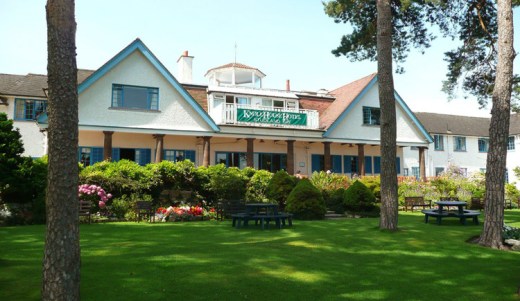
Knoll House Hotel – Studland Bay

So when Blyton used to stay in this part of the world, we have it on good Enid Blyton Society information that she used to stay in Knoll House Hotel. This very Carribbean looking house looks like it should have been in the lap of luxury in Blyton’s day. Even the reviews describe it as a throw back to times gone by.

Situated a short walk from the Studland Bay beach, and not far from Durdle’s Door, this throw back should be a good place for anyone really wishing to connect with Blyton this would be a good place. You can imagine her stomping about the grounds and waving to everyone as she and Kenneth or Hugh went out for a daily walk. It seems to be quite the atmospheric place.

knoll-house

There we are then, just a few Blyton locations in the South West of England for you to explore for yourselves. As I linked at the top, you can find many more destinations on the Enid  Blyton Society Forums.

Posted in Blyton on TV, Locations | Tagged , , , , , , , , , , , , , | 1 Comment

Monday #207

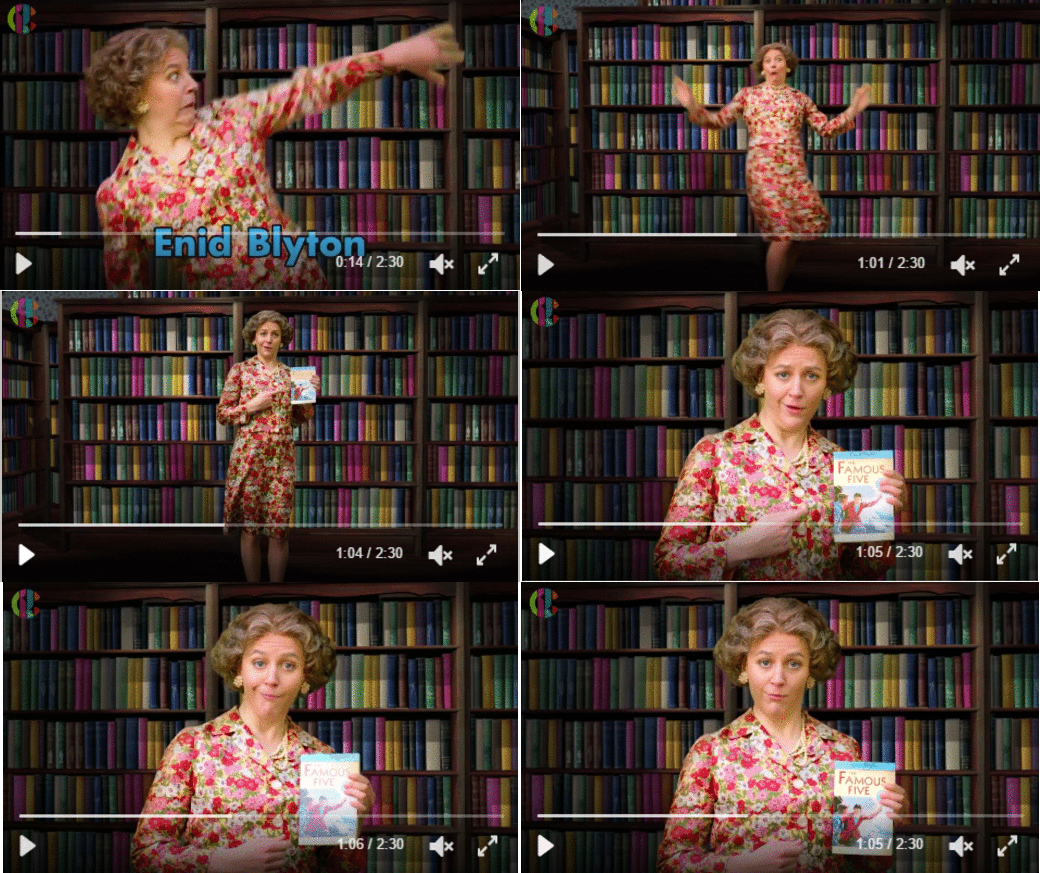
Proving she is still current Enid Blyton featured in a CBeebies video about female authors, alongside Jacqueline Wilson, Beatrix Potter and Malorie Blackman. I thought it was done this year for World Book Day but it turns out it’s actually from 2016, not that it matters! Performed to the tune of a Little Mix hit, I laughed out loud at the lyrics and the sheer attitude that Gemma Whelan gives Enid Blyton.

enidblyton

Seven hundred books in fifty years!

Watch the whole video here. (If my GIF above isn’t working properly you can see it here.)

And from us this week:

wedfrisun546

Posted in Blog talk, Blyton on TV | Tagged , , | 2 Comments

Fiona’s February 2017 (and more) round up

Well this is embarrassing. I was tidying up all the images I have saved on my laptop from various blogs (I know, I know, I should save them in the right place in the first place instead of just dumping them wherever…) and spotted a folder marked Round Up. I was momentarily stumped. Then I remembered we had been doing these round up posts. Huh, I thought. I don’t remember doing one recently. And as it turned out, we haven’t. The last one was in December, talking about what we did in November. Whoops!*

In my defence I am the organisational force behind the blog (read that as big bossy control-freak if you like) and I have had a lot on my mind what with being pregnant, feeling fairly lousy with it, and also writing a lot of extra posts for my maternity leave (I have done about 12 posts in a month).

Anyway, as I know you are all dying to know what’s happened in the past months here it is:


WHAT I HAVE READ IN THE PAST FEW MONTHS

Unfortunately not an awful lot, as I have been very tired!

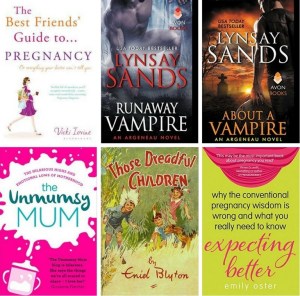
February –

  • The Best Friends’ Guide to Pregnancy – Vicki Iovine
  • Runaway Vampire (Argeneau Vampires #23) – Lynsay Sands
  • About a Vampire (Argeneau Vampires #22) – Lynsay Sands
  • The Unmumsy Mum – Sarah Turner
  • Those Dreadful Children (blogged about here and here)
  • Expecting Better – Emily Ostler

So mostly trashy vampire novels and pregnancy/parenting titles.

copy-of-presentation-untitled-design

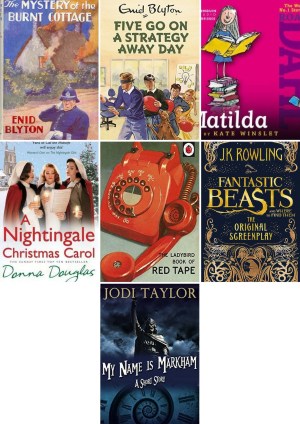
January –

  • The Mystery of the Burnt Cottage (finally finished! and blogged about, of course)
  • Five Go on a Strategy Away Day – Bruno Vincent (also blogged about)
  • Matilda – Roald Dahl (audiobook)
  • A Nightingale Christmas Carol (Nightingales #8) – Donna Douglas
  • The Ladybird Book of Red Tape – Jason Hazely
  • Fantastic Beasts and Where to Find Them – J.K. Rowling
  • My Name is Markham (Chronicles of St Mary’s #7.6) – Jodi Taylor

Slightly better month, though a fair few short books.

untitled-design

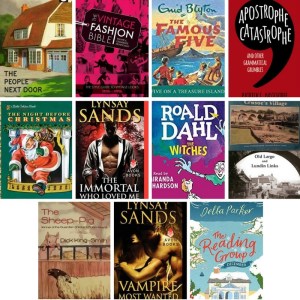
December –

  • The Ladybird Book of the People Next Door – Jason Hazeley
  • The Vintage Fashion Bible – Wayne Hemmingway
  • Five on a Treasure Island (audiobook, blogged about here)
  • Apostrophe Catastrophe – Patrick C. Notchtree
  • The Night Before Christmas – Clement C. Moore
  • The Immortal Who Loved Me (Argeneau Vampires #21) – Lynsay Sands
  • The Witches – Roald Dahl (audiobook)
  • Crusoe’s Village – Ian Morton
  • Old Largo and Lundin Links – Eric Eunson
  • The Sheep-Pig – Dick King-Smith
  • Vampire Most Wanted (Argeneau Vampires #20) – Lynsay Sands
  • The Reading Group, December – Della Parker

Didn’t do too badly in December actually even if a few of those were very short.

untitled-design

I’ve got a few more books on the go at the moment as well.

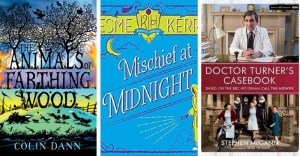
  • The Animals of Farthing Wood – Colin Dann (I loved the TV series!)
  • Mischief at Midnight (Knight’s Haddon #2) – Esme Kerr (audiobook)
  • Dr Turner’s Casebook – Stephen McGann (from Call the Midwife)

3books


WHAT I HAVE WATCHED IN THE PAST FEW MONTHS

I can’t even pretend to know what month I watched what in, so I’ll just put them all together.

  • Hollyoaks, as always.
  • The Adventure Series DVDS (Ship, Circus and River and the making of.)
  • Timeless – (which features the lovely Goran Visjnic).
  • The Good Wife – the final series!
  • Sherlock but I can’t say I really ‘got’ it, especially the final episode.
  • Call the Midwife – there was a Christmas special and then a new series started last month.
  • Erin Brockovitch (for the first time!)
  • Star Wars Rogue One
  • Only Connect – now approaching the final and making it nearly impossible for me to get a right answer

There have been other things on in my house – like How to Get Away with Murder but I’ve been tired in the evening and haven’t paid enough attention to really say I watched it.


WHAT I’VE DONE IN THE PAST FEW MONTHS

  • Well, November was the month I found out I was having a baby – which I announced some time in January – so I spent a lot of December and January feeling very sick. Too sick to do anything much more than go to work and lie on the sofa the rest of the time. I did see my family over Christmas for low-key celebrations at their home, and had them over to ours at New Year, though. My celebratory drinks were Shloer and alcohol-free cider.
  • In December I turned 30 and went away for a quiet weekend in Lower Largo. I managed a couple of coastal walks but not much more, and felt too sick to eat any birthday cake (I still have some in the freezer should I ever be able to look at cake again).
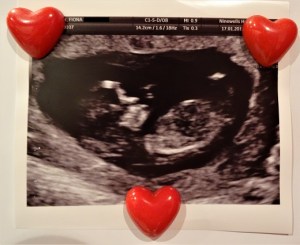
  • In January I had my scan and saw my baby for the first time. A week later we found out we were having a boy! Not to go into too much detail, but we had an awful time when screening showed there was a higher chance of the baby having a chromosomal abnormality. After further testing we happily found out that he doesn’t, he’s just fine. (I wrote my review of Five Go on a Strategy Away Day through a haze of tears trying to distract myself). We also chose a name on the same day we got the good news.

baby scan

  • In February I finally started to feel a bit better! Meaning I could really crack on with writing lots of posts for later in the year, allowing me a break to be a new mother. I also started a little bit of baby shopping and we have been looking at a new car too. I had to move lots of my books to make room in the second bedroom for the baby. I have put aside a few for eBay but rest assured my Blyton collection is safe!

Well that was pretty long, so Stef’s round up can have its own post now!

*Language made more suitable for the blog. What I actually said is unpublishable.

Posted in Personal Experiences | Tagged , , , , , , , | 2 Comments

Famous Five 70s Style: Five Are Together Again, part 2

The second part of Five Are Together Again, makes for interesting viewing. In this blog I will look at the differences and changes from the novel  and as usual we will find out whether the changes are good or bad. You can catch up with part one, here.

wp-1486510903961.gif


The Good

As we already know Five Are Together Again is one of the least favourite Famous Fives written, and it’s easy to see why. It should have been a really good story as the actual plot has some good parts to it, but there is something about it that falls flat. The last episode proved to be a good one however, with the writer Gloria Tors appearing again to take all the handy little details and turn them into a well planned episode.

You can’t fault Gloria Tors for keeping as much of the story arc as possible, and the best bit was the copying of the secret papers to take over to Kirrin Island and I enjoyed the fact that they still allowed George to row out to Kirrin Island with the papers and not changed it to one of the boys going. A subtle win for the girls there – I’m sure Enid Blyton would have been happy with that.

The scenes with Tinker are some of the most amusing, he’s a very unique character and retains some of his idiosyncrasies from the earlier book and episodes. In the 90s series the young, hyperactive Tinker was replaced with a much older an grown up Tinker, so having Tinker significantly younger and still car mad and a blabber mouth is all that more pleasurable for a true Blytonian. Another fact being that between the chimp, Charlie and the monkey, Mischief, half the time the small frame of Wayne Brooks is lost under those magnificent apes and its quite funny to see him struggling along, trying to carry them.

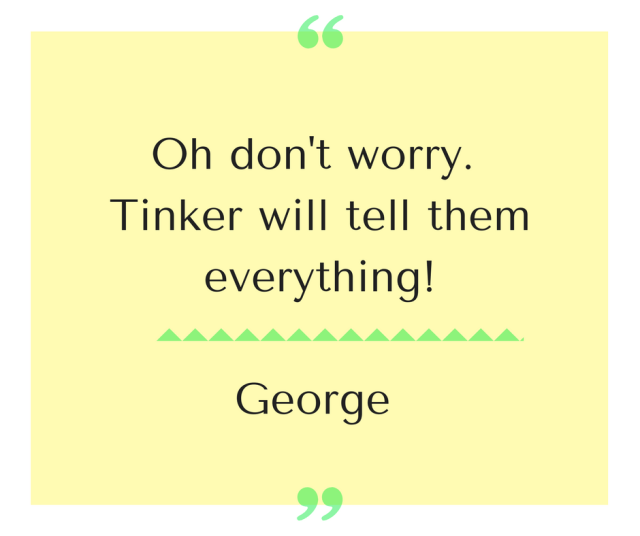
The focus moves away from the Five somewhat in this part of the story, which isn’t too bad a thing, and Tinker has his starring role. It does lead to some interesting dialogue between Tinker and the others and between the Five about him. George for example keeps having a go about Tinker’s tendency to blab about his father’s secret work to anyone, and Tinker gets very annoyed at one point. However when he is told to go and blab to Mr Wooh and Sam to smoke out the bad guy, the Five are worried he might not be able to remember everything, but George reassures them with this:

togetheragain3

This means at least they have faith and confidence in Tinker to help them out when they need him to!

The Bad

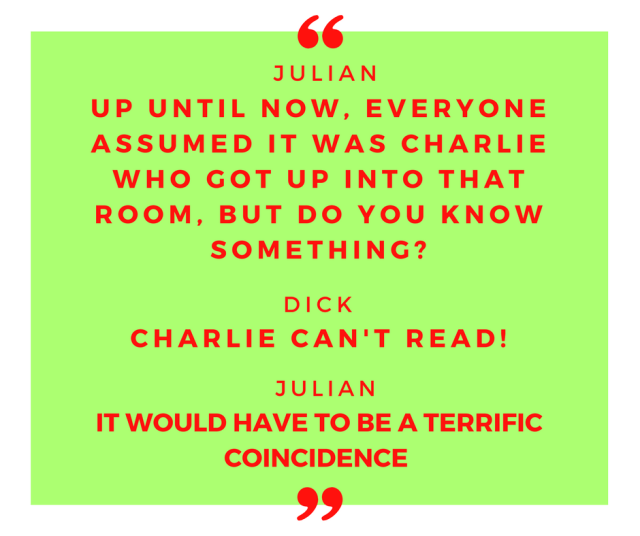
We start the episode by Jenny being awoken in the night by the sound of someone or something climbing the tower where Professor Hayling does all his experiments and keeps his papers. Jenny rouses the household and for a moment the professor doesn’t believe that there was anyone actually trying to break into the tower and Jenny dreamt it all when they discover Charlie the Chimp in the bushes by the tower – this isn’t something that happens in the book, they don’t spot Charlie in the bushes and they don’t suspect him of being up the tower until the very end. Overall the idea of Charlie being able to steal the papers is a strange one, even in the book, because as Julian and Dick point out:

togetheragain4-2

It is a fair point, Charlie wouldn’t have known what to take and the suspicion then moves onto Mr Wooh’s nameless assistant – eventually. This was a good addition to the TV show and shame it wasn’t thought of to go in the book.

The ending of the story was a bit rushed however, whereas the rest of the episode was well paced, even if it was a little slow which led to the rushed ending. I think we are more than established with the fact that 25 minutes is not long enough to either condense a Enid Blyton into for the telly and even two parters sometimes don’t get the balance right and this one left a lot to be desired. The dramatic ending where George is caught by the men and is thrown into the dungeons with a captured Sam, and they escape, not to mention the whole rescue with the rest of the Five and Uncle Quentin.

Conclusion

There really isn’t too much to fault on this episode as with the other one, they are literally only little things but I am beginning to think that this might be down to me not having read the book as much as some of the other Fives. I do wonder if that has a bearing on anything I’ve been saying.

Do you think the fact that I’ve not read the book as many times could lead to a less critical analysis of the TV shows? I think it might be a possibility.

Anyway as I was saying, this episode apart from a few bits and pieces which are mildly frustrating this episode of Five Are Together Again comes out quite well overall.

Any thoughts?

Posted in Blyton on TV | Tagged , , , , , | 1 Comment

Those Dreadful Children: who was really the most dreadful? continued

I’m back with another very long blog to try to answer the question I set myself! (Previous part here.)


THINGS I DIDN’T REALLY CONSIDER AS A CHILD

As a child I think I glossed over a lot of the Carletons’ faults.

They are laid out very clearly in the opening pages, and reading it last night I wondered how I could have so quickly thought them the better children.

Annette was spoiled. She yelled when she couldn’t get her own way. She sulked if she was scolded. She was pretty when she smiled and looked happy, but very ugly when she frowned or pouted.

John remembered things too long. If anyone offended him or made him angry he though about it for a long time, and wouldn’t forgive them. He seldom flared up or quarrelled – he just said nothing, but went on thinking little bitter thoughts that made him most unpleasant for some time.

Margery was scared of mice and bats, moths and beetles, worms and earwigs. She was afraid of strange dogs, and hardly liked to stroke a cat in case it scratched.

Well, Margery’s isn’t particularly bad – but the other two immediately do sound like quite unpleasant children.

Margery cowering from Dopey

Margery cowering from Dopey

Blyton actually tries very hard to make them seem unappealing – “I don’t think it’s a very right thing to do,” said John, who was always rather afraid of doing anything that might not be quite right and proper. He’s talking about going to explore and play in someone else’s garden without permission. I think he’s quite right to be doubtful! The Famous Five or the Find-Outers normally only ‘trespass’ in the pursuit of finding a clue, from a sense of doing right by doing wrong. Many Blyton characters would have an unerring sense of right versus wrong as a strong point in their favour.

I think as a child I read over this so quickly that it didn’t really settle. They also don’t show a huge amount of this behaviour – except Annette. Annette is rather a brat for several chapters, though she does slowly improve. John holds one or two brief grudges but nothing particularly noticeable, and after an initial fear of Dopey Margery stops being so afraid, so it is easy to forget they have those tendencies especially when the Taggertys come charging through with their bad manners.

One other thing I dislike about the Carletons later in the book is their piousness. They are called pi, along with other things and I think it’s quite true. They don’t quite say it so awfully to the Taggerty’s faces but John instructs his sisters to try to convert the two Taggerty girls to Christianity – as they are ‘heathens’. I don’t generally have a problem with religion, it has certainly given the Carletons high morals, and they are kind enough to pray for the Taggertys’ mother (though they have perhaps missed the ‘do not judge lest ye be judged yourself’ motto) but I dislike those who think their religion, done their way is the only way to live and that they must ‘save’ or convert others to it too. It’s really rather judgemental and awful of John to say that (and that Pat is a ‘lost cause’ too).

I think Blyton could possibly have done a little more to balance out the children’s dreadfulness. For example John could have held a grudge and learned the hard way it meant missing out on a fun afternoon.


WHY I STILL THINK THE TAGGERTYS ARE DREADFUL

The Taggertys display their worst qualities a great deal right through the book.

I entirely sympathise with the Carletons when the Taggertys capture them savagely and tie them up on their first meeting. I would have hated that! It’s not so bad with friends when you know everyone is playing. With strangers you could feel genuinely threatened.

I will reiterate that they are not a bad bunch of children. They are jolly, great fun, energetic and imaginative. But they are also inconsiderate to extreme, always thinking of themselves first.

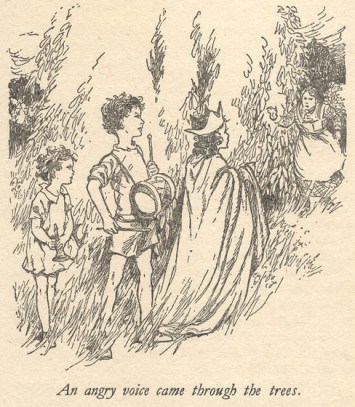
An angry voice came through the trees, and then someone appeared in a hurry. It was Bridget, the mother’s help.

“Och you naughty little ragamuffins, you, making all that din with the baby, bless his heart, just asleep after a bad tummyache….”

“Oh, sorry, Bridget,” said Pat. “I quite forgot about Michael. We’ll play Red Indians instead.”

“Indeed you won’t, not till the baby’s awake and happy,” said Bridget. “War-whoops and what-nots, and dancing around with mad things, scaring the baby into fits. And your mother with a headache too!”

Bridget giving them a scolding

Bridget giving them a scolding

I know most children have to be told to keep the noise down fairly often, but Pat at the very least is old enough to know not to play such loud games when the baby’s sleeping. They do this all the time, up until their marauding sends Dopey crashing into the pram and baby Michael falls out. This is one of the disasters that does prompt some better behaviour from them – but most of all from Dopey!

If you were to give the Taggertys some praise you could say they are very honest about their opinions. Unfortunately they have no tact whatsoever and think it’s fine to say someone’s mother seems stuck-up and that someone else had called the children prigs. As everyone knows, it’s really bad form to insult someone’s mother!

As I’ve mentioned earlier, the Taggertys like to resolve problems with shouting and hitting. I honestly cannot abide people (children or adults) who resort to violence to get a point across. I have no respect for people who find it acceptable to punch someone for a perceived slight. Anyway, Pat does just that and slaps Annette (this is a boy of at least 8 or 9 hitting a 4 year old) when she is having a bit of a tantrum. The worst part is that Annette starts to respect and look up to him after that. Sometimes someone standing up to you and challenging your behaviour can be admirable but I would find it extremely hard to made a friendship with someone who slapped me like that.

They also have little to no respect for other people’s (or really their own) belongings. The girls practically ransack Annette’s doll’s house and admit theirs is rubbish because everything in it is broken. I’d be pretty upset if someone came to play at my house and started roughly chucking my favourite toys about!

Incidentally, I think one of the criticisms of Pat is a bit unfair. At the end of his first term in a new school he is bottom of his form and his parents are hugely disappointed. He gets an unpleasant letter home and is not allowed to play in the football match.

Some of that is justified – a child that doesn’t try and doesn’t put in effort needs to be made aware it’s not good enough. However, the bottom of the form thing I despise. Someone HAS to come bottom, it’s a fact of life. I really hate that way of marking people’s work and ranking them because someone will always come last. It is like punishing an Olympian for coming last in a race, if they’ve all tried hard then where’s the problem?


RUBBING OFF CORNERS

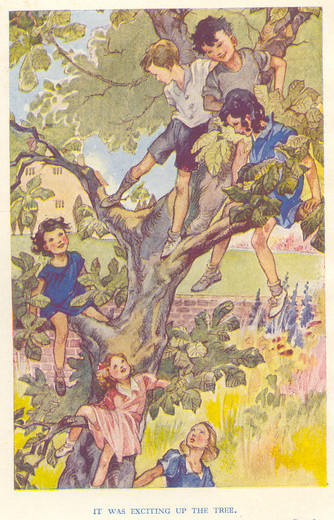
The Carletons start to change quite quickly. After a few meetings they discover it’s fun to play loud, messy games. Annette and John both dare to climb a tree. Annette reverts back to being a bit spoilt on occasion but it’s not tolerated by the others so it doesn’t last long. John also improves vastly in his father’s eye and becomes “a real boy” but I can’t say that he had much of a problem in the first place. But then I’m looking at it from a modern viewpoint.

All but Margery daring to climb a tree

All but Margery daring to climb a tree

The Taggertys change much more slowly, they do seem to take things on board and try – but they aim to emulate the Carletons on the surface by being a bit quieter and neater but underneath are still being lazy and unhelpful.

John does make a break through with Pat, though. Pat dares him to jump a stream that John knows he could not. Pat then calls him a coward. Later, Pat lies to a neighbour and says it is not their cricket-ball that broke her greenhouse window. John points out that it is far more cowardly to lie your way out of trouble than to refuse a dangerous dare, and Pat actually goes to the neighbour and admits the lie – also giving her money to replace the glass.

It’s not until Mrs Taggerty is hit by a car that they really change, though. The children feel terribly guilty as she wasn’t feeling well that morning and begged each child in turn to drop her list off at the grocery store. All three of them refused for petty reasons – they just couldn’t be bothered and didn’t see why they should have to put in the effort when someone else could do it.

The Taggertys visit their mother

The Taggertys visit their mother

This leads to a huge change. Pat turns over a new leaf and works hard at school. Maureen starts taking care of baby Michael and helping more around the house and Biddy starts picking up after herself. They are amazed that the Carletons have been generous to pray for their mother and are very grateful too.


SO WHO WAS THE MOST DREADFUL?

I think the two older girls sum it up quite well at the end.

You showed us how beastly we were anyway said Maureen.

And you showed us how silly we were Margery said.

Both sets had flaws. The Carletons were too uptight and stuck in their ways. They had some unpleasant traits that could have grown worse over time. But the Taggertys were dishonest, lazy and inconsiderate and that in my opinion is worse.

They were all Dreadful Children at times, but the Taggertys were more dreadful more of the time. It’s not nearly as black-and-white as my child-self saw it though. It is nuanced with both sides have faults and having those faults due to their parenting.


PARALLELS TO OTHER BLYTON BOOKS

There is quite a similarity in basic premise to Six Cousins at Mistletoe Farm. When the new arrivals turn up we are shown their many faults and they learn to become better people – but at the same time the other children also learn a few things along the way. The newcomers are much worse than the Mistletoe Farm lot, and I think that’s similar to how the Taggertys are worse than the Carletons. But in Six Cousins, the mother has a huge amount of learning to do, too. Mrs Carleton does relax a bit over the book, but I don’t think she is as ineffectual a parent as Rose is.

It also has similarities to many stories Blyton wrote where a family has to pull together and work hard in times of strife. House-at-the-Corner and The Family at Red-Roofs are good examples, but those children had fewer faults to begin with than the Taggertys.


Posted in Characters | Tagged , , , , , , | 3 Comments

Monday #206

Another Monday, another week. This week as well as our posts for this week to share with you, I have an interview with Jemima Rooper, who played George in the Famous Five in the 90s, for you to read through. Its interesting how the interviewer describes her previous roles! See what it says here.

I hope you like the look of our blogs for the next week! 🙂

monday206

Posted in Blog talk | Tagged , , | 1 Comment

Blyton’s Britain, part 1

Thanks to a comment on one of my previous posts, from a reader saying that it would be nice to have a list of locations that Enid Blyton used for inspiration and where she lived, I have decided to put this post together. I’m going to first start off with her home locations; places we know she lived, loved and worked. Then over the next few blogs I’ll look the places she might have used for inspiration in her stories and why. Finally the plan is to look at the places used in filming the two Famous Five TV series for those avid TV fans!

So let’s get started with those home locations of Enid Blyton’s!

Beckenham

Beckenham, South London, near to Bromley is the birthplace of our great author. She began her humble life in a small terraced house near the station. Fiona and I visited a few years ago now with the Enid Blyton Society. You can find our blog about it here with the walk we took. There are five of Blyton’s former homes here, plus a school she worked at, the church she went to Sunday School in and a street called Malory Close. This will be helpful if anyone else out there wants to follow the same route and take in places from Blyton’s early life. For any enthusiast, it is a fantastic walk as long as it isn’t raining!

Enid Blyton's home on Chaffinch Road

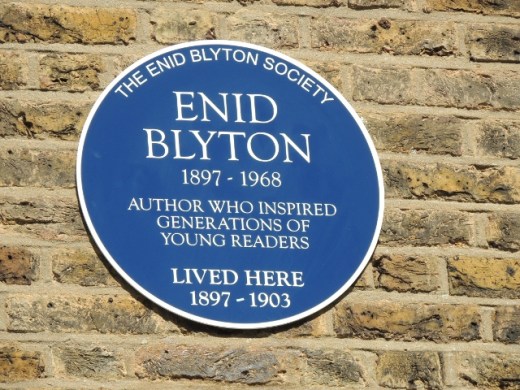
The blue plaque on the house on Number 95 Chaffinch Road

Bourne End

Bourne End is possibly my favourite place that Enid Blyton lived. Such a beautiful walking area down by the River Thames, a pleasure to walk the bank and watch the boats go by. You can really feel as though you might bump into Enid Blyton with either of her two girls,  or first husband, Hugh Pollock, walking their dog, Bobs.

Hidden away in Bourne End is the spectacular ancient cottage, Old Thatch, where Blyton spent a part of her life (from 1929 to 1938). The thatched roof, roaming gardens and beautiful surroundings were a favourite visiting place of mine up until Old Thatch’s owners decided to close their award winning gardens to the public. However, that should not deter you from visiting Bourne End and walking down by the river. It really is a spectacular place! (And you can usually get a look at Old Thatch through the hedge!)

To cap it all off, I do believe that Bourne End was the inspiration for Blyton’s Five Find-Outers and Dog’s village of Peterswood. She took the charm of her own village and put the Five Find-Outers right in the middle of it. The magic of that single piece of inspiration can just entice you to go searching for Fatty, Pips, Larry, Daisy, little Bets and Buster in the local area on the search for clues and eating gooey macaroons and ice creams. Places mentioned in the book by name are other places to go and visit as well, such as Marlow, just down the road from Bourne End and Burnham Beeches which is not even a fifteen minute drive away from the glorious Old Thatch.

If you’re looking for somewhere to eat as well, next door to Old Thatch, is a very well aged, good food pub called The Spade Oak. Thoroughly recommend it on your trip to visit this lovely area.

You can see all our blogs on Bourne End here just to give you a flavour of how beautiful it is.

Panoramaonblkbackground

 Beaconsfield

Beaconsfield, is simply ‘up the road’ from Bourne End and Old Thatch, approximately a fifteen minute drive once again. This makes these three locations perfect for a whole day or two in the same area as they are so close together and as an Enid Blyton enthusiast you will want to spend as much time as possible at these locations!

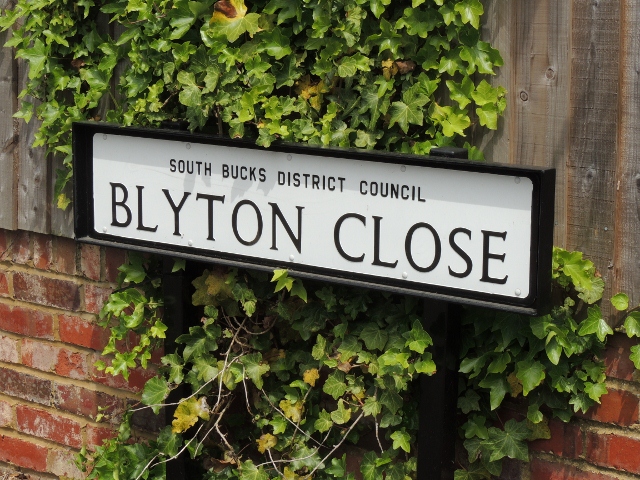
The first place I suggest you visit in Beaconsfield would be Blyton Close. This is the location of where Green Hedges once stood. As Green Hedges was torn down in 1973 to make way for a housing development so we no longer have that luxury of being able to view the grand house that Blyton moved into in 1938 and lived in until shortly before her death, when she moved into a nursing home. A lot of her famous parties for children took place there, and she ended up doing most of her writing in Green Hedges.

Once you’ve finished with Blyton Close – literally the name is all that makes it stand out as something an enthusiast would want to see – you have a couple of options. The pub opposite is supposed to have been frequented by Blyton during her time in the house, I believe so that would be worth a visit.

DSCN4235 (640x480)

Blyton Close signpost

The next place you will want to visit in Beaconsfield is Bekonscot. Bekonscot is a model village and railway that has an array of delights for those of all ages (Fiona especially enjoyed it!) For the Enid Blyton aficionado however, the delight comes half way around the model village is a model of Green Hedges with a little Enid Blyton sitting outside it with her typewriter, writing a story while some children who look like they’re supposed to be the Famous Five exploring and splashing around in her pond.

The whole place is delightful and quirky; there is plenty to look at and enjoy, even if you just have this one little piece of Blyton memorabilia it is a brilliant place to visit and enjoy. There is always something to look at, examine and enjoy. Some of the things we saw we could not believe were actually happening in this small model village. You can find our blog about it here. To cap it all off, Blyton wrote a small book all about Bekonscot, and what sort of a model village it was. They do actually sell this small book in the gift shop (an old railway carriage) for something close to 50p – at least it was 50p in 2013. Prices may vary!

DSCN4331

Green Hedges miniature and the gardens at Bekonscot

So there you are; your first part of Blyton’s Britain. We focused on her homes today, and hopefully when I’ve done a bit more research we can look at other places you could go to to get your Blyton fix.  These three places can be done comfortably over two days – Fiona and I did that in 2013 – while enjoying the whole Blyton atmosphere that surrounds a proper fan when they just cross the border into Buckinghamshire.

Let me know if you do go to any of these places! They come highly recommended!

Posted in Enid Blyton, Locations | Tagged , , , , , , , , , , | 7 Comments

The Adventure Series on TV: The making of feature

On the final disc of the set is a feature called The making of The Enid Blyton Adventure Series. I can’t say I noticed one on the Secret Series DVD but I will have to check that.

makingof


THE SERIES IN A NUTSHELL

The series is described as: A foursome with a parrot roaming the world finding treasure running away from baddies capturing them at the end. There’s a lot of adventure in it by David Taylor who played Jack. He had read all the Secret Seven and Famous Fives passed down from his brother but never the Adventure Series.

Also described as Critically acclaimedThe flagship of the Blyton estate. The jewel in the crown and the legendary Adventure Series, brought to the screen for the first time ever. Well, not quite as Island and Castle had already been adapted for the small screen, but as they’re being so nice about Blyton’s work I’ll let them off.

promoshot

It could also be slightly inaccurate to say that it is amazing how few of her books have been adapted for the screen as at a quick count there were 14 adaptations before this one! Not all in English, but they still exist.) Also said is that the books are the story of Allie Mannering and her secret agent friend. I think that’s where the series went a bit wrong, to be honest. Focusing too much on the adults – it’s supposed to be about four children and Bill popping up when necessary.

Another claim made is that it was the biggest children’s series ever filmed. There were 24 episodes, so the equivalent of 8 feature films back to back. Well, if a feature film is only an hour and ten minutes! Both adaptations of the Famous Five had more episodes than this series did, though they filmed as two separate series with a break in the middle.


A MODERN SERIES FOR A MODERN AUDIENCE

None better than Blyton they said, for a family audience from Granny right down to a five year-old.

And they have cleverly adapted and updated the stories to appeal for a modern family audience without losing any of the original values and the charm and a lot of humour too. Not sure that completely make sense, at least not the but about the humour. Did they not lose a lot of humour? Did they mean they added a lot of humour?

I’d go with the second meaning as they added rather a lot of slapstick moments (the clip playing of the idiotic baddie from Ship crashing his bike is playing while this is said). I also think they did lose at least some of the original values, and a lot of the charm!


WHERE AND WHO IN THE WORLD?

Where in the whole wide world would they make the series? Apparently they did do a lot of searching for locations and ended up in New Zealand as it has a very versatile scenery. It has beaches, grasslands, hills, rivers and all sorts of things. I know New Zealand often gets used in place of Britain for filming (and also doubles as Middle Earth too).

I agree it’s a very attractive place but doesn’t quite double as the Middle East!

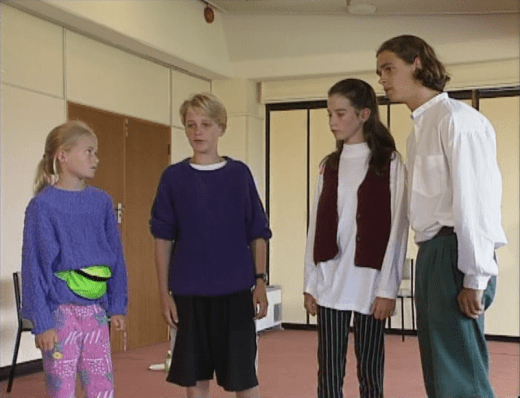
Being filmed in New Zealand it was natural that many New Zealanders would audition for roles. In total there were around 1,200 children attended the audition – in the rain – and some had flown in from Australia and elsewhere.

Do you read EB? the presenter asks one group of rather older looking teenage girls. NO, they laugh, and then, yes we do, all the time, religiously.

I really almost cried at those 1200 kids queuing in the rain for hours and getting up at 5am to drive to the audition. After that, they were narrowed down to 12, three children for each part, and sorted into four groups.

jennyfer

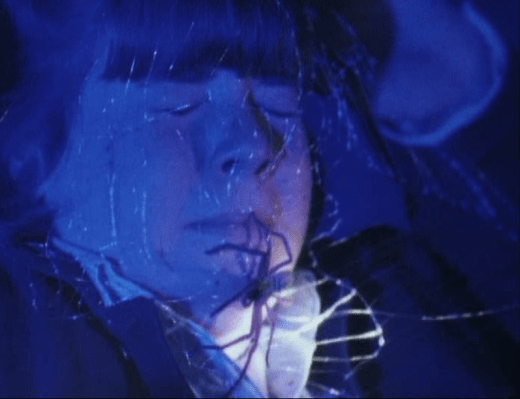
It was interesting to see the different groups with one or two of the final kids rehearsing with those who didn’t make it. Alexis Jackson, who played Dinah, had never acted before. They included hidden camera footage of her getting told she was getting the part over the phone. (I may have cried real tears.) It also revealed that Alexis was not fond of creepy crawlies (but not to such an extent as Dinah) and she very bravely allowed a real spider to crawl across her face in one episode

realspider

Jennyfer Jewel revealed she loved all the screaming she was allowed to do (and that was a lot!).


THE ADULTS

Mothers from the books are described as middle-aged plump, homely women, baking cakes and serving lashings of lemonade and ginger-beer. Well, I think they’re confusing mothers with the cooks, really! Aunt Fanny wasn’t plump even if she helped with the baking! They describe Kirsten Hughes’ Aunt Allie as more modern than the one in the book. So that would be the Mrs Mannering who ran an art gallery for years to support her children after her husband died? Even in later books she’s hardly a homely or plump woman tied to the kitchen. She holidays with her children all over the place and I’m sure she drives her own car.

To be fair she never went toe-to-toe with Sir George (or any equivalent) but that’s because nobody was phoning Bill’s mobile constantly and ruining their plans!

Malcolm Jamieson, playing Bill, liked to think of himself as a bit of a James Bond and did some of his own stunts – like the jump from one boat to another during Sea of Adventure.

They rather over-promote their baddies here, showing us all the ones they had. Unfortunately most of them over-acted their parts and came across as foolish rather than frightening.


PLACES AND PETS

We get to see the making of the various tunnels they used for filming. They are actually the same ones, turned to different angles and repainted across the eight episodes. I do have to admit that this wasn’t too obvious (not as obvious as say, the later series of Red Dwarf where they only had one corridor and used it over and over for different parts of the ship).

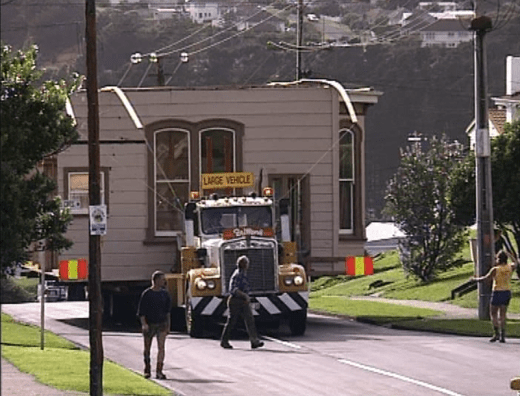
For Craggy Tops, they found a perfect house, and a great location that really looked like it could be in Cornwall (even if it wasn’t quite the desolate craggy coast of the book). The only problem was, the house and the location were not in the same place. It was solved by putting the house on a very large lorry and simply driving it to the new location!

craggytops

For Kiki they had either three or four cockatoos acting (they used both numbers at different parts of the documentary). One was called Benny and another, Goldie. The trainers had to squeeze into full sets to ensure the birds did the right action at the right moment. David Taylor (Jack) said he got along well with the birds, apart from the occasional bite, and even got used to the claws in his shoulder. That’s probably because his shirts had padding sewn into the shoulders!

trainingkiki


This was a nice 45-minute look into making the series, without going into boring detail of every location or character. I learned a few things certainly.

Posted in Blyton on TV | Tagged , , , | 4 Comments

Monday #205

Our congratulations to Laura Petela (now called Laura O’Bree since her marriage) who has had a baby girl this week.

You can find her on Instagram (where the below photo is from) and Twitter.

How cute!

How cute!

And from us this week (probably less exciting than a new baby!):

wedfri44

Posted in Blog talk | Tagged , , | 2 Comments

Those Dreadful Children: who was really the most dreadful?

Those Dreadful Children has long been one of my favourite Enid Blyton books. I had an Armada paperback when I was a child and I read it many times. I was quite firm in my belief that the Taggertys were the Dreadful Children of the title. I don’t think I had ever considered (despite the Taggertys calling the Carletons the same thing) that it was a clever story about two sets of Dreadful Children who rub each others’ corners off.


THE STORY IN SHORT

The Carletons, John, Margery and Annette are polite, well-dressed children with a polite well-dressed, if rather fussy, mother. The Taggertys, with four children – Pat, Maureen, Biddy and baby Michael – then move in to the house behind theirs, so their gardens meet at the bottom.

Initially the Carletons are excited to have someone new to play with, but soon find that the Taggertys are not to their taste. They are loud, rough, rude and dirty. The Taggertys, though, think the Carletons are stuck up cry babies and both sets of children vow to have nothing to do with each other.

620wide1957453

The neat, tidy Carletons on the left and the wild Taggertys on the right

This is a fine plan until their fathers come home to announce they have met an old school friend, and he has some fine children. And would you believe it? They live in the house at the bottom of the garden…

The children are then forced to see each other. Over time they get to rather like each other, despite their perceived faults. Both sets of parents are pleased at the little changes the children go through, as a result of these friendships.

Both sets do improve, but it takes a few disasters before the Taggertys truly buck up.


THE CHILDREN 

I definitely identified more with the Carletons when I was younger.

John is a quiet boy who doesn’t mind being as neat and tidy as his mother demands. He’d rather stay in and read a book than go tree climbing or on long walks with his father. His father wishes he was more of a ‘real boy’, 1950s gender divides clearly well established in his mind, but his mother puts being clean and tidy above most other things so she’s quite happy he’s not going out and getting muddy. His main character flaw is that he holds grudges. If his sister does something that he considers to be beyond the pale, he will tell her and then not speak to her for days.

Margery is much like her brother in that she is happy to play nice, quiet games. There isn’t as much to say about her, other than she is quite a nurturing soul and likes sweet little animals and babies. She isn’t perhaps as well-rounded or fleshed-out as John is. She does have a ‘character flaw’ though, in that she is terrified of most creatures like mice, bats and even cats and dogs.

Annette is the youngest, not yet at school. She is probably the most objectionable of the Carletons. She is rather vain, good at making her face look sweet to make sure she gets what she wants, and likes to preen and be told how pretty she is. She’s also a dreadful tattle-tale and goes running to Mummy at every opportunity, usually in floods of tears because someone wouldn’t play with her or she couldn’t find them during hide-and-seek.

I can see that the Carletons are not perfect. They are probably missing out on quite a lot by kow-towing so eagerly to their mother’s wishes. In a modern setting, there’s little wrong with John. His grudge-holding is probably unpleasant but something he may grow out of in time. Margery’s fears are the product of growing up without pets or access to animals I bet. I was pretty scared of dogs when I was her age as we’d never had one, and few friends or relatives did either. I did have hamsters, though, so I wasn’t afraid of all pets. Annette, as I said, can be pretty unpleasant. But at four she has plenty of time to grow up – though I suspect her older brother and sister wouldn’t ‘squash’ it out of her like other Blyton characters would. I suppose their other flaw is they, along with her mother, are quite quick to turn up their noses at people and things. They do judge people a bit, if they are not as tidy or well-mannered and the children are only allowed to play with the Fitzgeralds (no-one else comes up to their mothers’ standards) who they call stuck-up. I wonder how truly Dreadful the Fitzgeralds are!

The Carletons are, however, very honest children, who never tell lies, cheat or disobey their parents (honestly.) They are helpful around the home and each looks after his or her younger sibling without complaint. It does seem a little unnatural at times, but some children are just extremely well-behaved.

And now, the Taggertys.

Pat, the oldest, is very much the leader of the children. He does try to keep them in check (sometimes) but his way of doing that is to bellow and slap. He’ll run around all day playing yet won’t lift a finger to do an errand for his mother, nor does he believe in working hard at school.

Maureen will also deal out a slap if one of her siblings rubs her the wrong way. She’s not as aggressive as her brother, but she’s about as lazy and won’t help with the baby or do any chores.

Biddy, ages with Annette is very good at hiding should her mother, or Bridget the home help, want her to tidy her own room. She’ll also lash out and squash any behaviour she doesn’t like in others.

Michael is the baby, I would guess he is around a year old perhaps. He seems to spend all his time in a cot or his pram except when he is being fed, but that’s possibly normal for the era. He doesn’t say or do much, but requires being cared for and peace to sleep, which add a bone of contention around the house.

There is also Dopey, the Taggertys mad dog. He’s not a bad dog at all, just very excitable and often getting into trouble.

The Taggertys aren’t all bad, though. They are certainly active and healthy, and no doubt very loyal to their own (as long as loyalty doesn’t mean making the beds or tidying up the tea-things). They are very much free spirits who have been left to do what they want for a very long time, and so you can see why suddenly changing that would be hard. Their mother has been ill a lot, which is why the parenting has slid. And of course father, in the 1950s, wouldn’t be doing a lot of parenting (or housework) anyway. Both parents admit to being rather lax, doing things for an easy life.

I think you can feel sorry for both sets of children as they are absolutely products of their parents method of upbringing. The Carletons have never been allowed to be daft, care-free children while the Taggertys have not have enough rules or boundaries in place. You also get the impression that they have been brought up with far less money. They are excited to have a large garden because they’ve only had small ones before, and it’s said that their father is a writer. I wonder if he has not been that successful a writer in the past and so some of the grubbiness and so on is due to lack of money before. (I doubt they were living in poverty, mind you.) They’ve also had to contend with a mother who couldn’t be “there” for them as much as they’d like because she has been ill. They haven’t been able to ask for her help with homework, and presumably they have gone without costumes for parties and so on as well. I can’t see them having done a lot of work around the home, though, which would be the default for a lot of children with a sick parent. Still, they can’t have had it entirely easy.

Neither sets of children are truly set up for facing adult life and have some hard lessons to learn. Annette will have to learn she can’t just cry and tell tales to get her own way and Biddy will have to learn that she can’t hide from all her responsibilities or smack other people when she doesn’t like what they’re doing.

Both have their own strengths, still. A Taggerty would rush to your aid regardless of the danger, while a Carleton would hang back and worry about getting into trouble for trespassing or tearing his/her jersey on a fence, but it would be a Carleton who would bring his you groceries when you were ill and be much more thoughtful over little, every day things.


And I have to stop for now, as I have written so much already! I will answer the question who was really the most dreadful next time, though I am already leaning towards the Taggertys.

What are your thoughts?

Next post: Those Dreadful Children: Who was really the most dreadful? part 2

Posted in Characters | Tagged , , | 4 Comments

Famous Five 70s Style: Five Are Together Again, part 1

wp-1486510903961.gifLike a lot of the 70s episodes of the TV series, Five Are Together Again comes in two parts. For me that means another blog and for us as viewers it means more content from Enid Blyton’s book on the TV screen. Gloria Tors is the writer of these two episodes and from past experience we know that the story can go either way! So let’s see how she does!


The Good

Gloria Tors seems to have done a good job getting all the relevant parts of the story into the first episode from Enid Blyton’s novel. All the details that you would expect from the episode and the writing are there and clearly visible to a practiced fan! So let’s have a look at what makes this episode work!

To start with,the essence of Tinker is perfect, Wayne Brooks who played Tinker seems to be the right choice for him. I know Tinker however is supposed to be younger than the others but he does seem a bit too young. However it does help the situation of Tinker bragging about his clever father, and his naivety about a near total stranger i.e. Mr Wooh. The monkey who plays Mischief is much too big for him however, and clearly should be a smaller ape, however the duo is comical enough.

I find that Tinker’s interactions with Dick are by far the best in the whole episode. Dick has the least patience with the little boy and tries to act very disinterested when Tinker has a big thing to share with the Five. Tinker however is somewhat immune to Dick’s sarcasm and just shrugs it off which is something I wish I could do. I have to respond like for like!

togetheragain2-1

Its just a very laugh out loud line when this comes up, and is one of a few that Gary Russell’s characterization of Dick delivers in perfect form. I always imagined Dick as a very sarcastic young man, especially as he got older and could stand up to Julian a lot more. In the 90s version this happens when Marco Williamson is incapacitated with a broken leg, but in the 70s show it seems to happen more naturally with Marcus Harris’ Julian allowing Dick more responsibility and breathing space to develop and have these funny lines. Its really is a pleasure to watch, especially when Russell delivers a corker of a line about having to carry all the bags when they leave the train station at the beginning of the episode. togetheragain1

Classic Dick! Makes for an enjoyable episode.

The Nitpicks

One thing that really gets me with this episode is that while the Five are still in the train station they get drowned out by the noise of the train when it goes to leave the station. This makes it hard to work out what they are saying above the clatter of the train. I do think that a little more could have been done on the sound balance of that one!

We also don’t see Timmy at all in this episode. We are told that he has to stay at Kirrin Cottage. We’re not really told any more than Professor Hayling doesn’t want him around. I mean come on, he lives with a monkey, surely a dog is less hassle? Anyway, Timmy isn’t allowed at the Haylings’ and George gets annoyed with Rogers more than her father.  Julian does tell her to leave it alone when she says she will get Rogers back for keeping Timmy from her but that doesn’t stop her getting up in the night to try and fetch the pooch from Kirrin cottage. It’s all a bit of a saga really because instead of getting Timmy, they end up chasing around Charlie the chimp from the circus, who has somehow escaped his cage.

Just a couple more things to look into before we round up this blog, and next it is something that crops up in the TV episodes, throughout the 70s and 90s show – the addition of characters into the story that don’t necessarily add anything to the story.  In this case it’s the introduction of Sam, played by Kenneth Cope who is someone even I recognise as a great talent. Such a distinctive voice, not to mention charm about him, Cope does wonders with this character Sam who owns the chimpanzee, Charlie. A deviation from the book where the chimp is owned by magician Mr Wooh. The need for this update is unclear to me,  unless it is to pad out the double episode issue.  What do you think? 

My last nitpick is all about the simple issue of Mr Wooh. This grand magician has seemingly turned into more of a memory man, picking random facts from the air and doing impossible sums in his head.  So much less a magician as far as I am concerned and more of a trickster. Actor  Peter Jeffery does make a credible Mr Wooh however and is very good at appearing to be a smarmy gent in a suit, under which you wouldn’t want to look. A little change but as I said,  a nitpick.


Conclusion 

Overall, the episode is good. It has detail and Gloria Tors has done a decent job of adapting Enid Blyton’s original text into an dhow good enough for TV.  There are few little niggles, but when isn’t there? Has anyone spotted any more?

Let me know what you think about this episode!

Posted in Blyton on TV | Tagged , , , | Leave a comment

Monday #204

monday204

Once more it’s a Monday and we have a packed week for you coming up! I’ll be looking at the penultimate episode of the 70s Famous Five and Fiona’s going to review Those Dreadful Children.

Hope you join us for the blogs and enjoy them this week!

Stef

Posted in Blog talk | Tagged , | 2 Comments

The Adventure Series on TV – The River of Adventure

Here I am going back to the penultimate episode after watching in book order. I rate River as my least favourite anyway, so I suspect this could be quite dire. I imagine a lot will have to be changed, as Tala and Oola’s portrayals might potentially be considered too ‘racist’ just as Jo-Jo’s was. Then there’s the bargua – I can’t see Philip carrying a snake around for any part of this episode so some reasonable rewriting will have been done.


THE MYSTERIOUS PRECREDIT SCENE

It’s a dark night outside a government defence department. The gate has a sign reading No Entry and other writing in what looks like Arabic. A security guard comes to check the gate is still padlocked… Meanwhile, somewhere inside the compound a man with a torch turns down a narrow alley. He is dressed all in black with only his eyes showing so I have mentally nicknamed him Ninja Man.


Ninja Man has a blank key card and a handheld device which manages to trick the door system into opening. Once inside he already knows the code for the vault (which conveniently seems to be right by the door he’s just come through). Inside is a room empty expect for a suitcase – marked extreme danger – on a table. Ninja Man opens the suitcase to reveal a tube of green liquid.


SPOILED PLANS AGAIN?

Bill is planning a river cruise with the Mannering/Trents, but is interrupted by phone. It is, as usual, Sir George, who wants to speak to Bill. Bill reminds him that he is on holiday, but that means nothing in the world of secret service agents and so he has to go in ‘for a chat’ which apparently won’t spoil his holiday plans at all…

In the book Bill suggests the river cruise because he wants to keep an eye out for Raya Uma, and thinks his family will be the perfect cover. It makes little sense for them to plan a river cruise then be told that Raya Uma (or an unknown enemy) is conveniently going to be around that area, or even another river that you could cruise down.

And we know that Raya Uma is going to make an appearance (as a fat, bald man) because we then see him happily admiring his green vial while being served exotic food somewhere presumably abroad.


RAYA UMA AKA RAY UMA AND MR RABOS

So by complete coincidence, Uma who they wouldn’t normally bother a minute on – because he couldn’t organise a kids birthday party is planning something big so Bill is to keep an eye on him while on holiday.

As noted in my heading he is now called Ray Uma, and is an overweight, Caucasian bald man. Raya Uma of the books had a very uncertain heritage – nobody really knew who he was or what he looked like. He has a man servant who seems to be of middle-Eastern origins, called Taj. Taj does all sorts of jobs though the episode from spying to passing on messages but he also serves food to Uma so I think that man servant still applies.

They are in league with a bad, evil man by the name of Rabos (pronounced Raboss, though I thought it was Ramos for a while).

So instead of ‘Raya Uma, criminal mastermind, plus a few hired thugs’ we instead get ‘Ray Uma, rather mad, power hungry but considered quite useless plus a prominent lacky plus a genuine evil mastermind that everyone’s terrified of.’ So basically a lot of unnecessary complications.


BAD SCIENCE

Unfortunately this episode is also guilty of a fair bit of bad science. Not as much as other episodes, but enough to be worthy of note.

The stolen vial from the teaser is called Zero One. I’m not sure what that name is supposed to convey other than being easier to say and remember than ethalhexylmethylsuphate or something like that.

Anyway, Zero One is the deadliest liquid known to man. It is said that One drop could wipe out the whole of London and even breathing the fumes is deadly.

As such, it is of course a toxic glowing green. Plenty of very dangerous substances are incredibly innocuous looking, but film and TV makers always feel the need to make something dangerous neon green.


AT THE HOTEL SHIRAZ

By second handy (or not so handy) coincidence Bill and Rabos are staying at the same hotel. I immediately thought of red wine (which I don’t even drink) but Shiraz is also a large city in Iran – a choice to suggest we are in the Middle East somewhere.

Bill is oblivious to Rabos’ presence, but Rabos is sure he has seen Bill before.

Also at the hotel are a snake charmer and his boy assistant. He does a moment or two of snake-charming with a very plastic-looking cobra. This is derailed when a large and deadly-looking spider escapes from a drawstring bag. Bill throws some sort of cloth over the spider (isn’t your reaction usually to flatten it?) and the spider is safely stuffed back in the bag.

Unfortunately Rabos sees this and marks Bill as react(ing) like a man trained for action and he puts Uma on finding out who he is, so that he doesn’t get in the way of their big plan.

The kids then see that poor boy of the snake charmer’s. He is being scolded and pushed about a bit roughly. This is nothing compared to in the book where he is beaten by his uncle. Yet the cause a big scene screaming at him to run away. It works well in a poor-run down town by the river, but not so well in an expensive hotel.


THE MIDDLE EAST AKA NEW ZEALAND

The hotel manages to look suitably Middle-Eastern, but when they head outside and onto the river we can tell they haven’t left New Zealand (which usually is pretending to be England but also Austria and Wales at times). Allie had earlier said that there wouldn’t be snakes on the river which seemed a bit ludicrous as there are many water snakes and snakes that live near water, but as they are firmly in New Zealand it seems more reasonable!

Bill gets off the boat at the first landing spot, and goes off in a taxi. The pretence of the Middle-East is held by having a cafe/shack surrounded by donkeys and chickens. The stall is being manned by Taj, adding to the effect.

The riverboat has also been doctored with a very obvious stick-on sign with Arabic text.


FAKE NAMES AND FAKE SPIDERS

Taj, having bribed the real stall-holder, is there to find out what he can from the kids. Being suspicious they stuff him up with stories of Bill being a pop star guitarist in a band called Kiki, and that surname of the family is Howe (some quick thinking after Jack stamps on Lucy-Ann’s foot and she yells “ow” which he turns into Howe). So not quite the ‘always be honest’ mantra from the books, where the kids will do everything they can to avoid lying, even if they manage to omit a truth occasionally.

After that, Oola, the snake charmer’s boy comes creeping around the boat. That begs the question as to a) how he knew where they were and b) how he travelled so far in a fairly short time. Anyway, he still has the big spider and Dinah quite rightfully screams the place down.

13spider

Instead of it being a poisonous (well actually I’m sure the term is venomous, but you know what I mean) spider with something done to make it safe, it is in fact a non-dangerous spider doctored to look like a dangerous one. Philip can’t pronounce its name but it translates to whiteback. So it’s a regular brown spider with a white bit painted on its back to scare people (unfortunately there is no act performed as with the barguas to really justify this). Oola gives the spider to Philip, making it his first pet of the series at last!

My worries about them seeing Oola’s role as racist were apparently unfounded as the kids happily proclaim Oola, you can sleep out on the deck!


LOST TEMPLES, LOST POCKET COMPUTERS AND LOST PARENTS

An “official guide,” meets them at dock to take them to the temple of dreams. Allie is not feeling well, so Bill stays with her and Oola stays as his leg hurts…

15temple

Naturally they are disappointed with what’s left of the temple so the guide wants to take them to second temple and walks off. That leaves the kids rather lost – the five minute walk from the boat was a lot further than promised. Jack had plotted route back on his computer, but this has gone missing in the past few minutes.

Bill somehow manages to find them, following Dinah’s screams.

The computer was taken by the guide and given to Uma, but is password protected. They try a few things and Taj suggests the name of the bird. Ray spells it Keke first, then Kiki. And they’re in. It kind of makes you glad of the “capital and lower case and number and punctuation” passwords forced on us now.

Back at the boat Bill recognises Ray Uma right away when his boat “accidentally” bumps into theirs. Bill assumes Uma won’t recognise him, and Ray invites them to his camper nearby for a drink. Bill thinks this will give him a chance to get information from Uma, but he is suspicious enough to deliberately drop the drink Ray gives him, he gets Ray’s drink which is still poisoned and collapses.

Uma orders Taj to get rid of the kids, we need that boat. That seems rather ridiculous as surely you wouldn’t deliberately use a genuinely broken-down boat just to lure Bill out of the way. What if he hadn’t fallen for it? You’d then be left with a broken boat and no way of following him. Anyway, Taj tries to oust the kids from the boat but is scared off by the spider.

When Bill and Allie don’t return the kids leave Oola to guard the boat. They discover signs of a struggle at the cabin and return to find out that men with guns have overpowered him, loaded an unconscious Bill and tied up Allie onto the boat and stolen it.


TIT FOR TAT ON STOLEN BOATS

Naturally the kids take Uma’s repaired-by-Bill boat and handily find a vital map to follow.

Oola then abandons them to walk back to his village rather than go to the temple, as he believes it to be full of ghosts. It’s a shame, really, that his role has been reduced to the bringer of a spider and not much more.

The boat had only had a temporary repair so when it starts smoking they panic it will blow up – how dramatic. Instead it sinks after they get off and all we get is an off screen gurgling noise.


DARN THAT BIRD AND MORE BAD SCIENCE

Kiki (as so often is the case) flies off at inopportune moment leaving kids to search inside the temple/cave/tunnels for her. Another example of torches in very well-lit areas.

16torch

Meanwhile Bill tries to turn Rabos and Uma against each other by trying to make Uma look stupid (I’ve got men coming, Uma was so obvious) and/or a double crosser (Uma  couldn’t get the real Zero One, that’s a fake). 

Bill even goes as far as to encourage Rabos to open Zero One. If he believes Bill and does that it that could kill Bill and Allie too! Uma suggests they use it on Bill instead. How? It’s not like they have protective clothing to keep themselves safe! (Even breathing the fumes is deadly, remember.)


UMA REALLY IS A STUPID SOD

Uma has hidden the vial in the underground burial chamber…. where Kiki just happens to have gone.

This is why these episodes are such a let-down most of the time. Why on earth didn’t Uma disguise the Zero One in an ordinary suitcase, meet Rabos at the hotel and receive a discreet envelope in return. Bill would never have noticed. They could have waited until the next day while Bill was on the river, in fact.

Instead we get a stupid and convoluted story that makes no sense, but manages to alter enough from the book to make it vaguely recognisable.

After solving a ridiculous looking yet easy maths puzzle to open the chamber door (clearly an underground waterfall would take up too much budget) the kids find the case of Zero One before Rabos and Uma get to it.


INEVITABLE POINTLESS WANDERING AND RUNNING

Every episode has it. A lot of wandering around tunnels. Kiki’s noises scaring people. Then the running around the tunnels. The kids play CATCH with the incredibly deadly vial. Then Philip hides it and makes Uma reach into a hole for it and we go through the “bitten by a poisonous creature who is not actually poisonous” rigmarole.


REVEREND MOTHER, I HAVE SINNED

Oola makes a nice little appearance at the end, doing a Sister Margaretta. He has removed something from Uma’s car, meaning Bill can easily arrest him later.


Yeah, so. A fairly naff episode. Not as ridiculous as some from the Secret Series, but a lot of nonsense added in. We get very little river exploring (which is probably just as well as it looked about as exotic as something any one of us could see if we drove an hour outside of a town), no sense of history or mystery around the mysterious Cine-Town.

There’s no rivalry between Tala and Oola, no thrilling ending at an underground waterfall, just a lot of extra characters and silly running around.

But I may have nearly cried when letter came at the end to confirm they’ve legally adopted Jack and Lucy-Ann. But that’s probably just the pregnancy hormones.


Posted in Blyton on TV | Tagged , , , | 6 Comments

The Famous Five 70s Style: Five Go to Demon’s Rocks, part 2

This is going to sound harsh as I know that there are people out there who love the theme tune for the 70s Famous Five but after several false starts (I put the wrong DVD in for the episode three times before settling on the right one) the beginning of the song and the singing does rather begin to grate on ones nerves. For the first time in a long time I had to mute the titles in the beginning because I just couldn’t listen to the song one more time. I dislike when DVD’s put the theme song on the menu’s because it usually means that if you have to leave the room for whatever reason, the tune just keeps playing on and on and can really become annoying. Anyway, on to the second part of one of my favourite books!

The Good

There’s a lot of this episode that works really well, making homage to the books, and the little touches are lovely to see.

We basically start off with Dick teasing Anne, and its quite a nice, fond sort of teasing. He asks her what she’s cooking for dinner, and when he’s been told, he tells her that he doesn’t look impressed because she’s cooking it, and it may turn out to be anything! Julian doesn’t get involved until Dick mention’s he going to sit down. Julian then teases him about saving his energy for doing the washing up. Its a nice little moment between the siblings because there is no outside intervention from George and you get a screenshot into their lives and bond before they were the Famous Five. Its just a nice little moment to have included in the episode.

Another thing about this episode is that works really well is that you get to see a bit more interaction between Ebbie and Jacob and how they work as a pair. In the book there is little if any in the book interaction between the brothers . So this is a nice addition to the story because you get more of an idea of how they would react and interact with each other and arrange the locking in of the children and searching for the gold.

Overall the little touches with this episode are good ones, the use of the oars to block the door from the inside is fast thinking on Julian’s part, the use of the plans that Tinker’s father drew up to find the shaft in which the lighthouse’s foundations have been laid, thus leading Julian and Dick to the treasure. Not to mention when the Five and Tinker work out that Jacob and Ebbie wanted to keep them out of the way long before they had actually discovered any treasure which all started with the stealing of the lighthouse key.

One of the best bits was when Ebbie and Jacob, Dick and Julian were in the tunnel together but approaching from different ends and Julian starts making a noise which alerts the baddies to their presence while also scaring them and making them think that the tunnel is haunted. Its a nice touch, even if it does give the game away that the kids have found a way out of the lighthouse.

The Bad

There are lots of little things on the flip-side however. Mostly they are little niggely things like before, but as a Blyton Purest, they’re hard to ignore. Like Timmy being able to hear Jacob locking them into the lighthouse from so far up! I know Timmy is supposed to be a super dog and all that, but I’m pretty sure that there would be lots of other noises and things to distract him. Its the same in the book as well – how would Timmy hear the door being locked? Just doesn’t make sense to me!

Also without it even being mentioned before Dick brings in the fact that when they were down in the caves, his compass was apparently pointing east (towards the lighthouse) and no one thought to mention the compass before this point. In the book, Tinker brings it up by saying that he has a compass on his watch and the others accuse him of showing off. Whereas here, its randomly mentioned when Julian is looking at the lighthouse plans and they’re discussing the use of the foundation shaft as an escape route.

With this episode there are some technical issues I think. I remember from the 90s version that it was hard for them to create a good storm for the five to be caught in; it usually consisted of a rain video being played over the still of the lighthouse. In this episode the supposed storm barely brings in any rain, or a rough sea. Jacob and Ebbie are able to row across to the lighthouse in what is supposed to quite a strong storm just seems like the normal tide coming in and out. Obviously you can’t really predict a storm during filming, but people could have been out of shot, throwing water and making the sea seem rough to create the illusion of a hard, stormy sea.

Conclusion 

Overall its a nice little adaptation; all the right points in most of the right places. Just the small little points that have made it a little disappointing. I did love the little interactions between Dick and Anne about the food, and Julian putting his brother in his place.

Another good piece was when Dick reminded Jeramiah that he promised to eat his hat if they found the gold and the silly fool starts pretending to eat the hat.  Not to mention the points where we spend more time with Jacob and Ebbie, which is development on the book.

Overall its a good solid episode. I don’t think I can fault that really. I’d score this two parter quite highly out of all of the episodes so far. What do you think? Let me know in the comments!

wp-1486510903961.gif

Posted in Blyton on TV | Tagged , , , , , , , | 2 Comments

Monday #203

It’s February, and I’ve finally got the hang of writing 2017 instead of 2016 (well, for the most part). I have also started writing extra posts now, so I can schedule them for later to give me a bit of ‘maternity leave’ from the blog. This benefits you as well as me, as I don’t think anyone wants to read a disjointed, rambling (well, more than usual!) book review from a sleep deprived mother.

Anyway, this week we have:

wedfri88-1

Posted in Blog talk | Tagged , | 1 Comment