
My niece turned three this weekend (where has the time gone?) and so I have celebrated that and Easter with much cake. I’ve yet to crack open my egg so I still have something to look forward to!
Coming up this week:

My niece turned three this weekend (where has the time gone?) and so I have celebrated that and Easter with much cake. I’ve yet to crack open my egg so I still have something to look forward to!
Coming up this week:
It rather goes without saying that I will be reading Blyton to my little boy once he’s born, and encouraging him to read Blyton himself when he’s older. I do have lots of thoughts about that which I may explore on here later – mostly about how to broach the subject of gender equality etc and the differences between current times and the times the books were written – but it would never stop me introducing the books to my son.
Blyton did write for a wide age range but not quite so extensively for the very young. There’s also the problem of my collection being all original editions and not really suitable for grabby baby hands. That leads to the next quandary of risking early editions or buying sanitised modern ones?
Anyway, the point is I will read a lot of non-Blytons too, and I thought I would explore my already long reading list for baby this week.
The first list are all books I adore – mostly ones I read as a child but also a few I have stumbled upon as a grown-up.

One or two you might not be so familiar with are Aileen Paterson and Mairi Hedderwick. Both are Scottish authors that I’ve grown up reading.

Then there are other random classics on there (or at least what I consider classics):


I asked on Facebook for some other ideas, it has been a while since I have looked after children and realise there have probably been some great books I have missed out on.

Lions and tigers and bears, oh my!

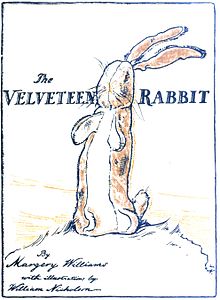
Not on the written list but also suggested are The Velveteen Rabbit by Margery Williams (but probably not in an early edition!), Harry and The Bucket Full of Dinosaurs by Ian Whybrow, The Little Red Train series by Benedict Blathwayt, Supermarket Zoo by Caryl Hart.
Phew! That’s a lot of books!

So there you go, this kid is going to have the fullest bookcase before he’s even born! And yet, I’m still going to ask you for any suggestions you have. Leave them in the comments below!

I can imagine hearing you all cheering when I say that this is the last Famous Five for Grown-Ups that I can review for a while. I know I have really bombarded you with them, and I suspect that there will be more to come as there are some waiting to be published in the summer, as I mentioned last week! Either way Five Go Parenting was the last one to be read of my existing pile, so lets get on an have a look at what this book brings to the fore.
As some of you may know I have often written about the possibility of the Five and their perspective partners having children and what sort of parents they would have been. Dick for example would have been the ‘funny’ one and Anne, the almost perfect domestic stay at home mother. Needless to say that I cannot imagine George having children and I’m almost glad to say that not only is this theory backed up by Fiona, but indeed by Mr Bruno Vincent in Five Go Parenting.
To carry on with the idea of George being a parent, let’s look at what happens in the book when the Five are told that they’re to have temporary, if not total, custody of their “evil” cousin Rupert’s young child, Lily. Yes that pesky cousin has appeared again (and we still don’t know what side of the family he is from), and he’s been up to trouble. The Five track him down and deliver him and his girlfriend to the police, only then to be landed with the daughter of said evil cousin as the closest family members.
Lily, basically, is the typical baby; she cries, poos, dribbles, and wraps everyone’s heart around her little finger. However George remains the most aloof, most hard heartened and most practical. Lily is less than a year old – she’s about eight months I think its said at one point – and Julian and Anne want the little girl to start learning an instrument. George rightly points out that the little girl can’t even hold an instrument, let alone understand how to play one. Julian and Anne get so caught up in the idea however that the end up with a list if instruments that Lily could play. George remains unconvinced however. She seems to be fond of Lily but at the same time, aware of the implications of bringing up a child.
The most surprising member of the clan to take to Lily and adapt her into his lifestyle is Dick. He manages where the others failed, in calming Lily down enough to sleep for short periods of time. He manages to even multi task. Mostly by singing to her while he’s doing things on the computer or something similar that doesn’t take much brain power, but for Dick this is amazing as he’s not portrayed as a very capable adult. However, Lily wraps him around her little finger by grabbing tightly onto Dick’s almost the moment she is deposited with the Kirrin cousins. It’s really quite nice to see because I always felt that Dick would be good with children.
Anne of course is the organised one, making sure she’s got enough bottles to feed Lily, and encouraging the others to be pro-active with the activities and being social with Lily. She even encourages the boys to take Lily to a dads’ class, where they have to do some running around with the buggy, without a pub in sight!
I suppose for most of you that what I am going to say next is unsurprising. However, Julian, in my humble opinion, if you were true to the books would be a model father. In this however he is less than useless. I do not think there is one time where he does something that endears Lily to him, at least that is mentioned. He leaves her with Dick on the dads’ buggy run, and the only times he seems to be interested in her is when it comes down to finding her a school and her learning an instrument, that seems to be it. I mean its good that he’s interested in her academic studies – like anyone should be – but he’s not the best at dealing with Lily as a small person.
The thing is that overall the Five as a unit make up one responsible, functioning parent, at least up until the very end of the book where they accidentally leave Lily at a birthday party. Still, it’s good to see that they can get round most of the tricky parents of parenthood. Maybe when Bruno Vincent’s Five have their own children they will actually manage to make a better go at things. I still believe that mine and Fiona’s interpretation of the Five with children of their own was much much closer to Enid Blyton’s than this spin off.
Or maybe I’m just tooting my own horn a bit too much! Whoops!
This particular Famous Five for Grown-ups is probably the best to date. There were a few bug bears that my mind rebelled against, such as Julian and Dick trying to sneak out to the pub, and the fact that the five have iPhones is still somewhat jarring to someone who adores the original books.
However, it seems the Bruno Vincent has gotten closer to the mark with their personalities in this book, and the way they actually end up taking on the challenge of looking after Lily is endearing and quite heart-warming. I think without a doubt that any new mother should read this an hopefully see the funny side to the problems and such. In fact it’s a good one for all parents. I think it really seems to catch the pitfalls and highs and lows of parenthood and modern-day technology impacting on the way we deal with children now-a-days.
Fiona, I think you need to read this one before your baby arrives. As a how NOT to do it!
The other thing about Five Go Parenting is that its actually funny! Funny! It has been the only one I have actually found myself laughing out loud at. There are some genuinely funny moments, especially when Julian ends up standing on Lego, which I know is no laughing matter, but the fact that its good to know that however pompous you are, it doesn’t stop you standing on Lego!
If you read only one of these grown-up Famous Five books then I suggest it is this one. Hands down the best so far, which is why I gave it a four star rating on Goodreads which is rare for me to do. I’m not the only one who seems to think this is a good read. Check out the Goodreads reviews if you don’t believe me!
I think that’s enough of a bombshell to end on. I actually like one of these books. I do urge you to go and read it. At the moment, most places seem to be selling them at discounted prices, so go and get your copy while you can! You won’t regret this one, I promise!
Looking for something else to read? More Famous Five for Grown-Ups reviews can be found here.
We have had some truly fabulous weather this weekend, so much so I have caught the sun a little. Anyway, time for our blogs for the week! It took a while for us to come up with a blog that Fiona felt she could do, and in the end we went with the baby theme as you can see!
In my case, we’ll be looking at Five Go Parenting, my last Famous Five for Grown-Ups novel for the moment until I can get my hands on the others (there are more due out soon according to Amazon).
Hope this week looks good for you too!
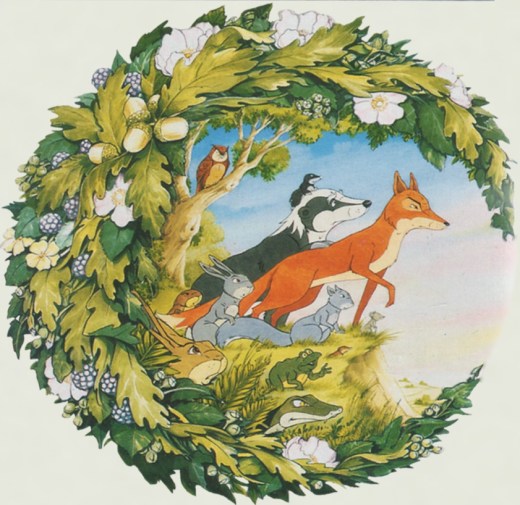
I have recently read The Animals of Farthing Wood for the first time. I watched the BBC cartoon as a child and loved it – enough to remember the main plot and some details. I’m also now rewatching the series on DVD, having deliberately waited to have finished the book first.

There are actually several books in the series (which I only found out when I marked the book as finished on Goodreads) but I have only read the first so I will stick to talking about that, though the whole series is probably known as The Animals of Farthing Wood. Anyway.
Farthing Wood is under threat at the start of the story, as are the animals that live there. It had, long ago been a huge expanse of woods host to many families of animals but humans have encroached year by year until only a small wood and pond are left. They are now destroying even this – the pond is filled in, the diggers are coming closer – and the animals are running out of water.
Despite there being predators and prey in the woods they call an assembly which hasn’t been done in a very long time. All the animals gather in Badger’s set to discuss what they should do, and Toad comes up with a plan. He has only just returned to the woods, having been scooped up in a jam jar by a human. Having escaped and made a very, very long journey back he has become aware of a place called White Deer Park, a nature reserve where all the animals would be safe.
It is then proposed that the animals band together and follow Toad to this safe haven. In order to ensure the safety of all the animals they wear a solemn Oath of Mutual Protection to help each other (and not eat anyone!) on the journey.
The main story is therefore the long journey they make to reach White Deer Park.
There is a wide variety of animals making the journey and this causes a lot of problems as they range in size, speed, ability and needs for food and shelter.
There are the large and quick – Fox, Badger, and Weasel. Fox becomes the leader as he is clever, cunning and brave, while Badger becomes an unofficial but very respected second in command. He is a very good listener and considers everyone’s needs with great care. Weasel is fairly quiet through the book and doesn’t do anything particularly memorable.
Then there are the fliers – Kestrel, Owl and a pair of pheasants. Really these birds could have flown to White Deer Park in a matter of a day or so, but they choose to stick with the pack. With the somewhat dumb pheasants this is for their own good, but Owl and Kestrel are integral to the group’s safety. By day Kestrel leads the fliers and scouts for dangers ahead, and Owl does the same if they travel by night.
Most of the smaller animals are in family groups – the rabbits, voles, squirrels, hedgehogs, lizards and mice. These add the challenge of having shorter legs and thus moving more slowly than the larger animals. There is also the added trouble of getting them to cross roads and rivers and so on, not just because of their size but because they tend to panic and go in all directions. The poor squirrels have to adjust to sleeping on the ground for a lot of the journey as there are not always suitable trees for them.
And last there are some other smaller lone animals. Toad, of course, who is slow but their guide. Mole is practically blind and terribly slow and so rides on Badger’s back most of the way (when he’s not stuffing himself with worms and getting left behind). Adder makes up the group, and is probably the least popular member. Despite Fox also being a predator it is Adder that the smaller animals are most afraid of. Probably because he is very sarcastic throughout and it’s not always clear if he’s joking about eating a vole or two. He does show great bravery at times though – not that he would like to admit it.
Two animals join the group along the way – Fox finds a Vixen to be his mate and a stork called Whistler also joins, but meanwhile the lizards stay behind at a marshy area as they struggle to travel too far between water sources. A few animals also die but I will talk about that later.
The journey takes place over many weeks as they can only travel so far each day. The first issue is somewhere to drink, and swimming pool is found in a garden.
Then they have to navigate though the housing estate and cross a road just before daybreak. The road is their first major obstacle and the birds are key in scouting for traffic and urging the others across.
On the other side of the road is some military land where they manage to rest and eat during the day. Moving on they come to marshland and woods – and a forest fire. They all nearly perish but manage to cross a causeway and shelter on an island in the middle of the marsh until the worst of the danger has passed.
Then a storm breaks and the animals decide to shelter, rather foolishly, in a farm outhouse. The farmer’s dog alerts him to their presence and they are shut in – the dumb pheasants are on guard duty and get themselves shot. Mole rescues the rest of the party, by digging his way out and then the other animals widen the tunnel and escape. Fox has to see off the dog, which he does by clever talk rather than physical strength.
Not long after this they encounter a river. This wasn’t too much of a problem for Toad of course, but it heralds a disaster. Most of the animals (even the ones you wouldn’t imagine to be good swimmers) make it across reasonably easily but the rabbits panic and swim in all directions. Fox and Badger are forced to return to the water to round them up, and exhaust themselves in the process. So much so that when a large collection of twigs and grass comes down the river they get caught up in it. Badger is recovered not too far downstream and sleeps off the accident, but Fox is nowhere to be found.
Here the story diverges. We have a few chapters chronicling what happens to the main group first, as they move on. We see some more losses here as the fieldmice and voles have had babies, and decide they cannot continue with so many small ones. The main group can’t wait around for weeks and so intend to leave them behind. Unfortunately the babies fall victim to a ‘butcher bird’ – something I was unfamiliar with. The proper name is a shrike , a bird which kills small animals and impales them on bushes. So it’s quite a nasty part of the chapter when the other animals find a bush with all the baby mice and voles impaled on its twigs.
The adult mice and voles then calmly re-join the group (I suppose they are used to losing babies).
Meanwhile, we discover Fox has survived the ordeal and has met Vixen. She is persuaded to come along, though she is yet to decide if she wants to live in White Deer Park.
Shortly before the foxes (travelling much more quickly than the others) catch up with the group, Toad had led them partly in the wrong direction. Therefore then the foxes reach that point there are two trails to follow. Fox goes the right way, Vixen checks out the wrong one. She decides she will join the group heading to the park but finds herself being chased by a fox hunting party, and very nearly is caught. Fox manages to distract the hunt, but then brings them after himself, Vixen and the other animals. It is adder who saves the day – biting the hunt leader’s horse and causing the hunt to retreat.
After this they meet Whistler the heron – he saves Toad from being eaten by a pike in a quarry pond – and then they face one of their biggest troubles.
There’s a six-lane road in the way. It had only been under construction when Toad had passed that way, but now it is busy with traffic. The hunt has reconvened and they are desperate to put the road between them and the humans so, taking advantage of a traffic jam on their side, they cross to the median strip. The next part is not so easy – the traffic is heavy.

Whistler is able to carry many of the smaller animals to safety but the rest are left and have to make dashes across the road in gaps in the traffic. Unfortunately the hedgehogs are not fast enough and are killed.
Next up is a modern farm. It’s busy most days so they are stuck for a while, unable to proceed without fear of being spotted. When they eventually do move on the vegetarian animals are desperate to have a nibble of the cabbages and other crops. The wiser animals are against it – the plants look too plastic and perfect. Thankfully nobody does eat because they soon discover that the pesticides used on the crops have killed all the local birds. It’s quite a creepy chapter as much is made of how quiet the farm is – no insects buzzing, no bird tweeting.
Then a pleasant moment – they come across a naturalist in a field and allow him to watch their rather bizarre parade for a while.
White Deer Park is now close, and after crossing through a village they decide to seek shelter in a church for the night. They creep in through a hole in the wall and hide under the organ – though they don’t know that’s what it is. Next morning workmen arrive and start fixing the hole – leaving the animals trapped inside. Their peaceful hiding place then turns into a nightmare when the organist starts to play – for a wedding no less! The wedding turns a bit hysterical as a hoard of animals rush down the aisles and past the bride.
And then, they finally reach the park. Sneaking in through a broken bit of fence they are welcomed by the animals that live there and in particular the oldest of the white deer (as ?Kestrel had flown on ahead earlier to let them know they were arriving). Interestingly they had been waiting on the group for ages as the news of their journey has spread far and wide.
We even get a couple of chapters of the animals settling in to their new home. They all go their separate ways at first – determined to find the best tree to nest in or the best earth to dig in. After a time though, Badger especially starts to miss the comradeship of the group and calls a meeting. All the animals gather – and get drunk on some spilled alcohol! – and realise they have a bond that will never truly break.
I’ve actually asked myself this a couple of times. It’s actually quite different to anything she ever wrote. But there are similarities. If anything, it could be thought of as The Secret Island with a cast of animals instead of children!
There is a strong environmental message which naturally focuses on animals and their habitats. Blyton’s books often have strong moral messages that are comparable, I think. Her characters never leave litter in the countryside and they take care of the places they camp in. There are also strong messages about taking care of animals and preventing cruelty to them. She didn’t really go as far as talking about houses encroaching on habitats – that probably wasn’t such a huge issue when she was writing although it had started – but she certainly valued the wild spaces and wildlife around her.
Blyton also delved into the world of talking animals from time to time – usually with a fairy-tale element. The Farthing Wood animals all converse in full English with each other, but it’s unknown if they can communicate with humans. Humans, on the few occasions the animals cannot help but be seen, are naturally amazed at seeing so many animals together in broad daylight. The general public are too amazed to pose any real threat in fact – apart from road accidents – it’s the farmers and developers that pose the biggest risk.
If Blyton had come up with this story I think it would have read fairly similarly, but perhaps without the deaths. She also may have worked in one or two more positive encounters with humans to show that we are not all bad, but otherwise I think she would have stuck to a similar plot.
 It’s been a while since I favoured you with a Five Find-Outers review, and quite frankly it was because I found it hard to convince myself to keep reading. I just don’t gel with these books as much as the Fives which I read and adored as a child. Also as you know I can’t really get along with Fatty – I am the Goon of the Enid Blyton world in that respect, but anyway, I think its time to see what the Mystery of the Missing Necklace is all about and what its like for those of you who haven’t yet read it. Shall we?
Literally until the last quarter of this book, the whole thing is slow! We start out with no mystery, and the children are almost due to go back to school and they haven’t even had a sniff of a mystery yet and they’re bored. I was as well.
They discover that Mr Goon has a case he’s working on and they’re a bit miffed that their detested Mr Goon has a case to work on and they don’t. They try the best they can to find out what the case is, but Goon isn’t telling (too right!) In the end they decide to go and see Inspector Jenks and try and get him to tell them what the case is because they want to help solve it.
Jenks decides to tell them what Goon is up to but forbids them to get involved because what is going on, a spate of robberies, could turn very nasty indeed. So naturally, this being an Enid Blyton novel, the children ignore the adults and decide to put their sleuthing hats on once more to catch the robbers. However, they have next to nothing to go on, so generally just end up watching Mr Goon to find out something they can go on to try and leapfrog him in this case. These children are bright, I won’t take that away from them, but the problem is that they don’t seem to have much common sense!
That’s a bit of a lie, they do have common sense, oodles of the stuff when they are actually in the middle of a mystery, and solving things, but when they’re trying to find one, especially one that they have been warned off of, they seem to make silly decisions. Now of course they usually involve Fatty ‘having’ to dress up and disguise himself to try and find them a lead, and it must be blooming obvious there’s something going on because a lot of the time the others are hanging around him!
So my Fatty disdain aside, we have Goon puffing and panting around Peterswood on his bicycle, being snapped at by Buster, though this only happens a few times. Once again I am not impressed by Goon’s idiocy. How he even got to me a policeman is beyond me, because he near useless. I used to think that he was just shown up as incompetent by the Five Find-Outers who always seemed to find the mystery before him! However, no – he just is a little bit… unclever!
We begin to speed up the story a little when the Find-Outers realize that the gang who are stealing all these precious gems and things are using an old deaf man in the village to pass on messages between members of the gang. This old man is appearently always sat on that particular bench every afternoon, so why haven’t we been introduced to him before?! We’re five novels into the series and this is the first time we’ve been told about him, and a stinky little sweet shop where they children and Mr Goon end up staying to observe the old man and the comings and goings of the gang with no real idea how the messages are passed between them!
Eventually it gets figured out by Fatty who dresses up as the old man and pretends to be him so the gang come to talk to him instead. Actually a lot of this book seems to be based on Fatty and his dressing up skills. He even ends up dress as Napolean’s waxwork to spy on a meeting of the gang, but ends up getting caught. I actually dislike how much of this book is about Fatty’s brilliant dressing up, and no, the boasting from the obnoxious boy does not get any less as we go on throughout the series and the others just seem to be encouraging him! I mean honestly!
The quick part of the book comes when the gang finally make an appearence and Fatty gets found out and tied up. Mr Goon shows a particularly nasty side to himself at this point where he leaves Fatty tied up in a cupboard on the understanding that he is a “nasty toad of a boy” who deserves to be in that cupboard. There is also some logic to this because in a way it’s the safest place for him instead of letting him free to run around the criminals and distract the police from apprehending them and maybe getting himself into even more trouble. However Goons main reason behind leaving Fatty in the cupboard is spiteful and not what a responcible adult should do. Inspector Jenks is less than pleased when he find out what Goon did; there goes Goon’s chance of promotion.
It then turns out that the necklace was lost from the arrest because one of the team managed to get away from the policemen. The inspector then invites the children to help the police find the jewels because he seems to believe more in the children than he does in his own officer – which is sort understandable because of Goon’s behaviour towards Fatty earlier on. Anyway, we end up with the Five Find-Outers finding the jewels in the most obvious and at the same time most obscure place for the jewels to be placed. Anyway they find them, and look frorward to the next adventure for the next holiday.
I just wasn’t feeling this book at all, can you tell? I suppose for a child it probably is full of the magic it was intended to have from Blyton’s wonderful imagination, but it’s just not for me. Fatty is getting worse, Goon is his worst yet and the mysery takes so long to get started you just want to give up. I mean to give you some perspective, I started the book on the 26th Janurary and only finished it yesterday! Thats over a month of trying to read it. I just wasn’t engaged with it.
As usual that is probably just my opinion but I am just not getting on with these books at all. Anyone want to explain to me what I am missing?
Next review: The Mystery of the Hidden House
Or we have another review of Missing Necklace, by Poppy, here.
After a surprise round up yesterday (I nearly forgot about it again!) here’s what we have planned for this week:

The clocks have gone forward, meaning we lost a precious hour of sleep but on the plus side, spring is (apparently) here!

Dundee doing its best impression of spring

As you can see I managed to fit in a lot more reading this month! I am aiming for 100 books this year so the more I read before July the better. It’s not like me to read books out of order I have to add – but the Harry Potters have been borrowed online from my library and there’s usually a waiting list so I just borrowed what I could get at the time! Similarly the Adventure Island books I just took what they had from my library as they were getting sold off.
I have also been reading books to the baby regularly, but I thought I would list those separately!
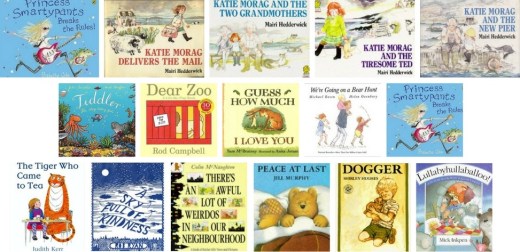
So baby has ‘read’ as many books as I have this month! Many of these are my childhood favourites and others are new recommendations.
Current reads are:

And her current reads:
My ‘watch’ list seems to be decreasing recently, I guess I just don’t make time for it like I did before. However, here is what I have watched:
To start it all off, I’ve turned a year older. I went out, had some nice times out with friends and family.
On my actual birthday I spent the day in Oxford with my friend, wandering around the streets, having a look around the wonderful buildings and then having a sumptuous cream tea!
I also went away with my other half for a long weekend Milan, Italy! My first foray into another country in over ten years! We did a lot of walking and we took a lot of pictures!
The last thing, even if it wasn’t the best is that I managed to tear a muscle in my calf, and have spent the last couple of days on bed rest, trying to get it back to ‘normal’ so I can walk, go to work etc. Unfortunately it means I will not be taking part in a run I had scheduled to do this weekend, and its unlikely I’ll be back to Thai Boxing for a week or two! How gutting! Especially about the race – I had trained as much as possible so I would get a good time!
Hopefully I’ll be fit enough to do another one soon! Onwards and upwards for April huh?
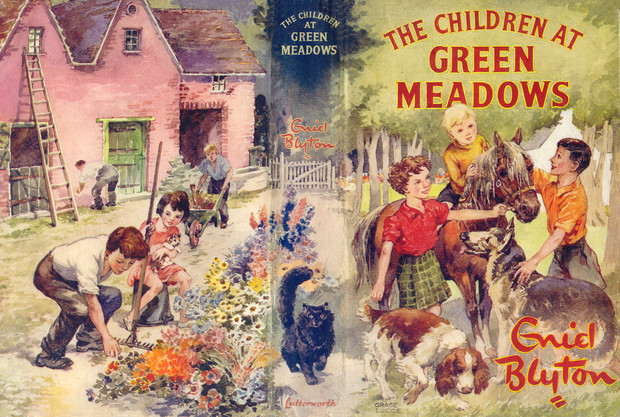
So here is the rest of my review of this book! Previous part can be found here.
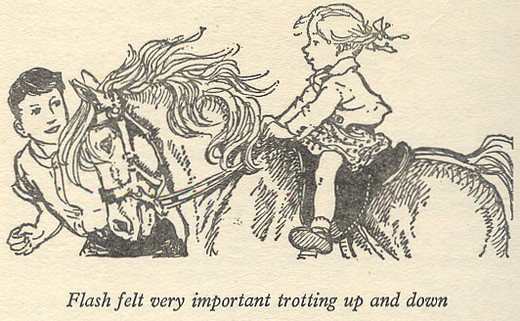
The next arrival is a pony called Flash – who pulls the greengrocer’s cart (this is remarked on as being old-fashioned by his nephew who uses a van for his store). Francis rescues Flash from his stable, having woken up in the night to notice a fire near Green Hedges. It seems a little out of the ordinary for him but he leaps out of bed and goes out into the night to see what’s happening and ends up bringing the pony back.
The nephew doesn’t want the pony at the moment, he’s of no use to him, and there’s no stable to keep him in so he asks if Flash can board at Green Hedges. Daddy says absolutely no way – it will be too much work for Mother – but Granny insists she will do all the work. She even gives up her afternoon rest to do so.
Interestingly, it is mentioned that they go up to Daddy’s bedroom, implying it’s upstairs. I can’t see how it can be as it’s also said that he can’t get out of bed without help.
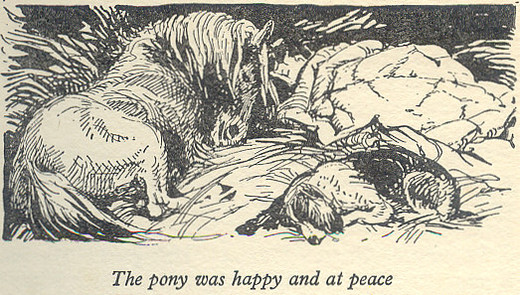
Flash has a wound on his leg from scraping it in the rescue, and it’s too far to the nearest vet. It would cost too much to have the vet on a house call too. Luckily there is an Animal Van visiting near by and they take Flash there. Here there is a bit more exposition as Blyton explains about the PDSA (the People’s Dispensary for Sick Animals, a charity that is still going today), their TOs (technical officers), the animal van aka the caravan dispensary and their van doctors.
The children all think this is wonderful, especially when the doctor fixes up several small animals and then Flash, and are motivated to become Busy Bees – a club of children who are encouraged to learn about taking the best care of their pets but also fundraise for the PDSA and spread its message. Enid Blyton was a supporter of the PSDA and she encouraged her readers to become Busy Bees through her magazine. She also wrote for the Busy Bees newsletter.
The SADP… no I mean the PASD. No I don’t mean that either. Clare what do I mean? – Sam
Sid (the greengrocer’s nephew) decides his way of paying back the Marshalls is to do some gardening for them, and Dan helps out too.
Now that Flash is better the children start offering rides to others for a penny. More animals arrive (mostly from the new flats) including a rabbit and a guinea-pig (the family thought they’d be allowed a hutch on their balcony…) and Sam gets very bossy. I can only assume the Busy Bees have well educated him as he suddenly is an expert on what sort of food rabbits and guinea-pigs need and the size of hutch as well.
Granny adds pigeons to the mix, when a chap moving into the new houses by the flats realises he can’t keep them there. She has him fix up the old pigeon house in secret and hides them away at the bottom of the garden. I’m not sure why it has to be a secret – Mother and Daddy have happily accepted all the other animals. Clearly she doesn’t learn though as of course it gets found out.
Daddy’s room is confirmed as being upstairs here, which still makes no sense. He cannot get washed and dressed without help, cannot get out of bed alone and relies on his wheelchair to get around. How can he get up and down stairs? I’m not sure Stannah Stairlifts were common in the 1950s.
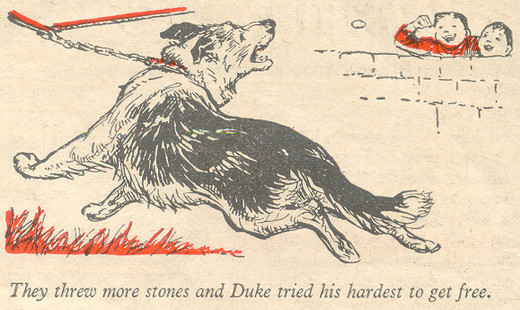
A man called Bill stops by about an Alsatian called Duke. He doesn’t live in the new flats or houses, but his house borders the new ones. The dog is not popular with the neighbours – it is suggested it is partially sour grapes as they are jealous they cannot keep animals. It is then explained that the dog isn’t even Bills, he belongs to his boss. Bill is the chauffeur and is minding the dog on a temporary basis. Give we see later there is a big house beyond Bill’s gatehouse, and a butler at least, you wonder why the dog couldn’t stay there… instead he is kept on a short leash in Bill’s garden, where the local kids taunt him and throw stones. There are tales of Duke escaping and having bitten a few children and the postman as well.
Green Hedges agrees to keep Duke and he is put in Rex’s old run (Rex is now allowed in the house) but on a long lead tied to a wire so he has more freedom. The local kids manage to find Duke still and chuck stones again and he escapes.
Francis has another late-night escapade hunting for Duke, finding him in the summer-house at his master’s home. His master is Sir Giles, an eminent surgeon. He seems to love Duke, but as the dog seems quite feral and won’t let anyone near him he is fairly quick to insist the dog must be shot. Francis does a Philip Mannering though and frees Duke from the tangled wires around his legs, returning him to his more friendly self.
Sir Giles is grateful and lets Francis stay the night, at breakfast he blurts everything out from Daddy’s injury to Mother’s struggles to manage the home and their financial woes.
Of course, we can all see where this is going, can’t we? A world renowned surgeon… Daddy with an old war wound… And yes, Sir Giles thinks there is something that can be done and whisks Daddy away to a distant hospital with the assurance he will almost certainly be able to hobble about after.
Questions are raised though, about Bill. He seems a decent enough person but his care of Duke perhaps left a lot to be desired, and he isn’t really trusted with him after this. I’m not sure what to make of it. He never deliberately abused Duke, and I think he tried his best to ensure he was safe. Oh and it turns out that the stories about Duke biting people were all lies.
Interestingly Mother seems far worse with Daddy away. Perhaps it’s worry and loneliness but she becomes thinner and paler. You’d expect her to be a little better really, as the burden of caring for an invalid has been lifted.
I have noticed one horrific error in the chapter though – Or do you mean are they all like me too look at? Cringe.
An awful lot happens in this chapter – pretty much everything is finally resolved in the space of a dozen pages.
An old friend of Granny’s visits – she recalls Green Meadows in its heyday and, as a huge coincidence, is looking for somewhere to start an animal shelter. Her mother had died recently and left her money to do this.
They leave after a nice afternoon tea and it is Francis that comes up with the idea – sell Green Meadows to the friend! It’s just what she needs, and they can convert the stables into the perfect little house that mother can easily manage. That way Granny doesn’t truly have to leave Green Meadows.
Surprisingly this is jumped on almost immediately and put into action. The friend is contacted, the stables are converted (though goodness knows what this new animal sanctuary will do with any ponies or horses that come their way – but I assume Flash went back to his owner before the work was done) and all is well when Daddy comes home.
Daddy has had a miracle happen, and he strides in at the new garden gate and even picks up Clare his back is so well now – though it did take several months. I can’t help but wonder what Sir Giles did for him!
And there you have it, Mother got her nice little house (even if Sam is lumped with a tiny box-room bedroom), Daddy can walk again and Granny didn’t have to leave Green Meadows really. It is a slight shame all this occurs in the final chapter so we don’t get to really see them enjoy the new set up – or see the more professional animal sanctuary up and running.
 I know you’re getting an onslaught of these Enid Blyton for Grown-Ups at the moment, but as they’re quick to read they make a perfect blog to work on. I can pick up the book on a Monday night and finish it by Tuesday lunchtime if I don’t get interrupted while reading.
Anyway, Five Give up the Booze starts out promisingly, I’ll give you that. So now is time to take a look at it all!
We open the book on New Year’s Eve, and the Five are sipping champagne cocktails and wondering what the New Year will bring for them. On their way to their party they pledge to only have a few drinks and then leave, no one really wanting to stay long and Anne asks them about their New Year’s resolutions. The others join in with her resolutions halfheartedly and the party begins.
The next morning three of the Five are hung-over (Timmy being the one who was completely sober the whole time) and Julian who has been permanently drunk since before Christmas. Slowly it dawns on all of them that they have to do something about their drinking problems and Anne makes them all agree that they should give up the drink for January and focus on their health.
Julian is the most reluctant because he doesn’t see himself as having a problem, but eventually realizes that he has been drinking excessively and agrees to join in. They face a huge problem however because they have a family friend’s wedding at the end of the month where the drink is going to flow. Julian also happens to be the best man so the double temptation to drink is there because he has to go on the stag party, with Dick, and the girls have to go on the hen do, leaving Anne to have a little lapse.
The whole book culminates in the Five raising a double scotch to a ‘dry’ month when the clock strikes 12am on the first of February and the friends have done remarkably well, even with the curve balls they’ve been thrown.
You might all be a bit surprised at this, but Five Give up the Booze comes out quite well compared to some of the others I’ve read. Its actually got substance to it, a problem that doesn’t just appear out of the blue, and the challenge is presented to the reader quite early on. There’s a bit more ’emotional’ depth to the Five this time around. We get to look a little deeper into their heads, especially Julian’s!
It turns out that Julian is fighting a lot of demons about the drinking, and being best man. The Julian we know, who tends to be organised and on top of things has gotten lost somewhere and he only writes his best man speech the day before the wedding! The dark sides of Julian seem to be the key to this characteristic. The parts that no one seems to like, such as the pompous attitude, the arrogance etc, make up the basis of his character. Gone is the integrity of his good meaning ways, and its been replaced with an ignorance arrogance as you’d expect from some sort of high class nincompoop! However, you Julian haters out there will like the fact that by the end of the book he does get himself a black eye. I won’t spoil how, but it comes after a particularly cringe-tastic part of the book that I never really thought would make it into a Famous Five book. I literally slammed the book down at this point and had to have a moment to compose myself before reading on to see how it ended.
That all said, there are some down parts to this book, for example Anne took up smoking in her teenage years and then again when she’s denied booze for a month – where on earth did that come from?! Anne, smoking? Purrleeeasssseeee! She wouldn’t have touched one of those – and neither would she have been a heavy drinker. The characterization in these Famous Five for Grown-Ups is way off. I can never really find the original characters in them, and tap back into the nostalgia. The characters are basically lost in a mash up of grown-up and modern day mannerisms that make them unbearable to read about in a way.
Even though I write stories about the Five in their advanced years I cannot see how anything could change them to be so different. Of course I agree that is only my interpretation of them, but it’s hard to enjoy the book when the link back to the original Five is so weak and flimsy. Where are the Five we love, Mr Bruno Vincent? Just where!
This Famous Five for Grown-Ups comes out much better than the others so far, it has a linear progression – we know it comes after Brexit Island for example, and we know that the Five have a hurdle to get over to complete their goal of a dry January. So I really feel as though this book deserves a higher rating than the others apart from the fact that the characters are so unrecognizable.
Have you read Five Give up the Booze? What did you think? Let me know?
Looking for something else to read? More Famous Five for Grown-Ups reviews can be found here.
So I’m back from Italy and we have a busy week for you on the blog: Fiona will bring you the second part of her Children at Green Meadows blog, and I’ll be looking at Five Give up the Booze!
In the mean time it has been Mother’s day here in the UK and the clocks have bounced forward signalling the beginning of British Summer time! Yay!
Here’s to a busy blog week!
Looking for something to write about this week I browsed older posts and spotted Stef’s post about her least favourite characters, and I decided that would be a fine thing for me to write about too. I didn’t have any ideas for my characters at the time but I was sure I could come up with something.
Ah, Gwen. I have seen several rather passionate defences of Gwen lately, suggesting that she is to be pitied. It is said that the other girls are merciless bullies and tear her apart simply because she doesn’t quite fit in – and that isn’t even her fault because she has had a lousy upbringing.
Well, sorry, but I still can’t like her. She has been raised in a wealthy home, never wanted for anything and has had the love and support of her parents and her governess. This is far more than many people have in their young life. Yes, her family life is not perfect, and yes she has been encouraged into being somewhat spoiled and over-confident in her own abilities, but many girls have gone to Malory Towers. St Clare’s, Whyteleaf or indeed into the garden of Those Dreadful Children next door and have then taken a long hard look at themselves. They have recognised their shortcomings and have taken at least some steps to becoming better and more pleasant people.
But not Gwen. No, she never seems to learn. Once of twice she perhaps attempts to be better, but it is a case of too little too late really and she gives up at the first hurdle.
Throughout the six books she is at best boastful and shallow and at worst spiteful, manipulative, dishonest and cruel. She picks on sweet, quiet Mary-Lou and ducks her under water in First Term, (she is even reluctant to apologise after) and then tries to make Darrell look like a bully by setting up thefts and breakages. Just about every year she shamelessly stuffs up her parents and governess with deliberate lies about her popularity and academic ability. In the upper fourth, she pretends to have a heart problem to get out of doing exercise – thus worrying her family sick and making light of what is a serious and upsetting problem for Clarissa. Even seeing a good many of her flaws practically mirrored in Maureen isn’t enough to make her change.
So despite any arguments you could make defending her, I cannot like Gwendoline!
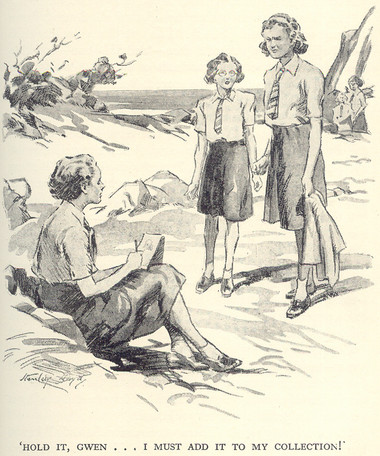
Gwen showing off one of her best scowls for Belinda
Policemen in Enid Blyton’s books are by and large friendly and helpful characters (the one in Five on a Hike Together is a rare example of the opposite) so it makes Mr Goon stand out all the more.
He appears to be inept at police work on the whole, as the Find-Outers regularly outshine him in the detecting department. Perhaps left to his own devices he would solve things eventually, but I wouldn’t put money on it.
He holds himself in very high (and rather undeserved) regard, believing that everyone ought to respect him and treat him as a higher being. In my opinion, he hasn’t done very much to earn anyone’s respect! He is aggressive, rude and bullying throughout the series not to mention violent towards his nephew and Buster.

As is often the case for me, I had trouble coming up with a third character and then after some ‘research’ ended up with several potentials.
I wrote the below in response to which character’s ears would you most like to box? way back in 2009 (I have corrected the spelling, for anyone who reads the thread!)
I don’t think there are any characters I hate (except the mean evil baddies like Jo-Jo or Guy Brimming) but at certain points I might quite like to box Gwendoline’s ears (especially when badmouthing her father and trying to blame Darrell for the mean things she herself did to Mary-Lou), Theophilus Goon, June (before she saves Amanda of course), Horace Tripalong for giving away Bill’s escape, Junior for being so sneaky and rude, Tala for the way he treats Oola, hmm and Oola’s uncle too, Arabella for her stuck-uped-ness and going behind Elizabeth’s back……. and oh my I have to stop now I’m getting all worked up!
I can’t find myself feeling particular animosity towards Horace, Junior, Tala or Arabella now though. In fact I can hardly remember Arabella’s crimes. No doubt all are quite unpleasant at times though.
I also wrote
I’d give up the chance to box the ears of all of the above for a chance of giving a hefty slap to whoever updates the books.
But that’s not technically a character. So that left me with a few suggestions from other forum users. They made plenty of suggestions I don’t agree with (like Julian!) but a few stood out. Rose Longfield from The Six Cousins, Mr Lynton from The Barney Mysteries and Susie from The Secret Seven.
Susie I ruled out as she only pops up sporadically throughout the Secret Seven books – though I can tell you she is utterly maddening none the less.
Mr Lynton and Mrs Longfield were hard to choose between as both are somewhat lacking in the parenting department. Mr Lynton is one father you wonder why he even had children as he seems to despise having them around – Roger, I believe, does remark that ‘Daddy’s such fun on holidays’ (or words to that effect) so I will give him the benefit of the doubt and assume he’s not always so crotchety. In fact, perhaps he is utterly charming when he hasn’t got Snubby (another popular choice for the above thread) causing chaos around the house.
And so that leaves me with just one last name.
There are some very good arguments both in favour of and against boxing Rose’s ears and I will try not to simply repeat them.
For anyone unfamiliar with this character or books – Rose and her family lived a well-to-do life in London for years until their house burned down. The children are sent to Mistletoe Farm to stay with their cousins. They are a bit spoiled and affected at first but learn to enjoy a more simple life on the farm while their father works very hard to raise money to sort themselves out again.
It seems like both parents have been a bit silly perhaps – they don’t have any savings or contingencies but at least the father – David – pulls his socks up and makes the best of things, as do the children.
Rose, on the other hand, well. She goes off to a convalescent home or somewhere like that to recover from the tragedy. You have to have a certain amount of sympathy for the lot of them, losing everything as they did, but it’s only Rose that decides to wallow in misery and self-pity. People have said perhaps she has less coping ability – maybe so but she’s a mother and surely should do what she can to put her children first? The children go off alone to Mistletoe Farm, having lost everything, and could probably have done with the support of their mother. Saying that, they were probably better off without her though!
When she does finally turn up to visit them she has put a lot of effort into making herself glamorous, and turns her nose up at most of what Mistletoe Farm has to offer. She even goes as far as to insult her children for no longer being pale, weedy and meek town-folk.
In the second book David has bought a smaller farm near Mistletoe Farm, and thinks the family can settle happily there and be together again at last. He and the children put a lot of effort into making it a success, but unfortunately Rose doesn’t put as much work in. She hasn’t changed her ideals in the slightest and is still trying to live an upper-class life with dainty afternoon teas which doesn’t fit with farm life in the slightest.
So to summarise, Rose is pretty selfish and self-serving throughout (unpleasant in itself but so much worse when it’s a mother). I think she does resolve to do better eventually but it’s right at the end of the second book so we don’t really get to see her redeem herself. I would like to think she does though, for her sake as well as her husband and children.
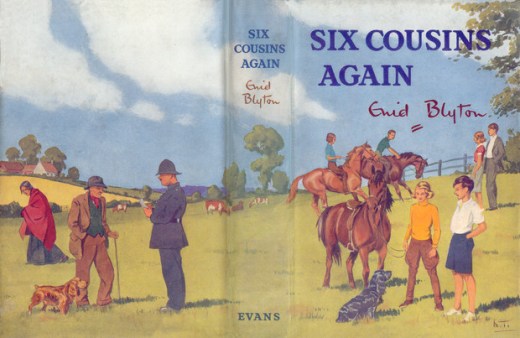
I think it’s perhaps interesting that all of my choices are fairly reasonable ones – unlike those people who hate, for example, Julian! I tend to dislike the objectionable characters and like the ones I’m supposed to like. I very much follow Blyton’s clear suggestions as to who are the ‘good’ ones and the ‘not so good ones’.
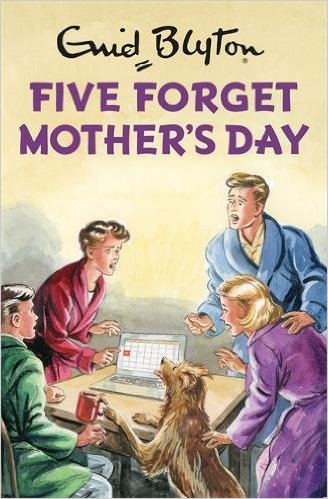 Five Forget Mother’s Day – honestly, how could our beloved Famous Five forget the one day a year that we use to celebrate our mothers (not that we shouldn’t celebrate them everyday!)? I got this book to give to my mother on Mothering Sunday or before as I won’t be in the country for the UK’s mother’s day this year – taking a long weekend with my other half in Italy – so I felt that before I gave this to her, I should read and review for the blog. I mean, come on, how much more topical can I get than this? So let’s take a look at what Bruno Vincent has done to our much loved Five and our darling Aunt Fanny in this installation of Famous Five for Grown-Ups!
Bear with me on this one, because I don’t necessarily mean that the whole book is an utter disaster, but the whole point in the story line is that the Five cannot basically arrange a drinking session in a brewery, which is a long cry from when they were children and used to have brains and proper adventures.
Between Julian, Dick, Anne and George they have successfully managed to screw up getting a birthday present, a Christmas present and an anniversary present for Aunt Fanny and George is worrying what to get her mother for the upcoming mother’s day. Well this is where it all goes a bit wrong because Aunt Fanny just arrives at the Five’s shared house and starts taking over, rearranging the kitchen and buying them a new vacuum cleaner.
The Aunt Fanny we knew and loved from the books seems to have gone and been replaced with some strange hybrid who doesn’t listen to anyone and tries to force her opinions on everyone and has a lost her motherly filter. Shes very blunt and the whole visit plays on the fact that George and Aunt Fanny can’t see eye to eye, when it seems to me that they are actually very alike!
Eventually, after a strange, surreal ‘moment of truth’ in a Wetherspoons of all places, Aunt Fanny leaves the Five to their own devices and heads back to Kirrin. The whole thing blows over, especially when Uncle Quentin manages to land himself in hospital, and Aunt Fanny proclaims it as the best present ever because she was desperate to get him into the hospital for a check up anyway. Help! She’s suddenly gone sadistic!
So that’s a basic overview of our plot, now shall we look at the actual story?
Without a shadow of a doubt this is another Five on Brexit Island all over again. The concept is fine, it works as a’grown – up’ novel but the story doesn’t seem to have much a point to it for a long time, not to mention some of the things that Bruno Vincent throws in randomly! Such as Julian being a heavy drinker, Aunt Fanny feeling like she could fancy Dick if she was younger and Anne randomly saying darling every five seconds.
The whole book feels messy! Just as messy as Brexit, as if it was written in a rush without any proper characterization or way to string the very basic idea of the plot together. To look at the characters properly first for example, Enid Blyton’s loved characters are so far from the original in Bruno Vincent’s book, that I could be reading about very different people.
Julian is an alcoholic; Dick reserved and yet incapable; Anne tentative and overly sweet and sickly; while George probably shows the most similarities to her original character than the others in the fact that her temper is always close to the surface in this novel. The essence of the characters is there I suppose but the warmth, and joy of them isn’t. Vincent has failed to bring the characters – even a vague approximation of them – to life again. He’s made them too modern, to sassy, to techy. Not to mention appallingly ignorant of anyone else! I wish I could say that the redeeming factor was that it was funny, but for me the humour fell on deaf ears.
I really wish I could like this book, because the idea is such a good one – especially with the twist at the end, but its so hard for me to do, even though I pick up these books and never expect to find the Famous Five of my childhood I can’t find them funny.
Some little titbits here and there can be found a little amusing, maybe the summaries of Uncle Quentin or Dick breaking something valuable in an antique shop where they were hoping to buy a present for Aunt Fanny, but all in all, I can’t recommend this book. If you get given it for mother’s day, then please do read it and let me know what you think, but if you can borrow it from someone, please do! The only reason I brought it was because it was on offer on Amazon and you know I’d do anything for you guys.
So there you have it – I never thought there would be a grown-up Blyton as bad as Brexit Island, but there is, and we have it. I am surprised we didn’t have many more titles for Valentine’s, and St Patrick’s day. Maybe we’ll have one for father’s day, but I think there might be a new one out in the summer… we shall have to see!
As always, let me know what you think in the comments, its always helpful to hear another opinion!
Looking for something else to read? More Famous Five for Grown-Ups reviews can be found here.
How is it Monday already? I never used to notice Mondays so much when I worked weekends, but now I have weekends off it’s a different matter. I don’t actually have to work until Wednesday this week so perhaps I shouldn’t complain! (I do have to be up first thing for my whooping cough vaccination though so that feels like enough!)
Anyway, here’s what we have planned for this week:
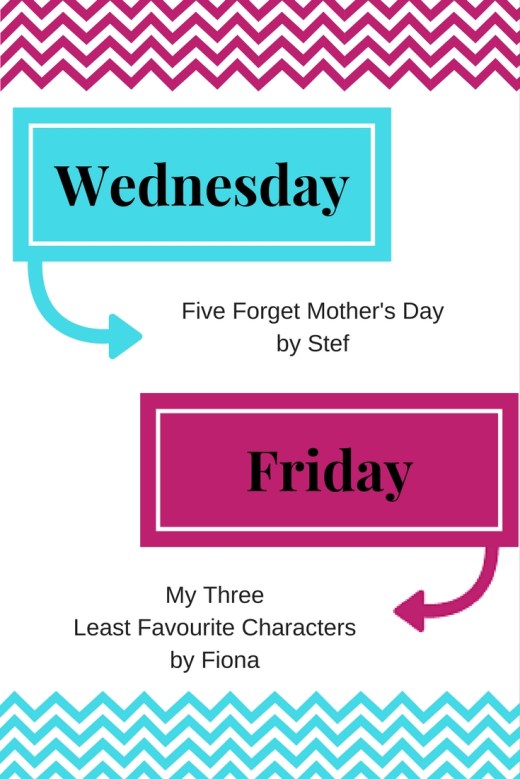
The title of this book doesn’t give much away, and it could be a story about just about anything. It would probably be classed as one of her ‘family’ books, I have it on the shelf beside The Family at Red-Roofs and House-at-the-Corner.
It could also be considered as an animal book, as that is the other main theme. I like family books, but I’m one of those strange people who doesn’t particularly love animals. I mean I don’t go around kicking puppies but I wouldn’t want a cat or dog myself and if you ask me what my favourite animal is… well, I don’t really have one. I visit zoos and aquariums occasionally and I like to spot squirrels and buzzards when I’m out, but I really wouldn’t call myself an animal person.
Because this book is about the family and the animals I still enjoy it though, but Blyton has the ability to have you enjoy a book even if the subject isn’t something you would normally read.
I’m not sure if I’ve read this more than once before. I certainly had a 1992 Dean edition when I was younger, it’s possibly one I read later on when I had nothing else new by Blyton as the cover didn’t really appeal to me. I have a hardback now (second impression) but I’m not certain if I read that edition when I got it.
Before reading this week I jotted down my recollections just to see if I was right:
And that was about all!
It turns out that it was Daddy in the wheelchair, but they do live with Granny as it’s her house so I obviously muddled the two. The cause of Daddy’s disability – a back wound in the war – is explained, and how they came to live with Granny, how the house is run down and yet she won’t sell and so on. This is all explained by Francis, the eldest boy, and Mother having a conversation with a lot of ‘and you knows’ in it. It unfortunately does come across as exposition as there’s no need for two people who have lived through all that to stand and explain it all in great detail to each other.
Anyway, apart from the unfortunate exposition my lasting thought from this chapter is that Granny doesn’t seem very nice! OK, so she allowed the family to live in her house for a long time (while she was elsewhere it seemed) so that would have saved them money perhaps. But now she has moved back in and refuses to sell. No ‘decent’ daughter would move out and leave an older lady struggling in a large house so Mrs Marshall is forced into over working herself caring for an invalid husband, three children and a large house.
It’s honestly like a conversation you would read on Mumsnet.
“Am I being unreasonable?” asks MotherMeadows. “My mother let us live in her home free of charge for a long time, but now the house is too big and unmanageable. My husband is wheelchair-bound and we need a more accessible property but she won’t sell. Can I move out and leave her alone after all she’s done for us?”
There would be two distinct types of response,
YANBU (you are not being unreasonable). Yes your mother did you a kindness but you don’t owe it to her to stay forever somewhere that isn’t suitable for you. Have you made it clear she would be welcome to join you in a new house?
And on the flip-side,
Yes, you are being VU! (very unreasonable). Your mother let you live in her house free of charge for years and now you want to leave her in a house she can’t afford on her own?
I think I may have strayed into Duncan McLaren territory now – making up imaginary scenarios so I will move on.
Housing aside, Granny is the sort to pick faults with people and be quite difficult to get along with. It’s said a few times that she is really kindly though, and would do anything for anyone, but I don’t often find that having one good quality negates the effects of nastiness. She also wears ‘many chains’ and thus jingles when she walks. Very odd.
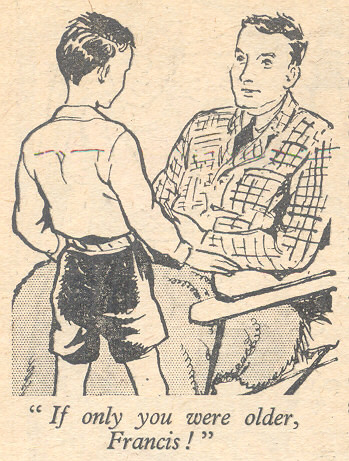
Mother does seem to work very hard though, and the poor children have quite a lot put on their shoulders too, and not just from Granny. Even Daddy wishes that Francis were older so he could act as the man of the house.
A lot is made of the fact that all three children respectively belong to the Scouts (Francis) the Brownies (Clare) and the Cubs (Sam). For those of you unfamiliar with the idea, all three are groups inspired by Robert Baden-Powell who was involved in the Boys’ Brigade and then wrote his own books on Scouting. He trialled the first scout group in 1907 (on Brownsea Island no less, which may be why Scouts are the only folk allowed to camp there now) and then lots of others were modelled on his work, and in 1910 his sister began the Girl Guiding movement which includes Brownies and Guides.
They both instil the idea of doing a ‘good turn’ every day, and of putting others before yourself. It’s interesting as in many Blyton books the moral compass is defined by Christianity. They do pray a few times in this book but for the most part their good and selfless behaviour is attributed to their scout groups.
Francis lets the Scouting side down by allowing himself to be goaded into a fight with another boy. He had been wandering around pretending he had a dog (as he longs for one) and when this bigger boy teased him and tried to ‘steal’ the imaginary pet Francis ends up fighting.
Blackie (Granny’s cat) also gets himself into a fight in this chapter and it shows a slightly nicer side to Granny as she worries about him.

After the fight Francis’ imaginary dog just won’t reappear for him, so it’s really somewhat ironic that the unkind boy from earlier then turns up at Green Hedges begging them to take his own (real) dog in.
This is because new blocks of flats have gone up near Green Hedges, on what used to be farm land, and the landlord has declared no pets are allowed. You would assume this would be made clear before any tenancies were signed, but no, everyone has a week to get rid of any animals. So the boy, Dan, wants Francis to allow Rex somewhere to stay but he will come over to feed and walk him.
Being a Scout and therefore a good person, Francis puts aside the fight and agrees. I’m always astonished how quickly Blyton’s children forgive and forget real nastiness.
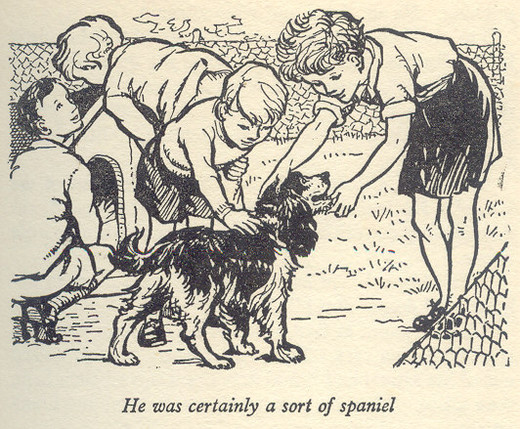
It’s not unusual for Blytonian children to keep a secret from their parents or whichever adults are responsible for them. However it is generally stated that they mustn’t outright lie, and you may only say “I don’t know where he is” if you genuinely don’t know his exact location because he carefully didn’t tell you before he went. It is also acceptable to say “I can’t tell you where we have been because it is a secret,” as long as you accept the punishment with grace. Usually they get away with it as the parents never ask the right questions and not admitting something isn’t the same as lying.
Here, however, the children choose to keep the dog a secret as they believe that the adults would tell them they couldn’t keep him. They blatantly get asked where they have been after constantly disappearing to tend to Rex and they never seem to use the “I can’t say.” They just mysteriously manage to not answer.
Considering they are keeping a reasonable-sized dog at the bottom of their garden it isn’t too surprising that Granny finds out. She is quite happy though – she misses a dog she had a long time ago – and agrees to keep it a secret from Mother and Daddy.
Mother still finds out though – when Dan’s mother, Mrs Oldham, comes to thank her for keeping Rex. Mrs Oldham then insists on doing something in return – by coming in a morning a week to clean and work around the house.
There are a few interesting insights like that in the book – showing us the differences to people’s lives when they moved out of older homes and into new flats with all the mod-cons. Mrs Oldham suddenly has a lot of time on her hands – perhaps she has a washing machine and tumble drier now, instead of having to hand wash and ring out all her clothing and linen. A small new flat would also be easier to keep clean and tidy.
Of course there were drawbacks at times, when close communities were separated and moved to different new homes where there wasn’t a community spirit at all.
This chapter also sees a kitten arrive. A little girl’s family have also moved into the new flats and her new birthday kitten has to go – again this seems slightly poor planning!
I think I have written enough for one day now! But so far we have a very promising menagerie and various problems still to be dealt with.
 As we know, I managed to lose the track of which Famous Five episodes I had reviewed, which is why we have come back to Five Run Away Together. I completely skipped it for some reason! Anyway shall we get on and have a look at the episode?
Adapted by Gail Renard, Five Run Away Together starts with the arrival of Mrs Stick and Mr Stick and Timmy being less than pleased. Mrs Stick mentions that she’s usually quite good with animals and George doesn’t exactly trust his instincts which she usually does without a shadow of a doubt.
The reason that Uncle Quentin and Aunt Fanny are going away and taking Rogers with them is because Uncle Quentin’s mother has been taken ill so they need to look after her and Rogers will be tidying the garden – a big difference from the book where Aunt Fanny has to go to hospital and have an operation and Joan the cook has a broken leg, I think. Anyway, the fact that Uncle Quentin is supposed to be the brother of Julian, Dick and Anne’s father rather begs the question that, if the Ju, Dick and Anne are being sent to Kirrin, doesn’t that mean that Quentin’s brother can go to their mother instead of Uncle Quentin rushing off? I know that would mean no adventure because the parents would be around to stop the Sticks in their dastardly work, but don’t you think that there’s something in that? I mean makes sense for them to take turns I suppose. We’re not actually told what is the matter with “Granny” only that she’s not very well but judging by the reactions of the cousins when Aunt Fanny apologies for leaving them so soon, they know what’s going on and are worrying as well. All very tricky!
Almost as soon as Aunt Fanny and Uncle Quentin have left Mrs Stick starts laying down the law and after Timmy has had an apple thrown at him by Mrs Stick’s son, Edgar, he is locked up in a shed and the key hidden. A midnight excursion sees Timmy set free and the decision to leave Kirrin cottage and live on the island is formed. We don’t have the wonderful build up of the Five packing and deciding to get the fresh bread from the bakers and piling the boat up high with rations. In fact the whole thing is rather less thrilling, and down to the discovery that Mr Stick is trying to move the boat and the decision to leave as soon as they find out that Timmy is going to spend the rest of Mrs Stick’s visit in the village.
The last change I want to share with you is the lack of a kidnapping, and little Jennifer Armstrong. We actually have a whole change of plot and its down to an escaped convict being housed on the island until the Sticks can get him away. So its a complete change of situation really, and I’m not entirely sure why!
Without a doubt the special guests made it for this episode, especially when the gentleman playing Mr Stick turned out to be none other than the second Doctor himself, Patrick Troughton. Barely recognizable as the second Doctor, Troughton makes a perfect crook, though probably not the right kind of Mr Stick – who is a sailor in the book, or at least thought to be one. Without a doubt, Troughton was one of the ones who could turn his hand to anything. Long ago in the dim and distant past, somewhere on the internet there was an article written by Gary Russell, who played Dick, talking about his memories of the time he spent filming and even though I can’t remember exactly what he said, I remember him talking about how much he liked having Patrick Troughton on set. I wonder whether this gave Russell the first big buzz to get into the Doctor Who production family – how I wish I could ask!
Anyway, moving on, I also liked the inclusion of Edgar – the Stick’s son – who is thoroughly nasty and sings those horrible songs at George. He’s a much more lively Edgar than that of the 1990s TV series who always seems lethargic and bored. The fun part is finding out that Julian and Anne swapped Edgar for Dick and George, who had been imprisoned by the Sticks in the dungeon.
For such a slow beginning, all the adventure rushes to the end, and when the Five trap the Sticks and the convict in the dungeons and head for their boat once more, the unexpected appearance of a new boat on the shore and a figure no one can make out, puts them all into panic stations and they make to pounce on this new stranger. Who then turns out to be Uncle Quentin! Whoopsie!
Some of the dialogue that was inserted into the episode was very much in keeping with what we have come to expect from these Famous Five episodes. Renard’s adaptions don’t carry as much of this as some of Gloria Tors’ for example, but when she does insert it into her script it is amusing.
Upon their arrival at Kirrin station and Rogers picking them up in the car, Dick greets Rogers in a rather friendly way, knowing that the gardener is hardly ever happy to see them, where as Julian is the one who makes the silly comment. Rogers looks less than impressed but for me it is one of the only lines that stood out in the episode.
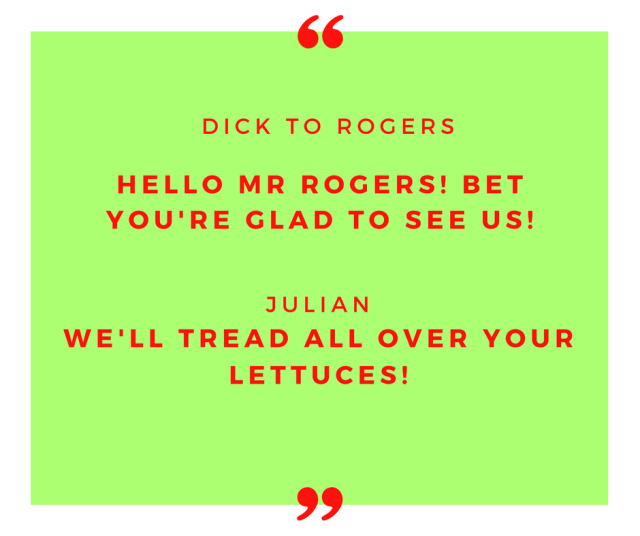
Now tell me that’s not amusing!
So it’s not word for word what it is in the book, but show me a TV episode of either series that is. The problem with this one is that because it changes so much from the book, it’s trying to become its own story while being true to the original. As a stand-alone, it would have been a brilliant episode and I think whoever decided not to allow the writers of this TV series to write their own episodes for a third series shot themselves in the foot, because all the writers – even if I haven’t liked the episodes – did a wonderful job with their episode whatever they did to it. Renard’s Five Run Away Together would have been a very good stand alone story with a few names changed and maybe the odd plot tweak here and there but as a version of Run Away, it doesn’t come anywhere near Enid Blyton’s original, which is a shame because its actually one of the stronger episodes!
Anyway, please let me know what you think of this episode!
Once again, the week has gone sailing by and another set of blogs is called for! Fiona is one week closer to having her baby and I’m one week away from my 26th birthday (St Patrick’s day no less)!
With that all said, we’ve got a busy blog week for you, so I hope you’re looking forward to our work!

Whoops, as you probably gathered we have missed the last couple of round ups. Fiona has done her blog and now it’s my turn.
February –
January –
December –
Current reads –
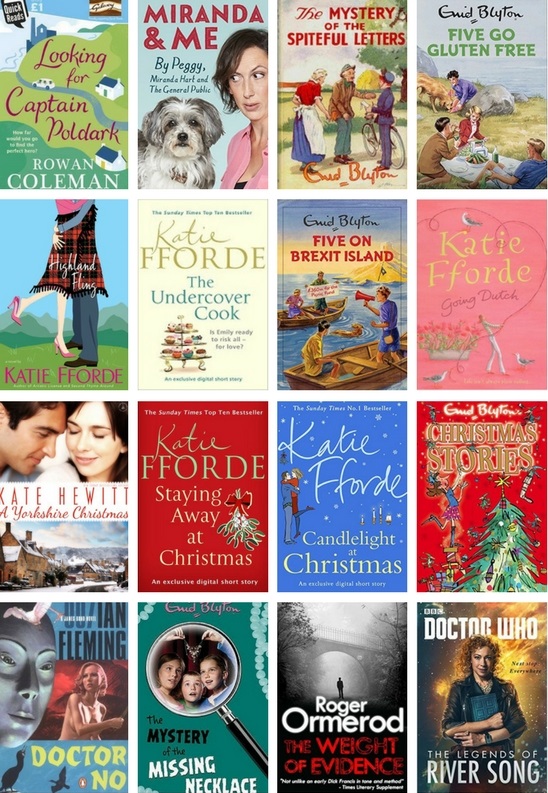
Now don’t ask me what I watched when, because I don’t think I could remember! However here we go:
I think that’s all from me really! However, hopefully as my birthday’s coming up in a week, I might be able to have plenty more things to tell you next month! Enjoy!
Some of you may remember that I have previously reviewed the original version of the Who’s Who book (it took three posts – Adventure Stories, School Stories, and Toys and Enchantment. You also may remember that I pretty much ripped it apart as it was riddled with errors and incredibly inconsistent. I am clearly a glutton for punishment, however, as here I am with the updated edition to see if it is any better. I have been reliably informed that previous mistakes have unfortunately not been corrected, so I just hope the new additions are worth having published a new version.
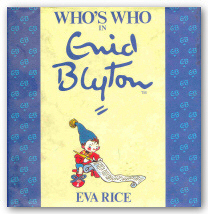
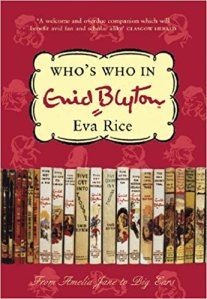
This has been updated to reflect the fact it is a revised edition – and it says that the book has been expanded to include The Barney Mysteries and the Farm books. I don’t know which books the Farm books refer to as there are quite a few, but we shall see! In slightly different words it still states that it does not claim to cover every character which is just as well.
The first section is still adventure books – and The Put-Em-Rights is still wrongly included. Interestingly, despite the list being changed from lowercase text to uppercase and an added illustration at the bottom of the page they have failed to include The Barney Mysteries to the list at the start of this chapter (it is there in the contents page at the start though).
This is a fairly good section, and it was definitely worth adding – it’s clear that Eva Rice has either read the books or done a decent amount of research here. There are very few characters I can see as missing – but I myself am not sure if they are ever given a name in the book and so their omission is quite reasonable (off the top of my head I came up with the woman in charge of Ring O Bells hall, the men – particularly the leader – from the underground portion of Rockingdown and a few shop keepers from different books.
There are however, two mistakes. One is using the name Sardine for the Lynton’s cat without mentioning she was originally called Snoek. The other is worse! In the opening description it tells us that the children are often looked after by Miss Hannah Pepper. This is incorrect. They are looked after by Rebecca Pepper, and her sister Hannah runs the guest house they stay at in Ring O Bells. Strangely they get them the right way round when they get their own sections later.
The Farm Stories are listed as – Cherry Tree Farm and Willow Farm, Six Cousins. This is slightly confusing as Cherry Tree Farm and Willow Farm are from the same series, the titles being The Children of Cherry Tree Farm, The Children of Willow Farm and More Adventures on Willow Farm, and they are usually known as just the The Farm Series.
The introduction to this section does a lot of comparing these books to the Six Cousins books, which is fine but as the reader hasn’t yet read the Six Cousins section it doesn’t necessarily make the most sense.
Likewise, some of the descriptive sections don’t make sense. Several donkeys are named individually (fine) but all but one read ‘see Hee-Haw’. A couple of them come first alphabetically and one afterwards. Hee-Haw’s section simply states which donkey belonged to which child so I can’t see why the section for each donkey couldn’t include that piece of information rather than referring the reader to another one. It also makes no sense to pick Hee-Haw as the one referred to being in the middle of the list.
This happens again with Hoppity and Jumpity. Hoppity’s section just reads see Jumpity. It would have made more sense to have it the other way around so that anyone reading it in order would know they didn’t have to go back.
The children’s father, for some reason, appears in two sections named as Father and John.
Apart from those niggles the Farm section is decent, many animals are included but they are quite important to the story.
The only problem I can see in the Six Cousins part is a few instances of very lazy, choppy sentences. I hesitate to even call them sentences in fact. Hazel the shepherd gets two proper sentences about him, followed by Has twinkling eyes. Old. Did Eva Rice forget to turn jotted notes into coherent sentences? Why could his age and eyes be worked into the earlier lines?
Otherwise, again, this is a good section and well worth having been added. Some good character analysis is given and examples from the books are well used.
I think it is fair to say that this is a revised book as there are two significant sections added but it is not quite right to call it fully revised as the majority is remains untouched. They have, however, changed the illustrations. There are not more, I don’t think, but they are given half- and even full page prominence instead of being squashed into the margins as vignettes. They make use of some newer illustrations mixed in with the old as well.
It’s just a real shame that the original problems – major omissions and errors – are simply reprinted. For example, the Adventure Series has only the main cast, Bill, Uncle Jocelyn, Gus and Jake listed. I still can’t get over the fact it ignores Mrs Mannering. And possibly worse – the Secret Series is missed out entirely!
Last time I brought you a selection of destinations in London and Buckinghamshire where you could go and be close to our favourite authoress Enid Blyton. This week I’m going to start looking down by the coast, the south west of England and a mixture of locations that might have sparked Blyton’s imagination, places she visited and places used during the filming of the two TV series. I haven’t been to all of these places so I’m just going to explain to you what they’re related to in regards to Blyton.
So what are we waiting for? Full list of TV series locations can be found here, on the Enid Blyton Society Forums.
Corfe and its ruined castle is a must see for Blytonites (I can’t believe I’ve never made it down there!) Poole and Dorset are places that we know Blyton used to visit on her own holidays, so we assume that a lot of her inspiration came from there and we can trace that with some of the places and descriptions she provides us with throughout her book. The Corfe Castle ruins may well have been the inspiration for the castle on Kirrin Island in the Famous Five, and the 1957 Children’s Film Foundation version of Five on a Treasure Island was even filmed there, so this castle is central to the Blyton experience.

Bossington, for me is a central point of the 1990s Famous Five as the actual cottage they used as Kirrin Cottage – George’s home. A couple of years ago I was in Somerset with my Dad and we made a special trip to Bossington so I could soak up the 90s nostalgia. The whole small village is full of tasteful cottages, nestled in between woods and some stunning Somerset hills. The beach is a little bit of a let down as it’s not sandy as the series seems to promise, but full of smooth stones and pebbles which crash wonderfully when the waves hit them.
You can even book to stay in the very same Kirrin Cottage through the National Trust. I would love to do this, but unfortunately its a little expensive at the moment. I would recommend this visit only if you’re close to the area as it is a bit out of the way. The surrounding area is beautiful as well, Dunster Castle and Village is well worth a visit – especially for a cream tea!

Exbury House, its garden and the village all seem to be key to the 1970s Famous Five filming and always comes up in conversations with the cast and in interviews. It’s a firm favourite, discussion wise on the Enid Blyton society forums as well, which means there is lots to know about where the filming was done and how much of the place was used in various episodes.
Just across the Solent from Portsmouth, Exbury sits on the Beaulieu River, in the New Forest National Park in Hampshire. This means it is a beautiful place to visit and the website for the house suggests a whole host of activities to do in the area, as well as in the gardens and the house. The house even boosts its own steam railway – so if you have a train fan in the family, all the more excuse to go! They can enjoy their train ride while you get your Blyton fix. Also with the 200 acre gardens in Exbury House, you might even find a stray camera man trying to find his way out. Or the odd smuggler, hidden treasure or secret passage yourself!

Brownsea Island is a small largely uninhabited place, owned and maintained by the National Trust. Just across from Poole and up from Studland, near Swanage where Enid Blyton used to holiday. It is generally accepted that Brownsea Island is the inspiration for Whispering Island in Five Have a Mystery to Solve .
The island is famous for being one of the few places left in the south of the UK to be home to red squirrels. Also used for scouting and guiding activities, Brownsea Island has a ferry timetable to allow people to visit, but unless you’re part of the scouts or guides I don’t believe you’re allowed to stay on the island. I may of course be wrong.
So if you want to have a Blytonian day out, Brownsea Island is the place to go – but make sure you take a torch and some rope, in case an adventure ensues!

So when Blyton used to stay in this part of the world, we have it on good Enid Blyton Society information that she used to stay in Knoll House Hotel. This very Carribbean looking house looks like it should have been in the lap of luxury in Blyton’s day. Even the reviews describe it as a throw back to times gone by.
Situated a short walk from the Studland Bay beach, and not far from Durdle’s Door, this throw back should be a good place for anyone really wishing to connect with Blyton this would be a good place. You can imagine her stomping about the grounds and waving to everyone as she and Kenneth or Hugh went out for a daily walk. It seems to be quite the atmospheric place.
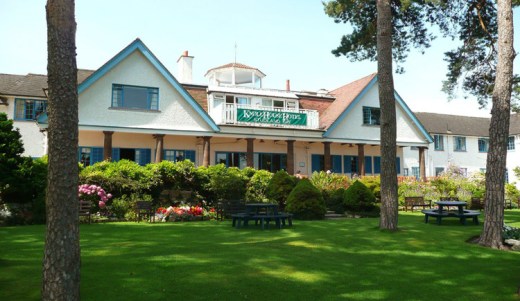
There we are then, just a few Blyton locations in the South West of England for you to explore for yourselves. As I linked at the top, you can find many more destinations on the Enid Blyton Society Forums.

 Fiona
Fiona pippastef
 worldofblyton
 | Adelaide Dupont on Milton King x Enid Blyton |
| Adelaide Dupont on Monday #780 |
| Adelaide Dupont on April 2026 round up |
 | Fey on Monday #780 |
 | Andrew on Five Go Off in a Caravan: The… |
 World of Blyton