The Mystery of the Burnt Cottage: How has Blyton’s original text fared in a modern edition? part 4

I’m determined to keep coming back to this every third week or so, purely so that it doesn’t take me a whole year to get through it! The other parts are herehere and here.

As always my own copy is a Methuen from 1957 – a 12th reprint/impression of the original. The new version is the most modern of any paperbacks I have looked at so far,  which is an Egmont copy from 2014.


CHAPTER EIGHT: WHAT MUST BE DONE NEXT?

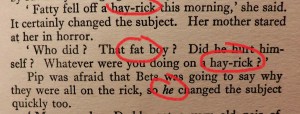
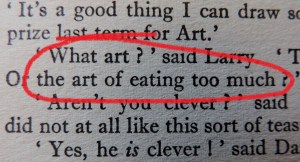
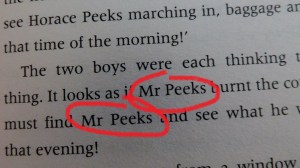
dscn6424 dscn6425This chapter starts off quietly on the updates front. Hie, when the boys greet a farm-labourer has been changed to Excuse me. Perhaps they thought this sounded more polite. Talking of politeness, when Mrs Hilton is talking about Fatty, that fat boy has been cut to that boy, twice.

As previously, italics are just been chopped out whenever they appear. This time in we must get in first, and so he changed the subject quickly too.

Bruises have gone the way of italics too, it seems, and a few lines from Bets are cut. “No. He’s got some lovely bruises though,” said Bets. “The best I’ve ever seen. I guess he’ll boast about them till we’re sick of hearing about bruises.”

dscn6426And then, after that fairly mild set of updates, the editor simply went mad and chopped out an entire page. That’s not even an exaggeration.

“Do you want to see my bruises?” asked Fatty.
“I’ve seen them,” said Bets. “But I don’t mind seeing them again. I like bruises best when they begin to go yellow, really. Pip hasn’t seem them, have you Pip?”
Pip was torn between wanting to see the bruises, and not wanting Fatty to boast and show them off.
Fatty didn’t wait for him to answer, however. He began to strip off various garments, and display bruises of many sizes and shapes. They were certainly good ones.
“I’ve never seen such beauties,” said Pip, unable to stop himself admiring them. “I never have bruises like that. I suppose it’s being fat that makes them spread so. Won’t you look lovely when they go yellow-green?”
“That’s one thing about me,” said Fatty. “I’m a wonderful bruiser. Once, when I ran into the goal-post at football, I got a bruise just here that was exactly the shape of a church-bell. It was most peculiar.”
“Oh, I wish I’d seen it,” said Bets.
“And another time,” said Fatty, “some one hit me with a stick -just here – and the next morning the bruise was exactly like a snake, head and all.”
Pip reached out for a stick. “I’ll give you another snake if you like,” he said. “Just tell me where you’d like it.”
Fatty was offended. “Don’t be mean,” he said.
“Well shut up about snakes and church-bells then,” said Pip in disgust. “Bets has only got to say ‘Oh, how wonderful,’ and you make up the tallest stories I’ve ever heard.

That’s a whole page, nearly 300 words, just chopped right out of the middle of a chapter! Having looked at a lot of updates I think I can see why this page might have given them a few ‘problems.’ Saying that, it could have been handled much, much better, with Fatty simply pulling up his sleeves to show off some bruises if they didn’t want him stripping off. I can’t see much wrong with the rest of it. There are countless current books about bottoms and bodily functions out right now, so I don’t see why a few bruises have been considered so offensive!


CHAPTER NINE: LILY COMES INTO THE STORY

The first update in this chapter makes Fatty sound lazy and entirely uninterested in their investigations. Originally, he really was too stiff to want to do anything more that day, and so is left in the garden with a book. After his fall from the hay-rick, that’s quite understandable. The newer version is that Fatty really didn’t want to do anything more that day, with no explanation as to why.

Mrs Minns sister is described as a very large woman instead of a very fat woman. Is large significantly kinder than fat?

dscn6427

Mr Hick’s threats to the kittens has been cut again – Unless they are out of the house by this evening, I’ll drown the lot! This is despite the fact that a paragraph earlier the cats entered the kitchen as they flew through the air, landing on the floor with mews and hisses. And they were thrown by Mr Hick, no less.

dscn6428

There is one change here that I actually don’t mind so much – Blyton has capitalised Suspect in the middle of a sentence, seemingly at random, and this is ‘corrected’. If that had been the case throughout and it was a stylistic choice to have Suspects, Clues and Motives etc, then it would be fine. And as one correction is made, a mistake creeps in elsewhere. Generally hyphens have been removed throughout these updates, so I was surprised to see dis-heartened appear in the paperback. Checking the hardback, it is rendered as dis-heartened too, but appears at a line-break. I don’t know if it would have originally been hyphenated to start with.

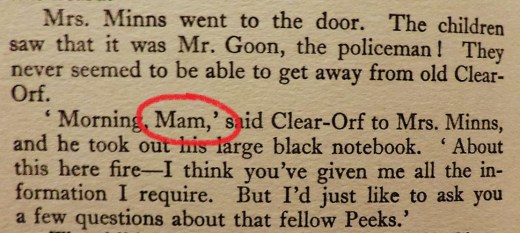
Mr Goon no longer calls Mrs Minns Mam, he calls her Madam instead. This is a strange one, because although usually written as ma’am, mam – to rhyme with ham is how the title is usually pronounced (if you are talking to the Queen, for example). I imagine that’s how Goon would have said it, so as a manner of speech it should have been left alone!
dscn6430

And lastly, the italics have all been removed again.

  • We simply must get Horace Peeks’s address
  • Mrs Minns would chase us
  • I don’t know
  • I am pleased

While chapter seven certainly should win an award for ‘most text cut’ I’m choosing to count each sentence – rather than each word! – and so, while it may seem like many more, it is only 34 changes. Added to those from previous chapters and we reach 103.
 

Posted in Updating Blyton's Books | Tagged , , | 1 Comment

Monday #184

Just a quick blog from me today as I’m later writing this than I thought I would be, and I have to head off to bed shortly.

Anyway, we’ve got an awesome week lined up for you!

ristorante8

Posted in Blog talk | Tagged , | 1 Comment

Famous Five 70s Style: Five Fall into Adventure, part 2

This week we’re following on from Five Fall into Adventure part one with part two. The question I posed last week was could it really be possible to fill episode two with all the bits and pieces that were left out of the first one? Well let’s take a look and see shall we?

The Good

As I mentioned last week, Julie Davis’ portrayal of Jo is sublime. She has the cheeky little ragamuffin done and dusted. The sharp wit and cunning comes across and even though she may be smaller in stature than the boys she gives as good as she gets. She gambols about like the Jo in the book and generally clambers and climbs everywhere. Even though the boys treat her badly at points, and Dick’s attitude is something we will look at later on, she still comes back to help them, and to rescue George. She could just disappear and leave them stranded in this house on the cliff but she doesn’t – and unlike in the book where we know that she’s fond of Dick, and why, that’s not so clear in the adaptation. Still, a good strong Jo is what we have and continues from part one to part two.

The episode in fact manages to cram an awful lot into it in the twenty-five minutes, the fact that bar one or two scenes at the end, the entire episode takes place in Red Tower’s house. It is a very bog standard house from what you can see, lots of it not in very good condition, but the children can just thunder up and down it without being seen. Jo uses the scaffolding to get onto the roof and then into the room where George is being held. The modern updates are a little odd to have  but they seem to worked it into the episode seamlessly. The motorised dinghy at the end of the episode where the children are all pinning down Markhoff is one of the only other references, apart from the clothes that are being worn, of the updated  time period.

Another good thing about this episode is that the rescue of George from the tower room is pretty much exactly how it appears in the book. Jo climbs up the outside of the tower, slips into the room next to George’s and lets her out. She also lets Markhoff catch her so George can make an escape. I think this more than anything else leads to George insisting that they have to go back for Jo when she hasn’t followed them down to the beach. This is one of the key scenes in the book, even leading to a mutual respect between George and Jo; this is clearer in the book because there was more animosity to begin with, whereas in the TV episodes the spats with Dick overshadow the whole group getting to know Jo and changes the way she interacts with them all.

The Hilarious

Now like the first episode, this one is full of laughs, possibly some that you won’t remember as children, if that was your first time watching it. However they certainly stand out now when re-watching them as an adult.

As I mentioned last time Dick’s sarcasm is a big part of the first episode especially with the interactions to Jo are a huge comedic pull. At least from an adult point of view, the sarcasm is very apparent and isn’t going over my head like it did when I watched them at a younger age. (I did not, as you may be able to guess, watch them when they were first broadcast.) In the book, after the first meeting there is a touching scene where Dick wonders if he had given her a bruise, although this is reciprocated somewhat in the first episode, the warmth and trust between the characters is very much lost in the two episodes. Its some of the most touching and real interactions between two characters that I felt Blyton ever wrote. I wish that it had been translatable onto the screen.Back to Dick’s sarcasm however, when Jo mentions that climbing a wall is noting to her, as her father was an acrobat in the circus Dick lays on the sarcasm nice and heavily;

trouble-quote

This happens before Jo insists on climbing up the front of the building to rescue George because she is the only one who can do it. The boys appear to disbelieve that she can do it, until she starts climbing. Then they begin to believe that she really is as good as she says.

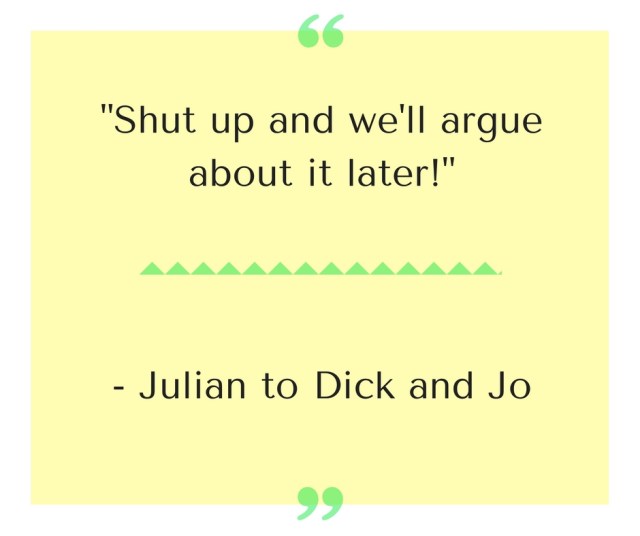
Julian gets fed up of the exchanges between Dick and Jo, as Jo rescues them from the room where they have been tied up. Dick ends up blaming Jo for getting them into this mess and Jo says she’s getting fed up of saving them. For once you can really see Julian’s nerves fraying when he quite firmly says to them:

trouble-quote-1

The interactions are overshadowed by the sniping between Jo and Dick, so we don’t get to see George and Jo, and Jo and Anne’s relationship and because they never shot Five Have Plenty of Fun, and Jo’s character never appeared in Five Have a Wonderful Time, so we don’t get the progression of their friendship.

The Not-So-Good

They have to be mentioned: the baddies. The bad guys, Markhoff and Red Towers are scary but not convincing that they could actually control the children and over power them when needs be. There is a scene at the end where Markhoff is trying to stop the children leaving the island but as soon as Timmy is revived, he is over powered by the dog and the four children. In fact even the girls could take him out. In my mind the Markhoff in the book is huge and overbearing and not really able to be taken down by a group of children.

One last thing: the boat. They don’t actually disguise the boat when they go off to find George in Red Towers house, so actually the fact that they’re surprised the boat is still where they left it, is genuine, because I’m pretty sure Markhoff would have actually found it and smashed it up.

The Round Up

So, did writer Gail Renard manage to deliver a show stopping second half of Five Fall into Adventure? She did! Were all the important parts shown? They were! Was it true to the book? As much as it could have been within the constraints of time and TV. Is Gail Renard possibly the most talented script writer? Without a doubt; Yes!

If you haven’t watched these two episodes, you need to. The hilarity of Dick’s sarcasm is something that really stands out in these episodes. You really do need to watch them for the brilliance of Gary Russell’s sarcastic one liners. You will not be disappointed.

Posted in Blyton on Screen | Tagged , , , , , , , , | 2 Comments

If you like Blyton: Arsenic for Tea by Robin Stevens

Having started to read this book I am wondering if perhaps I should have made the title If you like Agatha Christie… as this book has moved away from the Malory Towers backdrop to a secluded country mansion where a party-guest is poisoned.

But to return to the beginning, for a moment. This is the second Wells & Wong Detective Agency story. The first book was Murder Most Unladylike, set at Deepdean school where Daisy Wells and Hazel Wong investigated the murder of one of their teachers. Everyone else believed the teacher had just left the school, only the two detectives knew that there had been a dead body and so were the only ones properly investigating.

Now Hazel is visiting Daisy at Easter for Daisy’s birthday, in her huge old house. Daisy’s parents are Lord and Lady Hastings and seem to be of a familiar archetype: ditsy, helpless mother and jolly father, with not quite enough money to keep the house up to its old standards.

There are perhaps less parallels to Blyton in this story, now we don’t have the familiar boarding school setting. It really is more of a Miss Marple or Poirot-style mystery, though there are shades of the Find-Outers, perhaps.

We start with a great many people arriving at Fallingford for Daisy’s birthday weekend.

fallingford map arsenic for tea robin stevens


THE CAST (AND SUSPECTS!)

Aunt Saskia: an eccentric and badly dressed woman who seems to have an issue with kleptomania. She sneaks silverware into her handbag and is always eyeing up shiny watches that belong to other people.

Mr Curtis: Daisy’s mother’s friend, an arrogant art and antiques dealer who is there to appraise some of Fallingford’s items for sale.

Bertie: Daisy’s older brother who attends Eton.

Stephen: A friend of Bertie’s, also from Eton.

Uncle Felix: Much younger than the visiting aunt, Felix has an air of mystery about him. There are rumours that he is a secret agent.

Beanie and Kitty: two of Daisy and Hazel’s friends from Deepdean.

These people added to Daisy’s mother and father, Miss Alston the slightly odd new governess and the few members of staff makes for a real houseful!


THE MURDER

The murderer is inconsiderate enough to wait until the middle of Daisy’s birthday party to strike. One of the guests complains that the tea tastes funny, and within ten minutes they are choking and retching and have to be carried off to bed. The doctor is called, and diagnosis dysentery, but cannot do anything.

Daisy and Hazel (and also Uncle Felix) don’t believe that it’s dysentery. Daisy and Hazel reason that nobody else is sick while Uncle Felix demands samples be sent off for testing. The Wells and Wong Detective Agency are ahead of him in their investigation though, as Daisy has recently read a book where it says arsenic poisoning is often confused with dysentery…


THE INVESTIGATION

There are a whole cast of suspects roaming Fallingford – and none of them can go anywhere due to the storm causing flooding in the surrounding areas.

Daisy and Hazel conclude that everyone (apart from themselves and their school chums) must be put down as suspects.

Almost everyone has motive and everyone but the staff had the opportunity. All the guests were around the party-table and could have doctored the tea-cup.

Not even Daisy’s parents escape scrutiny. After all, Lady Hastings was caught kissing the victim and her father was seen demanding he leave Fallingford immediately. Then again, it could have been Aunt Saskia who had been greedily coveting that golden watch or Bertie with his famous temper. It could even have been the governess who has displayed some suspicious behaviours of her own (not least with that handbag of hers that she never, ever puts down).

It’s a big job, and it seems only logical that the two other Deepdean girls end up involved. Poor Beanie and Kitty were shoved aside several times in the early chapters while Daisy and Hazel snuck around. It turns out they knew all about the secret detective agency anyway.


RULING OUT THE IMPOSSIBLE

Various things are looked into over the next chapters but it isn’t until Lady Hastings is pushed down the stairs that they are truly able to rule anyone out.

Unfortunately the more people that are ruled out, the more likely it becomes that someone dear to Daisy is the culprit.

Finally the police arrive and move straight for the person that Daisy is most determined to protect, and it’s only thanks to a couple of genius realisations from Hazel that the girls work out who the real murderer is.


MY THOUGHTS

Much like in the first book I was rarely much ahead of the girls in their detectings, and I did not work out who the killer was until the last possible minute – a sign of a very good murder mystery.

As I said at the start this is an Agatha Christie style whodunnit, and it plays it like that the whole way through. Though of course, we have four fourteen-year-olds doing the investigating. These children are of comparable ages with the Find-Outers, the Famous Five, the Mannering-Trents and so on, and yet are rather more worldly when it comes to grown-up problems. They may feel very awkward when they see two grown-ups kissing (especially when it’s a married woman kissing someone other than her husband) but they are able to discuss it without any giggling or hysterics. They also touch on topics such as suicide, guilt, loyalty and honesty in a mature way for the most part.

On the whole it was a satisfying read – with which I only had one small niggle. If you were an undercover agent you would NOT bring with you a letter detailing the nature of your mission.

It may be a bit of a departure from what is considered traditional Blyton fare, but if you appreciate good children’s writing then you’ll probably like this.

arsenic for tea robin stevens

Posted in Book reviews, Other Authors, Reading Recommendations | Tagged , , , , , , | 4 Comments

Monday #183

After spending what must have amounted to 15-20 hours of work on the Blyton on TV and in film guide, this week we’re going back to just the two regular posting days so that I can relax again. I’m glad I got it done, but it really was a labour of love! Every time I thought I had all my entries at least listed if not finished I would find something else I needed to add. I’m still not convinced I got everything!

Anyway, this week:

wedfri5


Posted in Blog talk | Tagged , | 1 Comment

A Guide to Blyton on TV and in film

This is a chronological list of Enid Blyton’s works adapted for TV and film. I haven’t included stage or theatre productions unless they were filmed. I have tried to include information about who made the work, the cast, episode titles and if it’s available to be bought or watched. Some titles have very little information online, however, so I haven’t been able to include all those things for every entry.

halden

Episode titles which are links will take you to our reviews of those episodes unless otherwise stated.


PERSONALITY MEET: ENID BLYTON, 1946

This is a one minute TV-movie starring Enid Blyton, Kenneth Waters, Imogen Smallwood and Gillian Baverstock as themselves. It can be watched online.

1-personality-meet-enid-blyton


ADVENTURES OF NODDY, 1955-1963

& FURTHER ADVENTURES 1963-1975

There are just nine episodes of this early programme listed on IMDB, but judging by the dates given elsewhere there are many episodes missing.

Of the episodes that are listed, eight comprise a first series, and the one further episode is from an unknown series.

  • Hello, Little Noddy
  • When Noddy Came to Toyland
  • Noddy’s New Car
  • Noddy’s Taxi
  • Noddy Does Some Gardening
  • Big Ears’ Smokey Chimney
  • Noddy’s Burglar
  • The Big Balloon

From what I can gather this was a puppet-show and the episodes were just 15 minutes long. None of it has ever been seen online, though you can view some archived images here.

Further Adventures is not even listed on IMDB but there are references to it elsewhere on the web. I did find one episode, The Great Car Race, on YouTube.


 FIVE ON A TREASURE ISLAND, 1957

An eight-part serial made by the Children’s Film Foundation. Blyton herself was involved in the production, and had a say in the casting. She was apparently very happy with the finished product.

The Five were played by:

  • Richard Palmer – Julian
  • John Bailey – Dick
  • Gillian Harrison – ‘Ann’
  • Rel Grainer – George
  • Daga – Tim

You can get it for under a tenner on Amazon.

Five-on-a-Treasure-Island-006


NODDY IN TOYLAND, 1957

I can’t find much information on this adaptation, other than the cast.

  • Colin Spaull – Noddy
  • Gloria Johnson – Silky
  • Leslie Sarony – Mr. Pinkwhistle
  • Peter Elliott – PC Plod
  • David Brierly – Jinky
  • Graeme Harper – Moonface
  • Richard Huggett – Mr. Noah
  • Bobby Kerrigan – Big Ears

All I can surmise from that scant information is that it crosses over with The Magic Faraway Tree!


FIVE HAVE A MYSTERY TO SOLVE, 1964

Another CFF production, this time in six parts. As this was made seven years after the previous one, it’s hardly surprising that there is a new cast.

  • David Palmer – Julian
  • Darryl Read – Dick
  • Mandy Harper – George (as Amanda Coxell)
  • Paula Boyd – Anne
  • Uncredited – Timmy

This is also available on Amazon at less than £10.

mysterytosolve


DE 5 OG SPIONERNE (FIVE AND THE SPIES), 1969

A Danish adaptation of Five Go Adventuring Again. 

  • Mads Rahbek – Julius (Julian)
  • Niels Kibenich – Richard (Dick)
  • Sanne Knudsen – Anne
  • Lone Thielke – Georg (Georgina)
  • Ove Sprogøe – Onkel Quentin
  • Astrid Villaume – Tante Fanny

I can’t spot this for sale at the moment but the full thing is available on YouTube.

7-de-5-og-spionerne-dvd


GONIN TO IPPIKI (FIVE CHILDREN AND DOG) 1969-1971

This is one I had never heard of before. It is a Japanese adaptation of The Five-Find Outers. Created by NHK – Japan’s national broadcaster – it ran for 113 episodes, over two-and-a-half years. The children were given different names and identities, and Buster became a black poodle. The early episodes were based (loosely) on the books but after that they used newly written stories. Unfortunately the tapes were deleted by NHK and very little survives now.

Also unfortunately the website I found the below image (and some information) on has now disappeared.

8-ippiki

(P.S. This is an initiation ceremony to the FFOs, not a Nazi salute!)

Continue reading

Posted in Blyton on Screen | Tagged , , , , , , , , , , , , | 27 Comments

Famous Five 70s Style: Five Fall Into Adventure, part 1

Five Fall Into Adventure is one of the mysteries I don’t really enjoy reading much, so the finer details of the book escape me, but I still know the story well enough to give you a general overview of the adaptation from the 70s.

The Good Bits

This generally comes across to me as one of the more scary books, I mean George has been kidnapped for a start and her parents can’t be informed. The baddies are quite scary, in fact I do wonder whether Red Tower is even stable, but I can’t talk about him too much now because he only really appears in the next episode.

One of the best bits from this episode is the fact that it is split into two parts. Like all the other two parters it contains much more detail than the single episodes, so much so that this episode is very much the run up to the exciting ending and rescue.

For now let’s look at the best bits of the first episode where we have that tremendous build up to the big drama.

My first thought when we get past the credits is working out where in the story we are starting, and quite strangely Aunt Fanny and Uncle Quentin are still at home, packing for their holiday to Malaga. In the book Blyton just generally mentions Spain as a holiday destination, keeping things quite vague given that Uncle Quentin is supposedly being hunted by reporters, but in this there is a set place. I suppose that gives the audience some idea on where the parents are actually going and some context for the visit. While packing the car however, Quentin tries to take some of his work to do, much to his wife’s disgust, and the scene were they try and take it all off him in some sort of chain motion is very amusing to watch.

Another good point in the script, something I think writer Gail Renard knew needed a good build up and scene was the body swap, where Dick and the paper boy Sid swap places so Dick can go and spy on who comes to collect the papers. It’s a much smoother and less hurried effort than in the 90s series, possibly because they didn’t have the time constraints. It’s smooth, quick and perfectly executed by Gary  Russell.

Julie Davis as Jo was an excellent piece of casting, she really had the ghastly little raggamuffin down to life (apart from being very clean and sharp in her clothes and hair cut). She was fiesty, determined and she had the best rapport with Gary Russell who played Dick. The two of them are a joy to watch, the way they fling the dry, sarcastic comments back and forth at each other is amazing. I don’t know if Gail Renard had intended that to happen but it did and for that I am greatful. It’s a shame that they didn’t do another adventure with Julie in as Jo because picking up where it left off would have been amazing. I was lucky enough to be able to meet, talk to and listen to stories from Gary Russell, Marcus Harris, Julie Davis and Gail Renard at an Enid Blyton Society Day some years ago and the stories they could tell were amazing! However, Jo and Dick are supposed to have a special relationship in the book, there’s a sort of respect and connection there, a fondness if you like. In these episodes we get less of the fondness and more of the raw sarcasm of people who don’t want to get too close to one another but can’t help liking the other person. If you know what I mean.

aif-jo

The Not So Good Bits

Now we all know I have my little niggles about these episodes, and here comes a few. Now they are nothing more than niggles, but for a seasoned Famous Five viewer they are enough to make you roll your eyes and sigh. I hope you can see I don’t do this out of spite, but out of love for the books.

There are a couple of cracking ‘niggles’, such as when Anne screams about a face at the window, the boys have enough time to run into her room that she shares with George and manage to put their dressing gowns on nice and neatly! I mean your sister screams and you still manage to get your dressing gown on before you go to see if she’s all right? Not sure that works.

Another thing that bugs me is how irresponsible the adults are. Uncle Quentin allows Julian to accompany him into the garden to check for intruders, but we’re forgetting, Julian is probably only 16! Quentin and Fanny as the responsible adults shouldn’t have allowed Julian to go outside with Quentin, even if he has faced all sorts of danger in past adventures.

Rodgers the gardener is exactly the same, he seems so hopeless with the children and usually he growls and warns them off his plants and how noisy they are, but in Fall into Adventure he suddenly becomes nice and really weedy! He does things like leave the house with the professor’s papers unguarded and not in the safe, he lets the children walk all over him, which isn’t characteristic of him at all.

One last character niggle and then we’ll wrap up, but the one thing I want to talk about is the fact that Jo does not meet the Five through stealing George’s sandy hole where she’s been sitting, but in fact tries for a bigger kind of theft and tries to make off with George’s beloved boat. Now I know that sets the tone for how things go with Jo, and all I can assume is that it was too cold for the cast to be swimming in the sea during filming to make the original introduction difficult to do. Anyway, it’s a big boat and Jo isn’t too big, so you wonder how she would have managed it. However, the punch up between Jo and Dick is pretty awesome and goes on much longer than it does in the book. Now if that’s not girl power I don’t know what is!

Summary

Overall, even though this episode may start off slow, and fills in all the details (which we like) it’s attention to detail is what makes it truly excellent. Gail Renard is a genius and a proper Blytonite. She managed to get those little quirks and tit bits into the episode so wonderfully that the actors, who by series two have settled into their roles, manage almost perfectly.  Let’s hope that part two is just as well developed and detail filled. We shall have to wait til next week to find out!

Posted in Blyton on Screen | Tagged , , , , , , , , , | 7 Comments

The Adventure Series on TV – The Woods of Adventure

The Woods of Adventure? I hear you ask. No, this is not a long-lost Blyton title you’ve never heard of.

I’m not quite sure how all the copyright laws work, but earlier in the 90s there was a mini-series make of Castle of Adventure and so they still had the rights to that title. There was also a version of Island of Adventure in the 80s but those rights must have been available again for this series. Confused? Good, so am I.

The blurb for this episode reads:

The children and Mrs Mannering take a trip to a mysterious mountain cottage, which lies close to an old castle. Curious about the ruin, and eager to find a tawny owl nesting in it, the children explore the surrounds. When Kiki goes missing Jack is determined to find her and searches the surrounds, but he is alarmed to discover that they are not alone and soon alerts the other to get help.


WOODS, CASTLES AND STRANGE MEN

The opening shows us a sign reading Woods Castle, keep out. In the background is a Monty Pythonesque drawing of a castle superimposed on the blue sky. A man with a rucksack is sneaking about, apparently being followed by some sort of heavy-breathing animal. Ah, no, it’s a white-faced man in dark purple robes. Gosh isn’t it amazing how those types always turn up to ruin your illicit wanderings around old castles (or ‘secret’ islands)?

An older woman bursts out of the castle as the hiker is attacked and seems very upset by it all. Though it turns out she’s not upset about the poor young guy who gets his head cracked open, she’s more concerned with the crazy monk-type. She is seen tending to him by candle-light later and he is mumbling about Margaret whoever she may be.

Bill is getting involved from the start of this story, with his boss showing him a picture of Craggy Tops, where a man has been murdered. (The man being the hiker from the opening). There is talk of radiation being involved.

Interposed with these threads of story are short underground scenes of a sci-fi nature, with men in radiation suits.

Having heard an owl from their tent the children end up in the woods by night, then right by the castle. They get scared off by the monk, though.


MRS BRIMMING, GARY AND THE RADIATION MAN

The old woman is the monk’s mother and he has been unstable since the death of Margaret. Even crazier… a man with the old woman seems to call her Mrs Brimming. Even The Secret of Moon Castle didn’t have a Mrs Brimming. The sci-fi radiation stuff is going on under the castle as Mrs B’s friend is monitoring it all on a computer (while eating jelly babies). They talk, and reveal that the monk, who turns out to be named Gary, was badly burned in trying to save Margaret.

The children are still suspicious of Bill when he turns up, because he is pretending to be on holiday but Dinah sees him with a gun.

The children visit the castle again, and after about ten pointless minutes of wandering around, Kiki ends up inside with Gary who has taken a shine to her. This gives Bill a perfect excuse to come up to the castle and snoop around. The children are the ones that end up getting a ladder and climbing in at the broken window, however (while Bill and Allie wander uselessly around the outside of the castle). Naturally the ladder breaks just as the last child makes it inside, leaving them trapped with a lot of rats.

It’s Mrs B who finds them eventually – after another pointless ten minutes of wandering – not surprising as they are doing some of the worst hiding ever behind curtains and so on. She hurries them all out and back to Mrs Mannering again.


BAD SCIENCE AGAIN

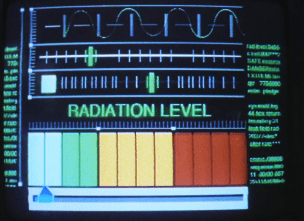
radiationThe radiation levels are being monitored by the mystery man and they fluctuate wildly. When they get high the children have to cover their ears at the horrible noise. Even Bill and Allie hear it from outside but can’t work out what it is. As the children also point out, there are no warning labels of any kind on the radioactive material they find later. Though as they look like cheap metal rods that’s not so surprising.


THE HUNT FOR KIKI

Jack is still distraught about Kiki and so goes off in the night to try to find her. The other children follow and they end up inside the castle again. And we then get another ten minutes of the children running about the castle. Them chasing after Gary. Gary chasing after them. It felt more like Scooby-Doo than Blyton.

Gary mistakes Lucy-Ann for Margaret and expresses feelings of guilt, yet still fights with Jack over Kiki. I was rather losing the will to watch by this point but the kids got Kiki back eventually, helped by Bill.

Jack and Lucy-Ann had heard from their uncle during the episode and he was reluctantly coming back from the US to take care of them again, but they didn’t want to go. This is dealt with at the very end of the episode when he comes down with some illness and can’t travel for another few weeks.


FINAL THOUGHTS

The ‘plot’ of this more like Moon Castle than the plot of Moon Castle was, and nothing like Castle of Adventure at all. Really they should have just done seven episodes and left this one out. They stole so much from Moon Castle that the actual Moon Castle episode made a year later clearly had to be massively changed otherwise it would have been far too similar. For example, the picture below is of a portrait with glowing eyes which backs onto a secret passage.

stolenfrommooncastle

There was barely enough material to have a twenty-five minute episode, let alone one that went on for more than an hour. Bill was completely under-used and the whole radiation work under the castle had next-to-no point other than having someone complain constantly that Gary was out of control.

I don’t understand why these New Zealand adaptations keep feeling the need to add strange men/women in hooded robes to the stories either.

I would give this zero stars if I had to rate it, and I wouldn’t feel bad in the slightest as there was nothing even remotely Blyton about any of it.

And lastly, I’m annoyed that the blurb and the title were misleading! There’s no rented cottage at all, they are at Craggy Tops the whole time. Worse is the fact that the woods barely feature at all, only as something they have to walk through to get to the castle.

Posted in Blyton on Screen | Tagged , , | 6 Comments

Monday #182

This week we have a themed week for you, in a change of dynamic and our on going changes to the blog. We shall be looking exclusively at the television adaptions. Fiona will be looking at the next Adventure series episode while I will be looking at Five Fall into Adventure 70s style.

On Sunday we will be bringing you a guide to the TV adaptions that have been created from Blyton’s novels, so you can tick them off and see what you have watched and what you need to watch!

I am leaving you with some pictures of Cramond, in Edinburgh from my trip in May/June. I hope you like them!

Posted in Blog talk | Tagged , , | 1 Comment

Reblog – JSlawit’s introduction to Enid from Where there’s a Jill there’s a way

I’m always browsing blogs and looking for interesting things to read, and this was one I stumbled upon through a comment on one of Stef’s posts. The blog is still a work-in-progress but it looks like it will be a good one. Jill has a section of her blog dedicated to Blyton, and has called it her Blyblog.

since

Lashings of ginger beer, heaps of potted meat sandwiches……deep filled pies and huge slabs of fruit cake packed with juicy goodness – just right to feed four hungry children and a dog. Maybe this is what first sucked me into the Famous Five and the wonderful world of Enid Blyton, luring me with one of them cartoon vaporous fingers. I too could go cycling with the Five, have an thrilling adventure, and enjoy a delicious picnic tea afterwards. OK so I was never keen on ginger beer or potted meat, but Enid Blyton had the happy ability to make even sand and dog-meat sandwiches sound mouth-wateringly yummy! […]

via Blyblog – JSlawit’s introduction to Enid — Where there’s a Jill there’s a way

Posted in Personal Experiences | Tagged | 1 Comment

If you like Blyton: Frozen in Time by Ali Sparkes

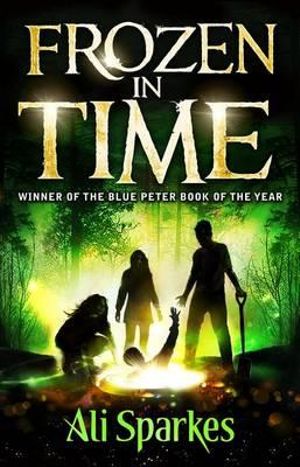
ali-sparkesI suspect that a lot of you have never heard of Hampshire based authoress who turns up for her public appearances in amazing sparkly boots (the clue’s in the surname). Last month I had the fortune of Ali Sparkes coming to my library to do a creative writing workshop with some children and I discovered that she was a big fan of our favourite author, Enid Blyton. In fact, so much of a fan that one of her books, Frozen in Time in a way pays homage to Blyton and the Famous Five. So I decided I needed to read this book, and now I’m going to share my thoughts with you.
The Plot

We begin to cross over into Blytonian territory as we meet two children, who are helpfully brother and sister, Ben and Rachel, who are having a very boring summer holiday. Sound familiar?

Their parents are away, working on a cruise ship, and they’re being looked after by an Uncle Jerome who is more interested in his scientific projects than his niece and nephew. Sound familiar?

Anyway, enough of the comparisons, let’s look into the adventure that awaits our heroes Ben and Rachel and their forgetful Uncle Jerome. When the rain finally clears, the two children rush outside and explore their overgrown garden where they discover a sealed chamber and manage to get in and explore. The discovery is more than diamonds, smuggled goods or a kidnapped child. In this sealed chamber there are two cryogenically frozen children and puppy from 1956 (we’re now in 2009). That would be fifty-three years suspended in time for the children, Polly and Freddie who get woken up when Rachel accidentally pushes a button while Ben and she are looking around.

frozen-in-time ali-sparkes

What follows next is the hilarious escapades of trying to bring Freddie and Polly into the 21st century and work out why their father left them frozen for fifty three years. This is where we get into Five Find-Outer territory as we deal with a big mystery trying to be pieced together with some interesting Cold War connections. Such a thrilling read.

The Characters

The classic set up of two girls and two boys and a dog dominate the book and the scatty uncle in the background in a very Famous Five, Five Find-Outer situation. So let me introduce you;

First of all we have Ben, the eldest, well if you don’t count Freddie’s extra fifty-three years. He’s Rachel’s older brother and there are a couple of very Julianish moments where he tells her that he has to do something first because he’s the eldest. Due to his knowledge of the twenty-first century he comes across as older and wiser than Freddie.
Rachel could be seen as the tomboy of the group, the George figure if you like, but that would only be in stark contrast to Polly who is an Anne if ever I saw one. Whereas Polly likes feminine things and getting things tidy and prepped for the boys, Rachel can’t stand waiting on her brother and says that she’s only doing it to help Polly adjusted to the new time she’s found herself in. Fair play, but some of those habits are probably going to do Rachel some good.

Freddie next, and he’s the older brother of Polly, archetypal in his Julianness, an older brother used to being in charge and the first to really acclimatize to his new surroundings before his sister Polly. He is the brains of the outfit in rather a older brother way, and he has good brains.

Last but not least Polly, the perfect 1950s housewife in the making. She misses her father and can’t work out why he would leave them frozen in time if he didn’t have a good reason. She loves setting the table and playing house and looking after her brother. If anything she is the Anne of the four, even though she’s as brave as anything.

trouble-quote-5


Verdict

If you want to try someone knew, who loves Blyton and does a wonderful job of mixing the new with the old you need to read this book. The sci-fi element is a good twist on an old story, the mystery harks back to John Le Carre’s spy thrillers, and the wonderful freedom of the children wandering around the Hampshire countryside is a beautiful homage to the much loved Blyton. Ali Sparkes has done an amazing job with Frozen in Time, which was published in 2009, and I am surprised that no one had shown this book around to the Blytonites out there. Oh and can I just add, it was the winner of the Blue Peter Book Award of the year? How good is that! A nice little touch is in the acknowledgements at the beginning and  the last line says:


And thank you Ali for such a wonderful story and a wonderful tribute to our beloved Blyton. This one is definitely a re-read!

Posted in Book reviews, Other Authors, Reading Recommendations | Tagged , , , | 3 Comments

The Mystery of the Burnt Cottage: How has Blyton’s original text fared in a modern edition? part 3

It has only been two weeks since the last instalment but I would like to try to get through this book before the end of the year! The first parts can be seen here and here.

As before my personal copy is a Methuen from 1957 – a 12th reprint/impression of the original. The new version is the most modern of any paperbacks I have used so far, an Egmont copy from 2014.


CHAPTER SIX: MRS MINNS DOES A LOT OF TALKING

Mrs Minns is the subject of several changes in this chapter. First she is described as a a round fat woman. This has become a round tubby woman. Somehow tubby is better?

Her elbows are no longer described as podgy, and she and her cheeks are not fat now either  but no other descriptive word is added instead.

dscn6414

Italics are removed every time they appear.

  • And I shouldn’t be surprised
  • Mr Peeks was far too much a gentleman
  • is that his real name?
  • no more back-chat from you
  • perhaps he fired the cottage

That last one is also changed to set fire to the cottage.

Mrs Minns’ also suffers some kitchen updates, her larder is now a st0re-cupboard (yes, hyphenated!) and her dripping has been replaced with butter though it is still in a basin.

Some of her speech has likewise been changed. She had said more than anyone else in the kingdom, this is now in the country, and when telling Lily off it was for talking like that to your elders and betters. This has been changed to like that to me. 

The rents in Mr Smellie’s clothes are now tears. 

Then Sweetie the cat is subjected to the editor’s pen. After being trod on by Mr Hick she had come into the kitchen with her tail swollen to twice its size. Now that is her tail in the air. 

How many more times am I to tell you to keep her under control? I shall have her drowned appears in both editions, spoken by Mr Hick, but the next two sentences are cut entirely.

Sir, the day you drown my cat I walk out! said Mrs. Minns, laying down the rolling-pin with a thump.
Mr Hick glared at the cook as if he would like to drown her as well as the cat.

If they felt the need to remove references to drowning, he could have threatened to have her taken to the pound or given away to a farm.

dscn6415


CHAPTER SEVEN: THE TRAMP – CLEAR ORF! – AND FATTY!

The editors really hate hyphens. Again, every instance of them is removed and leaves the dialogue flatter without the emphasis they give.

Who?
Mr Smellie!
It isn’t really very funny, but it seems as if it is.
We are getting on
we can rule him out
That is going to be a problem
His feet!
What’s bitten you?

dscn6417

Hyphens also come under attack, examples include hay-rick which becomes hayrick and in Mr Goon’s colloquial speak, this-ere becoming this ‘ere. Then again they leave his come-alonga-me with the hyphens in it.

And lastly, several changes have been made to the final scene in the field.

The policeman kicked out at him is removed when Buster is dancing around his ankles.

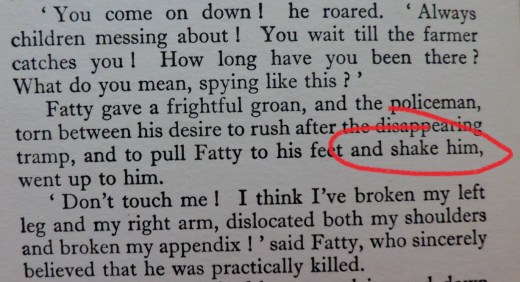
Then Mr Goon no longer has the desire to pull Fatty to his feet and shake him. 

dscn6418

After Fatty falls from the hay-rick (or hayrick) it originally read that except for a good shaking, and some fine big bruises, Fatty was not hurt at all and that His fat had kept him from breaking any bones!

These have been changed to  except for a few bruises, Fatty was not hurt at all and He had not broken any bones!

dscn6421

As usual most of this doesn’t make any sense. Mr Goon did not shake Fatty, his being shaken is from falling to the ground from a height! Then to say he wasn’t hurt, then he had not broken any bones… it doesn’t real well and it doesn’t flow. We know he can’t have broken bones because he wasn’t hurt!


So that is 32 changes in those two chapters, bringing us to 69 in total!

Posted in Updating Blyton's Books | Tagged , , | 3 Comments

Monday #181

I can’t believe it is September already! To be fair, though, we’ve had some of the best weather of the “summer” in the past week.


COMING UP THIS WEEK

wedfrisun2


In case you missed it, we did a round up of what we read, watched and did last month. Hopefully it will help you all you to get to know us a bit better, and help us to come up with some more topics for the blog.

Posted in Blog talk | Tagged , | Leave a comment

August 2016 round up

I have decided to try something new this month, having seen it on some of the other blogs that I read. A round up of what we’ve been reading, watching and doing. Naturally not all of it will be Blyton related, but I think it can be interesting to know what else Blyton fans read and do.


WHAT I READ IN AUGUST

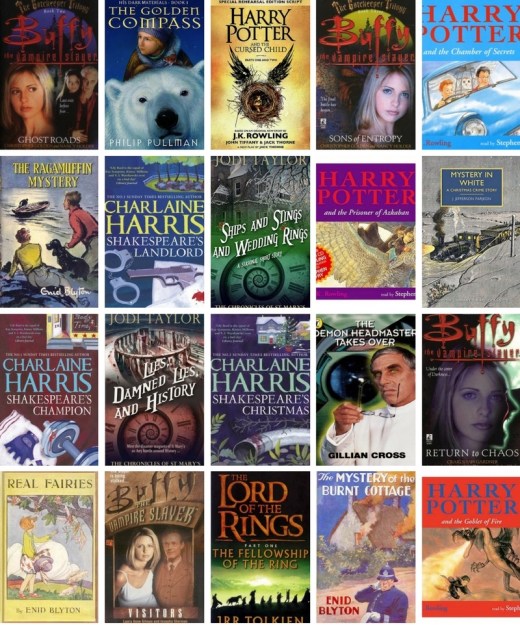
  • Ghost Roads (The Gatekeeper Trilogy #2) – Buffy the Vampire Slayer TV tie-in
  • The Dark Compass (His Dark Materials #1) – Philip Pullman
  • Harry Potter and The Cursed Child – J. K. Rowling
  • Sons of Entropy (The Gatekeeper Trilogy #3) – Buffy the Vampire Slayer TV tie-in
  • Harry Potter and the Chamber of Secrets – audio book narrated by Stephen Fry
  • The Ragamuffin Mysteryreviewed here
  • Shakespeare’s Landlord (Lily Bard #1) – Charlaine Harris
  • Ships, Stings and Wedding Rings (Chronicles of St Mary’s #6.5) – Jodi Taylor
  • Harry Potter and the Prisoner of Azkaban – audio book narrated by Stephen Fry
  • Mystery in White – audio book written by J. Jefferson Farjeon
  • Shakespeare’s Champion (Lily Bard #2) – Charlaine Harris
  • Lies, Damned Lies and History (Chronicles of St Mary’s #7) – Jodi Taylor
  • Shakespeare’s Christmas (Lily Bard #3) – Charlaine Harris
  • The Demon Headmaster Takes Over (Demon Headmaster #5) – Gillian Cross
  • Return to Chaos – Buffy the Vampire Slayer TV tie-in
  • Real Fairiesreviewed here
  • Visitors – Buffy the Vampire Slayer TV tie-in

There are also a couple of things I haven’t finished yet

  • The Mystery of the Burnt Cottage which I’m blogging about
  • The Fellowship of the Ring – J.R.R. Tolkien
  • Harry Potter and the Goblet of Fire – audio book narrated by Stephen Fry

untitled-design-1


WHAT I’VE WATCHED

  • Hollyoaks (I watch this religiously)
  • The Good Wife starring Julianna Margulies, on Netflix
  • The Originals (spin off from the Vampire Diaries) also on Netflix
  • Only Connect – the quiz show on BBC2
  • The Olympics – I loved seeing how well team GB did and I’m looking forward to the paralympics next week.
  • The Adventure SeriesI reviewed Island of Adventure here

WHAT I’VE DONE IN AUGUST


WHAT STEF HAS READ

  • Harry Potter and The Cursed Child – J. K. Rowling, John Tiffany & Jack Thorne (This just made me even more determined to get tickets to see the show. A friend and I got some for August… 2017)
  • The Mystery of the Disappearing Catreviewed here
  • Kindred Spirits – Rainbow Rowell – I love Rainbow Rowell, she is one of my favourite American authors and gets that perfect balance between real life, fantasy and hilarity.
  • Private Lives – Tasmina Perry

And her current reads:

  • Raising Steam  – Terry Pratchett – Because who doesn’t love a bit of Discworld and Terry Pratchett?
  • Crash Into You – Katie McGarry – My ‘easy trashy’ read of the month, easy to read, dip in and out of.
  • After Alice – Gregory Maguire
  • A Mindfulness Guide for the Frazzled – Ruby Wax – As my mind is fairly frazzled anyway I thought it was worth a go.
  • Career of Evil – Robert Galbraith aka J.K. Rowling

stefbooks.jpg


WHAT STEF HAS WATCHED

  • Five Get Into Trouble from the 70s series – part one and part two
  • Five Go Off to Camp from the 70s series – part one and part two
  • Various Episodes of QI, Mock the Week and Who Do You Think You Are? – I’m not very good at watching the TV at the moment, the most I’ve watched is the Olympics so reruns, easy watching is my go to.

WHAT STEF HAS DONE

  • Been to Derby for her goddaughter’s christening – Someone trusts me with their CHILD! Plus, she’s so adorable!
  • Reconnected with old friends – thats what christenings will do for you!
  • Been invited to TWO weddings
  • Had a some successful dates – we went bowling. He won!
  • Been forced to adopt the ‘new look’ for blog posts – She’s killing me here! Send help!;) Kidding Fiona!
  • Has ventured forth for blackberry picking in a hope of making some jam – My Blytonite is showing!


Posted in Personal Experiences | Tagged , , , , , | 1 Comment

Famous Five 70s Style: Five Get Into Trouble, part 2

So here we are looking at the second part of Five Get Into Trouble, and I feel safe in saying that this two-parter has to be one of the best. Now, grab some ginger beer, a sandwich and read on while I try to explain why!

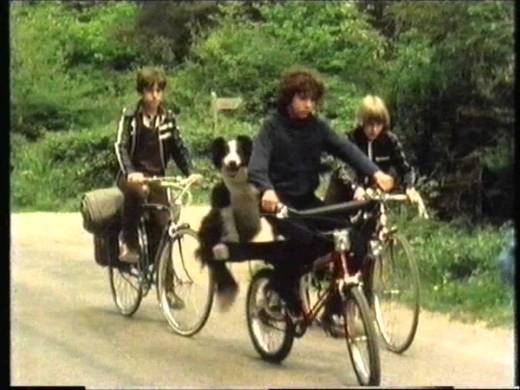
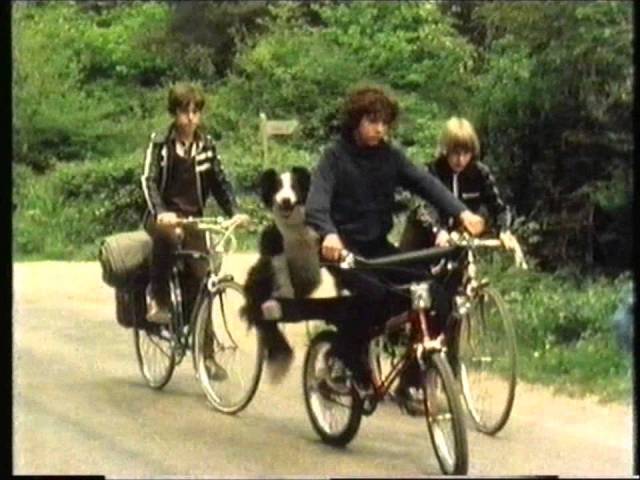
Dick (Gary Russell), Timmy (Toddy), George (Michele Gallagher) and Richard Kent (Grant Bardsley) on their bikes in Five Get Into Trouble.

Dick (Gary Russell), Timmy (Toddy), George (Michele Gallagher) and Richard Kent (Grant Bardsley) on their bikes in Five Get Into Trouble.

The Bad Guys

After the ending of the last episode, we’re brought smack bang back into the middle of Owl’s Dene and the mysteries that are overflowing. The Five are reunited, as in they are all under the same roof. Dick is still being kept prisoner  and the others have tagged along with Richard Kent. The smooth talking Mr Perton in my mind is one of the most dangerous criminals the Five ever face because he is a calculated criminal with real brains (even though in the book he is called the cat’s paw – but let’s just assume that he is the brains behind this operation). In fact this is closer to the way things are in the book than the 90s series because Perton is the brains, in control, calm in both this adaptation and the book, whereas in the 90s version, he’s more a bumbling idiot and Rooky is the one who’s seen to be in charge and the brains.

Another thing that is interesting to see how he, Perton, deals with Rooky, Hunchy and Ted and the difference in his attitude between them and the escaped criminal Solomon Weston, aka Solly. Perton (Stephan Chase) does his best to keep Solly sweet as the criminal knows the whereabouts of the valuable Culpepper diamonds that he had stolen.

An interesting fact that I noted from this episode is that Solomon Western is played by Walter Sparrow who has another part in the 90s series of the Famous Five; when he plays the kindly, yet strong minded Great Granddad from Five on Finniston Farm. Just an interesting titbit for you. Both performances are fantastic and he completely nails the two different personas. Walter Sparrow was truly a magnificent actor.

The Contemporary Feel

So first off, it’s clear to see the big changes in the show; the updated clothes, bikes, food, transport, but there are some bits and pieces that make you stop, rewind and reconsider. One thing I hadn’t noticed before from this series is that Marcus Harris, is wearing a necklace. I know, an actual necklace! I felt this was a bit much for our straight laced Julian, but I wonder if it was something that had been agreed by the creative team or whether Harris just decided to add it to the part or forgot to take it off! I would love to know!

One big thing I noticed when watching the second episode is during one scene where the Five and Richard are stopped from leaving because Rooky has spotted Richard underneath his hat, glasses and sooty hair. The children are all lined up in the kitchen being talked at by Perton and Rooky, when Julian starts standing up to Rooky he receives a punishment for his smart mouthed nature. As Rooky walks past Julian, he elbows him hard into the ribs. Now this is something we never see in the book, or in the 90s version – in fact no one lays a finger on anyone really in the 90s version – but in the 70s, there is much more rough and tumble with the cast and the baddies. I think it might have something to do with the changing times as well as the fact that the bad guys could be seen to be more violent, even towards children. However it isn’t just Julian who receives some violent treatment: in fact Richard Kent is manhandled quite horribly when Rooky is washing the soot out of his hair and Dick is brought down from the attic in quite a tight grip by the looks of things. The boys certainly have more to deal with in this series.

The Plot

Now down to the nitty gritty, the plot. Last week I said I wasn’t sure how the show would cram so much of the book into a 25 minute slot, and surprisingly it did really well. There are some key elements that are left out, giving Aggie the money, feeding the chickens, getting secret food parcels from Aggie in the garden, but the time constraints are never friendly in these cases. It’s a secondary story really that doesn’t really add or take away from the main one. However, all the key parts were there, the children discovering the boot was big enough to hide Richard in, Julian exploring the house at night and finding the secret room where Western was hiding so that he could put the others in there for safety, and not to mention Richard making a dash for it out of the car and running away from Perton, straight into the police station.

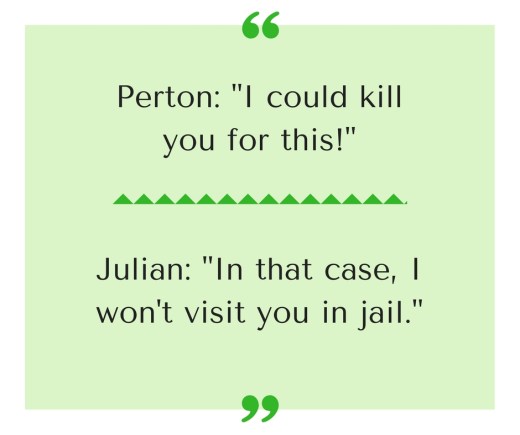
Another thing I like about this adaptation is some of the dialogue that comes out at the end. A bemused Perton, trying to work out how he had been outsmarted by a bunch of kids, and ultimately blaming Julian, threatens him only to receive such a sharp quip in return: ^E310DF688A24B5BB8F5A142B53F0341EFCAEDB0029DE375918^pimgpsh_fullsize_distr

Its just that moment of pure cheek that comes out of Julian, knowing that he has outsmarted this man, and done the right thing. Cool as a cucumber, aren’t you Ju?

Another good quote I enjoyed came from all of them really, the characters working together to create such an enjoyable last scene, that ends in the usual laughter. The inclusion of Uncle Quentin just tops off the scene as you can see he just doesn’t believe a word the children are saying and is just one of those ultra magic moments that charms you into the series, and keeps you there.

^FFBAD2C6C1B1F49A7157488502E0DE6F41DB0C24DD31BE296F^pimgpsh_fullsize_distr

I think that has got to be a contender for the ultimate Famous Five TV series quote. What do you think?

Anyway, Five Get Into Trouble did its job wonderfully, and provided great story telling and viewing to make a damn near perfect episode, or two. These two episodes truly deserve five whole stars!


Posted in Blyton on Screen | Tagged , , , , , , , , , , , , | 3 Comments

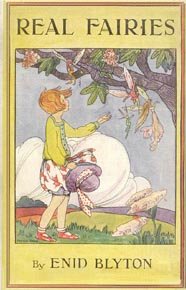
Real Fairies borrowed from Dundee Free Libraries

This is the gem of a book that I discovered in the secondary stock of my library. As I said in my previous post I truly didn’t expect the book to be the one I was thinking of. It would have been too easy for it to have been a mistake in the catalogue record, or a later reprint that I didn’t know of. And yet – it turned out to be exactly what it seemed. Somehow, in a library system where the majority of children’s books date from the 80s or later it seemed unlikely I would get hold of a rare – and somewhat obscure for Blyton – 1920s poetry collection.

The editions of Malory Towers etc that I borrowed from my community library in the 90s are no longer part of the library’s collection. Children’s books naturally get grubby and damaged more quickly than those from adult lending, and therefore get replaced sooner too. (They also seem to get lost and never returned more often too!) Perhaps it’s the relative obscurity of Real Fairies that has let it remain part of the collection for all these years.


DUNDEE FREE LIBRARIES

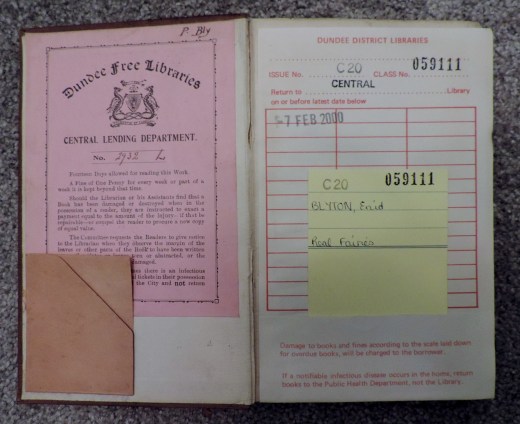
Dundee Free Libraries (Now Leisure and Culture Dundee, though it has gone through several incarnations including Dundee Public Libraries, Dundee City Council and Dundee District Libraries) acquired the book for its Central Lending Department on the 20th of February 1926, so it has been in their possession for ninety years now!

DSCN6409

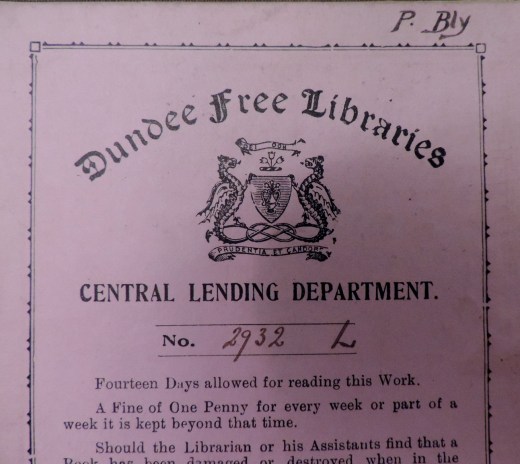
Inside the front cover is a pasted in sheet headed Dundee Free Libraries, which details the specifics of the lending policy.

Fourteen Days allowed for reading this Work.

A Fine of One Penny for every week or part of a week it is kept beyond that time.

Should the Librarian or his Assistants find that a Book has been damaged or destroyed when in the possession of a reader, they are instructed to exact a payment equal to the amount of the injury – if that be repairable – or compel the reader to procure a new copy of equal value.

The Committee requests the Readers to give notice to the Librarian when they observe the margin of the leaves or other parts of the Book to have been written upon, the plates or leaves torn or abstracted, or the Book otherwise mutilated or damaged.

Borrowers in whose homes there is an infectious disease must deliver books and tickets in their possession to the Sanitary Authority of the City and not return them to the Library.

I’m assuming that dates from when the book was first acquired by the library (clearly in an age when librarians were mostly men!).

DSCN6410

The date due page is headed Dundee District Libraries and has only one date stamped on it – 7 Feb 2000. That is presumably the last time this book was borrowed, though I don’t know how many times it was issued before that. I should have checked Spydus (the computer software for the library catalogue) but that record would probably only go back as far as whenever it was installed.

The due date page also carries some lending information – though it’s much briefer.

Damage to books and fines according to the scale laid down for overdue books, will be charged to the borrower.

If a notifiable infectious disease occurs in the home, return the books to the Public Health Department, not the Library.

That must be quite an old insert, though, suggesting the book wasn’t borrowed through the 90s. I’m saying that because I’ve got a couple of Gillian Cross paperbacks which have 19 Feb 2000 and 28 Dec 2002 as their first date stamps, and they have much newer inserts which don’t mention infectious diseases.

The Real Fairies due date page also has a folded pocket – which still contains the issuing card. I’m not sure if I remember using those cards to borrow books, but I certainly remember playing with old ones belonging to my parents.


REAL FAIRIES

Real Fairies is a short poetry collection, and one of Blyton’s earliest works. Child Whispers (1922), another collection of poems, was the first book she wrote. Responsive Singing Games then came out in early 1923, making Real Fairies her third published work.

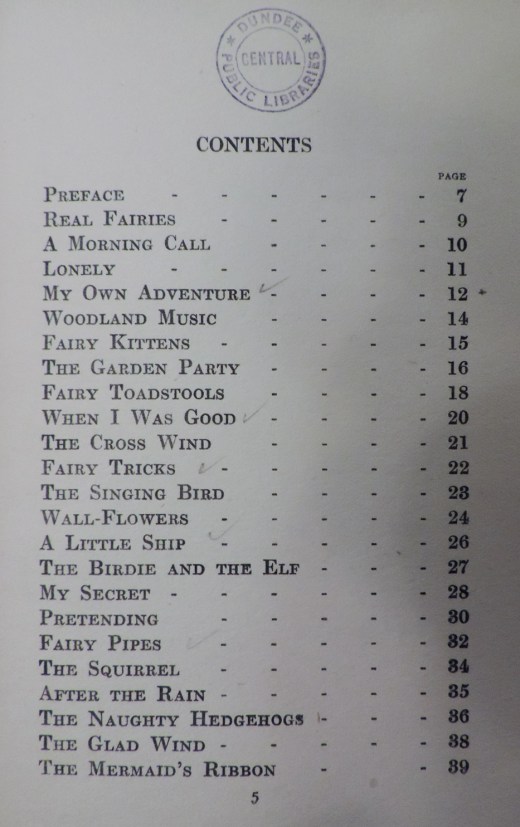
It contains thirty poems, though not all of them are about fairies. The majority do feature fairies, elves and pixies but there are other childhood topics in there as well.

DSCN6413

There is also an interesting introduction from Blyton at the start.

The welcome which was accorded to Child Whispers, the forerunner of this book, lead me to hope that not only will my friends, the children, equally welcome this one, but also those “grown-ups” who love childhood in all its moods. A little child, with his wondering, sensitive mind, is the loveliest thing in creation. This book is for him, and for the pleasure in glimpsing the ingenuous workings of his mind, and are helped thereby to a better understanding of childhood.

The first poem is entitled Real Fairies too, and puts me in mind of the Cottingley Fairies hoax of 1917. It is about a child who sees fairies in the garden, yet her parents, Nannie, Cook and gardener never see them.

It was interesting to read such an early collection of poems and I do feel that her writing style (at least in poetry) did develop over time. I can’t put my finger on it, but these poems seem a little differently written from those in The Enid Blyton Poetry Book (1934). It is perhaps that almost every poem is written in the first person. Some in the EB Poetry Book are, but not nearly as many.

The poem that stood out the most to me is the very last one, called Little-Place, about a child who finds a secret, special place to play.

This summer I went out alone, to play in Cuckoo Wood,
For now that I am eight years old, my Mummy said I could;
And, oh! I found a lovely place, all carpeted with moss,
And through the middle flowed a brook that I could jump across.

It goes on to how the child played there every day, seeing robins and rabbits and butterflies.

And then, one summer’s day, I found some other people there,
And orange peel and paper bags were scattered everywhere.
My little brook was muddy brown, the buttercups were dead;
And all the birds and butterflies had taken flight and fled.

The child tries to reclaim the special place, burying the rubbish and so on, but to no avail.

It looked the same, but oh! it had a different feel
The feel those people left behind, with paper bags and peel.

And then I knew that Little-Place belonged to me no more,
For never would it feel again as it had felt before.
And when I said good-bye and went, the tears ran down my face,
Because I knew I’d never come again to Little-Place.

 It’s such a sad little poem! The ‘other people’ may well have gone on to be the trippers to the Secret Island, I suspect. It just struck me as a very sad poem to end on, with that little child having lost their special little place.

To Nurse is another one that stands out, as it has perhaps more attitude than I would say is common. It is from a child’s perspective, arguing that she can’t be slow when the wind is blowing her about, that she can’t be quick when the bread and butter is thick, and she cannot be good when the nursery is hot and she is bored. It ends

When I’m dressed in Sunday’s frock,
And my best shoes slip just like ice,
When both my garters hurt at once,
I simply CAN’T be nice!


I’m so glad I found this and was able to borrow it. I probably would never have come across a copy otherwise. I only wish I could keep it now!

It also provides a fascinating glimpse into libraries of old. I thoroughly intend to look at other old titles still in the collection to see what I can learn.

Posted in Poetry | Tagged , | 3 Comments

Monday #180

Bank Holiday Monday has come upon us and it’s the last one of the year before we get drawn into that autumn feeling. Still I hope that you’ll sit back and enjoy our blogs this week.

Fiona is planning to review Blyton’s Real Fairies book which she found in her library last week from where it was hiding in her overflow shelves. I’m sure we’re all looking forward to what she’s got to say about it.

I will be reviewing the second part of Five Get Into Trouble from the 1970s series. It’ll be interesting to look at how the rest of the story is done after such a successful first half.

One last thing before I go; as of this week we have recieved 2000 comments on the blog, across our various posts. Our 2000th blog comment was made by Chrissie. So we just wanted to say a huge thank you to everyone who reads and takes the time to comment on the blog. You guys are the reason we keep writing.

Hope you’ll join us this week for the blogs.

Posted in Blog talk | Tagged , | 5 Comments

Best of Blyton at the library

I’ve started my new job in a library now, and I’ve been taking full advantage of my access to all those books! In a quieter moment I ran a catalogue search for Enid Blyton and it came up with 264 hits over the 14 libraries.

I’ve listed the ones I’m most interested in below.


ADVENTURE SERIES TV TIE-INS

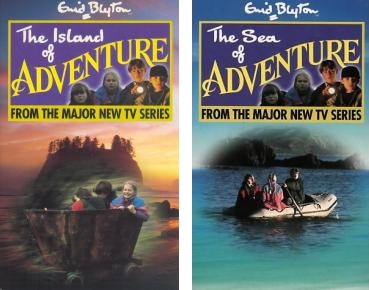
Written by Hugh Morgan, these are novelizations of the 90s TV series. All eight were published, but my library has just the two. Seeing as I just watched the Island of Adventure episode, I’d be interested to see if the novelization adds anything to the overall story.

the-island-of-adventure-tv


MALORY TOWERS AUDIO ADAPTATIONS

I think these are the same adaptations that Stef has reviewed, but I would like to listen to them myself and see what I think.


MALORY TOWERS CONTINUATION NOVELS by PAMELA COX

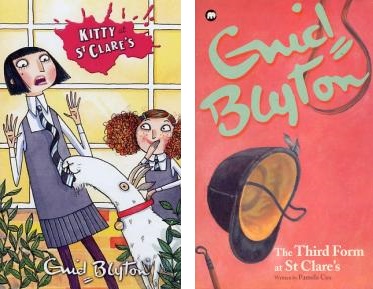
I’m not sure that there’s anyone who could really and truly capture Blyton’s characters and writing well enough to convince me they are worthy of having her name on the front of a book.Yet, I’d still like to read these continuations. These books pick up after Darrell, Sally and co’s last term at Malory Towers, then seem to focus on Felicity who is in her third year to start with. The blurbs make them sound rather like repeats of the original books – a new girl with a secret, a thief in the fifth form and so on, but the last one sounds interesting at least.

After taking their Higher Certificate, the sixth formers want to relax this term. But the Head has a surprise: a finishing school course, with old girl Gwendoline Lacey as teacher. Yet someone is determined to drive her out — and it takes the return of Darrell to solve the mystery.


ST CLARE’S CONTINUATION NOVELS also by PAMELA COX

There are three of these, filling in the gaps in the St Clare’s series, and my library has two. I think, potentially, these would be harder to believe in than the Malory Towers books as they slot in-between other titles and presumably feature all the main characters. That requires an even bigger skill in capturing personalities and atmosphere.

kitty-at-st-clares


THE NAUGHTIEST GIRL CONTINUATION NOVELS by ANNE DIGBY

The library has the first four novels out of the six that have been written. Some of them sound rather modern – girls called Kerry and Emma, waterpistol fights, a campaign to save a tree in the school grounds – but the first few sound closer to the sort of things Blyton wrote about.


ALSO OF INTEREST 


enid-blytons-holiday-stories

Enid Blyton’s Holiday Stories. This is one of the new themed collections that have been published by Hachette recently (including Christmas Stories and Summer Stories amongst others) and contains a host of short stories from publications such as Sunny Stories for Little Folk. It also contains At Seaside Cottage, which is a story about Janet and Peter before they formed the Secret Seven. That’s something I’d like to read, but it would be nicer in its (hard to find) original form.


the-riddle-that-never-was


The Riddle that Never Was – formerly known as The Mystery that Never Was – is part of a six book series created from stand-alone titles. Gillian Baverstock (Blyton’s elder daughter) edited each of them to form a series about the same children. I have read the original, so it would be interesting to see how it has been changed.


AND A FEW THINGS I’M PROBABLY BETTER AVOIDING

The first Famous Five Adventure Game I read/played the second in the series and didn’t think it was particularly good, however, my need to ‘complete’ series is making me want to borrow this too.

The Case of the Bogus Banknotes just one of several Famous Five on the Case titles the library has. I don’t think I could stomach a ‘Blyton’ story about bogus anythings.

Bizzy and the Bedtime Bear is another crazy continuation, this time of the Faraway Tree series. There are seven sickening-sounding titles in total. How revolting does this sound?

Recovering the Bedtime Bear from the Sleepeez who live there won’t be easy. Especially when the Faraway Fairies are accused of being ‘party poopers’. They need to put this adventure to bed quickly when Talon the Troll is ready to take advantage of any mistake.

The Island of Surprises is a Wishing-Chair follow up (one of six). These feature Jack and Jessica, and a Pixie called Wishler. They sound marginally better than the Faraway Tree continuations, but that’s not saying much!


AND THE ICING ON THE CAKE

real-fairies

I didn’t truly believe that this Spydus record would turn out to be true. It doesn’t exactly contain much detail, and at the time I viewed it it was apparently in transit from the Children’s Centre to Leisure Reading. It turned out to be amongst the other Blytons in the secondary stock area (where all the books that don’t fit out on the shelves have to live) and amazingly, it is indeed a 1923 copy! I’m going to do a proper blog about it later, so I won’t say anything more about it now.


I can see that I’m going to be very busy borrowing books now – thankfully as a staff member I can borrow up to 30 books and don’t get fined if I bring them back late!

  • Does your library have any good Blytons in its stock?
  • What gem would you love to discover on your library’s shelves?
  • Would you borrow any of these if you had the chance?


Posted in Other Authors, Reading Recommendations | Tagged , , , , , , , | 4 Comments

Famous Five 70s Style: Five Get into Trouble, part 1

Five Get into Trouble is one of my favourite books; the complex plot, the danger, the really really bad crooks – plus all the mystery – makes it one super adventure. So I have to say that the rushed twenty-five minute adaptation of it in the 90s is not my favourite. We lose a lot of the mystery and back story, which is why I may prefer the 70s version where it’s split into two parts.

First of all we are treated to a nice friendly scene where the Five are about to set off and Aunt Fanny is fussing around George to make sure that she hasn’t left anything behind. Uncle Quentin is doing something mysterious to Anne’s bike, something that looks a bit like checking the tire pressure. Well fair enough, it needs to be done, but what’s the point? In the book Uncle Quentin only shows a passing interest in the Five and their trip only because he remembered that he had always had a puncture when he was younger.

So off we set with a lot of fussing from Aunt Fanny, and Timmy on the back of George’s bike on a special saddle. This is a completely new invention in the scheme of things; I wonder if Uncle Quentin thought of it. Anyway, off they go and its not long til we’re treated to that nights camp and the morning after. George is steadfastly still asleep with her head poking out of the tent, Anne is cooking and the boys are swimming in a lake, and complaining that the water is cold.

Enter Richard Kent.

Now I hate his character at the best of time, but Grant Bardsley makes for a very very arrogant, annoying, self entitled git of Richard Kent. Now, that is fair play to Bardsley because there isn’t much scope with a character like Richard Kent, but it makes the arrogance seem really real, and yet by the end of the episode he is beginning to shift and crumble into the scared little boy we know him to be. To begin with however, Bardsley makes Kent try to appear larger than life, inviting himself along with the Five without so much as a please, or my name is.

Bardsley works well to bring the arrogance of Richard Kent to the screen and not to mention there is something about him that you just don’t trust. The way he evades questions about his mother and his aunt is suspicious to say the least and quite frankly I don’t trust the little rascal. Julian gives him more than enough chances, more than I would that’s for sure, especially if this particular person had been the reason my brother had been kidnapped. I suppose we shall what happens to Richard in the next episode, and we shall find out if Bardsley manages to pull it off.

Character Development

Its nice to see Marcus Harris’ Julian interpretation come into its own here. The fact that Trouble is in the second series just demonstrates how much the cast has grown. Harris is beginning to demand a larger role in screen time, and is beginning to have  a mustache. He puts Bardsley’s Kent in place without needing to raise his voice, the presence he is now demanding is quite impressive. You know he’s in charge and this is a Julian who is not to be meddled with. Harris proves this later on in the episode when the Five find their way in Owl’s Dene where Dick is being held prisoner and he starts to talk to George, driving the ghastly Hunchy to get even more angers and threats to beat the children. Harris provides a strong, in control Julian that the rest can get behind and back up. This is completely different to Marco Williamson’s Julian who comes across as more of a caricature and the others undermine and argue with. The difference is phenomenal.

The dynamic between Harris and Gary Russell at this point is much more brotherly and in fact less awkward than the first series where Russell was simply following orders. Like Harris, Russell demands an on screen presence that really brings Dick to life. However this isn’t a Dick like Paul Child’s over compensating characterization, this is a Dick who’s growing up with respect for his brother, and fewer less noticible issues. In fact the boys are more like friends here than brothers, which helps the dynamic. Harris and Russell aren’t relying on each other as much now and are less of a double act but still work in a near perfect balance.  As a side note, can I just say that you can really see the shift in the times between the 70s and 90s adaptations, the change in dynamic between the fives and the focus on the story and characterization. For a sociology graduate, its utterly fascinating.

Overall

I quite like this episode, and the attention to detail is outstanding and actually the slow start to establish the story is effective and doesn’t feel drawn out. Its a wonderful adapation of the book and I like it not being rushed, drawing the characters out and showing us how they’ve changed and developed. I hope this follows though into the next episode and it isn’t too rushed with the storyline as they’ve got a lot to happen in that episode. Fingers crossed eh?

maxresdefault

Dick (Gary Russell), Timmy (Toddy), George (Michele Gallagher) and Richard Kent (Grant Bardsley) on their bikes in Five Get into Trouble.

Posted in Blyton on Screen | Tagged , , , , , , , , , | Leave a comment

The Mystery of the Burnt Cottage: How has Blyton’s original text fared in a modern edition? part 2

This week I’m back with the Five Find-Outers to see what else has changed. The first post can be seen here.

To remind you – my personal copy is a Methuen from 1957 – the 12th reprint/impression of the original edition. The new copy is the most modern of any paperbacks I have used so far, an Egmont copy from 2014.


CHAPTER THREE: THE FIRST MEETING

Nothing too major to report for this chapter.

As per usual, hyphens are being removed from phrases. Summer-house is now summerhouse (except for the first time it is used, when it’s left with its hyphen).

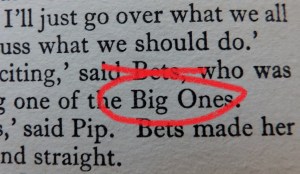
When Bets is enjoying being one of the gang it is referred to as being one of the Big Ones. Generally random capitals are frowned upon – especially by me – but in this case changing that to one of the big ones means it loses some of its impact.

DSCN6302

Like the previous chapter fire it has been changed to set fire to it. 

Previous books have taken out a lot of the italics Blyton used for emphasis – and it happened twice in chapter two of this one as well. In this chapter we had it’s his mystery which has now lost the added emphasis.

Lastly something that will carry over into the next chapter too. Larry plans to drop a shilling so that they can pretend to be hunting for it in Mr Hick’s garden. This has been changed to drop a coin on both occasions it is mentioned.


CHAPTER FOUR: CLUES – AND CLEAR-ORF!

The shilling/coin change becomes silly in chapter four. Larry now says look for my coin, all of you, answers my coin to Clear-Orf’s question of what they are looking for, then Ah! My coin! when he finds it, and lastly, I’ve got my coin now. 

DSCN6301

Nobody drops a pound or fifty pence and says I’ve lost my coin (unless, I suppose the coin was of some historical value – but then you’d say I’ve lost my ancient Roman coin. Sometimes using a vague reference to coins or money works in updating, but in this case it doesn’t at all. If he had said my money it wouldn’t have sounded so silly, or he could have been specific and said a pound.

When looking for footprints in the garden it is said that There were none on the path, which was made of cinders, and showed no footmarks at all, of course. The 2014 book only says There were none on the path. I can’t understand why, unless they think that children will be stumped by a cinder path. It could easily have become gravel, which wouldn’t show footprints either.

In the original text Fatty says he won a prize for Art. School subjects always seem to be capitalised in Blyton’s books but are lower-cased in the modern reprints including this one.

While Fatty hasn’t been called fat in these chapters (not even when squeezing through a gap in the hedge) Larry’s joke about the art of  [Fatty] eating too much has been removed.

DSCN6300 circled

The hyphen is also lost from tea-time, but instead of the more common tea time they have rendered it as teatime.

And lastly – they have clearly decided all italics must be abolished.

  • You haven’t found a thing
  • This must be the print must
  • Yes he is clever
  • I would not have said
  • You nearly made me go green
  • You’d say we had been looking

Perhaps Blyton did use rather a lot of italics for emphasis, but I can’t see the harm in that. It’s all in direct speech from the children and it’s only natural, when speaking, to emphasise important words. Without the emphasis many of these lines fall rather flat.

Strangely, the reference to Mr Hick having a man-servant hasn’t been changed. Most references to servants and maids have been changed to staff or other more modern terms.


CHAPTER FIVE: FATTY AND LARRY LEARN A FEW THINGS

This chapter is surprisingly light in changes.

Italics are removed from two further phrases:

  • What about me?
  • She simply could not remember

Th only other changes are where Fatty talks about Horace Peeks. Thomas, the chauffeur talks about him as Peeks, and Larry asks who is Peeks? Fatty calls him Mr Peeks on all subsequent occasions, and he is also Mr Peeks in the ‘thoughts’ of the two boys.

DSCN6312


Seeing as many of these changes are just repetitions of earlier ones, the count is only 15 for these four chapters. Adding that to the previous ones we get a total of 37.

And – disclaimer! I haven’t drawn on any books, promise!

Posted in Updating Blyton's Books | Tagged , , | 7 Comments