The Twins at St Clare’s – How has Blyton’s original text fared in a modern edition? part 2

I am comparing an Egmont paperback from 2005 (on loan from Stef) with a Methuen 6th impression from 1945. I think the Methuen is fairly close to the original text, if not identical so we shall see how many changes have been made sixty years down the line. The previous part can be read here.


CHAPTER FIVE: A BATTLE WITH MAM’ZELLE

They continue to mess about with the italics and highlighting in the Egmont copy. Mam’zelle’s French is in italics in both, so when she says the twins are insupportable, originally the preceding text is italicized and insupportable is not – giving it emphasis. The paperback has it all in italics.

Despite shan’t being used multiple times already, when Pat says I’m jolly sure I shan’t stay, it is changed to won’t. Hilary’s speech in response to the twins sneaking off to the cinema has also been needlessly altered. Originally she says I can’t think why you go out of your way to make things so difficult for yourselves. It has been changed to I can’t think why you should go out of your way to make things difficult for yourselves. I find the new wording clumsier, should adds nothing. Should also implies they are yet to make things difficult, while they’ve been doing that since they arrived.

Lastly for this chapter a fine nature-film at the cinema is now just a fine film. I suppose it would seem strange for two fourteen year olds to be desperate to go to the cinema to see a nature film now.


CHAPTER SIX: POOR MISS KENNEDY!

Very little is changed in this chapter. Queer behaviour becomes strange, and queerly becomes strangely. Also any one is corrected to anyone (as it refers to people). 


Quite a short post this week then, but I didn’t have time to do further chapters. Six changes this time (sticking to my rule of  counting new/unique alterations only) bringing us to a total of 28.

Posted in Updating Blyton's Books | Tagged , , | 1 Comment

Monday

Back at Monday again, and lets just say I don’t want it to be Monday! I need another two days at least of the weekend. Anyone else with me?

On that note, lets get on to what we’ve got to blog for you this week. Fiona is back to comparing St Clare’s original and new editions. I shall be bringing you the second part of Five go to Billycock Hill from the 90s TV Series.

And we have no blog news this week, apart from a call out for blog donations!

I shall leave you with some of the pictures from my trip to the Roman Baths in Bath a couple of weeks ago! It was very interesting to walk around the old baths and tread where the Romans would have trodden. Very much history alive!

Posted in Blog talk | Tagged , | 3 Comments

Famous Five 90s Style: Five Go to Billycock Hill, part 1

Another two parter from series two, and we’re back to splitting the episodes again because I couldn’t find a block of 50 minutes to watch the two back to back (this week has been crazy busy) but I’ll walk you through part one, and we’ll do part two next week.

Five Go to Billycock Hill is not one of my favourite books and neither is it one of my favourite adaptations. The execution of the story is quite sloppy over all I feel, but again this is what keeps cropping up, but I do think it was because I wasn’t a child any more when I watched it. At this point in the filming I feel that the script was becoming too much like Five Go Mad in Dorset (the Comic Stripspoof), and the cast perhaps seem too old.

When they came to the second series filmed in 1996, certainly Marco and possibly Paul as well looked too old and it was hardly surprising as Gary Russell remarked when he went to the press launch of the second series that both were drinking pints of beer! – Tony Summerfield. (The thread can be found here.)

The cast were clearly out growing their roles and the never ageing Five that Blyton envisaged all those years ago when she wrote them was never to be. In fact if you look further down on the thread from the Enid Blyton Society, you can see that all the screening dates for the episodes have been listed and Billycock Hill was shown last. This doesn’t mean that it was filmed last but if they knew it was to be screened last they may have made the characters more grown up as a sign of them leaving childhood behind.

Anyway, on to the story. There is one major change that needs to be noted in this part of the episode and this would be that Uncle Quentin is advising on the planes on the airfield that plays such a significant part of the story. As a general rule he is fairly inconsequential  in the episode so including him seems a bit pointless, but he’s there and working on the planes with Toby’s cousin Jeff.

Speaking of which, Toby Thomas is a bit wet really, maybe a bit young to be a school chum of Dick’s but not a bad performance over all. I always imagined Toby however to have dark hair, not blond. That’s just me nitpicking, mind. We also don’t have young Benny and his runaway piglet Curly. Again not a necessary part of the story until the very end, but definitely brings some much needed lightness to the book.

We go through a few funny parts really, including the meeting of Mr Gringle the butterfly man who is only interested in moths and butterflies, and Dick falling into the only swimming pool for miles after being surprised by an air force guard.

When the highly handsome Cousin Jeff arrives after the swimming pool incident to reprimand Toby for taking his friends there without permission, we see a new side to George; the love struck teenage girl with her first crush. This makes her perfect to tease by Dick who takes every chance to tease his cousin on how she was talking to Jeff, especially telling the dashing pilot that she was actually a girl and not a boy, and letting him call her Georgina. Poor George. She can’t win can she? I mean Dick teases her when she’s all fierce about being a boy and then when she’s trying to be a girl. Well let’s just hope George saw the funny side.

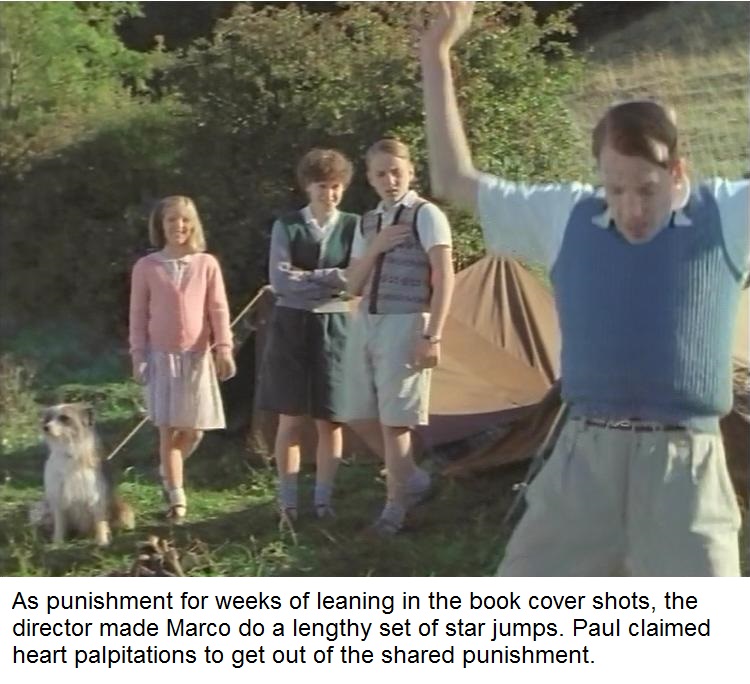
I can’t help but say, I don’t like this episode. The most cringe-worthy bit is when, on their first morning at camp, Julian tries to make them all do star jump exercises before breakfast. I can’t watch that scene it just makes me cringe so much. Ironically around the time this would have been set in, plus the ages of the boys, they would have been getting ready to go off and do their national service, and its possible (though I don’t know) that this was how boys at boarding school started their mornings! Either way I always fast forward that bit because it just seems so out of character to me.  What to you all think? Is this episode really as bad as I think? Or am I just jaded because I watched it first through adult eyes not children’s? Let me know before part two next week; it will be interesting to find out what everyone else thinks!

Starjumpsone

Posted in Blyton on Screen | Tagged , , , , , , , | Leave a comment

Five Have a Mystery to Solve: An exciting dramatised adventure

This is the last of the CDs that I have, and I’ve left this one to last as it’s one of my least favourite Fives. It’s hard to say why. Something to do with how un-Fiveish it is for them to let their boat float away on the tide, perhaps. They were always so careful and considerate of any belongings big or small, especially those that were not their own. I’m also not a huge fan of Wilfrid, he’s rather annoying and somehow his affinity with animals seems like it should be in a fairy-tale, not a Famous Five book. Anyway, that’s not got anything to do with what the audio dramatisation is like.

7

As often is the case, the cast of voices is quite small though there are a few incidental characters along the way.

We have the Five, of course. It’s not the strongest group this time around, the two boys quite similar, as do the two girls. In fact at times George and Dick could even be confused. Then when you add Wilfrid – another average boy – it’s really not always clear who’s meant to be talking.

Saying that, there are a few times where Wilfrid is very wooden sounding, as if he’s reading right from the script as he goes. “He was. Once. One of the. Watchmen. Himself.” He also gives a rather awful scream as Anne throws water over him (we do get to hear the splash of that as well). Anne sounds distinctly un-Anne-like at this point but perhaps as she’s being a tiger this is intentional. Oh – and – the Five actually sing briefly at the start while they’re riding their bikes. What a treat!

I don’t recall hearing a lot from Timmy which is perhaps because he actually sounds like a real dog this time and he doesn’t stick out like a sore thumb. We do get to hear him lapping water from a bowl at one point, though thankfully we are spared the sounds of him choking on a ball as that is omitted from the dramatisation.

Mrs Kirrin(/Barnard) is cut from the story apart from the briefest of mentions but Mrs Layman gets to appear still. She sounds like a nice old lady. Later we meet a rather elderly sounding Lucas at the golf course and he actually gets quite a lot of time to deliver his story about Whispering Island as well as the other bits and pieces he says about Timmy and his hedges. The golf pro also appears (though he’s described as a man checking golf scores) and he sounds very posh.

The ‘boy of 15’ who rents the boats never gets to speak but it’s interesting they haven’t updated him to a grown-up.

And lastly, we have the two baddies of the story. Julian (I think) says “There’s something wrong. Those men look like foreigners, they certainly aren’t groundskeepers,” when he sees them. Their names are Emilio and Carlo and they have rather stereotypical European, perhaps Italian accents. They’re a bit like Bella from Fireman Sam actually and say things like “We don’ta wanta strangers around,” and “I’mma getting outta here!”. Generally they’re ok but toward the end they start acting rather comedic and over the top.

Apart from the voices there’s a good array of sound effects to go with the story. Some are perhaps strange choices such as Julian emptying golf balls from his pockets and the pro pouring them lemonade, especially when Wilfrid’s pipe ‘dirge’ is spoken of but never heard.

We hear the Five rowing in the sea and dragging their boat (not far enough) up the beach, plus Dick makes some very odd noises as he climbs down into the well. The Five also do rather a lot of exaggerated grunting as they pull him back up, then a few more times as they deal with Wilfrid’s boat and so on.

The wailing cliffs and whispering trees are rather a disappointemnt. They both sound the same and neither sounds like it would be truly frightening or even disconcerting should you hear it on an isolated island some day.

This time around I noticed a little more of the good old exposition dialogue. Especially when Dick is down the well and is pretty much talking to himself about what he’s seeing and doing instead of it being described by the narrator (or Enid in the book). The end paragraphs where Enid describes that Julian is lying back and Dick is looking down at the island etc is narrated exactly as is.

One question I had was how does Wilfrid know George is a girl? Quite near the start he mentions George is a girl, though I don’t recall anyone telling him. Mrs Layman thought she was a boy (though she doesn’t appear to speak to Wilfrid between her meeting the Five and then Wilfrid doing so too.) I don’t know if that’s in the book and I can’t remember where it happened so I haven’t spotted it yet either. If you can answer the question please leave a comment!

So there we have it, I had rather a lot to say about my second-least-favourite Famous Five story. Perhaps it was because I spent the hour painting shelves and really listening rather than multi-tasking and browsing the web like I usually do. That’s my top tip for the day then, do your DIY while listening to an exciting Famous Five audio dramatisation. Just don’t get too enthralled or you might end up making a bit of a mess.

Posted in Audio Books and Audio Dramatisations | Tagged , | 3 Comments

Monday

Another Monday has rolled around and I’m trying hard not to calculate how many are left until December 25th arrives. I’ve started my shopping and even bought my cards but I’d rather not know how little time is left!

What I do know, though, is what we’re doing on the blog this week.

Ristorante

And now so do you!

Posted in Blog talk | Tagged , | 1 Comment

The Twins at St Clare’s – How has Blyton’s original text fared in a modern edition?

I will be comparing an Egmont paperback from 2005 (another loan from Stef) to a Methuen 6th impression from 1945. The Methuen should be pretty close to the original text, if not identical so we shall see how many changes have been made sixty years down the line.

I’ll be doing it chapter by chapter as usual, but there are always a few things to note before I even get that far.


I really do hate the cartoony cover from Egmont. It looks like a horror story with those blank faced twins with their weirdly long skinny hands. I don’t know why there’s a pink splodge around the title either. Is it supposed to signify the bad attitude of the twins, somehow? Books about naughty children always seem to have splodges or stains on the covers these days (think Horrid Henry and The Naughtiest Girl).

On the title page the Methuen has The Twins at St Clare’s a school story for girls while the Egmont just has The Twins at St Clare’s. In the Methuen there are also the details that the book is by Enid Blyton and has eight illustrations by W. Lindsay Cable. 

The chapters numbers are now given in “normal” numbers and not Roman numerals, and at the start of each chapter they appear in splotchy shapes like the ones on the cover. Two chapters names are changed also. A bad beginning becomes just Bad beginning, and A broken window – and a punishment is now A broken window.


CHAPTER ONE: THE TWINS MAKE UP THEIR MINDS

For the first few pages I was worried this would be a rare and almost unaltered edition. At first all I could spot were very minor updates. Hyphens (as always seems to be the case) have been removed, thus head-girl becomes head girl and so on, the Head or the Head Mistress loses her capitals, and various full stops are removed after Mrs. and prep. etc.

Only two larger alterations have been made to the first chapter. It originally read Mr O’Sullivan rapped with his pipe on the table, and then later, Mr O’Sullivan lighted his pipe. For some reason it has been changed to Their father lighted his pipe and then Their father relit his pipe. I’m actually surprised the pipe hasn’t been cut out altogether! Saying that there are a few things that have been left in like references to maids both at home and school, plus the odd phrasing of in the train, rather than on the train. 


CHAPTER TWO: THE TWINS ARRIVE AT ST CLARE’S

Naturally we can’t have a queer-looking crowd, so it has become and odd-looking one instead. The tea-wagons have modernised into shops at the station, the common room wireless is a radio, and their gramophone is now a record player. That last one struck me as rather ridiculous. A record player makes it about as modern as the 1980s – maybe the mid nineties at a stretch if your parents were the type to still play the odd bit of Earth Wind and Fire or Fleetwood Mac. A child in 2005 is about as likely to know what a record player is as they are a gramophone. Surely it should be CD players? Well, that of course would have to be updated again for any 2005 editions as isn’t all music digital these days? Of course if there are CD players there would have to be iPod docks, and probably computers playing Spotify plus plenty of smart phones around… and therein lies the ridiculous, futile nature of updating anything that’s going to be out of date a few years later.

The drawing-room is now a sitting-room, and a dance-band (on the wireless) is just a band. The twins are no longer expected to say how-do-you-do to Miss Theobald, rather they are to say hallo instead. There’s no need for them to know how to sew a button on a shoe, just to sew a button on. And lastly the line and didn’t she just fancy herself has become didn’t she fancy herself. 


CHAPTER THREE: A BAD BEGINNING

The eiderdowns on their beds have become quilts (so children who are most familiar with duvets are still left out), and in what I think may be an attempt to be less snobbish the girls say that someone talks like a rag-and-bone man instead of our parlourmaid at home. Rag and bone men were very common when the book came out though I can’t say I know of too many around today. I believe there are some – dealing mostly in scrap metal which is quite valuable now – but it’s a strange thing to add in to the book, and is it any better a comparison to the parlourmaid? It’s ok for a working-class rag-and-bone man to speak badly, but not a maid? It can’t be that maids are being written out as archaic as they’re mentioned several times in earlier chapters.

One of the twins complains she hates having to be the same as everyone else – a product of being at St Clare’s where everyone has matching bedding and wears the same uniform and so on. This has been changed to I hate being the same as everyone else. The point is lost here – the twins feel they are somewhat different to the other girls (and of course all the girls are different as no two people are the same) so they hate having to fit in.


CHAPTER FOUR: A LITTLE TROUBLE FOR THE TWINS

I’m not in the least surprised that Pamela no longer calls the twins a pair of boobs. Instead they are a pair of idiots. Isabel wants to buy a new hair brush instead of a new set of hair-grips and she puts on a record instead of winding up the gramophone.

Emphasis is lost when Well, do GO! becomes Well, do go! And there are two occasions where it seems that the editor is trying to distance the top form girls from the chores they set. Pamela no longer says before you did our boots, instead it’s the boots, and Pat says she would even scrub the floor now instead of her floor. 


And so that is a total of 22 changes to start off with.

Posted in Updating Blyton's Books | Tagged , , | 2 Comments

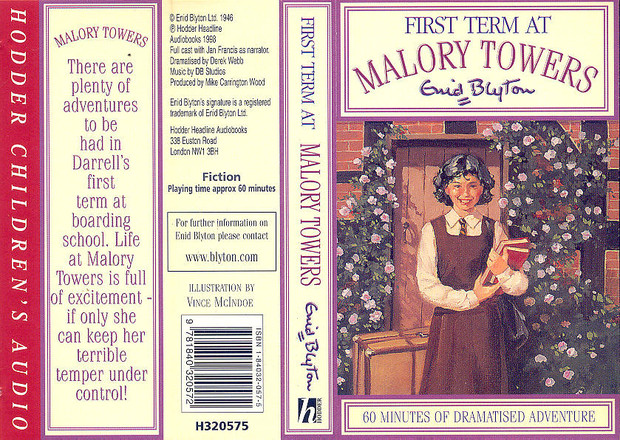
First Term at Malory Towers: Audio adaptation

Well thank goodness I still have a working tape machine in my room otherwise I wouldn’t be able to bring you this blog at all. Once I had located the tape I slipped it in the player and off we went, off to Malory Towers for our first time.

As a child I had tapes two, three and four and had no idea that there were any escapades of Darrell Rivers and co after Upper Fourth at Malory Towers. However, when I discovered a collection of tapes at my library I devoured the other three tapes. The First Term, In the Fifth and Last Term. I remember having huge gaps in my knowledge when I finally got around to reading the books, because I believed the tapes were absolute! How wrong was I?

When I listen to them now I can definitely find the gaps and flaws in the story telling. For example we lose a great bit about what Mr Rivers says to Darrell before he leaves for work that morning about being good and working hard, which is echoed by Miss Grayling later in the book. The fact that this part becomes the running theme through Malory Towers, and this tiny section where Darrell has an interview with Miss Grayling and pipes up that her Father said the same to her, doesn’t make sense. It was mentioned twice because it was important in the book and to Blyton so the fact it was missed out of the audio dramatization for length purposes I suppose is a little lax in the scheme of continuity.

The actors are very good and convincing in their rolls however, and the girl playing Darrell I think is the same one who plays Anne in one set of Famous Five adaptations and the girl playing Gwendoline plays George as well in the same set of Famous Fives. Their portrayal of the characters here are very convincing and good matches.

I wish there was more for me to talk about apart from nitpicking on the story. I can tell you where all the gaps are, what’s missed and what is included or changed. All I think I can really honestly say is that the adaptations on cassette were my way into the Blyton universe so they hold a special place in my heart. Which is the most important thing!

There are some stark differences however, especially when looking at the half-term event and its lead up. In the book there is a big build up and we get to see Darrell asking everyone she can think of to come out with her parents as her first choice, Alicia, is going out with Betty for half term. The business and frustration I felt with Darrell when I finally read the book was very real and I too got aggravated with Mary-Lou for not standing up to Gwendoline, as you’re supposed to. However in the audio, Emily, the girl Darrell asks to go with her in the end is absent completely!

Talking about characters who disappear completely in the audio, Irene! Our darling scatterbrained Irene, mad for music and maths is completely missing from the first audio and given that she plays a big part in the next book, she’s fairly important as a character and dominant throughout the series, not getting dropped off somewhere along the line like we experience with some other characters that never get mentioned again. The loss of Irene, although it doesn’t effect the plot too much is quite devastating for a seasoned Malory Towers reader.

One thing I would like to mention before I round things off, is the instrumental music that introduces the audio, and fills in some gaps. It gives a very jolly, happy going off to boarding school feel to the story, and is quite like something Irene would have composed. It’s a piece that transports you to Malory Towers and into that beautiful Blytonian world.

I could sit here and pull apart the pieces of the book that did not make it into the audio but I would only bore myself and you dear readers. Given that its taken me a while to write even this and its getting quite late, I’m going to say “ta-ra!” and just finish with a score for the dramatization. Probably my least favourite adaptation the score for First Term at Malory Towers is a shameful 2 out of 5 for the simple reason that some of the best bits have been left out and great gaping gaps spoil my enjoyment of an otherwise good solid recording.

Next review: Second Form at Malory Towers: audio adaptation

Or read a review of the First Form novel here.

Posted in Audio Books and Audio Dramatisations | Tagged , | 5 Comments

Monday

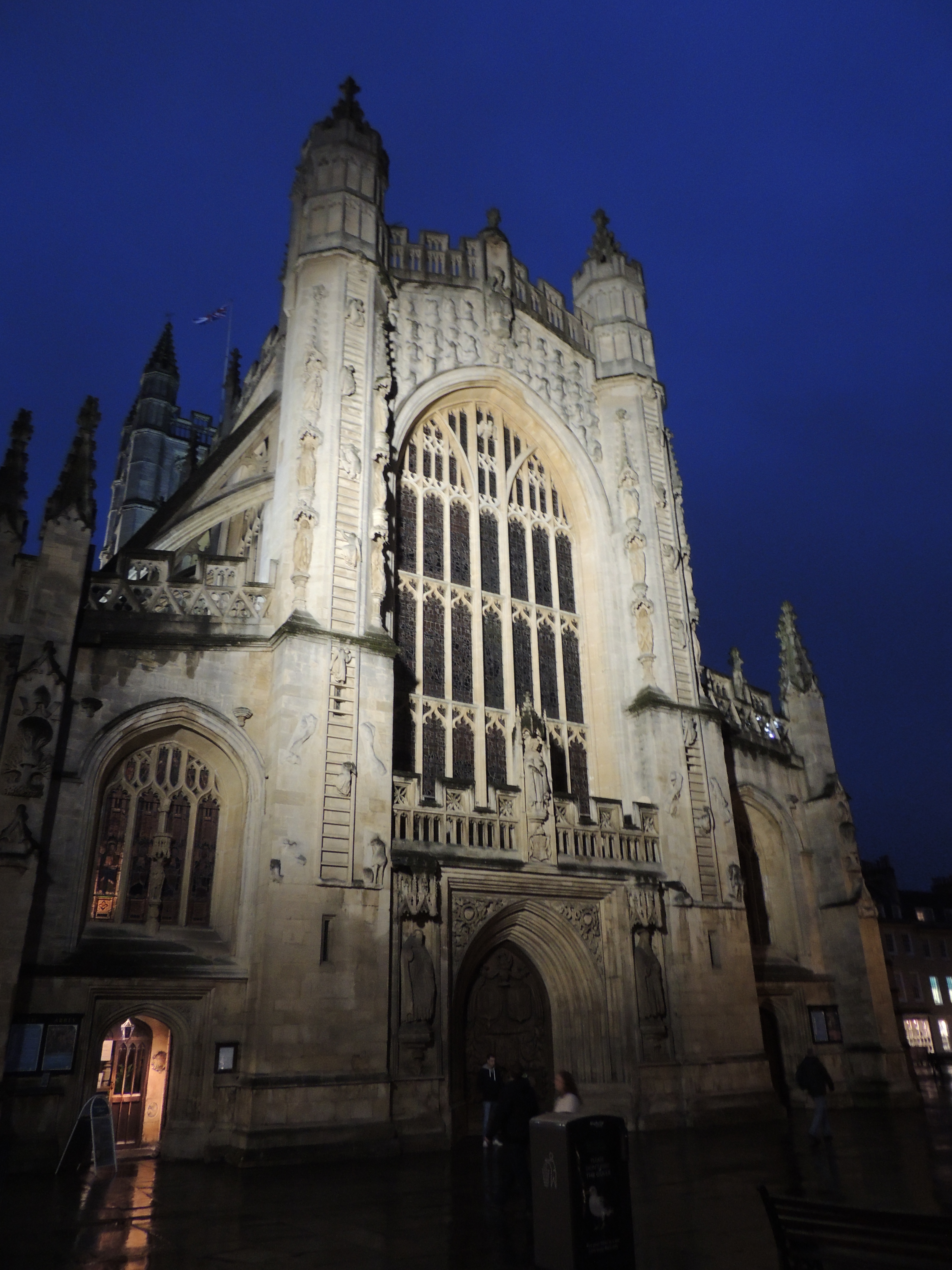
Well I spent a long weekend in Bath, Wiltshire (UK) and I got thoroughly wet. As some of you know Bath is synonymous with Jane Austen, along with Bath buns and the Roman baths. So we had a nice time being all touristy and wet through as it poured with rain on Saturday during our walking tour and when we spent the day at the new spa, enjoying the hot spring.

So really until I got home this evening I didn’t know what I would be doing for my blog and Fiona asked if she was doing the post today, I don’t know that she had either. Aren’t we bad?!

Anyway the plans this week are to bring you the first comparisons from The Twins at St Clare’s from Fiona who has run out of Noddys to do. We are also trying to find which audio books she hasn’t done and if you have any that she hasn’t reviewed on this blog, get in touch and let us know if you can lend us a copy.

I shall be starting my own audio comparisons this week as a consquence, and shall be looking at how the audio adaptations of Malory Towers differ from the books! Luckily there are only six of them and I have them all on cassette from my childhood.

With that plan in place, I shall leave you with a favourite picture from the weekend and wish you all well for the coming week!

Bath Abbey at night

Bath Abbey at night

Posted in Blog talk | Tagged , , , | 1 Comment

Famous Five 90s Style: Five on a Secret Trail

Five on a Secret Trail is a hard to find episode, especially on video cassette. A limited number of video tapes were released with this episode in the 1990s from the retailer WHSmith. Thus when the likes of eBay was invented and people started looking for their childhood TV programs for sale, Five on a Secret Trail was rare and hard to find. They also only came in a cardboard box, which is partly why not many of them survive today.

I remember bidding on one such video cassette in my mid-teens when I was eagerly collecting the Famous Five episodes once again. My mother was doing the bidding on eBay and unfortunately we had no internet that weekend, so we put in our maximum bid and were outbid at the last moment.  That had been the last video to complete my collection. I still have all the video cassettes and a video player to play them on if I’m feeling particularly nostalgic.  So I didn’t get to see this particular adaptation until a few years later when I purchased the Dutch Famous Five DVDs for the 90s series (good copies, missing Smuggler’s Top though – and I’m still unsure why we don’t have English DVDs!)

Anyway on to the actual episode. For those of you who haven’t seen it, it is available to view on Youtube, and I do recommend you do! We start off with a rather hazy montage of scenes where we can sort of make out that something is being taken, or stolen. In fact it looks like the same place that Richard Kent made his escape in Five Get Into Trouble was filmed. This is possibly true of course and the filters are used to make it seem different.

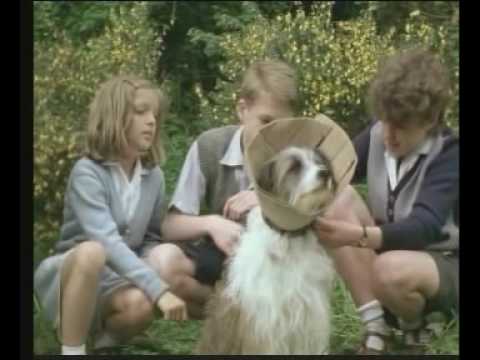
As the audience we are aware that something has been stolen, and we have an idea of what the Five will be looking for when we get to the main part of the adventure. We cut then to George (Jemima Rooper) and Anne (Laura Petela) chasing after Timmy who is going after a rabbit. Everyone knows that George doesn’t like it when Timmy goes for the rabbits and he is punished this time by catching his ear on some barbed wire and has to have a trip to the vets to get it stitched. The consequence of this is that Timmy now has to wear a cone around his head to stop him scratching the wound and opening it up again. This causes everyone in the village, even George’s own father to laugh at poor Timmy, causing George to run away until Timmy’s ear is better and the cone can be removed.

Anne agrees to accompany George, although in rather a timid way compared to in the book where she quite happily walks onto the moor behind Kirrin and joins her cousin. The boys, as you know from the book, are away camping with their school for the summer hols, which is why this book is always one of the hardest for me to get into, because in the book it takes up until about chapter eight for them to make an appearance and I find the action rather slow. However in a 25 minute episode, there is no time for all the dullness to settle in and before we know it, the girls have met Guy, a young boy who is digging around in an old archaeological trench containing Roman artifacts. He’s rather changeable in personality and the answer given in the episode is nothing like the one in the book.

[Spoiler warning] For all those in the know, Guy hasn’t got a split personality but an identical twin brother called Harry. The loss of Harry from this episode is a shame because it would explain Guy’s apparent mood swings much more clearly. Also, the fact that they hadn’t been able to find twins who were identical hasn’t mattered to the producers before as the Philpot/Finniston twins in Finniston Farm are non-identical when they are supposed to be as like as two peas. I suppose it might have made the situation in Secret Trail harder to run but they were not above changing the Blyton Gospel as we know!

After a disturbed and stormy night, where they think they see ghosts, hear strange noises and see odd lights, George and Anne are packing up to go home when the boys arrive, cheerful as ever and come to set the adventure straight. They convince the girls to stay, go and say hello to Guy and then start to explore. Obviously the idea that girls would be scared is something that’s picked up on when critics look at the books; the blatant sexism, that the boys aren’t scared and can look after themselves and the girls can’t. Fortunately I don’t see it quite as black and white as this, but as the fact that this was just how things were back when Blyton was tip-tap-tapping away on her typewriter. Society was much more consigned to the gender roles we were given (sorry, inner sociologist coming out there!)

With a bit more exploration and a night where the boys spy on the chaps who are trying to scare them away from the moor, the kidnap of Guy, and the discovery of the secret tunnel that the, once again,  comic crooks can’t find even though they have been searching harder and longer than the Five, we watch the quick fire discovery of Guy and the item that has been stolen.

In Secret Trail the boys’ rivalry seems as alive as ever, Dick (Paul Child) trying to take the lead but being quashed by Julian (Marco Williamson). We even get to see Dick being less than impressed with his brother and being told by Anne to be nice. Its easy to see that how in the second series when Williamson broke his leg that it was natural for Dick to assume the role and for Julian to become a little more of a Beta character.

I like this adaptation of Secret Trail because as I said before, it’s a slow book to start off with, and the fact that we miss most of the ‘boring’ bit of the book appeals to me. I know I’m supposed to be a purist when it comes to Blyton but I do admit the girls don’t hold my attention nearly as well as the boys do, and especially when the Five are separated.

Overall, a good adaptation, with the only exception of the comic villains once again and the loss of Harry Lawdler- Guy’s twin. Has to be up there with some of my favourite adaptations.

Anne (Petela), Julian (Williamson) and George (Rooper) with Timmy (Connal) in his collar.

Anne (Petela), Julian (Williamson) and George (Rooper) with Timmy (Connal) in his collar.

Posted in Blyton on Screen | Tagged , , , , , , , , | 3 Comments

My twenty-first Noddy book: Noddy and the Aeroplane

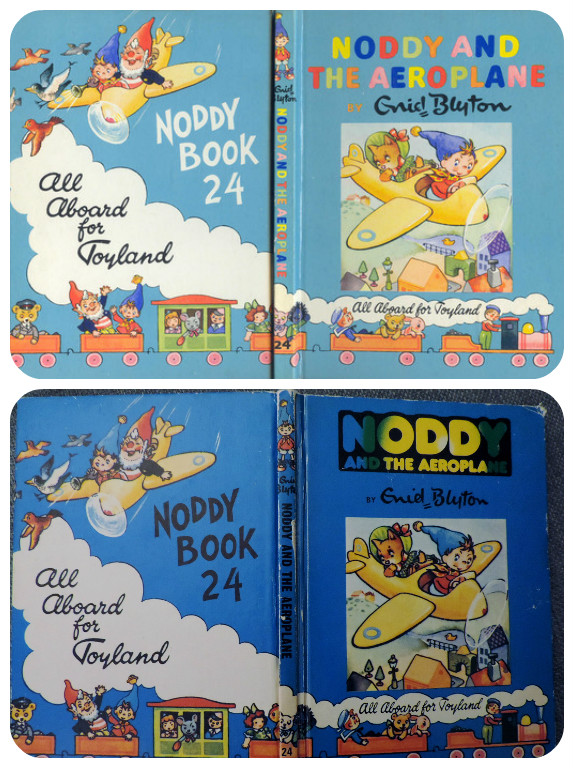
This will probably be my last Noddy review for a while, at least until I can get my hands on the three titles I don’t have. My Noddy and the Aeroplane is one of the slightly newer hardbacks which is very similar to the original but with a few minor changes.

On mine Noddy appears in larger lettering above and the aeroplane, the letters yellow in the middle and changing to green then blue towards each end, and on a black background. The lettering on the spine is all plain black as is Noddy book 24 on the back.

NoddyandtheAeroplane


I don’t know if Blyton intended this to be the final Noddy book but it starts with Noddy coming home at the end of a long day’s work, which seems quite apt. It was written in 1963 (the same year as Five Are Together Again, and two years after The Mystery of Banshee Towers) and comes around the time many people agree that Blyton’s skill as a writer began to decline. I think it’s fair to say this book suffers the same fate as the two I just mentioned, being a rather weaker instalment not to mention riddled with small errors.

So anyway, Noddy brings his car back after a day of driving in muddy weather whatever that is. Presumably rainy weather which produces mud but it rather sounds like it’s the mud that’s falling from the sky. And not an error on Blyton’s part but Noddy’s car is described as dirty, filthy and muddy, yet is perfectly clean in the accompanying illustrations.

Noddy’s very tired and Tubby (Little Tubby Bear) is attempting to turn over a new leaf behaviourwise and he ends up cleaning Noddy’s car as a good deed.

They don’t really contribute much to the plot but it’s still nice to see Tessie and (the) Bumpy-Dog (sometimes referred to with a the, sometimes not) turning up for tea and cake with Noddy.

Noddy has firmly told Tubby that he is NOT to drive his car, not even as a reward for cleaning it. He can’t be trusted to drive safely, and besides, the car is out of petrol. Surprisingly Tubby simply cleans the car beautifully and then eats four slices of ginger cake as his reward. Even though he has claimed the car has no petrol at least twice, Noddy still offers to drive Tessie Bear home, though she says she’d rather walk with Bumpy-Dog. She also says she’ll never bring Bumpy-Dog out to tea again, though earlier she was surprised that he was there at all, having been left at home.

Everything seems well in Toyland until the next morning. Noddy’s car won’t start. Instead it says eekoff over and over, and jerks about. Naturally the suspicion falls on Tubby who conveniently is no-where to be found. Big-Ears surmises that the car has hiccups and must have ‘drunk’ something that has upset it. Conveniently that something was contained in bottles that have been left in Noddy’s garage.

This being Enid Blyton and all, that something just happens to be ginger-beer. Mrs Tubby Bear confirms they are missing some bottles and Big Ears gets a confession from little Tubby who rather thought ginger-beer would make an acceptable substitute for petrol. The Tubby Bears are so sorry for the trouble their son has caused that they arrange for their pilot cousin to bring his plane over and lend it to Noddy while his car is repaired. (Incidentally Mr Golly is now just the garage-man). The poor cousin then has to then take the bus home while Noddy flies around. Couldn’t Noddy have flown the kind chap home? 

Naturally Mr Plod is quite concerned that Noddy, hardly the most road-safety conscious toy, now has an aeroplane to cause chaos with. He argues that Noddy has no permit and therefore can’t fly.

Big-Ears argues back with the claim that HE organise the loan of the plane and is paying for it out of his own pocket. That entirely contradicts what’s said earlier. His solution regarding the permit is for Noddy to take lessons with the instructor, who apparently turns up right away and teaches Noddy (who has already flown the plane) to fly the plane. There’s no explanation as to who the instructor is, where he comes from, and he’s barely seen or mentioned. He seems to do a good job though, teaching Noddy how to take off and land a plane fairly vertically like it was a helicopter. No need for runways in Toyland!

Noddy uses the plane like his taxi for a time, which all goes fine until the end of the week where he manages to accidentally fly off with Tubby hanging from a wing, land on a suitcase, drop the suitcase from a height into a train, knock someone’s hat off, squash some rose bushes and then finally knock Mr Plod from his bike. In a rather rushed ending that all turns out to be OK as Noddy’s car is fixed and therefore he won’t be flying the plane any more.


At the end there is still the message Look out for next Noddy book, so perhaps Blyton wasn’t ready to call it a day with Noddy – or it could simply refer to the various Noddys that were still being published in other series.

Not a terrible Noddy by any stretch – but the various errors do detract from the story. I also think that the Tubby Bears might simply have borrowed or rented a car for Noddy rather than arranging for an aeroplane. If Blyton desperately wanted to bring in an aeroplane there were probably more reasonable ways to do it.

Posted in Book reviews | Tagged , | 1 Comment

First Monday of November

lightblue (3)

Posted in Blog talk | Tagged , | 1 Comment

Famous Five 90s Style: Five Have Plenty of Fun

It has been a bit of a week for things not being set in stone. Tuesday night when she was due to write her blog, Fiona’s internet went down and I was supposed to be our Tuesday night but as it turned out, I am due to go out on Thursday night, so this blog is being written well in advance!

Like Five Go to Mystery Moor, Plenty of Fun is a twenty-five minutes adventure, condensing the story down into almost too short a time. This story is very complex if you read the book, there are lots of ins and outs and lots of bits are missing. Such as the third scientist that appears in the book, and has a very minimal part, but he’s non existent in the episode. Clearly he would have taken up too much screen time to explain who he was and what he was doing there. Which I suppose is understandable.

Once again with the episode we start off with a look at who might be to blame for the adventure, and we’re in a fair ground, with the reoccurring theme of gypsies being the bad guys or coming in for suspicion of being the bad guys. However we do see some money changing hands so perhaps we know more than the Five right now, and know who is going to be the kidnapper.

The episode moves quickly and we meet Mr Elbur Wright who is a scientist working with George’s father on a huge project. He’s American and we find out that his little girl Berta will be going to George and Anne’s school (except he thinks George is a boy not a girl) and gives Anne ten shillings to look after Berta. This all seems straight forward but as the audience know, something major is going to happen.

The unsuspecting Five enjoy a nice time on the beach with a picnic before the next day being told that Berta is going to have to come and stay with them, as she’s in danger of being kidnapped. Only Anne is sympathetic as she wouldn’t want to fall into an adventure any more than Berta does. One of the best scenes that is missed out of the show is the one where Dick stays up until Mr Wright appears so as to have a look at his car, and sees him climbing in the study window. This is one of my favourite scenes in the book and its a shame it isn’t replicated in this episode, or at all in fact because the 1970’s TV series didn’t film Five Have Plenty of Fun because it was thought to be too much like the other books where kidnapping is involved.

Anyway, so the mystery Berta arrives with her dog Sally, and it makes George even more miserable. Before we know it, George is being left out as the others think she’s being silly and that Berta is all right, really. The worst news for George is that Berta has to have her hair cut short like a boy and dress in boys’ clothes. George wants to be the only tomboy you see, and Jemima Rooper is perfect as the sulky George and some of her best facial expressions come out to play. Dutifully Berta submits to having her hair cut, though unlike in the book she can’t be said to make a better boy than George due to having straight hair as her hair is curly too.

Of course the moment Aunt Fanny and Uncle Quentin get called away, George gets kidnapped. The scene is fairly close to the one in the book; she goes down to the kennel to put Berta’s dog Sally in there and the crooks mistake her for Berta and kidnap her.  So the Five are down to four for a short while. Julian, Dick and Anne find the place where George must have been bundled into the car and some scrabble letters. I never could really work out why she had scrabble letters in her dressing gown.

As Berta, dressed as Jane now, is moved on to Joanna’s cousin in the next village over, who incidentally is the one who looks after the Five’s friend Jo, everyone puzzles over where George could have gone. It’s then we are treated to a second look at Vanessa Cavanagh as Jo as she comes bouncing back into the life of the Five and without a doubt proving her worth as she solves the scrabble letter clue in about five minutes (we are assuming that she has been taught to read and write at this point). With Jo’s help as she still has connections in the traveller world, they manage to get an idea where George might be being kept.

The build up to George being rescued is once again too rushed and there is detail missing, Dick almost falling down the stairs for example when he almost falls over the cat. Though my favourite bit isn’t actually in the book and is when Julian rings the police from the villains’ own house.

What can I say really about this episode? Some of it is brilliant and top notch, Julian ringing the police from the villains’ own house for example and Jo’s arrival in the house and stealing Dick’s bike. We come back however to the fact that 25 minutes is not enough time to accurately portray the book in the depth that us long term fans want. We forget, I think, that these programs are meant for children, but because they’re part of our Blyton lives we want them as accurate as possible, and I guess that just isn’t possible all the time!

The Five with Berta and Joanna (Joan) the cook and housekeeper.

The Five with Berta and Joanna (Joan) the cook and housekeeper.

Posted in Blyton on Screen | Tagged , , , , , , , , | Leave a comment

Collecting Children’s Books by Fiona

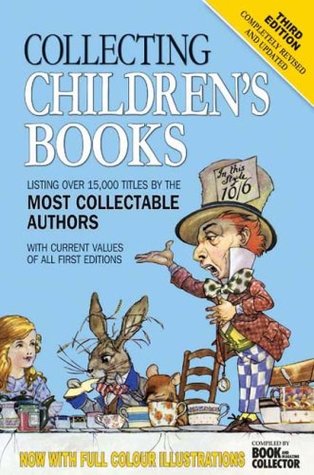
The title of this blog is simply the title of the book I have been reading: Collecting Children’s Books compiled by Book and Collector Magazine. Normally I would be more specific and add ‘review’ or some other context to a blog title, but I’m not entirely sure what this blog is going to turn into. Partially it may be a review of the book itself, but also somewhat of a commentary on some of the books’ prices especially in comparison with what I’ve paid for books.


I suppose I’d better explain what Collecting Children’s Books is all about first. As it says on the cover it lists over 15,000 titles by the most collectable authors, with current values of all first editions, though in many cases it does also list ‘special’ later editions if those are of unusual value. So in essence it’s a book of guide prices with a fragment of biography for each listed author, illustrator or publishing house. Perhaps surprisingly I found this in my local library – on the books for parents stand! It’s the third edition from 2007 so it’s probably a little out of date now. I think anyone who collects children’s books will know that prices are rising (astronomically in some cases) now that more people are aware that they are valuable.
2008036


STARTING WITH ENID BLYTON, NATURALLY

She has by far the longest list – stretching to fourteen pages! Happily she is described as the most successful British children’s author of the twentieth century.

As with most entries the prices listed are for Books in Very Good condition with dust jackets where applicable.

The most expensive book is, no surprise, Five on a Treasure Island which they value at £1,200. (Oddly they give the full title as Five on a Treasure Island: An Adventure Story, which I don’t think I’ve ever seen before.) That is followed by The Enchanted Wood and The Secret Island at £1000 each. (I know they couldn’t list EVERY series as a series but they haven’t listed the Secret Series separately which seems an oversight). Those are the only four figure books though there are many in the hundreds of pounds such as The Mystery of the Burnt Cottage at £750, five of the early Fives at £500 each, The Island of Adventure at £550, Mr Galliano’s Circus at £400 and The Twins at St Clare’s at £300.

It seems that the first of any series will be the most expensive with each subsequent book sliding down the scale. The list of all other works by year follows a similar pattern with some exceptions.

THERE ARE SOME SURPRISES, HOWEVER

The first Barney title – The Rockingdown Mystery – is only worth £35, The Secret Seven,  £65 while First Term at Malory Towers is just £40. Even the Noddy series starts at £80, the cheapest later entries priced at £40.

There are some titles I would consider truly rare and expensive but are not as highly priced as I would expect. I suppose that they are perhaps less desirable than those from the famous mystery or adventure genres which may account for that. For example some very early works (which I’ve almost never seen for sale on the usual sites) Real Fairies £225, Child Whispers £220, Silver and Gold £100 and Let’s Pretend at £45.They even note themselves that The Wonderful Adventure has only ONE known copy and have valued it at just £350. Even so, I’ll stick with my society reprint.

MY BARGAINS

I thought it would be interesting to see what I paid for my admittedly few first editions in comparison to what’s listed in the book. I started collecting only a year or two before this edition came out and continue to the present day.

I have a copy of Five Go to Mystery Moor which meets their requirements – it’s a first edition with dustjacket in a Good / Very Good condition . In Very Good condition is should be worth £45. Using their ‘ready reckoner’ at the back it should be around £35 in Good condition. I paid £8 for it which I’m pretty happy with. (I had bought a later edition for around £14 when I was first collecting – which was a bit of a mistake but I got rather carried away on eBay…)

Likewise I paid £9 for a first of Five on a Secret Trail which I would class as Very Good – and should be worth £40. I also paid just £5 for a Good copy of Five are Together Again which should have set me back around £25. My only other first from the Famous Fives is Five Go to Demon’s Rocks but I don’t have a note of what I paid for it – I only started keeping records a few years ago and my Paypal transactions only went so far back. At any rate it lacks a dustjacket and there is no clear advice on pricing Good or otherwise conditioned books without a dustjacket. With one it would be £35.

The Secret of Moon Castle is listed at £30-35, and I paid around £9.50 for my copy although it lacks the all-important dustjacket. I also don’t have a dustjacket for my first of The Mystery of the Pantomime Cat but then again I got it for £3.30 rather than the £50-60 suggested for one with. I’m still happy with The Mystery of Banshee Towers sans dustjacket when one with should be £50. This is where the pricing structure falls down a little – there is only one edition of Banshee Towers and it’s super hard to find, whereas firsts of the middle books in the series are easier to find.

I have firsts (without dustjackets) of Secret Seven Mystery, Puzzle for the Secret Seven, Secret Seven Fireworks and Good Old Secret Seven (none of which cost more than a fiver) and a copy of Shock for the Secret Seven with, which set me back £5.36. According to the list they are all worth £25.

I really wanted to see what The Hidey-Hole (her last novel-length book) was priced at, as I have a lovely first with dustjacket, but unfortunately it isn’t listed.

My first of In the Fifth at Malory Towers without dustjacket is perhaps only just in a Good condition but I only paid £1.58 for it, while it’s listed as around £25 with.

I have a dozen or so other firsts but they are all in a Good(ish) condition without dustjacket. I’m fairly sure I paid far less than the suggested price however as I generally stick to a £5 budget for second hand books and consider it splashing out if I go up to £10 for something I really want!


OTHER AUTHORS

I actually looked through the whole book – though I can’t pretend to have read every word. I more skimmed the prices looking for anything remarkable as well as seeing which authors names I recognized and so on.

I have a handful of firsts – with dust jackets – for a few other authors so I cant resist comparing prices for those either.

ANGELA BRAZIL

Starting with Angela Brazil I have what I believe is a first of Three Terms at Uplands which I can’t have paid more than £4 for. It’s listed as £35 in Very Good so probably translates to £25-30 in Good.

NOEL STREATFIELD

Then there’s my Noel Streatfeilds, namely The Painted Garden, The Fearless Treasure and Apple Bough. I don’t have records of what I paid for them but I’m certain they couldn’t have been more than my usual £5 budget. They’re listed at £15-20 so taking into consideration the Good rather than Very Good condition I think I’ve still done all right (especially as I bought them at least 6 years after the prices were set).

MALCOLM SAVILLE

Lastly, I have some first edition Savilles too, all Lone Pines. These buck the trend of prices reducing through a series as they fluctuate quite a lot towards the end. I can only assume there were smaller print runs of those titles. Anyway, my copies show one of the limitations of the book as there’s no grade between Good (no more than minor faults) and Poor (really bad condition ie warped, missing pages or an irreparably damaged spine). A book worth £40 at Good is worth only £5 in a poor condition and I have a few which don’t quite qualify as Good as they have some damage to the spine or some damage from being issued in a library yet aren’t quite as ruined as a Poor copy. I discarded my £5 budget for this series as I found it very difficult if not impossible to find decent copies at that price.

Saucers Over the Moor is worth £75 in Very Good, and as the example between £40 for Good and £5 for Poor. I paid £8 for mine so possibly not the best bargain but probably quite fair. Likewise Treasure at Amory’s is much better than Poor (£5-10) but not quite as good as Good £35 and I paid £15 for it.

Lone Pine London and The Secret of the Gorge are £55 Very Good and £30 Good which I think both of mine are, while I paid £19 and £18 respectively. My copy of Strangers at Witchend is definitely Good and priced at £35 and I got it for £22.50. Lastly I feel I’m entirely justified in spending £18.50 on an Armada paperback of Home to Witchend ( it first came out in that edition) as it is listed at £25.

Phew.


The book itself is very interesting and contains some useful information about identifying first editions in an opening chapter. I learned some things about authors I like or have simple heard of, too. I didn’t know about Anna Sewell’s tragic-sounding life, that Penguin Books did Ptarmigan imprints and others as well as the famous Puffins, or the real original title of Gulliver’s Travels (which is worth £20,000 as a set!)

There are many books listed around the £1000 mark (a large number of Biggles books for example) and plenty at several thousands. There are also a few with eye-watering suggested price tags. The most expensive I noted were specific editions of:

  • Robinson Crusoe, The Wizard of Oz and Pinocchio – £15,000
  • A Christmas Carol – £20,000
  • The Hobbit – £25,000
  • The Wind in the Willows – £45,000
  • Beatrix Potter’s privately published editions £50,000+
  • Edward Lear (set of 2) – £75,000
  • Alice in Wonderland [A withdrawn edition]£200,000+

This book can only be used as the loosest of guides to a book’s worth as quite often books are really worth what people are willing to pay for them. Having a look on eBay you will often see books priced into the hundreds of pounds but they don’t sell because they’re “worth” a fraction of that. Likewise the book makes no suggestion as to how to price standard later editions/impressions but as that would most likely vary from title to title let alone author to author perhaps it’s best they didn’t.

It also isn’t quite as exhaustive as it seems as there are a few titles missing – The Hidey-Hole as I mentioned already, also War Game and After the War Was Over both by Michael Foreman. Will Scott, author of The Cherrys books is very collectible and his books fetch high prices but he isn’t mentioned at all.

And to bring it back to Blyton, a copy of her favourite story The Princess and the Goblin by George MacDonald is priced at £1,500.


Posted in Book reviews, Purchases | Tagged , , , , , | 6 Comments

Last Monday in October

So as October draws to an end and Halloween marks the end of the month, I s’pose its only fair to tell you what we have on the blog this week!

Fiona may or may not manage to do  blog on collecting children’s books, and if she doesn’t get this very complicated blog done she will be reviewing her next Noddy book.

I shall be trying to construct a blog comparing two books that begin our beloved series by Blyton, or if that doesn’t work the plan is to go onto the 90s adaptation of Five Have Plenty of Fun.

With that not very clear schedule, I shall leave you. Once again, if you have any Blyton related writing you want to go up on the blog, just go to our Want to Write for World of Blyton page and get our email address!

I shall leave you with a couple of pictures I took last week when I was out on a photo job at someone’s engagement party. These photos are of the beautiful vintage inspired decor that I took. Hope you like them!

Posted in Blog talk | Tagged , | 2 Comments

Famous Five 90s Style: Five Go to Mystery Moor

Time to move away from two parters for a short while, and look now at a 25 minute adaptation of Five Go to Mystery Moor.

Mystery Moor is one my favourite books and in fact was the first one I ever read as a child. The gloomy, brooding moor is almost a character in itself in the book, but possibly because it’s hard to replicate, somewhat lacking atmosphere in the episode. It doesn’t feel dangerous and that’s the main thing; if the moor felt dangerous then the whole tone of the episode would be so much darker.

The start of the episode is also a dead give away that something very dodgy is going on. A plane on an airfield (to the French national anthem) is being loaded up and piloted in the dead of night. Now we know something is up and that the Five are going to be on hand to sort it out and solve the mystery.

We seem to skip an awful lot of the book to get to the part where the Five are all together in Captain Johnson’s riding school. There’s no mention of them being separated or Uncle Quentin deep in work and not wanting to be disturbed. Anyway we start off with the Five all sat in a barn with a reedy voice calling out “Georgina! Georgina!” from the book you know straight away that this is Henrietta played in a rather over the top, sketch show parody by Bianca Bonomi. The problem here is that the dislike between George and Henry (as Henrietta likes to be known) is not very clear so you end up siding with the disliked Henry. Again this shows how convincingly Jemima Rooper plays George that you start to dislike George’s treatment of Henry. Unfortunately Bonomi’s Henrietta is not styled so that she looks more convincing as a boy than George. Her hair is too long to be really convincing otherwise it would be perfect. The bravado she has as Henry isn’t genuine either, this might be to do with the over the top acting but even though you don’t agree with George about disliking Henrietta, you can’t really warm to Henry either.

We have been introduced to Lee Turnbull as Sniffer before, however as the episodes are out of sync with the books, this is really the first time we’re meeting him as the bedraggled gypsy boy who brings a lame horse to the stables in the hope of getting him made better. Sniffer’s good for nothing father disapproves of the horse being left at the stables and follows Sniffer to menace the others into giving him the horse back. Julian stands up to him and saves Clip the horse from having to pull a heavy caravan. One of Julian’s nobler deeds I’m sure you’ll all agree.

Jesse Birdsall as Sniffer’s father, Pedro, is an excellent bad guy as is his side kick Teddy Kempner as Moses. These two seem to pull away from the ‘comic’ bad guys that the other epsiodes have and are truly frightening and scary characters. It is possible that because Bonomi as Henry was playing a rather over the top character the show’s producers thought it would be too much to have the villains be comedic as well. (Just as a sidenote, Jesse Birdsall played opposite Jemima Rooper in the TV show As If and she mentions him in our interview with her here.)

As the Five go off to camp on the moor, its clear to see that Marco Williamson is still very much in control of Julian being the leader and Paul Child is very much back in second place, unlike in other episodes in the second series where Child pulls more in front due to Williamson’s broken leg. It can be deduced from this that the break hadn’t happened before filming this episode, otherwise it certainly would have changed a lot more of the dynamic and in fact the flow of the adaptation. Due to this, there would have been a lot more arguing between the brothers and the scene where they go to hide the packages thrown from the plane would have caused a lot more aggravation between the Five.

I am glad that this episode wasn’t tampered with in that respect. As the balance between the boys is right and how it should be, Mystery Moor is not a book to change that balance. Julian needs to be in charge because otherwise there would be massive issues above and beyond the simple mystery behind the packages out of the sky.

The basic plot of Five Go to Mystery Moor is quite complicated, too complicated for me to explain in a review at any rate so I suggest you read the book if you haven’t already. I don’t want to go into too much detail about the plot or the ending anyway in case I upset it for people. Looking at the episode it is mostly all there, but there are a few slip-ups, like the stable hand William is much older than he is in the book, and Captain Johnson is there at the rescue where he is absent in the book. So you’re looking at minor things, which are more than made up for by the superb quality of the villainous actors and Lee Turnbull as Sniffer. As always I’ve made it through the blog without mentioning Laura Petela! Oh dear. Well she’s just as always a very good Anne, but maybe not as scared as Anne in the book but quite firm with the sulky George and Henry, this is a nice development and its a shame it can’t have carried through. However my most favourite Anne moment it yet to come in Five Have a Mystery to Solve!

So there you are, a look into Five Go to Mystery Moor; a not too shabby adaptation, with a few niggly bits that only a fanatic would pick up on. What are your thoughts on the episode? Do you agree with me?

Let me know in the comments!

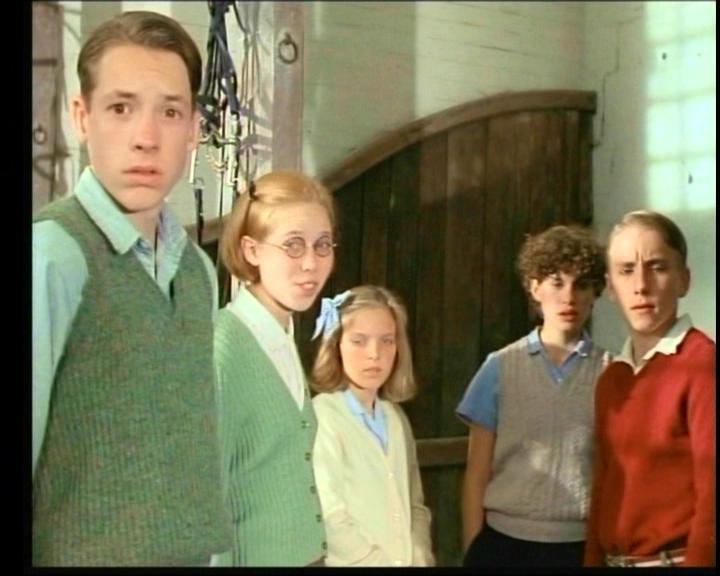
The Five and Henry in Five Go to Mystery Moor (L-R) Marco Williamson as Julian, Bianca Bonomi as Henry, Laura Petela as Anne, Jemima Rooper as George and Paul Child as Dick

The Five and Henry in Five Go to Mystery Moor (L-R) Marco Williamson as Julian, Bianca Bonomi as Henry, Laura Petela as Anne, Jemima Rooper as George and Paul Child as Dick

Posted in Blyton on Screen | Tagged , , , , , , , , , , , , , | 4 Comments

Hurrah For Little Noddy! – How has Blyton’s original text fared in a modern edition?

I realise now (having quickly browsed the previous Noddy comparison) that I didn’t do a tally of changes. I’ve now counted and can declare it was 14 – going by the same rule as past books and only counting the first instance of each new alteration.

The first book had a slow start for alterations but this time I was finding them right from the first page, and rather frequently too.


SOME CHANGES ARE THE SAME AS IN THE FIRST BOOK

  • Mr Tubby’s fat little wife is still just his wife.
  • Mr. and Mrs. lose their full stops.
  • When Mrs Tubby warns Noddy to be careful of one or two of the golliwogs this is changed to monkeys.
  • Hyphens are replaced with spaces in phrases like spring-cleaning.
  • Gay is replaced with other descriptive words like bright or cheerful.
  • Toy Village is still Toy Town

PLENTY OF THE CHANGES SO MINOR YOU WONDER WHY THEY BOTHERED

  • Noddy’s house was built of toy bricks, now it was built with toy bricks. 
  • Noddy’s head no longer nods very fast indeed, just very fast.
  • Till as in till you’ve got some money or until he comes back is replaced with until.
  • A dear little blue car has become just a little blue car.
  • Hoot the horns is now toot the horns.
  • Noddy’s new car originally said poop-poop, now it says parp-parp.
  • That was very very nice has become that was very nice.
  • When Noddy crashes the borrowed car and hits a tree originally it knocked it over. This line has been removed in the treasury.
  • After cleaning out the chimneys in the doll’s house one of the dolls tells him that your face is very black now. This has been updated to very dirty now.
  • The Three Skittles (referred to with both words in capitals every time) have become the three Skittles. That sounds like they are any three skittles, rather than a specific group.
  • Springtime (italic emphasis on spring) has been changed to springtime (all italics). To be truthful, neither makes total sense. The doll is explaining that spring cleaning has nothing to do with metal springs.
  • The italics have also been removed from I think he deserves a reward.
  • He couldn’t believe his eyes. He really couldn’t loses its second sentence.

CHANGES MADE FOR CONTINUITY’S SAKE

  • The policeman known as Mr Policeman, the policeman and the chief policeman is now called Mr Plod as he is in later books.
  • In the original the place where the goblins live is referred to as both Goblin Village and Goblin Town. This has been changed to be Goblin Village consistently.

THE LARGER CHANGES

In the original there is a mistress doll in charge of the house, but in the treasury her role has been amalgamated with the doll who opens the door for Noddy.

  • When Noddy arrives at Four-Chimney House the door is originally opened by a doll who speaks immediately. In the treasury two lines are added She had curly golden hair and bright blue eyes. She looked at Noddy, and  he bowed, his head nodding all the time.
  • “Perhaps the mistress will say you can help”. The mistress was a very beautiful doll with curly golden hair and bright blue eyes. She looked at Noddy, and he bowed, his head nodding all the time.  “The sweep hasn’t come,” she said. So we see where the earlier lines have been cut from, and used to describe the doll at the door. The treasure has her take charge,“I’ll see if I can find something for you to do.” The little doll thought for a moment. “The sweep hasn’t come,” she said.
  • After that the mistress doll is referred to as the golden haired doll, or on one occasion as just the doll. Confusingly the doll who opened the door is depicted as having golden curls and is, in the original, also called the golden haired doll. 

The owner of the Toy Town/Village garage was originally Mr Golly (also referred to as the golliwog for several chapters before he is named.) He is now Mr Sparks, a doll.

  • The garage owner is described as a golliwog with a very black, smiling face, and now as a kindly-looking doll called Mr Sparks.
  • When Noddy tooted a car horn The golliwog almost jumped out of his black skin, but now Mr Sparks, the garage owner, almost jumped out of his skin. There was no need to add the garage owner here though, as it was only a page or two ago that we were introduced to him and his role.
  • The Golliwog’s Garage is now named The Toy Garage (in characters’ conversations).
  • When the cars have been stolen it’s said that Mr Golly was crying black tears all down his face. The treasure reads Mr Sparks was in a terrible state. (Why he can’t be crying an unspecified colour of tears I don’t know.)

These aren’t all of the changed illustrations but as the majority replace Mr Golly with Mr Sparks in the same way there was no need to show them all.

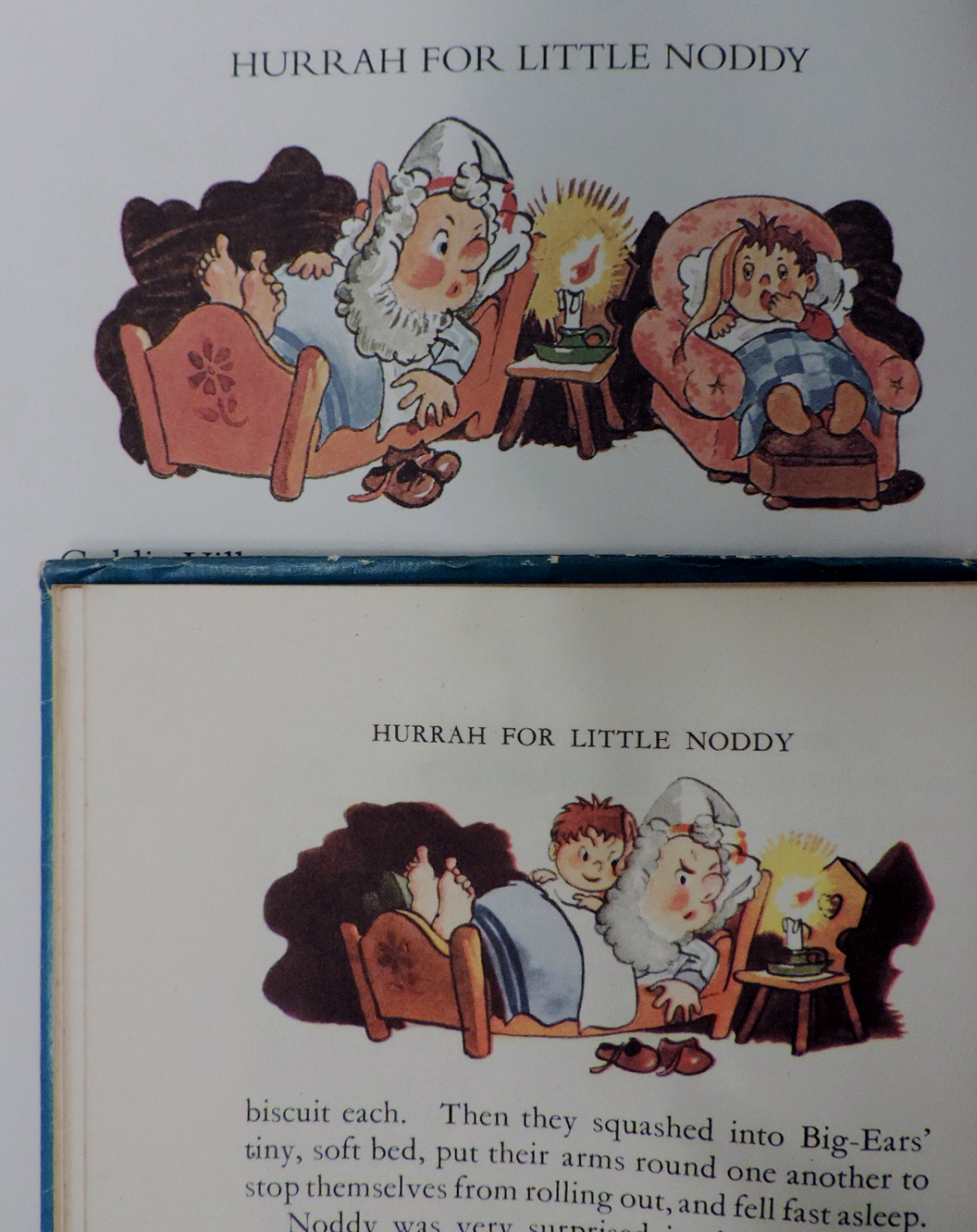
Big-Ears and Noddy no longer share a bed when Noddy stays over:

  • Big-Ears did say If you can squeeze into my tiny bed, you can sleep with me tonight. Now he says I’ll make up a bed in my big armchair for you and you can stay with me tonight.
  • So Then they squashed into Big-Ears’ tiny, soft bed, put their arms around one another to stop themselves from rolling out, and fell fast asleep has been replaced with Then they climbed into bed and fell fast asleep. Really it should specify that Big-Ears got into bed and Noddy got into a chair.

DSCN4188

And finally:

  • The car owners get into their cars, Jumbo, the Three Skittles and so did the Sailor Doll. Then Mr Golly got into his own best car, Mr Wobbly wobbled his way into his… The treasury makes it all one (very long) sentence, and the Sailor Doll got into his, Mr Sparks got into his own best car, Mr Wobbly wobbled his way into his…

ONE THING THAT DIDN’T CHANGE

Queer -shaped  is still queer-shaped.


Right at the end there are two illustrations which have been made a bit more multi-cultural – a doll in the middle of the left picture has been given dark skin and hair, while a boy in the middle of the right picture has also been given darker skin.


Phew! What a lot of changes. Thirty-two in total (and there are only 60 pages in the book).

Posted in Updating Blyton's Books | Tagged , , , , | 1 Comment

Monday

I don’t usually mind Mondays all that much, but this Monday I’m back to work after a week off so it is not my favourite day.

I spent a few days in Crieff while I was off and visited the very first (it opened in 1680) free public lending library in Scotland while I was there. And it was amazing. Downstairs was a huge collection of Scottish books donated by an American lady, and upstairs, the original lending collection with works dating back to the 1600s. We were allowed to (under casual supervision from the volunteers) pick up and read anything we wanted to no matter the age of the book. So we flicked through four-hundred-year-old atlases which were amongst the first to show the world in a flat rectangle (the Mercator way), dipped into a manual about child-rearing (you shouldn’t let your children drink hard liquor, and also shouldn’t let girls read frivolous novels apparently), and had a good feel of vellum-bound books. Most of the collection was non-fiction but there was a small side room with the “modern” collection in it – and by modern I mean books from the early 1900s. There were no Blytons unfortunately but I did have a look at some R.M. Ballantyne books (such as The Coral Island), two of the Little Women series and some other children’s works I’d never heard of.

I can thoroughly recommend visiting the Innerpeffray Library if you happen to be in Perthshire.

But anyway, back to this week.

ITSASALMONBLOG

I’ll end on a few photos from Crieff, including from the library. Those ones were taken hurriedly on my phone as I realised at the end of our visit that I had been too busy looking at things to take any photos of them!

Posted in Blog talk | Tagged , , , , , | 1 Comment

Famous Five 90s Style: Five Go Down to the Sea, part 2

We looked at Part One of Five Go Down to the Sea last week, and now I’m going to bring you part 2.

Last week we left off with the Five staring at the flashing light on the cliff at Tremannon. They then found themselves back at the farm and coming across a surprising thing! The Barnies’ Guv’nor hiding out on the barns! They knew that something fishy was going on and decided to explore that old tower where they saw the lights flashing from.

Before that can happen, there’s the Barnies’ show to watch and help out with. By all accounts it’s a hilarious show and the dinner afterwards is first rate. Now is the time for tom-foolery however as the boys discover that the precious head of Clopper the show’s big draw has been left unattended in the barn. They agree to take the Guv’nor over some supper and have a go with the pantomime horse. No one can work out why Clopper is so well guarded but the boys don’t worry about that as the find all the parts and climb into the suit.

Unfortatunatey for Dick and Julian the zip gets stuck so they have to manouver their way towards the kitchen to get some help. Mr Penruthlan comes out, thinking one of his horses is loose and manages to catch them and unzip them, much to the boys disgruntlement. They deposit the costume back in the barn with the Guv’nor and run back to dinner.

The next day the Five go to explore the tower and find nothing much but splashes of oil, presumably spilled from the lantern as it’s carried up the stairs. The funny thing is that Anne thinks she hears someone inside the old tower, and wants everyone to be careful, but as everyone knows, Timmy would bark if there was someone inside, and he doesn’t even growl.

Laughing at Anne for being scared, rather unkindly as it turns out, everyone makes a search of the tower for where the most oil has been spilt, hoping to find out where the secret passage is. Timmy eventually finds it in an old fire place and the Five find the passage and start to make their way down it. There isn’t a lot of jostling between the boys in this episode, it must have been before Williamson’s broken leg because Julian and Dick’s roles are still as they are in the books. Julian, unsurprisingly then, leads the Five through the tunnel, and tells George that she’s not to go back for Timmy as they think he’s run off to look for rabbits.

Alas, Timmy has gotten himself trapped by one of the smugglers and the Five, in an hope to rescue him get stuck as well. Desperate to escape but out of ideas how, all they can do is sit tight until the smuggler, whom they assume is Mr Penruthlan, lets them go when all the work is finished.

What they do not count on is Anne’s funny noise and feeling from the tower earlier. This turns out to be Yan! None other than the funny little boy who had latched on to them from the beginning. “No wonder Timmy didn’t bark!” they all exclaim when they work it out. Sometimes I wonder that they work mysteries out at all! With Yan having set them free, they follow the passage to the cove where they see someone signalling to the boat off shore and then creep back through the passage that takes them back to the farm.

One of my favourite scenes in the book, which becomes over acted and cringe worthy on screen is the one where Julian suggests to Mrs Penruthlan that her husband is a smuggler and gets a box around the ears by the lady of the house. In the adaptation there is no actual boxing of the ears but a short sharp scene where Mrs Penruthland gets very upset– and no wonder because then walks in her husband and puts them all to rights. He’s been searching for the smugglers, and not one himself.

Now there is still a mystery to solve, how are the drugs being transported and Dick comes up with the clever suggestion that its the Barnies! How can these happy, smiling people be in league with smugglers? Well, lets say the Guv’nor isn’t squeaky clean.

Now I won’t say much more because I’ll give away the surprise ending. Lets just say that the Five get their man and Yan, gets some well deserved sweets.

Overall, again not a bad adaptation; the format of the books is clearly more translatable onto screen through two twenty-five minute programs. They get a lot of detail in, but of course as lover of the books, even longer would have made a better episode. The cast are at their best here, older than they were in the first series, more settled in their characters and all this is pre-leg breaking, and the move away from the natural order of eldest first.

Five Go Down to the Sea has almost always been a favourite book of mine, with the scenes it depicts and the rugged Cornish coast, what could be any better? So I’m happy with these two episodes, they are quite true to the story, and definitely work well as  two parter.

What do you think?

Paul Child as Dick, Marco Williamson as Julian, Jemima Rooper as George and Laura Petela as Anne

Paul Child as Dick, Marco Williamson as Julian, Jemima Rooper as George and Laura Petela as Anne

Posted in Blyton on Screen | Tagged , , , , , , , , , , , | Leave a comment

My favourite Enid Blyton quotes

This post was inspired by an article on the Guardian site: Six of the best Enid Blyton quotes which was published in honour of Enid Blyton’s birthday this year. Two of the quotes were no surprise as they are always floating around the internet (usually attributed simply to Blyton rather than noting which book they came from) but it was interesting to see which other quotes they picked.


The best way to treat obstacles is to use them as stepping-stones. Laugh at them, tread on them, and let them lead you to something better.” (Mr Galliano’s Circus),

It wasn’t a bit of good fighting grown-ups. They could do exactly as they liked.” (Five on a Treasure Island)

and

I think people make their own faces as they grow.” (The Naughtiest Girl)

are often seen (by me anyway) on Pinterest in particular but also elsewhere on the web.


The other Guardian picks are perhaps less well known:

I’m good at exploring roofs. You never know when that kind of thing comes in useful.” (The Rubadub Mystery)

I don’t know why, but the meals we have on picnics always taste so much nicer than the ones we have indoors.”  (Five Go Off in a Caravan)

Mothers were much too sharp. They were like dogs.” (The Mystery of the Hidden House)

There are probably many quotes that could have been used for the”food always tasting better out-of doors” theme, most of them coming from Anne and Lucy-Ann of The Famous Five and Adventure Series respectively.

So, now to my personal favourites. I’m being quite loose with the definition of a quote here – there’s nothing as concise as in the Guardian article and some are more like paragraphs or pieces of conversation. But never mind, they are my favourites at any rate.


LINES I USE AS MY SIGNATURE ON THE ENID BLYTON SOCIETY FORUMS

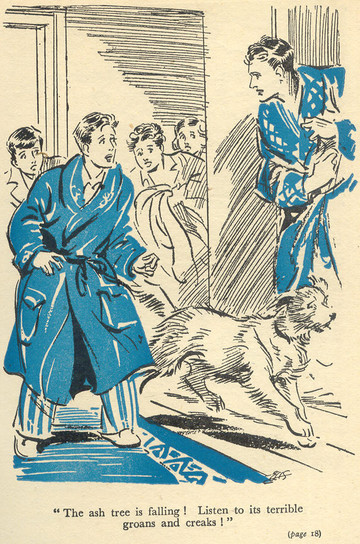
“It’s the ash! It’s falling!” yelled Julian, almost startling Dick out of his wits.

“Listen to its terrible groans and creaks!” yelled Julian, almost beside himself with impatience.

There’s some lines in between these in the book but those two are my favourites and make me smile every time I read Five Go to Smuggler’s Top.

Julian warns everyone about the falling ash tree in "Five Go to Smuggler's Top" illustrated by Eileen Soper.


JUST ONE OF THE REASONS IRENE MADE MY TOP THREE CHARACTERS

“Clear out,” yelled everyone, and Irene brandished her hairbrush fiercely, almost knocking Belinda’s eye out.

Again, this quote – from In the Fifth at Malory Towers this time – makes me grin every time I read it. It’s just such an Irene thing to do.

Irene brandishing her hairbrush so fiercely she nearly hits Belinda in the face in "In the Fifth at Malory Towers" illustrated by Stanley Lloyd.


BLYTON’S MOST ICONIC PHRASE

Two Trees.
Gloomy Water.
Saucy Jane.
And Maggie knows too.

From Five on a Hike Together, there can’t be a more quotable, repeatable, memorable line from a Blyton book. Most things whispered through a window in the dead of night, particularly by wide-eyed, bullet-headed escaped convicts would be, though.

560high+9242458


FOR THE SHOCK AND RELIEF OF THE FIRST READ,
AND FAMILIAR JOY THEREAFTER

Don’t forget Bill Smugs!

It’s Bill, coming to the rescue in The Mountain of Adventure. An iconic moment even if most readers rate Mountain as the weakest Adventure book.


ONE SUMMING UP A FINAL TOUCH THAT MAKES A HOLLOW TREE A HOME

“I guess we’re the only people in all the world that have a room in  a tree, with a window in the trunk and a curtain for it made of leaves.”

I just love the house they make in Hollow Tree House – with the branch shelf and the clock from home – but my favourite part is when they make a little window complete with a leafy curtain. Blyton was a master of making caves and trees and other unusual places into safe, comfortable places to live. All it takes is a sandy or mossy floor, a fern curtain, a shelf to put the food on and some candles to light it up after dark.


ONE OF KIKI’S BEST MOMENTS – AND SHE DOESN’T EVEN SPEAK!

Suddenly Kiki gave an alarming screech, lost her balance and fell right off of the tower! She disappeared below and the children leapt up in horror. Then they sat down again, smiling and feeling rather foolish – for, of course, as soon as she fell, Kiki spread out her wings and soared into the air!

A particularly funny moment in Castle of Adventure. I’m sure the readers are just as worried for a moment.


AND FINALLY, JULIAN AT HIS SHARP-TONGUED BEST

Battling with Mr Stick:

“Now, now, look ‘ere,” sid Mr Stick from his corner.

“I don’t want to look at you,” said Julian at once.

“Now, look ‘ere,” said Mr Stick, angrily, standing up.

“I’ve told you I don’t want to,” said Julian. “You’re not a pretty sight.”

(One quote isn’t enough…)

“Supper! The best things out of the larder – bought with my uncle’s money, cooked on my aunt’s stove with gas she pays for – yes, supper!”

(And neither is two)

“Let me offer you our supper – bread and cheese, Mrs Stick, bread and cheese!”

All of the above are from Five Run Away Together, with Julian masterfully facing off against Ma and Pa Stick. I could have ‘quoted’ whole pages here but I tried to keep it down to a minimum (!).

360wide+5354973


Likewise I could have come up with a lot more quotes I’m sure. Blyton wrote so many brilliant books. I haven’t even begun to explore Kiki’s best lines or the descriptions of Kirrin Island or the glorious feasts served up in so many farmhouses. But I have to stop somewhere, preferably before I reproduce entire chapters.

So what are your favourite Blyton quotes?

Posted in Enid Blyton | Tagged , , , , , , , | 10 Comments

Just another Manic Monday

We are steaming through October now, it’s the middle of the month already! Who can believe that? I started my new job last week, and it already feels like I’ve been there ages!

Anyway, from Fiona this week, we will be getting a look at her favourite Blyton quotes, and from me, the second part of Famous Five 90’s style: Five Go Down to the Sea.

It doesn’t look like we have any blog news this week. Please do remember that we are always looking for blog submissions!

I shall leave you with a couple of pictures I took on Saturday night when I was out with a friend, of some autumn leaves and pretty lights.

Posted in Blog talk | Tagged , | 3 Comments