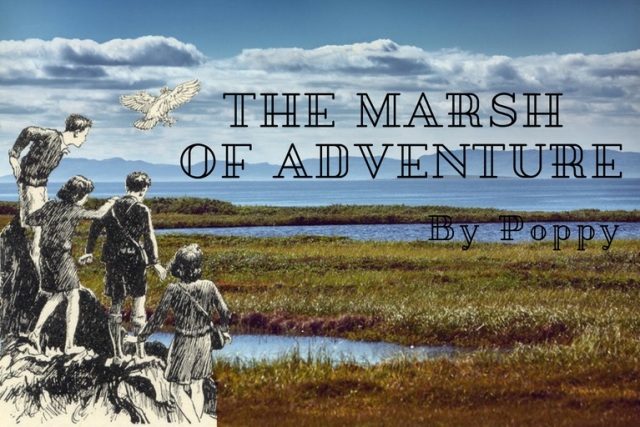
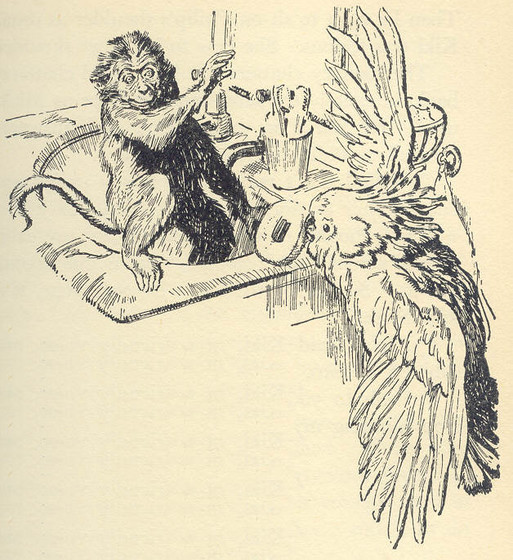
The Marsh of Adventure by Poppy, chapter 1

Chapter one:

A message for Bill

“Bill!” thundered a voice from the bottom of the stairs.

“Bill!” echoed a screeching one which of course was Kiki the parrot.

“What is it Jack? And will you tell that bird to stop screeching…” demanded Bill appearing at the top.

“There’s a message that has come for you, a private message from your base – the man said.” Bill raced down the stairs and snatched the scrap of paper from Jack’s hand. He read it gravely and looked down at Jack. “Who brought it?” he asked stolidly.

“A man wearing all black, driving a long black car. Why, is it so important?” Jack asked curiously trying to peer round to read the words scribbled on the paper.

“It is most important.” Bill replied coldly, “You didn’t read it did you?” he asked folding the paper and putting it in his pocket.

“Of course we didn’t. The man said it was private.”

“Good, go and tell the others to come and get some lunch now, your mother’s calling.” Jack went and fetched the others, rather disappointed he had not seen the message, but curious.

“Lunch’s ready,” he called to the others who were lazing under the oak tree in the garden. They all sat up and looked expectantly up at him.

“So, what did it say?” Dinah asked impatiently.

“He didn’t say, buck up won’t you all? It’s raspberries and ices for pudding.” The others got up rather disappointed and ran round to let themselves in the back door. They crept past the busy cook, Kiki pecking a few pineapple pieces along the way.

Mrs Cunningham, who was just putting the children’s plates out, smiled at them. “Hallo! Been having a nice time in the garden? I must say, it is a heavenly day!”

The children had arrived home yesterday from their boarding schools and were enjoying the second day in the sun. It was just going to be a lazy few weeks and it had been arranged that they would not be going anywhere these hols. The children had been rather disappointed but soon cheered up when Bill promised they would do lots of bird watching and watch for badgers in the garden at night. That pleased Jack and Philip anyway, but Dinah and Lucy-Ann were not as pleased about this. They didn’t mind though, they were just happy to laze in the sun and enjoy doing nothing! But it wouldn’t be like this for long. The children were about to jump headlong in to a hair-raising adventure though they did not know it yet.

They settled down to a good lunch, quite oblivious to the danger they were going to run into very soon. Bill seemed quite restless the rest of that day. The children guessed it had something to do with the note he had received earlier on. Apparently he had not told Mrs Cunningham as she seemed quite her usual self, bustling about and smiling at the children feeling glad she was able to run after the children she loved so dearly once again.
Bill sat up with his newspaper after dinner but did not seem to read it. He looked a little worried and at nine o’ clock he rustled his newspaper and closed it, looking at his wife and the children who were sitting round a table playing cards.

He raised his voice and spoke to the others. “I have to go out for a while. Expect me back at about eleven. Don’t wait up for me though please.” He threw his newspaper down on the chair and went out into the hall to put on his hat and coat. The children nudged one another and winked.

Continue reading

Posted in Fan fiction | Tagged , , | 5 Comments

Bank Holiday Monday

Well we had some rather un-inspiring weather on Saturday, but Sunday the weather perked up and seems to be staying with us all of Monday, which is good. This will the second bank holiday in a row where we’ve had lovely weather!

We are almost at 16,500 views on the blog, and we reached 16,000 just after Monday last week. So yay for us!

In other news it is just under three weeks until the Enid Blyton Society’s trip to Beckenham, so don’t forget to get in touch if you fancy joining us!

So this week  we have no definite contributor, because we have finished our back log of contributors blogs for the moment (hopefully). If we get nothing by Tuesday, we shall treat you to the first couple of chapters of Poppy’s fan fiction based on the Adventure Series.

By all rights this week I should give you May’s Flowers, fittingly as it is the last week of May, but failing this you may have to have another recipe from me or my first (and rather late) TV series comparison, assuming that it’s been checked again and had the pictures added!

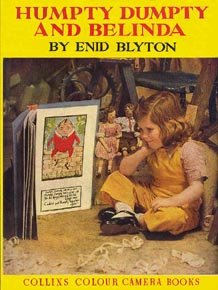
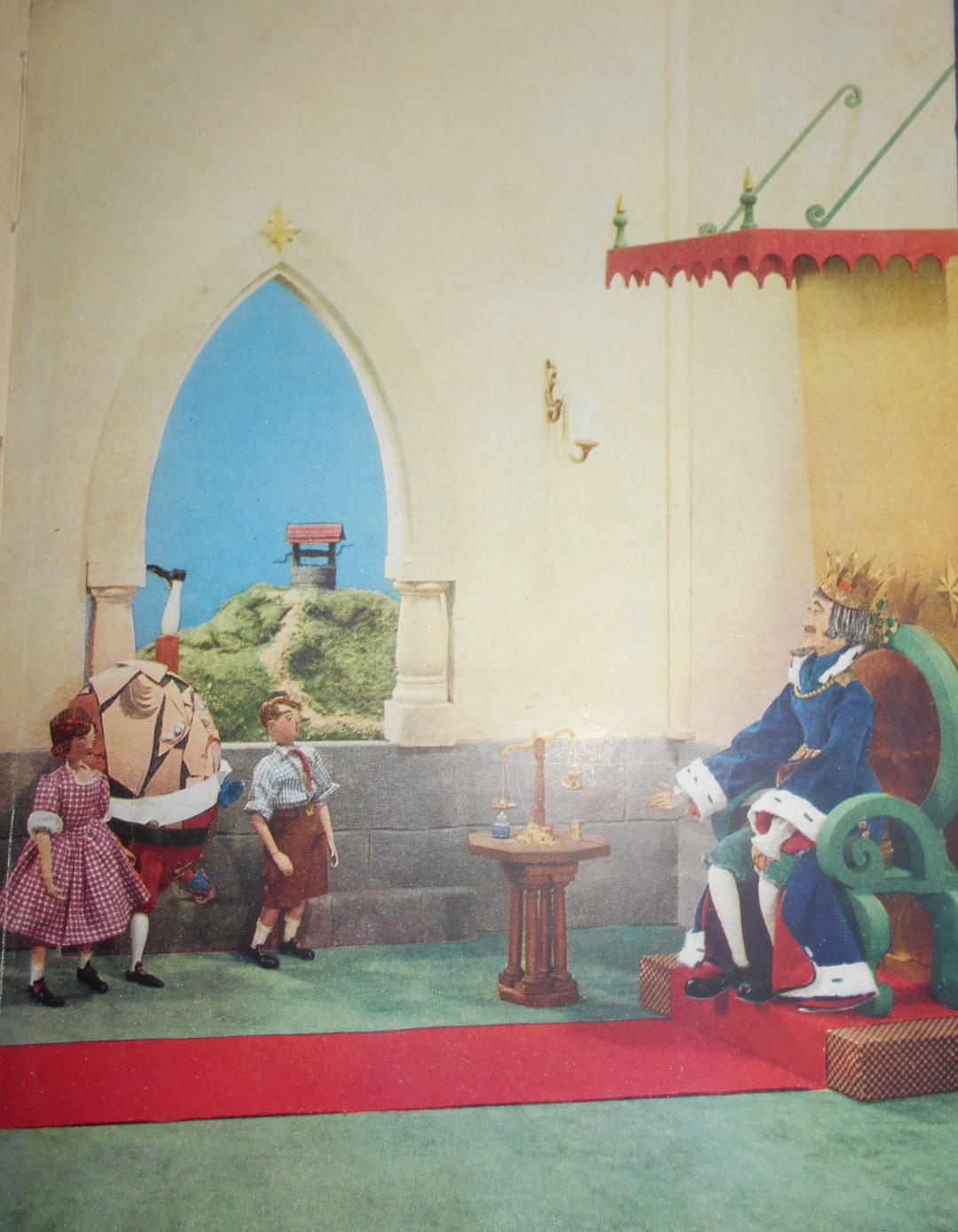
From Fiona, the one thing I think she’s been working on is her “Humpty Dumpty and Belinda” review. Though she may surprise us with another Adventure review or something else, who can tell?

Right now, I’m enjoying the last of the sunshine on Sunday evening, and looking forward to having a similar day in the sun tomorrow!

To celebrate the sun, I’ll leave you with some more of my best pictures!

Enjoy!

This slideshow requires JavaScript.

Posted in Blog talk | Tagged , , | 4 Comments

Making Blyton’s Food: Ginger biscuits

I hope you’re all hungry and free to do a little baking this Whitsun bank holiday.

That said, I suppose I should have baked something that appears in Five Go to Billycock Hill as that is the most obvious Whitsun adventure I do believe. However, it’s been a very busy week so I shall have to treat you to a quick and easy recipe for ginger biscuits!

The Dustjacket of Jane Brocket's Cherry Cake and Ginger Beer cook book. Taken from Amazon.

The dust jacket of Jane Brocket’s “Cherry Cake and Ginger Beer” cook book. Taken from Amazon.

This recipe is one of two that I tried, and through my unofficial testers at work, the favourite recipe comes from Cherry Cake and Ginger Beer by Jane Brocket. This recipe makes 20-24 biscuits and this is what you need to make them!

Warning: If you are a young child, please as an adult to help you. I don’t want to be responsible for any nasty accidents!

120g soft butter
120g golden caster sugar
1 dessert spoon golden syrup
1 egg yolk
200g plain flour
1/2 teaspoon cream of  tartar
1/2 teaspoon bicarbonate of soda
1 heaped teaspoon of ground ginger
Pinch of salt
Pinch of mixed spice (optional)
Pinch of ground cloves and/or ground nutmeg (optional) – I used the nutmeg.

You will also need a baking tray, lined with greaseproof paper.

To make your ginger biscuits follow these instructions:

  1. Preheat the oven to 170 degrees C/ gas mark 3.
  2. In a large mixing bowl, cream the butter and sugar together.
  3. Beat in the golden syrup and egg yolk [the yellow bit of the egg].
  4. Sift the flour, cream of tartar, bicarbonate of soda, ginger, salt and spices if you are using them, into the bowl. Then work them in until the mix becomes a firm dough.
  5. Break off small pieces of the dough, shape them into balls and place them well apart on the baking tray.
  6. Press down lightly with your fingers to partially flatten each biscuit.
  7. Bake for 10-12 minutes until the biscuits are golden brown and smelling delicious.
  8. Transfer the biscuits from the tray to a wire rack and leave them to cool.
  9. Devour!

This recipe works really well, it’s simple and straightforward. In fact the only part I had problems with was that the biscuits took at least forty minutes to bake in my oven. This may be because I had them in the middle of the oven. All I will say to you, is to start off with Brocket’s time for baking but don’t worry if it takes you a little longer to cook the biscuits.

About the Book

Just a quick world about the book Cherry Cake and Ginger Beer by Jane Brocket. It is a fabulous text for Enid Blyton (and other author) inspired recipes. In fact it had so many Blytonesque recipes in it that I went out and brought my own copy (I had borrowed a copy from work and was afraid of keeping it too long as I had requested it over from another library).

The book is filled with lip smacking recipes and little anecdotes on food. It is helpfully divided into sections such as School, Suppers, Lunches and Picnics.

I look forward to comparing recipes from other books to this one and seeing if Brocket has hit on the perfect Blyton cook book!

In the meantime, try the biscuits – they are delicious  and let me know how they turn out in the comments below!

P.S. If you have any recipes you want me to try, email the blog on worldofblytonblog@hotmail.com and I shall do my very best!

Posted in Food and recipes | Tagged , , , | 1 Comment

Recovering from illness in Blyton’s books, part 3

We’ve already looked at flu, measles and coughs and colds, now it’s time for mumps, scarlet fever, whooping cough and illnesses of an unknown type. I’ll also briefly look at illnesses at school.


MUMPS

No named character I can think of actually has mumps in Blyton’s books, but I’ve brought it up here because it is mentioned.

Sally Hope is late back to school after Christmas in the third term (Third Year at Malory Towers) as she has been in quarantine for mumps.

In Summer Term at St Clare’s Pat and Isabel have been in contact with a girl who’s come down with mumps, right before they’re due to go back to school. Their mother reminds them that they’ve not had mumps before and tells them you’ll both be in quarantine now – and the quarantine for mumps is rather long. You won’t be able to go back to school at the beginning of the term. In fact, they miss the first three weeks of term due to the quarantine.

None of these girls were actually ill, but it’s interesting to see how just being in contact with someone ill could cause quite a bit of disruption to people’s lives. These quarantines do affect the plot, however, as they allow the girls at school to develop different friendships (for example Darrell and Alicia spend a lot more time together at the start of Third Year, when Sally is absent.)


SCARLET FEVER

In Five Are Together Again Joan (sometimes known as Joanna) the Kirrins’ cook has fallen ill with scarlet fever. When the children arrive there from school, they can’t even enter Kirrin Cottage. Poor Joan is carried out to an ambulance and taken to hospital for treatment, and Aunt Fanny talks to them from an open window, explaining that she and Uncle Quentin are in quarantine (though thankfully Timmy isn’t!) The Five can’t stay at Kirrin, so they end up going to stay with the Professor Hayling and his son Tinker and having one last adventure.

togetheragainquarantine

As mentioned before Philip is studying at his teacher’s house at the start of The Island of Adventure because he’s missed a lot of school work due to having both scarlet fever and measles earlier in the term.

Bob, a little boy who once live in Rockingdown Manor, died at a young age from scarlet fever. Dinah, Roger and Snubby hear this tale from the woman in the village store, and it explains why the nursery looks like it had been suddenly abandoned before the rest of the house.

rockingdown scarlet fever nursery


WHOOPING COUGH

Due to whooping cough Betty is also late coming back to school after Christmas in Third Year at Malory Towers. Her best friend Alicia explains that Betty can’t come back for six weeks as she’s only just come down with it.

Interestingly, Blyton had whooping cough as a baby. Her parents were told she would probably not survive the night, but her father refused to accept this. He stayed with her all night long, cradling her in his arms determined she would live – and of course, she did.*


UNKNOWN ILLNESSES

In Five on Kirrin Island Again the children meet Martin, and the Coastguard says He’s been ill, so his father says. Got to have plenty of sea-air and that sort of thing. Martin does appear a bit pale and quiet, but as Mr Curton turns out not to be his father perhaps the convalescence is a smoke-screen for his criminal activities. It shows, though, that in Blyton’s world a holiday after an illness was common enough not to raise any eyebrows.

In The Naughtiest Girl in the School Joan, upset over a letter from her mother, goes out for a walk and gets completely soaked through when it rains heavily. She ends up in the san with a high temperature, and is ill for several days. The doctor merely says she has a chill, but her recovery is impeded as she is worrying about her mother’s letter. Her mother comes to the school, and Joan is able to stop worrying so much and get better.

joannaughtiest

Bill is new to Malory Towers in Third Year at Malory Towers and she is a day late in arriving as she and her brothers have been in quarantine for something or other according to Miss Peters. It’s not made totally clear but I don’t think she was actually ill, but had been in contact with someone who had been.

Also in Third Year at Malory Towers Mavis, the girl who believed herself destined to become a world-famous singer, does something similar to Joan. She goes out in the evening to a singing contest but misses the bus back. She gets soaked and collapses into a ditch where she is not found until hours later. She is very ill afterwards and loses her magnificent voice as a result.

mavismt


ILLNESSES AT SCHOOL

At Malory Towers every girl must produce a health certificate each term, and give it to Matron. Presumably it declares the girl hasn’t been in contact with any contagious illnesses. As Darrell says woe betide you if you go down with measles or chicken pox or something if you’ve just handed in a certificate saying you haven’t been near anyone ill! And Matron herself says there is a rule here that girls who forget their health certificate shall be isolated until one is produced.

Matrons at these schools seem to be busy people – not only are they responsible for the bed-linen and the children’s clothes and the all-important health certificates, they also take care of the children’s health. Children go to Matron with sore throats or headaches and they have to either treat them or seek a doctor’s advice. They also nurse sick and injured children in the school sanatoriums.

In Blyton’s books sick children seem to be kept at school to recover rather than being sent home. Alicia recovers from measles in Malory Towers san, Joan is nursed back to health in the Whyteleaf san, and when Sally has appendicitis she is operated on at school!

The schools are quite serious about protecting their pupils’ health, which is understandable given the plethora of nasty, contagious illnesses around in those days. One girl with the measles, un-quarantined, could easily spread it to half the school!


And that brings me to the end of looking at illnesses in Blyton’s books. I hope I haven’t missed any major plot-lines involving illness, but if I have just let me know!

* Whooping cough story from A Biography of Enid Blyton by Anita Bensoussane
Posted in Plot Devices | Tagged , , , , , , , , , , , , , , | 4 Comments

Poppy’s Book of the Month: Merry Mister Meddle

By Poppy Hutchinson

Title: Merry Mister Meddle
Series: Meddle Series
Main Characters: Mister Meddle, Aunt Jemima
Published: 1954
First Published By: George Newnes
Rating (Out of 5): 5

First of all, I’d like to express how much I enjoyed reading this fantastic, comical, original book and how much it made me laugh! The book consists of 14 short stories each about a meddlesome pixie who is always willing to do good deeds, but somehow they always go wrong! My three personal favourites are: Meddle’s Treacle Pudding, Meddle’s Good Turns and A Surprise for Mister Meddle.

Meddle’s Treacle Pudding begins with Meddle’ Aunt Jemima feeling unusually pleased with Mister Meddle, after him presenting her with a fine bunch of daffodils. In return, she invites him to share a fine tea of cold meat, baked potatoes and a jam pudding, however Meddle is not contented, he wants a treacle pudding ; not a jam one. Alas – Aunt Jemima has no treacle in, so Meddle must be content with a jam one. Meanwhile, work men are doing jobs in the scullery, and Meddle’s Aunt insists that he must help them if he wants to stay and have tea with her. Determined to share his aunt’s mouth watering tea, Meddle obeys, but after hammering someone’s fingers and upsetting all their tools into a wet sink, Meddle was sent away with a pot of a yellow-brown liquid, being advised to stir it above the kitchen stove. After inspecting the pot of mixture carefully, Meddle is convinced it is treacle (it is actually glue) and pours his aunt’s pudding which she had not yet put jam on. He leaves it steaming on the stove and surprises his aunt when she returns from her shopping trip and the dinner is prepared. The meal goes down well and Meddle fetches the treacle pudding. The two are disgusted when they taste the glue paste and Meddle is scolded well!

In Meddle’s Good Turns, Mister Meddle is in his aunt’s bad books again, after staying with her for a few days upsetting everyone including the cat. He is sent out to convince Aunt Jemima that he can be helpful and good, and help some other people. Meddle wanders down the road to meet a woman crossing the road with a large basket of goods. He tries to snatch it from her, meaning to carry it a little way for her. The poor woman thinks she is being robbed and calls out for help. Meddle is sent on his way. He carries on down the road to meet a lady carrying her dustbin out – Meddle wants to carry it for her, but she objects declaring she is a strong woman, though there is an old woman further down the road who could do with a hand. Meddle wanders down the street and wanders in at a house with three large dustbins standing outside the house. Meddle assumes this is the old woman’s house and carries the dust bins out beside the road. Inside was actually food for the man’s hen. Evidently, the man burnt his own rubbish. The story goes on to describe Meddle painting the wrong name on someone’s house and getting white paint all over his aunt’s skirt.

I would recommend this book to boys and girls of all ages – it is a delightful book with many comical scenes and lovely illustrations. A very enjoyable read. I rated this book 5 stars because it is an enchanting selection of wonderful stories suitable for all ages. Thank you all for reading my May review – hope you all enjoyed it. I will be back next month with yet another book and another review

First edition 1954 by Joyce Mercer and Rosalind M. Turvey

First edition dustjacket  by Joyce Mercer and Rosalind M. Turvey

Posted in Book reviews | Tagged , , , , | Leave a comment

Another Monday Message

In case you hadn’t noticed – the weekend is over and it is Monday again.

This week on the blog we will have Poppy’s book of the month, this month she has chosen a book about a single character. He tries to help people but he’s more meddlesome than helpful – can you guess who he is?

Stef’s still got a long list of options this week – you may see some of her fan fiction, a tasty Blytonian recipe, a look at the TV series or May flowers.

Unfortunately I’ve been slacking off lately so I don’t have a host of choices. From me you’ll either see part three of my look at illnesses in Blyton books or a review of Humpty Dumpty and Belinda. If you see Dame Slap this week, feel free to send her my way. I’m sure she could get me to knuckle down!

In other news, it has been confirmed that there will be an Enid Blyton plaque in Beaconsfield!  Hooray!

I’ve finally made up my mind that I will be going to the Beckenham day out in June so Stef and I will be having a few Blyton-y days together that weekend. Many photographs will be taken and I’m sure it will give us a lot to blog about. We hope to see you there!

Posted in Blog talk | Tagged , | 2 Comments

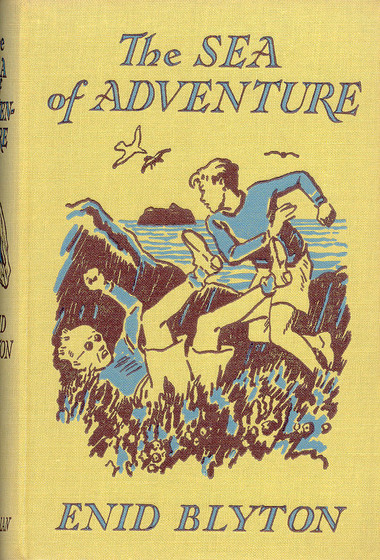
The Sea of Adventure

First published in 1948 this is the fourth book in the series.

The cloth board cover

The cloth board cover

First edition dustjacket by Stuart Tresillian

First edition dustjacket by Stuart Tresillian


THE LOCATION

This book is set in and around some of the many small islands off the north-west coast of Scotland. No precise details are given, and I think it’s safe to assume these exact islands are fictitious – though there will be real islands like them out there. They visit a couple of islands before choosing one to settle on for longer. The island they choose has a large puffin colony on it. It also has a hill in the middle, a pleasant cove and a rocky inlet just right for their boat.


THE STORY

This time the children are pitted against a nasty group of men who are using the nearby islands to smuggle guns into the country. 

Poor, silly Horace Tipperlong

Poor, silly Horace Tipperlong

We also meet Horace Tipperlong who the children immediately christen Trippalong, he’s a rather weedy fellow and he has a rather bad time at the children’s hands – though you feel he deserves it for being so silly.

Bill needs to lay low for a while, and as the children have been ill he decides to take them on a holiday to some Scottish islands. They plan to sail around, stopping to explore islands as they like. They find a great island, full of puffins, to camp on and the children have a lovely time, unconcerned about the one or two aeroplanes they’ve seen in the area.

The holiday takes a sinister turn, however, when Bill disappears and the boat’s wireless and engine are destroyed. The next night a terrible storm strikes the island, the wind whipping away the tents and smashing up the boat. A couple of days after Bill disappears the children see another aeroplane which drops a small packet hanging from a parachute. Two nasty sounding men turn up on the island, looking for anyone who might have been there with Bill – but they can’t find the children who are hiding underground in the puffin colony.

Bill is kidnapped

Bill is kidnapped

The tent blows away

The tent blows away


A man called Horace Tipperlong then arrives on the island, and the children assume he is a crook pretending to be a dippy ornithologist. They are – in Horace’s  words – vicious and blood thirsty in their treatment of him, and leave the island in his boat to track down Bill. First they discover a beautiful lagoon, one full of mysterious packages – obviously dropped by the aeroplanes. Horace also ends up in the hands of the enemy and nearly sabotages the whole rescue mission.


PHILIP’S PETS

The rats and Miss Lawson

The rats and Miss Lawson

Philip is training young rats called Squeaker, Woffles and Nosey. This is useful when Philip is able to scare off Miss Lawson, a potential governess, by producing them from his shirt.

Huffin, Puffin and Kiki

Huffin, Puffin and Kiki


He then befriends two of the puffins on the island, and names them Huffin and Puffin. They’re very useful pets as they bring fresh fish for breakfast in the mornings.


MY REVIEW

I think my favourite part of this book has to be the chapter with Horace Tipperlong. Jack comes up with such a brilliant idea, and they execute it beautifully. The end of the book is particularly thrilling – a rescue which goes wrong, and an escape which goes worse!

Mrs Mannering described her relationship to the Trent children to Miss Lawson by saying Jack and Lucy-Ann are not my own children. [They] are great friends of my own children, and they live with us. Jack and Lucy-Ann call Mrs Mannering Aunt Allie but in her thoughts Lucy-Ann says Aunt Allie was a lovely mother. She also wishes that Bill was her father.

We break slightly from tradition here – Bill’s around for more of this story than in previous books, and it’s the kids racing to his rescue instead of the other way around. Given the setting, it’s perhaps not surprising some of the happenings remind me of the Adventurous Four books (both of which published earlier). Trapped on an island with no boat, secret lagoons, island rescues, these things have been done before. Hiding under the seaweed in familiar too – though it’s usually boats hidden that way, not children. Saying that these elements are blended into a completely different story and their vague familiarity is forgotten in the excitement. In fact sometimes familiar plots are nice – part of what makes Blyton’s books Blyton-y is the use and reuse of familiar ideas like secret passages, caves, islands, smugglers etc.

The book demonstrates exactly what Mrs Mannering always says – that Bill and the children manage to fall head-long into adventures wherever they go. Bill is trying to stay away from trouble and accidentally picks the exact location enemies of his are working. He even recognises the men who kidnap him!


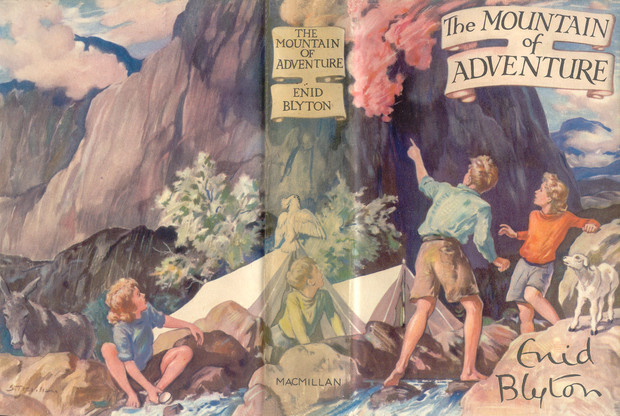
Next review – The Mountain of Adventure

Posted in Book reviews | Tagged , , , , | 9 Comments

Bourne End: A May Day walk

It’s beginning to look a lot like summer!

In the glorious sunshine on May Day (May 1st) I convinced my friend Catherine to come for another Bourne End walk with me. It’s basically my spring Bourne End blog but because we haven’t had the best spring months now seemed the best time to do it, with the sunshine and the slightly cooler temperatures before the year transitioned too quickly into summer.

So I will level with you, I picked a day that makes it look like summer to do this walk, and apart from the fact that some of the trees are void of leaves and some of spring’s flowers are out, you really wouldn’t know the difference. I hope the pictures will help you understand what I mean.

However, beautiful weather, a good friend and a chance to use my camera how could I say no to this beautiful trip?

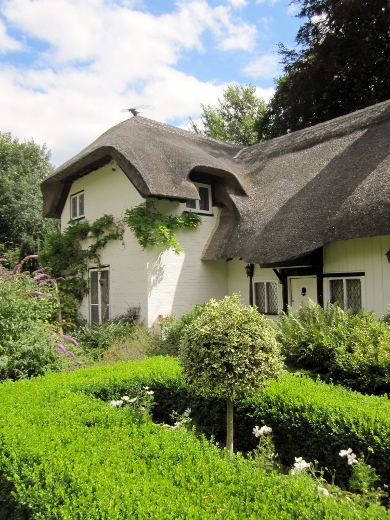
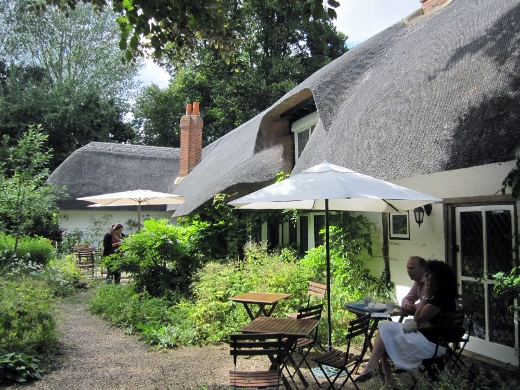
The walk from the carpark, past the Spade Oak towards Old Thatch.

The walk from the car park, past the Spade Oak towards Old Thatch.

We arrived around 3pm, for an afternoon’s sunny walk and were not disappointed. There were lots of lovely flowers and animals about. We started at the car park, taking a look over the fences, seeing daffodils, horses with their foals, and the fishing lake through a gap in the hedge. The next item on my list was to walk a little way back down the way we had come, past the Spade Oak and past Old Thatch.

First off we decided to walk down the little footpath on the side of the road, sheltered by trees and by the field with the horses in it. Catherine and I had walked this path before, but in the opposite direction during our Autumn walk where we encountered the possible exit for the stream that was supposed to run along the back of Blyton’s garden, and the ‘yellow leaf road.’  I did manage to get a few “artistic” shots of Old Thatch’s chimney through the gap in the hedge.

Old Thatch's chimney in a gap in the trees on the footpath.

Old Thatch’s chimney through a gap in the trees on the footpath.

This time, we had no ‘yellow leaf road,’ but a tangle of brambles, catching us on the legs and needing pushing aside carefully before we could proceed. As we wandered through the undergrowth, I spotted a beautiful little chaffinch in front of me, and snapped a picture. I have been after a picture of a chaffinch for months and have been unable to secure one until May Day. See I knew it was going to be a good day! I was incredibly lucky in fact before a second after I had snapped the picture the little bird flew off. Clearly I do not have the gift that Jack Trent and Philip Mannering have with animals.

Carrying on, we walked the remainder of the footpath, up to the little bridge over the old stream bed. I had another look at where the stream may have escaped from Blyton’s garden, and then we emerged from the undergrowth, making sure first that there were no cars coming as we stepped out onto the road!

We then doubled back on ourselves, keeping to the road this time (does that count as doubling back?), so I could get some better pictures of Old Thatch. From what I could see, the garden was waiting to burst forth into bloom, but it was still nice to see the place through a gap in the hedge. I’m very much looking forward to going back and having a look soon!

Closer to Old Thatch.

Closer to Old Thatch.

Then, photos of Old Thatch safely on my camera, we headed back to the car park and on to the riverbank.  The daffodils were shining brightly in the sun as was the blossom on the trees as we headed up to the level crossing. This time, we didn’t see a train pass, but a car had gone through before us, so we assumed that one had just gone. That didn’t mean that we didn’t observe the rule of stop, look and listen, of course. Satisfied that we weren’t walking out in front of the train, Catherine hurried across while I took a more leisurely pace!

The River Bank

The river bank

Once we were on the bank of the river, the Thames was gleaming blue under the sky and looked inviting, and I must admit that I wanted to swim in it, but I wouldn’t try it as the Thames was/is considered a very dirty river indeed.

There were a couple of boats moored at the riverside, busy with people enjoying the sun. After we’d taken in the beauty of the hills and the blue river, once again we headed up the all too familiar path, towards the marina.

Under the passage of leaves and blossom, between the riverside houses and their boat houses, we wandered along to the boat club part of the bank. I spotted a gorgeous wild rabbit with floppy ears, but I was unsuccessful in getting a picture. On our wander through we spotted a little mammal, ducking in and out of a hole between a jetty and the bank. I think it was a vole, but we couldn’t find a picture of verify this. If you do know what our little friend is, please let us know in the comments!

Our friend the Vole?

Our friend the vole?

We sat and watched the little blighter zip about for five minutes before we decided to head off again. As we reached the marina to looked up to the railway bridge and felt a strange sense of regret, as the bridge was covered with wooden planks and cloth. As we reached the bridge we saw a notice saying that they were fixing the bridge. Also not to dawdle which I did, I’m afraid. The magnificence of the bridge seemed to be diminished with men working on it, and not being able to see the train tracks on the left hand side of the footbridge.

The Cockmarsh walk

The Cock Marsh walk

After the winter walk, where the world seemed to be monochrome it was nice to see Bourne End in such colour. We slipped under the bridge to Cock Marsh, walking across the field in the sunshine, admiring the green everywhere, and the ducks. We wandered down the bank just by the field boundary and sat in the sun for a while, admiring the view.

It was lovely to sit in the sunshine after all the time we’ve had grey skies recently, and apart from the breeze you could almost believe that it was summer.  In fact it was perfect May weather as written by Blyton usually our springs are wet and blustery while hers seem to be as perfect as the summers, never too hot, always lots of sun and minimal rain.

The View from the Bridge

The view from the bridge

So all in all, a perfect walk. I just hope the summer weather is as good when it comes down to it!

Perfect Blyton weather as I’ve said. We came home, exhausted and sun burnt after a jolly good walk. As Old Thatch’s gardens are now open to the public on Wednesdays Thursdays and Saturdays, I will tell you that they’re worth a visit and the walk along the riverbank is always peaceful and well worth it. Give it a go!

Posted in Nature, Personal Experiences | Tagged , , , , , | 7 Comments

Mystery, Magic, and Midnight Feasts! by Poppy

By Poppy Hutchinson

Recently, I was invited to the very first viewing of the brand new Enid Blyton Exhibition at Seven StoriesMystery, Magic, Midnight Feasts, The Many Adventures of Enid Blyton. I was invited through on a rather special occasion – BBC Breakfast was going to be there and film a slot for the show which was shown on Wednesday. Not wanting to spoil the surprises for all those who are planning to go there, but I will tell you some interesting details and some of the amazing things that are there!

First of all, I would like to express what a great job Seven Stories have done putting together this brilliant exhibition. The room it is set up in, is dedicated to all sorts of exhibitions so before the Enid Blyton one could be put together, the previous one had to be taken out, so in total, Seven Stories only had a week or so to put the new exhibition together.

There are a few amazing details, which I’m sure you’ll all want to know about, about the exhibition. I will begin by saying the very large room is split up into a few different parts – a Malory Towers section, a Famous Five section, a Faraway Tree section, a Noddy part and a bit about Enid Blyton. There are a few other bits in between such as a Secret Seven Society Shed! There was also Enid’s actual type writer which was amazing to see, as well as quite a few of her hand written diaries!

There was also a very clever machine which was made to look like an old TV, and you could press a button and next to it, it had the year, and on the screen it showed some of the books that were published that year. When pressing the last few buttons, it showed how the books progressed into the modern ones which are sold today. It was a very clever aspect!
Also, the films I was involved in making were amazing! They had all been put together to make a new opening theme tune to the 70’s series song. It was great to see and everyone looked great! I was very proud that I had been involved in making such a fantastic exhibition. Of course there is a lot more to see if you go there yourselves – the amazing faraway tree, Toyland, and the Malory Towers common room! It really is well worth a visit and I would encourage anyone to go, along with children of any ages. There was so much to interact – it was a great experience and I can’t wait to go again!

Seven Stories were very interested in our World of Blyton Blog, and are going to advertise it on their own face book page! Thank you all for reading this, and I hope you can all make it to Seven Stories. If not, it will be going on tour in about a years time. It’s really to good to miss!

This slideshow requires JavaScript.

Pictures Taken from the Seven Stories Facebook Page

Posted in Blyton in the media, Personal Experiences | Tagged , , | 3 Comments

Monday’s here again!

Where has our GORGEOUS Blytonesque weather gone? It’s all cold and wet again, and once more the forecasts are suggesting that we’ll have a summer like the last one – how dull!

In happier news, we have reached over 15,000 hits on the blog and we are into our seventh month of blogging. Time goes far too quickly!

This week’s posts are a bit of muddle, I know for sure that we have Poppy’s account of Seven Stories Enid Blyton Exhibition opening as our guest blog this week.

If I get chance to get it finished and tarted up with the pictures, I shall treat you to my Mayday walk at Bourne End this week. If I am unsuccessful I shall have to let you have the next part of Julian’s News to enjoy. (To catch up, click here!)

Quite honestly, I don’t know what Fiona will treat you to. It may be her review of The Sea of Adventure, it may not. So we’ll all have a surprise!

Just a little reminder for our readers on the 15th June there is a gathering in Enid Blyton’s childhood home of Beckenham where there will be a tour of her old houses. If you’re interested check the Enid Blyton Society Thread here, and feel free to email Tony Summerfield about joining the group!

Some of my week included exciting news. The duck (henceforth called Jemima Puddleduck) who flew into the small enclosed garden at work has been sitting on her eggs for the last month, and has now hatched her eggs into 16 cute cheeping little balls of fluffy ducklings.

Jemima and the ducklings are all doing fine, swimming in the pond and  wandering around the garden.

These 16 little bundles have broken Woodley Library’s record for ducks which was set at 12. Not only that but they have proved to be the biggest distraction at work. I hope you agree with me, and enjoy the pictures!

Happy Reading!

This slideshow requires JavaScript.

Posted in Blog talk | Tagged , , , , , | 2 Comments

Recovering from illness in Blyton’s books, part 2

Part one covered the flu, and this blog will look at measles, coughs and colds. Not all of these illnesses lead to holidays and/or adventures, though the other illnesses still contribute to their stories’ plots.


MEASLES

The measles (or as Mam’zelle Dupont would say the measle) appear in at least seven books!

THE SEA OF ADVENTURE

The book begins opens with the Trent/Mannering children all having had the measles. Philip came down with them as soon as the hols started, and passed it on to Dinah, then Lucy-Ann and finally Jack. They’ve mostly recovered by the time the book starts, but they’ve already missed the start of term. Their doctor recommends that they go away ‘for a change.’ Dinah, especially, is not to do any school-work as she ignored his orders and read while she was ill, and as a result is left with watery, light-sensitive eyes. Dinah grumps about going away at first, as she loves the summer term, as does Philip who is sure he’d have been near the top of his class.

They soon change their tune when Bill offers to take them on a holiday to the islands of Scotland. This is convenient, as he has to drop ‘out of sight’ for a while and it gives Mrs Mannering a well-deserved rest – especially useful as she comes down with measles the morning after Bill arrives! Bill says he has had measles “dozens of times,” (I suspect he’s exaggerating slightly!) to which Lucy-Ann replies “but you can only have measles once.” But of course Philip has had measles before – he is at Mr Roy’s house getting extra tuition over the summer at the start of The Island of Adventure because he had measles right after scarlet fever and  missed most of his school-work that term.

HOLIDAY HOUSE

Pat and Mary are at the Holiday House as they have had both chicken-pox and measles recently. They have recovered but their mother suggests a holiday I wouldn’t want them to go on an exciting trip like [America] – they want to laze about by the sea somewhere.

THE CHILDREN OF CHERRY TREE FARM 

As mentioned in part one the Cherry Tree Farm children had measles as well as the flu and bad coughs before being sent away for six months on a farm.

UPPER FOURTH AT MALORY TOWERS

Alicia starts to feel ill during the School Cert. exams. She can’t think straight and develops a head-ache. She can’t sleep that night, and goes through the rest of the week worrying about what’s wrong with her brains. During the final exam she faints over her desk and is taken to the san where Matron diagnosis measles. Alicia noticed she had a rash but she thought was just a heat rash. She is put to bed for a week and is not allowed any visitors during that time. She doesn’t pass the exams, but is allowed to move up with the rest of her form and re-do the tests later.

CLAUDINE AT ST CLARE’S

Claudine is a week late arriving at St Clare’s because she has had the measles.

THE SECRET OF MOON CASTLE

Two of Prince Paul’s brothers in Baronia have caught measles and cannot come to England for a few weeks. This gives the Arnold children and Paul time to have an adventure in the castle before it is over-run by Baronion royalty and servants.

MR PINK WHISTLE’S PARTY

In the story Mr Pink-Whistle’s Party (in the book of the same name) Mr Pink-Whistle meets a kind young girl called Merry who helps people cross the road outside her house. Later, she is very upset as a friend of hers has come down with measles, and now Merry is to be quarantined for three weeks in case she has caught them. This means she can’t help people across the road, and she will miss a lovely birthday party. This is the reason for Mr Pink-Whistle throwing the party in the title of the story.

FIVE HAVE A MYSTERY TO SOLVE

Wilfrid’s sister has the measles, and that is why he is staying with his grandmother and thus around during the Five’s penultimate adventure.


SOME FACTS AND FIGURES

To modern readers it might seem strange that so many of these children had the measles. But in 1948 (the year Sea was published) there were almost 400,000 cases of measles reported in England and Wales, resulting in 327 deaths. In 2008 there were just over 5,000 reported cases of measles and just two deaths*. So Blyton’s frequent usage of the measles probably wasn’t  unreasonable for the times.


COUGHS AND COLDS

Plain old coughs and colds are actually quite rarely featured – perhaps they were not considered serious enough for many holidays!

FIVE GET INTO A FIX

The Famous Five were sent to Magga Glen in Fix after the four children had a bad cold. Dick said that the Christmas holidays were the worst [they’ve] ever had. They were so bad they spent Christmas day in bed and couldn’t even eat anything! Dr Drew visits once they’re back on their feet (though their legs don’t feel like they belong to them yet) and suggests they get away somewhere hilly, not too far from the sea. Somewhere really bracing, but not too cold – where the snow will lie to get rid of their coughs before going back to school. The Five are certainly not themselves – they’re exhausted after their car journey to Magga Glen and sleep for twelve hours that night – though their appetites have returned by the time they’re on their way. Thankfully by now the food no longer tastes like cardboard! Their coughs start to get better after just a day at Magga farm, and their legs are more steady so they can have a wander round – but poor George is obviously not quite herself just yet as she sheds a few tears after Timmy’s scuffle with the farm dogs. Conveniently the Five are absolutely fine by the time they move into the hillside cabin and start their adventure!

FIVE HAVE A WONDERFUL TIME

George  has a cold at the start of Five Have a Wonderful Time and can’t join the others at Faynights Castle at first. Her mother blames it on bathing in the third week of April and staying in the water too long.

THE CHILDREN OF CHERRY TREE FARM

As above, coughs were part of the reason the children were sent to Cherry Tree Farm.

And I think that’s all there is to say about the measles and coughs/colds. If I’ve missed out anyone who’s had those in the books just give me a ticking off in the comments. There will be a part three which will look at mumps, scarlet fever, whooping cough and being ill at school.

*Measles statistics from The Health Protection Agency.
Posted in Plot Devices | Tagged , , , , , , , , , , , , , | 3 Comments

In The Fifth at Malory Towers

Original dustjacket by Stanley Lloyd in 1950.

Original dustjacket by Stanley Lloyd in 1950.

I know it’s been a while since my last Malory Towers review and I apologise. I just kept having new ideas. Anyway, I’ve managed to start and finish the fifth Malory Towers book in one day and I’m now in a position to be able to review it for you.

For me In the Fifth at Malory Towers is tied for first place with Third Form at Malory Towers. There is something about this book, perhaps the characters’ development, the revelation of Darrell’s talent, the mire of problems that the girls face and some well-developed  new characters for us to enjoy.

We dive straight into the action with this book, starting with Darrell and Felicity on the last leg of their journey to Malory Towers. After that we’re almost immediately plunged into the world of Malory Towers with Darrell. In this book you can feel a shift in the reader’s perception – In the Fifth offers more of an insight into Felicity River’s time at Malory Towers than the last book. This shift is almost to prepare the reader for the next book, where there is more focus on Felicity and her friends.

But for this book, we are safe and sound with Darrell and the gang.

Immediately we are back in the swing of things, girls everywhere and it’s not long before we’re up in the girls’ new form room taking in the view, discussing what the term will bring and the new girls. As Fifth Form at Malory Towers actually follows on from the end of the Upper Fourth at Malory Towers, we have some fluidity in the transition from Fourth Formers to Fifth Formers and the girls do talk about those members of their class that they have left behind or failed their school certificate. Very pointedly we’re told that Alicia is allowed to go up to the Fifth Form with the others because Miss Grayling wrote to Ms Johns (Alicia’s Mother) and, as Alicia puts it, said  “I could pass the school cert. on my head any time I liked” and that she was to work for it on the side.

Bill and Clarissa on their horses.

Bill and Clarissa on their horses.

Once all the girls are back, and settled – with Bill and Clarissa who played significant parts in the last book “whinnying” away together about horses and Ruth Batton without her twin Connie – we’re introduced to the new girl. Maureen Little who, believe it or not, is worse than Gwendoline. A Gwendoline Mary 2.0 if you will as she’s basically Gwen without half as many corners knocked off.

The girls know instantly that they will have to do something about Maureen!

We technically have three new girls this term, as two have been left down from the old Fifth Form, Catherine Grey and Moira Linton. Neither are a great favourite with our old friends. Moira – who is made head of the Fifth – is domineering and bossy while Catherine is described as a doormat, self-sacrificing, martyr-like and over-helpful.

Felicity's first match

Felicity’s first match

The first big surprise of the Fifth Form is that Darrell is made head of Fifth Form games, which means that she gets to help pick teams for the younger school, and helps train them. She immediately imagines her first class lacrosse team that includes her sister Felicity. And as it turns on Felicity does make it onto a match team on Moira’s insistence. The match teams which she has put together so far have won their matches, but the match we are treated to is one where her little sister Felicity plays – much to the disgust of Alicia’s little cousin June, who accuses Darrell of favouritism.

The next big surprise is that the Fifth Form are allowed to produce the school’s Christmas entertainment. This sends the girls into a frenzy of delight until the dominating Moira takes control, organizing meetings and so forth.

Moria takes charge

Moira takes charge

In the end Darrell is asked to write the script for a pantomime of Cinderella. This at first stuns our heroine until she gets going. At one point she asks Sally “do you think I might possibly have a gift?” to which Sally’s reply is that she thinks Darrell does.

We have an interesting term as the pantomime progresses, we have tricks from Alicia’s cousin June – in the first form – but none from the Fifth Form as they feel that they are too old to play tricks on the mistresses now.

It’s a fascinating trick that consists of a balloon arrangement under June’s clothes, she inflates the balloons by pulling a string, and tricks Mam’zelle into thinking she’s getting fat. I shan’t spoil it for you, but nothing goes as planned, with hilarious consequences.

With the build up to the pantomime, Darrell’s drafting and being head of games, she’s very busy.

Now we move to the main focus of the book – the pantomime, which Darrell has completed writing, Irene has finished composing and all the other bits and pieces are half way through being completed. The only things left are to cast the pantomime and then rehearse.

Gwendoline and Maureen immediately see themselves as Cinderella, but after some cutting remarks from Moira, and the girls trying to take Maureen down a peg in a particularly viscous scheme, they realise that they won’t get to be Cinderella at all, but still hold out hopes for being another main park in the show. Both girls are self-centred enough to believe that they stand a chance of getting a good part.

In the end, Mary Lou is cast as Cinderella, to much delight. It’s a perfect piece of casting because even though she will be scared, she’s perfect for Cinderella.

From the casting, things pick up quickly, mostly because we haven’t got many pages left. We are ‘treeked’ by Mam’zelle, rather terrifically, Alicia and Moira have an explosive row, and then a big plot point of the book comes around, the sending of anonymous letters to Moira.

Darrell taking in the response to her Pantomime.

Darrell taking in the response to her pantomime.

It’s a quick finish  with someone learning a very sharp lesson and getting a good talking to, but soon all is glossed over as the pantomime is ready to start.

The parents are settled, and the orchestra is in place. We stand backstage with Darrell as she gazes solemnly out on to the stage worrying whether the pantomime will ever be a success…

I think I’ll have to let you read on to find out for yourselves.

Overall, In the Fifth at Malory Towers is one of my favourite books, lots of things to keep you busy, and interesting plot twists and the pantomime adds an extra dimension to Darrell’s character. So a brilliant read with one of our favourite heroines. Definitely worth picking up if you haven’t before!

In the Fifth at Malory Towers 1957 dustjacket reprint by Lilian Buchnanan

“In the Fifth at Malory Towers” 1957 dustjacket reprint by Lilian Buchanan

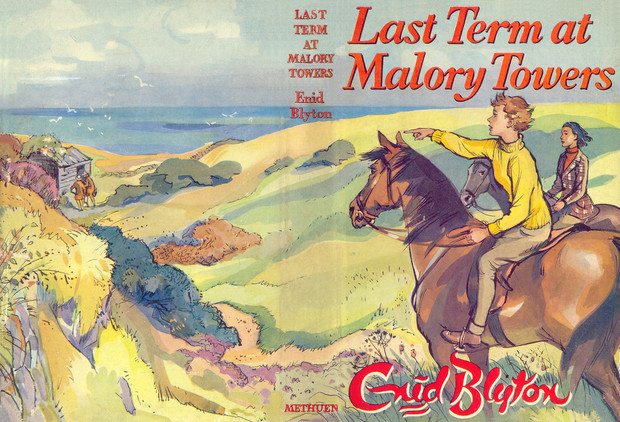
Next review: Last Term at Malory Towers

Or read a review of the audio adaptation of In the Fifth here.

Posted in Book reviews | Tagged , , , , | 7 Comments

Sunskriti’s *NEW* Character Exploration: Dinah from the Adventure Series

You might be wondering why I changed from animal character explorations to character explorations. Well, I realized I had done all the animals from the series that I have read. Most other animals are mentioned too little to write about.

So, my first character exploration is on Dinah. I generally like to pick less mentioned, or ‘in the shadows’ kind of characters, which is why I didn’t pick George, or Darrell, or someone like that.

Dinah Mannering of the Adventure Series, drawn by Stuart Tresilian

So, now for Dinah. Dinah Mannering (later Cunningham)  is a girl from the Adventure Series. She has a brother called Philip, who she often fights with. Everything about her is shown as fiery and hot-tempered. She can be a bit scornful and unkind at times, especially at any weakness shown. Lucy-Ann is often a victim of her scorn, as she is the weakest of the 4 (forgive me, 5!) and scared easily, while Dinah tends to be much braver.

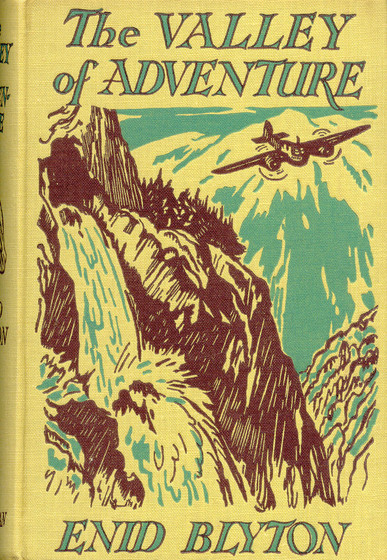
In The Valley Of Adventure, once, while discovering the path to behind the waterfall, the two girls are alone as the boys have gone to get food. Before they know they are coming out behind the waterfall and they hear a roaring noise. Dinah suggests it might be a fire in the heart of the mountain, and Lucy-Ann is scared to face a fire that makes a noise like that. She begs Dinah to turn back, but her request is rudely declined as Dinah tells her to go back alone or walk with her. This is an example of Dinah’s scorn and a little unkindness.

Dinah is also very impatient, and always like to be doing something. She never likes to sit still. Numerous moments in the series proves this. Whenever doing anything, while the others stop to discuss something, or sway off their original path of discussion, it is Dinah who spurs them on, with her usual impatience and desire to do something.

Her dislike and disgust of all living animals often leads to conflict between her and her brother Philip, who loves all animals and always has some running about him. They yell and kick at each other and Dinah is ready to lash out slaps by the dozen. Dinah’s not all bad though, her tempers go as fast as the come and she’s very loyal to Philip, Jack and Lucy-Ann.

In all, we can describe Dinah as a hot-tempered, scornful, impatient, active girl who hates anything to get in the way of what she’s doing.

valley of adventure tunnel crawl

Illustrations are by Stuart Tresilian and are taken from the Cave of Books

Find more of Sunskriti’s character explorations here, or more posts about Blyton’s characters here.

Posted in Characters | Tagged , , , , | 1 Comment

The first Monday in May

It’s the first Monday in May which, in Britain, means it’s a bank holiday. Hooray! I’m off to St Andrews with my family for a wander round the charity shops and lunch in one of our favourite restaurants. I’ve got a list of books to look for in the charity shops, fingers crossed there will be some Blytons I don’t have!

This week on the blog we new series from one of our regular contributors. Sunskriti is moving on from looking at animals and instead will be focussing on the human characters in Blyton’s books. Her first human character is Dinah from the Adventure Series.

Stef has lots of possible posts for this week so I don’t know what she will pick – perhaps her review of In the Fifth at Malory Towers, one of her fabulous Blyton recipes or maybe a new chapter of her fan fiction.

As for me, I’ve got a couple of possibilities (none of them are quite finished yet, though!) I might post the next part of my look at illnesses in Blyton’s books, or I may finish reviewing  Humpty Dumpty and Belinda, or start my review of The Sea of Adventure.

There’s not any other news from the blog this week so, as I often do, I will leave you with a few of my favourite photos from last week.

Posted in Blog talk | Tagged , , , | 1 Comment

Making Blyton’s Food: Recipes to make your mouth water

Last week at work I spotted this book “A Perfect Day for a Picnic” by Tori Finch on the new shelf at work, and I decided to take a look and see if it contained any of the wonderful food mentioned in Blyton’s books. Sadly, I have to say, it was very lacking in Blytonian food.

A Perfect Day for a Picnic by Tori Finch. The Book that started it all.

“A Perfect Day for a Picnic “by Tori Finch. The Book that started it all.

And then I had this idea!

Why don’t I do some searching, find a shed load of recipes for all the food that gets eaten in Blyton’s books and cook all the recipes and see which one’s the best? Then I can take pictures, tell you about them on here and give you a smashing, memory-stirring recipe to your favourite Blyton foods.

I’m sure you all know what food I’m talking about. The food that make your mouth water just through the descriptions, and you enjoy every mouthful with the Five, the Adventurers, the Find-Outers, the Secret Seven, Malory Towers and St Clare’s girls, wishing you could enjoy the magical food just as they do. The food in Blyton’s books are almost as famous as the woman herself!

Well that is my plan. So far I have raided my mother’s cookery books, and a couple I had gotten from work. I’ve compiled an Excel spreadsheet of 118 recipes to try. Some of those do need to be looked into as I’m unsure whether they just sound Blytonian or actually feature in the books.

The Kind of Blyton food we all think of! Taken from http://postwarthatchedcottage.blogspot.co.uk/2010/11/food-glorious-food.html

The kind of Blyton food we all think of! Taken from http://postwarthatchedcottage.blogspot.co.uk/2010/11/food-glorious-food.html

There you are, that is my proposed plan. I’m not saying that you’ll get a blog every week about a recipe, but I shall try to keep up a good momentum. Naturally some weeks may be busier than others.

So far I have tried my hand at the two recipes for ginger biscuits that I have, one of which – owing to the late start of the project – hasn’t done very well. I shall probably give them another go tomorrow to try to make them correctly. After which, I will hopefully be able to present you with a good solid recipe for ginger biscuits as featured in Five Go To Kirrin Island Again.

I think it’s a good thing that cooking always means you have no shortage of taste testers, and willing mouths to feed because I’m not sure how I’d manage to eat everything I’ll be making.

Still, it never stopped the Five!

P.S. If you have any foodie ideas for me to try, do share them!

Posted in Food and recipes | Tagged , , , , , , | 2 Comments

Who’s Who in Enid Blyton by Eva Rice, a (very critical) review 3: Toys and Enchantment

Welcome to the final part of my review. The first (Adventure Stories) was a rather bad review while part two (School Stories) was a bit more positive. Let’s see how this one fares.


TOYS AND ENCHANTMENT

Enid Blyton’s Fairy Folk
The Enchanted Wood
The Wishing Chair
Mr Pinkwhistle
Amelia Jane
Mr Twiddle
Mr Meddle
The Three Golliwogs
Brer Rabbit
Noddy

As I mentioned before I don’t believe Mr Twiddle should be in this section, as he’s a real man in the real world. OK, he’s a fictional character in a fictional world – but it is supposed to be real. There’s no magic, and no toys coming to life.


ENID BLYTON’S FAIRY FOLK

It’s not clear until you reach this section that the heading doesn’t refer to an Enid Blyton book or series. Rather, it’s descriptions of the different types of fairy folk to be found in Blyton’s books. It covers brownies, elves, fairies, gnomes, goblins, pixies and trolls.

Rice is quite critical of some of the Faraway Tree illustrators for giving Silky wings which are not in the text. If Silky could fly several exciting escapes would have been unnecessary.  I was interested to find out where the wings came from, so I’ve investigated a little. The first edition illustrations of all three books are by Dorothy M. Wheeler and show Silky without wings. Later editions of these books had a variety of illustrators such as Rene Cloke, Georgina Hargreaves and Janet and Anne Grahame Johnstone. Unfortunately Rice doesn’t mention which editions she is referring to. I do have a Dean and Son copy of The Folk of the Faraway Tree which does seem to show Silky with wings on one occasion (there are only about eight illustrations in the book, most of which she isn’t in.) I don’t know if subsequent illustrations continued to put wings on Silky, but I assume if they did it was because of Cloke’s illustrations. (You can see Wheeler’s and Cloke’s illustrations in the Cave of Books)


THE ENCHANTED WOOD

The Enchanted Wood by Dorothy M. Wheeler

The Enchanted Wood by Dorothy M. Wheeler

Time for me to admit something – I’ve never read any of the Enchanted Wood books. So I will have little idea about any mistakes in this section.

On the plus side, the characters are listed by their original names, Fanny, Bessie, Jo, Dick and Dame Slap rather than the modern updated versions Frannie, Beth, Joe, Rick and Dame Snap. Nothing is said anywhere about the updated names, though, for people with newer editions.

One mistake I can identify is that this book says there are many pop, biscuit or goggle bun-munching sessions in Moon-Face’s home. That should read pop biscuit as that’s one item, not pop and biscuits, (they are correctly referred to later in Silky’s section) and google bun. I’ve also no idea why there’s a hyphen between bun and munching… as the munching applies to both the buns and the biscuits. In addition, I think that Slippery Slip should be written as Slippery-Slip to match the name in the books.

I question why the three children’s father is listed as Mr Jones while their mother is listed as Mother to Jo, Bessie and Fanny.  If they were under Mr Jones, Father to… and Mrs Jones, Mother to… they’d be one after the other instead of pages apart.

Apart from what are mostly typos this is a good section, and I find myself a bit more knowledgeable about the series. Although I’ve not read the books I was aware of most of the main characters and of the general plot from reviews and discussion over at the Enid Blyton Society Website. I’ve recently  bought The Enchanted Wood (1949) from Amazon, and I hope to get the others soon.


THE WISHING CHAIR

The WIshing Chair by Hilda McGavin

The WIshing Chair by Hilda McGavin

Shamefully I’ve never read either Wishing Chair book. Until recently I only had the first book, and was waiting to find the second before I read it. Anyway this isn’t supposed to be about me or my book-buying addiction, so back to the book review.

Rice says something interesting about the Gnome Doctor, that he is obviously intelligent as he “has something in common with a lot of clever Blyton characters – he wears several pairs of glasses.” I can’t think of any Blyton character knowing for wearing several pairs of glasses, either all at once or one after the other… though that may be a common thing in one of the series/books I haven’t read, so an example or two would have been useful.

The Polite Pixie is mentioned a couple of times – we know the chair was made invisible to escape him, but he doesn’t get his own section so I’m left wondering who he was, and just how polite he was to warrant escaping from.

As far as I can tell this was a decent section for the book, though there may have been many mistakes and omissions I couldn’t spot!


MR PINKWHISTLE

Mr Pink-Whistle by Hilda McGavin

Mr Pink-Whistle by Dorothy M. Wheeler

The name really should be Mr Pink-Whistle, rather than Mr Pinkwhistle. Pinkwhistle has been used – the cave shows it in two Sunny Stories magazines, a few jigsaws, some story tapes and in two post 1970 short stories but these seem to be exceptions rather than the rule. It’s a minor thing, but as he has a double-barrelled name with a hyphen in a vast majority of his published works, I tend to think that would be the correct spelling – and the spelling Rice is most likely to have seen herself.There are 18 books with Pink-Whistle, 97 short stories and 46 magazine entries (many of these are the same story or book reprinted but they always kept to the same spelling.)

In this and several other sections there is suddenly no introductory paragraph, we jump straight in to the first character to be described, and the general plots/setting of the books are conveyed in the characters description.

Other than that Mr Pink-Whistle’s section is short but sweet. He and his cat Sooty are the only characters to get mentioned, but that’s completely understandable as Mr Pink-Whistle encounters hundreds of children in his books, all of whom appear very briefly – usually in only one chapter.


AMELIA JANE

Amelia Jane by Sylvia I. Venus

Amelia Jane by Sylvia I. Venus

The first fault is that only two Amelia Jane books are listed, More About Amelia Jane (1954) is missing.This is another section without an introductory paragraph (luckily Amelia Jane is alphabetically first, so we can start with an explanation of the series through the main character description.)

The Amelia Jane books feature a large cast of regular characters (the teddy bear, the golliwog, the sailor doll, the clockwork mouse, the brownies in the garden, Nurse, the pink rabbit, the clown and more.) However, there’s only a single page here with Amelia Jane, Mister Noah, Tibbs and  the cowboy doll the only toys to get their own section. The cowboy doll is only in one story Amelia Jane and the Cowboy Doll from Naughty Amelia Jane, as he doesn’t belong to the children who own the nursery but has been lent to them by friends. Tibbs (in original and Dean versions called Tibs) apparently he has an uneasy relationship with the other toys as he chews on them, but there’s no mention of the fact he is a cat.

I find it the choice of characters chosen to be featured ludicrous! Why not pick a couple of toys who appear in just about every story and have distinct personalities?

Having an early edition (7th impression 1947) to hand I can see the quoted description of Amelia Jane Rice has missed out the word long in describing her black curls (but at least she’s not blonde like in some updated texts). Rice also refers to Nanny’s scissors in the original texts it is Nurse not Nanny who cares for the children (Nanny appears in the updated versions.) I point this out as up until now (leaving aside the Jo/Joe/Jo-Jo issue) Rice has used names and information from the original texts.

She also gives the characters’ names capital letters Pink Rabbit etc, whereas Blyton, always using the in front of names, used lower cases the pink rabbit, as the rabbit’s name is not pink rabbit, he is a pink rabbit, and is actually called Bunny by the other toys in speech. Likewise Blyton says “the clown walked off” but when another toy speaks to the clown, it is “we’ll do it Clown,” and the toy soldier is called Tom. It should also be the brownies not the Brownies. Rice also calls the teddy bear just Bear…  It may seem silly, but Blyton was consistent in her capitalising. Normally using the capitals would be fine and sensible, but when you’re discussing characters from a book I think you should write them exactly as they appear – hyphens and capitals included. (I’ve checked both early editions and the Dean versions, though later editions may have started using capitals.)

A rather poor section for me.


MR TWIDDLE

Mr Twiddle by Hilda McGavin

Mr Twiddle by Hilda McGavin

Like with Amelia Jane, Rice has missed out one of the books in the series – the second book, this time – Don’t Be Silly Mr Twiddle! (1949). Again, there’s no introductory paragraph – and worse, Mr Twiddle is the only character listed. His wife is mentioned, but doesn’t warrant her own heading, despite being the second biggest character.

Not a great section.


MR MEDDLE

Mister Meddle by Rosalind M. Turvey and Joyce Mercer

Mister Meddle by Rosalind M. Turvey and Joyce Mercer

Another name issue here – I think it should be Mister rather than Mr Meddle. Mister is in the first edition titles of all three books, though some reprints of the first two books have Mr on the front cover. As far as I am aware he is always Mister Meddle or just Meddle in all book text. As before, this is a small error but an annoying one, and it’s more likely you will come across Mister in any published work than you would Mr.  (Mister is in 10 books, 116 short stories and 47 magazines, while Mr in in 6 books, 2 tapes, 10 short stories and 19 magazines.)

This section also has no introductory paragraph and there’s only one character listed. Even Meddle’s poor long-suffering Aunt Jemima doesn’t get mentioned.


THE THREE GOLLIWOGS

The Three Goliwogs by Rene Cloke

The Three Golliwogs by Rene Cloke

Redeemingly, Rice is sensible about this book, and asks us to remember the time it was written in. She also recognises that the three golliwogs are kind and friendly characters, and do not promote racism. She doesn’t, however, give any of the characters their own headings, or an introductory paragraph.


BRER RABBIT

Brer Rabbit by Grace Lodge

Brer Rabbit by Grace Lodge

Again, there’s no introductory paragraph and are no sections for different characters here – just a brief overview of the stories and short descriptions of some characters. Rice does explain the origins of Brer Rabbit who wasn’t a creation of Blyton’s.


NODDY

Noddy by Harmsen Van der Beek

Noddy by Harmsen Van der Beek

Noddy doesn’t get an introduction either – though a large number of characters get their own sections. I’ve never read a Noddy book before (and I call myself a Blyton fan!?) so I probably won’t catch any mistakes here.

Unless Rice writes sentences that make no sense: Big-Ears himself resides in Toadstool House in the Dark Wood, with Whiskers his cat, and his days helping Noddy out of scrapes and cycling round on his little red bicycle. Apart from being a rather long sentence (try reading it out loud without running out of breath) it should probably say and spends his days helping Noddy. It also sounds like Big-Ears helps Noddy ride his bike, when it actually means Big-Ears rides his own bike.

We do get a very interesting story about the Mary Mouse books, they are the size and shape they are as the publisher used offcuts from normal-sized books because of war-time paper rationing.

Interestingly, Noddy gets two whole pages dedicated to him (by far the largest description of any character covered in the book.)

Mr Sparks is listed as the mechanic of Toy Town, with no mention that the original garage owner was actually a golliwog, before the books were updated.


FINAL THOUGHTS

And with that, we are at the end of the book.

To summarise my 5,000+ word review in around 100 words:

  • This book is inconsistent. The depth of examination changes drastically from series to series, and the content/layout is not consistent between series either.
  • There are too many opinions stated as fact –  The most loveable Pixie [is] Chinky, [the Wishing Chair is] the most alluring of all… inventionsNoddy is the best loved and most celebrated of all Blyton’s characters, [Noddy’s] appeal is indisputableand so on. 
  • There are countless mistakes – books missing from lists, people with their name written wrongly or with the wrong name altogether, facts that are just completely incorrect and several examples of poor writing and grammar.

So, that was a rather scathing review, wasn’t it? It’s really unfortunate as the book could have been good.

I think it’s obvious which books the author was most familiar with, and I wonder why she chose to then write about books she clearly didn’t know much about. In her introduction she does say I am not pretending to have included every single Blyton character and that although she will write in detail about several series she will only mention characters from a number of other series. I can’t help but feel that’s a poor excuse given to explain the number of important characters who are missing. It may suit Rice’s work ethos, but it makes for a poor book.

I would still be interested to read the later, revised, edition to see exactly what alterations are made, though I’m not keen to buy it. According to Anita from the Enid Blyton Society Forums:

“Unfortunately, practically all those mistakes and omissions were repeated in the second edition, though it was expanded slightly to include a section on the Barney Mysteries.”

Perhaps I can get it from the library? If I do, I’ll certainly review the Barney section and have a look to see if the biggest mistakes have been corrected.

And with that I’ve finished reviewing this book. I’m actually very, very glad, as being so critical is hard going. (I bet reading it wasn’t a picnic either!) I honestly feel like I’ve written a review as long as the book itself.

Next up: Who’s Who in Enid Blyton the revised edition

Posted in Book reviews, Other Authors | Tagged , , , , , , , , , , , , , | 1 Comment

Go Ahead Secret Seven – a review by Ben

Go Ahead Secret Seven was first published 1953

A peculiar-looking George is out in the dark of night, practising his shadowing for the SecretSeven, when he is given the shock of his life and suffers a huge disappointment. Dressed up in a black overcoat, rubber shoes and holding a rubber truncheon the white-toothed black-faced George expertly follows a tall, stooping man who had just got off the bus. Suddenly a young man grabs the startled George from behind and accuses him of attempting to beat up and steal from the tall, stooping man. The angry young man forces George all the way back to his parents’ house.

George following the tall, stooping man.

George following the tall, stooping man.

Next morning the rest of the Seven hear, much to their dismay, that George has had to resign after being banned from the society by his father. Thankfully George’s replacement is Scamper, Janet and Peter’s dog! Following on from this Colin decides to do a bit of shadowing and sees a man with a distressed-looking and whining bull terrier. Intrigued, Colin follows the man down Hartley Street and across Peter Square, where he turns into a dark alleyway and then comes back out without the dog. Meanwhile, George’s loyal friends vow revenge on the young man for getting George banned from the S.S, when Colin, Jack and Peter pay a visit to Starling’s Hotel, where he happened to be staying.

During the conversation Colin realises he had seen the same young man the night before going down the alleyway with the bull terrier. Excitedly Colin ushers the boys down to the same desolate alleyway he had seen the night before and the boys search through the rubbish for a passageway where a dog could lie. Eventually Jack and Colin tire, before finding a wooden box to sit on. The pair fight over the box and come tumbling down with it, only for the box to reveal what looks like a coal hole.

Discovering the coal hole

Discovering the coal hole

At first it looked dark and seemingly empty, but Colin decides to whistle down the hole and hears dogs barking. Realising they are on the trail of another mystery the boys also happen to stumble across the same young man walking down the alleyway with a lead, which was strange as he had no dog. This only adds to their suspicion and when Pam and Barbara visit the local library and find out that expensive dogs have been stolen from their homes, the Seven know they are on the trail of some dangerous dog thieves. Convinced they are right Jack, Colin and Peter use a rope ladder to get down the coal hole one night, and make a discovery. To their horror the boys are discovered by the caretaker and are locked up. However, there is a twist as someone is waiting to rescue the boys. Scamper hears this someone, who can it possibly be?

Trapped!

Trapped!

In my view, this book has a very strong message to it. Blyton once again expresses her feelings on animal cruelty. Narratively, the plot involves a number of expensive breeds of domestic dogs stolen from their owners. Jack, Colin and Peter are alarmed to think that there could be dogs in the underground coal hole, and even more shocked that they might be caged. The most telling example of Blyton’s views is when Jack describes the treatment of the dogs as “animal cruelty”, before saying that the RSPCA should be informed about the men. Personally, I think a comparison can be made with the first book, The Secret Seven, when the boys find a racehorse locked in a dark cellar. In both these books animals are kept in the dark, ready to be sold on for money.

Due to this, I find Go Ahead, Secret Seven, quite upsetting. Having said that, George being forced to leave the Secret Seven due to the beastly young man was also a moment in the book I did not enjoy. To be fair, Scamper was a great replacement and it is nice to see he plays a more prominent role in the adventure when he alerts Jack, Colin and Peter’s rescuer at the top of the coal hole, but I was really left hoping that the angry young man would be punished for how he treated George and the dogs. Overall, this book really touches my heart as a dog and animal lover, and I thank Blyton for writing such a book. Let’s hope George returns to the Secret Seven, and the dogs are returned to their owners!

First edition dust jacket by Bruno Kay

First edition dust jacket by Bruno Kay

Next review: Good Work Secret Seven

Posted in Book reviews | Tagged , , , | 1 Comment

Another Monday

Monday comes around far too quickly doesn’t it? And we’re so close to the end of April that it doesn’t seem possible. At least we’ve had some much improved and decent weather this week. Such good weather in fact that I got sunburnt while re-reading In the Fifth at Malory Towers which was supposed to be my blog for you yesterday, but unfortunately I wasn’t able to finish it in time. Fiona swooped in like a saviour and sorted out the April showers  poem for you to enjoy.

This week we passed 14,000 views! We’re so grateful to everyone who pops in and even more grateful for our regular readers who keep coming back!

This week we bring you Ben’s next Secret Seven review; Go Ahead Secret Seven. You can check out his past reviews here.

I know that Fiona’s got a couple of blogs to choose from, for example the next part of her Eva Rice reviews or her next recovering from illnesses blog. Like you, I look forward to seeing what she treats us to!

As for me? Well. I dropped the ball (in more ways than you could imagine) last week, but I have a new piece on baking Blyton’s food that should be ready for you to view.

I’m afraid I can’t offer you much else, even in the way of Fan Fiction as my Julian’s News pieces have rather hit a brick wall. Any ideas are welcome! And on that particular issue, I have added a new tag to the fan fiction to make it more user-friendly. Just check the bottom of the page for the tag “Julian’s News” to see the series of fan fiction together.

I can’t really think if there is any more to tell you, so I’ll leave you with some of my favourite nature pictures to enjoy!

This slideshow requires JavaScript.

Posted in Blog talk, Nature | Tagged , , , , , , | 1 Comment

April Showers – A poem by Enid Blyton

Unfortunately Stef’s piece for this week isn’t ready due to technical issues, so here is a poem I think is just right for this week.

“What, take and umbrella on such a fine day!”
Cried an elf to his mother, and frowned;
“Just look at the sunshine, so golden and gay,
And the sky is quite blue all around!”
Off he went skipping in a new suit of yellow,
But before he had gone very far
There blew up a cloud, an enormous big fellow
(You know what these April clouds are!)
And down came a shower that pelted and stung
And soaked the poor elf; with a sigh
He squeezed out his new suit and carefully hung
The tunic and knickers to dry.
The sun shone out warmly, and dried them again,
But alas! when he tried to get dressed,
He found they had shrunk in the soft April rain –
So he had to walk home in his vest!
And now pray be careful, since April is here,
That  you are not caught like the elf.
Watch out for the clouds, and when they come near
Do hurry and shelter yourself.

Copied from the revised edition of Enid Blyton’s Book of the Year (originally published in Teachers World No.1717 Apr 22, 1936)

I got caught in a few April showers (both rain and hail!) on Friday, though at least I had a waterproof coat on.

An April shower falling on Templeton Woods pond in Dundee on Friday.

An April shower falling on Templeton Woods pond in Dundee on Friday.

Posted in Poetry | Tagged , , | 3 Comments

Recovering from illness in Blyton’s books, part 1

We’ve just had a very long and very cold winter, and I think just abut everybody I know succumbed to an illness at some point. This got me thinking about the all the times characters in Blyton books fell ill – and were quarantined or sent away to recover. I wish I could have gone away somewhere nice instead of going back to work after being ill!

The idea of these holidays wasn’t Blyton’s, but they were popular in the Victorian era when it was believed that sea air had health benefits. Sea air, or indeed any fresh air, was undoubtedly better for them than breathing polluted  air in industrial cities. Blyton didn’t just send her poorly characters to the sea-side though, they got trips to the mountains, farms and even abroad to recover.

Nowadays holidays just to get over the flu are pretty much the preserve of the rich and famous, though I’m not sure if they were as common in Blyton’s day as her books might imply. It is worth remembering though that many illnesses were much more prevalent and serious in her lifetime for several reasons such as a lack of immunisations and treatments.

I’m going to start with the flu as strikes in a few of Blyton’s stories and allows the children to have many an adventure on their convalescing holiday.


THE CHILDREN OF CHERRY TREE FARM

The four children have had the flu – after the measles (there’ll be more about measles in another post) and before two of them have a bad cough – and are thin, pale and don’t eat enough. So on doctor’s orders they are sent to Cherry Tree Farm for a six month holiday. Mother says you have all had such a lot of illness so there must be no more school for you for some time. Just the country air and good food and lots of walks. When they arrive Aunt Bess notes their pale cheeks and Benjy’s sticks of legs. The children develop good appetites quickly at the farm though for several days they are tired out by their explorations.


THE RING O’ BELLS MYSTERY

At the opening of the book Dinah, Roger and Snubby are supposed to be going back to school – but Dinah and Snubby have temperatures. Mrs Lynton says Snubby must be ill as he can’t eat even a sausage for his breakfast. Snubby himself says I do feel bad… do you think you could possibly take Loony out again?… He’s such a scrapey dog. Poor Dinah says she couldn’t possibly get up. I got up in the night to get a drink and could hardly stand.

The doctor diagnosis it as the flu – and a pretty nasty one at that. He recommends they stay in bed for several days and after that they shouldn’t go back to school for ten days or so, suggesting they get away somewhere to recover. Mrs Lynton says the doctor wants them sent somewhere inland, but not too low – and somewhere fairly warm. They head off to Ring O’ Bells village and are quite tired out by their car journey, though are all able to eat well at tea-time. They have a long sleep that night and eat heartily at breakfast before going exploring – but Dinah suddenly goes pale and the boys walk her back home. They’re all tired out and can’t eat much lunch before going for a nap. The holiday must do them good though as they all seem fine after that!

ringobellsill


THE RIVER OF ADVENTURE

The Mannering/Trent/Cunningham children all have the flu at the start of The River of Adventure, and poor Kiki has been kept away from the boys as Philip couldn’t bear her noises. When the book starts the boys are still unsteady on their feet but the girls have managed out of bed to play cards. The next day all four are up and about though all are still not feeling quite themselves. The doctor stops by and says they must go away somewhere for convalescence – ten days or a fortnight, say. Somewhere warm and sunny. This flu they’ve had is a bad kind – they will feel very down all winter if they don’t go away somewhere. Conveniently Bill is to be sent somewhere warm and sunny to spy on someone and having his tired wife and four children recovering from illness with him would be a great cover. The children are a touch pale when they arrive on their holiday, and are tired by bed-time that first night but after that they seem to be recovered.

riverflu


There are also a few unfortunate occasions when characters catch the flu yet don’t get a holiday.

The Five Find-Outers have all caught the flu by the start of The Mystery of the Strange Bundle, with poor Bets apparently being the one who caught it first and then gave it to the others. She also recovers first and so spends her time visiting the others, still stuck in bed, to cheer them up. They’re all better in a few days and can start looking for a mystery to solve.

fattyflubundle

One of the background characters in Holiday House is Ruth, the daughter of the woman who runs the house. She’s rather snappy with the visiting children and one of them suggests it was because she had influenza so badly and couldn’t go to school this term. Presumably the fact Ruth lived by the sea already meant a holiday was unnecessary. The main characters, though, are actually at Holiday House as they’ve been ill, but there’ll be more about them in part 2.


SOME FACTS AND FIGURES

A bit of background information on flu makes for interesting reading. There were several flu pandemics which affected Britain during Blyton’s writing career. There was an outbreak of Spanish Flu  from 1918-1920 which killed around 250,000 Brits and anywhere from 20 to 100 million people worldwide. In 1947 and 1951 (the year Ring O’ Bells was published) there were further Swine Flu pandemics (Swine Flu is the same strain as Spanish Flu)  – the outbreak in 1951 reportedly having a worse weekly death toll in the UK than in 1918-20. There  was a further flu pandemic in Britain in 1957, and by December 3,550 people in England and Wales had died from influenza, due to it being a new strain from China. Despite there being no pandemic in 1956  there were still over 1,000 flu deaths in England and Wales that year.

Nowadays most people will catch the flu at some point and be stuck in bed for a week or so. There have also been some nasty flu outbreaks in recent years; such as the Swine Flu pandemic in 2009. However the death toll was relatively low in comparison to the outbreaks mentioned above: in Britain just over 450 people died.

I don’t want to stray too far into anecdotage territory (my fellow forumites will know exactly what I mean) but I’m interested in the notion of Blyton using a real and current illness as an excuse to send the children to a new location where they can have an adventure. Whether it was something that came from her under-mind or a more conscious thought I wouldn’t be surprised if reading the flu pandemic reports in the newspapers had influenced her in using the flu to start these stories with – just a wild theory though! A list of relevant events might make my point clearer:

  • 1918-1920 Spanish Flu pandemic
  • 1940 The Children of Cherry Tree Farm is published.
  • 1947 Flu pandemic in Britain
  • 1951 Flu pandemic in Britain and The Ring O’ Bells Mystery is published
  • 1952 The Mystery of the Strange Bundle is published
  • 1955 River of Adventure and Holiday House are published

I’m mostly basing my theory on a few of the books published in the year of or years following large flu outbreaks, but even if the outbreaks themselves didn’t overly influence Blyton her giving the characters flu so frequently was still a wholly believable situation for the times.

I had planned to cover all the books featuring convalescences in one post but I’ve gone on too long and probably bored you all to tears already so I will leave the rest to another day. I’d be really interested to hear anyone’s stories of being sent away to recover in their childhood – or if you know of anyone who was.

Also, I apologise for the lack of actual Blyton content in this post! There wasn’t an awful lot to say about each book other than “they had the flu and then went on holiday” as the illnesses really were just a convenient excuse for an adventure!

Facts and figures taken from Centers for Disease Control and Prevention, the BBC, Science Daily, and Wikipedia.
Posted in Plot Devices | Tagged , , , , , , , , | 2 Comments