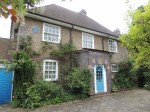
Old Thatch: Come rain, come shine

Ok, I know you’ve already had a Bourne End blog off me for Spring where the weather was delightfully warm and sunny, but bear with me.

Last time, I did not visit the beautiful gardens at Old Thatch because they were closed. During our last walk my good friend, Catherine, has said that she would quite like to see the gardens of Old Thatch when they were open.

Always keen to know when I can next visit Bourne End and Old Thatch, I needed no persuasion to take Catherine back to visit the gardens. We chose a Thursday afternoon – perhaps a surprising time, but a perfect time to go when there are not lots of people milling about.

When the Thursday (23rd May) dawned wet and miserable, my first thought was to check with Catherine that she wanted to still go, and she was game. So we beetled over to Bourne End in my little car and parked in the little carpark just past the Spade Oak.

We knew that we were going to get wet, with the showers sometimes being short and sharp while others were lengthy and drizzly, but nothing could put off the excitement for me. I fell in love with Bourne End and Old Thatch in 2011 when the Enid Blyton Society had an Unofficial Day out there in place of the Enid Blyton Day.

So take a look at my raining and shining photos and see what you think.


Posted in Nature, Personal Experiences | Tagged , , , , | 2 Comments

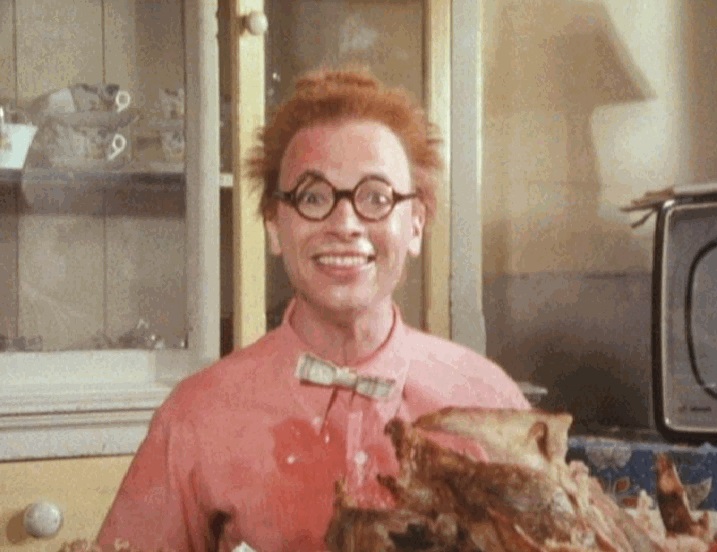
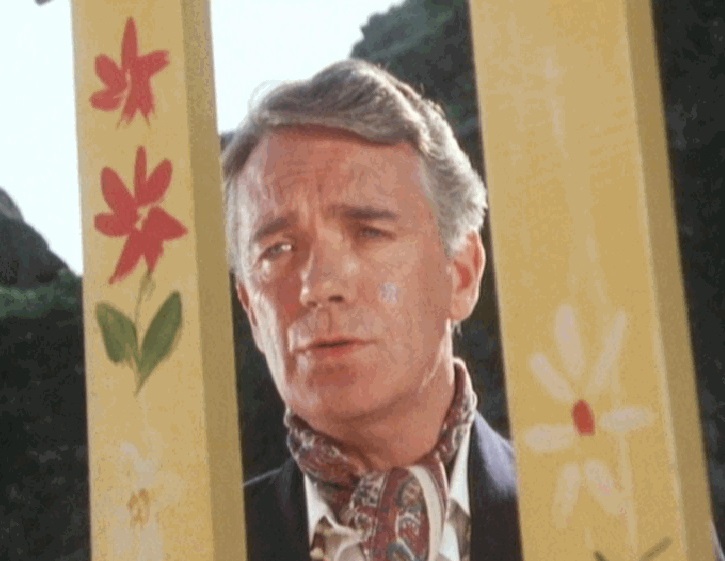
Comic Strip Presents… Five Go Mad on Mescalin – A Review

This is the third and final episode of the Comic Strip Presents Famous Five episodes that I’ll review, though it was the second to be made and aired. I started with the most recent one (Five Go to Rehab) and then did the first one (Five Go Mad in Dorset).

Five Go Mad on Mescalin seems to have the reputation for possibly being the worst of the three episodes, or second worst depending on what you made of Rehab. It was made back in 1983 (before I was born) and I’ve never seen it before so I will try and not let any preconceived notions spoil it for me. As before I’m watching it on 40d where you can also see Five Go Mad in Dorset (but not Five Go to Rehab as that was shown on Gold.)

The synopsis on 4oD for the episode is While on their way to stay with Mrs French at Hot Turkey Farm the intrepid youngsters learn that their Uncle Quentin, a well-known scientist and homosexual, has escaped from prison.
x5xf2h

So it seems the episode picks up some time after the events of Dorset.


FOOD GLORIOUS FOOD

It opens with the Five having a very typical picnic complete with their usual sort of banter. Dick remarks he’s eaten thirteen rounds of ham and turkey sandwiches, but he’s still hungry. That’s a bit of an exaggeration on the book but it is a running joke throughout that the Five have huge appetites.

Mrs French at the farm says she supposes they’ll want to start stuffing their faces immediately, to which they chorus rather! She also says that Aunt Fanny wrote to her to tell her about their excessive gluttony, and that she had prepared a meal that would kill an elephant. The Five celebrate that news. When we see them at the end of their meal there’s a whole pig on the table, picked clean apart from the head.

They rattle off the list of things they had at breakfast (though it never becomes a chant like in the last episode) and end it with lashings of alka seltzer. They immediately then ask what’s for dinner, and Mrs French says I thought I’d slaughter Daisy here, and a few chickens. The boys worry that won’t be enough, but George says they could have it with bags of broccoli and new potatoes, and that seems to satisfy everyone.

Another recurring joke is their upper-class attitudes, such as implying starving people are starving because they breed like rabbits. But, as Julian points out, they also die in childbirth so it evens out. I don’t really find the whole classist thing funny in the first place, and those lines are just really tasteless.

Slightly funnier is the scene in the little shop. The girl is young and pretty, and smoking a cigarette. She’s also very uninterested in serving the Five. They ask for gingerbeer and are told the only have 7up. The Five are incredulous and ask for home-made ice-creams instead. They don’t do ice cream, just ice lollies.

Lollies? George echoes in disbelief.

Unfortunately they rather spoil it by making lots of derogatory remarks about the girl, how she’s queer and cheap, mentally retarded and probably from a broken home. Or maybe she’s adopted.


A FAMILIAR FACE

Robbie Coltrane appears briefly in the scene, though only for a minute or two. I usually enjoy his appearances and find them the funniest part but his lines are fairly poor this time. Janeyyy it’s time to come and feed your illegitimate baby he calls from off-screen, and then appears as a woman again. (S)he apologises to the Five and says she’s not mine, she’s… adopted. As if that explains something huge.

Coltrane does get to explain about the farm they’re going to. Mrs French was apparently a Dear old soul until the menopause. Sometimes I feel they just try to throw in as many modern and adult themes as they can, but they’re not funny really. What’s funny about the menopause? So it’s Mrs French with that wicked son of hers with his… comings and… goings… and that strange love island across the water. 

It’s a bit like the spiel he got in the last episode but not as funny, and it doesn’t get repeated either.


They get some ice creams anyway, and are sitting to eat them (after Dick has had a good look at Janey’s bottom), when a message plays on the radio.

Uncle Quentin (not Mr Kirrin, or Quentin Kirrin!) the well-known scientist and homosexual, has escaped from prison.

Anne shows a little more feeling than they have in the past at such news. Oh it’s horrible to think of Uncle Quentin on the loose again, I do hope they catch him soon!

Dick assures her that the police will be doing everything they can to catch him, and that he will soon be in a special prison.

Oh yes, just like Rudolph Hess George replies brightly, despite the fact it’s her father they’re talking about. Nazis are another repeated ‘joke’ in this episode.

Dick later says that Nazis are preferable to Americans (and that it’s a pity the Germans didn’t win WWII) as at least they cared about racial purity and didn’t litter the country with bubblegum wrappers. Let’s just gloss over the war atrocities for a cheap laugh shall we? Not that I laughed.

Anyway, when the Five arrive at the farm they hear a loud man’s voice berating his ma, and him slapping her. It’s somewhat reminiscent of a few characters from the Famous Five books (Mrs Janes in Five Go to Billycock Hill, the old lady at Blue Pond Farmhouse in Five on a Hike Together for example) but taken much further. There’s no violence on screen but the sounds are there.

She shouts after him about falling into bad company and he roars about selling the farm.

Julian is super polite to him and introduces them (as he does a few times) as the Famous Five. When the mother appears she is younger and sexier than anyone from the books, wearing a corset top under her over-all.

She asks the boys if they want to shack up with her or share with a nice, rich American boy. Dick’s keen to share with her but Julian says he’d rather sleep in a ditch.


GEE SHUCKS, THOSE AMERICANS

It all becomes very Finniston Farm like then. Exaggerated, of course. There’s the young American boy, staying with his father at the farm. Pop is there to buy anything he can get his uncultured hands on. 

Willie (the son) is exceptionally loud and whiny so much so it’s almost painful to listen to. Gee shucks Pop, I’m hungry. Tell that woman to fix my dinner NOW. 
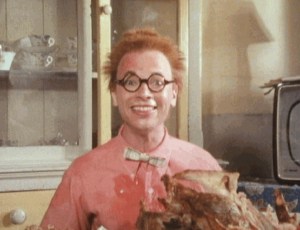
mescalin-3Blyton gets a bad rep for writing stereotypically about Americans, making them rather brash etc but this parody takes it much, much further than that.

Pops says in front of Mrs French that he wants to buy the farm and all the heritage crap, then sell it in the states for a profit. (His American accent is terrible by the way.)

So, as the boys decline to sleep with either Willie or Mrs French they end up sleeping in the barn. (A la Finniston Farm, sort of.)


A lorry is driven into the barn in the night and a huge consignment of secret packages (in the words of the men) is loaded onto it. They’re exceptionally obvious about the fact they’re up to no good as all criminals in the Comic Strip world always are.

The boys assume the police wouldn’t believe such a queer story, and that the wires at the farmhouse have probably been cut. They usually are in those sorts of situations! (Which is semi-true. They are cut on a few occasions). They both agree there’s absolutely no point in going to check, though and that they ought to go visit Love Island first thing in the morning.

George wants to row first, but Julian says absolutely not as there are jagged rocks and it’s much too dangerous and Dick adds that the girls might panic and get hysterical. Of course we all know that George is the best at rowing of the Five as she’s had the most experience, but the Comic Strip never misses a chance to play on the sexism of Blyton’s work.

There are no oars however, so the plan is immediately abandoned for a game of rounders. It’s cringeworthy stuff as the boys prance about and do the worst ‘moves’ for bowling and batting, not to mention the uncomfortable cricket-ball cleaning that Dick does.

Anne seemingly catches the ball by mistake and Julian tells Dick to bowl underhand for George as she’s a girl. She insists he bowl normally and she smashes the ball far across the beach.


STRANGE HAPPENINGS

The plot just gets plain strange from here on in. Dick finds a cave while looking for the ball and inside are sacks of objects. A woman appears behind him and says kiss me.

Back on the beach the Five are wondering where Dick has gone. Julian said not to worry he’s probably just meeting the Duke of Windsor or having a Jane Eyre. Maybe I’m naive but I have no idea what those jokes mean.

They go to investigate and find his underpants, and on the wall is painted love & peace. They decide this is a clue to Love Island and decide to head there, as Julian says, something will turn up to help them. That ends up being an outboard motor complete with fuel right outside the cave.

They find Dick on a rock, signing badly and playing a guitar and there’s an altercation with Julian who tries to stop him. Dick proclaims he loves him, loves everyone and gets a slap. George calls Anne something I don’t feel like I can repeat on the blog and after a ducking in the water Dick seems to be behaving normally again.

The baddies turn up again and this time they’re doing their routine of saying blah blah blah and random phrases.

Doctor Love is mentioned and the Five briefly wonder who he is (it’s fairly obvious…) and they meet Toby Thurlow again, though he has a very pointless and short scene where nothing happens apart from he spouts some nonsense as he seems to be high.

I think it might be Janey with him, and she’s wearing a really see through mesh top and implies she knows Dick rather well.


AND THE BIG REVEAL

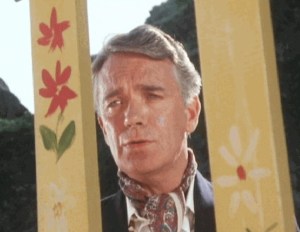
So, Doctor Love is Uncle Quentin. No big surprise there. He has his men put the Five in a cage – Timmy (who’s barely been seen in the episode) goes in meekly beside George without even a bark. Anne tries to sell the others out for her own freedom before Uncle Q explains his dastardly plan. He wants to turn the island into a love colony and use the Five in his experiments.
mescalin-12

Not only am I an outrageous homosexual… I’m an incurable drug addict too.

I’m glad it wasn’t just me thinking there must be drugs involved.

The henchmen prepare to ?spray the Five with some sort of drugs but the police arrive in a boat before they can do so. Willie is with them as he found out his Pop was a faggot and called them. The Five suddenly like him and Uncle Q is led off with Toby.

They all comment that it’ll be the last time they see the two of them.


I think it’s fair to say it deserves to be known as the worst of the three episodes. There was very little to laugh at. The things that were funny in Dorset – Robbie Coltrane, the repetition of lines – are either underused or missing and there’s no real plot to speak of. Pop being arrested off screen for being gay is a let down, there’s no real resolution for Mrs French, and nothing really ties together.

Posted in Blyton on Screen | Tagged , , , , , , , , | 5 Comments

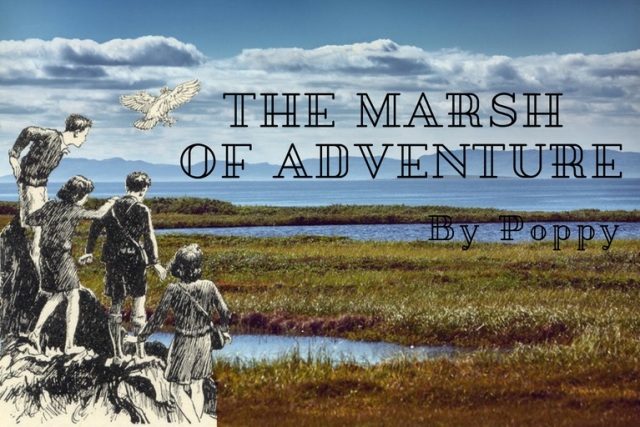
The Marsh of Adventure by Poppy, chapter 19

Chapter nineteen:

Mostly about Beaky

“Lou and Jo the smugglers?” asked Jack, curiously. “But they died years ago. On the night they tried to smuggle all that treasure out of The Forester and the marsh turned from sea land to marsh land.”

“But they’re coming back to life… ‘Ave you not ‘eard them gurgles? They’re comin’ back at’ life, I tell ya’. And they’re comin’ for eld’ Alf. And, I er, thought you was them when I ‘eard you ‘ammering at that door.”

“I really came to ask you about the purple herons,” Jack said, not particularly wanting to hear a lecture about Lou and Jo.

“Ah, they too, ‘ave bin’ acting right down strange lately too,” Alf said, leaning towards Jack, “Ever since this morning’ they’ve bin flyin’ over this ‘ere ‘ill. They never leave their nests until the chicks are ready to fly, and the poor little things were dropping from the sky, like goodness knows what! ‘Ere look. This one, I managed to save, and I brought it ‘ome and meant to give it te’ yer’ friend.”

From his pocket, the old man carefully took out a tiny purple heron chick. It was very much like the adult ones, but much smaller, and it had a little tuft of hair sticking up wildly from its head. Alf handed it to Jack, who stroked it softly. Kiki looked at it with distaste and tried to peck it jealously. Jack tapped her on the beak with his spare hand.

The little purple heron nestled down in Jack’s hand and apparently went to sleep, tucking its head under its wing. “Thank you, Alf. I’ll go and give it to Philip now. Er, thanks for the interesting conversation. I’ll let you know if I see Lou or Jo.”

“You take care,” Alf said, undoing the chain. “There’s bad things out there, you just take care.”

Jack nodded, and headed back down the hill, carefully carrying the little heron in his hands. Kiki perched on his shoulder looking at the bird in dislike. She was rather jealous of the little creature, but she was used to all the animals crawling round he children, and soon, she began to talk to the little thing in a soft voice. Jack grinned. He was rather envious that the bird was meant for Philip, it was such a dear little thing. But of course, it was Philip who had a spell over animals, and it was he who knew how to look after it properly. Besides, this one looked quite weak and bony. After quite a walk, Jack got back to the spot where he had left the others. They were all sat around, talking.

Continue reading

Posted in Fan fiction | Tagged , , | Leave a comment

Monday afternoon is still Monday

Oops. So I forgot about the Monday post, again. This is becoming a habit. At least this one didn’t become a Tuesday post though.

This week we’ll be putting up the latest chapter of Poppy’s Adventure series fic – The Marsh of Adventure and I intend to watch Five Go Mad on Mescalin and then write about what I thought of it. Stef isn’t sure what she’s going to do, either another review or she might bake something and put up the recipe.

I can’t say we’ve got any news on the blog this week, because we don’t!

I’ve taken a lot of photos in the past week or so, so I’ll try and just put up a small selection to show you where I’ve been and the sort of things I’ve seen.


Posted in Blog talk | Tagged , | 2 Comments

The O’Sullivan Twins

The 2000 edition

The 2000 edition

This week I finished the second St Clare’s book, no mean feat when I have been staying with Fiona and we have had such a busy week. However, we were on the beach on Tuesday and I managed to get some reading done in the sun (and mist), so here I am, reviewing it.

The O’Sullivan Twins starts with the twins being much less whiny than they were in the beginning of the first book. Almost straight away we get introduced to their cousin Alison, who had been with them at Redroofs. Alison is the same sort of vain, silly girl as the twins had been one term earlier. After this big, long introduction to Alison she really pays very little part in the story.

Now we start with the journey to St Clare’s and meet some of the regular chums, Tessie, who invites them to a midnight feast, Janet, and some others. We also get to see more of  Mamzelle who is probably the main teacher in this book. She plays some key parts in the story as well.

There are two new girls in the form, Lucy and Margery, and rather like Belinda and Ellen in the Second Form at Malory Towers, the two new girls are liked and hated.

Margery is sullen, and closed in, but shows a talent at being good at games, hockey especially and is picked for the team at St Clare’s. However before the match, Margery gets wound up and explodes at the girls’ history teacher, which causes the whole class to send her to Coventry and when she shoots the winning goal in the hockey match, no one cheers. It really is most odd. You don’t find out why Margery is the surly until half-term but no one seems sympathetic to her position and she gets blamed unjustly for things that begin to happen to the twins later in the book.

In many ways the book is unjustly named after the O’Sullivan twins as they take quite a back seat in the plot of this book. Pat and Isabelle do join in the midnight feast, but they do not play in the hockey match, or plan any tricks with anyone, and for some quite large chunks of the book, they do not appear at all.

However when they do appear, Pat becomes the dominant twin; she is the one people think of first, she is the one who becomes the target of a hate campaign, and Pat is the one who seems to take control of the situations the twins find themselves in.

If I’m honest, I felt that there wasn’t really a lot happening in this book, and when things were happening, it seemed forced and all too familiar (I read the Malory Towers books first and it seems to me that a lot of plot points in St Clare’s were reworked into better plots for Malory Towers). The characters are almost the same as well. In this book, Erica reminds me of Gwendoline Lacey who cannot see her own wrong doings. Lucy reminds me of Belinda, as I’ve already pointed out and Margery as Ellen.

The only thing that really feels different in this book from anything in the Malory Towers books is that towards the end of the book, there is a fire at St Clare’s in the hospital section. Its hard to explain it all without giving it away, but lets just say everything sorts itself out.

Now I think I might have to end here, because I really don’t want to say too much and give it all away by explaining everything. Personally, I’m not a huge fan of this book, the twins that give it the title hardly feature. I think it would have been better to have called the series something like “The Girls of St Clare’s” because then it doesn’t matter so much if things don’t always happen to the twins.

I may read the book again, and see if I enjoyed it more than the first time, but it might not be for some time yet. However if you’re a fan, or have read it and think differently to me, leave a comment below and tell me why!

I look forward to hearing from you!


Posted in Book reviews | Tagged , | 3 Comments

The Secret Island – How has Blyton’s original text fared in a modern edition? part 2

Right, so on to chapters three to five of The Secret Island. The previous chapters can be seen here. The original text I’m using is from the sixth impression from October 1949 and the updated text is from an Award paperback from 2009.


CHAPTER THREE: THE ESCAPE

In this chapter, again, references to violence are removed. I’m finding the alterations a little different to what we’ve seen in the other titles I’ve looked at. In the Famous Five it was almost always a case of a word or two being removed or changed for something else, and the same in Malory Towers except for in one or two cases where a line had to be altered more substantially to make sense. This book has already had at least one line completely re-written when it didn’t need to be.

Even Nora took a slapping without tears is the first line to be changed in this chapter. It could easily have followed the pattern set by the other books mentioned, and become something like Even Nora took a scolding without tears. Instead, we get a re-write to Even Nora didn’t burst into tears when she was shouted at. I can’t think why they needed to reorder the sentence like that.

Then we have they’ll be well slapped being changed to they’ll get into big trouble. (That could easily have become well scolded if they were trying to preserve as much original text as possible.

The phrase whip us well isn’t changed as much as it just becomes punish us well.

I only spotted two other small changes, where queerest becomes strangest and lake-water becomes lake water (though sleeping-place keeps its hyphen along with a few other phrases).

Like in the past two chapters the paperback includes one illustration – a full page one while the hardback has three taking up either half or one-third of a page each.

Wynne hasn’t done his own version of Davie’s work this time, he has drawn them in their boat heading to the island while Davie illustrated Nora taking items from the larder, the children carrying their things to the boat and Peggy filling the kettle on the island.

Again Wynne’s seem heavy handed and thick-lined – Peggy seems to have a moustache almost and Nora has war paint on her cheeks it seems.

IMG_1756

You can click  on this to see it (and the girls’ faces) larger


CHAPTER FOUR: THE FIRST NIGHT ON THE ISLAND

For the first time ever I’ve found a chapter with no new changes. All there is here is a few hyphens removed from to-day and to-morrow.

There are three partial page illustrations again in the hardback compared to one in the paperback, and again none of them show the same scene. It’s interesting to see a picture of the willow root larder though, by Wynne, but it doesn’t really match my childhood imagination of it which has stuck. The children seem oddly modern yet old fashioned in his pictures. Their clothes (particularly the boys’ striped trousers) aren’t far off what Davie drew but their hair (particularly Peggy’s) is much more modern.


CHAPTER FIVE: THE BUILDING OF THE HOUSE

I was getting a little worried, I admit. Seeing as the last chapter had no changes I was concerned that now the children were away from the slappings there would be nothing to write about. How wrong I was! The crusade in this chapter is all about gender equality. Never mind that up until now the girls have done the cooking, sewing, ironing etc while the boys have been farm-hands – now’s the time for them all to be equals, except then they’re perhaps not quite.

Jack’s the captain of the group so it’s all his speeches that get altered. First he says Now Peggy, wash up and Nora, too. This becomes Now let’s all wash up. 

Likewise Hurry up and get the supper, girls becomes Let’s hurry up and get the supper. 

Also, You two girls  clear up as usual, and Mike and I will get back to the house is changed to We’ve got to clear up as usual and then we must get back to the house. This little change has a big knock-on effect for the next few paragraphs.

Originally they read (with other text in between of course) Nora and Peggy washed up in the lake… Then they ran off to join the boys in the willow thicket… Jack had been busy. He had chopped down some willow saplings… and had cut off the long branches. 

But because in the update the boys stay to help with the dishes it all becomes They washed up in the lake… Then they all ran off to the willow thicket… Jack made himself busy. He chopped down some willow saplings… and cut off the long branches.

And finally, gender wise, Jack originally says of skinning rabbits: It’s a man’s job, that, so you two girls can leave it to Mike and me. This becomes if it makes you squeamish, you two girls can leave it to Mike and me. To be honest, I don’t think that’s much less sexist as he’s now assuming Nora is squeamish (and Peggy too) simply because Nora says she doesn’t want him to catch rabbits as she likes them. Perhaps it would have been better changed to if you’d rather, you can leave it to me. That way it doesn’t imply Mike is up for skinning rabbits while the girls aren’t.

I don’t have a problem with the original, I’ll just say that now, as I respect that Jack represents a child of the 1930s who had a different upbringing and different attitudes to what we have now. It’s especially not any less sexist when you consider the next line  – So long as you can cook the rabbits for dinner that’s all you need worry about, is left intact.

That’s one of my bigger problems with the updates – so many things are changed but it’s so pointless as they leave an equal number of things that seem just as outdated/sexist/violent and what have you.

Anyway, before I get too involved in my rant. A few more hyphens are lost from willow-trees and willow-boughs which both become separate words, and a small discrepancy is corrected. The original text has grandad in earlier chapters and then granddad in this one. The paperback sticks with grandad in each instance.

There are four illustrations in the hardback this time, and still just one in the paperback though this time it’s of the same scene, the building of the willow house.

Very similar, I think.


I make that eleven changes to the text (I’m not adding on each time a hyphen is removed.) Add that to the sixteen from chapters one and two and we get twenty seven in total.

Posted in Updating Blyton's Books | Tagged , , , , | 1 Comment

Secret Seven books at McDonald’s by Su, part 3

Adventure on the Way Home

This story comes from Enid Blyton’s Magazine Annual No. 2 first published 1955. Again there have been a few little interchanges on words such as lighted becomes lit, cautiously becomes carefully (happening twice in the text), scared becomes nervous and awful faces is changed to cross faces.  One change that I do not understand is that in the 1955 edition when Scamper hears a noise he is described as having his tail down, but this has been changed to tail up.  When a dog hears something and tenses up, maybe starts to growl, what position is his tail in?

In both editions Colin brings some rope along and Jack climbs up to a window.  This has been chosen as a scene by both illustrators to show in the book and gives a good comparison between 1955 and 2014.

There are also some instances of what may be considered old-fashioned words being left in the book. Thanks awfully for a jolly nice time, Colin remains untouched as does all subsequent uses of the word jolly. Chuck it up stays in the new text as does the description of the policeman walking; policeman had rubber soled shoes and went quietly.  In a lot of Enid Blyton books if you wish to remain unheard you have to wear rubber soled shoes, does this mean that this phrase has been kept in other modern editions and the editors are confident that the young children of today are used to it?

One major change through the book is the reference to violence.  At first the children are alerted to danger when they hear a scream but his has been changed to a noise.  When they hear this they have a little cold shiver of fright which has been changed to cold shiver.  When they eventually see through the window it is described as hand up, he was going to hit someone. Oh there’s another scream. Peter what… This is now hand up. Peter what… Also a most bloodcurdling howl becomes a really loud noise.

When this becomes too much and Peter decides to go to the police, it has been changed on three occasions to go for help but the phrase fetching the police has remained in the new one. Not particularly consistent but then Peter does come back with two policemen so maybe they felt they had to leave one mention of the police in the text  to try to make the story flow.

When we see the “baddies” they’ve got knives has been cut as has the phrase Where’s my knife, Peter saw that he had a knife in his hands, and just you put that knife down. When the girl is explaining what is going on though she states I have to scream like anything! This has not been cut from the new book yet there has been no mention previously of any screams being heard, just a lot of loud noises.

Also in the book the policeman chastises the Seven a little and suggests that if they get into any more adventures their parents would be after them with a cane.  Needless to say this has been cut.  Peter’s father also calls them little idiots when he has heard what they have been getting up to and guess what, yes, it is not a good thing to call your children idiots, even in jest.

There is another minor change in the story where it states he said in the text but it has been changed to Jack said.  It does seem obvious that it is Jack speaking but as the new sentence containing Jack said is at the start of a new chapter, it is probably better that the speaker’s name is mentioned.  A child may have finished the chapter and only be continuing with the story a day later.  In the original story none of the story is split into chapters so this change makes sense in the context of the new editions.

aotwh

Next post: Secret Seven books at Mcdonald’s part 4

Posted in Book reviews, Updating Blyton's Books | Tagged , , , , , , , , | 1 Comment

Back to Work Monday

As you well know, I was visiting Fiona up in Dundee this week, and we had a very nice, sunny, busy time. So apart from failing to blog yesterday, because the train was late, we’ve been pretty good in blogging. We’ve been walking, exploring waterfalls, going to the zoo and wandering around St Andrews.

Anyway this week, we have the next part of the McDonald’s Secret Seven books from Su, and Fiona will be marking the changes to The Secret Island.  And hopefully I shall get around to reviewing The O’Sullivan Twins.

Well with all that out of the way, only the blog news and pictures to go. This week, we have managed to hit 70,000 views on the blog. Its a wonderful achievement, and our blog goes from strength to strength. Can’t wait until we get 100,000 views.

So, just to leave off, here are some of my instagram pictures from this week to tide you over until I’ve edited my proper pictures.

Posted in Blog talk | Tagged , , , , | Leave a comment

A Beckenham day out

Stef had a three hour delay on the train heading home yesterday so she wasn’t able to finish her St Clare’s review. So while checking to see what we had in the drafts I stumbled across this. The day out was over a year ago now and neither of us managed to find a format or layout that really seemed good enough for writing about it. I figure, though, it’s better to publish it as it is than to let it languish for the rest of eternity. So, a year late, here’s what Stef had to say about the Beckenham day out (with some editing and additions from me) – Fiona.

~~~~~~~~~~~~~~~~~~~~~

About a month ago, on the 15th June 2013, some members of the Enid Blyton Society decided to take a trip to Beckenham where Enid Blyton spent her childhood, moving from house to house.

With great thanks to Cliff Watkins, our tour guide and Tony Summerfield of the Enid Blyton Society, for organising the day it was most enjoyable. We have copied the schedule for the day onto our blog and added a picture to show you which house is which.

You will be able to match the numbers on the schedule to the pictures below so you can put the names to the houses.

  1. Meet outside Clock House Station: cross Beckenham Road by pedestrian lights, turn left.
  2. Turn right into Chaffinch Road.
  3.  Arrive at 95 Chaffinch Road, Enid Blyton’s first Beckenham Home from 1897 to 1903.
  4.  Return along Chaffinch Road, until path and steps to Beckenham Road bridge over railway. Cross pedestrian lights, meet late arrivals at the station; turn left and then right into Clock House Road.
  5. Keep on pavement veering to right to reach Malory Close.
  6. Return to Clock House Road which turns right; reach 35 and 31 Clock House Road.
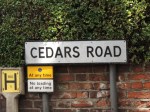
  7. Cross over the road and turn left, and then right into Cedars Road to Tresco.
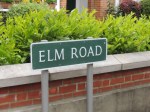
  8. Continue along Cedars Road to see the Chaffinch Brook then continue to Queens Road; cross over, continue along Cedars Road to reach Elm Road. Turn left to reach 14 Elm Road.
  9. Continue to the Baptist Church
  10. Cross over Hayne Road and turn left into Westfield Road with no 13 on right. Continue to the end of road and turn left in Croydon Road to reach the War Memorial roundabout with (left to right), Beckenham Road, Rectory Road, the Cinema and Beckenham High Street. Pause to note the 227 bus stop on the opposite side of Beckenham High Street.
    Lunch Break!
  11. Meet at the bus stop to take 227 bus to Oakhill and start of Oakwood Avenue. Alight bus, cross Westgate Road and continue 30 yards to use pedestrian crossing to the other side of Bromley Road. After 50 yards, cross Crescent Road. Turn left into Oakwood Avenue and proceed up the hill, passing on the opposite of the road the entrances to Perth Road and Overbury Road.
  12. Reach the entrance to White Oak Drive, which is opposite 34 Oakwood Avenue
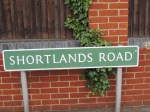
  13. Proceed to the top of Oakwood Avenue which is the summit of what used to be called Clay Hill. Carry on to reach the T junction of Scott’s Lane. Turn right and cross over Scott’s lane to pass Stanley Avenue and Ferguson Close to reach a busy interchange of five roads.  Turn left into Shortlands Road, pass the Library and Enid’s last Beckenham home –  83 Shortlands Road – is opposite.


Posted in Enid Blyton, Personal Experiences | Tagged , , | 2 Comments

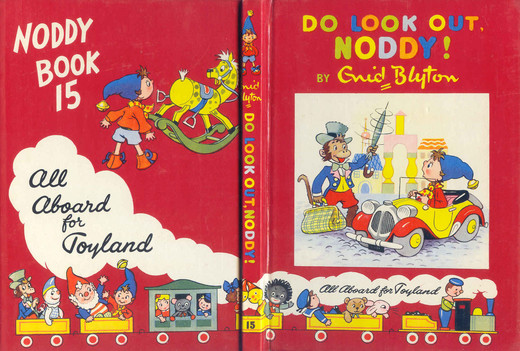
My seventh Noddy book: Do Look Out Noddy!

My seventh Noddy book is Do Look Out Noddy!, number fifteen in the series. I should have reviewed this last time but I accidentally took the wrong one away on holiday with me a few weeks ago. This is the last one I have actually, so I will have to start looking for some more so I can carry on reviewing them.

Dust jacket by Robert Lee and Robert Tyndall

Cover by Robert Lee and Robert Tyndall

Like most of my other Noddy books I got this in Alton, and as it’s very tatty it only cost me a pound.

This title was illustrated by Robert Lee and Robert Tyndall.


THE STORY

The story starts with Noddy being very cheerful as he has been taking lots of people to the station and earning himself lots of sixpences. However, as the milkman points out to him, all these people are staying by the seaside or elsewhere or holiday and there will be no-one left to hire his little car.

Noddy’s great idea is to go off to the sea-side himself, with Big-Ears, but his friend thinks it would be silly to spend his money on a holiday when he won’t be able to earn any more. They even have a little argument about it and Big-Ears slams his toadstool house’s door on Noddy!

IMG_1741

Noddy heads off to his next job then, after slamming his car door of course, and takes Sally Skittle  and three of her little skittles to the train station for their holiday. They’re in quite the rush so he has a few near run-ins with Mr Plod along the way, and then when they do get to the station Sally Skittle says she’ll pay him on the return leg of her journey.

520high+1316641

Toy Town is alarmingly empty on his way back home, and worse, when he gets there he finds a note from the policeman demanding he go to the station to see him. (A scary prospect, rather like when your teacher used to write SEE ME at the bottom of your work.)

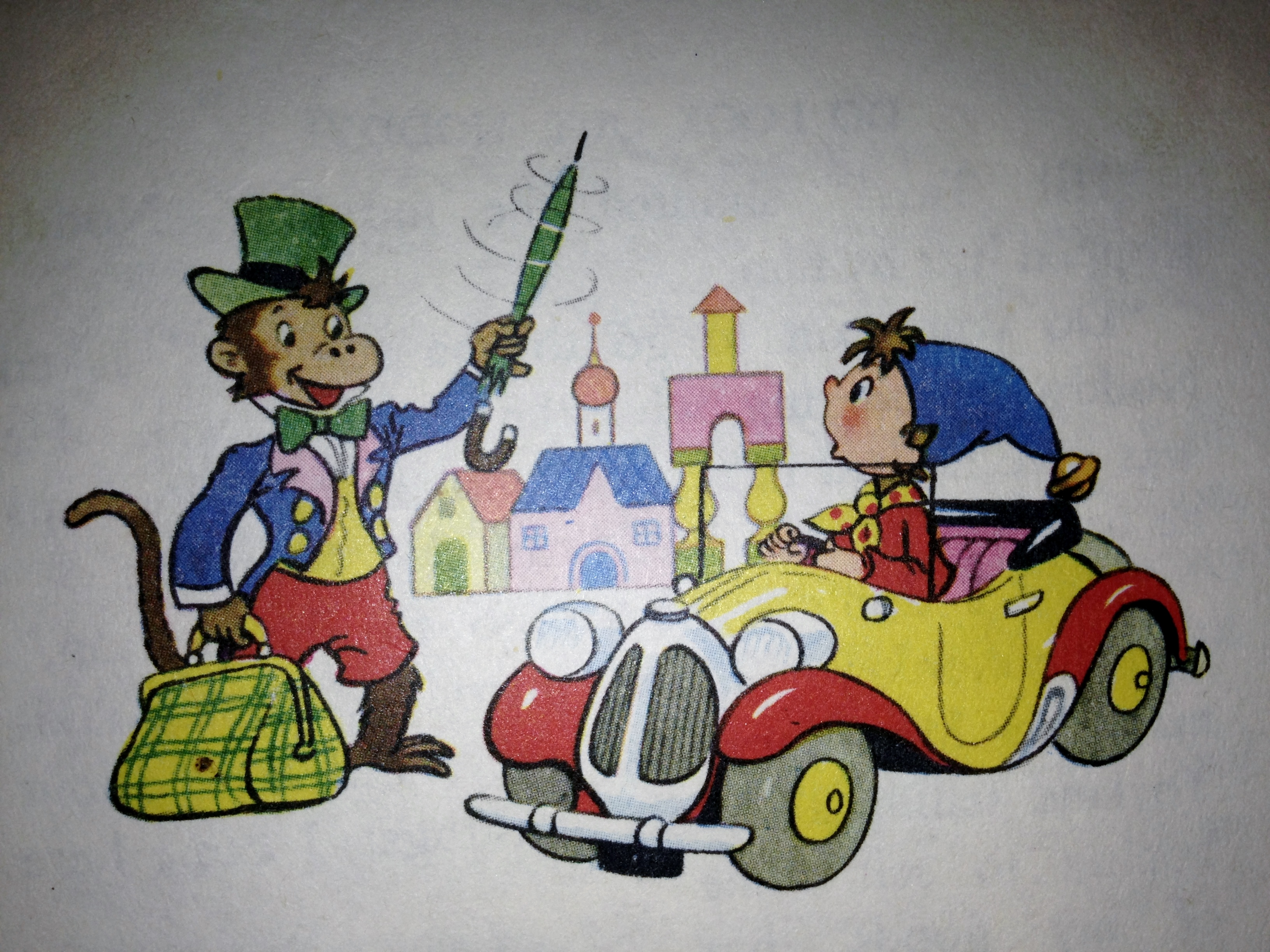
Noddy decides not to go but the note makes him too anxious to even eat his lunch so he decides to head over to see Big-Ears and tell him about it. On his way he sees a well-dressed monkey who hails his car. He introduces himself as Mr Marvel Monkey and tells Noddy he is a salesman but his bicycle is in for repairs. He asks Noddy to drive him around in the mean-time.

IMG_1742

Noddy wants to run this by Big-Ears who, as it turns out, isn’t altogether impressed with Mr Marvel(lous) Monkey. Mr Monkey sides with Noddy about not going to see Mr Plod despite the more sensible Big-Ears saying he should go. I think Noddy might get himself into a lot of trouble as this monkey seems likely to lead him rather astray.

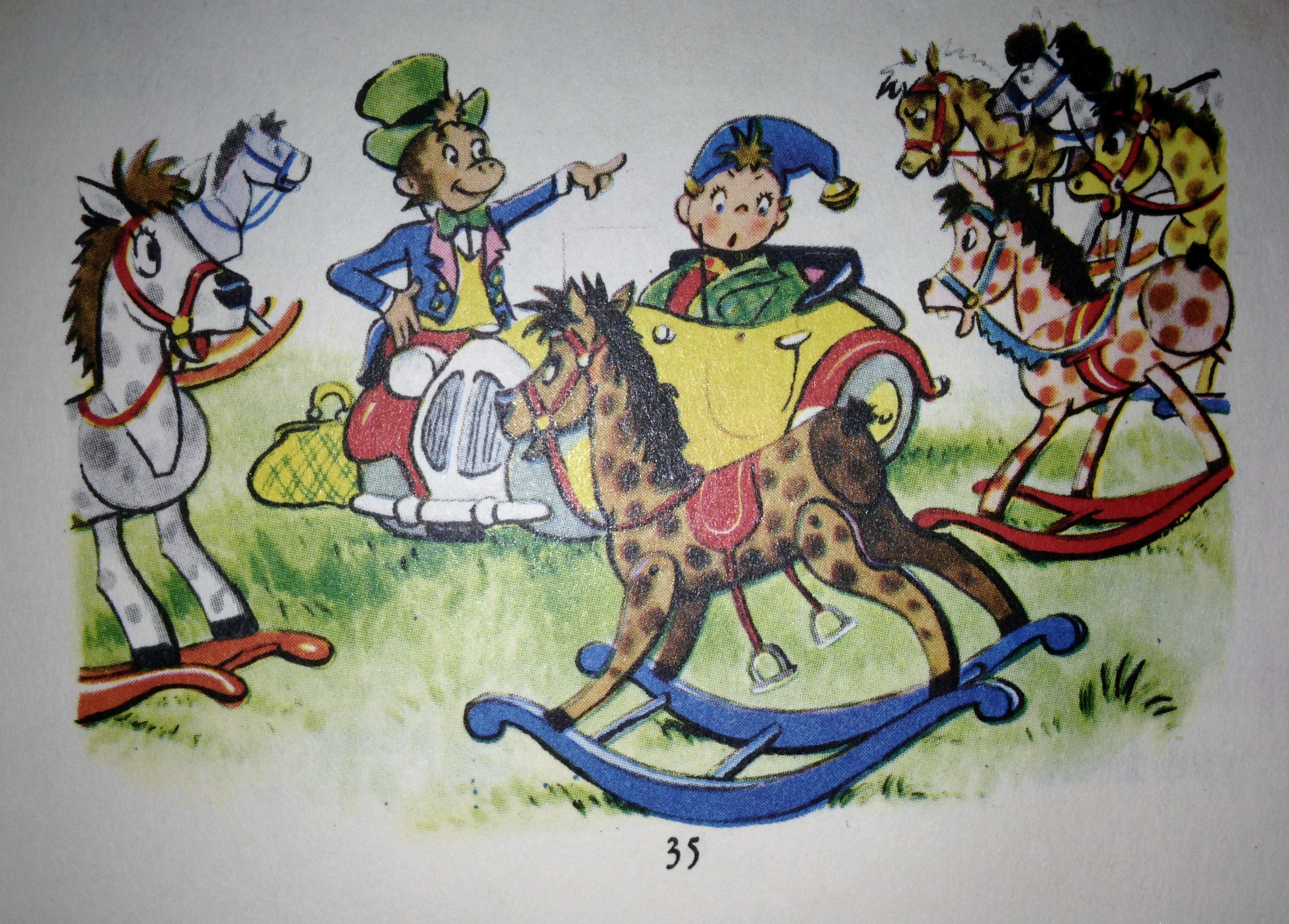
They head to Rocking Horse town to sell some horse tails, but all the horses there have fine tails and say ‘nay’ to him, which Noddy translates as no. They camp overnight as Mr Monkey says they will try again in the morning. He also tells Noddy (who has to sleep in his car) to just look out and see his tail poking out of his tent if he gets lonely in the night.

Come morning the Rocking Horses come to them to buy tails as they’ve lost theirs. I think I can see where this is going (I wonder how long it will take Noddy to catch on?). Noddy points out they have been cut off, and Mr Monkey remarks it was awfully lucky they were there with new tails to sell that day. Yes, very lucky indeed!

IMG_1743

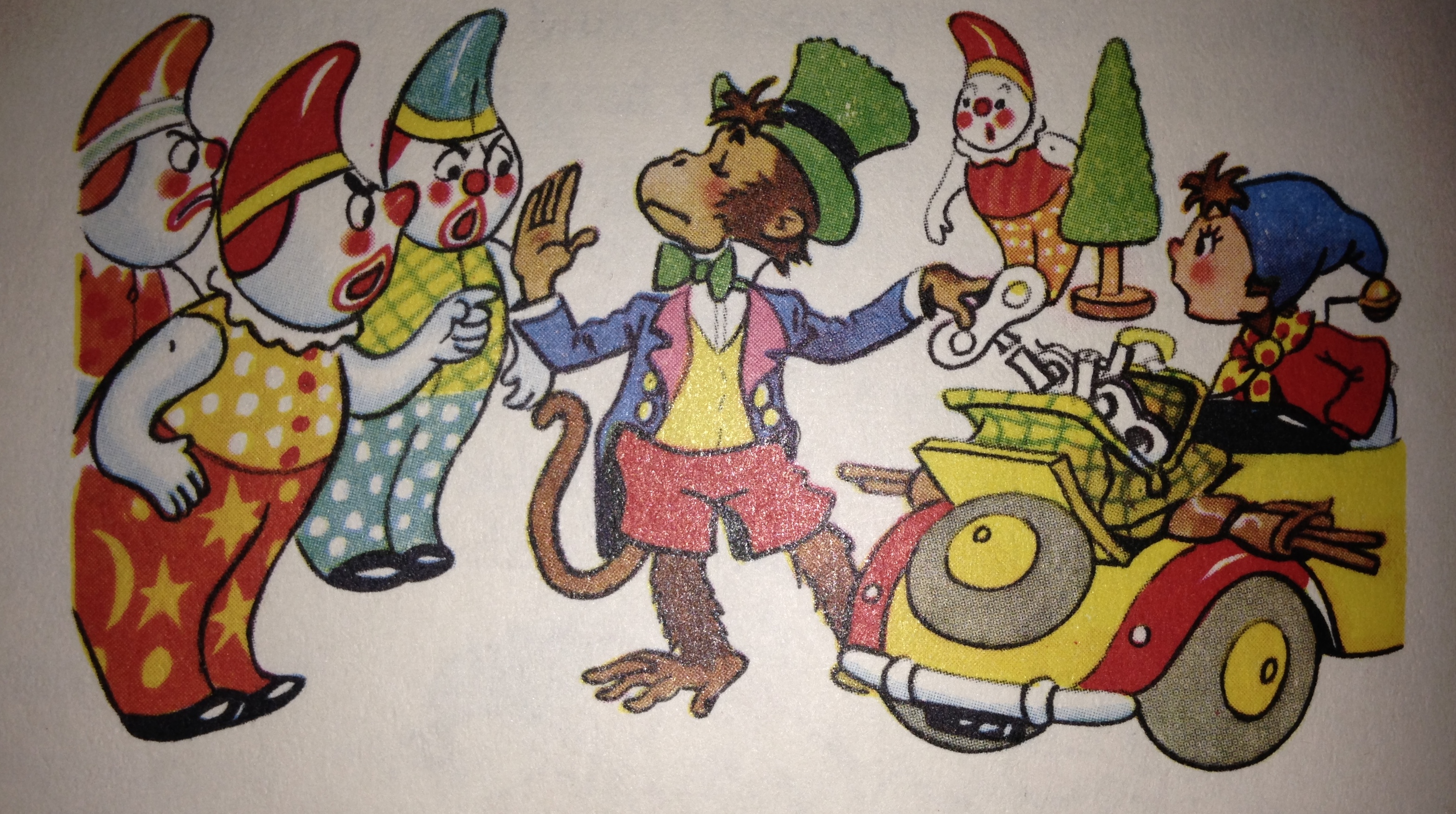
Next they are off to Clockwork Clown Village, where all the clowns already have keys to wind themselves up and don’t want to buy new ones. Again they camp out and in the morning lots of the clowns come to them in need of new keys as ones belonging to their friends or family were stolen in the night. Mr Monkey sells them new ones at two shillings each as they must have new keys or their clown friends can’t be wound up again.

IMG_1744

At this point, Alice might say curiouser and curiouser but Noddy doesn’t seem to have noticed anything odd yet.

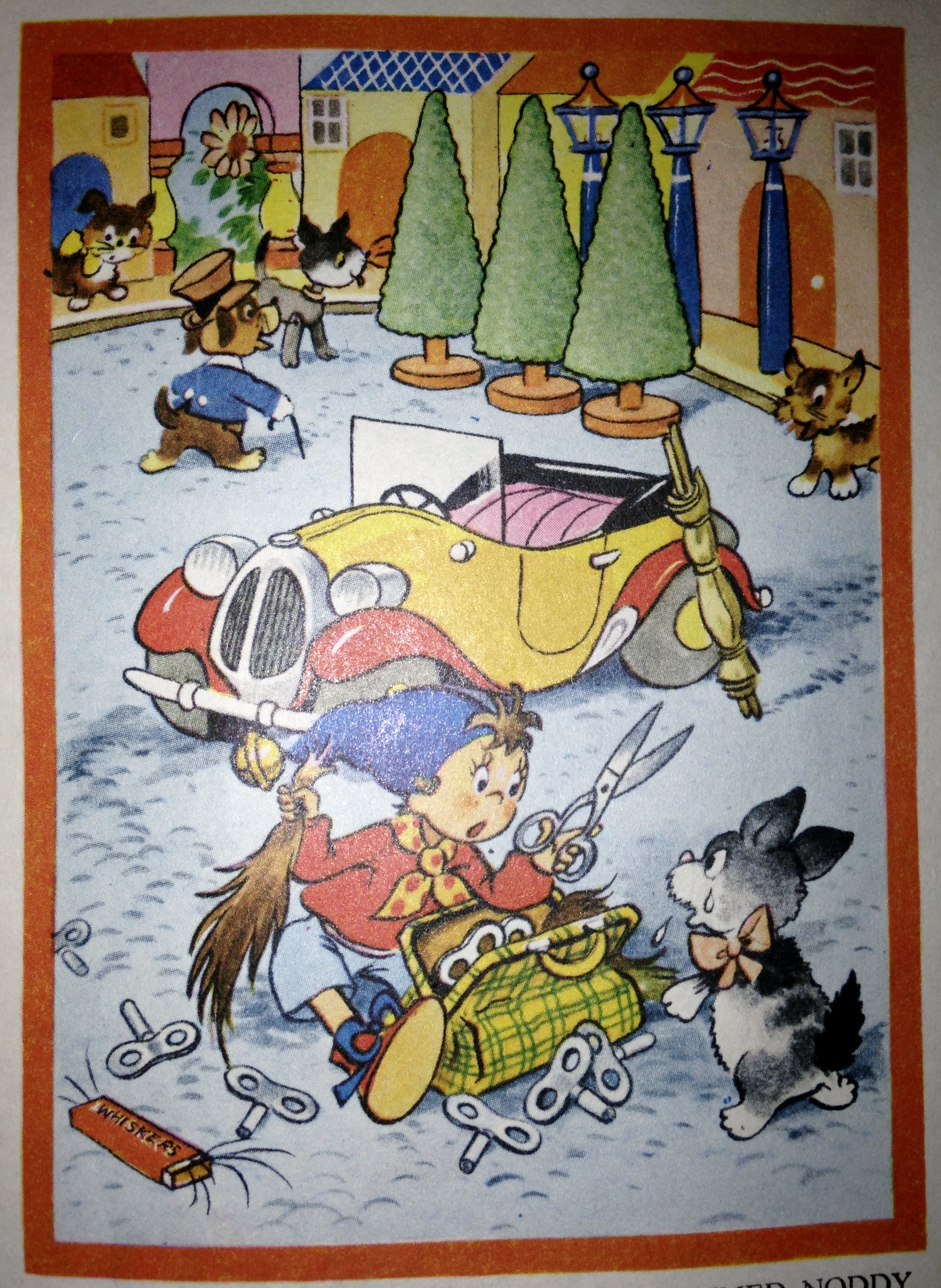
The next thing to sell is whiskers so they head off to Toy-Dog Town. There, none of the dogs want new whiskers apart from one little puppy Noddy stumbled across who has had theirs bitten off by another little dog. Noddy goes to fetch some of their whiskers from sale but instead stumbles across old cut off rocking horse tails and a pair of scissors as well as a monkey’s tail.

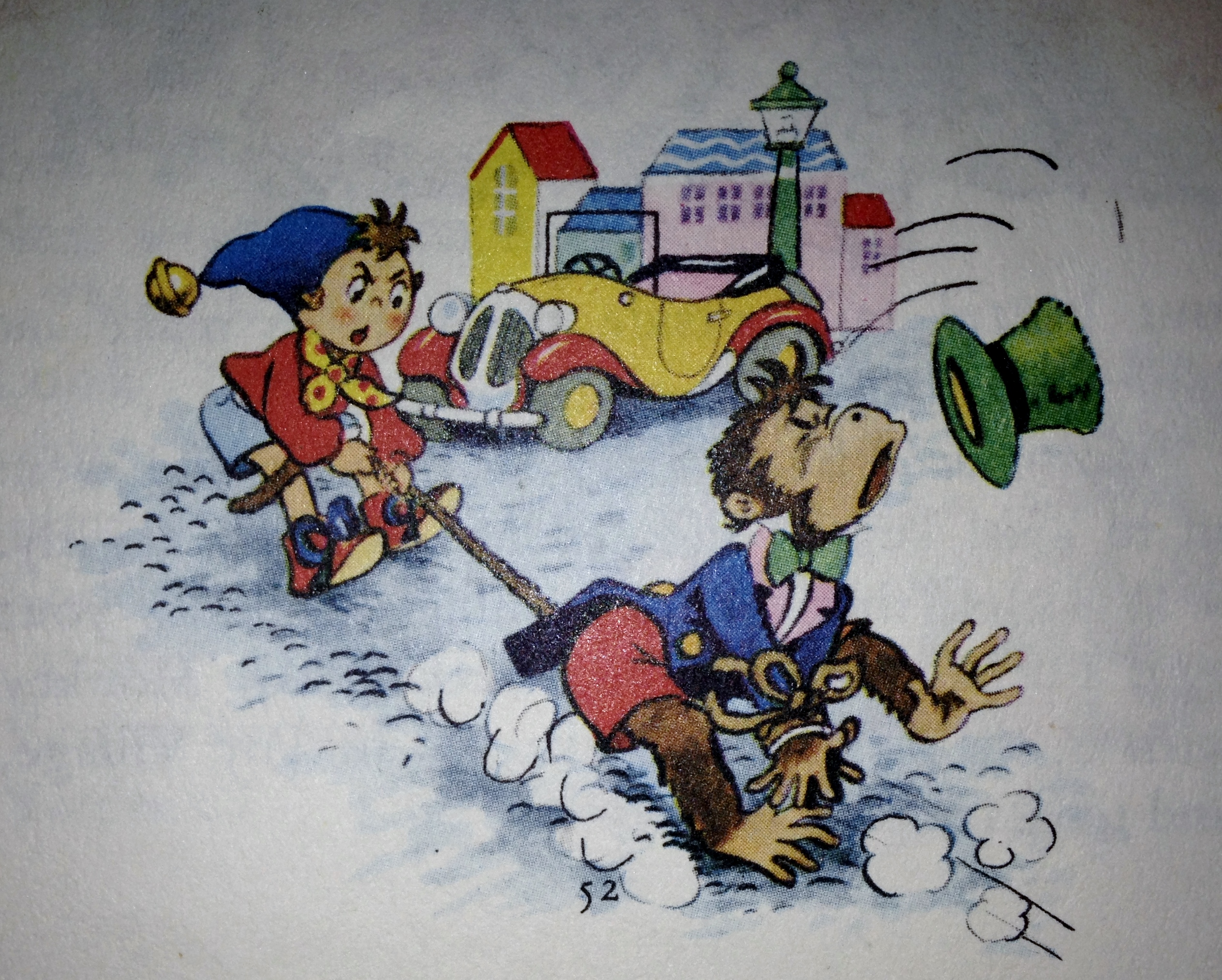
He confronts Mr Monkey about it and in his anger ties him up with his phony old tail and drags him to his car to take him to Mr Plod.

IMG_1746

Everything is rounded up very neatly in the end as Mr Plod had only wanted to see Noddy to warn him about Mr Monkey in the first place! Plus Noddy gets a reward for handing him in so that he and Big-Ears can go on a bit of a holiday after all!


It was good to see Noddy be so bold and brave in this story, even if he was rather slow on the uptake about what Mr Monkey was up to. Had he not found all the evidence in the bag I doubt he would have made the leap of logic himself.

IMG_1745

Posted in Book reviews | Tagged , , , | Leave a comment

The Rosewood Mystery by Cathy, chapter 9

ANOTHER STRANGE THING

Roger and Snubby were both most put-out in the morning when they heard about the night’s happenings.

“Another adventure without us!” Snubby sulked.

“Well we couldn’t wake you – we were trying to be quiet and not alert any burglars,” Diana said. “It would have made too much noise, creeping along and waking you, and Loony would have been bound to make a row.”

The four children were sat in the sitting room together after breakfast. The sun was shining brightly again and the day was already hot, with no trace of the storm, but everything in the garden was too wet to sit on, so they had decided to sit indoors. They couldn’t decide whether to tell Miss Pepper about the noises.

“I don’t think there’s any point,” Roger said. “If you think it was the door of the garden shed, why say anything?”

“I just can’t help feeling there’s something mighty strange about it,” said Barney solemnly.

Diana stared at him in surprise. “But – last night – you thought it was the door of the shed!” she exclaimed.

“Yes, I know,” Barney said. “I just can’t help wondering why Miranda was so frightened, whimpering like she was. It’s as if she knew there was someone down here.”

“But how could there be?” Snubby said. “All the doors and windows were locked – you checked them!”

“And like Diana said, the keys were all in the doors, so no-one could put a key in outside.” Roger added.

“I know, I know.” Barney still looked puzzled. “It’s impossible really, when you think about it.”

Miss Pepper came in with a duster.

“Come on now – shoo!” she smiled. “This room needs a thorough clean and dust!”

“Let me help you,” Diana said, and ran to fetch another duster. The three boys wandered out into the garden to see if the hot sun had dried the table and chairs so they could sit down. They were almost dry, so Barney fetched a cloth from the shed and wiped the rest of the raindrops off, and they sat down. Miranda began to chase Loony round the lawn.

Barney got up after a few minutes and went over to the shed. The door was still ajar. He pushed it sharply and it banged against the frame. It certainly would have sounded like a loud bump in the stillness of the night. But something else bothered him now. He and Diana had been sat right next to Diana’s window when he had heard the bump. And it had certainly not sounded as if it was in the garden. It had sounded further away. If it had been the door of the shed, they would both have heard it a lot more clearly because Diana’s window overlooked the garden. Barney felt uncomfortable. He wandered back to Snubby and Roger and told them what he thought.

In the sitting room, Diana and Miss Pepper were busy dusting. Diana was doing one side, and Miss Pepper the other. Suddenly she gave an exclamation.

“Well I never!”

Diana turned at once.

“What is it, Miss Pepper?” she asked.

Miss Pepper was standing looking at a small brown oak table that stood next to one of the armchairs near the fireplace.

“The silver!” Miss Pepper said. “There were two silver candlesticks and a goblet on this table – they’ve gone!”

Continue reading

Posted in Fan fiction | Tagged , , | 1 Comment

Monday

We’ll hopefully be heading for the beach by the time you’re reading this (assuming the weather sticks to the forecast).

The latest chapter of Cathy’s Barney Mystery fic will go up on Wednesday, then I plan to review another Noddy book on Friday. Stef is aiming to finish reading the second St Clare’s book this week too, so she can review it for Sunday.

A very short post this week, I know, but I’ll end on a few of my latest photos as usual.

Posted in Blog talk | Tagged , | 1 Comment

The Famous Five Diary

So I’ve just travelled up to Scotland to stay with Fiona for a week, so I’m writing this blog on the train to pass the time (it’s either that or you get something cobbled together at half ten this evening, when I’m not even sure I shall be able to string a sentence together!)

My blog for this week will be looking at The Famous Five Diary by Mary Danby. It was published by Knight books in 1988. The tag line at the top of the book claims “Have the most Adventurous Year Ever…” which is an interesting title.

the-famous-five-diary

I got my copy from a small second hand bookshop in Alton, Hampshire, for two pounds, so it wasn’t a bad buy. Its not something I had ever thought of owning. In fact I had thought that they were incredibly rare. Now I’m not so sure. There are a few copies on eBay, but not many, so maybe I picked up quite a gem.

It’s a funny little book really, not like a proper diary. There are little boxes for you to write in, randomly spaced on the page, but the gaps are filled in with little notes about nature, jokes and contributions, apparently from the famous five.

The feel of the jokes that the book contains are what you might class as ‘bad’. January for example has “what is the coldest form of transport?”A b-b-b-b-b-bicycle!”, so its that kind of bad. There aren’t too many jokes mind, so that’s a relief. I can’t imagine the Famous Five telling jokes that are quite so awful (but there is no accounting for Dick’s sense of humour after all!)

Danby includes little puzzles as well as the jokes. From what I’ve read they don’t seem very Blytonesque. Danby doesn’t seem to be very good at mimicking the style of Blyton. It may of course be the format doesn’t allow for much fluidity to get into the style, but any good writer who is taking on such well known works, should be able to work with whatever the format is.

A sample of pages, taken from a lovely blog over at vintagecobweb.com

A sample of pages, taken from a lovely blog over at Vintagecobweb’s website.

You may have heard the name Mary Danby before, and you would be correct in thinking that she has a Blyton connection. Danby is the author who wrote the “Famous Five and Me” books, where you got parts of a Blyton story, such as Adventuring Again, and then added different ‘paths’ into the stories and you have go pick the right way to go to find out the story. I only remember coming across these when I was about twelve or thirteen so I have only a hazy memory of them, but I can remember not being impressed (Which is odd because I did like one of the Claude Voilier books, The Famous Five and the Black Mask). So imagine my surprise when I realised that Danby had written other Blyton related things.

To give you an example of something that doesn’t feel very Blytonian is the passage that is on today’s date.

 On July 20th 1969, man first set foot on the moon. As Apollo XI spacecraft commander Neil Armstrong stepped out of the landing module, he said, ‘That’s one small step for a man- one giant leap for mankind.’

It’s a strange fact to put in the book, I mean I conveys a sense of adventure but is it in keeping with a Famous Five diary?

Another thing that comes with the diary is that there are a few extracts from the Claude Voilier novels, I can’t seem to find the right page now, but its only half a page worth of the opening passage. I am assuming that because these books are done by Knight, that Chorian didn’t give them publishing rights to print passages in the diary.

It has a nice recipe for ginger beer in the October part of the diary, one of the few different recipes in the diary, though I’m not entirely sure that they are seasonal.

I shall share the recipe for brewing your own ginger beer for those of you who wish to try.

…You will Need:

25g dried yeast

Ground ginger

2 Lemons

About 1kg Sugar

  1. Take 300ml of tepid, 1 teaspoon of sugar and the yeast and mix them thoroughly in a large coffee jar.
  2. Every day for the next 7 days stir in ½ teaspoonful of ground ginger and 1 teaspoonful of sugar. Make sure that you use a wooden spoon for stirring- yeast hates metal! In between stirring, keep your jar upright and still and keep it covered with a piece of kitchen paper.
  3. Next strain the liquid from the solid mass at the bottom of the jar – DO NOT THROW THE SOLID MATERIAL AWAY! Use a nylon sieve for straining, not a metal one. This must be done very thoroughly as no solid matter must get through. You may have to strain it several times.
  4. Into a large saucepan put the juice from the lemons, 900g of sugar and 1 litre of water. Heat gently to dissolve the sugar but do not let the mixture boil. Add it to the strained ginger liquid plus another 2 litres of water.
  5. The ginger beer is now ready for bottling. Pour it into clean bottles and seal them with corks. NEVER USE SCREW TOPS! Pressure can build up inside the bottles and a cork will pop out, but bottles with screw tops can explode. Not only is this dangerous, it will make you very unpopular.
  6. Store the bottles  somewhere dark and cool, like a garden  shed, attic or cellar where nothing will get damaged by whizzing corks. Leave the ginger beer for at least 3 weeks before drinking.
  7. When you want to make some more ginger beer, put just half of the solid yeasty material into a clean jar and start again, adding the sugar and ginger every day for seven days.

 So there is the recipe for the diary’s ginger beer, if you do try it, please let me know how it turns out.

So overall the diary is a nice thing to have, it has the added bonus of not having days and years in it, meaning it can be used for any year. I wouldn’t use it because it’s in a book form, and I was always taught not to write in books

I think  I was lucky to come across it, and for a good cheap price, but I certainly wouldn’t have brought it for any more than two pounds. That is just my opinion, it’s a nice edition to my collection for sure. Do you have one? Do you like yours? Let us know!


Posted in Book reviews | Tagged , , , , | 1 Comment

The Secret Island – How has Blyton’s original text fared in a modern edition?

As promised here I am starting a new text comparison, this time of the first book in the Secret Series, The Secret Island. My original copy is a sixth impression from October 1949 (and has an inscription in the front from Christmas 1949 when the book was given to Pamela, by her ‘Uncle Wendy,’ or at least that’s what it looks like!) The paperback is an Award one from 2009.

Starting, as you do, at the very start of the book, the first difference is that there is no end-paper illustration in the paperback, or vignette on the title page. Modern books so rarely have these lovely pictures which is a shame. Also, the Roman numerals have been removed. There are no chapter numbers in the paperback in fact, though all twenty-one chapter titles are unaltered.


CHAPTER ONE: THE BEGINNING OF THE ADVENTURES

The first change, which seems to be quite common is that the double quotation marks for speech are replaced with single ones. I always think double ones are clearer.

For some reason the single line after the first paragraph has been merged into the opening paragraph in the paperback. I can’t really see why.

Very quickly we get into the problem that the original text refers to Nora being slapped. She says Aunt Harriet slapped me six times this morning because I didn’t wash the curtains well enough. Look! This is replaced with yelled at me six times. Look! Originally she then shows Jack her arm, red with slaps. This is changed to her hands which were red and sore from all the washing.

Later when Mike says he hates to see the girls slapped and worked hard, it becomes bullied and worked hard.

And later, another line is drastically altered from Nora got a few more slaps and Peggy was scolded so hard she cried bitterly into her overall, to Nora got shouted at again, and Peggy was in such trouble she cried bitterly for hours. So slaps becomes a shouting-at, that’s expected really, but why has a scolding becomes trouble? And why can’t a girl doing cleaning wear an overall? It could easily have been changed to an apron or dress, why make it a time period instead?

Not all mentions of violence are removed though. In both copies Mike says that his uncle shook me so hard I couldn’t stand up afterwards. Likewise, the phrase no unkind aunt and uncle to slap them appears in both. I’m not sure either of these can be seen as any more acceptable to the editors so I assume they were somehow missed somewhere in the process.

The rest of the changes are quite minor really. The usual hyphenations become one word like to-day, good-bye and to-night, hallo Jack becomes hello Jack, and Granpa becomes Grandpa. I’m sure you can argue many ways that Grandpa is more correct but surely people are allowed to choose their own names for their grandparents? Be it Grandpop, Pop-pop, Paw-paw, Grandad, Granddad, Grandaddy… Granpa is pronounced a little differently from Grandpa and is a different name. Finally, some emphasis and excitement is lost when we must, must, see the secret island becomes just must, must (the second must losing its italics).

One change which may turn out to be a simple error comes when the children are being described. Nora is described as having a head of black curls originally, which matches the illustrations in both books, but in the paperback she is blonde in the text. Peggy also has blonde hair instead of yellow. It will be interesting to see if the hair colour changes back later.


CHAPTER TWO: AN EXCITING DAY

A few more references to slapping are removed. Instead of looking forward to being safe from the slappings and scoldings, it becomes from shouting and unhappiness. Also, Peggy originally says she doesn’t care how much we are slapped or scolded now and this becomes shouted at now. 

A spelling error is corrected too, as Jack in the hardback has them bale out and baling out the water from the boat, this is altered to bail out and bailing out. I admit I did a quick Google just to check, and the difference is explained as bale is correct for bundles of hay for example as it is from an old German word connected with ball. Bailing out is spelled so because it’s from the French for bucket – baille.


Somewhat unusually (in my experience anyway) the paperback has a fair number of illustrations. There is one decent sized one in each of the first two chapters (compared to six small ones in the hardback). Unfortunately, in my opinion, they are fairly poor especially when compared with E.H Davie’s originals. The cover is lovely, as expected as it was by the great illustrator Val Biro (who sadly passed away recently aged 92), but the internal illustrations are by a chap called Dudley Wynne. I’ll take a few photos of them just to show you what I mean.

Wynne’s are much more heavily drawn and shaded and the children (especially Nora) have odd-looking faces. E.H. Davie manages to put much more detail in too. I’ve had a flick through the paperback and the illustrations don’t seem to improve so I will probably share some of the worst in later posts.

Anyway, I make that sixteen changes to the text (if you count all hyphen removal as one). It will be interesting to see if there are as many in later chapters as they will be removed from the slappings and shakings and scoldings then. This updated text doesn’t seem to go as far as some others does in terms of gender equality (at least not yet) as Mike still takes on the burden of making the decision about running away despite the fact Peggy is the oldest. And he sits and wonders if the girls will manage, roughing it on the island without proper beds.

And I will leave it there for this week.

Posted in Updating Blyton's Books | Tagged , , , , | 28 Comments

The Enchanted Wood Review by Laura

[Apologies to everyone, especially Laura as this was meant to go up at 9 this morning. My only excuse is I’m off work so I’ve lost track of the days again – Fiona]

I loved the Faraway Tree series when I was a kid, but I unfortunately lost my own copies a few years ago and the new editions didn’t quite cut it. Then one day my mother-in-law told me she had a set in her garage that belonged to my husband. I happily accepted them and immediately started re-reading them (when I should have been helping with the garage cleanup).

It was so good to read them again that I thought I’d do a few reviews, starting with the first book in the series: The Enchanted Wood. I’ll try to keep the spoilers to a minimum, but you have been warned.

Published in 1939, the book starts with Jo, Bessie and Fanny moving from a town with their parents, as their father has now got a job in the country. The cottage is not far from a wood, which looks ordinary except that the trees are ‘a darker green than usual’ and sound as thought they’re whispering secrets. After finding out that its name is the Enchanted Wood, they naturally have to explore.

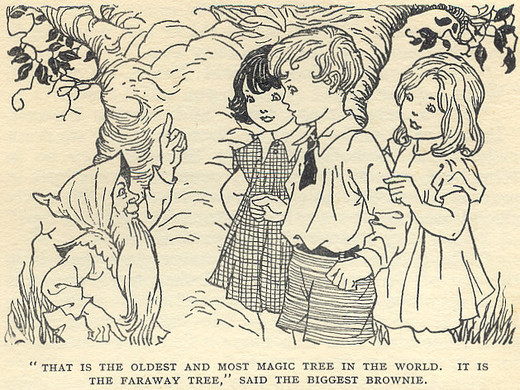
On their first trip into the wood, they help out some brownies and find the Faraway Tree. The brownies warn them that it’s dangerous and aren’t happy to find out that the children mean to climb it on their next visit. They try to stop them, but Jo throws an acorn at one, who thinks he’s been shot.

520wide+5161176

Since it’s growing acorns, you’d assume – Bessie did – that it’s an oak tree, but it soon begins to grow chestnuts a bit higher up. That’s one of the many peculiar things about the tree; one minute it’s growing lemons, the next it’s growing cherries or oranges.

Another are the folk living in the tree – there’s the Angry Pixie, who throws soup or ink over people who look in to see him, Mr Whatisname, who can’t remember his own name and doesn’t have a very pleasant temper either, and Dame Washalot, who lives up to her name by doing washing in the tree and emptying her soapy water down through the branches and onto any unsuspecting person climbing the tree.

There’s also Silky, the beautiful golden-haired fairy who becomes friends with the children and introduces them to pop-biscuits – when you bite into them, you find your mouth full of new honey – and of course the aptly-named Moon-Face, who lives right at the top of the tree and owns the famous Slippery-Slip, which is the fun way of getting to the bottom of this huge tree if you don’t feel like climbing down and have some toffee on you. These two appear more than any other character in the tree, apart from someone else who arrives halfway through.

And then, just past Moon-Face’s house, is a ladder leading up into the clouds. When the children climb it – you’d just have to – they find themselves in Roundabout Land, which always spins around to music and only stops in a blue moon.

Like my post (sorry), the book does take a while to get into the actual adventures, but the early chapters help the readers understand who everyone is and what the tree is like. And this is just the first of many adventures, as the girls and Moon-Face travel on the train through the woods to ask the three bears for help when Jo gets caught in the Land of Ice and Snow.

They all visit the land of the Saucepan Man – which results in this funny, deaf little man who wears pots and pans living in the tree, singing his strange songs and taking part in their adventures – and end up at Dame Slap’s school after escaping from the Land of Take-What-You-Want, which just shows that even the nicer lands can be dangerous.

One of the hazards of having strange lands arrive at the top of the tree is that the inhabitants aren’t always pleasant and some may want to visit the Faraway Tree and cause problems. In this case it’s the red goblins, who lock everyone up inside their houses and won’t let them out until they tell them some magic spells. But the help of the whispering trees and the brownies – even though they were scared of the tree – the children and the tree folk manage to trick the goblins and take them prisoner.

There’s always a nice land for the children and their friends to visit at the end of the books and this time it’s the Land of Birthdays. It (luckily) happens to be Bessie’s birthday and their mother agrees, but insists they wear old clothes as their adventures up the tree have damaged some of their good ones by this stage – she has been fairly relaxed about their strange friends coming to visit, so it probably isn’t too much to ask.

Bessie, understandably, isn’t too thrilled about wearing old clothes to her party, but not to worry, there are fancy-dress costumes for everyone once they get there. There’s also games and prizes, a table where the birthday girl can wish for her own food and a wishing cake – which can only be trouble in the hands of the deaf Saucepan Man, leading to another easily solved problem.

These books were probably intended for younger readers, but they still hold up for adults years later – the lands, the characters and the tree itself are so imaginative. The only fault is that some of the ways they escape from lands or solve problems sometimes feel a bit to convenient – what if there hadn’t been a plane in the Land of Take-What-You-Want or if Rocking Land had tilted another way – but I guess that’s so they get to visit more than one land instead of spending the whole book escaping the first.

Dustjacket illustrated by Dorothy M. Wheeler.

Dustjacket illustrated by Dorothy M. Wheeler.

Next time I’ll take a look at the second book, The Magic Faraway Tree.

We also have reviews of this book by Fiona

Posted in Book reviews | Tagged , , | 1 Comment

Monday

So it’s another week, and the weather seems to be up to all sorts of tricks at the moment. It’s been awfully muggy today but now it seems to have cooled down a bit.

Anyway, we’re back on track with MONDAY posts, because I’m sure you noticed Fiona’s little mishap last week. This week we have Laura with a review of The Enchanted Wood, and Fiona tells me that she’s going to start a new book to do her chapter by chapter changes analysis of, which just leaves me, as always.

Well I might get around to reading the next St Clare’s book, The O’Sullivan Twins, or I have in my possession the Hodder book, The Adventures of George and Timmy so I could review that for you. Or do a recipe or review The Castle of Adventure or another TV episode… so, you might just have to wait and see.

And because I haven’t edited my pictures from the last walk I did, I shall treat you to some ones I don’t think I’ve shared with you from earlier in the year, of Hampton Court.

Posted in Blog talk | Tagged , , | 2 Comments

Article Review: Rivals Or Allies? Malcolm Saville and Enid Blyton by David Cook

The article is written by a man well known to those at the Enid Blyton Society, David Cook is a well known and liked member by all, but we all know his terrible secret (well, its not that terrible!)…

He also likes Malcolm Saville!

Now, we’re over the shock, and now aware that most of us do like other authors as well, I should explain to you how I’ve come across this article in particular. You won’t find it in the Enid Blyton Society Journal (of which you can subscribe here) but in the Malcolm Saville Society’s journal, Acksherley! (Issue 12, Dated November 1999).

In this article Cook begins by writing about his surprise at being asked by the editor of Acksherley, Jonathan Calder, to write an article comparing Blyton and Saville as Cook notes “whilst he [Calder] is a gread admirer of Malcolm Saville, he is equally vehement in his dislike for Enid Blyton” (pg 23).

So, surprises out of the way, on we go! It’s interesting to read of the similarities between the two authors especially their love of nature. Cook does point out however that they did go about sharing their knowledge in different ways. “While Malcolm was renowned for his ‘sense of place’ in his stories… Enid gave greater botanical emphasis to her stories, mentioning many common plants by name…” (pg 23).  This is something I’ve noticed between the two authors as well: I have immersed myself in Saville’s locations and enjoyed Blyton’s factual nature stories.

Cook briefly compares the religious childhoods of Saville and Blyton, perhaps to show that they had fairly similar backgrounds when they were children. However there is one element of Blyton’s early life that does not match with Saville’s at all, and that would be her father walking out of the family home when she was young, and I believe that Saville certainly had no such drama in his early life.

Blyton eventually trained as a teacher, where as Saville worked for the Oxford University Press, and its around this time that they seem to drift apart in the comparison. Cook goes on to point out that in 1936 Saville was part of the publishing company Newnes, who had started to publish Blyton ten years previously with a book called The Bunnies*Newnes also asked Blyton to edit the magazine Sunny Stories, which she did, and continued until 1952 when she was succeeded by Saville.

Cook brings attention to the fact that Saville helped Blyton’s first full length novel The Adventures of the Wishing Chair into print, and to quote Cook, “So you see, Malcolm Saville actually kick-started Enid Blyton’s career…”(pg. 24) something I believe we are all thankful for indeed! So you may not actually know who Saville is but you now know that he helped make sure Enid Blyton was such a big household name! Who’d have thought it?

From this astonishing fact we follow Cook as he explored the  two authors publishing habits and similar story lines. In fact it is noted quite clearly that Saville was believed to have become friendly with Blyton and showed her some pictures or described Rye in Sussex, where he based his third Lone Pine Book, The Gay Dolphin, and she may have taken influence from that to write her fourth Famous Five, Five Go to Smuggler’s Top.

A difference noted in Cook’s article is the difference between the writers at their peak in popularity. Blyton was always  a full time writer, unable to take criticism, with six publishers demanding stories for publishing, whereas Saville was very much a part-time writer at the beginning of his career and became a full time one later on.

To conclude, Cook takes us on a summary of the authors’ later lives, remarking on Blyton’s literary inconsistencies and tentatively linking them to the early onset of dementia that finally claimed her when she was 71 on 28th November 1968. Whereas Saville was regarded as being old-fashioned because of the publishers demands to shorten and compress his work, left it without much of the character development and descriptive passages of his earlier work. Saville died aged 81, on the 30th June 1982.

Cook provides us with a comprehensive overview of the two authors that are close to many hearts. I think he does a good job at summing up the careers of Saville and Blyton and picking out similarities, but I feel he didn’t really answer the question in his title – were Blyton and Saville, rivals or allies?

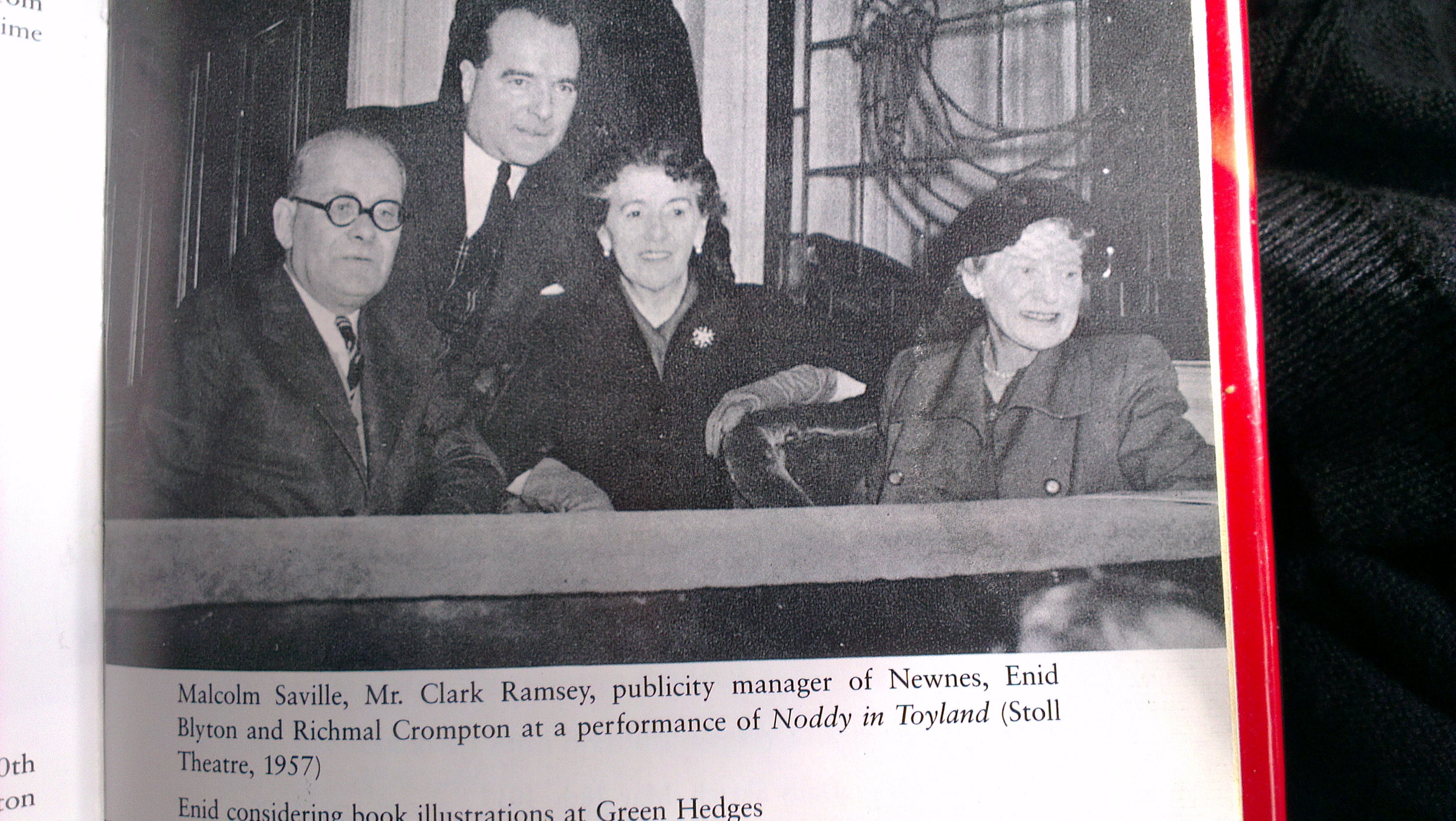
(L-R) Malcolm Saville, Clark Ramsey, publicity manager for George Newnes, Enid Blyton and Richmal Crompton.

(L-R) Malcolm Saville, Clark Ramsey, publicity manager for George Newnes, Enid Blyton and Richmal Crompton.

Well, from what I’ve read and a recent discovery when flicking through my works copy of Blyton’s biography by Barbara Stoney, I spotted a picture of Blyton and Saville, with Richmal Crompton  at a showing of the stage show Noddy in Toyland at the Stoll theatre in 1957, and I would like to believe that they were more friends than rivals. Its possible that Saville was one of the few adults who knew a bit about Blyton.

However I do have my doubts a little as Saville worked for the same publishing company Newnes as Blyton’s first husband, Hugh Pollock, so it is completely possible that Blyton didn’t see or speak to Saville much after her divorce from Pollock if the two men were quite companionable.

In many ways its a hard question to answer without speaking to either of them, but at the same time, I would most definitely like to believe they were allies. What do you think?

*The article doesn’t furnish any other details about this book. There is no Blyton book with that name, but there is The Enid Blyton Book of Bunnies published by Newnes in 1925. It may be that there is a compendium of different authors’ work titled The Bunnies though.

Posted in Other Authors | Tagged , , , , , , | 1 Comment

Comic Strip Presents… Five Go Mad in Dorset – A Review

I recently discovered that 4 on Demand has all the episodes of the Comic Strip Presents show available to watch, and found myself watching Five Go Mad in Dorset. It was the very first episode of the show made and was originally aired on the second of November, 1982.

Like last time I had a document open and typed up some notes and thoughts as I watched (pausing it frequently so I could make it a bit more coherent.)

On the whole I thought this was a better episode than Five Go to Rehab and I will hopefully be able to explain why as I talk about it.


CERTAINLY STILL A SPOOF, THOUGH NOT OVERLY CRUEL

Aunt Fanny is very made up and full of figure, not the homely scientist’s wife we expect though at least she isn’t played by a man! And Timmy’s a decent sort of dog. The initial banter is all in good fun, Aunt Fanny saying she’s made them a slap up meal and there are plenty of goshes to go around.

Less than a minute in we have Dick say I say Ju, that man looks foreign!, pointing at the porter, and George suggests his name might be Golliwog and they perhaps ought to call the police.

And someone must, because the poor porter is arrested after running all the way to Kirrin Cottage with their cases.

This is an obvious jest at the inherent racism of Blyton’s books. I’m not daft on those sort of “jokes” as they perpetuate the idea that Blyton was an all out racist and she wasn’t. However the joke is played and is over quickly so it doesn’t overshadow the rest of the episode. Later though, Julian spots a car that has no road tax and George asserts it must belong to an illegal immigrant.

Kirrin Cottage is very cute and there’s a nice tea-time scene alongside the porter’s drama. It’s mentioned that Anne’s happy to just be a girl, a little ‘joke’ about Blyton’s misogynistic qualities but it’s just a brief reference again. Funnier are the little things like them having lashings of cream,  and the surprisingly blasé conversation about how Uncle Quentin has been kidnapped.


I didn’t want to spoil your holiday but I’m afraid… your uncle’s been kidnapped again, says Aunt Fanny.

Bad show!  the children groan.

That must be a bit of a blow for you Aunt Fanny, Julian comments casually.

Yes twice in six months? someone else says (I can’t work out who though.)

Yes, well I expect it’ll all sort itself out, Aunt Fanny says calmly.


Uncle Q isn’t kidnapped quite as often as that in the books but far more often than anyone would ever expect to be!

There is an odd subtext though that there’s something going on between Julian and Aunt Fanny though. It’s hard to pin down what it is, something in their facial expressions and the way Aunt Fanny says something about Julian being very mature now. I’m not sure what it’s all about and it’s not referenced again in the episode as far as I could tell (except perhaps at the very end but I can’t explain that without giving it away).


THE CAST

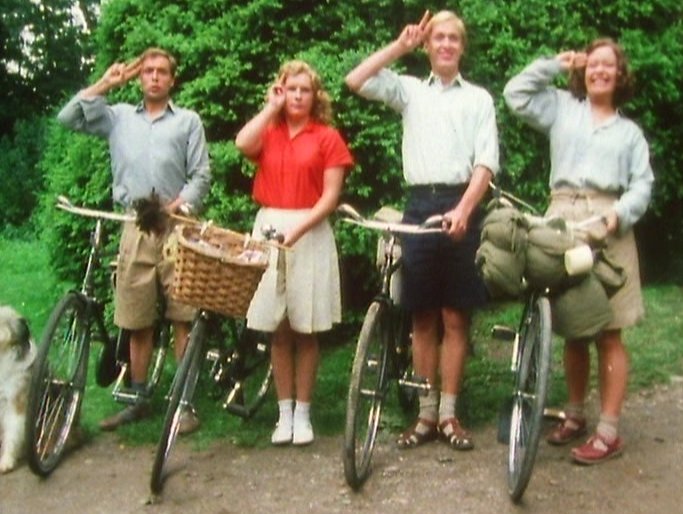
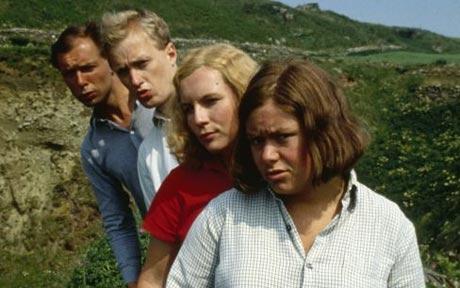
The actors are all much younger (and thinner!) here as it’s more than thirty years earlier, which makes it all more believable and realistic. The Five could easily be in their late teens here.

The Comic Strip cast

The Comic Strip cast


 LASHINGS OF GINGERBEER

Later we get a perfect Famous Five picnic, complete with heaps of tomatoes and lashings of gingerbeer (not lashings and lashings though!) Poking fun at the Five’s ability to fall into trouble, we have some criminal types behaving oddly not ten feet from the picnic rug. They have big noses, thick lips and mean little eyes as well as unshaven cheeks, ergo, they must be up to no good! They’re not exactly quiet either and mention how they’re out of jail and must lie low. The Five automatically assume they are escaped convicts or traitors to the country, as opposed to recently released prisoners. Another cliché is revealed later, as one of the baddies is called Jake. Blyton did have a lot of baddies by that name.

I like their list of food which almost gets chanted at every meal. Hard boiled eggs, bags of salad, heaps of tomatoes and LASHINGS of ginger beer. It’s almost a quote from a book that. Almost.

Perhaps the Five have had just too many adventures as they barely react when the men poison Timmy. Anne casually says Oh look, Timmy’s fallen over, and instead of George’s usual over the top panic she simply says, Oh crikey! in a less excitable manner than the words might convey. She at least sounds a little upset as she goes over to check on him and says He’s been poisoned! Later she very casually asks Do you think someone’s got it in for Timmy?

To which one of the boys, Julian I think, says  Never mind George, we’ll get another.

One quick telephone call later and they’re being congratulated by the police for helping them catch the two criminals red handed. The criminals are none too happy and one calls Julian a little b******! Not Blytonian language at all!


FAMILIAR NAMES AND FACES

Robbie Coltrane appears as the ice cream woman this time, and is very ominous as he talks about Strange comings and goings in this village. Secrets and signs and threats. 

We then run into another familiar face, if you’ve seen Rehab, Toby Thurlow. I mentioned last time how the name is

an amalgamation of names used in the series. Toby is the boy from Five Go to Billycock Hill and Thurlow is actually Richard Kent’s father’s first name.

He wants to join them on their cycling holiday but they aren’t too keen. Sounds a lot like Five Get Into Trouble to me (again). We’ve also got Dirty Dick (Five on a Hike Together) who works for Toby’s dad.


I admit I giggled when they all said look! because a man had parachuted down, and we weren’t allowed to look. Obviously the budget didn’t extend to stunts!

It was around now that my other half made a comment along the lines of

Is it odd that this doesn’t sound any different to the audio books you listen to?

Which I thought was quite appalling! But Dawn French does do a good job as George a lot of the time.

comic-1_1744961c

The Five are also very casual after Toby is kidnapped. (At least they get the right boy this time, unlike in the book!). It’s said it serves him right for being Jewish and nouveau riche. Presumably another dig at Blyton’s attitudes.

I’m not sure about the baddies. They seem a trifle too silly even for this show. They go through their plans and keep adding BLAH BLAH BLAH to the end of every other line, as the boys repeat all the important phrases they can clearly overhear. This does get explained in the end, however.

The names on the map are funny though, Kneecap Hill. Crutchley. Thigh Woods. Ankle on the Water. And we get to see the original Coltrane gypsy scene which they redid in Rehab. Coltrane’s on top form again here. No telephone. No eelecticity. No gas.  No water laid on. Just secrets, and signs and THREATS.

More jokes are made about how predictable the adventures are.

Perhaps there will be a secret way in, just like there has been in our previous adventures! Yes I’m sure this will be no exception!

and

I wouldn’t be surprised if this ladder led up to a little cupboard with a hidden room beyond full of government secrets and strange machinery.

Are two good examples but they’re delivered with such honest enthusiasm it makes them very funny rather than annoying.

The ending was pretty good I thought. I won’t give it away but the boss surprised me, and he got some very funny lines explaining how it all came about.


FINAL THOUGHTS

I think the episode benefited from being thirty minutes instead of an hour, so there were no unnecessary sub plots needed to flesh it out. Some jokes fell flat for me, such as a lot of the scene at the camp where they argued about Toby staying or not, based on the fact that Julian and Dick always shared a tent. A lot of it was very amusing though as you could see exactly why each joke or line had been included. It seems like the writers had a decent knowledge of the books.

So, if you don’t mind a few roll-your-eyes moments as they over-do the casual racism, I recommend this as a fine way to spend half an hour.

Posted in Blyton on Screen | Tagged , , , , , , , , | 6 Comments

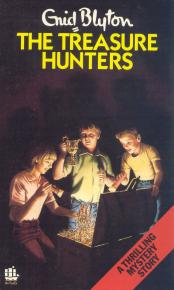
The Treasure Hunters by Fred

Is it totally unfair to say that Enid Blyton’s books are fairly interchangeable with each other? Well, yes it is, but that doesn’t stop the majority of her work being thoroughly enjoyable and decent reads in their own right.

Such is the case with The Treasure Hunters, a standalone story published in 1940 that bears the bog-standard Blyton-treasure-plot of a handful of children, John, Jeremy and Susan, setting out to discover lost treasure before their beloved Greylings Manor is sold on to the nasty Mr Potts. Even with its well-tread plot, The Treasure Hunters is still one of the more enjoyable standalone books in Blyton’s bibliography.

First edition dust jacket

First edition dust jacket

The book has some marvellous pacing that keeps the reader interested and rarely lags in its story-telling. The core trio of characters are enjoyable as well – John and Jeremy come across as being two sides of the same coin, but Susan is a hoot. She radiates the strong-willed nature of George with the demure sweetness of Anne.

The supporting cast of adults round off the adventure nicely – Mr Potts constantly popping up unexpectedly as the children hunt for the treasure and the grandparents offering additional tension towards the end when the refuse to let the children complete their hunting.

The scenery depicted throughout the book is another feather in its cap. While Blyton was hardly the most descriptive of writers, the locations she evokes are all wonderfully film-worthy. The woodland, the river, the secret house are all laid out in their bare forms that allow the reader to fully visualize how they might want these places to look.

The plot itself offers enough twists and turns, much like the river the children hunt alongside, to reward multiple readings. As the plot thickens, so to do the locations – the three children, and Rags the dog, continually become entrenched in soggy marshes, brittle woods and claustrophobic underground passages.

The climax is, ultimately, something of an anti-climax. Its not quite as action based as other Blyton books, relying on the children racing back home (or at least the Timble’s farm) before Mr Potts can ruin their adventure. But there’s still some build-up of suspense, which lies in whether or not the grandparents will believe the children’s version of the story or Mr Potts’ version. Having been scolded by their grandparents earlier, it becomes easy for the reader to cast doubt as to whether or not the grandparents will side with the children.

My copy, a 1983 Armada paperback, features some lovely illustrations by Barbara C. Freeman which do much to bring the characters and locations alive. I recall having this copy on my bookshelf for years, but sadly it was one of those Blyton books that I never got round to reading during my initial Blyton phase. I finally gave the book a go last year, and I wasn’t disappointed – the search for the treasure across the winding river is a particular favourite scene of mine, just for the scenery it evokes.

Frontis from later reprints by Barbara C. Freeman

Frontis from later reprints by Barbara C. Freeman

Overall, The Treasure Hunters is a corker of a Blyton book – fabulously paced, strong characters, and an engaging story. Well worth a read!

Armada 1983 edition

Armada 1983 edition


Posted in Book reviews | Tagged , , | 4 Comments

Tuesday is the new Monday

It’s my belief that Tuesday is the new Monday. This could be ascribed to the fact that I forgot to write a Monday post this week until it was too late (ie late Monday afternoon) or it could just be a coincidence.

Our contributor post this week is going to be by Fred, who has reviewed one of Blyton’s stand alone titles: The Treasure Hunters. I plan to write about Five Go Mad in Dorset (an old episode of the comedy programme  The Comic Strip Presents) or if I don’t manage that I may start a new series of text update comparisons or review another Noddy book. And Stef hopes to have a look at an article called Rivals or Allies? Malcolm Saville and Enid Blyton, which sounds very interesting.

I can’t think of any other news from us at the moment so I will leave off with a few photos from my short holiday.

I’ll hopefully be putting up some more of the pictures on our other blog, Two Points of View, later in the week.

Posted in Blog talk | Tagged , , | 3 Comments