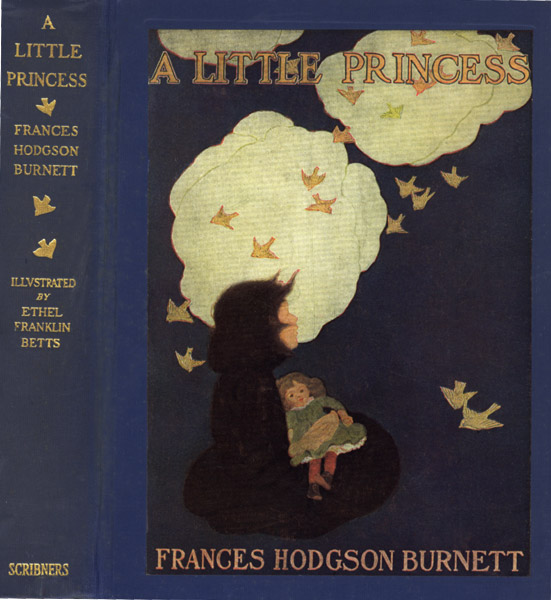
If you like Blyton: A Little Princess by Frances Hodgson Burnett

I was convinced that I had read this as a child, and in fact I did have a copy of the book – one of those Parragon Children’s Classics with no illustrations. However I was certain I’d read it at school. I know that I’ve seen the 1 film, so the rough story was familiar but when I read the book last week I realised that I definitely hadn’t read it before. I can only think that I had read a very abridged read-it-yourself version, or I was just confusing myself having seen the film.

First published in 1905, this is an expanded version of an 1888 short story titled Sara Crewe; Or, What Happened at Miss Minchin’s. When first published the full title of A Little Princess was A Little Princess: Being the Whole Story of Sara Crewe Now Being Told for the First Time. 

Anyway, there was more to the story than I expected in some respects, and less in others.


Who is the Little Princess?

The Little Princess is not, in fact, a princess at all. Sara Crew is a very wealthy little girl, however. The story begins with her being brought to a select girls’ school in London, where she is to be given every comfort. The girls are all from well-off families but Sara is the only one to have her own maid, and a suite of luxurious rooms. Not only that but her father has kitted her out with the best dresses and furs, as many books as she can read, and a new doll with custom-made clothing as fine as any for a real child.

And yet, Sara is not at all spoiled. She knows that she has more than most people and never looks down on anyone. She is the only girl at the school to acknowledge the new young maid and talk to her as an equal (something strictly forbidden by the upper society’s rules).

This is a stroke of luck, as Sara’s father dies without a penny to his name, leaving Sara equally penniless. She is allowed to stay on at the school, but as staff, not a pupil. She swaps her warm, comfortable suite for a cold, bare attic room, and her lessons for the daily drudge of a servant’s life.

She makes the best of this new situation by continuing to pretend. She has always enjoyed pretending, weaving stories for herself and the other children at the school, but also play-acting roles for herself and her doll. So, in the attic she pretends to be a prisoner in the Bastille, or on occasion that food brought by her one remaining friend at the school is part of a sumptuous banquet. She also makes up stories about the families in the neighbouring houses, whose lives she glimpses through the windows as she passes.

It is one of these families which is key to a happier ending for Sara, as although her father is truly dead (I had wondered if he would make a miraculous appearance at the end, see parallels below) it turns out her neighbour is a friend of her father’s and has been able to save her fortune.


Parallels

Reading this I was struck by how many parallels I noted with other books I have read.

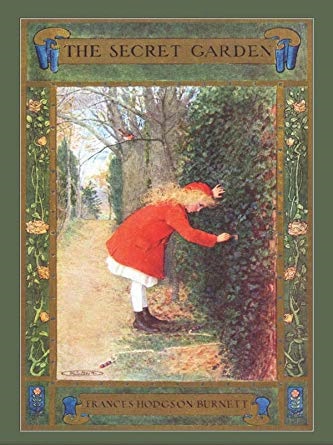
Firstly, you could compare (and contrast) it with Burnett’s work of a few years later – The Secret Garden. Both feature rich young girls who become orphans in the early chapters of the book and are brought to England from India to live in a large house.

Mary’s parents die in the first few pages – we never see them alive, in fact, while Sara’s father is present in the first chapter, and dies a little later. Both Mary and Sara form friendships with the servants, though for Mary it is encouraged and for Sara it is not.

I also thought there were some similarities between Sara and Pollyanna, from the 1913 book by Eleanor H Porter. Pollyanna is another young orphan, taken in by a stern aunt. Pollyanna has an unfailingly optimistic outlook on life and plays what she calls The Glad Game. The game involves finding something to be glad about in every situation, no matter how bad. She teaches others around her to play this game, and generally makes them happier people. This is similar to the games that Sara plays; although she is not specifically looking for ways to be grateful she does look for ways to make bad situations more bearable and she encourages Becky, the other maid, and Ermengard, a much-teased pupil, to do the same.

The 1962 book The Wolves of Willoughby Chase by Joan Aiken follows a similar plot, although against a very different backdrop. Bonnie (supposedly orphaned during the book) and cousin Sylvia (already an orphan) find that Bonnie’s house has been taken over by their distant relative who was supposed to be taking care of them. They are forced into an orphanage where they have to work for a living. This book ends with Bonnie’s parents reappearing. I think I confused the plot of this with A Little Princess somewhat, as there are several attempts from the girls to escape and I kept half-expecting Sara to do the same, or for her father to not really be dead.

Another parallel could probably be drawn to The Secret Island (1938) with the Arnold children being left with relatives who are supposed to take care of them, only for the death of the parents to lead to them being turned into servants. The Secret Island, of course involves the children running away while Sara stays put, and ends with the parents turning up alive, but Sara does at least get rescued by the family friend.


More or less?

As above, I was half-expecting an attempt at escape to be made (but without the wolves), or Sara’s father to reappear.

Instead, what I was not expecting, was Sara’s unusual character, stories and imaginings. Even from seeing the film I had no recollection of that side of the story. I also did not expect that the neighbour would have his manservant sneak food, books, soft furnishings and actual furniture across the roof into Sara’s attic room as a bit of a ‘game’ as he felt sorry for her, of course having no clue that she is the girl he has been searching for.

The end is therefore fairly unbelievable in its coincidences, that the man searching for Sara Crew moves in next door by complete accident (he had believed she was most likely to be in Paris) but is it any more or less believable than dead parents miraculously reappearing?

Still, I enjoyed the story and as we, the reader, know the neighbour’s identity and motive there is a certain sense of anticipation as we wait for the inevitable reveal of he to Sara, and Sara to he.


Posted in Book reviews, Other Authors, Reading Recommendations | Tagged , , , , , , , , | 2 Comments

Monday #468

Last week rather got away from me – somehow it took all week to write about Shirley Hughes, leaving no time for Malory Towers. I did read A Little Princess, though, which gives me something to write about this week.

P.S. It is officially spring in the UK now. It’s even been sunny this weekend, believe it or not.

If you like Blyton: A Little Princess by Frances Hodgson Burnett

and

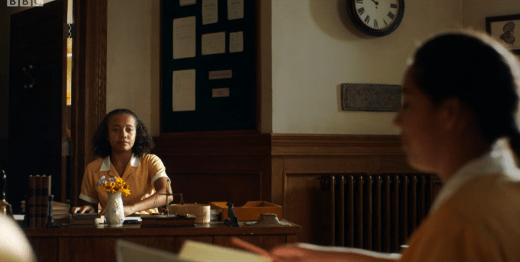
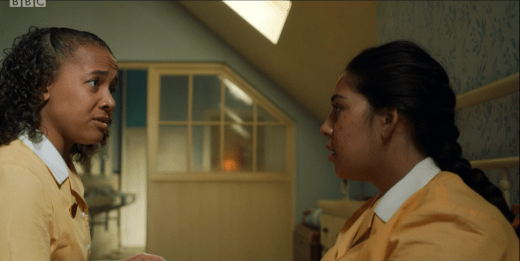
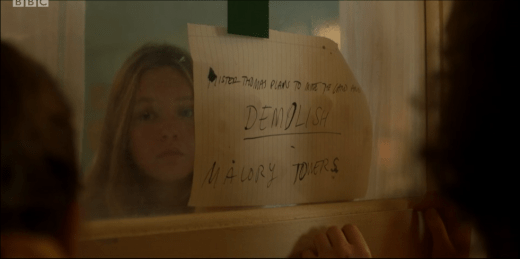
Malory Towers on TV series two: Episodes seven and eight

“But you are not at home now, you are at school, and you have to do as the others do, and keep their rules. We can’t have one rule for you and one rule for them.”

“I don’t see why not,” said Bill, obstinately. She often sounded rude, because she was so much in earnest, and Miss Peters sometimes lost patience with her.

“Well, you are not running this school, fortunately,” said Miss Peters. “You must do as you are told. And, Wilhelmina, if you insist on being silly about these things, I shall forbid you to see Thunder for two or three days.”

In Third Year at Malory Towers, Miss Peters and Bill go tête-à-tête over Bill wanting to go riding alone, which is against the rules.

Posted in Blog talk | Tagged , , , , | Leave a comment

If you like Blyton: Shirley Hughes

Usually the title of my if you like Blyton posts contain either a book title or a series by an author, but seeing as I’ve loved everything I’ve read by Shirley Hughes I’m just going to recommend her entire output.

As you may have heard, Shirley Hughes sadly died recently, aged 94. This made me want to revisit some of my favourites by her, so when I was at my parents’ house I picked out The Big Alfie Out of Doors book to read.

I had been thinking fondly of the first story, where Alfie and Annie Rose set up a little shop in their garden, selling leaves and acorns and using seeds for money. But of course that is also the book which has the story about Bonting in it. Bonting is a rock Alfie found in the garden one day. Alfie grew so fond of the rock that he gave it a name and it ‘slept’ by his bed in a little box. Alfie’s mum even made some little clothes – and a bathing suit! – for Bonting.

I was so taken by the story of Bonting that I chose my own – a grey stone with a large but smooth v-shaped nick on the top. I don’t actually remember when or where I found my Bonting but I know I kept him for years. He lived in a little basket made out of plastic cross-stitch canvas, it was stitched over in purple wool and I think it had yellow flowers on the side. I never did manage to persuade my mum to make him any clothes, though.

I don’t know what happened to my Bonting in the end. I know I still had him tucked in his basket in a drawer in my early teenage years. I must have thrown him away at some point – something I very much regret now!

But that was the magic of Shirley Hughes. Not just her stories, but also her illustrations, as she did both for her children’s books. I think that they really capture the imaginations of children.


My favourite Shirley Hughes books

It’s hard to choose so I’m just going to name my favourites without putting them into any sort of order.

As I’ve mentioned Alfie above, my other favourites about him (and his sister Annie-Rose) are

  • Alfie Gets in First where he shuts the door on mum when they come back from the shops, and he gets locked inside. Mum tries to talk him through opening the door, Mrs McNally and her Maureen come along to add advice, someone goes for the window cleaner to get his ladder… and then Alfie manages to open the door by himself. I read this to Brodie recently and he got a little bit upset, I think he was worried the longer Alfie was trapped inside.
  • An Evening at Alfie’s where Mrs McNally’s Maureen is baby-sitting and a pipe bursts in the ceiling. Mr McNally comes to the rescue, but not before Alfie and Maureen have been running about with buckets and basins.
  • Alfie’s Feet where Alfie puts his new yellow wellies on the wrong feet.
  • Alfie Gives a Hand where Alfie goes to a friend’s birthday party and ends up looking after a little girl who is feeling very shy.
  • The Big Alfie Out of Doors Book where Alfie makes a shop in the garden, finds (and briefly loses!) Bonting, follows a lost sheep with his Gran and camps in a field with his Dad only to be disturbed in the night by a large, pink, snorting animal.

Another fabulous compendium is Stories by Firelight which contains stories and poems. These are aimed at children a little older than the Alfie books are. Some of my favourites are:

  • Sea Singing which is a rather haunting story about selkies. Selkies are seal-people who can remove their seal-coats and walk on land as humans, but always long to return to the sea. This selkie was trapped on land by a fisherman who took her seal-skin from her. She had children with him, but eventually did leave them to go back to the sea where she already had a seal-husband and children. After that every year on their birthdays presents would be left on a rock by the shore. Presents very like some of the items seen in Morag’s house in the illustrations…

  • A Midwinter Night’s Dream – this story has no words at all, but is presented in a comic-book layout, where you see a boy get out of bed in the night, and then enter strange passageways full of odd creatures.

  • Burning the Tree. I misremembered this as an Alfie story, but it is about a boy called William and his grandpa. William spends a lot of time in Grandpa’s room, hearing stories about his youth, but there’s a mysterious box that Grandpa has never shown him. One day William sneaks a look inside and is disappointed to find it’s just old letters. He feels guilty for snooping, though. When it is time to burn the old Christmas Tree Grandpa throws on the letters too, which surprises William. He admits to having taken a look and Grandpa doesn’t mind, he just says that his memories are in his head and the letters themselves aren’t important.
  • And my sister’s least favourite, both on paper and on tape – Mrs Toomly Stones. This is a poem about an empty house in a neighbourhood, one with an overgrown garden and neglected façade. The children fear the house and believe it to be inhabited by Mrs Toomly Stones.
Other people say it’s empty
By the gate it says ‘to let’
But somewhere on the darkened landing
Or in the hallway (you can bet)
Lurks Mrs Toomly Stones…

I say those are my favourites, but apart from a few other (lovely) poems that’s the whole book!

Hughes’ most famous book is probably Dogger – another of my favourites – about David, who loses his toy dog at a school fete. He spies Dogger on a sale table, and he’s been priced at 5p! (Which aside from the clothes in the illustrations, very much dates this book to the 70s.) You really feel his anguish when he can’t make the lady understand that Dogger belongs to him, and he doesn’t have enough money to buy him back. By the time David has found his older sister Dogger has been bought by a little girl, and his sister has to make a generous offer to get Dogger safely back.

Then there’s Helpers, about three little children who are being looked after by George, a teenaged baby-sitter. This is a simple but amusing story about what the children get up to while George looks after them. They try to be helpful – in the way that only small children can – play games, go to the park, watch some TV… poor George looks quite worn out by the end!


You may also know Shirley Hughes from…

Apart from all her own books, Shirley Hughes also provided ilustrations for a whole raft of other books, including reprints of any famous titles. Some examples include books by Margaret Mahy and Noel Streafeild, The Secret Garden, The Railway Children and the My Naughty Little Sister books.


Why do I recommended Shirley Hughes?

Although she was writing  a few decades later than Blyton, there is still a vintage nostalgia to her works.

The Alfie books (and her others for young children) are full of cosy kitchens and rainy adventures, the simple games that captivate children’s attention and the trials and tribulations of being four years old. Nothing wildly out of the ordinary happens, but Shirley Hughes knew that children can find delight and intrigue in just about everything that goes on around them.

Her stories for older children can still be cosy at times, but bring in more creepy or haunting elements in a really fascinating way. I’ve never read Enchantment in the Garden but having seen it for the first time while researching this post I really want to!

Her illustrations are full of detail, yet you can take them in at a glance and know what’s going on and how it would feel to be in that scene.

Posted in Book reviews, Reading Recommendations | Tagged , , , , , , , , | Leave a comment

Monday #467

Thankfully this is the last week of winter, as spring officially begins on Sunday. I know that the weather doesn’t always take not of this fact, but we can always hope.

It could also be the last week of legal covid restrictions in Scotland, but we won’t know until tomorrow exactly what that means, or if it is happening.

If you like Blyton: Shirley Hughes

and

Malory Towers on TV series two – Episodes seven and eight

Spring is coming! With promising patches
Of blue; and sunlight suddenly catches
A gleaming rooftop, where sparrows in batches
Flirt and flutter and pipe up snatches
Of hopeful song

And windows are opened on stuffy rooms,
There’s a shaking of mats and a flurry of brooms
And it’s light in the longer afternoons,
And boys on bikes whistle cheerful tunes
It won’t be long!

Not a Blyton poem this time, but a Shirley Hughes on seeing as I’ll be writing about her this week.


Posted in Blog talk | Tagged , , | Leave a comment

New Class at Malory Towers: The Show Must Go On by Rebecca Westcott

We have now reached the final story in the book!


The plot of The Show Must Go On

From the title I had already guessed that this would be about the girls putting on some sort of show, which is generally not my favourite kind of plot – though I do enjoy their fifth form panto.

What they are putting on is a showcase, something to show off what life at Malory Towers is like. It’s the fourth form that are doing it, with each house supposedly doing a thirty minute show, but only the North Towers is ever mentioned, with the exception of a rumour that the West Tower has been practicing during the hols.

A few ideas are lifted from the fifth form panto. There one girl suggests a ballet because she is a ballet dancer, but the other girls say no as they can’t dance. Here Alicia wants to do a juggling, tumbling sort of routine (as she would go on to do in the panto), Irene wants an opera, Belinda an art work exhibition.

In the end they have to come up with something that everyone can be involved in.

The new girl isn’t mentioned until a few pages in – with the girls remarking that it’s unusual for a new girl to arrive into the term. Except that happened in the previous story, didn’t it.

All we know at first is her name is Margaret and there’s some sad tale involved as the teachers have called her a poor little mite. Then Alicia reveals that Margaret already has a cousin at Malory Towers, and tries to build a little suspense before telling the girls who it is. But that’s rather spoiled by the fact that the Amazon/Waterstone’s etc blurb reveals that she’s Gwen’s cousin. (Oddly Mary-Lou panics that it might her her mean cousin, though it’s not clear if her cousin is also called Margaret.)

It’s obvious from the start that Gwen and Margaret do not get on. Gwen is absolutely poisonous about Margaret, in fact I was surprised at just how vitriolic she was, despite some of the others things she has done. Perhaps it is because Margaret is her family, or because Margaret has just lost her father… but Gwen is really awful.

Most of it is based on class and appearance;

My mother married up and your mother married down and that is why I am who I am and you are, well, you.

But Gwen really sticks the knife in about Margaret’s wish to be known as Maggie, and her father’s death.

Mother and Miss Winters said it was foolish of your father to shorten your name like that and that maybe now he’s dead the silly nickname can die too.

Margaret has Gwen’s old uniforms which don’t fit her well, hardly surprising as Margaret is described as very tall, while Gwen is short (and plump). She also wears tatty boots as that’s all she has. Miss Potts eventually provides her with the correct sort of shoes (but not nearly soon enough, in my opinion, and after giving her order-marks over it), but by then Margaret doesn’t want to wear them.

She is bitter about being at Malory Towers, and doesn’t want to be like the other girls. She sees them as ungrateful for what they have.

You all think that you’re something special just because you go to school here. You think that this is normal but it isn’t. It isn’t normal to spend your afternoons swimming in a pool next to the sea. It isn’t normal to have all your meals cooked for you and your clothes washed for you while you swan around the place, riding your ponies and sketching in art books.

She has a point – the girls at Malory Towers are very privileged and some of them probably don’t realise it, or think about it very often. Naturally Darrell is a bit offended by this attack, though, as she and the others have been welcoming to Margaret.

It’s hard to overlook Gwen, though, who absolutely does not realise how lucky she is to have what she has. In fact she’s so spoiled that most of her attitude towards her cousin is jealousy. She is jealous that her parents have been paying attention to, and looking after Margaret instead of her. She doesn’t have the emotional maturity to understand that her cousin has just experiences a bereavement, and that the shift of attention is temporary.

I know that Gwen’s father is a sensible fellow, and it’s not altogether surprising that he has paid for Margaret to attend Malory Towers (despite she and her mother not wanting her to go!). But it seems like they’ve done a lot for Margaret, having her to stay, and even drive her to school for her first day, though Gwen’s mother hadn’t been resist making equally tone-deaf comments;

Mother and Miss Winter say that [the name Maggie] really is very common, and that people like them should make more of an effort to pull themselves up by their bootstraps.

By marrying a man of better social standing, I suppose?

Anyway the story progresses with little rows between Gwen and Margaret, interspersed with the girls making plans for the showcase. The title suggests that the showcase is somehow threatened, but it isn’t really. They are supposed to include all of the North Tower Lower Fourth (so, just the ten of them in Darrell’s dorm?) and it just seems difficult to find a place for Gwen, and to get Margaret to take part.

However Margaret discovers an aptitude for dance that she never knew she had – in the gym she just starts dancing beautifully with no instruction or experience.

Gwen is then challenged by the other girls and that’s when she reveals about her jealous and Margaret’s father, and goes from being incredibly spiteful and awful to very apologetic and subdued in the space of one page.

don’t want her to be here. Nobody asked me whether I was happy for her to come to my school and be given my clothes! Mother and father spent days talking about poor Margaret and what was to be done, but nobody asked my opinion, not once!…

I would have said yes if only they’d asked.

That seems rather unlikely, but Gwen suddenly realises she’s been awful.

I suppose I felt a bit pushed out. I know I’ve been horrible to her.

Margaret’s epiphany comes when Alicia and Darrell rescue her from drowning. Another unlikely scenario as they say that Alicia nearly drowned herself there, due to the tides, yet the two of them can drag a non-swimmer back? Margaret sees the girls in a new light after that, and both she and Gwen take part in the Showcase.

Despite there being at least the West Tower girls doing one as well, it isn’t mentioned at all, and somehow Irene is commanding the whole school orchestra for theirs.

Margaret and Gwen do a dance to end the showcase, despite Gwen not being able to dance at all, and not having rehearsed somehow she does well just being led by her cousin.


How does it compare to the originals?

As with the other stories I will look at four key points:

  • Does it fit with the continuity of the series?
  • Are the characterisations consistent?
  • Does the author attempt to adopt Blyton’s writing style, and if so is that successful?

The setting and updates

As with the other stories this is set in the 40s. My/your people is used quite a few times, which gives us a sense of the era, and the gramophone is mentioned a few times.

The class issues – marrying up, being common, and so on are also very accurate for the time.

Series continuity

This is set in the never before mentioned lower fourth, and I still can’t work out if the girls do two years in the fourth, or move up half way or whatever, but that’s not really a fault with this story.

Mam’zelle has suddenly picked up a Cockney accent it seems, and is dropping her Hs.

you ‘ave all returned from the ‘olidays like a bunch of young – ‘ow do you say? ‘oodlums!

Stop it you ‘orrible girl. You will be bringing Miss Pots in ‘ere… and I do not want ‘er…

I know that the French don’t generally pronounce their Hs but Mam’zelle has never spoken like that before.

Characterisation

The characterisation is a bit hit-and-miss. Gwen and Alicia have a nice little disagreement at the beginning, that fits their characters. Gwen then goes massively nasty, while Alicia becomes dependable and fair.

The girls begin well with teasing Mam’zelle Dupont, asking what an Oodlum is, (the dropping of the H in the text may be purely to facilitate this joke, whereas I feel that Blyton would simply have explained that due to Mam’zelles accent, hoodlum became oodlum), but it gets a bit OTT when they start making animal noises.

Miss Grayling gives a very apt speech to Darrell and Alicia after they rescue Margaret;

There are some people in the world who run away from a crisis and others who run towards it, looking for ways that they can help. You are both fine examples of the latter.

However I find it hard to believe that she would have let Margaret walk around school in brown boots, getting order-marks from Miss Potts, when she didn’t have any other shoes to put on. Mind you, it also doesn’t make sense that Mr Lacey would pay for Margaret’s school fees and not buy her a pair of shoes (or a few new uniforms…).

I know it’s a short story but Gwen’s about-face comes on very quickly, and next thing she’s buying Margaret new dance shoes. Gwen wasn’t just cruel once, it was on multiple occasions, deliberately and calculatingly, and there’s no way she hadn’t realised or understood what she was doing. Gwen’s the type to double down, anyway, or grudgingly apologise, so this turn-around seems out of character.

The style

Apart from my people the girls’ language is fairly time-neutral. It’s certainly not written in Blyton’s style, as it has quite a lot of run on sentences with many ands in them.


The book as a whole

Overall this isn’t a bad collection of stories. I think the stories are better than the full novel continuations that I have read so far, but it is unfortunate that the style and characterisations vary a bit between stories as it makes for odd reading sometimes.

The Secret Princess, I felt, was the closest to what Blyton would have written, if a little convoluted. I also enjoyed the library scenes in Bookworms, but the other stories I could take or leave.

Posted in Blog talk | Tagged , , , , | 2 Comments

If you like Blyton: Nancy Drew by Carolyn Keene

My if-you-like-Blyton post usually suggest books that are slightly less well-known, either newish authors or books that might have been forgotten over time. Whereas Nancy Drew is very much a household name, having been around since the 1930s in various incarnations. Still, I very much love her and I think that Blyton fan that might not have considered her already would enjoy her.


Who is Nancy Drew?

For anyone who has somehow not heard of her, Nancy Drew is an 18 year old amateur sleuth from the fictional town of River Heights (a fictional place) in Illinois.

She has solved baffling mysteries in well over 500 books (and that’s not including cross overs with the Hardy Boys or the recent graphic novels) but I will touch on the different series she appears in a little later.

Titian-haired Nancy lives with her father, Carson Drew, who is described as a famous (or sometimes prominent) lawyer. He often asks Nancy for help when he is working on a case (confidentiality be damned) and likewise she frequently consults him for advice on her cases. They are quite wealthy, living in a large house with a sweeping drive, and a live-in housekeeper. Nancy has her own car (a Mustang) and is regularly travelling both in the US and abroad for either fun or a mystery, though a mystery always turns up on her holidays too.

The housekeeper is Hannah Gruen, generally described as motherly or kind-hearted, and very close to Nancy since the untimely (or sudden) death of Mrs Drew when Nancy was three. (The bits in italics are things I can quote from memory as they are repeated in just about every book in the early chapters as they introduce the characters – just like the Famous Five each book is a complete story in itself and you needn’t have read any others let alone read them in order).
Nancy is often aided by her friends the cousins George Fayne and Bess Martin. George is actually a little like George Kirrin, described as tomboyish, slender and athletic, with short dark hair. She isn’t determined to be a boy but she is sporty and less prone to girlishness. Bess is the opposite of her cousin, blonde and often described as slightly plump. Although Bess is blonde I always picture her as Rosie O’Donnell as she looks in the Flintstones movie as Betty Rubble – without the cavewoman outfits, though.)

The main cast is rounded off by the love interests of the girls. Ned Nickerson has dated Nancy since high school, while his friends Burt Eddleton and Dave Evans date George and Bess respectively. One of them is tall and rangy, the other shorter and stockier but I can’t remember which way around it is!

Ned is generally considered a serious boyfriend to Nancy, while Burt and Dave are more casual dates of the other girls. Useful for local dances and events, but not a deep emotional connection. Ned and his friends are students at Emerson college (in one series anyway).

Those relationships don’t necessarily apply to all books. Dave and Burt didn’t appear until the 1950s, for example, and were then written out again in the late 1980s. Nancy and Ned have broken up a time or two in the 1980s on, in the Files books at any rate.


The different series

Nancy Drew Mysteries

The classic Nancy Drew Mysteries ran from 1930-2003, with 175 books. There are a few confusing points to highlight, though. Firstly, the UK did not publish the books in the same order as the US did, and so the series numbering is very different. The numbers below refer to the US publishing order as listed here, though the books are in a different order on my shelves.

The first 34 books were later rewritten – some with entirely new plots, though I believe all were shortened to meet a specific length, leading to some not making quite as much sense as they should.

There are different sections to the series, the first 34 which as above were rewritten, then books 35-56 which were written continuing on with the changes made to the earlier books (such as Nancy being only 16, and her mother dying when she was three, and not ten).

The books then moved to a different publisher (from Grosset & Dunlap to Simon & Schuster) and moved to paperback, with books 57-78 more or less following on with the same style and characters as the previous books, but adopting slightly more contemporary artwork. This is where my familiarity with the series ends – though this only takes us to 1985 which is before I was born. I suspect the quality of the later books meant lower sales and less reprints which is why I’ve not come across many.

Books 79-159 are from the S&S Minstrel imprint and began to add more contemporary technology and so on – which unsurprisingly has led to them being criticised for dating very quickly. Whereas books 1-78 do show the movement of time in slight changes to social customs and so on, they are fairly timeless.

And lastly books 160-175 are from the S&S Aladdin imprint. The criticisms of these are mostly that the continuity is poor, with the characters looks and jobs/education details being changed at random.

I would personally recommend books 35-78 as the best part of the series, closely followed by the first 34. I suspect that the first 34 would have been better in their original form, but of course Nancy being 16 and so on might make for a jarring change.

A last note is that Nancy never ages in the books. She is perpetually 18. I am sure she has several dozen summers over that time, and with mysteries that generally span at least a week if not two or more, then she would have aged at least 6 or 7 years in reality.

The Nancy Drew Files

Concurrent with the Minstrel books are the Nancy Drew Files. Several of these are amongst my favourite Nancy Drew books, despite being quite different to the originals.

These are set at the time they were written, the late 80s and early 90s, so will appear dated today – but then again the lack of any technology dates the originals. I think the difference is accepting a book will generally be dated to the time it was written and trying to update an old series to make it modern, despite modern not lasting very long.

These are perhaps for a slightly older audience as Nancy begins investigating more serious crimes such as murder. These are less cosy than the originals, which feature a lot of Scooby-Doo style fake hauntings (notable for straying from that trope is The Kachina Doll Mystery which has an actual ghost). There is peril in the original books, certainly, with Nancy locked in rooms in old houses while the criminals clear out, often tied up, but the Files does take this further with more serious threats to her life. The originals generally take the same line as with the Famous Five – with the baddies tying the children up and leaving them to be found later once they’ve finished with their activities.

Her relationship with Ned is also more grown up in the Files, with themes such as jealousy, long-distance relationships and so on explored, though they never go any further than affectionate hugs and brief kisses. As above they also break up and date other people but inevitably come back together in the end.

There are 124 of these, and I only have 41, mostly from books 1-74. It appears from the titles that from 70 on, and certainly from 98 on the books take a plunge into greater amounts of romance and the few I have from that time are not great.

I have a few absolute favourites:

  • Trouble in Tahiti (historic murder and scuba diving)
  • Danger in Disguise (political campaign and blackmail)
  • Vanishing Act (rock star disappears mid-concert and is presumed dead)
  • Bad Medicine (cheating scandal at a university leading to attempts on students’ lives)
  • Over the Edge (suspicious accidents at an outdoor sports centre)

There are also a few series from the 2000s, but they all seem pretty terrible. There’s at least one aimed at younger readers, and diaries from Nancy’s perspective.


Carolyn Keene

For anyone who doesn’t know, Carolyn Keene doesn’t exist. As a child I think I eventually realised that one woman probably hadn’t written all the books, not when they started in 1930 and were still going in the 90s. I think I thought that Keene was real, though, and the later books were ghost written to continue the series, much like with the Baby-Sitters Club by Ann M Martin. Though I didn’t know about the BSC back then, I actually assumed that Martin had written them all.

The books have had various authors over the years, but started with Mildred Wirt (later known as Mildred Wirt Benson), and with many early titles by Harriet Stratmeyer Adams.

Stratmeyer is an important name as the series was created by Edward Stratmeyer of the Stratmeyer Syndicate which had created the Hardy Boys four years earlier. (Franklin W Dixon is also a pseudonym.) Edward Stratmeyer wrote the outlines for the first three books, and edited them, before handing over much of those processes to his daughter, Harriet until 1981, which is the year before she died.

Despite all the different authors the series is very strong continuity-wise (excluding the impossible timeline). They stick to a tried-and-tested style, down to particular words and phrases being used from book to book, and this makes each one seem like an old friend. Nancy always behaves exactly as Nancy would, and so do her friends (even if on occasion this means they made the same sort of mistake more than once).


The mystery solving

When it comes to mysteries Nancy is a methodical sleuth. She works rather like Fatty of the Five-Find Outers, but with a car. She looks at the means, motives and opportunities, questions witnesses and suspects, finds a lot of secret passages and strange devices.

She has, however, got the back up of Chief McGinnis, head of police in River Heights who is always willing to vouch for her should she get into trouble, at home or elsewhere.

Nancy isn’t afraid of a bit of dressing up or false identities either. She even enlists her friends to go places she can’t, if she’s already been seen by the suspects for example. They do work together as a team but Nancy is definitely in charge, and often goes it alone. Her father does prefer it if she takes Ned, or at least her cousins with her, though.

Some of her mysteries just fall into her lap. Either an old friend (she must have hundreds of these) phones her for help, or she bumps into them looking distressed in a public place. Sometimes she bumps into distressed strangers and then embroils herself in their difficulties. Other times she is called or written to by friends, or friends of friends and asked to look into a mystery for them. Inevitably there are various red herrings along the way, and sometimes a secondary mystery. Often someone tries to prevent Nancy from setting off to where she needs to be or tries to deter her from investigating with various threats.


I don’t think this post has really done the books justice, but I do know that now I have a real hankering to re-read them. I have over 130 of them, and my instinct is to read them all in order (even though they can all stand alone)… but maybe I could break that rule so I can read my favourites first?


Posted in Other Authors, Reading Recommendations | Tagged , , | 6 Comments

Monday #466

We had some actual warm sunshine this week which was nice, it definitely feels like spring is on the way now. (I’m probably tempting fate by saying that and there’ll be heavy snow this week, but at least Brodie would be happy as he could finally go sledging!)

If you like Blyton: The Nancy Drew books by Carolyn Keene

and

New Class at Malory Towers part 4

Five on a Treasure Island, but as you haven’t seen it before. Unless of course you’re French, as this is a translation of a graphic novel that was published in French already.

I am not usually the biggest fan of graphic novels as I find them hard to follow, but I’d be willing to give these a go. Unsurprisingly the different format will have meant various changes made to the original story but I’m sure it will still be similar enough that I can still understand it.

Posted in Blog talk | Tagged , , | Leave a comment

New Class at Malory Towers: The Secret Princess by Narinder Dhami

I have reviewed the first two stories – A Bob and a Weave and Bookworms, and now for story three. I have been told that this is the best story in terms of characterisation, so I am wondering if I will agree.


The plot of The Secret Princess

Sunita has turned up five weeks into the term which is apparently unusual enough for the girls to question her. She tells them that her mother was ill and that delayed their travel but the girls are having none of it.

Alicia jumps rather far to the conclusion that she is a princess in disguise. Sunita then stalks in, acting every part the spoiled princess and carries it off well enough that even I wondered if Alicia had seen something before that evidenced the truth. But no – Sunita’s just a joker and had overheard Alicia’s conversation.

Alicia then notices that Gwen is eavesdropping and carries on the charade.

This is one of those plots that requires everything to align perfectly or it all falls apart. Firstly, Gwen has to have missed Sunita saying she is not a princess just a minute before, and then she has to keep it a secret that she knows as Alicia doesn’t tell the rest of the girls – or Sunita herself – until the next morning.

Sunita is naturally disappointed that Gwen only wants to be her friend because she thinks she’s a princess, but she agrees to carry on the joke for a while. She has another joke up her sleeve as well, a small vial of chemicals which produce violet smoke when mixed with water. This sounds exactly like the sort of tricks Blyton came up with herself, and coloured smoke appears in several mystery/adventure books as well.

All this makes Gwen wonder if Sunita is really a princess and so she manages to get Irene – distracted by composing – to admit it is a trick. It all becomes a bit Friends now – but they don’t know that we know that they know – as Gwen pretends not to know the truth.

For revenge she plays the smoke trick herself – after the girls decide to wait until after half-term – and uses far too much of the crystals as she did not overhear the warning that they only need a little.

Miss Grayling witnesses the smoke and quickly sees that Sunita is not guilty – while the girls argue amongst themselves as to whether it was Sunita or someone else, but who? Gwen is found out as Irene actually remembered their conversation and is punished with French prep during the hols, but what’s worse is that Sunita’s parents arrive in a swanky limousine as it turns out her father is a famous scientist. So poor Gwen misses out again.


How does it compare to the originals?

As with the review of A Bob and a Weave I will look at four key points:

  • Is it set in the same time, and is it updated in any way?
  • Does it fit with the continuity of the series?
  • Are the characterisations consistent?
  • Does the author attempt to adopt Blyton’s writing style, and if so is that successful?

The setting and updates

As with the previous two stories this is set at the same time, though it isn’t always hugely apparent. There are no gramophones or anything that heavily dates the book like pre decimal currency. They do earn order marks, though, which if something I always feel is quite of the time.

Series continuity

Malory Towers reopened five weeks before this story, after the summer holidays, so that would place this near the start of their third year. This is backed up by the girls saying remember when we were in the second form and that Sunita is best at science in the third form.

Third Year at Malory Towers begins in January, so after the events of this book, but of course Sunita doesn’t appear.

There are teachers mentioned that don’t exist in the original books – Miss Myers who teaches science, Mr Conway for maths. The science is of relevance to the plot but the maths is not.

Characterisation

Alicia is better written in this book, and her motivations are more realistic. She makes a great comment to Gwen;

Fish is good brain food, Gwendoline Mary. And if anyone needs brain food, it’s you.

Incidentally that had me wondering how far back the idea that fish is good for brain development goes. I know it has been a ‘thing’ for the past twenty years or so, but does it go back as far as the 1940s? I’ve had a look at some 1940s adverts for fish cakes, fish fingers and so on and although some of them are promoting themselves as being good for you, there’s no mention of the benefits to the brain.

Irene is described as tall with untidy fair hair which is not how I picture her, but I’m not sure if her looks are ever described in the books. Regardless, Irene is well written, there’s a few lines about her having lost an essay that is due in, and her preoccupation with music too.

Mam’zelle is also well written. Having worked herself into a panic over the smoke she declares We must fly for our lives. She does work out it’s a trick, though and declares that I, Mam’zelle Dupont, will discover the origin of this so-purple smoke. And if it is a terrible treek then you shall all be punished most severely which is so Mam’zelle.

The style

I would say that this is written in a style fairly close to Blyton’s but it doesn’t seek to mimic her exactly. There isn’t really the ‘frightfully golly gosh’ language of the last story, but the girls’ conversations are still well written.


Posted in Book reviews, Other Authors | Tagged , , , , | 2 Comments

February 2022 round up

February has passed by pretty pretty quickly, even for the shortest month of the year. We are now into March, when the days definitely start to get longer, a little warmer, and hopefully a lot less windy! March is also the month that the Scottish Government plan to drop the legal Covid restrictions, but I think we are all still waiting to see what that actually means for our lives.


What I have read

I started off the year badly in terms of reading, and for a long time was behind on my Goodreads goal. I am glad to say that in February I have caught up!

What I have read is:

  • Dundee, But Not as We Know It – Susan McMullan
  • Cookie – Jacqueline Wilson
  • The Borrow a Bookshop Holiday – Kiley Dunbar
  • A Batchelor Establishment – Isabella Barclay (aka Jodi Taylor)
  • Library of Souls (Miss Peregrine’s Peculiar Children #3) – Ransom Riggs
  • Night’s Child (Detective Murdoch #5) – Maureen Jennings
  • All The Little Liars (Aurora Teagarden #9) – Charlaine Harris
  • The Village Green Bookshop (Little Maudley #2) – Rachel Lucas
  • A Map of Days (Miss Peregrine’s Peculiar Children #4) – Ransom Riggs
  • Getting Started With 3D Printing – Liza Walloch Kloski and Nick Kloski
  • The Bookshop of Forgotten Dreams – Emily Blaine
  • The Road Trip – Beth O’Leary

And I’m still working on:

  • New Class at Malory Towers – Various authors, stories one and two have reviews
  • Clanlands Almanac: Seasonal Stories from Scotland – Sam Heughan and Graham McTavish
  • Sleeps Like a Baby – Aurora Teagarden #10) – Charlaine Harris


What I have watched

  • The usual suspects Hollyoaks and House of Games
  • Season seven and eight of Charmed (with much crying at the end of the final episode, as always). I need to decide now what my next watch will be – I could go back and finish off True Blood or Murder She Wrote, or maybe start from the beginning of Desperate Housewives?
  • I watched Call the Midwife which is now finished, the next episode will be the Christmas special!
  • I introduced Brodie to the first two Shrek films, which he loved, and decided that Princess Fiona was me as we have the same name… only when she turns into an Ogre her ears are apparently too small for her to still be me.
  • Tuesday nights have been dedicated to the Sex and the City reboot, And Just Like That – though every week I forget the name and think it’s And That Was That or something similar.
  • We watched the new BBC comedy drama This Is Going to Hurt – the comedy was very dark!

What I have done

  • I’ve gotten back into doing jigsaws a bit more regularly now, so after finishing the one I did with Ewan I borrowed a couple from my mum and sister. Between the three of us we have a decent library of jigsaws.
  • I’ve been learning about 3d printing at work and playing around with some of the design software.
  • I had a very fancy afternoon tea at the V&A – the kind where someone has to talk you through the menu and what it all represents.
  • We’ve been to our local zoo, and the transport museum.
  • I’ve been beachcombing once, but the tide was almost all the way in so I didn’t find much.


What I have bought

Writing up my guide to Enid Blyton biographies reminded me of a few that I didn’t have so I treated myself.

I got a copy of Gillian Baverstock Remembers Enid Blyton, and Enid Blyton and the Mystery of Children’s Literature by David Rudd. I’ve already reviewed Gillian’s book, but the David Rudd one joins a growing pile of ones on my to do list.


What did your February look like?

Posted in Personal Experiences | Tagged , , , , , | 1 Comment

Monday #465

It is almost March now which means the clocks will be going forward, and spring starts! February seems to have gone by very quickly, even for the shortest month of the year.

But beyond that, I hope that March brings better news for the people of Ukraine who are undergoing unbearable hardships right now. I don’t normally talk international politics and events but as with many Brits right now, I’m sure, the situation in Ukraine is on my mind.

February round up

and

New Class at Malory Towers part 3

A new (and probably occasional) Monday topic. Now and again I get comments asking questions I have no way of answering.

This week I had a comment from Jade:

When I was a child, somewhere in the early 2000’s I purchased a paperback Magic Faraway Tree book that was 3-in-1. It may have included the Wishing Chair books too. It was thick. I live in Australia and I am searching for an exact copy of that book. The cover was cream with a picture in the middle in an oval. I have scoured the internet for it and I can’t find it anywhere!

Does anyone recognise this book description?

Obviously not the right edition

Posted in Blog talk | Tagged , | Leave a comment

New Class at Malory Towers: Bookworms by Lucy Mangan

I’ve had this book ages but only recently read the first story, A Bob and a Weave by Patricia Lawrence. I wrote so much about that one short story that I’ve had to review each story in a separate post.


The plot of Bookworms

In a nutshell: Darrell starts visiting Malory Towers’ library and makes friends with the library monitor. Someone then starts playing pranks in the library and it’s up to Darrell to stop them.

There will likely be spoilers through the rest of the review, so if you don’t want the story spoiled I suggest you stop reading now.

Looking for a quiet place to sit Darrell ends up in the library where she meets Evelyn, the library monitor. Although the blurb of the book suggests that all the unfamiliar girls we meet are ‘new girls’ Evelyn doesn’t seem new, just new to us. She is older than Darrell and has clearly been at the school a while to earn library monitor status.

I really like Evelyn as I can really relate to her.

We use the Dewey Decimal System. Anything else is anarchy.

– Evelyn

My thoughts exactly, Evelyn.

She recommends that Darrell try The Lion the Witch and the Wardrobe, which Darrell loves.

When she returns for more Evelyn points her to the Noel Streatfelds, only for Darrell to remark that He seems to write an awful lot about shoes. I can relate to that too, as in a job interview for the library I referred to D.H. Lawrence as she. I didn’t get the job that time, I’m not sure if it was because of that blunder, but probably not.

Then the pranks start. Evelyn finds a muddy heap of worms inside a Shakespeare book along with a note.

A few more bookworms to join your club.

Which is actually quite witty! Darrell recognises the handwriting as Alicia’s but out of loyalty she doesn’t tell Evelyn, but just has a word with Alicia. It had no effect as next there’s jam and bread in a cookery book, then the trickster really ramps it up by turning all the books the so that the pages face out, and not in the right order. Not only that but various books have been bent and bashed in the process.

It put me in mind of the recent (heinous) trend for backwards bookshelves, but I doubt the trickster was just making a style suggestion.

Darrell has had enough now and having confronted Alicia and Betty a couple of times without success decides to turn the tables and play a trick on them, with the unlikely help of Emily and Mary-Lou. Basically they pretend to have read that some worms are poisonous, and make the two of them believe that they’ve been poisoned. And thus ALicia and Betty are chastened and Alicia apologises to Darrell and Evelyn, and even hints she might use the library after all.


How does it compare to the originals?

As with the review of A Bob and a Weave I will look at four key points:

  • Is it set in the same time, and is it updated in any way?
  • Does it fit with the continuity of the series?
  • Are the characterisations consistent?
  • Does the author attempt to adopt Blyton’s writing style, and if so is that successful?

The setting and updates

It is still set in the past, and the library books are by Blyton’s contemporaries.

Series continuity

They mention the chalk trick as occurring in the last term, so this is towards the end of their second form. Marietta isn’t mentioned, so it’s hard to say if this follows on from the previous story or not.

The Lion the Witch and the Wardrobe was published in 1950, and White Boots in 1951, which places this story to 1951 or later. So a few years later than Blyton had in mind. She didn’t always write her books to fit in with real time (for example the Famous Five have 21 adventures over 22  real years, but if you account for time of year the books are set in they take place over 11 years, but the children only age about 5 years), but with Malory Towers being published one a year for six years, and Darrell moving up a form each year, it would make sense that her fifth form year was around 1950 when the book was published. She certainly wasn’t still in the second form then.

I did wonder if Malory Towers actually had a library, but yes, there is one solitary mention of it in the six books –

“I’ve had to help Potty with the books in the library,” went on Gwen. “Great heavy piles! It’s set my heart fluttering like anything!”

– Upper Fourth at Malory Towers

I think Blyton threw that in there randomly as it’s never mentioned any other time, and the girls never spend any time in there that we know of. It still strikes me as odd that this story asserts that no-one would think to look for Darrell[in the library], as she intends to be a writer and surely therefore enjoys books?

In fact it’s quite a big part of the book that Darrell isn’t really a reader but Evelyn persuades her. I suppose Blyton never really had Darrell read for fun, I just always assumed as a budding writer it went without saying.

There are at least two or three occasions where Betty is in the north tower second form common room, something that I don’t think ever happened in the real books. Betty and Alicia were in separate towers to keep them apart for one, something that would have been pointless if they were allowed in each others’ towers – it’s also said that girls sneaking to other towers for midnight feasts is a far worse offense than just having one for that towers girls. In Fifth Form they do gather all the fifth formers in the north tower fifth form common room, but that’s the only time I can think of, except for the already rule breaking midnight feasts.

Characterisation

Again, I don’t think this story gets Alicia quite right. She’s definitely mean but she is not cutting, she doesn’t have that sharp, dry wit. She’s jealous of Darrell’s friendship with Evelyn – that’s like Alicia – but the repeated attacks on the library aren’t. I’d think her more likely to put worms or something into a book right before Darrell returned it, hoping to cause a disagreement between Evelyn and Darrell.

At the end while I suspect that Alicia and Betty might fall for the poisonous worms trick, they’d be rather suspicious, being tricksters themselves. Even if they did believe it, I doubt they would run from the room wailing as this story has them doing. I think they’d walk off, heads held high after pouring scorn on the idea that they’d been poisoned.

The style

This is closer to Blyton’s style than the last one, but it doesn’t capture it entirely. The language is Blyton-ish with frightfully, awfully, and so on used just the right amount.


Overall

I enjoyed the library scenes and I really like Evelyn – it’s a shame that she’s a one-off character.

I’ll shelve that in my “uninformed opinions section”

– Evelyn

Alicia being the enemy two stories in a row was a bit much, though. Between the two they’ve turned her into a bit of pantomime baddie.

There are quite a few contrivances in the story, though I recognise that short stories don’t have the space to explore all the backgrounds.

Darrell ends up in the library as she needs somewhere quiet to sit – this could have been achieved in a few words about her being tired of Gwen boasting or Alicia teasing or anything. Instead the story begins with them going to the pool and she and Alicia tormenting Gwen in the water.

It adds that Darrell is already in trouble for teasing Gwen recently, and for rushed prep – neither are unbelievable but they do seem like an information dump of excuses to get Darrell into the library, especially when you add that her first two choices are the boot room which is being cleaned and a music room which is being painted.

Overall this was definitely a better effort than the first story, but it still didn’t quite get it right.

Posted in Blog talk | Tagged , , , , | 2 Comments

A guide to Enid Blyton reference books

I have already written a guide to Enid Blyton biographies, books which have covered various aspects of her life and career, so what’s left are some non-fiction books that don’t really fit the biography category.


So You Think You Know Enid Blyton’s Famous Five?

by Clive Gifford

This is actually a quiz book rather than a standard reference-type book. It contains over 1,000 questions (according to the introduction, I didn’t count them), mostly about the Famous Five, but with a few about Blyton thrown in too, and even the odd one about Noddy and other Blyton creations. Personally I would have preferred just 900 Famous Five questions, rather than having it padded out to 1,000, but a bit of variety can’t be too bad.

You also have to watch as they go by the updated text as I have spotted a question about Uncle Quentin giving the children money, and whether it was 25p, 50p or £1.

The questions are divided into three sections easy, medium and tough, with there being 50 easy, 50 tough and the rest being medium. I’m sure you’ll be glad to know as well that all the answers are at the back.

I wrote a fuller review here, which I had entirely forgotten when I wrote this, if I had remembered I could have saved myself some time!


The Famous Five Everything You Ever Wanted to Know!

by Norman Wright

There is a chapter in this about Blyton herself, but it more or less just summarises the usual biographical information. The rest of the book is all about the Famous Five (not surprisingly).

There are guides to the characters, from the Five to their families, their friends to enemies and even the various animals they encounter. Places, both real and fictional, including a section all about Kirrin locations.

There is also a summary of each of the 21 books, and over 150 quiz questions (and answers) at the end.


Who’s Who in Enid Blyton

by Eva Rice

I have written three very long posts (one, two and three), and then a fourth about the updated version, about this book. To summarise, this is a guide to characters from several of Blyton’s main series. Unfortunately is is patchy and inconsistent, with some books getting almost every character (no matter how minor) listed, and other books getting the bare minimum. There are also glaring omissions and various mistakes throughout.


Dissecting the Magic of Blyton’s Famous Five Books

by Liam Martin

I have also written about this one, but just one post! This is a useful book which has categorised all sorts of details about the Famous Five books, such as locations, the weather, food stuffs, animals and nature, and so on. It lists each item and where the reference(s) can be found in the books.


Enid Blyton Society Publications

Many of the society publications are more booklets than books, but are still very much worth the money.

There are rather a lot so I will just provide a few highlights here, and leave a link so you can see the rest.

The ones I have are the illustrated bibliographies, which come in four volumes and cover every Blyton book published from 1922-1974. They provide all the main publishing details, publisher, date, plus the format of the book and dustjacket etc. It also gives some details on reprints.

There are also indexes to Enid Blyton’s Magazine (unfortunately sold out, and I wish I’d managed to get one), Sunny Stories and Sunny Stories for Little Folk.

And lastly The Famous Five — a guide to the characters by David Rudd surely promises to be better than Eva Rice’s attempt.

A full list of ‘further reading’ on Blyton can be found on the Society Website here, including all the Society booklets and some booklets and pamphlets from other sources that I haven’t mentioned.

The Enid Blyton Society Shop has some of their publications available, though others have sold out. It may be possible to find them second hand, however.

Posted in Other Authors, Reading Recommendations | Tagged , , , , , , , , | 3 Comments

Monday #464

It is back to just me writing this week, and although I was able to come up with two posts fairly easily it has taken me until 11.30pm on Monday night to write this. If I’m lucky I’ll get it finished before midnight and actually publish it on Monday still.

A guide to Enid Blyton reference books

and

New Class at Malory Towers part 2

Eunice!’ said Daisy. ‘Goodness, what an unusual name. But look at the clock, Fatty—you won’t be in time to meet them—it’s eleven-forty-five already!’

‘Oh, my goodness!’ cried Fatty, leaping to his feet. ‘I must go. No, it’s all right. That clock’s fast. What about you all coming with me to the station and seeing what our dear Eunice is like? Come on!’

They paid the bill hurriedly and went out of the little shop, all looking gloomy. Yes—no wonder Fatty felt fed-up. Blow Eunice—she would spoil everything!

With storm Eunice having blown through this past week I thought that this was an apt quote!

mystery of the missing man eunice tolling

Posted in Blog talk | Tagged , , , , | Leave a comment

Malory Towers on TV series two – Episodes five and six

I has been a while since I reviewed the first four episodes of series two, Christmas got in the way and then I just never got back to it. That’s not a great sign, really, if you watch 4 episodes of something then aren’t that bothered about watching the rest, but I definitely haven’t found this series as good as the last.

A reminder of episodes one and two, and three and four.


Episode five: The Caricatures

It is Alicia’s birthday in this episode, but unlike last year a hamper from her family has not arrived. Alicia is pretty upset – as you would be (it turns out OK in the end, though, as the delivery has just been delayed).

Mary-Lou, the recently discovered artist, gives her a picture of Matron and Mam’zelle, though a big deal made about how it mustn’t be shown to anyone else.

And so it becomes very clear now that Mary-Lou is taking on Belinda’s plots. In the book Belinda draws the two Mam’zelles trying to murder each other, as they are driving the girls mad fighting over who will act in the French play. The two Mam’zelles have a long history of not getting along but I can’t recall if Mam’zelle and Matron have the same sort of attitude, or if Mam’zelle had to face a spider in the last series/episodes. If anyone’s spotted anything like that as a background to the drawing, let me know!

Back to Belinda for a moment, I’m rather gutted that she won’t be in the show. Katherine and Emily have moved on (with no acknowledgement) so there should have been room in the dorm for two new girls. I love Belinda, and her friendship with Irene, so it’s a real shame that she isn’t going to be brought to life.

Anyway,  for a joke Alicia sticks it to the chalkboard, thinking that Mr Parker will enjoy it (in the book the girls put the sketchbook on the desk thinking Mam’zelle Dupont will find it funny). In both it is Mam’zelle Rougier who shows up unexpectedly, leaving the girls desperately trying to remove the picture before she sees it.

In the book Darrell goes up and says the book has been put there by mistake, and nearly gets away with it, but Mam’zelle Rougier being pedantic wants to check it before it was taken.

This adaptation goes for a sillier series of events. As it’s on the chalkboard in plain sight the other girls need to distract Mam’zelle while Alicia retrieves the picture. Before she can sit down again, though, Mam’zelle asks her to come up to the front. It seems to me that she had time to try to slip the picture into her desk or hand it to someone else, but no, she takes it back to the front albeit hidden behind her back. I know that Mam’zelle is sharp and might have noticed and asked to see it anyway, but surely it was worth a shot? Instead, running out of options she then slips it into the pile of prep on the desk, the pile that Mam’zelle is going to mark later…

After French class the girls join Matron in their housecraft lesson, where Sally has arranged for them to make a cake for Alicia’s birthday. Earlier, Matron had told her she needed to find the ingredients, somehow, a bit of a challenge given that they are still under rationing. As it turns out Ron has worked a miracle and got them flour, sugar and eggs (real, not powdered!) from the grocer.

They then make the cake in the attic room where they do their painting, music, try on debutante dresses etc. I thought it seemed an odd choice (but they only seem to have seven sets), as although the mixing is easily done anywhere it still has to be baked. Later we see Matron with the iced cake back in the attic room, so either there’s an oven up there or she carted it up and down the stairs. This is when she can’t resist eating a big slice (her internal battle is a treat to watch).

Luckily Alicia wasn’t present for the lesson, as she had gone to try to get the picture back – which begs the question, how was Sally planning to surprise Alicia if Alicia was supposed to be in the lesson? It isn’t explicitly said it would be a surprise but none of the girls mention it to her before hand, and Sally talks about making it for Alicia not with Alicia.

There’s also the question of how the cake gets finished, as Mam’zelle catches Alicia and hauls the rest of the class back down to grill them on who is responsible.

This is where Alicia acts somewhat un-Alicia like. She lies and tells Mam’zelle that she drew the picture. First up, Alicia isn’t a liar. In fact she often tells too much of the truth. Few of Blyton’s characters, excepting ones like Gwen, tell lies. Secondly, Alicia (at least of the books) doesn’t have a whole lot of time for Mary-Lou who she finds to be a baby, so she wouldn’t be that keen to protect her. And thirdly, Alicia is not stupid, and should know that it is not a credible lie as she simply cannot draw like that.

Miss Grayling is smart enough to know that Alicia is lying, but Mary-Lou has plucked up the courage to come clean just as Alicia is being forced to draw something.

Despite all the proof being in front of her Mam’zelle refuses to believe it is Mary-Lou –

She is lying to protect her friend. I know Mary-Lou and this is not her.

whereas Matron laughs and finds it funny – keeping her cast in the Mam’zelle Dupont role. I’m left wondering why nobody told her about any of this, she only discovers it by chance.

The caricature plotline is one I really enjoy in the book, and it’s a shame that it has been meddled with to such an extent. It’s barely recognisable as the same story, especially as it’s surrounded by two other plots.

One is Gwen and the play – I now realise that this play does come from the book, as above the Mam’zelles are putting on a French play, but beyond the casting issues the play isn’t really in the book.

But here we have Gwen begging Mary-Lou to help her with her lines as it is far more important (than Mary-Lou’s essay), and I have a lot on. She refuses Darrell’s help, in a cut-your-nose-to-spite-your-face sort of way, and later is furious when Darrell tells Mary-Lou about Gwen’s father. I still can’t work out if her father really is ill, or if it’s a lie.

Gwen’s also having to make the bunting for the play as Georgina has told her to do it. Are Gwen and Georgina the only actors in the play? It’s only the two of them at rehearsal anyway. Gwen tells Georgina about her father and the older girl is entirely unsympathetic.

I don’t have time for melodrama, Gwendoline!

The last plot is pretty minor – just a continuation of Ellen’s story. She has an outburst about noise in the common room –

Goodness I wish I could be as relaxed about work as you two are, playing music and learning lines. Some of us need to study!

rather out of the blue and Gwen, being Gwen later remarks that Ellen will have no friends with that attitude which Ellen overhears. Shortly after Ellen says to Jean that she didn’t mean to be rude. I feel like the show has tried to make Ellen a bit more rounded but she swings between behaving like a regular, happy girl and a snappy, studying obsessed girl. Maybe that’s more realistic but it makes the snappishness seem to come out of nowhere. In the book the other girls (and the narrative) mention how Ellen is always snapping about noise, always studying and so on. The show has shown us she is stressed about school work but perhaps not to the same extent as the book.

And we end on probably the best part of the episode as Matron brings the birthday cake to the dorm, with a slice missing, and says Obviously I had to grade your efforts.


Episode six: The Runaway

This episode focuses more on Ellen again. She wakes up in the morning with her bed full of books and papers from studying.  She resumed feverish studying, planning to skip breakfast even though that’s not allowed – and Jean covers for her at breakfast. They were to have a test that day, so skipping breakfast doesn’t seem like the wisest decision even if it leaves more time for studying.

She admits that she’s worried that she will fail and have to leave school. This is book Ellen’s worry too – compounded by her parents not being well off and having paid a lot of money for uniforms and so on. TV Ellen has another element added – she says if she goes home she will have to look after her aunt, presumably instead of an education and/or career.

We see them sitting their test and Elle looks pleased, she finishes in plenty of time and is even able to go back over her answers. That makes it double gutting that afterwards she realises that she has missed a page or two. She is so upset by this – assuming that she has failed the test and will be asked to leave. So she ‘runs away’ hence the title of the episode. She doesn’t go far – just to the potting shed – which at least makes sense. Running away because you’re being sent away doesn’t make any sense, but hiding away because you are afraid and don’t want to face the teachers I can understand.

Anyway, when she’s found she’s very shaken, and is sent to the San. I was thinking that we were getting back on track for the plot of the book – Ellen being ill ad unable to study leading to her trying to cheat. But Mr Parker comes to see her and says she’s had an attack of the nerves and needs to rest. Malory Towers is about more than academic achievement and she needs to broader her horizons and play sport and have fun. He even tells her that she wouldn’t have to leave even if she fails at tests.

So the pressure has been entirely taken off Ellen, now. I cannot see how the original plot can be brought back in now. Even if something really drastic happened, would Ellen really be moved to cheat?

The two secondary plots are interlinked. One is that Georgina has lost half-a-crown and asks Gwen to look for it. I was then wondering if we would get the thief plot from the book, even though we have no Daphne. But Gwen sees it in Mr Parker’s drawer (he found it on the classroom floor). Georgina finds Gwen slacking off in the common room and so Gwen pretends she was still hunting for the coin, which she by way of sleight-of-hand produces from the back of the sofa.

There was something odd about that whole scene. Was Gwen planning to keep the coin, or was her lie about still looking for the coin simply so that Georgina wouldn’t know she was slacking? She seems to look at the coin rather wistfully, making me wonder if there are money problems at home. What’s definitely odd is that Georgina doesn’t think it’s odd that her coin was found in the second formers’ common room. But saying I spotted a blue backdrop and brown curtains in the corner of the common room, ones that looked rather like the audition stage, so it looks like Georgina held the auditions in their common room, though I can’t see why. (Lack of sets, again?)

This all ties in to Darrell and Sally trying to think of money making schemes, their whispering makes Gwen paranoid that her secret (about her father being ill) will get out. So much so that she keeps trying to read Darrell’s diary. What she finds in there instead is about the school’s money problems, and she immediately spills the news to the rest of the form. None of them are very happy about being kept in the dark but Gwen is really vicious about it.

This episode also barely resembles the book, the plots that have been taken have been hanged substantially, so much so that both these episodes felt quite filler-y. Not a lot happened to move the main storyline(s) on.

One highlight was Matron falling asleep on a chair in the san and being woken by an embarrassed Mr Parker.

I think you were resting your eyes.

That’s the thing I do. Focuses my thoughts.

The other is Matron dancing around the San to a confiscated record. (There’s another subplot about a ‘dance’ that turns out to be the girls in their uniforms dancing around the common room with some sandwiches and sausage rolls).


So overall all, a couple of slightly disappointing episodes. Matron provided some bright moments, but none of the storylines really moved on. Gwen was magnificent in the first series but hasn’t been given a lot to work with this time, which is a shame.

Posted in Blyton on Screen | Tagged , , , | 5 Comments

How ‘Jennings’ compares with Blyton’s stories by Chris

I’m sure I’m not the only person who grew up with Anthony Buckeridge’s Jennings stories as well as Enid Blyton’s stories and still loves and re-reads them both. Yet both Jennings and Buckeridge are much less well-known than Blyton and many of her characters. There seems to be only one, not very active, Jennings fan site. Therefore I expect that some readers of this blog don’t know the stories at all. So I thought that discussing how Jennings compares with some of Blyton’s stories might be of interest to those who know them both and to those who only know Blyton’s work.

Just a small selection of the Jennings titles

Anthony Buckeridge OBE (1912-2004) was a near contemporary of Enid Blyton and, apart from wartime service as a fireman, was a school master for most of his career. He was a far less prolific writer than her, producing ‘only’ twenty-four Jennings books between 1950 and 1994 (almost all of them 1950- 1973), which started life as a series of BBC radio plays in 1948. He also wrote five books in the much less successful ‘Rex Milligan’ series.

The Jennings books are school stories, set in Linbury Court School, so the most obvious comparison is with Blyton’s St Clare’s (six books, 1941-1945) and Malory Towers (six books, 1946-1951) series*. However, Linbury Court is a boys’ ‘prep’ school (i.e. preparatory to Public school or independent school) whereas St Clare’s and Malory Towers are girls’ Public or independent schools, so the ages of the children are different. Even so, they are all boarding schools for mainly middle or upper-middle class pupils. It’s easy to imagine that if Jennings had an older sister, she might have gone to St Clare’s or Malory Towers.

Unsurprisingly, Jennings (John Christopher Timothy) is the central character throughout the series, more so than any one character in the Blyton series, even Darrell Rivers in Malory Towers. Almost as central is Jennings’ ‘side-kick’, Darbishire (Charles Edwin Jeremy). The extent to which Jennings (and Darbishire) hold centre-stage is probably why it isn’t called the ‘Linbury Court’ series whereas Blyton’s series are named after the schools. Another aspect of this is that Jennings and Darbishire are really the only characters who are well-defined. There is a recurring group of school-mates, especially Venables, Temple and Atkinson, but they are hardly described at all. This is very different to the Blyton series which both have a large ensemble cast of well-drawn characters, as well as the regular introduction of new and dramatic ones.

Another big difference with the two Blyton series is that Jennings and his fellow-pupils never get older or progress to more senior forms. Instead, they are permanently locked in their eleven or twelve year old incarnations. So the reader has to suspend disbelief as, say, yet another summer terms comes round and, by the end of the series, Jennings ought to be well into his twenties! This also means that there is no character development at all in the stories. In the same way, the main masters, Mr Carter and Mr Wilkins, appear throughout, whereas in the Blyton series they change to some extent. The headmaster, Mr Pemberton-Oakes, rather like Miss Theobald in St Clare’s and Miss Grayling in Malory Towers, is a consistent but remote figure of whom the pupils are rather in awe.

One minor difference is that, although we do know their Christian names, Jennings et al are routinely called by their surnames whether by masters or fellow-pupils, as was common in such boys’ schools at the time the stories are set, and indeed later. In Blyton’s stories the girls are known by their Christian names.

In Jennings, although again we do know their Christian names, the masters also address each other by surname, but use ‘Mr’ when speaking about each other to the boys, just as the boys call them ’Mr X’ or ‘Sir’ to their faces, or by nicknames such as ‘Old Wilkie’ behind their backs. In Blyton’s stories, the school mistresses are also referred to by title, with some, such as ‘Potty’ Miss Potts, also having nicknames amongst the girls. I can’t be completely sure without re-reading all the books again if they ever use first names amongst themselves when out of the girls’ hearing. I think not.

Blyton also has a couple of male teachers at her schools but there are no female teachers in Jennings, where the only regularly recurring female character is Matron who, as with the matrons in the Blyton stories, is unnamed. In all the series there are various members of domestic staff of both sexes, who sometimes play a minor role in the plots. It strikes me, now, that in both Buckeridge and Blyton stories all the teachers appear to be unmarried. That might have been the norm in girls’ schools of this type and time, but don’t think it was the case in boys’ schools

Like Blyton’s school stories, the Jennings books are not adventures in the sense of the Famous Five or Adventure series, although very occasionally in both there are adventurous episodes. Instead, the plots concern the ‘low-level’ excitement of school life. That includes things like the midnight feasts found in Blyton’s school stories, but is more often to do with Jennings’ confused understandings of the world around him, for example mis-concluding that a burglary is in progress or that a teacher is leaving, or Darbishire’s incompetence and impracticality, for example his boasts of swimming technique when, in fact, he is unable to swim.

In the Jennings series, there is none of the ‘moralism’ of the Blyton stories where snobbish or spiteful girls get put in their places, and almost none of the inter-personal conflict or jealousies that give her school stories much of their plot. There are no suggestions of social class differences between the pupils at Linbury Court, although there are passing references to some of the local people and domestic staff being of a lower class. Nor are there any references to ‘dramas’ or tragedies at home, and there are no ‘exotic’ characters like Carlotta or Claudine in St Clare’s, or even any ‘jokers’ like Alicia Johns in Malory Towers.

Instead, and far more than in the Blyton series, there is a huge amount of humour based on word play in the form of puns, double meanings and often quite complex metaphors. There is also an extensive jokey schoolboy language, some standard for the time (e.g. ‘flying into a bate’ when someone, usually Mr Wilkins, loses his temper) but much of it invented. Examples include ‘fossilised fishhooks’ (expression of surprised alarm), ‘addle-pated clodpoll’ (fool, idiot) and ‘ozard’ (meaning something bad, deriving from ‘Wizard of Oz’ because ‘wizard’ means good, so ‘ozard’ is its supposed opposite).

In fact, the whole tone of the Jennings books is of gentle good humour, including the wry amusement of Mr Carter, who is based on Buckeridge himself, at the strange logic and bizarre enthusiasms of Jennings and his friends, and the farcical situation this gives rise to. Actually, although all the series are told in the third person, there’s an intangible feeling that Jennings is being narrated by an adult – Buckeridge originally told them as stories to his pupils – which isn’t present in the Blyton stories.

There is also, to a greater extent than in the Blyton school stories, some sense of what is going on in the wider world (such as space travel) and also a sense of the place, the Sussex Downs, where Linbury Court School is located. By contrast, although we know that Malory Towers is in Cornwall, the location of St Clare’s isn’t even mentioned and nor, extraordinarily given when they were written and set, is the fact that there is a world war going on!

Whilst having all these differences and similarities, I think there are some underlying connections. A minor one is that all the series appeared in many editions, but the early ones in particular have some fantastic and atmospheric illustrations. They’re just pleasing books to hold and look at. More importantly, although all these stories are very much of their time, primarily the 1940s to 1960s, they all have a timeless quality. And although they are set in a very particular kind of educational institution, the English boarding school, they still manage to capture some of the universal experiences of childhood.

*Note: I haven’t made comparison with the Naughtiest Girl series partly because I haven’t read them and partly because, as I understand it, Whyteleafe School is very different to the others.

Posted in Book reviews, Other Authors | Tagged , , , , , , | 23 Comments

Monday #463

As with every week I consult my online calendar to see what I have lined up to write, or at least what rough ideas I could choose.

Sometimes (like this week) it is done with mild anxiety as I am not at all sure I have any suitable ideas, other times it is done with the confidence of someone who has half a dozen posts half-done and the calendar days filled with post headings for the next three weeks.

As it turns out, I’m sorted for this week! I had entirely forgotten that one of my contributors had sent me something, and as a bonus I had already drafted it into a post complete with images.

That nearly makes up for all the times I check with confidence only to realise that yes, a few weeks ago I had lots of half-done posts but I have already run out…

How Jennings compares with Blyton’s stories by Chris

and

Malory Towers on TV series two – episodes five and six

One of the moments that made me laugh this week came from the matron of the Malory Towers TV programme.

Matron, played by Ashley McGuire, had been helping the girls bake a cake in class, and when the girls were called away by an irate Mam’zelle Rougier, she succumbed to overwhelming temptation (remember they’re experiencing rationing and proper cakes are hard to come by) and ate a big slice.

Later she takes the cake, complete with missing slice and a candle on top to the dorm for Alicia’s birthday.

When the girls notice the missing wedge, she says with an absolute straight face and no shame whatsoever;

Obviously I had to grade your efforts!


Posted in Blog talk | Tagged , , , | Leave a comment

New Class at Malory Towers: A Bob and a Weave by Patrice Lawrence

Published in 2019 New Class at Malory Towers is a compendium of four new short stories set at Malory Towers. They are set during Darrell’s time there but each features a new girl joining the school.

The stories are:

  • A Bob and a Weave by Patrice Lawrence
  • Bookworms by Lucy Mangan
  • The Secret Princess by Narinder Dhami
  • The Show Must Go On by Rebecca Westcott

I have heard of the Guardian writer Lucy Mangan, and I know that Narinder Dhami has written the novelisation of the Malory Towers TV series and some additional Wishing Chair books. The other two, I have not heard of.

The internet tells me that Patrice Lawrence is known for writing Granny Ting Ting, Orangeboy, Indigo Donut and Eight Pieces of Silva and has won several writing prizes.


The plot of A bob and a Weave

I initially thought this story was going to be all about hair from the title, and it sort of is, though the bob and weave actually refer to boxing. Sport not being my thing that’s obviously not where my mind went first. Anyway, this review contains spoilers.

Marietta is starting Malory Towers and is reluctant to go. She almost echoes Elizabeth Allen of the Naughtiest Girl when her father agrees that if she still hates it after half-term she can come home, as she refuses to join in or get to like anyone because she plans to leave.

She has a lot more secrets than Elizabeth, though. Firstly she comes from a family of circus performers and doesn’t want the other girls to know in case they judge her (obviously she hasn’t read the St Clare’s books where Carlotta is widely accepted and liked). Then there’s her mother’s illness, we later discover that her mother is a boxer in the circus and has sustained a serious head injury which she is taking time to recover from.

And lastly, there’s the small matter of her stress induced alopecia which she’s hiding with a wig. That definition is never used in the book but I’m fairly sure that’s what it is, a she says her hair started falling out after her mother was injured.

So, Marietta goes to school determined that she doesn’t need to be there (she was previously taught by the circus conjuror), wanting to be at home with her mother and trying to hide three secrets, a recipe for disaster, surely.

She’s branded ?rude and stuck up by Gwen pretty much straight away as Gwen tries to touch her hair and Marietta pushes her away. It’s a gentle push but we all know how over-dramatic Gwen is and she acts as if she’s been hurled across the room.

The rest of the girls try to draw her out but have little luck, except for Darrell who manages to persuade her to try out for the lacrosse team. But when she is chosen and Darrell is not, Darrell is rather put-out. She’s not outwardly mean about it but she complains to the other girls.

Everything comes out after half-term as Alicia has been to a circus and seen women boxing – I assume it’s Marietta’s circus as that was nearby for her father to collect her at half-term and have a few days at home. She is scornful and saying it’s all fake and Mariette blows up to defend the boxers, ending up giving herself away on all three accounts.

The other girls, being the generally good people that we know them to be (except Gwen of course) do their best to make amends and at the end I think Marietta is much happier at Malory Towers.


How does it compare to the originals?

For me there are four main elements that I look at when comparing continuations to the original work(s). Your standards may vary, of course, as will how important each of the points are. I’d say that characterisation is probably the most important.

  • Is it set in the same time, and is it updated in any way?
  • Does it fit with the continuity of the series?
  • Are the characterisations consistent?
  • Does the author attempt to adopt Blyton’s writing style, and if so is that successful?

The setting and updates

Happily this is set in the 1940s or 50s with steam trains, governesses and circuses with animals in them. Saying that it isn’t very strongly flavoured as a period story, it’s too short to have space for fitting in a lot of references to place the time period. Money isn’t mentioned, for example, or gramophones or anything else that would date it. The language is fairly generic, so not a lot of golly goshes or anything particularly Blyton-esque, but it isn’t hugely modern either. I did note that Gwen is described as ‘whiny’ which stood out.

Series continuity

It doesn’t actively contradict anything that happens in the main series, but as with the St Clare’s fill ins, if you read them all in order things would stand out.

For example this must be set in either late in the second or early in the third form as Belinda has joined the school but Darrell has not yet made it on to the lacrosse team. In Third Form at Malory Towers Darrell is desperate to get on the team, and who is playing seems to be decided on a match by match basis. She is third sub for one match then makes it on to the team for the next, the decisions being posted on a piece of paper on the notice board.

In this short story she and Marietta try out, and Marietta is told she is on the team (seemingly permanently) moments after the practice game. Darrell is told she is not quite ready.

If you read this and then Third Form it would seem a little strange that Darrel doesn’t mention her previous disappointment, in fact it is presented as if this is the first time she has tried to get on the team (which of course it is).

There is also the matter of Mariette disappearing between this story and the rest of the books – but girls did rather do that in the main series.

I also noted that Darrell is described as having shoulder-length curly hair. At first we don’t know who the girl is and I’d not have guessed it was Darrell from that description. I’m not sure her hair is described in the books, but she is generally drawn with short hair and that seems to suit her practical personality.

Characterisation

On the whole I think this book did quite well. Gwen is recognisable as the vain and spoiled girl, talking about having to brush her hair 100 times a night and how a governess is much better than a school. She holds a grudge after Marietta pushes her and is the only one two crow when her wig comes off, which is all very Gwen-like.

Darrell is quite accurate too, keen to look after the new girl, encouraging her into lacrosse and being disappointed about not getting on the team. I’m not sure that Darrell would hold a lengthy grudge against a girl who got on the team ahead of her, new or not, and if she had been standoffish about it I’d expect her to apologise fairly quickly.

The other girls we see very little of – except for Alicia. Alicia is argumentative but we don’t see her cutting wit.

The reveal of Marietta’s secrets begins with Alicia badmouthing the women boxers, and then it all becomes quite bizarre. Marietta says it’s not true, and Alicia demands she says it to her face. Then, without waiting on a response Alicia accuses Marietta of stealing Darrell’s place on the lacrosse team. Alicia is known for being mean but this isn’t a calculated and cutting comment it’s more of a passionate accusation. Marietta has her mother’s boxing gloves and tells Alicia to put them on and hit her. Again, Alicia has no cutting remark she just sniffs the gloves and says yuck. 

Marietta attacks her and somehow Alicia ends up with Marietta’s wig in her hands, causing her to scream and flail her hand, throwing the wig.

Obviously Marietta is extremely upset and later Alicia tries to make amends by chopping all her hair off at the scalp. This just strikes me as very un-Alicia-like. Although she can be very sharp with people she is also more than capable of making a sincere apology when she knows that she’s in the wrong. She does apologise, but by cutting off her hair she’s making it all about her which isn’t like Alicia.

Going back to continuity I find it hard to believe that something as drastic as cutting all your hair off would never be mentioned again at school. Blyton isn’t known for massively harking back to previous books as each book is supposed to be a complete story which can be enjoyed by itself, but the school books (and many other) do contain references to earlier books. Admittedly Blyton’s continuity wasn’t always great and she often wrote things that either directly contradicted previous books or at least seemed odd given past events, but she was churning out massive quantities of books. If you’re writing a short story and you already know the contents of the next book it should be far easier to avoid such things.

The style

Patrice Lawrence makes no attempt to mimic Blyton’s style. I wouldn’t say that is necessarily a bad thing as a badly mimicked style is usually much worse than just writing in your own style.

As above the language is not particularly of the time, but everything else is Lawrence and not Blyton. The entire story is told from Marietta’s viewpoint, meaning that we don’t know any of the girls’ names until she knows them. This is rather odd for a Malory Towers story where although Darrell is the main character we get insights into all the other major characters. It rather felt like being stuck in a box and only seeing out a small hole.

There are several ‘flashback’ memories from Marietta, exposing information about her circus life and the circumstances of her mother’s injury so we spend quite a lot of time in her thoughts whereas Blyton usually kept inner monologues to a minimum.


Overall

This wasn’t a bad short story but I feel like Marietta had too many disparate secrets. Obviously being in a circus led to her mother boxing which led to her injury, but it all felt like too much. She was embarrassed about her social standing, about her appearance and reluctant to tell anyone anything else about herself including about her mother.

The ending was also plain silly as the argument between Alicia and Mariette escalates rather ludicrously. They are disagreeing about the boxers and then Alicia throws in the accusation about the lacrosse team and the next thing they’re in a physical fight, it just makes no sense. I actually read a page twice because I was convinced I must have missed a bit between Alicia saying ‘say that to my face’ and ‘you stole Darrell’s place’, but no, she just makes that leap all by herself.


I had initially intended to read all four stories and review them but quickly realised that I would have too much to say for that. As it is I have written 1,900 words on a 9,000 word short story.

Posted in Book reviews, Other Authors | Tagged , , , , | 1 Comment

A guide to Enid Blyton biographies

We all know that Enid Blyton wrote a lot of books, an awful awful lot of books. As well as being phenomenally popular she has been a controversial figure both during and after her career. So it’s perhaps not surprising that there have been a lot of books written about her. I have most of these books, though I haven’t read all the ones I have, and I have two more on order.


The autobiography

The Story of My Life is Blyton’s only autobiography. I would have loved for her to have written one for grown-ups, but most of her attempts at writing for adults had ended in failure. So instead, we have this short book, full of photos, aimed at her child readers.

It’s a lovely book but it glosses over a great deal of what makes Blyton’s life interesting. For example it makes no mention of her first husband, Major Hugh Alexander Pollock. Instead it features her second husband, the surgeon Kenneth Darrell Waters, along with her two daughters, Gillian and Imogen, as a happy little family. It makes out that there has only been one husband, and that he is the girls’ father, a pretence that I believe she kept up in real life too.

Likewise it doesn’t mention her parents’ divorce or her estrangement from her mother, instead focussing on the books she read as a child and how her father taught her about nature.

The Story of My Life published by Pitkin, 1952.

The biographies of Blyton’s life

There have been many more biographies than there have been biographies, from a number of different writers. The ones in this section focus primarily on Blyton’s life but as it’s nearly impossible to do that without mentioning her writing they do all feature various elements of her career.

Enid Blyton by Barbara Stoney

This is generally considered to be the definitive biography of Enid Blyton, and the one which most later biographies refer to.

After her mothers’ death many people reached out to Gillian Baverstock, wishing to write a biography of her mother. However, it was Barbara Stoney, who had already done a great deal of research on Enid Blyton after writing about a master thatcher who happened to have worked on the roof of Old Thatch, that Gillian chose to be the writer.

Gillian was adamant that she wanted the book to be the story of her mother’s life, rather than a literary criticism or an examination of how she wrote.

Stoney had access to what remained of Blyton’s papers and diaries (many of which were destroyed, reportedly by her second husband) and although many people she would have wished to interview had already passed away she nonetheless spoke with some thirty or more people who had crossed paths with Blyton at some time or another.

Enid Blyton: A Biography first published by Hodder & Stoughton in 1974, with revised editions in 1992 and 1997.

Enid Blyton by George Greenfield

George Greenfield was Blyton’s literary agent, having first worked for the publisher Werner Laurie where he contacted Blyton to request permission to reprint some of her books. He was her agent for the final 15 years of her writing career, and also considered himself a friend of Blyton’s.

This biography is a short one, at around 100 pages as it is part of a ‘pocket biography’ series.

Enid Blyton published by Sutton Publishing, 1998.

Blyton also has chapter six of Greenfield’s memoir – A Smattering of Monsters – dedicated to her.

A Smattering of Monsters published by Little, Brown and Company, 1995

Tell Me About Enid Blyton by Gillian Baverstock

This is a very short and simple biography, written for children and covering the basics of Blyton’s life and career. It has got a lot of photos across its 22 pages, and it is nice that it was written by Blyton’s elder daughter.

My review can be found here.

Tell Me About Enid Blyton published by Evans Brothers, 1997. Cover above from the 2003 edition.

Gillian Baverstock Remembers Enid Blyton

This is a similar book to the above, but aimed at slightly older readers as it has less photographs but more details. The first half has Gillian’s biography of her mother, followed by a significant section written by Sheila Ray (author of The Blyton Phenomenon, see below) who writes about Blyton’s books and the criticisms of them.

It is part of Mammoth’s Telling Tales series on authors.

My review can be found here.

Gillian Baverstock Remembers published by Mammoth, 2000

The Real Enid Blyton by Nadia Cohen

Relying particularly heavily on Stoney’s biography this book purports that Enid carefully crafted her public image to ensure her fans only knew of [her] sunny persona, but behind the scenes, she weaved elaborate stories to conceal infidelities, betrayals and unconventional friendships, lied about her childhood and never fully recovered from her parents’ marriage collapsing.

Whilst I would agree that Blyton presented a happy family life to the outer world (see her autobiography, above) I suspect that where this book deviates from copying Stoney’s painstaking research it veers into the realms of sensational rumours of naked tennis and lesbian affairs.

As much as I dislike linking to the Daily Mail, I think this article about the book – bizarrely written by Nadia Cohen herself, will tell you all you need to know.

It’s one that I am unlikely to read or add to my shelves unless I came across an extremely cheap or free second hand copy.

The Real Enid Blyton published by Pen & Sword History, 2018

The biographies of Blyton’s career

Whilst the above books are mostly about Blyton’s life, there are a few that are the opposite and focus primarily on

The Blyton Phenomenon by Sheila Ray

Starting life as a thesis by librarian and lecturer Sheila Ray this book delves into the changing attitudes towards Blyton’s books during and beyond her lifetime. Ray was a children’s librarian during Blyton’s career and not only experienced but seemingly shared the attitudes of the time that Blyton’s books were ephemeral and insignificant. Moving on to teaching librarianship Ray says that she delivered a lecture guaranteed to ensure that my audience of potential children’s librarians would never buy a single Blyton book. However, soon after Blyton died and Ray began to collect written references to her, culminating in her writing the thesis that appears to have more or less changed her attitudes to Blyton.

The Blyton Phenomenon published by Andrew Deutch, 1982

The Enid Blyton Story by Bob Mullen

This one begins with a personal biographical chapter but then gives way to an analysis of some of Blyton’s main series and book themes, drawing on her personal life to give context. The last few chapters examine some of the controversies and criticisms of her works. I haven’t seen it, but apparently the book is related somehow to the TVS television programme The Story of Noddy.

The book has lots of books covers and illustrations reproduced (some in colour) as well as various photographs of Enid.

The Enid Blyton Story published by Boxtree, 1987

The Enid Blyton Dossier by Brian Stewart and Tony Summerfield

This is an unusually large book – very much a coffee table book! It’s so tall I had to scan it in two sections and join the two images together, and it’s wider than I show as well. Tragically the publishers of this book went under at the time of publishing and the small print run was remaindered, all copies being sold in places like The Works. Copies do appear second hand, though, but often at inflated prices.

The book is packed full of illustrations, photographs and book covers, most of which are in full colour. It begins with a chapter covering the basics of Enid’s life before going on to examine a variety of her books and series, providing context from her life along the way.

The Enid Blyton Dossier published by Hawk Books, 1999

Enid Blyton and the Mystery of Children’s Literature by David Rudd

Described as an academic study of Enid’s works, I assume that this is either a thesis, or like above, a thesis that has evolved into a book. I have a copy on order (if you want one of your own I would shop around – it’s selling for £119 new at Waterstones, but was around £60 when first published and second hand copies vary wildly in price, mine was a little under £40.) so I will update this when I know more!

For now the synopsis will have to do:

Blyton has captivated children worldwide for almost eighty years, but there has been very little serious critical attention paid to her. This book remedies this, looking particularly at her three most popular and well-known series, Noddy, the Famous Five and Malory Towers . It is the first study to draw extensively on the view of her readership, past and present, and to use a variety of critical approaches to show how adult criticism has consistently missed the secret of her appeal.

Enid Blyton and the Mystery of Children’s Literature published by Macmillan, 2000

Enid Blyton – The Untold Story by Brian Carter

Despite the title suggesting tales of naked tennis and lesbian affairs, this is a serious look at Blyton’s writing career and particularly the parts that are less well documented. It examines primarily her non-fiction writing, especially that written early in her career for teaching purposes. It does segue into a chapter about clairvoyance, and so your mileage may vary with that part of the book, but otherwise this is very much a book worth having.

My review can be found here.

Enid Blyton – The Untold Story published by Bloomsfield Publishing, 2021

Enid Blyton’s literary life by Andrew Maunders

Published at the end of 2021 this is another quite academic book, attempting to reveal some of the secrets of the enigma that is Blyton. It does look at her personal life, but also her evolving career, her reputation, and some analysis of both well-known and lesser-known books.

Enid Blyton – A Literary Life published by Palgrave Macmillan, 2021

Partial Biographies

These two probably fall under the broad category of biography, but both are told through the lens of the author rather than taking a more unbiased approach.

A Childhood at Green Hedges by Imogen Smallwood

Imogen’s book has the subtitle a fragment of autobiography by Enid Blyton’s daughter. I think it is well-known that Imogen, Blyton’s younger daughter, had a more difficult relationship with her mother when compared to Gillian. Despite this she was heavily involved in the Enid Blyton estate and was still attending events celebrating her mother’s life as late as 2012, aged 76.

This book Imogen’s story, which of course is entwined with her mother’s, and gives an unparalleled insight into what went on inside Green Hedges, albeit from the viewpoint of a child.

A Childhood at Green Hedges published by Methuen, 1989

Looking For Enid by Duncan McLaren

I have chosen to put this alongside Imogen’s book as although this isn’t a story about Duncan McLaren’s personal life, it is partly the story of a sort of pilgrimage he takes, visiting locations that Blyton did, rereading her books and making up stories of his own about her life.

It has divided fans, I believe, as it is quite irreverent at times and clearly doesn’t appeal to everyone but I found it fun.

Looking For Enid published by Portobello Books, 2007

Location biographies

Lastly, a slightly odd sounding category, books that focus on places that Blyton had a relationship with.

Enid Blyton and her Enchantment with Dorset by Dr Andrew Norman

I haven’t read this one yet but even I know that Blyton used several Dorset locations in her book, she holidayed in the area and there is an endless belief that she based Kirrin Castle on Corfe Castle.

This book is an account of the various visits Blyton and her family made to Dorset, interspersed with chapters about the Famous Five books which are set in the area.

Enid Blyton and Her Enchantment with Dorset published by Halsgrove, 2005

Enid Blyton at old Thatch by Tess Livingston

This is a slim book which, by no coincidence, I bought while visiting the Old Thatch Gardens back when they were open.

Naturally the book contains information about Old Thatch but also expands the story out to encompass Bourne End, and its fictional counterpart of Peterswood.

Enid Blyton at Old Thatch published by Connorcourt, 2008

Phew, well that was supposed to be a quick and easy post but turned into about six hours work and 2,000 words.

This will be one of the posts that I update when new books come out, or I actually get around to reading more of the ones listed. I have read more than the reviews might suggest, but how many have you read?

Posted in Enid Blyton, Other Authors, Reading Recommendations | Tagged , , , , , , , , , , , , , , , , , , , , , , , , , , | 4 Comments

Monday #462

I’m a little bit late again this week, but it’s still Monday at least. I’ve made plans with Stef to watch more Malory Towers this week so that I can get back to reviewing series two, but in the mean time I have found some other things to write about!

A guide to Enid Blyton biographies (and other reference materials)

and

Malory Towers – the new short stories


One that a lot of people probably haven’t heard of is David Rudd’s Enid Blyton and the Mystery of Children’s Literature. This is an academic study of Enid’s works – so akin to a thesis or dissertation, I assume – by David Rudd who is a senior lecturer at the Bolton Institute.

Published by Macmillin in 2000 it was priced at £60 – and unsurprisingly had a small print run. This has made it quite hard to come by, with second hand copies regularly going for over £100. I just so happen to have bought a copy for just under £40, which I’m quite happy with!


Posted in Blog talk | Tagged , , , | Leave a comment

2021 birthday and Christmas present round up

Christmas (and my birthday) were quite a while ago now, so you might be wondering why I’m only getting around to posting about it now. Or, given my track record, you might well be assuming I had forgotten to write this up.

Actually, one of the things I got just took forever to be delivered. It was ordered in time for my birthday but didn’t even make it in time for Christmas. In fact it showed up around the second week in January. Of course my mum then forgot to give it to me for another week or two, but who’s counting,


Blytonian gifts

This will be a shorter post than some previous years as I think that my friends and family have probably just about exhausted any and all possible Blyton gifts over the last decade.

All three things I got were things I asked for, having already put them on my Christmas gift guide. (I got other presents which were surprises, though).

First up was the Famous Five 2022 calendar – there was a slimline version too, but I thought two was excessive as they have the same pictures. This is hanging in my kitchen now, though obviously I’ve turned it to the February page.

The January one prompted Ewan to ask if the backwards telescope had been put in as a joke.

The there’s the book – that’s the one that arrived very late between one thing and another. For some reason I keep wanting to call it (and search for it as) Literary Lives, but it’s Enid Byton: A Literary Life, singular.

And lastly the Faraway Tree Stories for the DS. The Adventure Series game wasn’t all that impressive, but this one looks like it has different kinds of games so I will see!


Loosely related to Blyton gifts

I got two of the Adventure Island books by Helen Moss, a series which I’ve recommended if you like Blyton. They were #5, The Mystery of the Cursed Ruby, and #9 The Mystery of the Smuggler’s Wreck. I’m missing a few more from the series but I thought these two had the most Blyton-esque titles.

Another If You Like Blyton recommendation that I got was The Secret Garden by Frances Hodgson Burnett. I listened to the audiobook not too long ago and loved it, so I wanted a paper copy and what better copy than the one illustrated by MinaLima with interactive elements like pull-out maps?


I also got Operation Goodwood by Sara Sheridan, from the Mirabelle Bevan series which both Stef and I would recommend as Blyton for grown ups. I have read this before but I think it may have been on my Kindle so there was a paperback missing from my collection. Not anymore!


Did anyone else get any nice Blyton gifts last year?

Posted in Personal Experiences | Tagged , , , , | 1 Comment