If you like Blyton: The Adventurers and the Continental Chase by Jemma Hatt

As you might remember I have reviewed three of Jemma Hatt’s books already:

The Adventurers and the Cursed Castle
The Adventurers and the Temple of Treasure
The Adventurers and the City of Secrets

I listened to all of the above on audiobook, but for this fourth instalment I have an actual physical (signed no less!) copy, as with the others, kindly provided by Jemma for me to read and review. I can still hear Ciaran Saward’s excellent narration in my head, though with all the different voices he gives the characters.

I am guilty of letting this book sit on my shelves for so long that there are actually two more books in the series out now,

The Adventurers and the Jungle Jeopardy
The Adventurers and the Sea of Discovery

(Image above taken from Jemma Hatt’s Facebook page).


Does it snow in Portugal?

Well, actually, yes it does – but only in January in the mountains in the north. But that’s not where the snowmobile scene in the cover occurs.

Let me rewind. I’ve probably read the blurb or some other description of this book before, but I didn’t refresh my memory before I began reading. Having a snowy scene on the covers and a snowmobile motif above each chapter heading, I somehow got it into my head that the snowmobiles and snow were going to be a much bigger part of the story than they actually are.

I mean, the title is Continental Chase implying that they travel to at least a few European countries. The book begins with the children discovering that Uncle Herb (of Kexley Castle) had won a holiday to Portugal but as he doesn’t like leaving the castle he just put the letter in a drawer.

Lara’s mother, when she finds out, is keen to go, and of course the hoard of children also want to go. It’s all sorted quickly that she and Tom’s mother will take the two plane tickets, while the children are driven by Dee and Logan, thus allowing them to embark on an adventure.

But how do they get from heading to Portugal to needing snowmobiles?


Detour one: Paris

Although the drive is already going to be some 22 hours at least, the children (at this point Lara, Rufus, Tom and Daisy) persuade Logan that it would be good to go via Paris. Logan owes Dee a trip to Paris as he cancelled on her the last time, so he’s easily persuaded. The real reason, however, is that Maye is in Paris and has been following some suspicious people from her hotel.

Her suspicions are pretty flimsy, but as it’s only an extra forty or fifty minutes on the road (and an overnight stop) they don’t see the harm in going, even though they also think she’s making a mystery out of nothing.

At this point I started getting a bit stressed about them even making it to Portugal and their free holiday. I was starting to wonder how much of the two week holiday they would get to enjoy. Fourteen days, minus 1-2 days travel each end, minus a day in Paris… but I reminded myself that the children would probably have a much better time on an adventure than lazing by a pool anyway.

As it turns out Maye’s suspicious people are actually quite suspicious. Logan gets passed a mysterious envelope by mistake (a la Five on a Hike Together), the suspicious people really don’t like the kids watching them, and Karim (Maye’s brother) disappears after taking a fake phone call from their hotel.


Detour two: the Alps

As the police are unhelpful (they are kind but seem to think that Karim will just turn up of his own accord), the group decide to travel to the co-ordinates that they found in the envelope.

This is in the Alps, but it doesn’t say exactly where. They they arrive the locals speak French, so they’re possibly still in France but it could also be Switzerland. Either way, they’re going well out of their way from Portugal.

This is where they get the snowmobiles, loaned to them by Leo whose family have a hire place. Having driven the snowmobiles up the mountain they find an abandoned factory and one small clue, some writing carved into the floor.

Much like in Five Fall Into Adventure, it’s from the kidnapping victim and mentions where they’re being taken next.

Karim had more time than George, it would seem, so he was able to write a proper note (in Arabic, thus proving the writer was him, much like George’s Rs identify her writing) saying that he was being taken to Rome, possibly the Basilica.

On their way down the mountain they have a James-Bond-esque showdown with the enemy and the girls do a very George-worthy bit of sabotage with the enemy snowmobiles.


Detour three: Rome

Going even further out of their way (yes I was still stressed by the thought of that lovely holiday going to waste!) they head to Rome and more specifically the Basilica in the Vatican City.

Here the book takes on shades of the Dan Brown series – the Da Vinci Code etc – as they split up to explore and look for Karim while trying to avoid the enemy. In a further Dan Brown-worthy plot, one of the enemy turns out to be not what he seems, and the children briefly team up with him. But is he what he then seems to be, or is he a double-crosser?

With all four sets of coordinates in the children’s hands, thanks to the their brief collaboration with the maybe enemy, another Da Vinci style puzzle awaits. All four clues together should lead them to a final location where the ancient treasure is hidden.

But first – they need to rescue Karim. With him free the children are told to butt out of the mystery and finally they start heading for Portugal. (Thank goodness, I thought).


But wait… it’s not over

Having solved the final clue (think National Treasure and The Five Find-Outers, two things that seem unlikely to have much in common but definitely do) they discover that the final place is actually only an hour or so from their holiday house.

So of course they are going to see it through! They get there early in the morning and run into the definitely enemies and also the maybe enemy. They find the treasure, but it’s a bit of a hollow victory with the enemy standing over them about to snatch it from them, and it’s only thanks to Barney that it turns out all right in the end.


Grown-ups and technology

This book in particular features a lot of two things that Blyton’s books don’t – grown-ups and technology.

They do get rid of the most sensible adults which helps, but a bunch of kids can’t really travel around Europe solving mysteries without access to money and a mode of transport. That’s what Logan and Dee are in the story to provide – they do the driving and pay for hotel rooms.

I gave Logan the nickname of Liability Logan in this book as he really is hopeless. Dee is a lot better (she pulls off her own vehicular sabotage towards the end of the book) but she along with Logan are pretty easily side-lined when necessary for the kids to go do their thing.

Their phones are used quite a bit – mostly as they need maps a lot to work out the coordinates and how to get there, but they also use them to keep in touch when they split up in Rome. The girls are rather glued to them at the start of the book which is remarked on by the boys, and they talk a few times about school gossip which they pass on via their phones, but other than that they don’t use their phones much.


A few last thoughts that didn’t fit anywhere else – I can see a similarity to the Lone Pine books with the group of adventurers growing larger though nobody was added in this book, except Leo temporarily. I can’t see him becoming a regular as he lives rather far away! Mind you, Maye has become a regular and is moving to London so there’s hope for Leo yet.

I was mildly disappointed that – like so many modern publications – there aren’t illustrations in the book (other than the snowmobile chapter headers). I think that her books are independently published (the listed publisher is Elmside Publishing which seems to only have published the six Adventurers books) which is probably a major factor. I know that Jemma Hatt has recently become a full-time author, so I would love it if she was picked up by a traditional publisher (as long as that was what she wanted!) and for her books to be reissued with illustrations – preferably by Andrew Smith who does the front covers.

This fourth instalment has more in common with the third book in terms of genre, than it does with the first two. Although not as detective-ish as book three it took the idea of following a trail and expanded it across Europe rather than sticking to one city. I hope that some of the later books in the series feature more of the brilliant puzzle/traps that appeared in the first two books, but again I didn’t miss them too much as there was so much going on as they raced around France and Italy.

Another strong entry to the series!

Posted in Book reviews, Other Authors | Tagged , , , | Leave a comment

Five on Finniston Farm part 2

I spent the whole first part of my review imagining what it would be like if The Famous Five booked their holidays through Airbnb. Now for (hopefully) more commentary on the plot and so on.


Janie’s gossip

Before they even make it to Finniston Farm the Five are in need of refreshments, and stop in at the local shop. There they are served by a girl called Janie, on this reading I realised she and her mother are the inspiration for the scene in Five Go Mad on Mescalin.

Janie is a chatty girl and provides them with some interesting information. On their first visit she tells them about Old Great-Grandad and the Harries.

‘I know the twins there,’ said the girl. ‘The two Harries. At least, I don’t know them well—nobody does. They’re just wrapped up in each other, they never make any friends. You look out for their old Great-Grandad—he’s a one he is! He once fought a mad bull and knocked it out! And his voice—you can hear it for miles! I was real scared of going near the farm when I was little. But Mrs Philpot, she’s nice. You’ll like her. The twins are very good to her—and to their Dad, too—work like farm-hands all the holidays. You won’t know t’other from which, they’re so alike!’

‘Why did you call them the two Harries?’ asked Anne, curiously.

‘Oh, because they’ve both . . .’

She is cut off there by her mother and so the Five don’t get to know why she calls them the Harries, giving them a minor mystery until they reach the farm and it all makes sense. I would write more about the Harries but I think Stef covered it all in her Twinnies Twins post, so I will save just a few observations for later.

On their second visit she drops a bit of a bombshell about their having been a castle on the farm’s land

‘My uncle’s been on Finniston Farm all his life. You ought to get him to show you where Finniston Castle used to stand, before it was burnt down, and . . .’

‘Finniston Castle!’ exclaimed George, in surprise. ‘We went all over the farm this morning, and saw every field—but we didn’t see any ruined castle.’

‘Oh no, you wouldn’t see anything!’ said Janie. ‘I told you—it was burnt down. Right to the ground, ages ago. Finniston Farm belonged to it, you know. There’s some pictures of it in a shop down the road. I saw them, and . . .

Yet again she is cut off by her mother. Makes you wonder what she could have told them, given the time!

Although she only features on a couple of pages Janie is actually really important to the plot. Nobody else on the farm has mentioned the castle to the children – not Janie’s Uncle Bill when he gives them the Land Rover tour (hard to point to the spot when nobody knows where it is, but still worth a mention, surely?). It’s not clear how much the twins know. They have never looked for the castle site before, and didn’t know that the great door to the kitchen once came from the castle, but then not all children are particularly interested in things like that. It’s strange that they wouldn’t know anything about the castle or the story of it burning, though. They sit silently and listen Anne retelling the story she and George got from Mr Finniston, actually it’s almost as if Blyton forgot they were there as they neither interject to say ‘Phew, we never knew that’ nor ‘Phew, we knew about the castle but not the secret passage’.

The chapel is obviously still standing but that’s never mentioned, not even on the tour, though I suppose with a huge farm they might just not have gone near to it in the Land Rover.


The Five hardly cover themselves in glory

The Five don’t mess up in this book, or do anything stupid, but they don’t exactly show any real intelligent mystery-solving, or do anything that impressive. Most things are practically served to them on a plate – I suppose this helps the action-packed final chapters keep up their pace, there’s no time for head-scratching!

Having found out about the castle by complete accident, from Janie, the girls do visit the antiques shop and hear a bit about its history and the relevance of the chapel. They don’t look at any pictures, maps, or do any other research (though it’s unlikely there’s anything to look for, it would have been nice if they’d even asked). Mr Finniston in the shop gets upset over the story and they leave him to it, not going back.

They decide to search for the castle (allowing them to be overheard and followed, but that’s mostly on Timmy!, and take the logical step of starting at the chapel, as they know that was connected to the castle via a secret passage.

They reason that the cannot be more than a quarter mile from the chapel, which seems fairly reasonable, so that’s where they start looking. They are successful, but only by sheer luck as the dogs dig up an old kitchen midden.

They are then able to identify the castle site due to a big round depression in the hill, and grass that is a different colour to the surrounding grass. To be honest, it sounds like it could have been found without the kitchen midden so all the locals who have already looked for it must have been pretty dumb.

By this point the Hennings have found out about the castle site and the Five can’t get to it again, so they have the brainwave about looking for the other end of the secret passage. Their logic says that the passage had to originate in the dungeons/cellars as the castle was surrounded. This is likely (and ends up being true) but not a certainty. How many passages have we seen down wells, for example. It could easily have started in the outer walls, an outbuilding, etc, as long as it was inside the outer walls.

They start to hunt for the passage, walking from the chapel towards the castle, hoping to find some clue as to the line of the passage to dig into. It doesn’t seem to occur to them to have a nosy in the chapel first. It is partly filled with sacks of grain and so on, but surely it is worth a nosy?

In the end they do find the passage but again it is dumb luck as Nosey and Snippet find it by accident. Having gone into the cellars they are then extremely lucky that the men clock off at 5 exactly, without noticing that they have just broken into the cellars.

And not the Five, but it’s incredible that two of the farmhands found a little underground room in the chapel many years before, but did not notice the completely unhidden secret passage leading from it.


Next time all my other notes and nitpicks.

Posted in Book reviews | Tagged , | 1 Comment

Monday #489

Better late than never…

Five on Finniston Farm 2

and

The Adventurers and the Continental Chase by Jemma Hatt

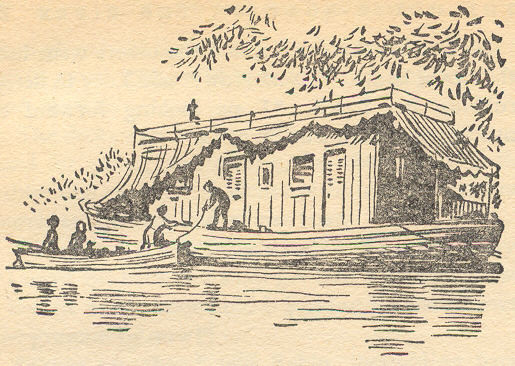
“And look—what’s that over by the bank there?” said Betty.

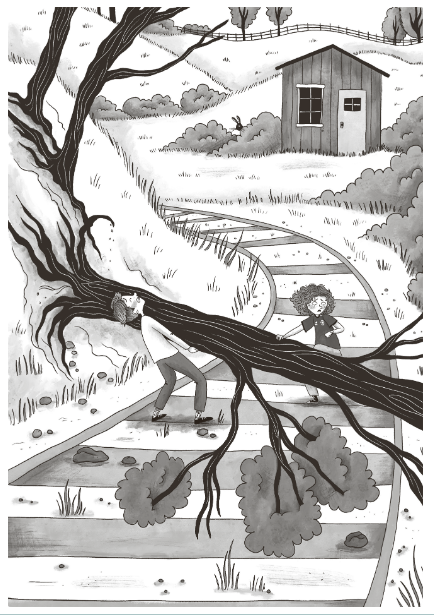
They all looked. They saw a house-boat there, badly in need of a coat of paint. It was very old and had been left to rot to pieces. It had once been a good one, and had had plenty of brass rails and white paint. But now it was a sorry sight. Plainly, no one had used it for ages.

The children make an exciting discovery in The Boy Next Door.

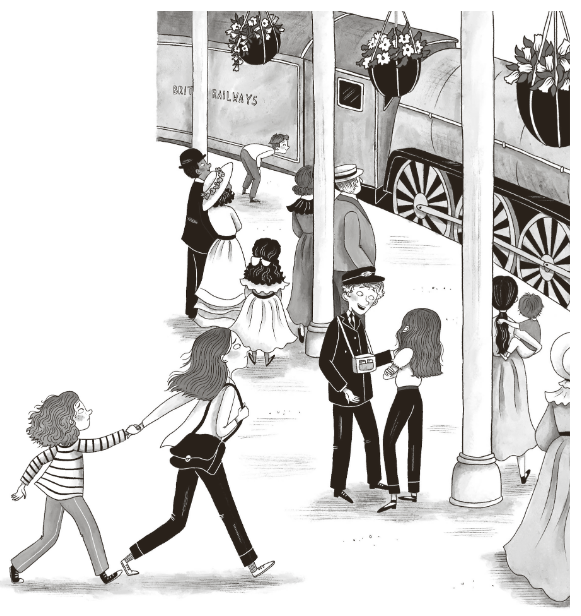
At the houseboat illustrated by Gilbert Dunlop


Posted in Blog talk | Tagged , , | Leave a comment

Blackberries

Like lighthouses I associate blackberries with Blyton, even if they only feature prominently in the odd book. For lighthouses that is, of course, Five Go to Demon’s Rocks, while for blackberries it is The Hidey Hole.


Blyton’s blackberries

Blyton’s children always seem to be picking wild berries and so on when they are on their rambles, hikes and camps. I haven’t the time to search though every book for references for this, but I know they are mentioned nine times in The Secret Island

The blackberries grew ripe on the bushes that rambled all over the place, and the children’s mouths were always stained with them, for they picked them as they went about their various jobs.

Jack picked them on his way to milk Daisy, and so did Mike. Peggy picked them as she went to get water from the spring. Nora picked them as she went to feed the hens.

Nuts were ripening, too, but were not yet ready. Jack looked at the heavy clusters on the hazel-trees and longed for them to be ripe. He went to have a look at the beans. They were ready to be picked! The runners grew up the brambles, and the long green pods were mixed up with the blackberry flowers and berries.

The children pick and sell blackberries, along with nuts, in the later months, after their strawberry and raspberry crops have died back.

There are no blackberries in the Famous Five books (according to Liam Martin’s excellent book, though the brambles and bushes are mentioned once each), but there are at least nine short stories with blackberry, or blackberries in the title, though.


The Hidey-Hole

The Hidey-Hole is Blyton’s last full-length novel, published in 1965 and coming in at 78 pages. It is not amongst her best books, her writing was definitely declining through the early 1960s. An EBSOC member once wrote in the EBSOC Journal that blackberries were mentioned 93 times in the first 8 chapters, so you can see why I associate the book with the berries!

The basic plot of The Hidey-Hole is that some children are looking for blackberries to pick to raise money for a disabled boy who needs a special trike. They try their usual spot – the common – but gypsies have already picked all the good ones. They later find a huge crop in an old man’s garden, and get permission to pick those, and that’s where the Hidey-Hole of the title comes in, as a place some thieves hide stolen goods.

the hidey-hole


My blackberries

We didn’t find 93 blackberries out back (or any stolen goods), but we found enough. There were actually a lot more but they were annoyingly out of reach, spread across the brambly slope at the back of the communal garden.

We just picked what we could reach from the steps and the bottom of the slope and our fingers were very pink by the time we were done. (We didn’t come down these steps, I thought I’d add. We came down the next set along then up these, very carefully!)

I’m sure (other than selling them) the blackberries picked in Blyton’s books would be made into blackberry crumble or some other sort of dessert to be served with custard, ice-cream or cream. I didn’t have nearly enough to do anything like that (nor the baking skills to pull it off), so we added them to porridge bars which are not entirely un-Blytonish. Porridge has a long history as a breakfast staple (particularly in Scotland) and oats have long been used in things like haggis, and in the 1950s Scott’s Porage Oats (a brand still going now) were putting recipes on the backs of their packs for flapjacks, rolled oatcakes, oat digestives and a crusty apricot pudding.  The porridge bars I make are, I suppose, are not entirely dissimilar to flapjacks.

For credit this is the original recipe I found when I first wanted to make porridge bars, but I quickly changed it up to suit me.

For a start I’ve always made double as that fits well in my rectangular Pyrex oven dish (and we’re greedy and can eat that much in a few days.) My basic recipe is:

  • 2 cups of oats (mine are usually Tesco’s or Aldi’s own brand)
  • 2 cups of milk (usually whole milk but my last batch had almond milk and was just as good)
  • 1 tsp baking powder
  • 1 tsp vanilla extract
  • 1-2 bananas, mashed (I have used tinned apple per the recipe, which is fine but a couple of bananas are really nice and make it go further)
  • 1 tsp cinnamon
  • 1/2 cup raisins

I’ve also experimented and added other fruit, like the blackberries above.

You can use tinned apple/applesauce per the original recipe or I imagine strawberries or any other soft fruit would work quite well – I quite fancy trying it with rhubarb next. That’s the beauty of this sort of recipe – you don’t have to be precise, you can throw in most things and you really can’t go wrong.

The recipe is sweet enough, I think, but you can make it more dessert like by adding sugar, sweetener, honey or golden syrup if you like. I sometimes add a handful of chocolate chips, too.

We always eat the slices cold, often for breakfast but sometimes for snack.


Posted in Food and recipes, Personal Experiences | Tagged , , | 1 Comment

Monday #488

That’s two weeks in a row that I have managed to write and publish two posts, I wonder how long I can keep it up for? Brodie starts school tomorrow so I will have a little more time on my hands (even if the school run is much longer than the nursery one was!).

Blackberries

and

Five on Finniston Farm part 2

“Blackberries, blackberries,” sang Betty, as they came to the common. “Dozens of blackberries, hundreds of blackberries, thou…”

Where are all these blackberries you’re singing about? asked Jocko, stopping and looking around. “I can only see a few rather unripe ones on that bush over there.”

“Oh well, there’ll be plenty further on!” said Betty.

Only there aren’t any more blackberries on the common as some gypsies have already harvested them to sell. The children have to look elsewhere, which is how they come to stumble upon the Hidey-Hole in the book’s title.

the hidey-hole


Posted in Blog talk | Tagged , , , | Leave a comment

Five on Finniston Farm

Here I am at book 18 now of the series, some four years after I began these reviews. It has been over ten years since I last read this book (though there are still some post-its stuck on the pages where macaroons were mentioned, for a post I wrote in 2020) and so I am noticing various details that I had forgotten!


An Airbnb horror story all round

It’s very easy for a book review to turn into a summary of the book with added comments. Today I’m going to avoid that by focussing first on one element of the book that really struck me, and then got stuck in my head.

If the Five were anyone but the Five they’d probably have had a bit of a rubbish holiday!

It all starts well enough, with them meeting in the charming village of Finniston, and having ice creams, but also hearing a bit about the farm they’re going to.

The farm itself looks good, but the welcome isn’t exactly what you’d expect when you’ve paid to stay somewhere. Their unwelcoming wagon is made up of (as Julian says) the most twinny twins I’ve ever seen. As fascinating as that is, they are also surly and have a strange habit of speaking in chorus. Their father also looks disgruntled to have more visitors as he puts it.

At least their mother is friendly, and is making scones for the Five’s tea. Things are looking up until she says that the boys are supposed to be sharing a room with an American boy who’s already staying.

It’s almost as if the Five have just turned up unexpectedly as she says I’ve a bedroom that would do for the girls, all right – but I’m afraid you boys would have to share one with the American boy – and – er – well, you mightn’t like him.

Thankfully the boys have already said they’d be happy camping in a barn – they did this before in Five Go to Mystery Moor, but they decided to come stay at a stables which was already full up, so that’s on them.

If this was some group of children other than the Five, it mightn’t have gone so well! Especially given exactly who they’d be having to share a room with. It’s one thing to book a bed in a hostel and know you’ll be sharing with strangers, it’s definitely a potential loss of stars on your review if you book a room and have to share it with someone!

I actually started trying to work out how many bedrooms there were, and came up with five. Normally there would be Mr and Mrs Philpot in one, Old Great-Grandad in two, and the Harries in three. We know that the Harries have given up their room, let’s say that Junior is in there now. Then there’s a room for the girls, and one for Mr Henning. That makes five, which isn’t enough for the boys as well. It wouldn’t surprise me at all if Mrs Philpot had intended for the Hennings to share but they wanted two rooms and wouldn’t take no for an answer. It’s not really important, the boys sleeping outside isn’t really a plot point at all (not like Dick in the barn in Five on a Hike Together, getting the message in the night, or even the boys in the stables in Five Go to Mystery Moor so they can stop Sniffer’s dad taking the horse) but this is the sort of place my mind goes when I’m reading to review!

On the other side, and the reason I mentioned Airbnb rather than B&Bs/guesthouses in general, is that on Airbnb the host gets to rate the guest, too. (I also mentioned Airbnb as there are a LOT of horror stories about rentals not existing, or turning out to be not at all as they were described.)

The Five, I’m sure, would get glowing ratings as the boys camp in the barn (despite having paid for a room), the girls wash dishes and lay the table, and the boys milk cows, fix the hen houses and do whatever else they can to help out around the farm. Again – it’s lucky that they are the sort to get stuck in and do that type of stuff, or who knows what the increasingly harassed Mrs Philpot might have ended up doing. A special star would also have to be given for their [spoiler alert] discovering of the long-lost treasure and keeping it from falling into the wrong hands.

Speaking of wrong hands… Junior and his father would, most definitely, not get a good rating from the Philpots.

Junior is a truly abominable guest. His list of misdemeanours include:

  • trying to set the tractor to drive off on its own
  • complaining (in a non-constructive way) about the accommodation in front of the hosts
  • being rude and demanding when he wants a drink during meals
  • wanting his breakfast served in bed at 9am, and repeatedly ringing his bell for it but then falling back asleep before it arrives
  • leaving his room an untidy mess, including strewing the floor with nut shells
  • trying to ride the calves
  • chasing hens
  • stoning ducks
  • splitting bags of seeds and letting it all pour out
  • sneaking around listening to conversations

Some of these are more minor than others. Wanting breakfast in bed is fine if the host offers that, but you ask for it politely not demand it!

His father is not significantly better, also being rude and demanding, talking rudely about Old Great-Grandad to Mrs Philpot, while the old man is in the same room,  throwing used matches on the kitchen floor and plotting to buy up as much of the farm as he can, using any unscrupulous means that he can.

In the end the Five would rate Finniston farm highly – great food, lovely place, friendly family (once the twins unbent, having seen the Five helping out a lot), great adventure to be had. Mr Henning’s holiday was definitely soured by his failure to find the treasure and his review would probably mention how he would have got away with it, if it wasn’t for those pesky kids.


Well, I’ve rambled on for nearly 1,000 words about how things would have gone if Airbnb had existed in 1960. Next time maybe I’ll get to the actual adventure!

Posted in Book reviews | Tagged , , | 5 Comments

If you like Blyton: The Wreck of the Argyll by John K Fulton

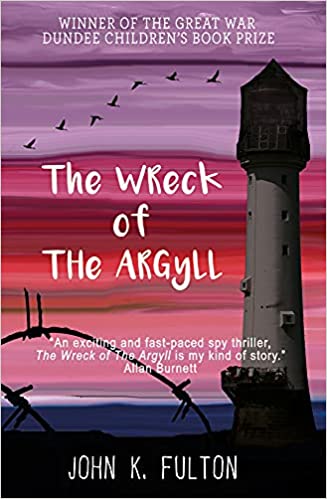
I happened to see this on the returns trolley in the children’s library where I work, and I picked it up because of the lighthouse on the cover. I like lighthouses and tend to associate them with Blyton, despite only having read one book (you can all guess which one) with a lighthouse setting. I suppose they are mentioned a few other times, normally in conjunction with some sort of night-time signalling.

Anyway, I noticed that it was set in and around Dundee which piqued my curiosity. I borrowed it there and then, and now, some months later I have actually read it! I actually read the whole thing while sitting on the beach at Carnoustie, (in between paddling and rock-pooling) which is about as close as you can get to the lighthouse on land. If I had thought about it I would have taken a nice photo of the book on the beach with the sea in the background – the lighthouse not being visible due to the curvature of the Earth – but you’ll have to make do with a stock photo of the cover instead.


The lighthouse and the wreck

The basic story of the wrecking of HMS Argyll is a true one. In 1915 the Bell Rock Lighthouse was in darkness, to prevent enemy submarines using the light to navigate to their advantage. The HMS Argyll, having travelled from Devon, up the West Coast of Scotland and then down the East – attempting to avoid the more dangerous waters off the south and east of England – got caught in a storm off the coast of Angus. They requested that the Bell Rock Lighthouse was turned on to aid their passage past the treacherous shelf of rock upon which the lighthouse sits.

However, the lighthouse at that time had no radio and could only be contacted by boat or by signalling from the mainland. Due to the storm neither or these methods could be used and so the light was not lit. Nor was a message passed back to the Argyll to warn them of this, and so, expecting the light to be lit they didn’t know they were passing the lighthouse and ran aground.

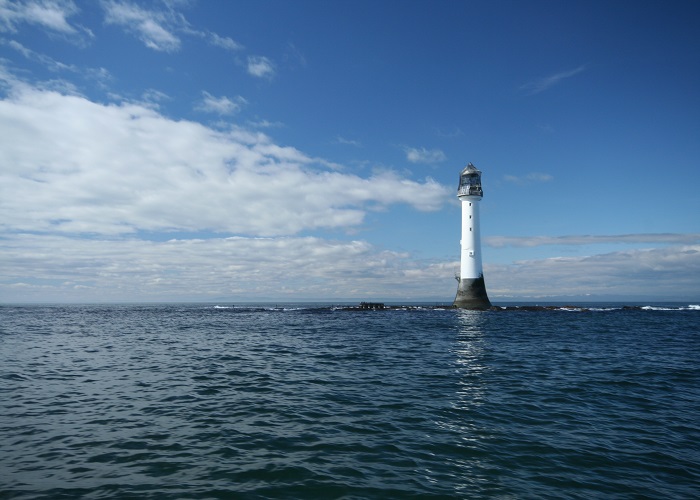
The lighthouse itself is a pretty fascinating one. It is the oldest working sea-washed lighthouse in the world, having been built between 1807 and 1810. Despite being over 200 years old (and the lowest 15 metres being underwater) the masonry base hasn’t been upgraded or replaced since it was built.

Shamefully, despite it being within 25 miles of my home, and only about 10 or 11 miles off the Angus coast – where I frequently visit the beaches – I didn’t know anything about the lighthouse until I read up on it after reading the book. While reading I was picturing a lighthouse at sea, but sitting on at least some visible rock. But as you will see in pictures it’s very much just a lighthouse sticking out of the water!


Mr King or Mr Roland?

The story begins with Nancy sneaking out of her house to follow her teacher, believing he is a spy. Her evidence is fairly flimsy, but he does go walking each evening, late at night, in the direction of the docks or the railway station.

Her first night of following him is a bust, but on the second she meets a boy known locally as Jamie the Howff – so named because he lives in the ancient (and very much still there today) graveyard behind the high street of Dundee, the Howff. He saves her from a couple of other boys who are hassling her and accompanies her on her endeavours.

The question is, will her teacher turn out to be a Mr King (sneaking around on the side of good) or a Mr Roland (sneaking around evilly as charged).

In their search by the docks Nancy and Jamie stumble upon a (fabricated for this novel) plot to signal a German U-Boat with the HMS Argyll’s route (unbeknownst to them the aim is to relieve the HMS Argyll of some critical war intelligence). The policeman at the docks won’t listen to them, so it’s off to Arbroath on an ambulance train to try to warn the shore signal station there – and then back the same way to try to catch one of the culprits


The other side of the story

Meanwhile, the alternate chapters tell the story of 15 year old Midshipman Harry Melville as he is on watch for the Bell Rock Lighthouse and is issued with orders to protect the intelligence documents at all costs.

Then of course the ship runs aground and they must try to evacuate in the middle of a storm. Spoiler alert (as much as it can be a spoiler when it’s based on a true story) due to the daring actions of a couple of two destroyers all men were saved.

The ship was destroyed soon after it was emptied and it’s still down there, and apparently still diveable if you’re capable of that sort of thing!


Is it Blytonian?

This isn’t the most Blytonian novel I’ve read, I’d admit that. Firstly it’s set a fair bit earlier than any of her works – though I do recommend books from a wide range of eras so that isn’t exactly an issue.

Secondly it’s set very specifically in war-time, (WWI, naturally) while Blyton generally skirted around WWII in her books. Even the ones that did mention the war were a bit oblique about it.

Thirdly, it’s based on a true story which, as far as I’m aware, Blyton never wrote any fiction based on real events.

None of these are reasons not to read it, of course. It has a fast pace (which is very Blytonian) and a girl teaming up with a homeless boy to solve a mystery unaided by the police.

If I had one criticism it would be a slight lack of description. It’s a short and pacey book – we meet Nancy at 10pm one evening, Jamie not too much later. The next evening they set off again around 10pm and everything is done and dusted by the middle of the next morning. There’s not a whole lot of room for long descriptive passages, but it could have benefited from Blyton’s skilful way of describing people and places.

For example the poor state of Jamie’s clothes are described – this is important to show us why the police and others would not want anything to do with him. However nothing about Nancy is described leaving us with no idea what she looks like other than she had a coat on at one point. I knew fine well this was set in WWI, and I know more or less what the fashions were, and yet I ended up with a very 1940s or 50s image of Nancy. The same goes for the car that features. A 1915 car is a very different beast from the 1940s or 50s kind I was picturing.


Over all, though, it was an exciting read. You could feel the frustration of Nancy and Jamie as they travelled the Dundee and Angus coast trying to contribute in their own way to the war effort. The few helpful characters they met along the way were (if rarely physically described) were well-written and clearly the whole thing was very well researched.

I enjoyed the setting in particular, as of course I am familiar with all the places mentioned (with the exception of the lighthouse, of course. But I am putting Arbroath’s Signal Tower Museum on my list of places to visit). Your mileage may vary on that, depending on how much you know of this area.

Posted in Book reviews, Other Authors | Tagged , , , , , | Leave a comment

Monday #487

Well, I managed to write twice last week. Let’s see if I can manage to do it two weeks in a row! It’s the last week of the school holidays here, today we are going bowling and crazy golfing to celebrate Brodie turning 5.

Talking of birthdays, this week marks 125 years since Enid Blyton was born!

If you like Blyton: The Wreck of the Argyll by John K Fulton

and

Five on Finniston Farm

‘Old junk!’ shouted Great-Grandad again, banging with his glass now. ‘Do you call that great old cart-wheel you bought old junk? Why, that’s more than two hundred years old! My Great-Grandad made it—he told me so, when I was a mite of a boy. You won’t find another wheel like it in England. Hoo—that wheel was made before the first American was born! I tell you . . .’

Great-Grandad is great character and I always wish we could have had more of him in Five on Finniston Farm.


Posted in Blog talk | Tagged , , | Leave a comment

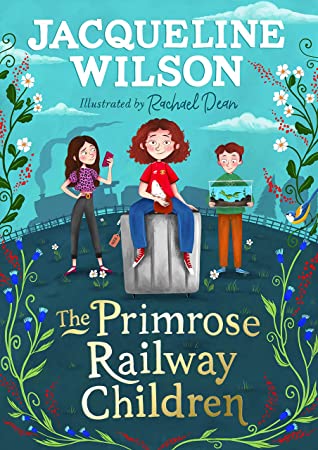
The Magic Faraway Tree: A New Adventure by Jacqueline Wilson

I finished the book earlier in the week, so finally I have finished the review!


The style and setting

I think the first thing I will say is that Jacqueline Wilson does not attempt to mimic Blyton’s writing style. This can be done well – but the best examples I have seen have been from fan-fiction writers. No professional author I’ve read has managed to do it very successfully.

Secondly, the book is set firmly in the present-day. The language is modern but fairly neutral – it isn’t full of slang or pop-culture references which would quickly date it. There’s also none of that strange dichotomy whereby some books have children exclaiming golly gosh how frightfully awful one minute and then spending their decimalised money the next.

There are a few brief references video games and Satnav (which stops working once they are near the Enchanted Wood – something magical going on, perhaps?) in the first chapter, but Wilson has kept the charming old holiday cottage a technology-free place to allow for a more timeless setting. It is not completely timeless, as the odd reference to modern activities are made, but they are rare.


What’s the same?

Wilson has not taken the entirely of the Faraway Tree cannon and added to it, but she has preserved the majority of it, making changes here and there to suit her narrative. Of course this book takes place some 70 years later, and so you’d imagine some things would change over that time period.

Anyway, what has remained the same are the inhabitants of the tree. Moon-Face is there, in his house with the slippery-slip and the red squirrel who collects the cushions. Silky is there, still baking magical treats. The Angry Pixie stills shouts out his window and throws water at unsuspecting climbersby. Dame Washalot is still washing away and also tipping water over unsuspecting climbers. The Saucepan Man and Mr Whatzisname are still friends.

Various lands still come to the top of the tree at random intervals, and there’s still the danger of being swept away if you stay too long in one of them.

The woods are still a mysterious place, over the ditch and full of wisha-wisha-wishas and friendly animals.


What’s different?

Aside from it being in the present day with different children, of course.

Silky shows herself to Birdie, the youngest, their first evening at the cottage, and then every time they go into the woods an animal meets them and leads them there, whereas in the original stories the children find out about the tree from some gnomes and have to persuade them to to show them the way. After that they are able to find it whenever they want.

I wondered if the tree, and its inhabitants got lonely after Jo, Fanny and Bessie stopped visiting, though perhaps their children and their children’s children would have? So perhaps its more of a sign of the times – the tree only allows trusted visitors and sends an escort, nobody else will ever find it.

The passage of time is different, too. In the originals the children would take off for a few hours and return after a few hours. Here they are only gone minutes, no matter how long they spend in the tree. Again, the tree is magic so this could be its way of maintaining a way for it to have visitors. In the present day children don’t get to go running off all day on adventures in the woods without someone at least wondering what they are up to.

Despite not having wings in the original books Silky was illustrated with wings by Rene Cloke, and then by most other illustrators after that, too. Interestingly she also has wings in Wilson’s book. I can imagine Wilson thinking how Silky doesn’t have wings, but she really ought to, and putting them in, rather than it being a mistake. There are so many other details from the original book in there that it’s obvious research has been done, but I’d be interested in seeing her actual thought process on it.

The lands that come are new for this story and are obviously designed to appeal to modern children. There is the Land of Unicorns (with unicorns being hugely popular for girls in particular), the Land of Bouncy Castles, The Land of Princesses and The Land of Dragons.

There was one new element that I wasn’t quite so keen on, and that was the hint of romance between Silky and Moon Face. I have only read the first two books, and only once each, so there may in fact be a subtle closeness between them in the original books, but I don’t think so. There’s nothing overtly romantic but there is definitely a special friendship there, with Moon Face rushing in to defend Silky and getting quite upset when he thinks she is going to go off with a prince. There is also a couple of references to kissing, for example the children looking for Silky and wondering if she’s off kissing the prince, which I’d prefer not to have had in this book.


Is it ‘woke’?

To answer in brief, it’s really not.

I mean, not unless you think that boys and girls both being allowed to do adventurous things is woke, or not having boys say things like ‘you girls can stay here and clean the house while I go exploring’. I don’t agree with rewriting the original books to ‘fix’ these things but it would be pretty weird and pointless to go inserting 1940s social attitudes into a 2022 novel, unless it was set in the 1940s.

There are perhaps three times where the children say anything deliberate about equality (but without using such a word). There’s nothing outlandish, nothing more than the kind of thing George would say about being as good as a boy, and why should she have to do the washing up just because she’s a girl. If I was to make any criticisms of the book it would be that one or two of these comments from the children seem a fraction contrived, or at least a little too obvious.

It’s interesting, though, that I feel the book is aimed a little more at girls than at boys. Almost all of Blyton’s books were aimed at both genders – Malory Towers and St Clare’s being the only strongly girl-orientated series – including the Faraway Tree books. This one isn’t strongly aimed at girls, but with the Land of Unicorns, a cute baby bear, The Land of Princesses, an emphasis on how pretty Silky and her ever-changing outfits are, and so on, I feel that the content is a little more stereotypically girly than ‘gender neutral’ as the Daily Mail called it. (Incidentally, the children are not at all gender-neutral. Milo likes comics and gaming, Birdie wants to be a princess and Mia loves unicorns.)


Over all?

Over all this was an enjoyable read. It was different enough from the original to stand apart as a modern continuation, but it also retained enough of the original books to be familiar.

The new foods Silky made were wonderfully imaginative and would have been perfectly at home in Blyton’s tales. The lands that visited the tree were interesting, with the last one being the sort of dangerous one that would have gotten the original trio into just as much trouble.

The one thing I really didn’t like were the illustrations. They managed to make even the sweetest of characters look positively terrifying! They’re not so bad in colour, on the jacket, but in shaded black and white… shudder. I don’t have my scanner set up right now but I will get some of the illustrations scanned and added as soon as I can so you can experience them for yourselves!


Have you, or will you read this?


Posted in Book reviews, Other Authors | Tagged , , , | 1 Comment

July 2022 round up

There was not an awful lot of blogging done last week – as I mentioned in the last Monday post I ended up being ill again – what a summer!


What I have read

Another not very good month – I didn’t read anything for about a week while I was ill. What I did read has been bolstered by Brodie discovering Roald Dahl and demanding I read his books to him while he’s in the shower, putting his pyjamas on, brushing his teeth and finally in bed.

What I did read is:

  • Wedding Bells for Land Girls (Land Girls #2) – Jenny Holmes
  • The Masked City (Invisible Library #2) – Genevieve Cogman
  • Just One Damned Thing After Another (St Mary’s#1) – Jodi Taylor
  • The Last Chance Hotel (Seth Seppi Mystery #1) – Nicki Thornton
  • The Twits – Roald Dahl
  • The Giraffe, The Pelly and Me – Roald Dahl
  • The Magic Finger – Roald Dahl

And I’m still working on:

  • A Room of One’s Own – Virginia Woolf
  • George’s Marvellous Medicine – Roald Dahl
  • Are We Having Fun Yet? – Lucy Mangan
  • The Magic Faraway Tree: A New Adventure – Jacqueline Wilson
  • Scotland’s Lost Branch Lines: Where Beeching Got it Wrong – David Spaven

Anyone who’s read more than a few of these round ups will recognise Jodi Taylor’s name and probably be thinking She’s reading those books AGAIN? This is my fourth time reading the first in the series as it was all I could face when I wasn’t well – listening to the audiobook.


What I have watched

  • We’ve continued House of Games, Mythbusters and the new season of Only Murders in the Building, and started Ms Marvel.
  •  I finished Desperate Housewives – I binged quite a bit while I wasn’t well, and The Great Big Tiny Design Challenge
  • I continued Murder She Wrote series 10 & started 11, but it’s on DVD and I can only watch it in the living room, and when I can be bothered swapping discs so I have also watched various other things including Cabins in the Wild with Dick Strawbridge, the new series of Dream House Makeover and The Parent Trap (both the original and the remake).
  • Our weekend films were Renaissance Man, The Princess, and Dr Strange in the Multiverse of Madness – I thought this was better than the first Dr Strange film.
  • On Tuesday nights we watched Honey I Shrunk the Kids and Honey I Blew Up the Kid
  • Brodie and I watched Ghostbusters 2 to console him after I encouraged him to bin a broken toy and he was sick from all the crying… He had watched the first one while I wasn’t well and now it’s his favourite thing ever.
  • We took Brodie to the cinema for the first time to see Minions: The Rise of Gru. Probably the weakest instalment in the series, but it still had its funny moments and Brodie was enthralled.
  • And lastly my sister and I went through to Edinburgh to see Footloose the Musical (we were supposed to see Bring it On earlier in the year but it was cancelled.)

What I have done

  • Managed away for a brief holiday to Tomintoul and took a ride on a steam train before I felt too ill to do anything else.
  • Went school uniform shopping for the first time, though I still have more to get.
  • Did several walks, and have been to the beach a few times – collecting pottery and glass every time of course.
  • Spent the height of the hot weather in the garden as I was just coming out of being unwell. Sadly the paddling pool had managed to develop multiple holes at some time over the winter so we had to resort to putting our feet in a big plastic box filled with water to cool off. That and eating ice poles.
  • Went to Cupar for their model railway exhibition, we all enjoyed looking at the set-ups and spotting the little details.

What I’ve bought

I filled another gap in my magazine collection with Volume 3 issue 26. I now have all of volume 3, (and all of volume 1) and only 12 more to collect from across the rest of the volumes. (If anyone’s has any spares or any to sell I am missing 2.14, 2.15, 4.22, 4.23, 4.24, 5.17, 5.19, 6.6, 6.13, 6.14 and 7.12.)


How was your July?

Posted in Personal Experiences | Tagged , , , , , , | 2 Comments

Monday #486

I was going to begin today’s post by lamenting about promising a review of the Jacqueline Wilson Faraway Tree book last week, and then not delivering. (I was only halfway through the book by the time Friday came around and I didn’t feel like it would work if I reviewed the book in two halves. It may end up being two posts still, but I’d rather divide them by themes/topics).

Anyway, what actually happened was that I also failed to schedule last Monday’s post, so I never made the promise in the first place…

It’s August now so hopefully this will be a better month. I ended up losing a whole week in July as I had another bout of illness (I felt significantly worse than I had when I had Covid in June) – hence at least some of the blogging gaps last month.

July round up

and

The Magic Faraway Tree: A New Adventure by Jacqueline Wilson

“Hello, little bunny!” Birdy whispered too, though it almost came up to her knees.

“See how its ears are twitching,” Milo whispered. “It’s listening to us!”

“I am listening,” said the rabbit. “But it’s hard to hear exactly what you’re saying because you’re whispering.”

The older children meet their first magical creature in Jacqueline Wilson’s modern version of The Magic Faraway Tree. Birdy – the one who already believes in magic has already met a fairy, though no-one believes her.

Posted in Blog talk | Tagged , , , | Leave a comment

My favourite Blyton covers part three

I have already written two posts about my favourite covers, but as there are so many good ones I am back with a third. This time I’m going to look exclusively at the wrap-around kind of dustjacket. I have shown a few already – from the Adventure Series and the Caravan Family series amongst others – but here are some of the others I have found that didn’t fit into the categories I already used.

It’s hard to put into words why I like wraparound dustjacket illustrations so much. I mean, first, I suppose, it more than doubles the amount of space that was available for the artist to fill with their work. But there is also the clever way they use the spine and the back panel – all part of the same scene but so often beautifully framing individual elements so that they each create a picture in their own right.

Some jackets look nice from the front but when you open them out to get the full effect it just elevates them.


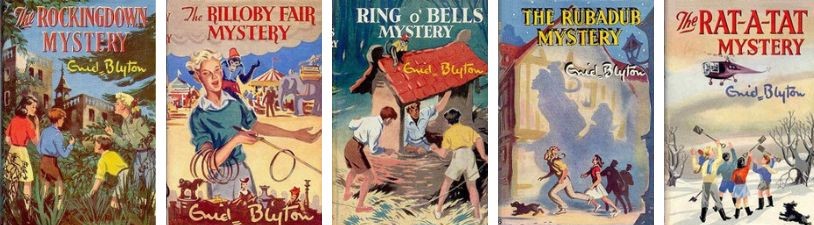
The Barney Mysteries

I have already featured one cover from the first book – the Rockingdown Mystery – but it wasn’t a wrap-around one. That book didn’t get one, despite having at least three early hardback editions.

Anyway, all the rest of the series did. I think my favourite two are from The Ring O Bells Mystery and The Rilloby Fair Mystery, though they are all good.

ring o bells mystery

The front of Ring O Bells is attractive, and this looks good on the shelf with just Loony visible on the spine, but opening it out reveals Diana holding on to the other end of the rope, with Naomi Barlow’s cottage hidden amongst the trees.

rilloby fair mystery

Again, this is a nice cover just from the front. However, opening it up to reveal a wider view of the fair is even better. I particularly like the framed post on the spine with the hanging sign that reads Enid Blyton, and Collins being written on the box supporting that ornament.

rubadub mystery

The front of The Rubadub Mystery is almost claustrophobic with the narrow passage filled with the enormous shadows of the children, and then opens up to reveal more of the village, and the mysterious light shining from the window.

the rat a tat mystery

The Rat-a-Tat cover doesn’t have a lot on the back but the snowed in house is still attractive, with the tower framed on the spine.

the ragamuffin mystery
And lastly the Ragamuffin cover, at first glance, looks rather bare on the back. But then you may notice some shadowy figures emerging from a cave. Plus Miranda and the man with the heavy sack are nicely framed on the spine.


Malory Towers

All the Malory Towers books had two different wrap around covers so I’ll just show a few of the best here.

Second Form at Malory Towers dust jacket 1957 reprint by Lilian Buchanan

The original jacket for Second Form is attractive but does not stand out terribly. This second reprint cover, however, has possibly the most exciting episode of the series front, side and back. From the front view we see Mary-Lou hanging from Daphne’s belt rope, and only when the cover is opened up do we see the rescue party about to leap into action.

The wraparound here on the (reprint) Upper Fourth is able to give us a much better view of a classroom than the front cover alone could. 

The same goes for the reprint of In the Fifth, which opens out from the stage of the pantomime to show the ‘orchestra’ and some of the audience.


Some other titles

The Magic Faraway Tree 

The front of this cover is very inviting as you almost wait to see is Silky is going to open her little yellow door. And then it opens up to show us the Angry Pixie, Moon-Face and some other inhabitants of the tree.

The Adventure of the Secret Necklace 

I absolutely love how Isabel Veevers has created an almost 3D scene with the spine forming the dividing wall between the corridor on the back and the room on the front cover. When the book is closed they are two separate scenes, but open, as above, the 3D effect is very clear.

Mr Pink Whistle’s Party

This is another beautiful front cover, packing in a ton of detail like the writing on the cake and the pleats in the skirts. Then opening it up there’s a whole host more detailed characters enjoying the party.


Do you have a fondness for the full jackets in particular? If so, what’s your favourite one?


Posted in Illustrations and artwork | Tagged , , , , , | 3 Comments

Malory Towers on TV series two – Episodes nine and ten

I had almost forgotten about this, as it’s been quite a while since I last watched any of it. And with five episodes still to watch, I discovered five minutes before I sat down to episode nine that series 3 has arrived on iPlayer today.


Episode nine – the sneezing trick

This episode doesn’t really resemble anything from the Second Form book. Firstly we have the sneezing trick – as played by Alicia and Darrell in the Third Form.

The notion that the school might be closing is not really considered by the girls, this isn’t a trick played to keep the spirits up or anything like that, it’s just because Alicia has been sent it and can’t resist.

And so they do play it – despite Sally’s protests (much like in the book). They play it on Mam’zelle Rougier (Mr Parker being inexplicably absent this episode and there being no Mam’zelle Dupont at all) who, of course sneezes madly, causing all the girls to laugh from the moment it starts. In the books they always try desperately not to laugh as to not give the game away but on-screen they don’t seem to be able to do that – except Sally, of course.

Mam’zelle Rougier leaves class because of the sneezing, giving Sally another chance to remonstrate with the girls. Later, when Mam’zelle Rougier returns to her desk with Matron, and they both start sneezing they realise that it was a trick. This is funny, but not as funny as the sequence of Mam’zell Dupont, Miss Potts and Matron all getting the sneezes.

While both book Mam’zelles had a temper, Mam’zelle Rougier’s was colder and sharper, while Mam’zelle Dupont could rage but generally saw the funny side of things later. TV Mam’zelle takes a different direction here and gets upset – questioning why the girls play tricks on her (as if she has been singled out somehow) and why they do not like her.

Mam’zelle had already asked Sally if a trick had been played and she had – shock horror – outright lied about it. No ‘good’ Blyton character ever lies outright. They may hedge a little with statements like I don’t know who put the sneezing pellet there as they didn’t actually see which of the two girls it was, but they would never say It wasn’t a trick when they knew fine well it was.

She gets an unfortunately comeuppance, of course, as they identify the sneezing powder. Sally won’t snitch on Darrell and Alicia, though, and is punished by not being allowed to go away on the half-term trip.

Darrell is horrified that Sally is being punished over her trick and urges Alicia to come with her to take the blame. Alicia refuses as she sees that Sally is being punished for lying and her admitting to playing the trick won’t change that – she also points out that she took the blame for the caricatures so she’s not doing it again. It turns into a huge fight – a physical one – between the two girls with Darrell declaring she will never be Alicia’s friend ever again.

This is quite dramatic of them as they still have at least one more series to go, so either Alicia is going to have to do something heroic or generous to get back into Darrell’s good books or they may have to avoid each other for the rest of their school years. (In the book Alicia does come clean and every girl except Sally – the only one to oppose the trick – is punished with missing a half-term holiday.)

They get caught fighting and Darrell admits her part in the trick, earning her the punishment of missing the trip too.

Interestingly there’s no outward suggestion that Miss Grayling and Matron connect the dots between Sally’s lie, the fight and Darrell’s admittance of guilt. I think it should be fairly obvious to them that Alicia was involved in the trick but doesn’t want to own up. Still, I’ll give them the benefit of the doubt and assume they do have an idea but also have a reason for not saying anything. I also noticed Gwen being her usual cruel self – having witnessed Darrell and Alicia rolling around on the floor she declares to Matron that Darrell started it, though she had no way of knowing that.

Talking of Gwen, the very minor secondary plot in this episode is the continuation of her being a thief. We’d already seen her taking Georgina’s compact, a shilling and her mother’s brooch, but now Irene’s hair-pin is missing…

Gwen then takes the brooch to Ron, telling him it’s an unwanted gift and asking him to take it to the village to sell it to the antique store. I have been baffled by her motivations for stealing, so this almost makes sense. She isn’t getting her allowance, so stealing things to sell for money has some logic at least.


Episode ten – The school trip

In addition to the items listed above, Alicia’s pen has gone missing and Mary-Lou’s lucky coin. This is the point where the girls come to the conclusion that this is not a coincidence and there is a thief about.

Gwen seems particularly anxious about her stash and keeps getting it out to examine it and then hide it in a new place. She’s also planning to buy the ice on the school trip – I’m not exactly sure why, it doesn’t seem like a very Gwen thing to do but I may have missed some earlier detail that would explain it.

Gwen – duplicitous to the end – spends time helping Mary-Lou look for her lucky coin and then they both miss the trip as they are late to the drive and the bus goes off without them. I suspect that it was deliberate on Gwen’s part, avoiding the trip to avoid buying the ices (the money for the brooch not having reached her yet.)

While searching for Mary-Lou’s coin again, Gwen locks her in the classroom cupboard, giving her time to go and hide her stolen stash again.

She spends a ridiculous amount of time taking it out her trunk to look at it, considering she shares a dorm with several other girls, girls who are the rightful owners of some of it! I literally kept shouting at the screen telling her to put the stuff away before she got caught. When she locks Mary-Lou in the cupboard it has been left under a hanky in the middle of her bed.

She is further delayed by Darrell throwing her the key and it going down a grate, but this serves a dual-purpose. First it gives her time to listen to Mary-Lou’s story of why the coin is special to her (purely sentimental) and Darrell and Sally find a ring in the grate which buys them some more conversation time with Miss Grayling.

The ring is unfortunately not part of the treasure as according to Lady Jane’s diary it was given to a housemaid (it doesn’t say why, though) some time before the rest was hidden. Miss Grayling impresses on them how one ring can’t rule them all save the school, but finding all the treasure could. Darrell and Sally then have a look at the diary and spot a possible clue about the treasure, leading them to a spot on the cliffs where they have unfortunately already collapsed. (My prediction is that when Mary-Lou falls off the cliff and Gwen – as she’s the thief – rescues her they see something sticking out the fallen cliff.)

Before this Darrell had already managed to warn her about Mr Thomas and the mines, a fact Miss Grayling took more seriously than Mam’zelle did, thankfully. Then she and Sally are caught sliding around in the mop bucket, causing Miss Grayling to laugh about how she and her siblings used to do the same.

They then draw her attention to some markings on a stone arch in the hallway – height marks of Miss Grayling and her siblings as they grew up in Malory Towers. Either I’ve missed something previously or this is a newly revealed secret designed to give Miss Grayling further impetus to save the school. It’s a nice little backstory, a little spoiled unfortunately by a) the girls never noticing the marks before and b) Miss Grayling having ‘forgotten’ all about them despite them being standing out clearly against the stone and being located in a well-used corridor right outside her office. Miss Grayling even says how she often thinks of Min, her six-year-old sister who died of measles. (I haven’t had a chance yet but I’d like to go back and try to see if the marks are even there in earlier episodes, particularly series one, as you can see below they’re pretty visible even on a screen shot!)

Back to Gwen, and in an attack of conscience she returns the coin to Mary-Lou and appears to want to return Irene’s hair pin too. The fact that Mary-Lou’s coin is sentimental (and badly damaged) makes it an interesting choice to steal. It would be recognised if she pulled it out her purse as it stands out, so she’s unlikely to spend it, so why take it?

It looks like things may be unravelling for her anyway, as the girls report seeing Mrs Lacey’s brooch in shop window. As it was Ron who sold it, however, I can see him getting the blame for at least a while.

Posted in Blyton on TV | Tagged , , | 9 Comments

Monday #483

Only one post this week as I’m away for a few days, but one is better than none, especially when it’s very overdue!

Malory Towers on TV series two: episodes nine and ten

A cold hand seemed to creep round Gwendoline’s heart and almost stop her breathing. Suppose—suppose that the wind had blown little Mary-Lou over the cliff? Suppose that even now she was lying on the rocks, dead or badly hurt! The thought was so terrible that Gwendoline couldn’t swallow her morsel of bun and half-choked.

Funny that the book should contain a line that still fits perfectly despite them changing the roles of the characters. I am hoping this will play out much as it does in the book, of course swapping Gwen for Daphne as the rescuer. What will be interesting is the reveal of the thief and how on earth they will be able to justify keeping Gwen at the school, and how the girls will be able to forgive her.


Posted in Blog talk | Tagged , , | 3 Comments

June 2022 round up

I might not have been on the blog as much as usual last month but I still did enough things to write about.


What I have read

Not a great month for reading as I barely read a thing for a week while I had Covid, I just couldn’t focus.

What I did read is:

  • Stepping Up – Sarah Turner
  • Puzzle Pirates – Susannah Leigh
  • The Invisible Library (Invisible Library #1) – Genevieve Cogman
  • The No-Show – Beth O’Leary
  • The Diary of the Naughtiest Girl – Jean Willis, reviewed here
  • 101 Pieces of Me – Veronica Bennett

And I’m still working on:

  • Wedding Bells for Land Girls (Land Girls #2) – Jenny Holmes
  • The Masked City (Invisible Library #2) – Genevieve Cogman
  • A Room of One’s Own – Virginia Woolf

What I have watched

  • House of Games
  • The last episodes of the latest series of Taskmaster, and their second Champions of Champions special.
  • I’ve carried on with Desperate Housewives and am now onto season seven which I’ve never watched before.
  • On the Tuesday  we managed to get together my sister and I watched Father of the Bride
  • We continued Stranger Things and finished Obi-Wan Kenobi.

What I have done

  • We had our family holiday in Glencoe, and were lucky to have a lot of warm days and sunshine. We drove up to Oban to visit Dunstaffnage Castle and Mccaig’s Tower (a huge folly), and of course treated ourselves to ice creams to cool off.
  • We took a boat trip on Loch Shiel, and afterwards went up to the Glenfinnan Viaduct viewpoint in time to see the steam train cross it.
  • We also drove up to Fort William to visit Treasures of the Earth – a favourite from my childhood – and had a quick look at Neptune’s Staircase and then crossed the road to see the steam train again as it headed north.
  • We had a couple of days where we didn’t go far, and visited the former slate quarry at Ballachulish (now home to a lot of tadpoles, fish and birds) and built a dam in the river behind the house, and took a couple of walks around a lochan (full of very hungry ducks).
  • Also local to us was a lovely little folk museum and a group of deer which we saw in the fields behind our house and even the garden too.
  • After that we came home, had time to visit the wildlife centre and then caught COVID which cost us a whole week.
  • Post COVID we managed to have our delayed BBQ for father’s day, and Brodie finished nursery forever (sob) so we got to go along for a celebration and join in some activities with him.
  • We also went to a play session in the park which was filmed for the local news and Brodie ended up on TV!

For context: the photo of Brodie in his waterproofs was taken at nursery. The hole he is pointing to normally holds a bowl for the mud kitchen. It is this hole he chose to climb into and get stuck in during his second-last week at nursery…


What did your June look like?


Posted in Personal Experiences | Tagged , , , , , , | 3 Comments

My top five St Clare’s villainesses by Chris

I suppose the St Clare’s books were mainly aimed at girls, and I probably wouldn’t have read them as a child had I not had five sisters, four of them older than me, and so I inherited their copies. For some reason they either did not like or did not have Malory Towers books. Anyway, I read them and one of the things which appealed to me about them was that, like many of Enid Blyton’s books, there are clearly signalled heroes and villains, or, in the case of St Clare’s, heroines and villainesses.

In St Clare’s, heroines range from plain decent Hilary Wentworth and Lucy Oriell, to decent – but flawed – Pat and Isabel O’Sullivan, to decent – but a bit cheeky – tricksters Bobby Ellis and Janet Robins, to cheeky – but fundamentally decent – French minxes Claudine and Antoinette.

But, actually, Blyton was more subtle than that, and in St Clare’s there are several characters who initially appear to be villainesses (like Mirabel Unwin and Margery Fenworthy) who turn out to be heroines. I can’t, though, think of any who travel in the opposite direction, from heroine to villainess.

Anyway, I must confess that reading them as a child my main enjoyment was in seeing the villainesses ‘taken down a peg or two’, as Blyton might have put it. So, here, in ascending order of badness, are my top five St Clare’s villainesses along with any mitigations there may be for their faults.

Alma Pudden (Fifth Formers at St Clare’s)

Alma, demoted from the Sixth Form, steals food from the midnight feast cupboard and when Alison realises that someone is pilfering, leading to the cupboard being locked, she plays nasty tricks on her. Then, after Antoinette realises that Alma is the pilferer and humiliates her for her greed, Alma sneaks to the Mirabel, the Games Captain, about the planned feast.

Mitigation: In my memory, Alma was most dislikeable, but thinking about it now, I feel she was unfairly depicted. She was certainly wrong to sneak, but it does seem as if she had an eating disorder and, really, her main ‘sin’ is being fat. Blyton eggs us on to dislike her for that reason alone by naming her ‘Pudden’, which of course leads to her being nicknamed ‘Pudding’ by the other girls (there was actually a recipe in Mrs Beeton’s Cookbook of 1861 for ‘Alma Pudding’).

Elsie Fanshawe (The Second Form at St Clare’s)

Like Alma Pudden, ‘Catty’ Elsie should be in the form above, although in her case she was not put up rather than being dropped down, but is made co-head of the second form. She abuses that position to indulge her spiteful nature, leading a campaign of nasty tricks against Mirabel Unwin which she tries to blame on her fellow head girl. However, the form turns against her and decide not to accept her as co-head, leading to Elsie’s humiliation. Despite attempts to reach out to her, Elsie tries to ruin Carlotta’s birthday party but fails, in the process exposing herself to a dressing down from Miss Jenks. However, with the form’s support, Miss Theobald allows Elsie to move to the third form.

Mitigation: It’s hard to forgive Elsie’s spite against Mirabel, especially, but, to her credit, she seems to understand her shortcomings when Miss Theobald proposes to move her up to the third form, despite her behaviour. She’s also quite nice to Gladys at the end, so we should probably accept Miss Theobald’s judgement.

Erica (The O’Sullivan Twins)

Having found out about it by bullying Gladys, a maid, Erica sneaks on Tessie’s midnight feast by waking up Mam’zelle. Then, when sent to Coventry by the form for having done this, she takes her revenge on Pat (who had most keenly encouraged the punishment) by ruining her knitting and stamping on her nature work. Erica allows Margery Fenworthy to take the blame for this, until Margery rescues her from a fire, at which point she confesses. Miss Theobald then expels Erica from St Clare’s.

Mitigation: Erica (unless I’ve missed it, we are not told her surname) does confess in the end, so at least she has a conscience. In the end, though, the decision to expel her weighs against her, because we know that ‘wise’ Miss Theobald rarely makes mistakes.

Miss Quentin (The Second Form at St Clare’s)

Miss Quentin is the only mistress in this list. A flamboyant Drama teacher, she actively encourages ‘featherhead’ Alison, the O’Sullivan twins’ cousin, to idolize her. Alison is then devastated to overhear her idol speaking contemptuously of her behind her back, including comparing her to a ‘pet dog’. Whilst it’s true that Alison is far too given to heroine-worship, Miss Quentin, as an adult, should not have led her on, and her remarks about Alison to other teachers were spiteful and unprofessional. And although she was within her rights to give the best part in the play to the best actress, rather than to Alison, she could have handled the situation much better.

Mitigation: Miss Quentin leaves at the end of term, having received an invitation to pursue a career on the stage, so it seems that her heart was never in teaching and she was just at St Clare’s as a stopgap. And she did not know that Alison would overhear her conversation. Even so, as a teacher and an adult, Miss Quentin has to be judged against a higher bar than the others in this list.

Prudence Arnold (Summer Term at St Clare’s)

Prudence ‘Sour Milk’ Arnold sneaks on the tricks that Bobby and Janet play, spies on Carlotta the ‘circus girl’ hoping (though failing) to turn the other girls against her for her ‘common’ background, and sucks up to rich American heiress, Sadie Greene. Worst of all, she enters into an abusive ‘friendship’ with Pam Boardman, making the girl ill. When her wrongdoings are exposed, she shows herself to be a coward, sobbing to Miss Theobald to ‘let her go home’. Miss Theobald confirms that Prudence will be expelled.

Mitigation: Very little can be said in Prudence’s favour. We know she is a Vicar’s daughter, and perhaps her overly ‘pious’ ways can be attributed to that, but there’s really no excuse for her behaviour.

Posted in Characters | Tagged , , , , , | 10 Comments

Monday #482

I’m so glad to finally have gotten that Naughtiest Girl Diary done and dusted last week. Now I can move on to other ideas, though it feels like I just did a monthly round up, and yet here I am doing another.

Chris’s Top 5 St Clare’s villainesses

and

June round up

On Wednesday I arrived at a branch library to cover a shift and there was a copy of the new Faraway Tree book by Jacqueline Wilson prominently on display. This improved my day quite a bit as it turned out that after me rushing up there from my regular branch the shift had already been covered by someone else due to poor communication.

I had actually forgotten that the book coming out at the end of April and although there are 14 library copies (one per branch) in my city this was the first time I’d seen one. Naturally I borrowed it straight away, and this is me making myself accountable. Hopefully now that I’ve admitted to having it I’ll get around to actually reading it – I mean, miracles can happen, right?

You can read my thoughts on Jacqueline Wilson writing a new, modern story based on the Faraway Tree series here.

Posted in Blog talk | Tagged , , , | Leave a comment

The Diary of the Naughtiest Girl

I celebrated a little presumptuously a few months ago when I finished the Naughtiest Girl continuations by Anne Digby. I then remembered I also had The Diary of the Naughtiest Girl. By remembered I mean found the book behind the sofa. I borrowed it at some point before the lockdown in 2020, so it’s high time I read it so I can return it.


Several degrees of separation

A diary belonging to Elizabeth Allen could be quite interesting. Difficult to write, perhaps, making sure all her entries matched the events of the books whilst still adding something new and interesting for readers.

But that’s not what Jeanne Willis has done. Elizabeth Allen has been brought smack into the 2010s, and enough changes have been made that no painstaking timelines and detail-checking are required. The girls’ names are different, and I wonder who this book is aimed at. If it’s for fans of the OG* naughtiest girl then there’s a lot of work in trying to figure out who’s supposed to be who. If it’s for children who have never read the original books then… why bother?

So, in short, this Naughtiest Girl is not at all like the original one.

*original gangster, but means someone who’s old-school. I threw it in to reflect all the slang in the diary, but I’m not sure that I can pull it off.


A guide to the characters

Anyone who’s read the original series will be familiar with the characters, but I feel like a guide is needed here as it’s not always obvious who is who.

Elizabeth is still Elizabeth, and her mummy and daddy are the same (but they’re off to Africa to study baboons, and instead of buying Elizabeth a laptop they bought her a diary, leading to a big rant at the beginning of the book).

Instead of Miss Scott, Elizabeth has Kesi, who has lived with them since Elizabeth was born in Kenya.

On the train, then at the school Elizabeth meets:

  • Hannah James aka Hamster – Ruth
  • Ellie Marden (referred to once as Ellie Marsden) aka Smellie Marsden – Helen?
  • Joanna Townsend aka Mousie – obviously Joan Townsend
  • Mei Ling – Eileen
  • Melinda Cartwright aka Carthorse – Belinda?
  • Shauna O’Sullivan – Nora O’Sullivan, one tiny improvement is that she speaks in an Irish-sounding pattern, whereas Blyton mentioned she was Irish once then seemed to forget about it.
  • Rebekah Shah – Rita the head girl
  • Harry Dunn – Harry Dunn
  • William Murricane – William the head boy. Murricane is actually a real (if uncommon) name but has clearly been chosen purely so Elizabeth can nickname him Windy Hurricane.
  • Rowan McDonald
  • Kenji Nakahara
  • John Terry – John Terry but nicknamed JT (and now Scottish)
  • Humphrey Pickleton aka Grumphrey (accuses Harry Dunn of cheating)
  • Ricardo Marconi – Richard

The fact that names have been changed and events and dialogues are reported via Elizabeth’s diary entry means it’s really hard to know who a lot of the pupils are meant to be. It’s not until Elizabeth quotes a bit of dialogue from the original book, or makes a particular observation that some of them become clear.


The events

While the story plays out in more or less the same way various details are change throughout.

As above it begins with Elizabeth not getting a laptop, and she tries to burn the diary (might have been good if she had succeeded). She tries behaving really well, and also really badly to get out of going to Whyteleafe. There’s a strop over having to wear tights (not stockings) and Elizabeth does pin a pair to Kesi’s skirt, like she does to Miss Scott (though there’s no seccotine in the shoes). I actually liked the added detail that Kesi went to Tesco with the tights pinned to her, and they got caught in someone else’s trolley in the cheese aisle. That’s a good way of modernising the book while staying true to the original.

The uniform has changed to a kilt and beret, for some reason, and they are in year 7 rather than first form.

Shauna/Nora still has her run ins with Elizabeth and removed the belongings from the top of the dresser. The items are different, though, as they are now photos, hair straighteners, lucky hippo, catapult, musical torch, lip salve, scrunchy, bubble-gun stash and nodding dog.

Things then escalate. Elizabeth runs Shauna’s bra up the flagpole (Elizabeth frequently mentions that Shauna has boobs like melons etc) with Shauna retaliating by hanging Elizabeth’s pants on a hockey stick stuck out a window, getting them soaking. She uses a hairdryer to dry the pants as the rads (radiators) are off. Somehow this takes her an hour and she blows up the (borrowed) hairdryer.

Despite it being banned Elizabeth has snuck her old phone (but apparently not a charger) along. She also hides her money in a book so that she doesn’t have to hand it over, she is planning to use it to run away to stay with her uncle. She’s silly enough to put it back in her purse and take it to the meeting, though, so it gets taken in the same way as the original book.

She gets sent out of class (though her misbehaviours are a little different) she gets laughed at for wearing socks instead of stockings (though it happens at a different point in the story). She goes to the village alone and is caught by Rebekah. She pours blackcurrant juice on her rug (rather than ink).

She takes music lessons with Ricardo, who puts on an over-done Italian accent. She has her fight with Harry, though instead of tipping water over him she puts porridge in his pockets. He gets his own back by pinning a sign to her back. But it’s not the sign we know about the Bold Bad Girl. Instead it says I love John Terry.

She spends all her money (£50) on presents for Joanna’s birthday and gets caught out, Joanna goes for a walk and gets soaked and falls ill. Elizabeth writes to Mrs Townsend and it ends up resolved in a broadly similar fashion.

She still intends to go home at half-term and is talked out of it by the head boy and girl.


The writing

I really didn’t like the writing, but I could tell that from reading one page. As it’s a diary it isn’t written in full sentences. Bridget Jones’ Diary is a bit like that, quite abbreviated to reflect it being handwritten and often at speed. But the Naughtiest Girl’s writing is just all over the place, and although possibly accurate for an 11 year old it’s awful to read.

The worst offenders are

  • this + that + something else
  • it was v v annoying
  • I did it cos
  • I’m in big trubs

I can understand wanting to be brief but given how long Elizabeth yammers on about nonsense, saving a few syllables here and there is largely irrelevant.

It’s clear that Jeanne Willis wanted to write in a ‘young’ style, as Elizabeth, but as so often the case a grown-up trying to imitate the slang and speech style of older children and teens it is often very cringe-worthy, and has dated very quickly.

I mean were 11 year olds (even in 2016) talking about strutting their funky stuff, or throwing crazy shapes?

There’s also a huge reliance on immature humour. It’s probably an accurate representation of at least some girls – I have an 8 year old niece who finds bodily functions and body parts hilarious. But you can barely go a page without Elizabeth talking about Shauna’s boobs, or her bra, or which teacher is adjusting her bra strap. Or kicking someone in the goolies, girls being sweaty or farting or peeing in the pool. Or Joanna’s boobies, or girls in the nuddy getting changed, or poop hitting the fan and it goes on and on. Even Mr Lewis talks about how his pupils don’t give a ferret’s fart.

It is also very definitely set in 2016, which is not a particularly bad thing. This is made clear by references to WH Smiths (though she has the notion that the shopkeeper would put aside a CD for her, as if it’s some quaint independent store), Pizza Hut, DVDs, decimalised (and reasonable amounts of) money, Coke, Britain’s Next Top Model and so on. Though there are a few darlings and shan’ts thrown in.

What is not so great is it has fully embraced the depressing modern trend of girls as young as 11 being obsessed with their looks. Blyton could be rather mean about girls who were fat, pasty or spotty but it was mostly (I believe) her way of encouraging good eating and exercise in an over simplistic belief that it would fix these ‘problems’.

There’s a lot of nail filing, eyebrow plucking and even ladyshaves. Elizabeth mentally praises Shauna for getting rid of her moustache, as if that somehow makes her a better person (this is in addition to a lot of nasty comments about the size of her chest). There are even references to getting a plastic surgeon, along with a makeover for Joanna where they accidentally shave off half an eyebrow and repair it by gluing some fake fur on with a Pritt Stick.

There is also the pointless addition of Elizabeth having a big crush on John Terry, which adds nothing to the story and just pushes the idea that girls and boys can’t be friends without it becoming romantic.

There are also a few lines, casually thrown in that seemed a bit too mature for the audience, based on the rest of the writing especially. It’s not to say that these are inappropriate themes for older children, but the accessibility of the rest of the book and the immature humour means that it will probably be read by girls like my 8 year old niece and I’m not sure I’d be happy with her reading the following:

  • I hope they haven’t built gallows in the playground or I’m gonna swing
  • this hell hole
  • what do I have to do to get out of here, commit homicide?
  • Beans [her pet] is suicidal

Handled sensitively none of these themes should be excluded from children’s books but the casual, blithe way they are thrown in as jokes seems very distasteful and inappropriate to me.


A few positives

There were a few clever jokes, I’ll admit that. As above I enjoyed the modernising of the stockings prank.

Elizabeth changing the school name to Frightleafe, Blightleafe Tighteleafe, Spiteleafe and so on (though she runs out eventually and has to reuse some of them) is quite funny, especially at the end when she decides to say and changes it to Righteafe.

Her joke about someone looking like a lizard as they were a monitor raised a smile, as did her observing that Joanna had more than six used tissues on her drawers and it was  a wonder that Shauna didn’t have anything to say about it.

Lastly, when Richard says Sir, do I have to play with her? She’s a girl. Elizabeth writes how Mr Lewis ignored that sexist remark. (Of course it would have been even nicer if she’d challenged it out loud.)


A few things that don’t make sense

The French mistress is normally just referred to as M’selle (rather than Blyton’s usual Mam’zelle) but on one occasion she is M’selle Dupont. This is Whyteleafe, not Malory Towers. It’s possible that it’s a little in-joke, an Easter-egg, but it looks more like an accident.

At one point Elizabeth gets Shauna in a headlock, but this is never mentioned again. Attacking a monitor would surely lead to some sort of punishment?

Elizabeth defending her parents is similarly outlandish, she doesn’t  just stamp her foot and insist that her parents have beautiful manners, instead she does that and also calls William you son of a baboon at the top of her voice. Again, this isn’t treated as a separate ‘crime’ and the story just carries on without it being mentioned.

Lastly, a back-story for Shauna is crammed in near the end of the book as she tells Elizabeth that she was so mouthy when she first came to the school that she had no pocket-money for a month, but with the school’s help she settled down and became a monitor.


So what did I think?

I thought it was pretty awful. The odd amusing part can not make up for the rest of it. All the heavier parts of the book – Joan’s backstory and her reconnecting with her mother, Elizabeth’s soul-searching over whether to stay or go and the lesson she learns about it being a brave thing to change her mind are completely ruined by the irreverent and always-trying-to-be-funny writing style.

Other enjoyable parts like the details of what Elizabeth does in the school gardens are abandoned in favour of her gushing about John Terry. It has the same number of pages as the 2012 edition of the original book, but somehow most of the details are missing and many minor things are skipped altogether. The font is larger and a fair bit of space is ‘wasted’ with scribblings, bubble fonts, bullet pointed lists and so on.

The majority of the changes – particularly the new names for the cast are pointless. I can understand wanting to modernise the odd name, and/or suggest a little more diversity but half the changes are plain silly, and Elizabeth’s nicknames on top are utterly ridiculous. Joanna is Mousie throughout, and she then starts calling Elizabeth Monkey. Elizabeth uses Carthorse, Hamster and Smellie Marden right though, which does not give her the same redemption arc as she realises she doesn’t hate the school or the pupils. Instead she just comes off as mean and nasty to the end.

One star, I do not recommend!

Posted in Book reviews, Other Authors | Tagged , , | 5 Comments

The Blyton covers that give away the endings

I have done a lot of posts looking at the cover art for the books. How the styles have changed over time, my favourite covers and the ones I think are terrible. Now for some that give away the ending, or other important plot points. Some will have artistic merit, others will probably be bad, but they will contain spoilers.


The Famous Fives

Five Go Adventuring Again

More than one of these covers reveal the location of one end of the Secret Way. The Five spend a lot of time puzzling over the clues on the bit of linen, and tapping away at wooden panels at Kirrin Farmhouse. Many of the covers – including the first edition, though not terribly obviously – show the Five in the secret passage. It’s the Five, though, so finding a secret passage is almost inevitable. However, showing that the secret entrance they are hunting so hard for is in the floor, beside a fireplace and in a room full of books, that’s a real spoiler.

Five Go Off in a Caravan

Likewise this book has a few covers showing the children underground, but it’s hard to do a cover without giving something away. What is easy not to give away, though, is the ending. Yet two of the covers show them finding the jewellery, giving away the whole mystery of why Lou and Dan are so determined to keep the caravans away from their underground hiding spot.


Five Have a Mystery to Solve

Two things are given away between some of the covers. One being that there is some importance to the well on the island, and that the Five find treasure. I had thought about listing some of the Five On Finniston Farm covers, for showing treasure, but in that book the Five know -or at least believe the rumours – that treasure is to be found in the remains of the castle dungeons. Showing them finding it makes the book a story about how they did it. Whereas showing them finding a treasure that the blurb doesn’t even hint about, that’s something else.


The Adventure Series

Some of these are slightly more grey areas in terms of how much they are spoilers.

The Valley of Adventure

Depending on what blurb you read you may well know that the pilots of the plane are looking for some sort of treasure in the valley. And that sort of excuses the treasure on the front cover. (The early covers with the statues and stalagmites/tites are less evocative of ‘treasure’ in its more obvious forms).

The Circus of Adventure

Showing the children in the circus – even Philip with the bears – seems reasonable.

Showing the daring tightrope rescue, however, seems like a spoiler. Part of the story is a) finding out where the children are being held, then working out a way to rescue them. Showing that on the cover gives rather a lot away. (If it wasn’t for the change of shirt these two could be the same scene a minute or two apart in fact.) Saying that, though, the tightrope scene graces the frontispiece of the early Macmillan editions, thus giving it away before you read chapter one.

The Mountain of Adventure

This probably has the most clear-cut spoiler for the series. While most covers show the outside of the mountain, one shows inside complete with a mad scientist (The King of the Mountain, possibly, given his bald dome) and weird machines.


The Treasure Hunters

One more treasure one for now. Three of the four covers for The Treasure Hunters (including the first edition) show the children finding the treasure. As adults, we know that any Enid Blyton book about treasure hunting will definitely lead to treasure being found. For children, though, I can’t help but feel that this takes away rather a lot of the anticipation and the mystery! Perhaps children don’t see it that way, though. Perhaps they are simply excited by seeing treasure on the cover, but don’t then think about what that means for the plot?


How many of these do you see as spoilers, and how much do you think it matters?

Posted in Illustrations and artwork | Tagged , , , | 5 Comments

Monday #481

I went AWOL again last week. Unfortunately nothing as fun as a holiday, rather I came down with my first dose of Covid. I haven’t read a book or opened my laptop for a whole week, but I am more or less back to normal now so it’s back to business.

I know I’ve said I will review The Diary of the Naughtiest Girl for about two months straight, but I’ve almost finished it and written the first 800 words of the review so who knows, this week might be the week.

Blyton covers that give away the ending

and

The Diary of the Naughtiest Girl by Jean Willis

‘Well, we’re all going down to Cherry-Tree Farm to stay with Auntie Bess for at least six months!’ shouted Penelope, and she danced round the table in joy.

‘Penny! Are you sure?’ cried Rory.

‘Oh, Penny! It can’t be true!’ shrieked Sheila.

‘But what about school?’ asked Benjy in surprise.

‘Mummy said that the doctor advised a good long holiday for all of us,’ said Penny, still skipping about happily. ‘She said . . .’

‘Penny, do stop still and tell us everything properly,’ begged Rory. So Penny sat down on a stool and told her brothers and sister what she had heard.
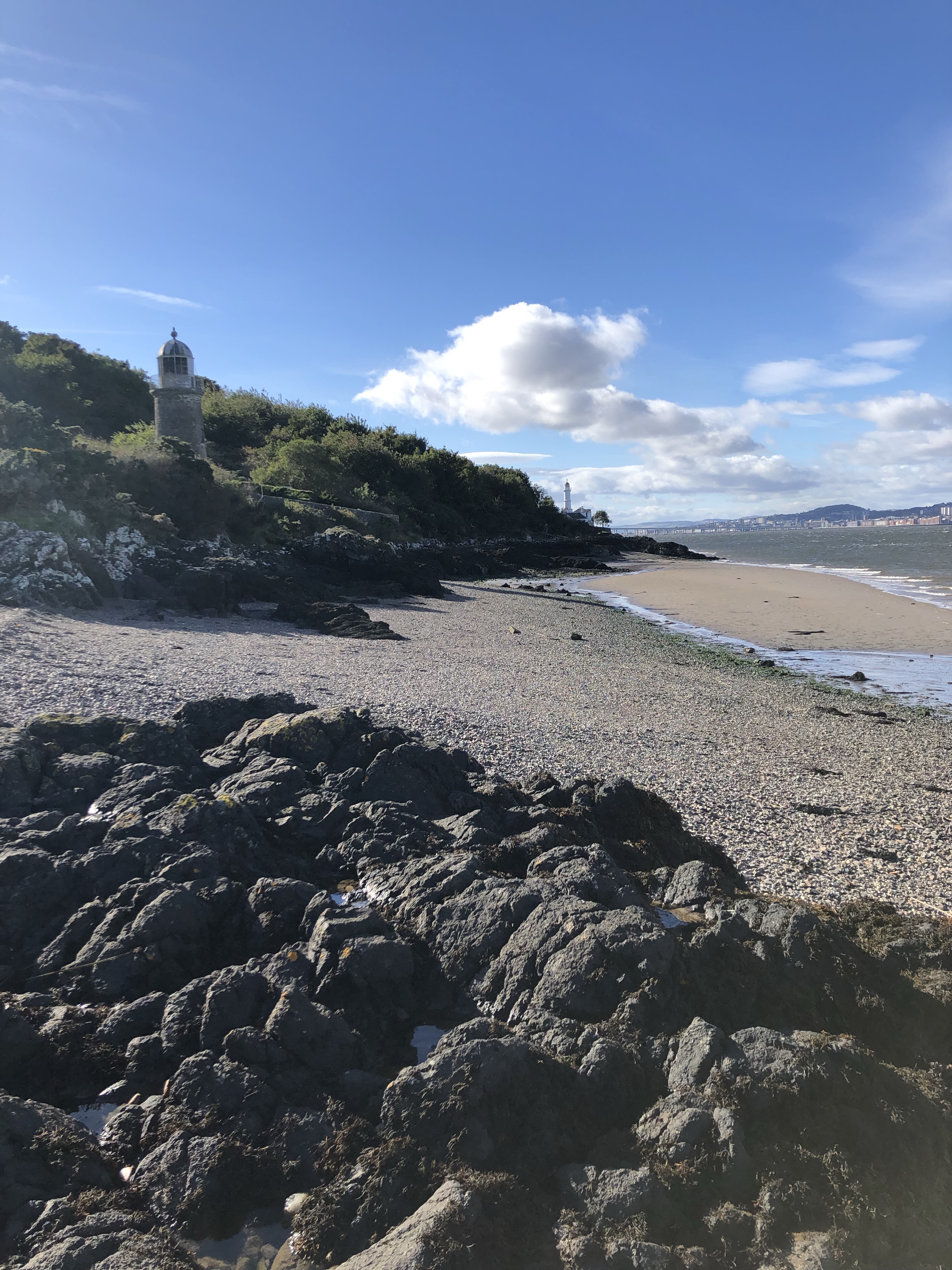
‘Well, we’ve all had measles, and then we had the flu, and then Benjy and I got that awful cough, and Mummy said we were all so thin and pale, and we didn’t eat enough, and the doctor said the only thing to do was to let us run wild down in the country, and Mummy said, “What about Cherry-Tree Farm?” and the doctor said, “Splendid,” and Daddy said, “Just the thing,” and I listened and didn’t say a word, and . . .’

This is probably the most generous holiday due to illness in any of Blyton’s books. Usually the children get a few weeks somewhere, though even that’s not to be sniffed at. I could sure do with a holiday!

the children of cherry tree farm enid blyton


Posted in Blog talk | Tagged , , | 1 Comment