It primarily features Darrell Rivers and Anatoly Petrov, who as a couple we call Dartoly. It also has a cameo from Bill Smugs, due to a recent request.
If you need a little help picturing these two I’ve included a picture of roughly how we see them. We use Michelle Dockery as inspiration for Darrell and Anton Yelchin for Anatoly.
Anyway, on with the story!
“Yes, sir,” Anatoly said into the small telephone receiver which was attached to his powerful wireless, issued to him by the SIS. He listened for several minutes, one eye on his watch. He knew he shouldn’t interrupt his boss, Bill Cunningham, when he was talking, but if he didn’t leave soon he would be late for his date with Darrell.
“Do you have somewhere else to be?” Bill asked him shortly after. He must have read the impatience in his replies.
“Well, yes, as a matter of fact,” Anatoly said, wondering how much to give away.
“I don’t have you down for anything this evening”, Bill said, and Anatoly could hear him shuffling papers.
“It is not work, sir. It is personal.”
“Oh. I see,” Bill said. Then there was a pause. “You’re meeting your new friends, then? Or… dare I ask-”
“You dare not,” Anatoly responded quickly, wishing he had never confided in Bill about Darrell.
“You have a date, then.” The grin was evident in Bill’s voice, even over the wireless.
“Petrov? Are you still there?”
“Petrov?”
“I am here, sir.”
“I expect a full briefing when I call you tomorrow.”
“I respectfully decline, sir.” Thankfully Bill wasn’t just his boss. He had been the one to bring Anatoly into the SIS, and had become a mentor and somewhat of a friend, too. He therefore got away with a lot more cheek than other agents.
“Do you want to be removed from St Andrews, Petrov? No, I thought not. Same time tomorrow. Smugs over and out.” The connection went dead. Anatoly glared at the receiver, banged it down, grabbed his suit jacket and then dashed from his room, pausing only long enough to lock it securely.
– – – – – – – – – – – – – – – – – – – –
Darrell nervously pushed a hair pin into her dark hair and bit her lip. She leant forward over the chest of drawers and pulled her mascara out from the bag. Using as little as she could of the precious cosmetic, she applied it to the ends of her lashes.
Sally watched Darrell from her bed, where she was propped up, reading a book for her class and smiled at her friend.
“Are you sure you want to do this?” Sally asked Darrell. “I mean he is four years older than you. I will admit that he is a bit of all right when it comes down to it, but I didn’t realise you were so interested in him.”
“Just because I haven’t verbalised anything, doesn’t mean that I wasn’t interested,” Darrell said, turning around, hands on her hips, making her best skirt swing out in a circle.
I reached my target of 100 books in November and finished the year on 119.
December’s books:
The Cat in the Hat Comes Back – Dr Seuss
Christmas Shopaholic (Shopaholic #9) – Sophie Kinsella
The Day the Crayons Came Home – Drew Daywalt
Click, Clack, Moo: Cows that Type – Doreen Cronin
How the Grinch Stole Christmas – Dr Seuss
Undead and Unappreciated (Undead #3) – MaryJanice Davidson
Spark Joy – Marie Kondo
The Exile – Diana Gabaldon
Five Fall Into Adventure – reviewed here and here
Buffy the Vampire Slayer: Slayer Stats – Steve O’Brien
Discovering Scotland’s Lost Railways – Julian Hollans
Undead and Unreturnable (Undead #4) – MaryJanice Davidson
Why is Nothing Ever Simple? (St Mary’s #10.5) – Jodi Taylor
The Making of Outlander: Official Guide to Seasons 1 & 2 – Tara Bennett
The Organised Mum Method – Gemma Bray
And I’ve ended the year with a few unfinished books:
The Naughtiest Girl in the School – I’m doing a text comparison on this one
Hocus Pocus and the All New Sequel – A.W. Jantha
Jane Eyre – Charlotte Bronte
I’m finding both Hocus Pocus and Jane Eyre a slog, but for different reasons. The first part of Hocus Pocus is based on the film and was a decent writing of it, the second half, however, is a new story. It’s not great and worst of all it’s written in first person present tense. First person is fine, but present tense I hate with a passion. It just sounds so ‘me me me’ in a really shallow teenage way.
My problem with Jane Eyre is that I really can’t stand Rochester. I was enjoying it through her childhood and time at boarding school, but then Rochester showed up… and I find him rude and boring in equal measures. Even the mystery of the crazy woman in the attic hasn’t persuaded me to get past 52% read.
On the plus side I forced myself to finish Spark Joy (actually decent once I picked it up again) and The Exile (still dire) so they’re not hovering on my current read list any more.
What I have watched
Hollyoaks
Only Connect
Murder She Wrote, season 7 and I’m now onto 8
More of His Dark Materials
A few Christmas films including The Christmas Chronicles
I’ve also been rewatching the last series of Call the Midwife, to refresh my memory for the new series.
What I have done
It has been very cold that that didn’t stop us going out to several parks.
We went to the Transport Museum (again) and got an annual pass to save ourselves some money.
It was my birthday halfway through the month and of course Christmas at the end so a lot of food was eaten and presents opened. There was also the decorating, shopping, wrapping and general organising for Christmas.
I went to see Rock the Halls – a concert of Christmas songs – at my local theatre
I got back into doing jigsaws and did one that I got for Christmas the year before (!), and then I did the one I got this year as well.
It doesn’t sound like a lot but it was a very busy month!
It is likely that the Nature Charts for January will show snowy, frosty days, for as the proverb says, stronger cold comes with the longer days. Keep a list of the sunset times for this month, so that the children may see with interest how each day is a little longer than the one before. They will soon remark, too, how much longer light is there when the sky is clear and how quickly it gets dark when the sky is cloudy.
Enid’s first nature notes in her Book of the Year. I always console myself that, the shortest day of the year falls between the 20th and 23rd of December, and so once Christmas and New Year is over the days are already a bit longer and will just keep on getting longer. I’m already anticipating the days that it’s not dark before 5pm!
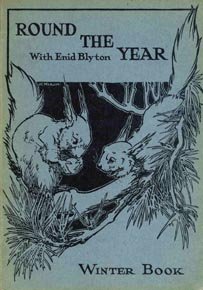
For a winter-themed book you can’t beat Round the Year with Enid Blyton – Winter Book. I have it as part of a combined volume titled Round the Year with Enid Blyton which has all four season’s books in it.
It is a guide to all things winter in nature; the whereabouts of all the creatures that are so plentiful in other seasons (and how we can help them), the formation of frost crystals, identifying footprints in the snow, feeding the birds, evergreen trees, and even a bit about astronomy and other things.
First I’ll admit that’s a slightly misleading title as I didn’t actually get any Blytonian presents for my birthday this year – gasp! I did get two Blytonian birthday cards, however.
There are a few cards out there based on the Famous Five for Grown-Up books. My cards were Five Go on a Digital Detox and Five Go to Party Island. They look just like the other books in the series and I actually had to check they weren’t real titles.
That reminds me I have a few of those books that I really must read, if only to write reviews saying how bad they are! Anyway, I fared much better for Christmas
Pepys card game
Famous Five playing cards
These 1950s Pepys cards might look familiar to you. And so they should. I was given a set in 2013 and they had sat on my bookcase in the flat since we moved in 2015. Then last year I realised they were no longer there. I suspect they had fallen off and landed in the bin because I’ve searched everywhere for them. So now I have a nice new set (which is in slightly better condition than the old one, and even has the instructions and all the cards!)
Noddy happy family cards
I actually ordered these myself and gave them to Ewan to put in my stocking. I bid on a Faraway Tree set and a few other things but didn’t win. There are two sets of Noddy cards out there, a snap set by Pepys and this happy families one by Sampson Low (publishers of the Noddy books). This one is also complete and has the instructions.
Noddy party game
This is a Pepys game, a bit like my Famous Five party game but much more simple. The game is to find Noddy’s friends hidden on the cards.
New Class at Malory Towers
This is a short story collection by four different authors, set during Darrell’s time at Malory Towers. It will be interesting to see if any of them capture the essence of the original books.
The Adventure Series Nintendo DS game
This is a bit of a weird one, but I couldn’t resist asking for it as I actually have a (pink) Nintendo DS tucked away in the cupboard. All eight books can be read in full on the DS and you collect jigsaw pieces as you read to unlock puzzles and games. There are also quizzes on the books to unlock more pieces. The books are described as interactive, too, and the box says there are links in the text to view character profiles and play sound effects. The DS has two screens (one is a touch screen), so I imagine you can turn it sideways to read the book, a page to each screen but I suppose I will find out when I play. I will review it, of course, then!
Happy New Year, everyone! Enid Blyton wrote such a wide range of material that it’s hard to find a subject she hasn’t at least touched on. There are, of course, some topics she gave more attention to than others.
New year got a fair amount of attention, after all, it comes around every year! I think she was a fan of resolutions as those are mentioned a few times.
Unfortunately there aren’t a whole lot of illustrations to go with these (mostly early) works so I hope you didn’t have too much to drink before tackling this.
1920s New Years
On New Year’s Resolutions from The Teachers World 1005, Jan 1924
This is a rather serious article, I suspect to be read by the teachers and not their children.
Blyton comes firmly down on the side of resolutions and suggests it’s better to have a positive I will resolution rather than a negative I won’t resolution.
This is a cheery look at how everyone gets a New Year which will brings a fresh start along with all the wonders of spring.
Read it in full here (where you will also find a poem titled New Year Sing-Song).
New Lamps for Old from The Teachers World 1133, Dec 1925
This is a strange one. I’ve not heard the tale of Father Time collecting old lamps for new ones on New Year’s Eve. There’s a poem of that title by Rudyard Kipling but it seems to have a different background. It may be something Enid has made up as the whole article is a huge metaphor where the old lamps represent people who have become jaded and miserly.
The Golden Promise: A New Year Story from The Teachers World 1135, Jan 1926
This is a lovely story, though it has two curious elements. One is that it specifies the year as 1925, and secondly Blyton speaks to the reader near the start. She often addressed the readers at the end of chapters in her adventure novels but here she says I once saw the number written downbut I couldn’t have read it out. Anyway…
The story is of a bored old wizard who has a ton of money but nothing to spend it on. Then at his door arrives a small child – a Little New Year who has fallen from Father Time’s sleigh. He is terribly upset that he is lost in fairyland and won’t reach the mortal world in time for New Year, and even more so that he has lost some of his spring flowers and animals.
The wizard, who at first comes across as somewhat aloof (he may even be a cruel wizard for all we know) suddenly melts at the child’s tears and does all he can to make things better.
I have not done it justice at all in that summary so please do read it for yourself, it’s such a shame it hasn’t been collected anywhere else. There’s no reason the year at the start couldn’t have been changed for a new publication.
New Year Letter from The Teachers World 1261, Jan 1928
This one’s addressed to boys and girls. It combines a couple of her favourite themes: nature and doing good. She extols the joys of the spring to come (she even enjoys January, apparently), and hopes that the children reading will become happier, braver and kinder as the year goes on.
The New Year from The Teachers World 1389, Jan 1930
A short but sweet nature-themed poem (and a few mentions of the New Year in the letter below, too).
A Happy New Year from The Teachers World 1597, Jan 1934
This is another poem, this time about what Gillian would wish for at the New Year.
Poor Mr Tumpy from The Teachers World 1389, Jan 1930
Mr Tumpy is probably one of her less-well-known characters. I’ve not read any of his stories though I know there’s one about him and his caravan. Anyway, Mr Tumpy makes a mistake ala the Three Golliwogs, and tears off too many days on his calendar and thinks it’s New Year’s Day a day early.
A Happy New Year Poem #2 from The Teachers World 1649, Jan 1935
This poem has the same title as the earlier one, but is a different piece. I suppose there are only so many possible titles for New Years’ poems!
This one has a nature-theme as well, and you can read it here.
A Happy New Year! from The Teachers World 1936
A story in which Benny makes a resolution to smile more and it pays off. Read it here.
1940s New Years
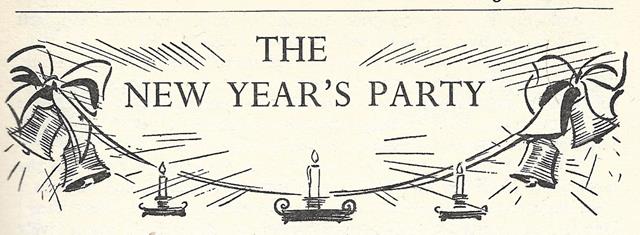
New Year’s Party from Enid Blyton’s Book of the Year, 1941
A clever story about three children attending a New Year’s Party. One is selfish and greedy, one is lazy and the other is kind.
Blyton introduces an idea I’ve only ever seen in her work, this one and another story featured later in this post. I assume she is using an old idea from folk tales or somesuch but I really don’t know.
The children go into a candle-lit room and see there are long pictures on the wall, pictures of children doing all sorts of things.
One is spoiled by blots of colour across it and another has lots of unfinished bits. The marked one represents the selfish child’s year, and the marks represent all the times she has been unkind. The unfinished one belongs to the lazy boy, the unfinished portions showing where his laziness has meant he has abandoned tasks.
They then see the picture created by the kind child and hers is unmarred and wonderful.
Yes, it wasn’t just books, poems and magazines Blyton wrote. She did calendars too!
It wouldn’t be of much use to write your appointments or birthdays on as the dates are the smallest part of this calendar. Each month has a few pages of beautifully illustrated poems and nature stories.
For January 1943 there is a New Year poem.
1950s New Years
Father Time and his Pattern Book from Enid Blyton’s Gay Street Book, 1951.
This is one I nearly missed as it doesn’t have New Year in the title! If it hadn’t been for a fellow Blyton fan sharing the contents of the story I wouldn’t have known it even existed as I don’t have a copy of the book.
This is another story that features the idea of children making pictures, or patterns, each year and the picture or pattern showing how ‘good’ or ‘bad’ they have been.
This time there is one child, Robin, who is shown several patterns by Father Time. His brother’s is lovely but spoiled by black dots here and there where he has lost his temper. Another is attractive except where rips show a girl’s cruelty. One is almost all ugly – made up of greed and selfishness, with just one or two bright threads which represent hard work.
Lastly Robin sees his own pattern which is beautiful apart from the grey smudges of lies.
I really do love this pattern/picture idea. If you’ve seen it elsewhere please let me know.
A New Year Promise from Enid Blyton’s Magazine issue 2 volume 1, 1954
As the title may suggest this is a story about resolutions. John always breaks his so his resolution then is to keep any promises he makes. His sister Dinah goads him (perhaps her resolution is to be more encouraging!) that he always forgets and breaks promises but he’s determined. He does well at first, but then forgets he has promised to put fresh straw in the dog’s kennel. He remembers in the night and, eaten with guilt, sneaks down to do it and instead catches two burglars.
The dog gets to sleep inside as a reward for helping and John is forgiven for breaking his promise.
John writes a letter about his story a few pages later. (It is absolutely Dinah in the story, I’ve double-checked!)
This is the last post of the year and of the decade!
You may be pleased to know that’s the end to the Christmas quotes in the Monday posts but I think I’ll move on to wintry ones as having a theme is quite fun.
Enid Blyton at New Year
and
Birthday/Christmas present roundup for 2019
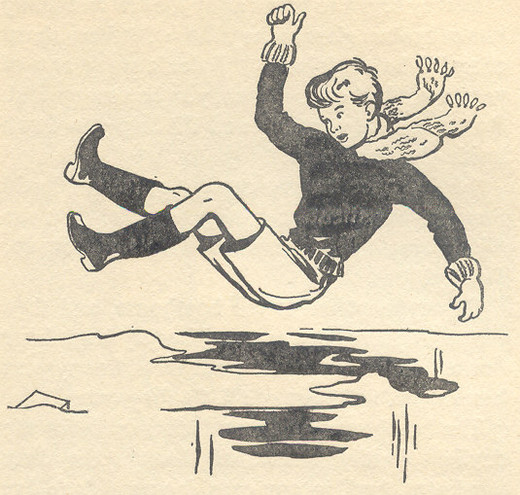
It was grand fun to be on the ice that clear winter’s morning. Roger fell over quite a lot, and groaned and rubbed himself, quite envious of the others, especially of Snubby. Snubby did not skate as gracefully as either Barney or Diana but he was as usual, full of idiotic tricks, leaping in the air on his skates, twisting himself round in never-ending circles till he fell over in giddiness – and altogether behaving in what Diana called a “very Snubby-ish way.”
From The Rat-A-Tat Mystery.
Five Get Into a Fix is set in the depths of winter and the Five get an extended Christmas break to recover from being ill. They are sent off to Magga Glen which, of course, they find an adventure in. There’s a big house on the hill which has signs warning off trespassers, it also has a strange ‘shimmering’ above it some nights. There’s Aily, who brings notes telling of a woman being held prisoner in her own home. There’s surly Morgan with his booming voice and seven dogs. There is also a lot of fun as they toboggan in the snow and ‘camp’ out in the summer-house above the farm.
Christmas is finally here! This will be the only post this week, as I’m taking the rest of the week off to celebrate and eat too much. (After I’ve cleaned and tidied and wrapped etc!)
I’ll be back on Monday the 30th for the last post of the year, and posting as normal from then on.
Coming up in the next year there will be a new fanfiction story about Darrell’s first date with the suave-yet-secretive Anatoly, a guide to our other recommended children’s authors, and I’ll be carrying on comparing The Naughtiest Girl in the School, reviewing the Famous Five books and sharing letters to Blyton from her magazines. Plus a lot more, which I’ll have to dream up at some point!
Following on from part one of my review now it’s time to see what happens now that the three plus Jo are hunting for George.
Delaying tactics
Jo being taken off by Jake means that the other three get lost when trying to get out of the woods again, and after going round in circles for hours they have to sleep there. Jo finds them in the night and leads them home in the morning, so there’s about two chapters out of these three which don’t further the story, really.
Perhaps Blyton just felt like we needed a chance of pace after all those hectic event-filled preceding chapters.
Off to Red Tower’s tower
The final assault begins in chapter seventeen with Julian, Dick and Jo taking George’s boat up the coast to find Red Tower’s abode.
You’d think they would be in their element here, exploring the caves that lead from the beach to Red Tower’s house, but it all goes very wrong. They’ve brought their own rope and torches but neither can stop Red from catching them. He orders their boat to be destroyed and for Timmy to be shot.
So shortly Julian and Dick are tied up, Timmy is drugged in the summer house and George is locked in a high room in the Red Tower’s tower.
All about Jo
Jo is pretty much the hero from this point on. OK, so it’s substantially her fault that they are in the situation they are in, but she fixes everything for them.
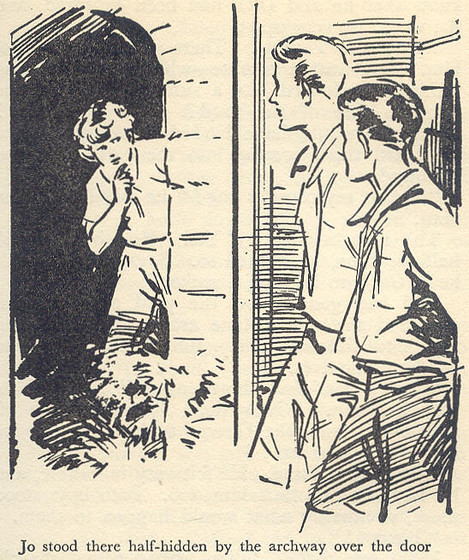
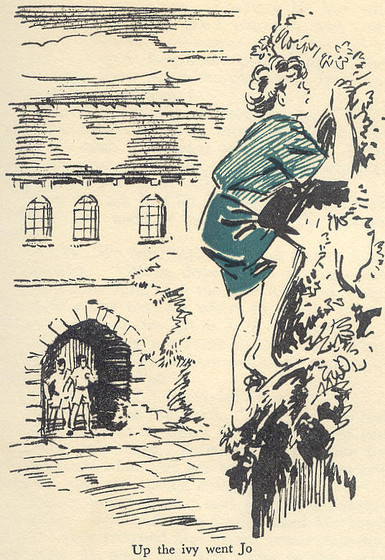
Having hid when Red Tower catches the boys, she is free to rescue them a short time later. She then scales the tower, rescues George and even takes her place so that George can escape. She stands up to her father and Jake, knowing they’re likely to beat her, and manages to lock them and Red in the tower room before making her own escape.
She’s absolutely fearless and very brave, it has to be said. With everyone free – though Timmy’s still very dopey – they just have to work out how to escape. The lack of a boat is a major problem, of course.
There are several dramatic moments in the final chapters, as they strive to escape. The twist is the boat has not actually been destroyed, but getting to it and getting it in the water becomes the challenge.
Uncle Quentin
Quentin only appears in the first chapter, but there’s a reasonable amount of things I can find to say about him, still.
George tells her cousins that Father’s in quite a good temper. He’s been to America with Mother, lecturing and hearing other scientists lecturing too. Mother says everyone made a great fuss of him, and he liked it.
This is an interesting insight, I would have imagined he would have no time for being fussed over, but I suppose he does have an ego.
It’s also said that The children were fond of him, but held him in great respect. That’s perhaps over-simplifying things. There is certainly respect, and perhaps some fondness, but they also find him frustrating and Anne certainly can be afraid of him.
He is wild about what’s in the newspaper. “Look here, Fanny,” he shouted. “See what they’ve put in this paper – the very thing I gave orders was NOT to be put in! The dolts! The idiots!” He’s so mad, in fact, he doesn’t appear to even notice the children have arrived. Of course, he’s right to be angry, anyone who has read the book before will know that.
Contradicting what George said a mere page or two earlier Quentin is snappish and jumpy, Fanny declares he is as touchy and nervy as can be and it will do [him] good to get away. I suppose his good moods disappear as quickly as his bad moods arrive.
He is, at least, consistent with his forgetfulness. I didn’t know [the children] were coming… you might have told me, Fanny. Of course she has, several times. And regarding going to Spain – Well you might have warned me it was tomorrow!
The next day he spends ages sorting his notebooks while the taxi waits. Eventually he is chased out the door by another call from a reporter, but he’s taking a despatch case of work with him much to Fanny’s dismay.
My questions, comments and nitpicks
This is the fifth Kirrin adventure, and comes after two non-Kirrin ones. It is the end of the summer holidays, they only have two weeks as Julian, Dick and Anne have been in France for six weeks.
The first chapters are such a clever series of tiny events. The newspapers have published details of Quentin keeping his work at home. The adults leave. Jo makes friends with Timmy. The pantry window doesn’t shut. Timmy goes out on his own for a walk at night. George takes him out the next night. Some of these are mentioned well before they become important and everything draws together nicely. You could say it’s all a bit coincidental but it works for me.
Jo spits damson stones at the Five, and I honestly have to admit I’ve never seen or eaten a damson before. I had to Google to make sure I was picturing them correctly.
The Five dig ‘comfortable’ sand holes. It may be my age talking but I can’t imagine a hole in the sand being particularly comfortable.
How funny would it have been if Anne chose an ‘unimportant looking’ notebook for the kidnappers, but it turned out to be the very important American one? (Uncle Quentin gave them to a friend for safekeeping so it’s not possible, but Anne wasn’t to know that.)
I always feel sorry for Sid as it’s after midnight before he goes home, and he has a paper round in the morning! He will be up early for that, I bet.
When the Five are on the beach with the whole place to themselves, they ask why Jo and her father would sit right beside them. Well, a) Jo’s clearly trying to get the measure of them and get in with Timmy and b) that happens everywhere. Park in a deserted bit of car park, someone will park next to you. Sit in an empty cinema row, someone will plonk themselves in front or right next to you. Some people just don’t observe the unwritten social rules!
Looked at with an adult’s critical eye there are some possible flaws surrounding the burglary.
Quentin’s study is fairly trashed, but surely that would have made a lot of noise? It was done in the middle of the night, and while I’m sure they didn’t want to be there for hours surely a careful search through his papers would have been more sensible?
Why did they bother locking the door behind them when they left? That then identified the pantry window as the entry point.
The illustration of Anne and the window shows that the window is not that small at all. Anyone could slide through it feet first, surely?
Julian is described as sensible but he goes off to bed, leaving the front door open for George to return later.
I wonder that there only seems to be one set of keys (unless Quentin or Fanny has taken some away).
Dick’s adventure (following Jo after the parcel is picked up) takes around an hour based on the times given (the notebook is collected at 11 and it is after 12 when they bring Jo inside) but what’s written doesn’t seem like it would have taken nearly as long as that.
A few general nitpicks:
Joanna, the cook, has become Joan. There’s no mention that it’s a new cook, it reads as if it’s the same person. Perhaps she turned 40 and decided to go by a more mature version of her name? Or is it just me who thinks Joanna sounds younger.
All of a sudden George’s boat has a sail. Jo takes the tiller and steers the boat while Dick and Julian look at the map on the way to Red Tower’s, with no mention of rowing. They also take a sail down when they get there. On the way back the row all the way with no mention of a sail. That’s not implausible if the wind is not in their favour but at no point is a sale ever mentioned before this point. I know if I had a sail and had to row I would be lamenting the lack of wind/wind blowing in the wrong direction. Also, there are no illustrations of a sail on George’s boat in this or any preceding book.
Final thoughts
I have this ranked as 13th in the series. It doesn’t mean I don’t think it’s a great book, just that there are 12 others I enjoyed more.
If I was to pick the ‘flaw’ that pushes this title down into the bottom half it’s the fact that George is missing for a significant chunk. She goes out with Timmy at the end of chapter 7 (p56) and doesn’t appear again until chapter 18 (p132). That’s 76 George-free pages, and actually 86 without any dialogue from her. Of course Timmy is absent for all those pages too, so that’s three fifths of the Five missing for well over one third of the book. To add to that, Anne is missing for 54 pages (and barely appears for a few before then) which is almost a third of the book.
As much as Jo is a great character the Five books are about the Five, and how they interact and solve problems together.
It’s a pity there isn’t a lot of the Five together (54 pages at the start and 6 at the end!) because there are a lot of good things about this book. As I’ve said earlier I love the fast-paced beginning with all the little details that tie together. I enjoy the scene with Sid, and the escape from Red Tower is a real thrill-ride. I just like my Famous Five books with more Famous Five!
It’s no secret that Eileen Soper is my favourite Blyton illustrator. She is best known for her work on the 21 Famous Five books, both the covers and internal illustrations, but she also illustrated lots of short story collections, a few other novels, jigsaws, card games, nature books and lots more.
So here is a look at the illustrations she has done for various Christmas stories, spanning just over a decade. There are potentially many more but these are just the ones I happen to have myself. You might have seen some of these if you have read my Blyton at Christmas series, but there are new scans as well.
Santa Claus Gets a Shock
from Enid Blyton’s Happy Story Book, 1942
Santa Claus falls into the pond and is rescued by Betty and Fred before warming themselves at their fire.
I’ve seen the Famous Five illustrations so many times in my life that I can’t help but see the Five in Soper’s other illustrations. That could just be Anne and George with Santa, had they known each other that young and had Santa dropped in on Kirrin Cottage one Christmas!
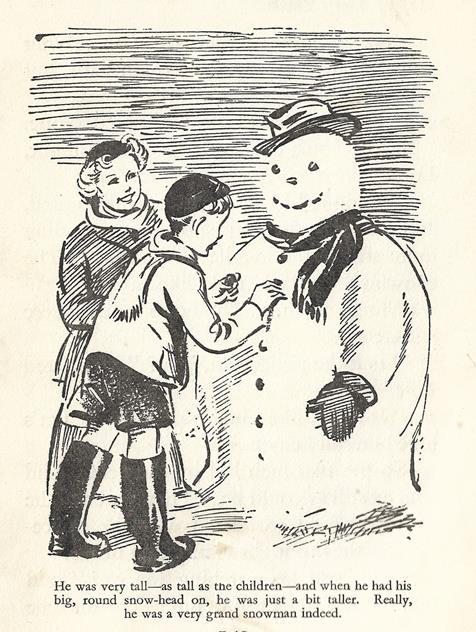
The Great Big Snowman
from Enid Blyton’s Happy Story Book, 1942
This isn’t strictly a Christmas story, but snowmen are associated with Christmas and appear on cards. The girl doesn’t resemble anyone from the Famous Five, but the boy with the cold knees could be Dick.
Five Go Adventuring Again
Obviously Soper illustrated the whole book, but of the 32 illustrations (not including the two dust-jackets and the endpapers) there is just the one that depicts anything Christmassy. We can forgive her as so much happens in the book that Christmas is the least exciting part.
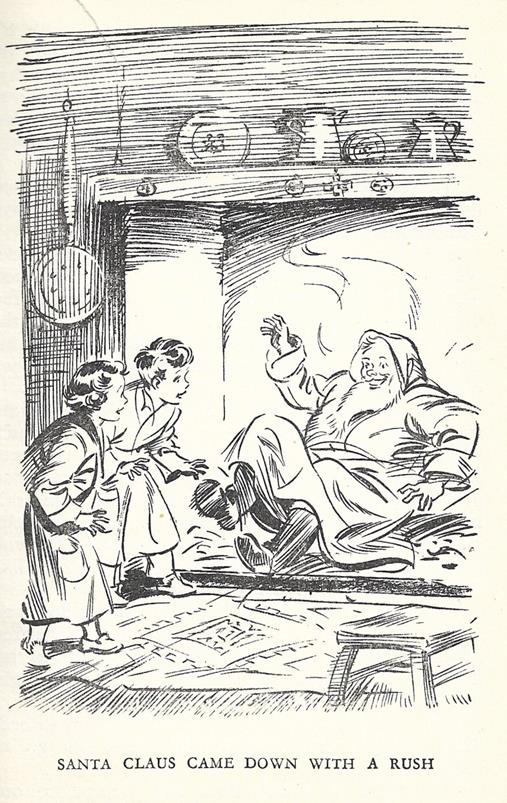
Santa Claus Makes a Mistake
from The Green Story Book, 1947
Another Santa with two children by/in a fireplace. I’d say the boy looks like Dick again but the girl is fresh.
The Cracker Fairies
from Enid Blyton’s Lucky Story Book 1947
I’ve never featured this story before – I missed it on my previous searches because it doesn’t have Christmas or Santa in the title. Soper must like Dick Kirrin’s looks because there he is again! In actual fact that is William with his sister, Elsie. They have been ill over Christmas and too miserable to enjoy any of it, until they open some magical crackers.
The Tiny Christmas Tree
from Tales After Supper, 1949
Compare this to the little Christmas tree from Miss Brown’s Class below, it’s very similar. (I have a 1962 edition of Tales After Supper which I think is of a cheaper making, hence the awful colour of the paper).
Enid Blyton’s Book of the Year, 1950
The first edition of this book was illustrated by Harry Rountree, illustrator of the first two books in the Cherry Tree/Willow Farm series (coincidentally, Soper illustrated the third book), The Secret Mountain and around eight other lesser known Blyton titles.
Eileen Soper then freshly illustrated the whole book for the 1950 reprint. I have the 1952 reprint which has the same Soper illustrations. Normally I date the book as 1941 (as I have done in my Blyton at Christmas series) but as I’m really looking at the illustrations I’m dating it as 1950 this time.
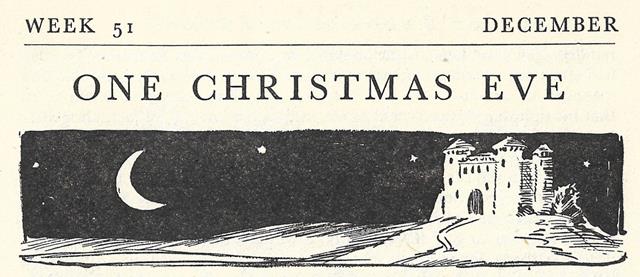
One Christmas Eve
This is perhaps less recognisable as it has no people in it, but I can still see Soper’s style in the castle (she’s drawn enough of them over the years!)
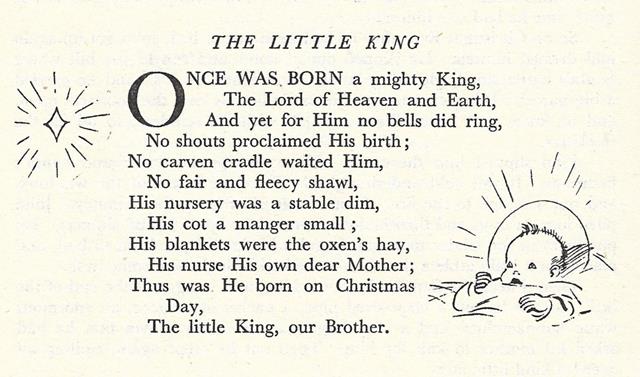
The Little King
This I can’t really recognise as Soper’s work. Poor baby jesus looks a little awkward without a neck.
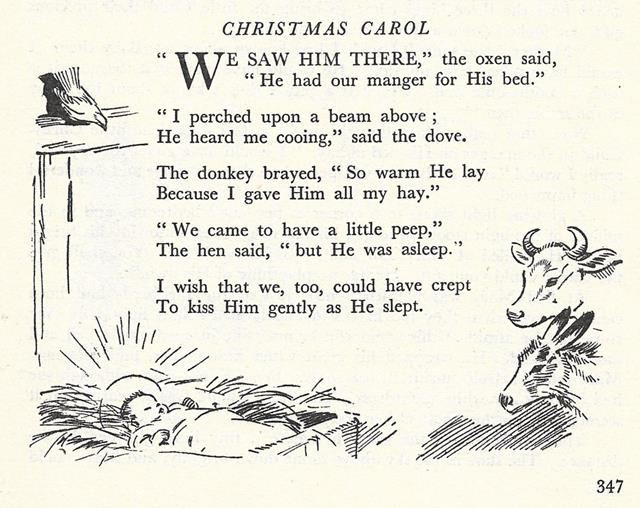
Christmas Carol
Baby Jesus looks a little more natural here, and the animals are certainly Soper.
A Christmas Tale
Soper’s girls certainly have more variety to their looks!
The Christmas Tree
The three Santa Clauses we have had so far from Soper look very much as if they are the same person.
What They Did at Miss Brown’s School
What they did was make a Christmas cake, as above, and a little Christmas tree for the birds, shown below. Above we have Dick, Anne with longer hair, George and an unknown child.
The Christmas-Tree Party
from Tricky the Goblin and Other Stories, 1950
Showing the pictures alone here you could almost read it as a comic with little to no text, the illustrations show the story so well. There’s a young Anne (it’s really Janey) and her brother Dick (really Robin) and the child in the first image really makes me think of Fairuza Baulk. The changing colours between illustrations is funny as it looks like Janey has two identical outfits, one in red and one in pink.
Enid Blyton’s Bright Story Book, 1952
There are two stories in this one – one of which I have featured in my Blyton at Christmas, and one which I managed to miss entirely despite it having Christmas in the title.
Santa Claus Gets Busy
No people but a very Soper-ish castle in this one.
One Christmas Eve
I hope you’ve enjoyed looking at Eileen Soper’s Christmas works.
There were trees about three feet high, just big enough for a small nursery. Then there were rows of bigger trees, whose branches could take quite a lot of toys and ornaments. Then there were bigger trees still for parties – the kind of Christmas trees that almost touch the ceiling of the drawing-room, and look simply wonderful when they have candles lighted.
And largest of all were the trees that were sold for school-parties – the sort that tower right up high, and hold hundreds of presents and sparkle like magic.
Who knew there were so many kinds of Christmas tree? From The Tiny Christmas Tree in Tales After Supper.
Janey, from The Christmas-Tree Party is a little girl who is a bit of a voyeur, actually, but a nice, honest one. She isn’t invited to the party in the house across the street but she watches it all being set-up in awe, exclaiming over all the lovely decorations and food. Meanwhile, her brother Robin is sulky and jealous about it. Being voyeuristic means that Janey sees the Christmas tree about to fall on the dining table and rushes over to warn her neighbours. Her good deed earns her an invite to the party, while sulky Robin has to stay home and sulk even more.
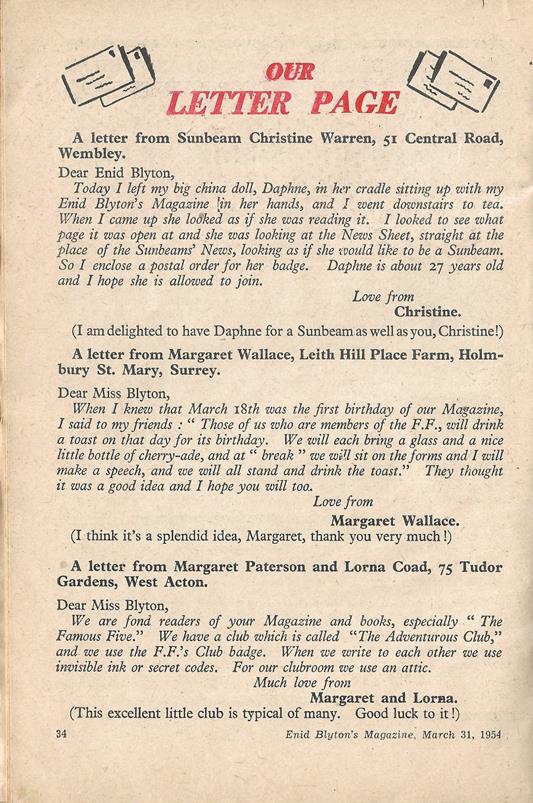
Letters page from Volume 2, issue 7. March 31st-April 13 1954
OUR
LETTER PAGE
A letter from Sunbeam Christine Warren, 51 Central Road, Wembley.
Dear Enid Blyton, Today I left my big china doll, Daphne, in her cradle sitting up with my Enid Blyton’s Magazine in her hands, and I went downstairs to tea. When I came up she looked as if she was reading it. I looked to see what page it was open at and she was looking at the News Sheet, straight at the place of the Sunbeams’ News, looking as if she would like to be a Sunbeam. So I enclose a postal order for her badge. Daphne is about 27 years old and I hope she is allowed to join. Love from Christine.
(I am delighted to have Daphne for a Sunbeam as well as you, Christine!)
A letter from Margery Wallace, Leith Hill Place Farm, Holmebury St. Mary, Surrey.
Dear Miss Blyton, When I knew that March 18th was the first birthday of our Magazine I said to my friends: “Those of us who are members of the F.F., will drink a toast on that day for its birthday. We will each bring a glass and a nice little bottle of cherry-ade, and at “break” we will sit on the forms and I will make a speech, and we will all stand and drink the toast.” They thought it was a good idea and I hope you will too. Love from Margaret Wallace.
(I think it’s a splendid idea, Margaret, thank you very much!)
A letter from Margaret Paterson and Lorna Coad, 75 Tudor Gardens, West Acton.
Dear Miss Blyton, We are fond readers of your magazine and books, especially “The Famous Five.” We have a club which is called “The Adventurous Club,” and we use the F.F.’s Club badge. When we write to each other we use invisible ink or secret codes. For our clubroom we use an attic. Much love from Margaret and Lorna
(This excellent little club is typical of many. Good luck to it!)
Such nice letters this week, and they make a refreshing change from the frequently seen letters about how much money has been raised by the writers.
Continuing the theme, I thought I’d have a nosy in the magazines for more Christmassy things. I’ve included some crafts and stories in some other posts but I have some new magazines to look through, and there are other things I’ve not used before.
Christmas Letters
Naturally Blyton references Christmas in several of her letters at the start of magazines published in November and December.
And now I must send some special messages of my own to my readers. First, the Famous Five Club members: Happy Christmas, Famous Five Members, and may you enjoy the next adventures of Julian, George, Dick, Anne – and Timmy! Thank you more than I can say for all the help you have given to our little Children’s Home this year. You really are good friends.
Next, the Busy Bees. Happy Christmas to all my Bees, and may you buzz loudly and often in the coming year! Thank you very much indeed for all your kindness to animals and birds this year, and your really splendid work.
And last the Sunbeams, our newest Society. Happy Christmas, Sunbeams, and may you shine brightly in the months to come. Thank you with all my heart for the way your are helping our little Blind Children.
And now to every one of my readers, big and small, I send my warm wishes for a wonderful time at Christmas – plenty of cards, children, a stocking full to the top on Christmas morning, a fine Christmas pudding, Christmas tree, balloons and crackers! I must wish you a Happy New Year too, because it will be in 1954 before I write to you again.
– Vol 1 Issue 21, Dec 23 1953
DEAR BOYS AND GIRLS,
Only a little more than four weeks and Christmas will be here! I have had many letters from you, telling me of your Christmas plans – and I am very pleased to hear that o many of you are thinking more of that to give other people than of what you are going to have yourselves! Some of you are suggesting that you might send toys to our little Children’s Home here, but as the generous Famous Five Club members have, as usual, send me almost enough money to buy new toys for every one of our small children, I suggest that you send your toys to the Evening News, who are asking for Christmas Toys for Sick Children… I know they will be grateful. The toys will go to children ill in hospital, of course.
And now I must tell you some news you have been waiting for. I told you that my pantomime “Noddy in Toyland” is to be performed again this Christmas – and that I had written another play also, for older children, about the Famous Five. Well, we are now busily rehearsing for both plays – and they will both be in the same theatre, one in the afternoon (Noddy) and one in the early evening (Famous Five), and the theatre is – PRINCES THEATRE in London. I know that hundreds of you could not see “Noddy in Toyland” [I think there are a few words missing here!] telling you early, in order that any of my readers may be sure of seats at either of the plays.
– Vol 3 Issue 23, Nov 23 1955
DEAR BOYS AND GIRLS,
Now that we are in December I expect you are all thinking of the excitements of Christmas-time – the carol-singing, gay cards arriving, mysterious parcels – the Christmas tree and the Christmas pudding – parties and pantomimes! It really is a merry time, isn’t it? I have already had my first Christmas cards – they came from abroad, where they had to be posted early – and they must have caught a fast boat because they certainly arrived in good time. One is from South Africa, two from New Zealand, and three from Australia. I wish I could post cards back to the kind senders, but they wouldn’t get there in time.
As you can guess, I am very, very busy now, not only with Christmas, but with rehearsals for the two plays… which must be ready to be performed the week before Christmas. We haven’t much time left!…
There will be another number of the magazine for you before Christmas, so I shall be able to give you my Christmas wishes there. We shall all be feeling very excited by then, shan’t we?
– Vol 3 Issue 24, Dec 7 1955
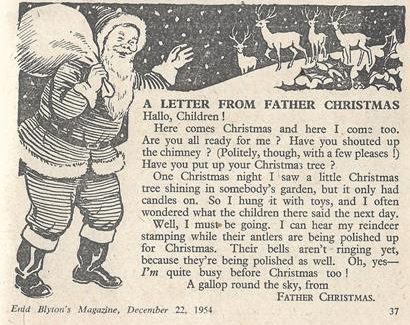
There is also another letter from Father Christmas in Vol 2 Issue 26.
Christmas adverts
While Sunny Stories was advert-free from what I’ve seen, Enid Blyton’s Magazines have quite a lot of adverts. Some are for her own books, and lots of others for Noddy toys, but there are plenty for other toys of the time as well as adverts for sweets and chocolates.
Here are a selection of Christmas-themes adverts I’ve picked out (some are similar to ones that had already been running with ‘perfect for Christmas’ type wording added!).
Three consecutive years (1853, 1954 and 1955) feature a list of books which would make good Christmas gifts.
Of course an Enid Blyton book is at the top of each of these lists! Malcolm Saville features on them all as well.
The Children of Green Meadows even gets its own advertising space in 1954, after being serialised.
These are just some of the Noddy adverts – if I’d shown all the ones from November/December issues we’d have been here all day. I’ve just picked the ones that say ‘Christmas’ in them. Also in there is an advert for the Enid Blyton Diary.
And here are a couple of confectionery adverts which feature Christmas. The comic-style one is for Mars and tells the story of a boy who dreams that Santa only gives Mars bars to boys who help others. The boy then goes carol-singing for the children’s hospital and is rewarded with a Mars bar.
The Palm toffee bar advert is a good example of the times Enid was living in – and why she used golliwogs so often. You can see along the bottom that the banana split flavour is illustrated by a banana, the fruit and nut by a strawberry, and the chocolate and liquorice flavours with a golliwog’s face (I assume as they are ‘dark’ or ‘brown’ flavours). That’s far worse than anything Blyton ever wrote! I’ll stop there as this is supposed to be a Christmas post not a debate about racism in her books.
And some other bits
If you do decide to make skittles out of cotton reels I’d advise you to leave off the stereotypical ‘Chinaman’ additions. You could easily paint them in reds and greens with more pointed hats as elves, or in red, black and white with a cotton-wool beard and red hat for Santa.
Possibly the least-festive Christmas greeting I’ve ever seen!
Hallo, hallo, here’s Santa Claus,
He’s come to see you all because
To-morrow’s Christmas Day!
So bring the ducks and bears and gollies,
Motor-cars and books and dollies,
Crackers bright and gay.
One of Santa’s songs from Santa Claus Gets Busy.
Margery from The Enormous Stocking is painted as greedy and piggish. And to be fair – she probably is, as she always takes the largest portion and the best toys. Her Christmas list is also very very long. Saying that – her solution, knitting an enormous stocking – is not only clever but very industrious. She works long and hard to make a big enough stocking for all she wants and it’s quite harsh that all she gets is vegetables in it! I think her ingenuity should have been rewarded at least a little bit.
It’s the penultimate round up of the year already!
What I have read
I reached my target of 100 books this month! It was helped along by me working through quite a few short books, classic children’s ones that I missed out on. But I read several ‘real’ books, too!
One of Our Thursdays is Missing (Thursday Next #6) – Jasper Fforde
Undead and Unwed (Undead #1) – MaryJanice Davidson
Where the Sidewalk Ends – Shel Silverstein
Where the Wild Things Are – Maurice Sendak
Dead Girls Don’t Dance (Undead 1.5) – MaryJanice Davidson
Alexander and the Terrible, Horrible, No Good Very Bad Day – Judith Viorst
The Snowy Day – Jack Ezra Keats
The Four Streets (Four Streets #1) by Nadine Dorries
The Woman Who Died a Lot (Thursday Next #7) – Jasper Fforde
Jurassic Park (Jurassic Park #1) – Michael Crichton
The Harveys See it Through – Phyllis Gegan (reviewed here)
Undead and Unemployed (Undead #2) – MaryJanice Davidson
The Lost World (Jurassic Park #2) – Michael Crichton
Yertle the Turtle and Other Stories – Dr Seuss
A Light in the Attic – Shel Silverstein
Bite (Five short stories) – Laurell K Hamilton and other authors
And I’m still working on:
The Naughtiest Girl in the School – I’m doing a text comparison on this one
Off this list I do not recommend The Four Streets as it was dire, and unless you’re a fan of at least a few of the authors in Bite (I was only reading for the MaryJanice Davidson story from the Undead series) I wouldn’t go for that either. I’d already read the Charlaine Harris entry and the others were pretty awful.
What I have watched
Hollyoaks
Only Connect
More of Taskmaster
Tiny House Nation on Netflix where people build very small homes, usually on trailers.
Murder She Wrote, season six
The start of the new adaptation of His Dark Materials
George Clarke’s Old House New Home and some of Grand Designs House of the Year
Some of Tutankhamun with Dan Snow which explored possible reasons for the pharaoh dying so young, his less than stellar burial rooms and other mysteries.
What I have done
Hosted International Games Week at my work and did a few games events
Visited the wildlife park
Hosted International Games Week at work
More trips to increasingly damp playparks
Did a few rather muddy walks in the woods
Educated Brodie on Christmas songs by putting the music channels on
Did some Christmas shopping (but not enough!)
Went to our annual Christmas event and Brodie was not impressed by Santa
What I have bought
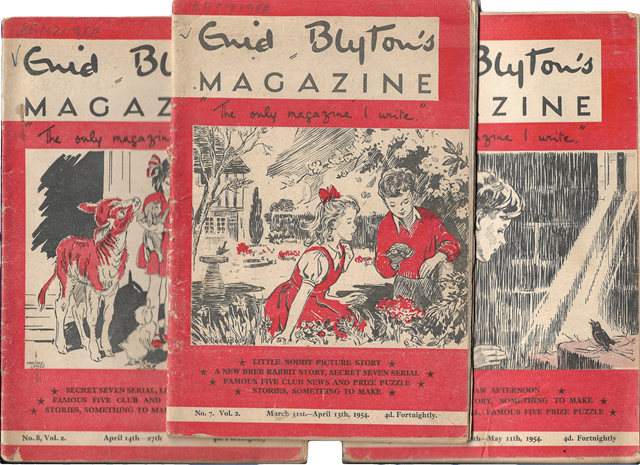
I’ve been back on eBay again – much to my bank balance’s horror! I’ve bought ten more of Enid Blyton’s Magazine, as I’m trying to fill the gaps in volume 2 so that I don’t have to skip any letters pages. I also bought two Mary Mouse strip books from the same seller as I couldn’t resist.
Please excuse the terrible photos, I only have time to take blog photos after dark these days!
We’ve done this once before but have written a lot since then – so here’s a new guide to all our Christmassy posts from the past six years. (I had written this ready to go up in December 2018, but due to a scheduling glitch it didn’t post! I have now updated it again and hopefully it will post this year.)
“That’s the way I always go into and out of a house.It’s much more exciting than using the door.”
Father Christmas extols the virtues of using chimneys as an entry and exit point to a house in Father Christmas and Belinda.
The Man Who Wasn’t Wasn’t Father Christmas doesn’t have any other name given. He resembles Father Christmas, and would like to be as generous, but as he is poor he has nothing to give any children. He takes a job on Christmas Eve, dressing as Father Christmas and handing out adverts for a toy-store and feels quite disgusted with himself. All he wants is to be handing out sweets or toys so he is very happy when the real Father Christmas allows him to do so while he takes a break.
This is the ninth book in the series, so I’m almost half-way with my reviews. Just as a random point – I always confuse this title with Five Go Adventuring Again. It doesn’t hep that they are two of the vaguer titles and have the adventure/adventuring similarity, but I know they’re not that similar. I just have a bit of a mental block about them.
If I’m trying to remember plots I have to think for a moment about Fall Into Adventure, Plenty of Fun and Wonderful Time (but I know what Adventuring Again and Get Into Trouble are about instantly… the mind is a strange thing.)
Anyway, I am writing about Five Fall Into Adventure today, so I do know the plot. If I happen to call it by the wrong name, forgive me?
A story in three parts
Continuing what I’ve started by dividing each book into chunks:
Part 1 – The first days at Kirrin
Part 2 – George is kidnapped and Jo is found to be involved
Part 3 – They go searching for George but lose Jo
Part 4 – Up the coast to Red Tower’s place
You could combine parts 3 and 4 for a very long search and rescue mission, but a lot happens and all the drama at the end is quite different from what comes before.
A series of somewhat unfortunate events
Dick foolishly remarks that two weeks isn’t long enough to find an adventure when they arrive at Kirrin. But the very next day a chain of events begins which will lead to a pretty big adventure.
First they get rid of Uncle Quentin and Aunt Fanny to Spain, amidst phone calls from the press. Quentin is not long back from America where he has attended a conference and attracted quite a lot of attention.
Later they see a man and boy on the beach, and the boy is bold enough to sit in George’s sand hole. That turns into an argument which Dick breaks up, he won’t let George fight a boy. Only, once the boy has punched Dick and Dick has punched him back, it turns out that the boy is actually a girl.
And so we meet Jo, who I will dedicate a section to later, and the Five are already on the slippery slope to adventure though they don’t know it yet.
That night Anne sees a face at the bedroom window in the middle of the night – and it wasn’t a dream because the ivy is damaged. The boys are a bit worried but downplay it for Anne’s sake. They have no leads so there’s not much they can do anyway.
They have another meeting with Jo the next day on the beach – and a damson stone spitting competition, of course – and she makes friends with Timmy, much to George’s horror.
Uncle Quentin’s study is burgled that night, and Timmy didn’t react as he had been doped with something while on his evening walk.
The Five manage to deal with all this quite well – even becoming bored of the police as they ask their endless questions and eat their way through all of Joan’s baking.
As you can see there has been a steady series of small events – seemingly unrelated – all leading to the real disaster striking. George and Timmy go missing – though it takes a while for anyone to realise as they think they’ve just gone off fishing early in the morning. By late afternoon they are quite concerned and then a ransom note arrives!
The note says that the kidnappers want to swap George and Timmy for another of Uncle Quentin’s notebooks so it’s up to Julian, Dick, Anne and Joan to come up with a plan to foil the kidnappers and rescue George and Timmy. The telephone wires have been cut and someone is watching to make sure none of them leave to get help. In a clever idea where they swap Dick for Sid the paper-boy Dick is able to follow the person who comes to collect the notebook – and lo and behold, it’s Jo!
What next?
What are the three remaining Famous Fivers to do? They have one of the gang in custody, but Jo’s just a messenger, or so she says. She admits to having let the burglars in, doped Timmy and shut the front door to make it seem like George had returned. So she’s in deep but she wants to help them, mostly because she’s taken such a liking to Dick.
Nobody is sure if they can trust her or not, but she’s got inside information and they decide it’s worth a try. She leads them towards Ravens Wood where she thinks they’ll have taken George, but on the way she is dragged off by a friend of her father’s.
Julian, Dick and Anne make the rest of the journey by themselves and even manage to find the caravan – but George and Timmy aren’t there. All that’s been left behind is a strange scribbling on the wall, Red Tower, Red Tower, Red Tower…
The exciting finale and my usual thoughts and nitpicks will come next.
Christmas today is probably quite different from Christmas back in Blyton’s time. There weren’t any plastic trees for a start (though ones made of feathers or brush bristles had been around a while) and while it’s easy to imagine it all as idyllic and cosy there was at least a certain level of consumerism and tat. Saying that, the majority of the Christmases that feature in Blyton’s works are very wholesome and that’s what I’ve tried to capture in this post.
Making your own paper decorations
Bring a bit of 1950s festivities to your home by cutting out various shapes from paper or card and making all these lovely decorations.
These are designed to be tied to a stick but you could easily string them across a ceiling instead. I think they would look great with red tissue paper over the windows, or even red cellophane saved from sweet wrappers. For the gum feel free to substitute a glue stick!
This one strikes me as challenging – to draw and cut out fourteen identical bells! I think I would have to make a template and trace the rest.
Paper chains can easily be made – there are plenty of shop-bought kits with precut strips and little bits of double sided tape to stick them together. When I was young we had kits of gummed paper that just needed to be licked at the end then stuck down. Or you could easily make your own by cutting up wrapping paper, newspaper or any other paper and gluing them into links.
Very fancy paper chains are shown in one of the magazines, though they wouldn’t be much use for hanging bells from.
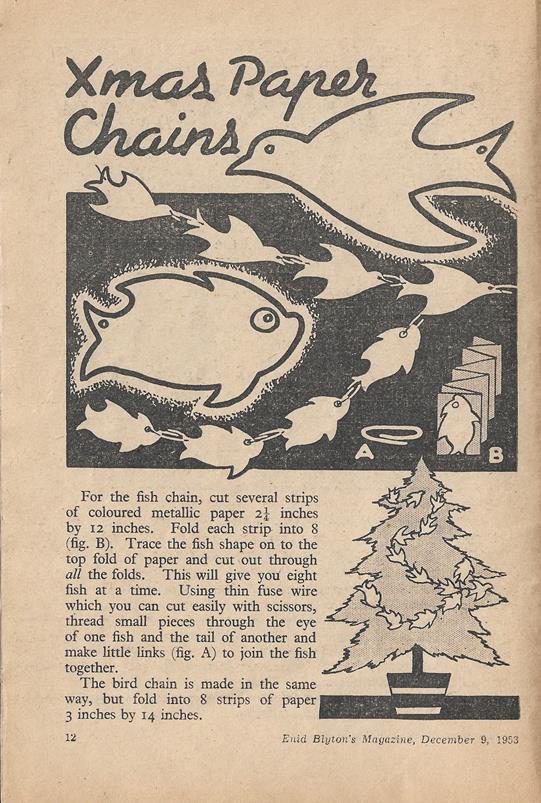
I’m not sure how festive fish or birds (excluding robins, of course) are! but these could look quite effective if done using metallic paper as suggested.
These paper robins are definitely Christmassy. If I had the time I would give them a go – maybe in a few years when Brodie is old enough to want Christmas crafting projects.
If you have my crafting skills easy probably isn’t the right word for these, but there are some interesting uses for milk bottle tops if anyone still has the same type!
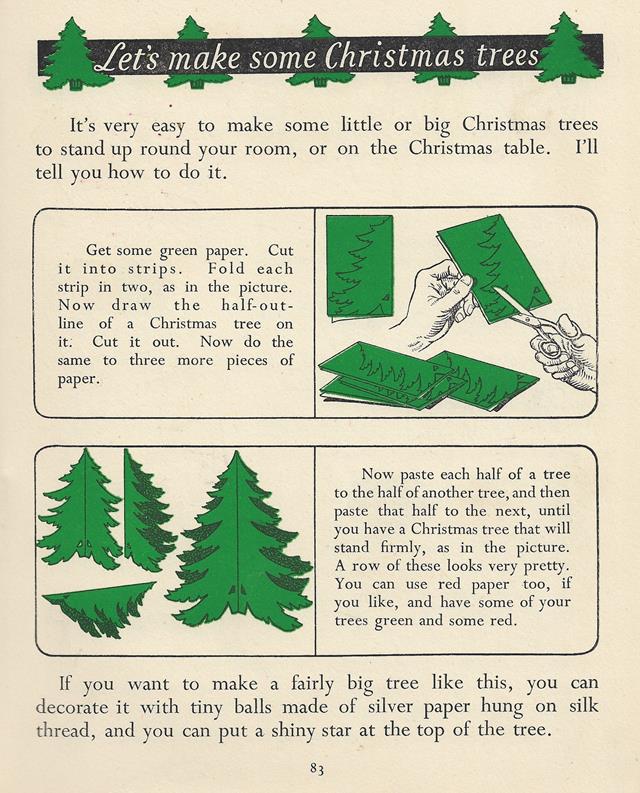
This looks like it would be really effective (but I’d have to use a template again, me freehanding would just make for really wonky trees!). If you used card instead of paper you could cut two trees and then cut slits in them, one from the top and one from the bottom then slide them together.
Decorating your tree
Something that has become more popular again recently is having a tree that is planted outdoors through the year and then brought in for Christmas before being replanted again. Now it’s being done for eco reasons, but it is mentioned in several of Blyton’s stories as a perfectly normal way of doing things.
Decorating the tree, however, has changed a lot!
Lots of Blyton’s Christmas stories involve trees decorated with toys and gifts which are then given to children attending a party, or the children who live in that home.
In Five Go Adventuring Again Anne hopes for the fairy doll from the top of the tree, whereas now I’m sure most people reuse the same fairy doll every Christmas. In The Christmas Tree Aeroplane Mrs Lee who holds the party gives each child a present (including a toy boat) from the tree. And in The Christmas-Tree Party the tree is hung with dolls, and engines and books and motor-cars. It seems strange to think of toy cars and boats and dolls ‘decorating’ a tree.
The other big difference is using candles as tree-lights! They were clipped on to the ends of branches and must have created a huge fire hazard. This is one ‘tip’ I don’t recommend!
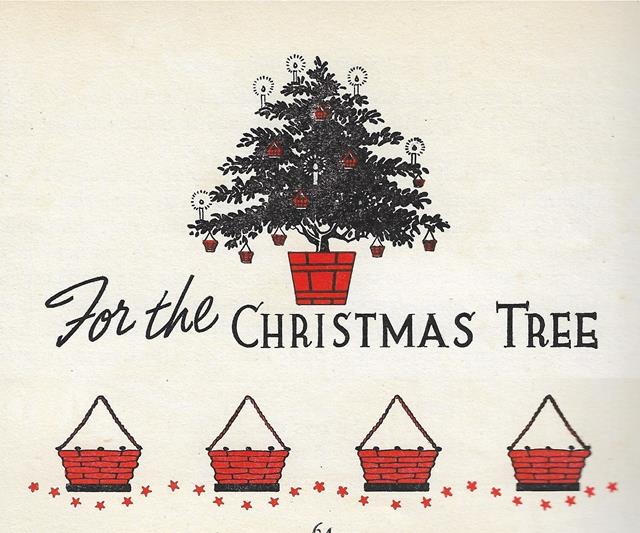
In another make-your-own (but not out of paper) you can have little baskets of sweets on your tree.
It would be fun to make some gay little baskets to hang on the Christmas tree, full of sweets.
We want some flat round corks, some long pins, and some bright coloured wool.
Perhaps Mother has a pickle-cork she can let us have, a nice flat one that we can cut into two, and use for the bases of two baskets. If you are not very old, ask Mother to cut the cork for you, or you may hurt yourself with the knife.
Now we have our flat cork. Stick the long pins in all round – not too close together. Now take a gay length of wool and begin to twist it from pin to pin. You must begin weaving at the base of the pins, of course, not at the top. Go on weaving until the pins are quite covered with the wool, and you have your little basket.
A piece of wire (or a hairpin) will do for a handle. Twist some wool over it, then bend the ends to catch under the edges of the basket, just as in the picture.
Now put your sweets in, and hang your little basket up on a twig of the Christmas tree. If you make half a dozen, they will look very gay hanging on the tree.
I suspect the corks mentioned are cork jar lids rather than the type of corks we use now for wine bottles.
A different kind of tree
There are a few mentions of an outdoor tree – but not the kind we see now with outdoor string lights.
Rather how about decorating a tree (or bush!) for the birds?
As suggested in The Little Christmas Tree
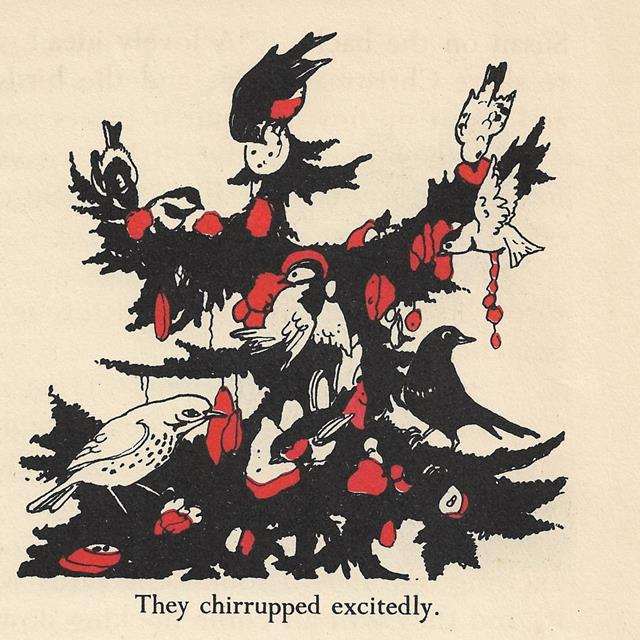
“Robin! I’ve got such a good idea!” [Susan] said. “Even if we don’t feel like using the tree for ourselves, we could use it for the birds. We could hang biscuits and crusts and nuts and bacon rind on it. The birds would love it.”
They took a coco-nut and broke it into bits. They made holes in the middle of the bits and threaded them with string. Then they tied the bits of coco-nut to the branches, just as if they were toys.
The the children brought out some bits of bacon-rind and they hung those on the tree too. They brought out a bone and tied that to one of the strongest branches! Then the children tied crusts of bread and biscuits on to the tree, and then three fine sprays of the millet-seeds that the birds love so much.
The Tiny Christmas Tree
I imagine both trees would have to be refreshed and redecorated every few days as the birds ate away at the decorations!
Other decorations
In keeping with bringing a real rooted tree indoors, in several Blyton books and stories families bring in real holly and mistletoe to decorate with. Best to ask permission before you cut any down, though, unless it has grown in your own garden!
I wonder how many of these things Blyton decorated her house with at Christmas?
Thursday is the 51st anniversary of Enid Blyton’s death. We have done a special post in the past to mark the occasion but I haven’t anything planned this year, as I write something every week that I hope shows the impact her writing had on me and her many other readers.
Decorating for Christmas – the Blyton way
and
Five Fall Into Adventure
“It’s Santa Claus,” said Brer Rabbit in a deep voice. “I’ve got a sack of presents for you, Brer Fox.”
“Come on down then,” said Brer Fox, pleased.
“I can’t,” said Brer Rabbit. “I’m stuck.” Brer Fox unbolted his door and went into the garden to look up at the roof. Sure enough, in the moonlight he could see someone in his chimney.
Brer Rabbit pretends to be Santa Claus to trick Brer Fox in Brer Rabbit is Santa Claus! from Enid Blyton’s Book of the Year.
Harry from The Christmas Tree Aeroplane found in The Second Holiday Book is one of Blyton’s almost too good to be true children. A lady with a grand house has invited him and several other local children to her special Christmas party. Harry comes from a poor home and his mother is ill at the time. Still, he is generous without fault. He doesn’t complain when he doesn’t win any of the games, and gives away his balloon to a child whose balloon has burst. He gives his toy ship from the tree to a child who was accidentally missed out and gives his bonnet from his cracker to another child, too. And he doesn’t say a word about being left without anything to take home. He is lucky that the lady hosting the party notices, and when she hears how he gave all his things to others, she gives him the special Santa-in-an-aeroplane from the top of the tree as well as some cakes, jelly and a ride home in her car.
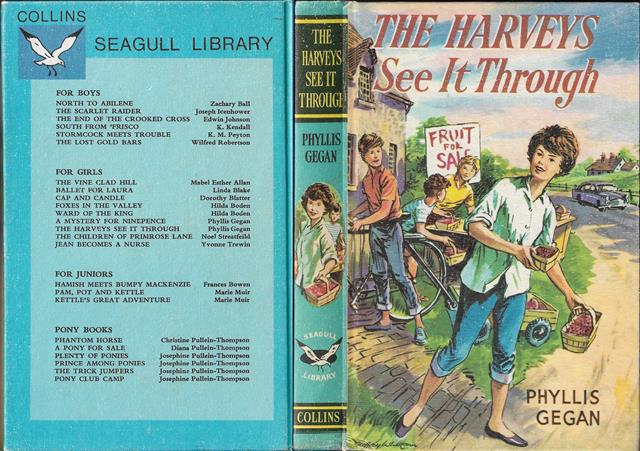
You might remember the name Phyllis Gegan from my review of A Mystery for Ninepence recently.
I bought this one partly because I like the Collin’s Seagull Library spines and partly because I like collecting books by authors I already have (even if I haven’t read them yet!). Anyway, it’s the second of the only two books she was known to have written, and it’s a different genre.
If a Mystery for Ninepence is like a Blyton mystery, then The Harveys See it Through is like…
As I said above, The Harveys is of a different genre to Gegan’s other book. It is far more like one of Blyton’s ‘family’ books – The Family at Red Roofs, House-at-the-Corner, or even The Four Cousins in a way.
It is not as deep as either of the first two I have mentioned. The Harveys do help someone out and manage their own home in the absence of their father, but as none of them have any deep character flaws to begin with, they don’t have to develop or learn any lessons along the way. Their situation is also not as serious as either of those books – nobody is presumed dead or gravely ill or anything like that.
The cast
The Harveys are
Miranda, 15
Julian, 13
Verna, 11
Giles, 9
Mr Harvey
Mamie (Giles’ spoiled cat)
There is also:
Miss Hodges the lodger
Mr Blake the neighbour whose garden meets the bottom of the Harvey garden
Nicky, 14, and Jo-Ann, 13, Weavers, friends of the children
The general plot
The story opens with the Mr Harvey telling his children that he is to go off to America on business for six weeks. He will leave them housekeeping money, an emergency five pound note, and a grown-up lodger as he doesn’t want them alone over-night. (Their mother died several years before and their daily woman is recovering with a broken leg).
While not overjoyed at the prospect the children take it well and resolve to be sensible about everything.
The main part of the story develops when they discover that Mr Blake has been in a car accident and ended up in hospital. They do not get on with Mr Blake as he unjustly accused Julian of causing the death of his dog. They can see that Mr Blake’s raspberries and currants are ripe, and know that he normally picks them and sells them.
So despite heartily disliking him, and being disliked back just as much, the children spend a lot of their summer holiday picking Mr Blake’s fruit and selling it by the roadside, intending to give him all the proceeds. They even turn a load of it into jam when it looks like it will rot before they can sell it.
When Mr Blake first returns home from the hospital he is incensed to see the Harveys have been in his garden and accuses them of stealing from him. However, when he receives the letter, account book and money from them, he is forced to apologise and a friendship is struck up between the neighbours.
The sub-plot regards the family managing without their father and daily woman. There is the shopping, cooking, cleaning and laundry to consider. Things become much worse when a visiting puppy eats his way through several envelopes which had contained a weeks worth of housekeeping money each. They then have to live very frugally – even with using the emergency money – until Mr Blake produces a miracle from the shredded notes.
In between these plots are various bits of fun where the children have their friends over, redecorate their fathers’ room, attend a fair and so on.
What’s Blyton about it?
First up the adults are quickly disposed of, excepting the lodger who is happy to have little to do with managing the children. There are plenty of good meals and even more scrupulous honesty in dealing with Mr Blake’s fruit, down to the last penny spent on sugar for the jam.
As I’ve mentioned, children having to earn money and/or manage a household alone features in a few Blyton books.
Is it as good as Blyton?
No, of course not, but very few of Blyton’s contemporaries do match up in my opinion.
The story lacks a compelling reason for them to be putting such effort into selling the fruit. If Mr Blake had been a very dear friend, I could understand it. Or even if he had been a kindly stranger! However, doing good for the sake of doing good doesn’t work so well.
The children, while likeable and having sufficient personality to stand out from each other, very rarely get cross, fall out, get upset or react in any interesting way. They tease each other, and there is a small amount of upset once or twice but generally they trundle along cheerfully.
Final thoughts
It may sound dull when I describe it, but the story isn’t boring. The ways in which the children manage to pick and sell the fruit is interesting and is interspersed with other plots like their tree-top party and a treasure hunt in the public gardens.
Giles often provides light comic relief with his nonsense over his cat, and his mosaic cake is funny (if concerning on a hygiene level…). There are even a couple of occasions when the children comment on terrible grammar which was appreciated by me, though your mileage may vary!
If you can pick this one up cheaply in a charity shop or online it’s worth reading. And as a bonus it will look good on your bookshelf.

 Anyway, on with the story!















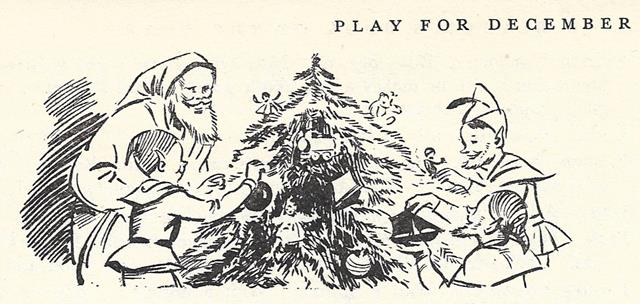


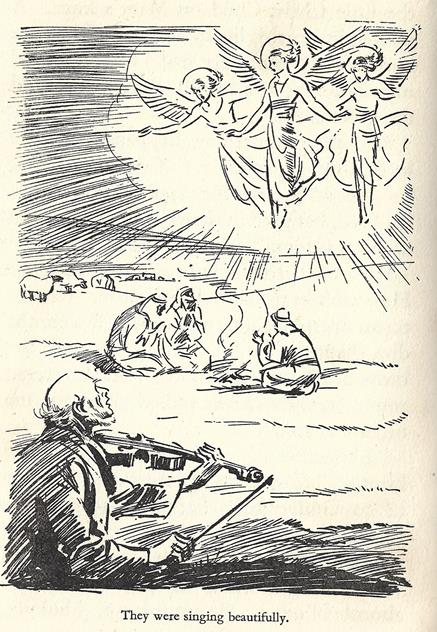




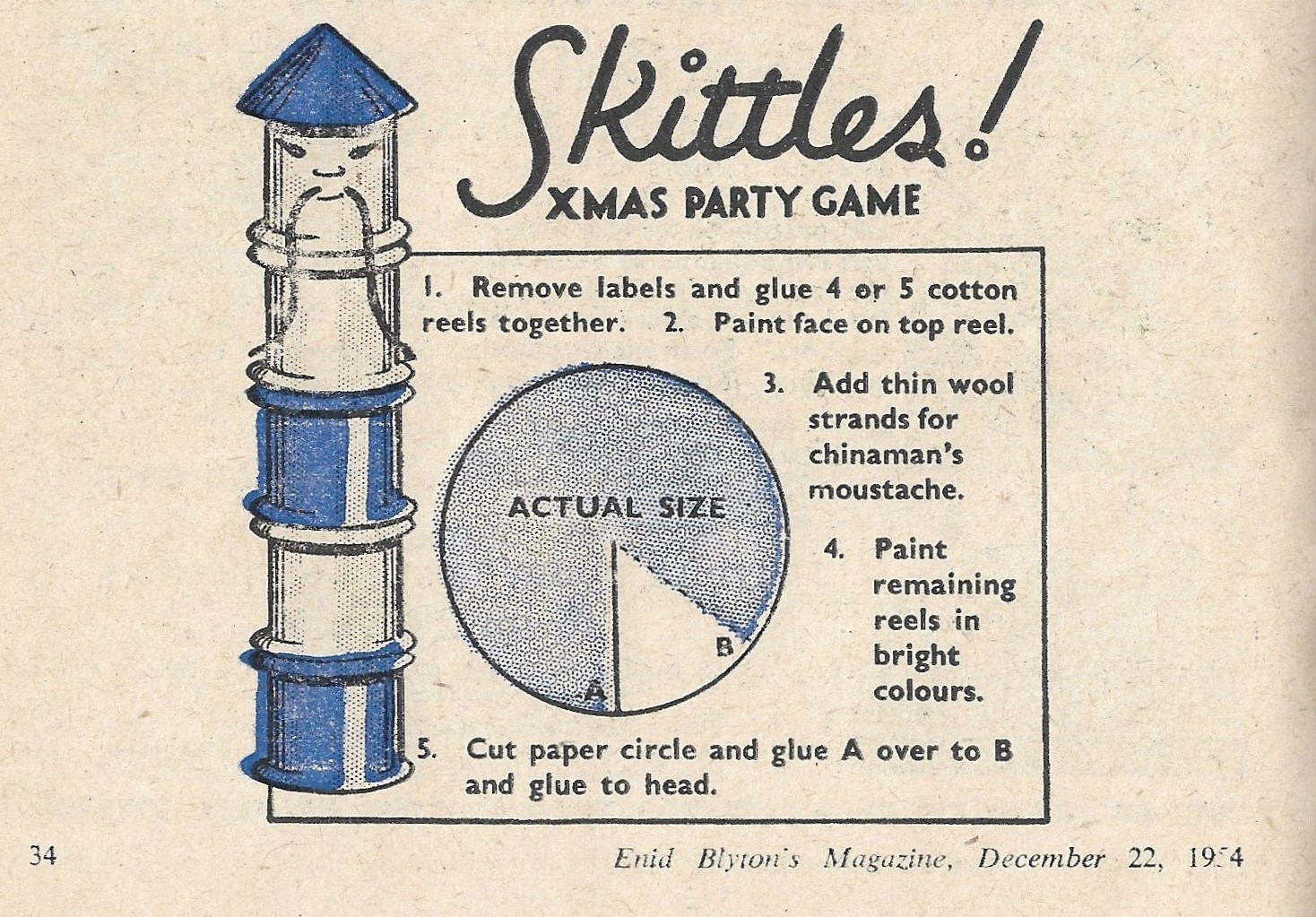 If you do decide to make skittles out of cotton reels I’d advise you to leave off the stereotypical ‘Chinaman’ additions. You could easily paint them in reds and greens with more pointed hats as elves, or in red, black and white with a cotton-wool beard and red hat for Santa.
 Possibly the least-festive Christmas greeting I’ve ever seen!
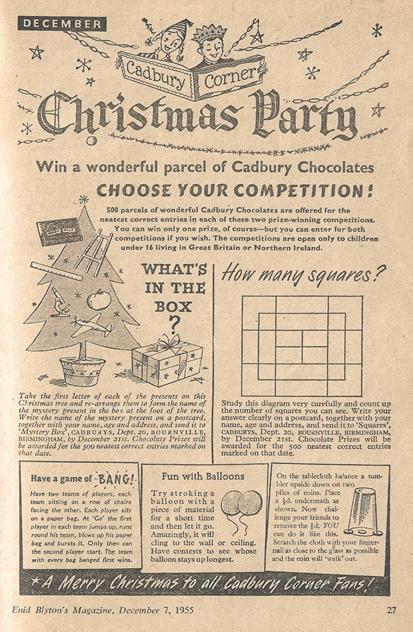 A part advert and part puzzle from Cadbury.









 Fiona
Fiona pippastef
 worldofblyton
 World of Blyton