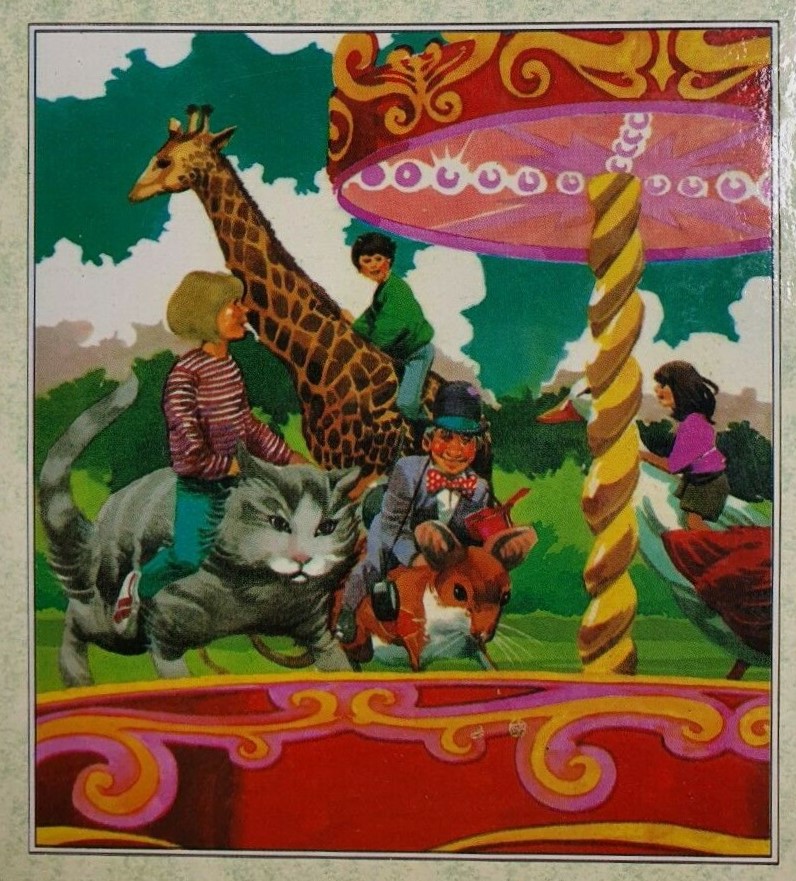
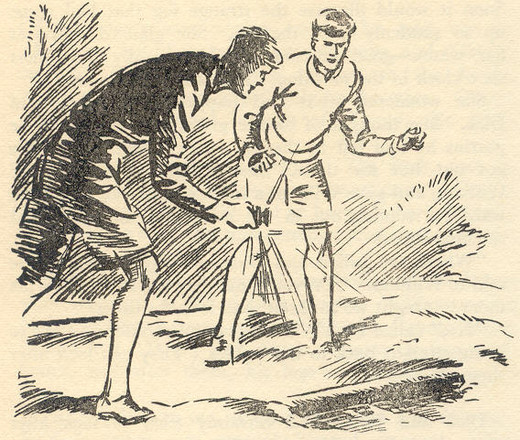
The Magic Faraway Tree covers through the years

I was looking for something reasonably un-taxing to write this week, and decided that as the Faraway Tree series only has three books (well, four if you include Up the Faraway Tree which is a different format, but even so that only has three editions so hardly adds any complications) so I’m hoping it does prove to be more straight-forward than some of the ones I’ve done.

The ones I’ve done previously are:

The Famous Five, parts one and two
The Adventure Series, parts one and two
The Secret Series
Malory Towers, parts one and two
St Clare’s, parts one and two
The Barney Mysteries
Mr Galliano’s Circus
The Naughtiest Girl
The Five Find-Outers

So now for the Faraway Tree covers!


The classic first editions

Despite there being perhaps slightly longer gaps between books (there are seven years between the first and third books, and twelve years between the first and fourth), and the fourth book being a strip-book put together from Sunny Stories content, all the first editions were illustrated by Dorothy M. Wheeler.

George Newnes, 1939, 1943, 1946 and 1951.

A really long gap

If you thought 3-5 years between the books above was bad, well, the first time these books were republished was in 1971! Yes, a whopping thirty-two years after The Enchanted Wood was published. I find that quite bizarre. The hardbacks were probably printed many times over – it was common to see 14th or 18th impressions of Blyton’s books in the late 60s, but over thirty years for a new edition seems a very long time. All the other series I’ve looked at had paperback editions by the mid-to-late 1960s, so even for The Secret Island which was out in 1938 had a shorter gap. Many series even had two hardback runs (some complete, some only for certain titles). Anyway, I’m getting off-track here.

The first new editions are from 1971, and so we skip the 1960s style artwork we’ve seen on so many Armada paperbacks, and go straight to Dean with a strong 1970s vibe from an uncredited artist.

The bold colours definitely give me a 70s feel, particularly the green/orange combo of The Enchanted Wood, then on The Magic Faraway Tree I swear there’s a discrete flare to those jeans!

Dean 1971, 1971 and 1972

Mind you Up the Faraway Tree, the fourth book, had to wait until 1981 for its first new edition, which is when the other three got their second. The 1981 editions are from Beaver with covers from Gerry Embleton, who has given Moon-Face a literal moon for a face. I think he was called Moon-Face because his head/face were very round, but not an actual moon. He certainly doesn’t have a moon for a face on the first edition covers, or in any of the internal illustrations, but you can’t always trust illustrators. Both Embleton and Rene Cloke have given Silky wings, and then there’s the infamous back-to-front telescope from Eileen Soper… but I’m getting off-topic again. Moon-Faced or not, he’s a bit of a creepy specimen.

These are, to me, instantly recognisable as being for the Faraway Tree series but that’s perhaps its the cover I most often see for the fourth book.

Beaver 1978, 1978, 1978 and 1981.

Janet, Anne and Georgina

The first ‘complication’ of this series, is that three editions had two different illustrators. The The Enchanted Wood’s 1978, 1985 and 2001 Dean editions were by Janet and Anne Grahame Johnstone (twin sisters, who as far as I have seen were always credited together on Blyton’s books – this is backed up by Wikipedia). The Magic Faraway Tree and The Folk of the Faraway Tree had Dean editions come out within a few years of these, using a similar style but with Georgina Hargreaves as the artist.

Janet Grahame Johnstone died in 1979, and although it is said that her sister Anne fulfilled all outstanding contracts alone, despite never having worked alone before, she did not work on any more Faraway Tree editions. Perhaps there was not a contract in place at the time, and she chose not to take on any new ones in the first few years after the loss of her sister.

What’s interesting is that none of the covers are not the same, they are not even a close-up or cropped piece of the same work, they are three entirely different pieces of artwork. So either Janet and Anne submitted more than one cover and some were used later, or they are taken from the internal illustrations.

Georgina Hargreaves’ covers are reused, but not each time. Her 1981 and 1985 covers of The Magic Faraway Tree use the same artwork but cropped for the second one, but the 2011 edition is different. All three editions are from the same work for The Folk of the Faraway Tree.

All these editions, I believe, are called ‘Deluxe’ editions, I think referring to the full-page and full-colour illustrations inside, also by Georgina Hargreaves (and presumably the Johnstone sisters for The Enchanted Wood). All are quite large books, too, somewhere around a4 size, even so, it’s a shame that the most recent ones have reduced the cover art to a small square.


Familiar territory

The next Dean editions came in 1990, with a hardback style that was used on many series and stand-alone titles. I don’t have a better name for these than ‘colour border’, though it’s interesting that sometimes little bits of the square image escape their boundaries.

These were by another uncredited artist. What’s strange to me, is that the first two are quite dull and generic at first glance. They’re just some kids in the woods. The second looks rather like Hollow Tree House, while the first could be any adventure. It’s only on a closer look that you see there are a couple of fairies in them. And then the third, well, that’s a brightly-coloured scene from a dream, perhaps even a nightmare!

All Dean 1990.

Here’s a close-up so you can appreciate the sudden change of direction.


Despite there only being three/four books in the series, that still turned out to be more complex, or at least, more wordy than I had anticipated. I think it’s best if I return for a part two later, instead of making this post two or three thousand words long.

Have you seen any of your favourite covers yet?

Posted in Illustrations and artwork | Tagged , , , , , , , , , , | 8 Comments

Monday #415

In Scotland we are now allowed to meet in groups of four outdoors, and it’s even getting almost warm enough to sit outside comfortably!

The Faraway Tree covers through the years

and

Five Have Plenty of Fun

The real Green Hedges, Enid’s home from 1938 until shortly before her death in 1968, was demolished in 1973. However there is a perfect miniature of it which can be found in the Bekonscot less than half a mile away from where the real Green Hedges once stood.

The miniature even has a tiny Enid, typing away in the garden, though sometimes (perhaps on rainy days) she moves to the covered porch.

Obviously Bekonscot is closed at the moment but hopefully it will reopen when the rules allow because it’s a lovely place, with a lot more to offer than just Blyton’s house.


Posted in Blog talk | Tagged , , , | Leave a comment

A guide to the Famous Five’s sidekicks

We all know about the main Famous Five cast, but what about the various friends that show up throughout the series? They never had any long-term sidekicks, no Robin, no Samwise Gamgee or Watson, but in several stories they had friends who tagged along and helped out (in the subservient sort of way that denotes them as sidekicks and not equals).

They met a lot of other children during the 21 adventures but not all of them are worthy of sidekick status. Some are enemies like Edgar Stick, others are merely rescued by the Five, like Mary Armstrong of the same book.

I will look at the genuine sidekicks first, and perhaps revisit the topic for the hangers-on. In order for me to count them as a sidekick the child must: have some sort of purpose within the story, take part in some or all of the adventure, be accepted however temporarily into the friendship group of the Five.


The repeat offenders

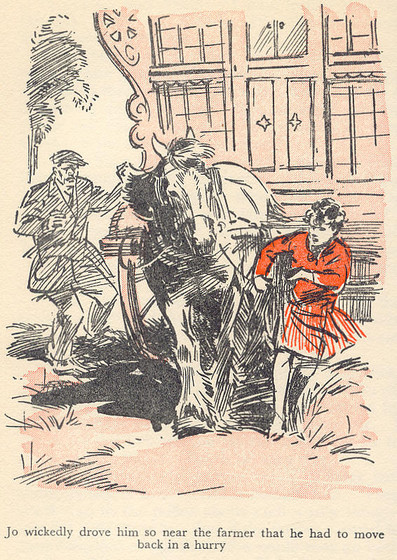
A couple of sidekicks appeared more than once – Jo the gypsy girl and Tinker Hayling.

Jo the gypsy girl

Appearances – Five Fall Into Adventure, Five Have a Wonderful Time and Five Have Plenty of Fun.

The Five first meet Jo on Kirrin beach when she steals George’s sand hole to sit in. At first they want nothing to do with such a dirty little urchin, but when Dick hits her and finds out she’s a girl he is impressed by her pluck. Dick is the only one Jo likes at first, and he is the only reason she helps them track down a kidnapped George – even though it was her who helped with the kidnapping by luring Timmy to eat drugged meat. She shows true bravery by the end of Five Fall Into Adventure, climbing an ivy-covered tower to swap places with George as they look quite alike. In the end she does not return to her father as he is locked up for his part in the kidnap, instead she goes to stay with Joan’s cousin.

She appears again in Five Have a Wonderful Time, just in time to resolve a feud between the Five and some fair-folk some of whom she just so happens to be related to. She then joins in on the attempted rescue of the missing scientist Derek Terry-Kane, but then ends up helping rescuing the Five as well, after getting temporarily tied up herself.

Her last appearance is a brief one in Five Have Plenty of Fun, when she visits Kirrin Cottage at night and finds out that George has been kidnapped (again). Having been told not to take Julian’s bike she takes Dick’s instead and rides off to a fair where she knows people. Later she brings a friend from the fair to speak to the remaining members of the Five as he may have information about George.

Tinker Hayling

Appearances – Five Go to Demon’s Rocks and Five Are Together Again

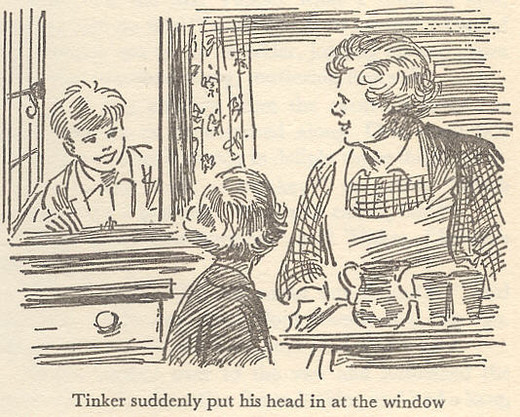
Tinker is – I assume – several years younger than the Five as he behaves like a car. By that I mean he makes car engine noises and requests petrol top ups in the kitchen. Despite being quite annoying due to his car obsession, he has two interesting aspects. The first is he owns a monkey called Mischief, and secondly, he owns a lighthouse. The lighthouse becomes the setting for Five Go to Demon’s Rocks and Tinker is involved in the adventure, though his usefulness doesn’t go much beyond having supplied the lighthouse. I don’t mean that he is useless or causes difficulties, but he as a sidekick he doesn’t really shine. Mischief comes in useful, at least, as she finds some very old coins indicating that the old treasure is in the underground caves somewhere.

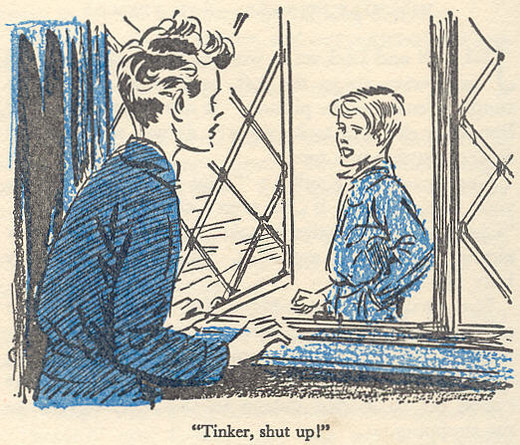
Tinker shut up said George

When Tinker appears two books later he is still making car noises, but at least with reduced  frequency. He has again provided accommodation for the Five, this time at his home at Big Hollow, where of course a mystery occurs.


The one book wonders

Sooty

The first sidekick to appear in any Five book is Pierre ‘Sooty’ Lenoir, in Five Go to Smuggler’s Top.

Sooty is a school friend of Dick and Julian’s, and the Five go to stay with him at his home, Smuggler’s Top on Castaway Hill. Sooty, at school, is apparently a big joker and always in trouble for playing tricks. At home he is a bit of an inventor, having rigged up a sort of alarm system to warn him if anyone approaches his bedroom. He takes on the task of hiding Timmy in the secret passages of Smuggler’s Top (his step-father hates dogs and won’t have them in the house), he takes the Five on a tour through the catacombs in the hill, and he stands up to Block, his step-father’s creepy man-servant. He even pretends to have bitten Block on the leg to cover for the fact that Timmy nipped him during a skirmish one evening. He even has the dubious honour of being kidnapped, and spends quite a while wandering an unfamiliar area of catacombs with Uncle Quentin before Timmy comes along.

Nobby

The next sidekick comes in the following book – Five Go Off in a Caravan – and is a circus boy. Nobby loves animals, having two dogs of his own, Barker and Growler, and he has a strong friendship with the chimp Pongo, too. He loves to work with the horses, and helps out whenever the horse trainer allows him to.

He has no parents and lives at the circus with his ‘uncle’ Dan, known as Tiger Dan on account of his furious temper. Nobby bravely ignores his uncle’s threats and warnings and to spend time with the Five, and shows them around the circus camp. Having lived a circus life he is very impressed with the Five’s fancy modern caravans and is keen to make a good impression on these posh kids by putting on his best manners.

He gets embroiled in their inevitable adventure, and is lucky to end up free of his cruel uncle and goes to work on a farm near where the Five had been camping.

Jock Robbins

Jock – a good Scottish name and given a Scottish accent in the audiobooks, so I’m claiming him as Scottish – appears in Five Go Off to Camp. He lives on the farm which supplies the Five with copious amounts of food and drink, both take-away and sit in. He is a cheerful, good-natured boy who quickly becomes friends with the Five, showing them around the farm, visiting their camp and accompanying the boys on a middle-of-the-night visit to see the spook trains. He’s not able to join them for their second night-time trip – he’s unfortunate to have a nasty step-father who is trying to keep him away from the Five – but he joins the boys for the final excitement, though, getting himself held prisoner along with Dick and Julian.

Richard Kent

I was of two minds about calling Richard a sidekick. He certainly appears in a significant portion of Five Get Into Trouble, though for a lot of that he’s more of an antagonist than a sidekick.

He meets the Five while they are camping and insists on joining them on their bike tour, even though they find him a bit annoying. He lies that he has permission to ride with them as far as his aunt’s house, but when he gets there his aunt is out, and he runs into Rooky, an ex-employee of his father’s, who has a grudge against him. He brings all this trouble straight to the Five, whereby Dick is kidnapped having been mistaken for Richard.

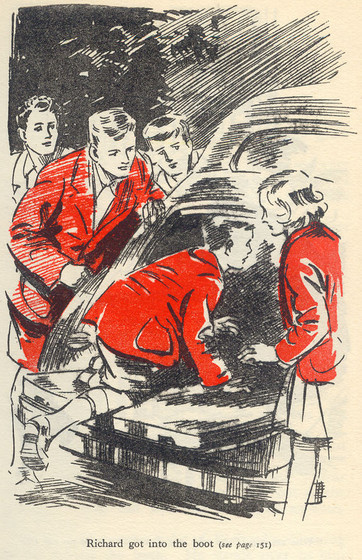
Richard is not the bravest at this point – he is terrified of Rooky and only accompanies the Five to rescue Dick because he’s too afraid to try to make his own way home alone. At least he makes up for his earlier shortcomings by being the one to hide in the boot of a car being driven by the enemy so that he can summon help.

Toby Thomas

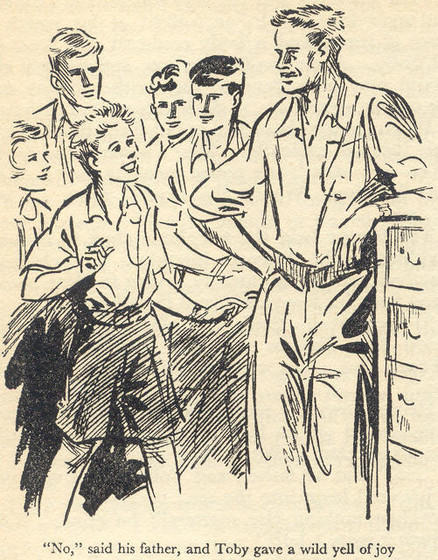
Toby is another farm boy, this time appearing in Five Go to Billycock Hill. It’s his mother’s task to feed the Five while they camp and so Toby, who already knows Julian and Dick from school, is a natural addition to the group. He gets them into trouble by showing them an off-limit pool which they bathe in, but when his cousin Jeff is believed to have stolen a new plane and then died in a crash he shows his backbone. He refuses to believe it and along with the Five investigate the suspicious goings-on at the nearby butterfly farm, ending up in them finding and rescuing Jeff and another pilot.

The Two Harrys

Harry (Henry) and Harry (Harriet) are twins in the Philpot Family. The Five stay at the Philpots’ Farm, Finniston Farm in the aptly named Five on Finniston Farm. The twins are plucky and hard-working, doing all they can to help their over-worked mother. They gain respect for the Five when they pitch in too, and together they work to uncover a centuries-lost treasure.

Wilfrid Layman

Wilfrid is a curious boy. Like Philip Mannering he has a way with animals, though he plays a little pipe to lure them to him. He is not so good with people, which is why Mrs Layman – his aunt – has asked the Five to stay and try to keep him company while she is away. He is not impressed with having to share the cottage with others, but as he takes a liking to Timmy he lets the others stay as well. When the Five manage to strand themselves on the mysterious Whispering Island, Wilfrid is brave enough to row across to attempt a rescue.


Who was your favourite sidekick?

Next post: The Famous Five’s other companions


Posted in Characters | Tagged , , , , | 10 Comments

Enid Blyton Ephemera

I’m one of those people who keeps everything. Old schoolwork? Check. Ticket stubs? Check. Programmes, leaflets, flyers, wedding favours…? check. Unsurprisingly some of those bits relate to Enid Blyton.

If you look for Enid Blyton ephemera on the internet you’ll probably see vintage postcards, greetings cards, autographed letters,  and other things of some value.

The definition of ephemera is paper items which were meant to be briefly used and enjoyed and then discarded. For example you send a greetings card, the person reads it, perhaps displays it for a short time then discards it (hopefully into the recycling bin these days). Sometimes people do keep hold of these things though, and some of them can become collectible, as the majority of the items produced were discarded.

My collection is not at all valuable but they are things I can’t seem to throw away.


Places I’ve been

I’ve visited a few Blyton places in the past and I’ve always picked up any leaflets or fliers or booklets I could get my hands on.

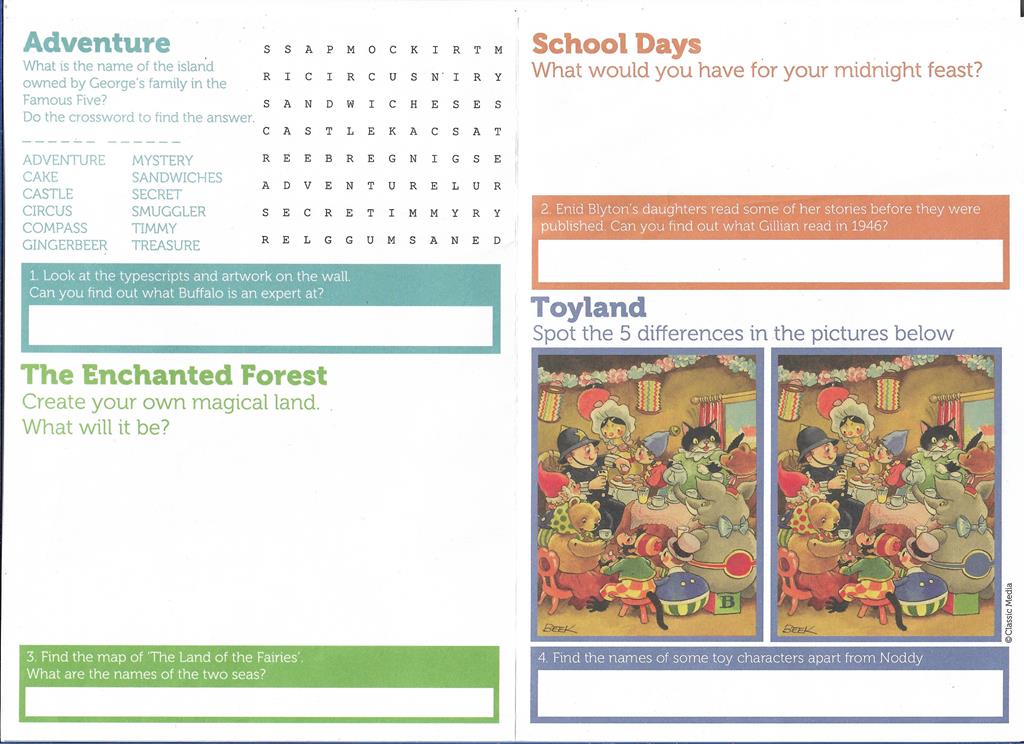
First up – Mystery, Magic and Midnight Feasts, the Seven Stories Enid Blyton Exhibition from 2013. This was a free leaflet I picked up which has a few puzzles inside and a map of the exhibition space.

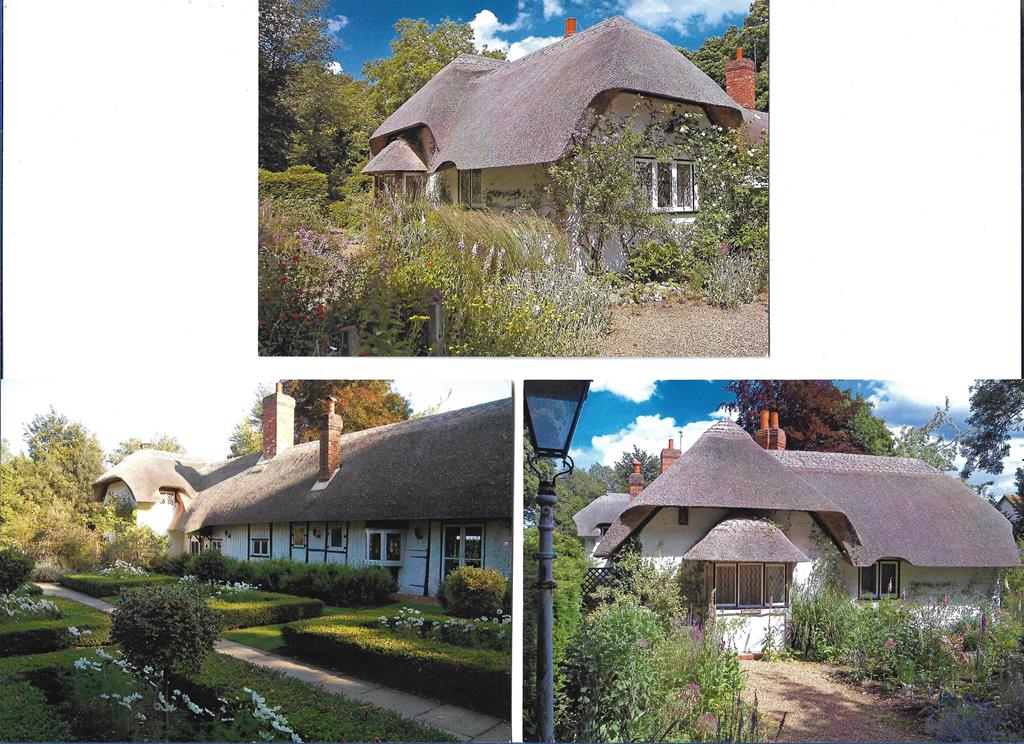
Then one of my favourite places in the world – Old Thatch. I must have picked up this one at Old Thatch itself, though you probably could have found it at Tourist Information stands and other visitor attractions in the area.

And another from Old Thatch, a map and some information about the gardens. (I actually have two of these, one from each of my visits, both entirely identical…)

I am infinitely sad that the gardens are now closed due to Old Thatch being sold to new owners. Below are a few postcards that either I bought on one of my visits, or Stef sent me from one of hers.


Places Stef has been

While Stef has been to Seven Stories and Old Thatch she has also been places I haven’t and can always be relied upon to post me a leaflet or flier from places she has been.

Here is a flier for the Ginger-Pop Shop and Eileen Soper’s Illustrated Worlds, which are both sadly closed now.

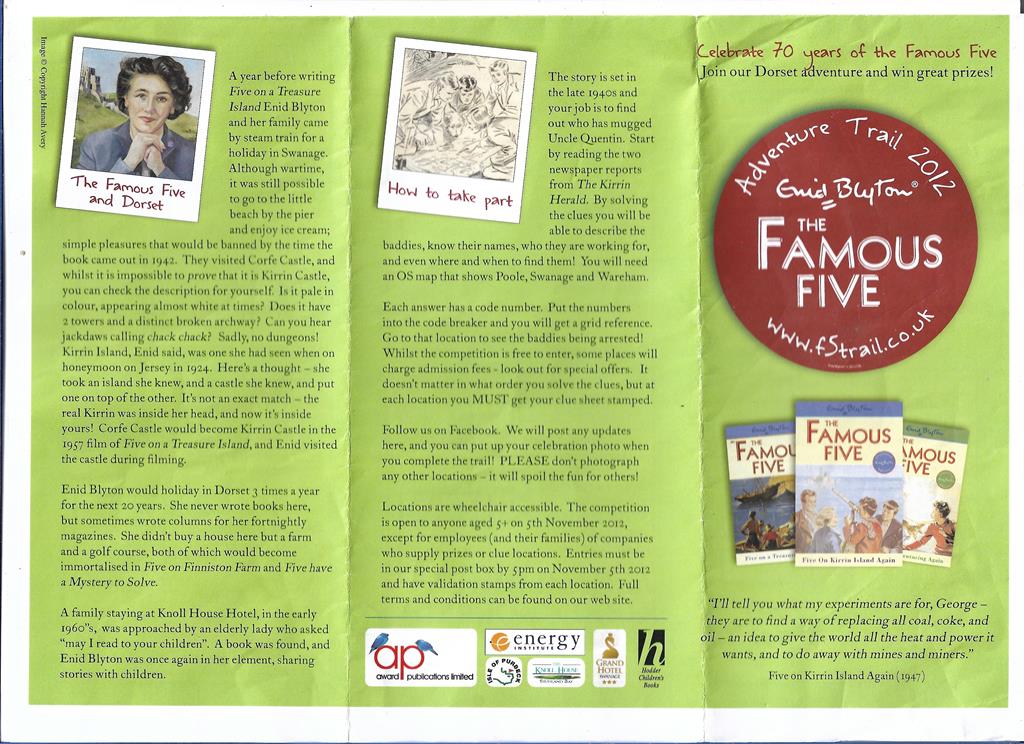
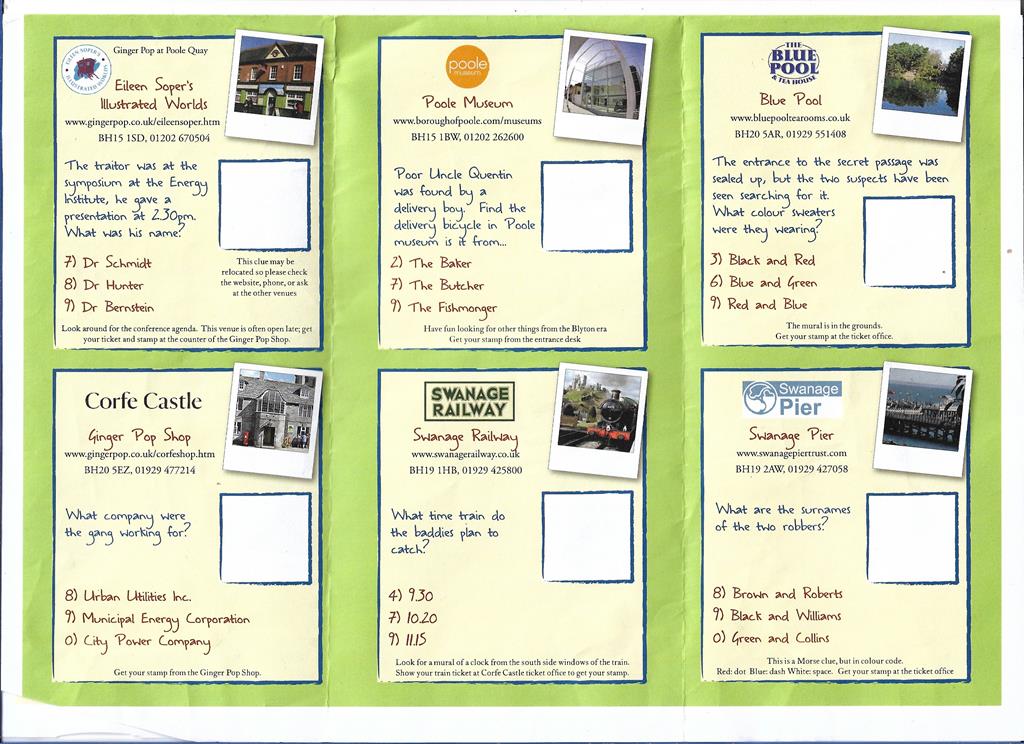
Next up is another one from Corfe/Dorset, a Famous Five Adventure trail from 2012.

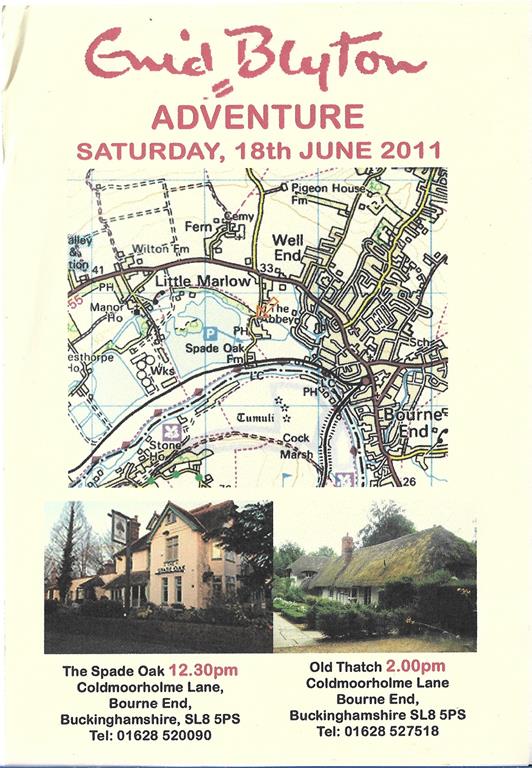
And an Enid Blyton Adventure Trail leaflet, Stef tells this was an Enid Blyton Society get-together where they had lunch at the Spade Oak and then visited Old Thatch after.


More Enid Blyton Society things

I’ve been a member since 2007 and yet I have bits of paper from the late 90s… this is because I’ve been buying the older journals and sometimes they still have the renewal slip inside.

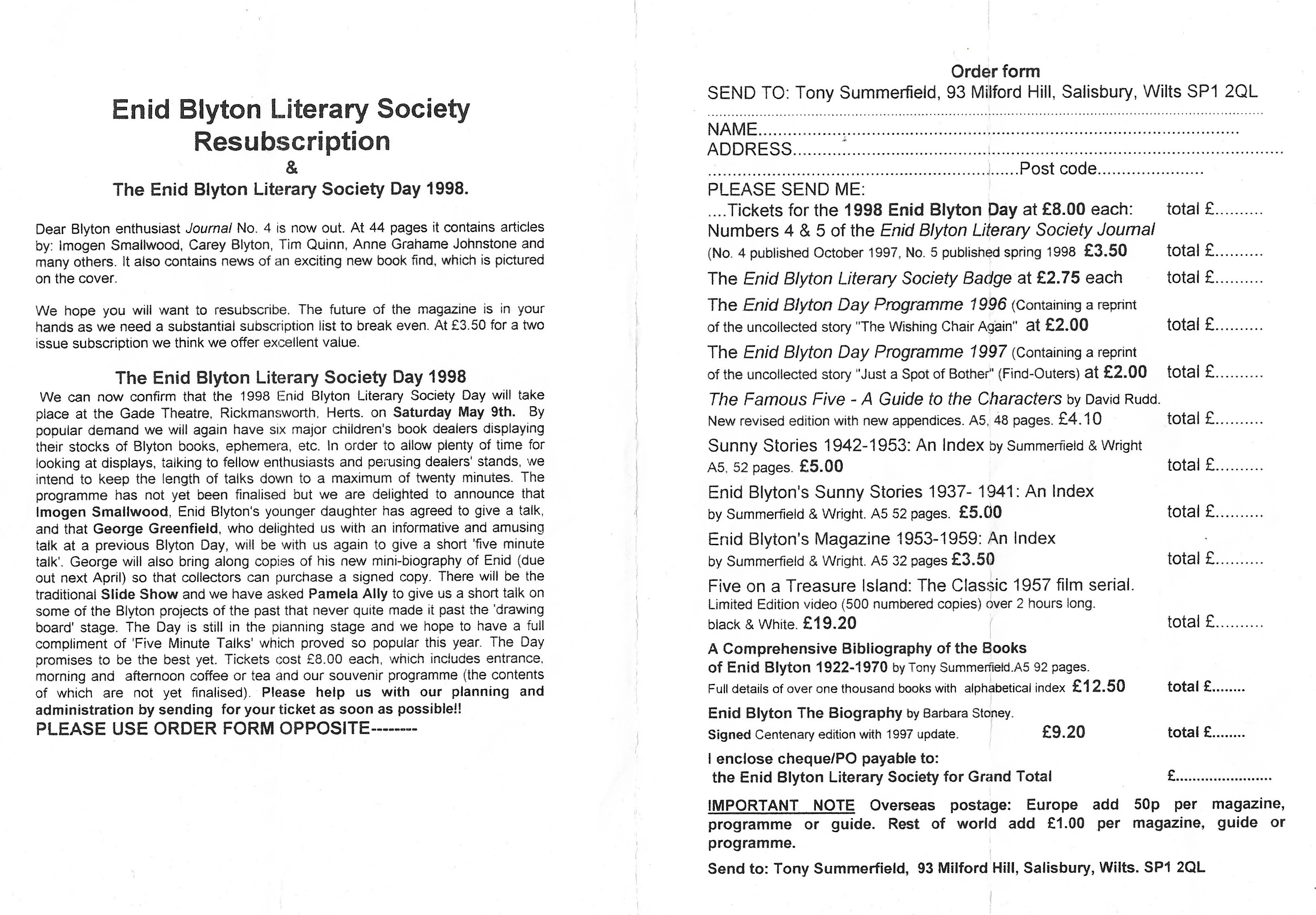
This 1997 one is an advert for the Enid Blyton day – back when the Society was called the Literary Society, and before it was held at Loddon Hall. I wish I’d been able to attend this given the amazing line up, but I was only ten years old and I don’t think I would have really appreciated it back then.


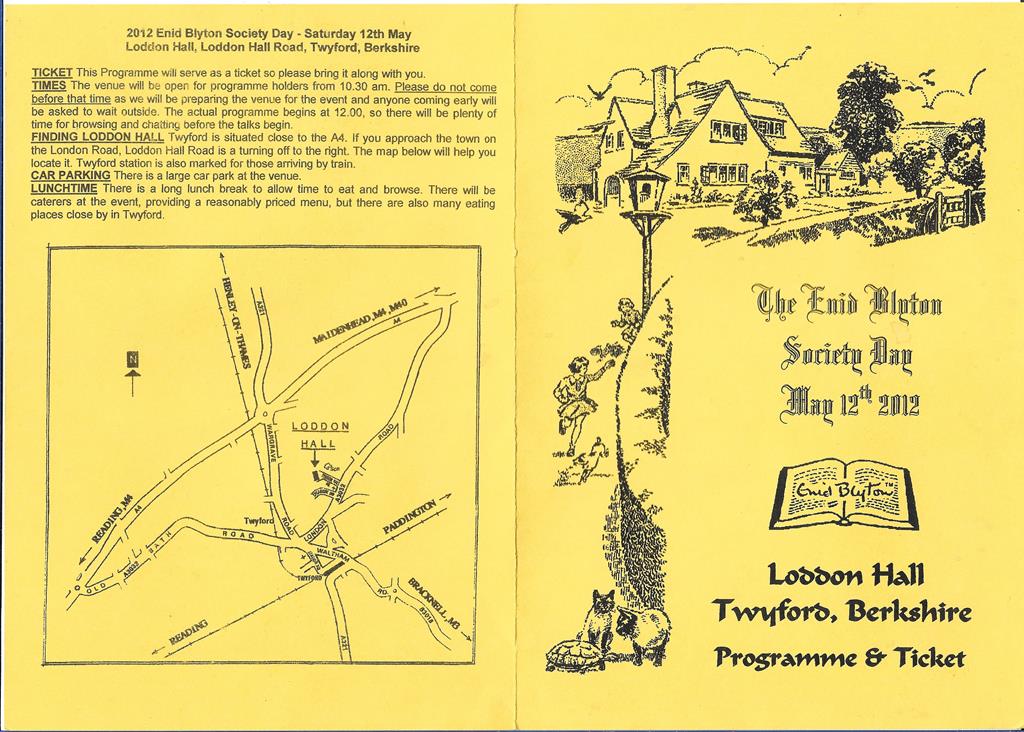
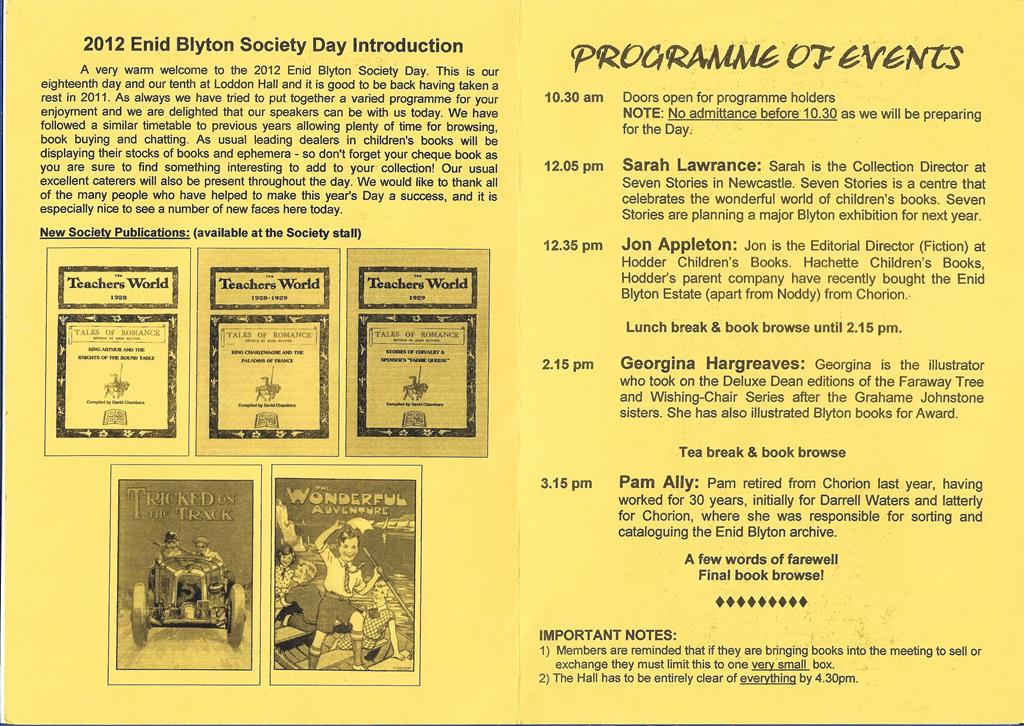
Then the 1998 one is a joint advert and renewal slip. It was £3.50 for a two issue UK subscription back then, and is now £10 for 3 issues, proving the continued good value! I also like the sound of the 1998 line up for the Society Day, un-finalised as it is! It’s funny to me that this bit of paper that I’m treating as ephemera has a bit about Enid Blyton ephemera on sale on it.And here is the programme/ticket for the one day I did get to attend, which also happened to be the last day ever (nothing to do with my attending, I promise!). I was lucky to meet Imogen at this day and even spoke to her briefly, and got her autograph.


Performances

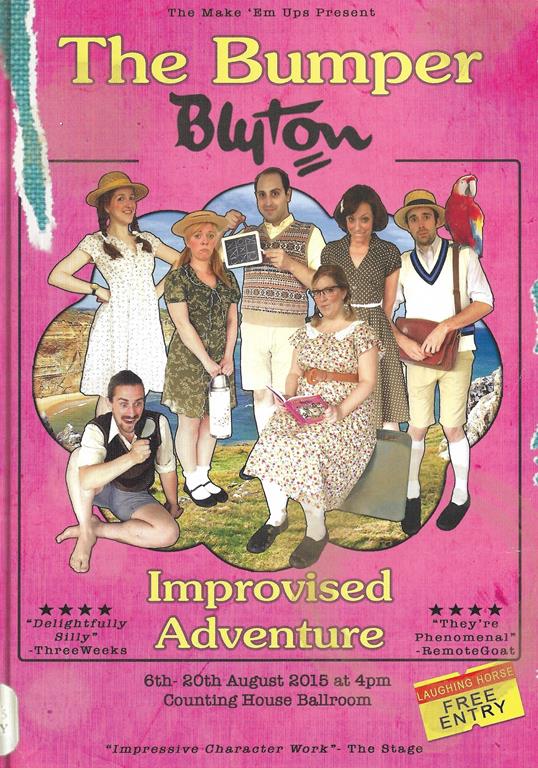
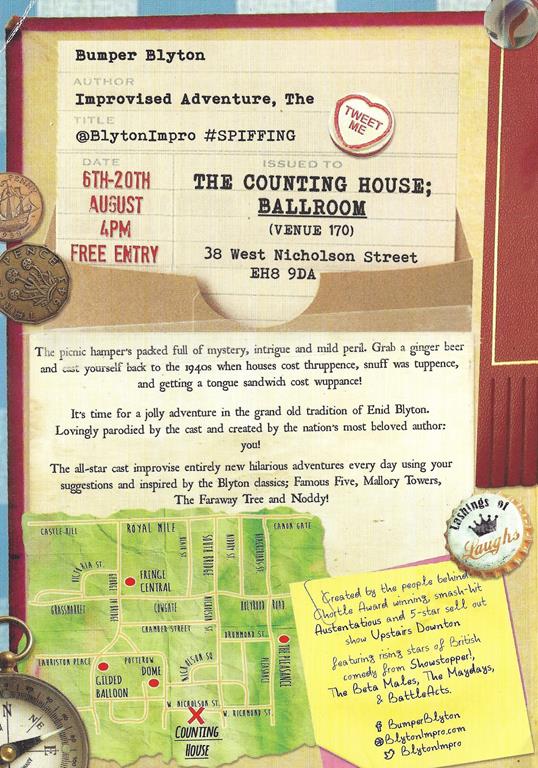
There’s only one of these actually, but I have several pieces relating to it. I saw The Bumper Blyton Improvised Adventure at the Edinburgh Fringe in 2015.

I picked up a post card when I was there.

And a couple of leaflet/fliers.


And everything else

You’re probably wondering what other useless rubbish I’ve held on to…

Well, there’s the Secret Seven code cracker that went along with the books issued with MacDonald’s Happy Meals in 2014.

I have some of the books as well, but those are designed to be enjoyed for longer than ephemera is.

Some post cards featuring the Paul Child Band, Paul Child being the actor who played Dick in the 90s Famous Five TV series. Unfortunately the band seems to have broken up, I really enjoyed their debut album.

And lastly, one of the business cards for the blog that Stef and I designed, printed and cut out ourselves. Does ephemera even count if you’ve make it yourself?


I still enjoy looking through these now, whether or not I experienced the places or events that they refer to. What seemingly pointless things have you held on to?

Posted in Locations, Personal Experiences | Tagged , , , , , , , , | 2 Comments

Monday #414

The weather has been a little kinder the past week or so, at least, it has remained mostly in the plus figures which is a start. There has even been some sunshine and I’ve managed to get the washing outside a few times. I’ve notices primroses all over too, but not daffodils quite yet though they can’t be far off.

Enid Blyton Ephemera

and

A guide to the Famous Five’s sidekicks

“Roger, where are all the socks you took back to school with you? It says you took back eight on this list, but I can only find one pair, very holey and dirty.”

“I’ve got one pair on,” said Roger, helpfully. “That makes two.”

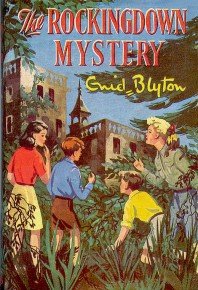
Poor Miss Pepper has her own uniform woes to deal with in The Rockingdown Mystery.


Posted in Blog talk | Tagged , , , | Leave a comment

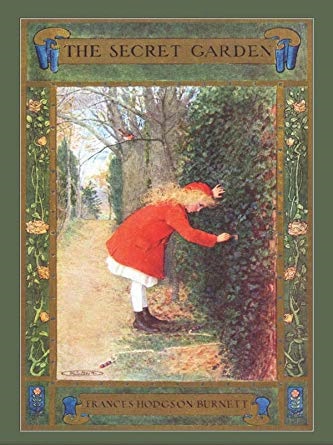
If you like Blyton: The Secret Garden by Frances Hodgson Burnett

Usually my If you like Blyton posts are on modern-ish authors you might not have heard of, mixed with a few older things that again, you may not have read. This time, though, I fear I may be teaching your grandmother to suck eggs. You’ve probably read The Secret Garden, and if not, you’ve at least seen one of the films and are aware of the plot.

So why am I still going ahead with a review? Not because I’m desperate to find something to write about – though that’s a good a reason as any – rather because I just loved it so much.


A familiar story

I had never read The Secret Garden until a few weeks ago when I listened to an audiobook version. And yet, having seen the film – the 1993 one with Dame Maggie Smith as Mrs Medlock – I felt like I was reading an old favourite. I suppose that’s more testament to the faithfulness of the film adaptation than the writing, but never mind.


In case you aren’t familiar with the story of The Secret Garden, here is a summary.

Mary Lennox is a ten year old girl living in India when her parents die suddenly of cholera. She has never been loved by her parents but she has been spoiled by the servants and so is a cross, rude, demanding little girl. She is sent to England after the death of her parents and has to adapt to living in the lonely Misselthwaite Manor in the middle of the Yorkshire Moors. Her only company are her maid Martha, the crusty old gardener Ben Weatherstaff, and a little robin redbreast who flies around the garden, though soon she gets to know Martha’s brother Dickon, and discovers another young inhabitant of the Manor who’s mere existence has been kept a secret from her. She also, after some searching, discovers the Secret Garden of the title, and with Dickon’s help she works on the garden to try to restore it.


One of Blyton’s inspirations?

The Secret Garden was published in 1911, when Enid Blyton was 14. She might have felt too old for a children’s book at that age (though interestingly the book was marketed at adults and children when it came out), but she may well have become familiar with the plot even if she hadn’t read the book.


There is a great deal of gardening in the book, as Mary learns the joy of watching plants come to life in the spring, and she learns from Dickon how to prune rose bushes and how to tell if a bush or tree still has life in it. We know Blyton was an avid gardener and how she loved nature, inspired by her father, and she wrote many books (both fiction and no-fiction, and some a mix of both) about plants and nature.

Dickon is very much like Philip Mannering, he has a way with animals and has pockets full of squirrels, a tame crow who follows him everywhere, a fox cub he has raised, he even has a wild moor pony who he has tamed.

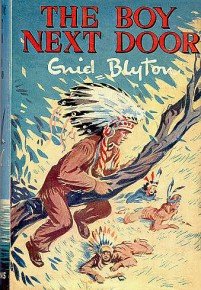
The discovering of Colin – the boy secreted away at the Manor – reminded me of the discovery of Kit in The Boy Next Door. In both cases the child/children discover a boy’s existence even when the adults deny such a boy exists. The reasons they are hidden, however, are quite different.

Having been scanning through The Mountain of Adventure for our latest fan fiction, I also noted that the entrance to the mountain; behind a curtain of ivy and brambles, is much like the entrance to the garden; hidden behind a curtain of ivy. Both blow away from their entrances at just the right moment to reveal their secrets to the child or children.

None of these elements are unique to Blyton or Burnett, if you took the time you could probably come up with dozens of stories with ivy curtain and boys being kept hidden, or boys who charm the wildlife (Wilfrid of Five Have a Mystery to Solve is another), but probably not all at the same time. I just found the parallels interesting.


The moral of the story?

There is a strong set of morals underpinning the story – and by morals I don’t mean preachy do-gooder morals. Saying that, though I find all the morals seem more like threads of the same moral, all intertwined.

I think primarily it is about the power of positive thinking. Mary arrives as Misselthwaite determined to hate everything, and yet as time goes on she starts to see it’s not as bad as she thought. Then when she makes up her mind to enjoy herself, she really does. Then Colin has always believed himself to be a cripple (the book’s words, not mine), and so has lived the life of a feeble invalid. After he meets Mary he decides that he is going to like getting up and going out, and so he does. He also decides he is going to walk even though he had always believed he couldn’t, and so he walks.

Mary, Colin and Dickon in the garden. Illustration by Charles Robinson from the first edition.

Of course positive thinking alone can’t solve a problem but it can help, conversely negative thoughts can make it harder to achieve something. I suspect that there is a religious undertone to the message here, as they almost form their own church to pray to the magic that they believe flows through the garden, bringing the flowers to bloom and Colin’s legs to work. However it is fairly discreet as Christ, God and so on are never mentioned, just magic and prayer and the sorts of things that are mentioned in religion.

There is something very Blytonian about the growth and development of Mary and Colin – how many stories has Blyton written about a spoiled or lazy child who later reforms their behaviour? Elizabeth Allen and the O’Sullivan Twins come to mind, but there are dozens of short stories with similar themes. Being short stories they don’t delve into the same depths of character development as we see in The Secret Garden, but the idea’s still there.


A few darker elements

There are several tragic and even quite dark elements in the book.

The sudden death of Mrs Craven in an accident in her garden, and her husband’s subsequent emotional abandonment of baby Colin due to his likeness to his mother. Colin, who is hidden away in his room, never spoken of outside the Manor, his existence actively denied.

the secret garden

Mary looks at the portrait of Mrs Craven, which Colin normally keeps covered. Illustration by Charles Robinson from the first edition.


The doctor who stands to inherit Misselthwaite Manor when Mr Craven and Colin dies, and for a long time has encouraged Colin to believe in his hopeless condition. Colin frequently says he believes he cannot live.


And some problematic scenes for modern readers

In general I don’t believe in banning books or butchering them to fit modern attitudes, but it can be helpful to know what to expect in a book before you read it, particularly if you are reading it to children. That way you can decide how you are going to discuss the racism, sexism, or other attitudes which are unacceptable today.

There is some colonial imperialism particularly in the early chapters – something that would surely be edited out if Blyton had written it. Mary says of her Indian servants They are not people. 

The native servants she had been used to in India… were obsequious and servile and did not presume to talk to their masters as if they were their equals… Indian servants were commanded to do things, not asked. It was not the custom to say “please” and “thank you” and Mary had always slapped her Ayah in the face when she was angry.

Martha at first assumed that being from India that Mary would be black:

I dare say it’s because there’s such a lot o’ blacks there instead o’ respectable white people. When I heard you was comin’ from India I thought you was a black too.

However Martha also says she has nothing against the blacks, because she has read they are very religious – religious but not respectable apparently.

I don’t know what Frances Hodgson Burnett’s thoughts were on people from India. Was she merely putting words into a rich spoilt white girl’s mouth, and a poor uneducated servant’s mouth or did she really think that people from India were unequal to whites, and not people? I don’t know. The characters are certainly speaking from their time and say far worse things than I’ve ever seen in any Enid Blyton book. Both the quoted bits made me take a sudden intake of breath, and think how offensive those remarks are today.

There is also the expected classism, with the servants firmly knowing ‘their place’, though Mary begins to treat Martha as more or less an equal, and she never considers Dickon as anything less than an equal, in fact she is in awe of him.

What surprised me was that Mrs Sowerby (Martha and Dickon’s mother) provides food for the children while in the garden. Mrs Sowerby has 14 children, Martha being the eldest, so there are 13 at home. They are always hungry – this is made clear several times in the book with references to their never being enough to eat, the children eating the moor grass as if they were ponies and so on. And yet Mrs Sowerby provides food because Mary and Colin are so hungry from their exertions – hungry because they’ve deliberately undereaten meals served in the Manor as to not draw undue attention to Colin’s recovery which they are keeping a secret.


I really loved this book. I sometimes don’t enjoy books as old as this because the language can be a pain to unpick, many authors of the early 1900s and earlier were fond of dramatic lengthy sentences which in the end didn’t say very much at all (I’m looking at you, Charlotte Brontë). But this is very readable – or well, listenable, as it was an audio version I had.

Despite knowing the vast majority of the story from the film (which I now realise was incredibly faithful, other than leaving out the motivations of the doctor and some of the magic prayer meetings) I found myself hanging on every word. The unwelcoming manor, the wild and lonely moors and the abandoned garden really come to life in the book.

As with The Indian in the Cupboard I don’t feel like I’ve done this book justice with the review. I can’t express the feelings this book evokes with its various mysteries and secrets. But haven’t we all wanted to find a key, buried in the flower beds, and a door that hasn’t been opened in ten years with an overgrown garden behind it? I know I always have.

Posted in Book reviews, Reading Recommendations | Tagged , , , , , | 6 Comments

February 2021 round up

Two months of 2021 are now done and dusted and the light at the end of the tunnel is slowly growing along with the length of the days.


What I have read

I haven’t read an awful lot this month though I have gotten through quite a few audiobooks. I put this down to me trying to get through The Book Thief for my new book group, not doing very well and not picking up anything else in case it distracted me from not reading The Book Thief.

I did read:

Mind Your Own Business, Kristy! (Babysitter’s Club #107) – Ann M. Martin
L is for Lawless (Kinsey Millhone #12) – Sue Grafton
Five Go to Mystery Moor – reviewed in three parts, here, here and here
Midnight Crossroad (Midnight, Texas #1) – Charlaine Harris
M is for Malice (Kinsey Millhone #13) – Sue Grafton
The Secret Garden – Frances Hodgson Burnett
Real Murders (Aurora Teagarden #1) – Charlaine Harris
No-One Ever Has Sex on a Tuesday (No-One Ever Has Sex #1) – Tracy Bloom

Five of those were audiobooks. The only ones that weren’t, are the Babysitter’s book, Midnight Crossroad and the Famous Five.

And I’m currently reading:

The Book Thief – Marcus Zusak
The Home Edit: Conquer the Clutter with Style – Clea Shearer and Joanna Teplin


What I have watched

  • Hollyoaks, as usual.
  • More Mythbusters and Only Connect, plus we returned to Richard Osmond’s House of Games and QI XL.
  • Brodie’s films included Peter Pan, The Incredibles 2, Shrek, Shrek 2 and Shrek the Third, and Despicable Me 2
  • I also watched more Outlander, I’m now on the fifth season which is the most recent one, and Wandavision, which I think has only one more episode to go.

What I have done

  • Another jigsaw, this time a bookshop one I borrowed from my mum, as well as helping Ewan with a very difficult one of a Jaws movie poster.
  • A little bit of colouring in
  • Many more wet and cold – and snowy – walks and trips to various parks, including taking Brodie sledging for the first time.
  • More home-baking, Brodie and I have made pancakes for Pancake Day, heart-shaped biscuits for Valentine’s Day and lemonade scones and tiffin just for fun.
  • Had a special afternoon tea – on the living room floor – for Valentine’s day
  • Broke my laptop and had it repaired but lost a lot of files in the process
  • Returned to the boot camp portion of The Organised Mum Method to get the house back under control now Brodie is back at nursery (which involved emptying every last book from the bookshelves so I could move them out and clean behind them)


What has your month looked like?

Posted in Personal Experiences | Tagged , , , , , , | 1 Comment

Monday #413

I can hardly believe that it is March already. If all goes well restrictions will slowly start to lift over the next two months, though it all seems quite far away still.

In other good news – I got my laptop back in a working condition. The bad news is that the hard drive was damaged in such a way that no data could be recovered from it. I did have a partial back up from November 2020 which had the important stuff – photos, all the fics we’ve written and all my blogging stuff, more recent photos are safe between my Amazon cloud storage and my phone. It’ll take some time to redownload and organise them, though. Unfortunately I didn’t back up much else (my priorities are clearly a bit off, I didn’t back up anything important like copies of my CV etc), so I’ve had to go back to an old save on a different device from 2016 and so most of it is very out of date, including my very important catalogue of all my Enid Blyton books!

I have managed to recreate 7 chapters of the latest fic we are working on by trawling through the chat archives from the start of the year to pick out all the bits we wrote in amongst general chatter, but it has delayed progress on the story bit.

Anyway, at least I can write properly again.

February round up

and

If you like Blyton: The Secret Garden by Frances Hodgson Burnett

Boy! A boy here! There’s no boy here at all! You must be mad. I shall complain to your mother about you. You are never to come here again. As for there being a boy here, you are quite mistaken. Whoever told you that has not told you the truth. There is no child here at all.

The Dragon tells a very curious lie to Robin, Lucy and Betty who have just been tied up in the summer-house by a boy who apparently doesn’t exist, in The Boy Next Door.

Posted in Blog talk | Tagged , , | 2 Comments

Five Go to Mystery Moor part 3

Here we are for part three of what should have been a two part post. Part one was a general review of the plot, and part two was entirely taken over by George and Henry.

So, part three is all the rest of my nitpicks and comments.


Unusual phrases and words I noticed

First up is skewbald, as used to describe Sniffer’s horse. I’ve read this book dozens of times and yet I had no idea what that word meant until I Googled it right now. It means irregular patterns of white and another colour (but not black). It’s one of those words that it’s not essential to understand to understand the book. Similarly, piebald. In The Circus of Adventure the children despair at Gus for not being able to identify piebald horses. Nope, me neither. You can tell I wasn’t into horse stories as a girl. As it turns out, piebald is black and white. So a bit of a pedantic difference and totally not worth arguing over.

Then we have patrin. I took it at face value that these are real things and it seems to be that is the case. I did a little Googling anyway and found other mentions of them online but sadly no pictures or real details.

Two odd phrases were Her face one big beam and They really do get across one another. I get the meaning of both but I don’t think I’ve ever seen those particular combinations of words before.

Ben’s dialect is interesting, but I’ve no idea what area it pins down Mystery Moor to. He uses baint, nigh, worrit, and most interestingly mort to mean a lot.

I also noticed that Dick calls them the Famous Five in this story. It’s fine to be on our own – just the Famous Five together.


Illustration issues

I love Eileen Soper’s illustrations, she’s without a doubt my favourite Blyton Illustrator and probably my favourite illustrator of all. Saying that, she makes errors now and again.

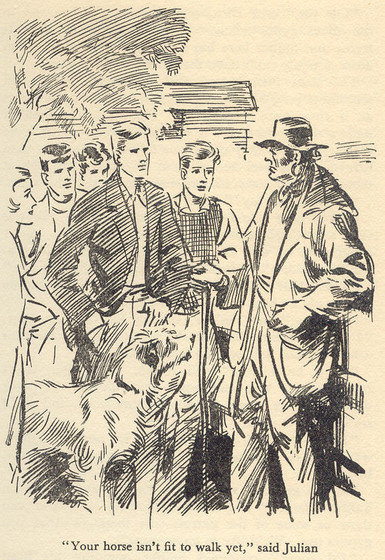
The first is when she depicts the Five talking to Sniffer’s father. There is another child with them who looks like Henry. It’s certainly not Sniffer. And yet Henry is not with the Five in the text.

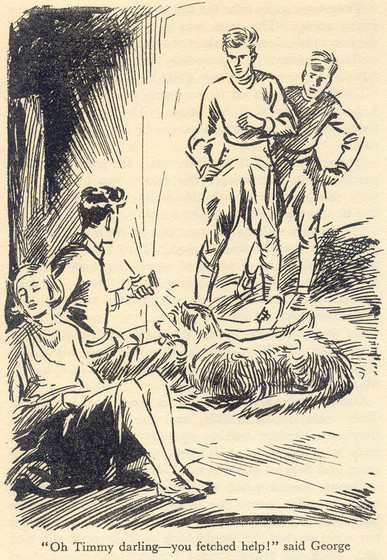
Later on, when George and Anne are being held prisoner they cut their ropes with a knife brought by Sniffer, and lie down to sleep. George wakes when she hears Henry coming, and thinking it’s one of the gypsies she arranges the ropes around herself again. After Henry and William come in Anne wakes up – but Soper has drawn her asleep sitting up against the post.

I’ve also noticed that Soper has Anne awake while Sniffer’s father is talking to George, but she’s asleep in the text.


Random Rudeness

I noticed a lot of what I would consider rudeness – and a lot of it from our beloved Five!

First Julian and Dick turn up at the stables unannounced, expecting to stay. OK they’re happy to sleep in the stables but still, they turn up with a fair bit of entitlement! Anne and George also just seem to announce that they are staying an extra week, too. Aunt Fanny may have called and arranged it – if so it’s not mentioned. Then there are another four children who are going to arrive early. Poor Mrs Johnson, she seems happy enough to run a fairly casual booking system but I still think it’s a bit rude to just turn up and expect accommodation and meals.

Dick says to Sniffer of his caravan I hope it’s not smelly, and Julian says Why doesn’t he get a haircut behind Sniffer’s father’s back. The second one I get, it wasn’t done for men or boys to have long hair in England in those days. It still sounds rude, though.

They (mostly Julian) presumes that the gypsies are thieves on two occasions. As they are involved in a counterfeit money operation, they are, for all intents and purposes thieves, but that’s not the point. They assume that the gypsies will be stealing ducks and hens just because they’re gypsies.


Food

There isn’t a great deal of food in this book. There are a couple of meal-time scenes where food isn’t even mentioned!

One picnic includes egg and sardine sandwiches, tomato and lettuce sandwiches and cherry cake. Can’t say I think much of those combinations!

The only typical Famous Five feast is the breakfast at the end – and that’s simply described as huge platefuls of bacon and eggs.


The Five’s failures

One thing that is more prevalent than food is the Five’s failures. The Five aren’t perfect and do make mistakes now and again but they seem surprisingly incompetent in this book!

Firstly, Julian manages to get them lost on the moors twice. The first time it’s daylight and he is using a compass. The second time they don’t think ahead to avoid losing the railway tracks in the mist, and then only remember they have a compass at 5am.

The girls manage to go up the tracks in the wrong direction, which is somewhat understandable in the mist, but are then stupid enough to think that the quarry, a mere quarter mile from the gypsy camp is a safe place to stay.

Julian and Dick are also unbelievably dense when it comes to Henry. They mistake her for a boy which is not an issue, but then George talks about HENRY who is really HENRIETTA and they just don’t twig that the HENRY they met could possibly be a girl?

They are also very slow to consider that the money might be counterfeit. As they say, there’s no rule against bringing (legal) money into the country.


The moor

I always picture the moor starting right outside the stables, and so wonder why George and Anne only hear about it so much later. Clearly it’s a bit further away than my mind lets me picture. I can’t help but think that pap endpapers would be great for all the Five books.

What is intriguing, distance aside, is that Captain Johnson has never heard the story of Mystery Moor. He explains it by saying he’s only lived there for 15 years! Old Ben says it happened some 70 years ago (which by my rough count makes it the 1880s, farther back than I think I’d imagined) but still, if your local area had a tale like that, wouldn’t you know about it?

Which leads me to wondering about the name of the moor. Old Ben tells the Five that, when he was young, it was Misty Moor. Sometime after the Bartle’s disappearance it became Mystery Moor. What I want to know is what is it called on a map? Is Misty/Mystery just a colloquial, local name? If the mist comes off the sea, as they say it does, isn’t it a haar anyway (or hare, hoar, har, harl etc)?

Regardless of the name, the stories of the moor are quite dark for Blyton. We get the stories of the Bartles, Mrs Banks who was berry-picking, and a boy called Victor who was playing truant, who all disappear in the mist. Are there a load of dead bodies lying in shallow graves on the moor? Did they fall into the sea? Did the gypsies get them all and toss them over the cliffs?


And all the rest

This story is set in April, with the previous adventure being the summer of the year before. I’m not going to try to work out their respective ages based on that, but there’s a website which has done just that… Julian would be 18, Dick and George 17 and Anne 16. I think you have to ignore that sort of maths, though, as it puts the Five far too old by book 21. I did notice that the police call Julian sir, suggesting that in this book at least he is around 17 or 18, or at least looks it. Any younger and I can’t see them calling him sir.

Anne and George were set to stay at the stables for one week, while the boys camped, then they were all to return to Kirrin. However they stay at the stables so I wonder if they saw their parents at all. Julian’s parents are away abroad and their house is being decorated (I think it gets decorated a couple of times through the series but I don’t have the evidence to hand).

Julian (I think) tells Old Ben to get himself more tobacco, as a thanks for telling them the story of the moor, as Ben is smoking a pipe. I wonder if this is left alone in modern editions, or turned to sweets like in Demon’s Rocks.

Strangely both George and Anne sleep though the aeroplane the first night it flies over, and even stranger George isn’t annoyed that Julian and Dick went off in the night to investigate without her (after her outburst in Off to Camp in particular). Anne seem capable of sleeping through anything as she also sleeps through George’s conversation with Sniffer’s father and the arrival of Henry and William.

I find that I don’t really like Sniffer, but I’m not sure why. I feel sorry for him but I don’t like him the way I like Nobby, for example.

Maths isn’t my strongest suit but I think that Mrs Johnson is in a bit of bother when it comes to visitor numbers. She says she’s at full capacity with George and Anne staying on. Thus the boys sleeping in the stables. She has four to arrive after three depart, which would have her one over, but the four are to arrive early…. making her four over, but George and Anne go camping, making the stables two over capacity… and that’s assuming that it’s an appropriate mix of boys and girls to share the rooms! She definitely has a casual approach to organisation.


I’m surprised I had so much to say (again!) but there you are. I’ll try not to leave it so long before I review Five Have Plenty of Fun.

Next post: Five Have Plenty of Fun

Posted in Blog talk | Tagged , , , | 7 Comments

Corfe Castle – A first hand look

Hi everyone, it’s been a while. I’m sorry for that, and I’m largely sorry for leaving everything to do with the blog to Fiona. She’s done a smashing job though, hasn’t she?
I wanted you guys to know, before I really got into my adventure to Corfe Castle, that just because I stopped writing for the blog, doesn’t mean I still don’t love Enid Blyton, but that my depression and anxiety were giving me writers block, and I was finding it harder and harder to write and keep to schedule. Fiona was a saint, even though she was ever so frustrated with me, but she’s really understanding which has been a life line!

So I just wanted to let you know this before I get going that I may not be returning on to blogging full time, but I’m going to try and be around. Now let’s get started!

Pandemic Holiday

In October 2020, in-between the lockdowns in the UK, I managed to get away for a few days, which was very nice and I was lucky with the weather, on my Corfe day at least. I chose to go down to the South West of England to Swanage.

Swanage is somewhere where you have probably heard about in conjunction with Enid. We’re aware that she was fond of that area of the country and used to holiday there with her daughters, Gillian and Imogen, and her second husband Kenneth Waters. In fact, its believed that the Famous Five novels setting of Kirrin is based around Swanage, Studland and all the different places around there, which is partly why I’ve always wanted to visit.

October 2020, I was on the edge of burning out again, and I needed a few days away. So, I booked a very nice Air B’n’B with a friend of mine (unfortunately because of travel restrictions and small persons Fiona was unable to come with me – one day I will get her there!) I also hadn’t seen the sea in over a year and I didn’t want to go somewhere I’d been before. Cue Swanage.

It was beautiful. The beach, the scenery, even the town was fairly thriving so late in the season for a UK beach town, but it wasn’t packed, so we weren’t fighting crowds or anything like that. For those of you who know your traditional run down UK beach towns, they’re kind of sad and a but gaudy, but Swanage wasn’t like that, it was quaint. Enid Blyton could have met me strolling down the street and I wouldn’t have even been surprised. You can find out more about Enid in Dorset here.

I’m largely just going to show you the pictures now, but, I’m so glad I went, it was beautiful, the views were stunning and when it is safe to do so, I really encourage you to go and check it out for yourself!

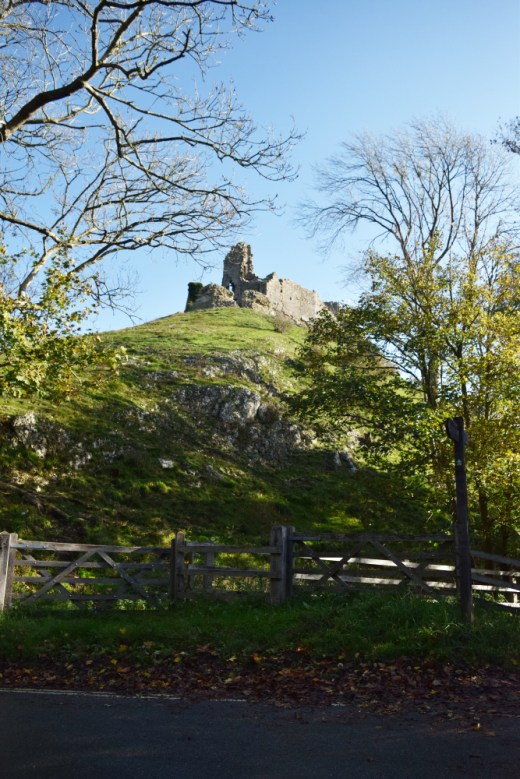
From The National Trust car park, just past the village, and almost past Corfe Castle, you take a foot path around the back of the castle, down by the river – the Corfe River – and follow the path around to this point where you can look up the hill and see the castle as you walk around to the village and entrance to the castle.

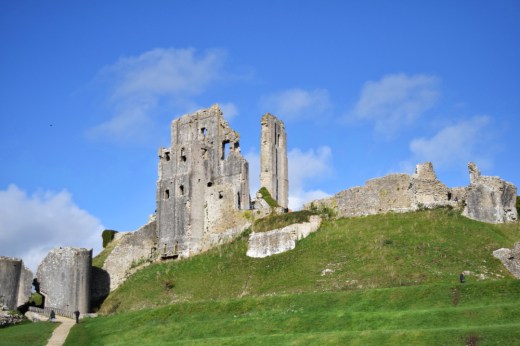
This picture is standing within the walls of the castle, looking up at the remains of the structure. It really is impressive and awe inspiring even today. When you get to know the history behind it – an English queen fought off invaders solidly for a long time here, and find out how far you can actually see, its a pretty impressive view and building for it to even have been built on this hill.

What is left of the castle walls and defences is really impressive and there is a feeling about Corfe Castle that made me feel like even now, if you had to, you could defend it successfully there. I enjoyed imaging the Famous Five running around the castle, finding the secret passages, the cellars and just exploring the ruins. You could even imagine that the castle was on an island, the hill is so tall. If you looked to the North East from the castle ruins (not the courtyard) you can actually see Poole Harbour where Brownsea Island is based – another of Blyton’s places of inspiration.

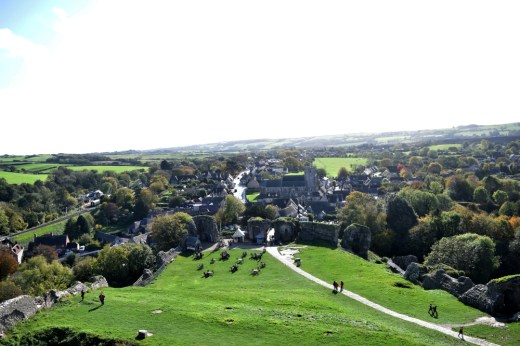
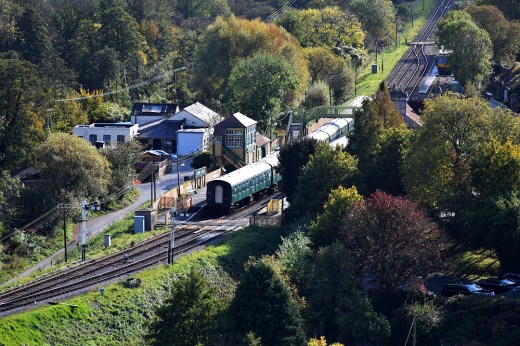
The view from one of the castle windows. My camera doesn’t do it justice at how far you can see from the hill, as well as being strangely misty and hazy – maybe we’d had a haar come in early in the morning which hadn’t lifted yet. However you get a sense of how far you and see, and the layout of the village in the shadow of the castle. On the left hand of the picture, you can just about see the railway line. I would assume that there were time when Blyton and her family arrived for a day trip to the castle via the train.

Here is a shot of the railway from the castle. We didn’t get chance to go down to the station, as I needed to do some shopping for Fiona’s birthday and Christmas gifts but I did make sure I took some pictures. Unfortunately the day we were at the castle the diesel train was running, and not the steam train. Had the steam train been running, my friend and I possibly would have forked out the £25 for a ride on the train. The diesel train didn’t quite feel worth the sum for the trip!

For now, that’s all I’ve got for you! I hope you have enjoyed my photos and maybe Fiona’ll let me back to tell you about Brownsea Island and Swanage itself.

Posted in Locations, Personal Experiences | Tagged , , , , , , , , | 4 Comments

Monday #412

Unfortunately my laptop has gone and died on me this week. I think it’s the harddrive as it’s making funny noises and won’t boot up properly. I’ve booked it in for a repair today, so I will hopefully have it back by next week, if not I hope they can recover all my files and I will have to buy a new one.

In the mean time I am typing this on my partner’s work laptop. It seems to work fine with WordPress so I am going to try to still blog this week. Of course I’ll only discover that some crucial feature doesn’t work as I go to work on a post, so this week’s proposed posts may or may not materialise. We will just have to see!

Already I’m being driven nuts by the keyboard layout – the = is exactly where my fingers think the backspace should be, so every time I make a mistake (which is often) I add a few =s for good measure then have to delete the lot. Still, beggars can’t be choosers, and a badly placed = key is better than no keys at all.

Stef has kindly offered to make a brief return to blogging to share her Corfe Castle photos on Wednesday so that’s one less thing for me to worry about.

The Famous Five are so lucky they never had to deal with these sorts of modern problems…

A visit to Corfe Castle

and

Five Go to Mystery Moor part 3

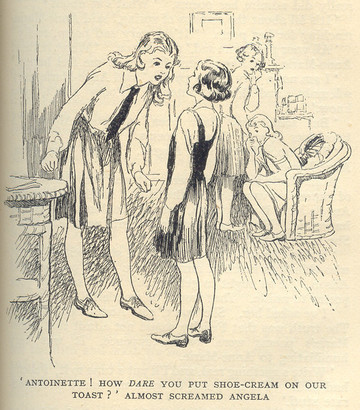
It’s that fool of an Antoinette! She’s cleaned my shoes with my best face-cream! Oh, the idiot! All that lovely cream gone – gone on my shoes too!

Angela discovers one of Antoinette’s tricks in Fifth Formers of St Clare’s.


Posted in Blog talk | Tagged , , | 2 Comments

Five Go to Mystery Moor part 2 – George and Henry

Last week I reviewed the main story of Five Go to Mystery Moor, and now it’s time for the comments, nitpicks, questions and so on that I always seem to have these days.

I have an awful lot which relates to a subheading I often use – George as a boy, so after writing 1,300 words on that alone I decided to leave this as a single topic post, the rest of my critiquing can follow next week. (I also forgot this was due to go up on Friday until 9.30pm, which is quite late to turn nothing but jotted notes into a whole post, but that’s another story.)


Girly stereotypes

Everyone apart from George seems to be painting girls as weak and silly.

Right at the start Anne explains why they couldn’t have gone camping with her brothers. Because they’re girls –

Anne – We couldn’t do the things they do.

George – I can do anything that Dick and Julian do. I can climb, and bike for miles, can walk as far as they can, I can swim – I can beat a whole lot of boys at most things.

Has Anne forgotten all the times they’ve camped and hiked and had adventures together?

Mrs Johnson expects the girls – George, Anne and Henry to do the washing up. Anne knows the other two hate that so says she’ll do it alone. At least Dick redeems himself by saying they’ll all do it together.

George says she and Anne would like to sleep in the stables but Captain Johnson says

You’ve got beds that you’re paying for. Anyway, girls can’t do that sort of thing – not even girls who try to be boys, George.

Henry replies that she’s often slept in the stables when there’s been a lot of visitors at home.


George vs Henry

On the surface Henry’s just like George. She wears her hair short, goes about in boys’ clothing and calls herself Henry. You’d think she and George would get along famously, well, maybe not as we know she didn’t get along with Jo.

Even Julian says

I should have thought she’d like someone like Henry who has exactly the same ideas as she has.

But instead of bonding over how stupid being a girl is they snipe at each other, making catty comments and competing over who’s the most boyish.

Apparently Henry wins as she has straight hair while George’s is curly. Henry says this to George, Dick repeats it, even Blyton herself says it! I don’t get it, lots of boys/men have naturally curly hair! Blyton’s words are that George’s hair suited wearing a blouse and skirt but Henry’s didn’t (the girls have to wear girls’ clothes when they sit down to dinner. I understand they have to change out of their grubby jodhpurs, as do the boys, but I don’t see why George and Henry couldn’t wear clean shorts and a shirt like the boys – in fact I’m surprised that neither of the emptied their suitcases of skirts and blouses before they left for their holiday! Henrietta also has to wear a dress when her great aunts come to see her).

Blyton’s attitude to curly hair has me wondering. It doesn’t just appear in this book, either, the idea the curly hair is girly is repeated in Five Have Plenty of Fun when Berta is being disguised as a boy.

It’s often suggested that Blyton based George on herself. I don’t think there’s any evidence that Blyton went around wearing boys’ clothes and asking to be called master, but I get the feeling she didn’t want to be tied down to typically feminine roles. Anyway, as an adult she always seems to have curly hair – at least in all the photos I’ve seen. As a younger woman it was short, and not particularly curly, though perhaps wavy. The older Blyton may have permed her hair, I don’t know. I just wonder if she felt that her curly hair was feminine, if it made her feel attractive in a feminine way, and so she places that onto George? Or was it just common ‘knowledge’ in the 1940s and 50s that curly hair was for girls? Long hair certainly was, but even short curls?

George and Henry both fool a few people into thinking they’re boys. I kept a little tally to see who ‘won’.

George –
Sniffer calls her Master George,
Old Ben the blacksmith refers to her as a boy,
Sniffer’s father assumes George is a boy when he captures her and Anne

Henry –
Both Julian and Dick believe she is a boy when she picks them up from the bus stop.

George convinces three people, Henry only two, at least those are the ones who outwardly show a conviction either way. Ben might have thought Henry was a boy too, but never ‘said’ it. Plus Dick and Julian should have been harder to fool, knowing George, so I’d say the score is about even.

Regarding Sniffer, it’s interesting that although he calls her Master George, and to all outward appearances seems to just assume she is a boy, his internal thoughts contradict that.

Sniffer was pleased. He liked this girl who had presented him with such a magnificent handkerchief. He took it carefully out of his pocket, hoping to please her.

Ok so it’s not exactly an inner monologue from him, it’s Blyton’s words and she knows George is a girl, I just thought it was interesting.

It’s possible that Sniffer has called George a boy in front of his father, and so Mr Sniffer (for lack of a better name) just assumes that’s the case in the dark. George is angry when Anne says they’re both girls. Anne’s thinking is that they might get treated better if they’re just two girls.


Is Henry ‘as good as a boy’?

Henry’s a bit of a strange one. On the surface she’s just like George, only she brags a bit more about all the things she’s done. (She’s a bit like Bill from Malory Towers, both have brothers and do everything they do, though Bill’s not a bragger). And yet, when it comes down to it, she doesn’t exactly strike a blow for feminism!

When Timmy brings her the note to say that George and Anne being held prisoner she practically falls to pieces. Her first instinct is a sensible one – get Captain Johnson, after all he’s a grown up. But he’s away. She can’t tell Mrs Johnson as she would have the fright of her life if I fetched her. #

She goes on to say I’m not brave like you are. I pretend I am, Timmy – but I’m not really. I’m afraid of following you! I’m afraid of going to find the others.

That’s fair enough – lots of people fake bravery and boast more than they should. Being woken in the middle of the night and being asked to ride across the moors to rescue kidnap victims from a gypsy camp is pretty scary. It’s what she says after that that’s a real shame.

I’m going to dress and get William. He’s only eleven, I know, but he’s very sensible – and he’s a boy. He’ll know what to do. I only pretend to be a boy.

I mean – gah! Fine, ask for help. William’s only eleven, he’s sensible, two heads are better than one, I don’t want to deal with this alone. But for a girl who pretends to be a boy – who to all intents and purposes insists she is as good as a boy – to say she’s just a weak hopeless thing because really she’s a girl, it makes me mad. I guess that Blyton wanted us to cheer and think Yes, our George is the better character, we knew that all along, and I do feel that, it’s just a shame that Henry couldn’t be a close second.

It makes me wonder how much of Henry’s bragging was false. George always said Henry was making it all up, and maybe she was. Dick says that  “She [Henry] ought to have been a boy. Like you, George,” he added hastily. “Both of you are real sports – plucky as anything.” And of course she does ride off into the night, so she’s not a coward at all, it’s just a shame that she blames any fears she has on being a girl – she actually seems to believe that girls are inferior creatures. George on the other hand always says she’s as good as a boy and tries to prove that by showing that she can do all the things boys do, even if she’s a girl.

At least Mrs Johnson proves herself not entirely useless when she does realise something’s going on. OK her first instinct is to call her husband, but she then calls the police and deals with everything reasonably calmly. And she provides a cracking breakfast after!


Next post: Five Go to Mystery Moor part 3

Posted in Book reviews, Characters | Tagged , , , | 2 Comments

The Five Find-Outers covers through the years

Having previously looked at the Famous Five (parts one and two), The Adventure Series (parts one and two) St Clare’s (parts one and two), Malory Towers, (parts one and two) Mr Galliano’s Circus, The Secret Series, The Naughtiest Girl and the Barney Mysteries I thought it time I did the Five Find-Outers as well. I’m not sure why I missed such a major series before.


The first editions

The Five Find-Outers (or FFO as I will probably call them a lot, as it’s so much shorter!) is one of those series with multiple illustrators across their first editions. It had four different cover artists – Joseph Abbey (books 1-7), Jean Main (book 8), Treyer Evans (books 9-12, and also the internal illustrations for book 8), and then Lilian Buchanan (books 13-15).

To me it looks like Treyer Evans at least tried to mimic Joseph Abbey’s style, while Jean Main and Lilian Buchanan went very much in their own directions.

Joseph Abbey, 1945 / Joseph Abbey, 1949 / Jean Main, 1950 / Treyer Evans, 1951 / Treyer Evans, 1952 / Lilian Buchanan, 1957 / Lilian Buchanan, 1961.

While the first editions are in my opinion the best covers for the series, they are not amongst the best of all Blyton’s book covers. Jean Main’s cover struggles with perspective, while Joseph Abbey’s Goon is a strange looking creature indeed. Several other covers suffer from looking rather ‘muddy’ and indistinct too.


The confusing part of the 1960s and 1970s

Mary Gernat is a well-known Blyton cover illustrator, mostly linked with the Armada books of the 1960s, her covers includes titles from the St Clare’s, Malory Towers and Barney Mystery series. However she rarely did the covers for all books in a series; each Armada run had a mix of illustrators and The Five Find-Outers books are no different. Other illustrators who were published alongside her include Charles Stewart and Dorothy Brook.

Armada frequently published the first paperback editions of Blyton’s books; they did all 15 FFO books between 1963 and 1966. The illustrators were Dorothy Brook (book 1), Charles Stewart ( books 2-9), Peter Archer (books 10-11) and Mary Gernat (books 12-15).

Dorothy Brook, 1963 / Charles Stewart, 1963 / Charles Stewart, 1963 / Peter Archer, 1965  / Peter Archer, 1965 / Mary Gernat, 1965 / Mary Gernat 1965.

So different artists, different colour schemes, similar but not identical art style and different fonts, yet they all scream Armada to me! It’s probably the solid-coloured backgrounds that does it?

Then it all gets a wee bit confusing, as Dragon and Methuen did alternating runs, some only doing parts of the series, some with artwork repeated…

After staring at lists of publishers, dates, artists as well as the covers themselves, I think I’ve more or less sorted it all out. I have grouped these covers into “sets” based on the design (rather than artist or year…) In reality it may be that publishers switched design and consider their sets different from mine, but I’ve got to organise it somehow.

So, the second ‘set’ are from Dragon, who reprinted the whole series between 1966 and 1969. These were the instantly recognisable upside-down polaroid covers (as I call them).

Peter Archer provided the covers for the first eight books, and Mary Gernat the rest.

Peter Archer, 1966 / Peter Archer, 1967 / Mary Gernet, 1969 / Mary Gernet, 1969.

Methuen then did a set of books 1-8, 11, 12 and 14, using the full versions of the previous dragon covers with text straight on the background.

Peter Archer, 1972 / Peter Archer, 1970 / Peter Archer, 1970 / Mary Gernat, 1970.

Most of these have a solid background colour which echoes the earlier Armadas, but for covers like Disappearing Cat, it makes a bit of a strange scene. That’s not a missing cat, that’s a huge disembodied cat head floating above a strange alien landscape…

Then we have a 1973 set of Dragons, with covers by Paul Wright – another upside-down Polaroid design but with only covers for books 2, 3, 4, 7 and 8.

Paul Wright, 1973 / Paul Wright, 1973 / Paul Wright, 1972 / Paul Wright, 1972.

These are quite skilful, especially Strange Bundle, though the window being off-centre on Pantomime Cat bothers me a little!

And last in this confusing lot are four covers by Methuen, some dated 1970 and others 1973. These have a bright block of colour at the top and use previous artwork by Paul Wright and Mary Gernat – Wright’s for books 9 10 come from the Dragon polaroids, while Gernat’s are for books 13 and 15 and are from the earlier Methuen polaroids.

Paul Wright, 1973 / Paul Wright, 1973 / Mary Gernat, 1970 / Mary Gernat, 1973.

The illustrations are fine on these, but the coloured banners look a bit cheap and garish – they don’t compliment the other colours on the cover at all!


The straight-forward 1970s, 80s and 90s.

You’ll be glad to know that the next thirty years had nice, straight-forward sets where the whole series was printed with one artists and one design!

First up, another Methuen lot, this time from 1979. These covers are by Reginald Grey and I always associate them with Malory Towers as that’s where I saw the ‘arched label’ design first.

All Reginald Grey, 1979

What’s interesting about these as although they have a solid colour background like other covers they manage to look as if the foreground has been cut out and stuck down on top like scraps. That’s not necessarily a bad thing, though.

Then we have two sets by Dragon. The first are dated 1983, and have covers by Bruno Elettori – the third and final set of upside-down polaroids (the most of these I’ve seen for any one series!)

All Bruno Elettori, 1983

These are probably the least attractive of the polaroid covers, being quite dull-coloured.

The second Dragons are from 1987, artwork by Mick Austin. These use the notion that mysteries are denoted by question marks and so have bordered the title with lots of little question marks.

These are fairly uninspiring, if I’m honest. From these only Strange Bundle really gives an insight into the plot of the story, the others could be from any story more or less.

Into the 90s we start with Dean, in 1990 with Liz Roberts covers.

All Liz Roberts, 1990

You might think I’d class these as upside-down polaroids, but no, they’re not white so they don’t give me that vibe. They do give me a very 90s vibe, however, particularly Banshee Towers! I do associate these covers with Blyton as I’ve seen other series/titles in this style, and the artwork is actually inoffensive – the children look like actual humans, the colours are fairy nice and they’re just nice drawings (even if the clothes are awful) in general.

The FFOs must have been popular as Armada released another set in 1991 (these I think were paperbacks, while the Deans were hardbacks, different publishers could hold the license to publish the books at the same time if they were in different formats), with artwork by an uncredited artist (the only one for the series). These are also the only photo-covers, and I find them really odd. The only TV adaptation of this series is the Japanese Gonin to Ippiki (Five Children and Dog) from 1969-1971 – and that is definitely not what is on these covers).

All uncredited, 1991

So, if it’s not from a TV series then these are just some random 90s children that we’ve never met, who are hanging around in fields or riding bikes or writing letters and not doing anything we might recognise as a scene from the books. What a great marketing strategy!

Mammoth used Button Design co (a name that’s popped up for several 90s editions on other series already) for their 1996 paperback covers, and Dean then used the same artwork for their 1997 hardbacks. Mammoth and Dean are both owned by Egmont, which helps explain this.


Button Design co 1996 / 1997.

As you can see the Deans have stretched the image from a square to fill the whole cover, resulting in a lot of cropping. Some books appear to have Four Find-Outers, or sometimes Four-and-a-bit.


The almost entirely straight-forward 2000s to present day

There is only one set from 2000 on which doesn’t do all 15 books, and those are the second Dean set in a line up that goes Egmont, Dean, Egmont, Dean, Egmont.

So, the first Egmonts are from 2003, with Jason Ford covers.

All Jason Ford, 2003.

I actually don’t hate these. They don’t suit the FFOs at all, but if they were for another author I’d not mind them. They at least make a good attempt to convey some elements of the story – Fatty’s walk in the night when he speaks to the night watchman, Fatty out at night again (a little vaguer but at least he’s not just lounging around), the Lorenzos and their dog Poppet, Eunice having a pop at Fatty.

Then in 2004 Dean used the same Button Design Co. art as previously.

All Button Design co, 2004.

These look pretty cheap and nasty but at least they haven’t cropped 1/5th of the gang out.

In 2009/10 Egmont had covers by Martin Usborne and Shutterstock. I’m not sure what part Shutterstock are responsible for – they are generally stock photos, so it’s probably the magnifying glass.

Martin Usborne and Shutterstock, 2010 / Martin Usborne and Shutterstock, 2010 / Martin Usborne and Shutterstock, 2009 /Martin Usborne and Shutterstock, 2009.

Again, I don’t hate these. They’re not what I’d pick for Blyton but a lot of thought has actually gone into them. The scene in the magnifying glass is at least related to the story and shoe the children actually doing something, and then the motif in the background is cleverly related to the story too (well, one or two books they obviously struggled with which is a shame, but the rest are clever). Smoke to signify the fire in Burnt Cottage, paw prints for the missing cat in Disappearing Cat, post marks for Strange Messages, painting frames for Banshee Towers, and so on. They’re the kind of detail you might not pay much attention to until you’ve read the book, then you realise their significance.

And then we have our partial Dean set in 2009, with books 1-6 having new Mary Gernat covers.

All Mary Gernat, 2009.

Initially when I saw these I wondered how these could be Mary Gernat. Looking closer, however, I can just about see her style under the dark, heavy lines. I’m not sure if her original work has been digitally edited, or if she was trying a new style… anyway, these were published more than ten years after her death, so they could have been done during the heyday of her career in the 1960s, but not used for whatever reason.

The last Egmonts are from 2014 with Timothy Bank covers. The artwork by Timothy Banks was then reused by Hodder in both 2016 and 2019. Hodder and Egmont are separate publishers, so this time I’m not sure how to explain it.

All Timothy Banks, 2014 / 2016 / 2019.

I don’t know if these particularly suit Blyton or the FFO, but I like the overall design. It’s a pity that the children have silly cartoonish features though.


Do you see any of your favourites amongst these? Or any that make you want to claw your eyes out?

Posted in Illustrations and artwork | Tagged , , , , , , , , , , , , | 11 Comments

Monday #411

We ended up with at least a foot of snow falling in the first few days of last week, snow that’s hung around all week due to the low temperatures. It is supposed to be warm today – up to 9 degrees, so no more sledging but at least we might be able to walk on the pavements again!

The Five Find-Outers covers through the years

and

Five Go to Mystery Moor part 2

“You know, it’s a lot better for us when Mr. Johnson makes sandwiches of tomato or lettuce or something like that. We do get them all then – but when we have meat or sardine or egg sandwiches Timmy gets as much as we do!”

Henry (Henrietta) laments Timmy’s appetite in Five Go to Mystery Moor.


Posted in Blog talk | Tagged , , | 1 Comment

Five Go to Mystery Moor

My last Famous Five review came in August last year, and that was Five Have a Wonderful Time. If you’re about to tell me that I have missed Five Go Down to the Sea, I haven’t, I just accidentally reviewed it before Wonderful Time…

Anyway, Five Go to Mystery Moor ranks at #17 in the series for me, which is pretty far down. According to the post where I did my rankings this is because it has a slow build up and the exciting end hasn’t stuck well in my mind.


A story in three parts

As usual, here are the distinct parts of the story as I see them;

  1. Time at the stables
  2. The tale of the Bartles and going camping
  3. Parcels dropping, the mist, kidnap and rescue

You could sub-divide the first part into pre and post boys arriving, and the second into more time at the stables and their time camping.


Where are the boys?

Just like with Five Have a Wonderful Time, we start with only some of the Five. This time it’s George, Anne and Timmy who are at Captain Johnson’s Riding School. Anne chose this as she loves horses, and the boys were going camping with friends. George is sulky (what’s new!) as she just wanted to spend the holidays with her cousins.

George’s sulkiness is compounded by the fact that there’s another girl-who-thinks-she’s-a-boy at the stables – Henrietta aka Henry. Instead of bonding over a love of boy’s attire the two of them can’t stand each other and call each other by their full first names.

But never fear – the machinations of Blyton means that Uncle Quentin succumbs to an unidentified illness, meaning the the Five can’t all meet up at Kirrin as planned. The girls are told to stay at the stables for another week, and Julian and Dick decide to come along too.


The gypsies

Blyton was fond of bringing gypsies and other travelling folk into her stories. We’ve already had Jo’s father and the gypsies they travelled with in Five Fall Into Adventure, the fair folk of Five Have a Wonderful Time (more distant relatives of Jo) and the Barneys from Five Go Down to the Sea.

The Mystery Moor gypsies are not terribly well described. None apart from Sniffer get names, and only his father has any sort of identity.

Sniffer is a skinny young boy who brings his horse to be seen by Captain Johnson as it is lame (for some reason when typing the introduction to this post I wrote Tinker, and I also wrote Tinker in my notebook while reading!). Sniffer’s a bit of a sorry character, much abused and beaten by his nasty father. He does have the comfort of his little dog, Liz, though. Sniffer’s father turns up trying to take the horse before it is recovered and has a bit of a stand-off with Julian, though it’s nowhere near as impressive as the ones with Mr Stick.

This gives us our first mystery: Why are the gypsies so desperate to travel onto the moors by a certain date? What’s waiting for them out there?


The second (and third) mysteries

We find a second mystery when the Five (well, minus George and Timmy and plus Henry) find old train tracks on the moor while riding.

Now, George and Henry are both pretty silly when it comes to fighting and arguing, but  actually think Julian is an ass to invite Henry along for the ride. He barely knows her, and he knows she and George don’t get along. It’s not just that George has taken a dislike to her, Henry goes out of her way to annoy George and vice versa. Who wants to be in the middle of that? OK, so he feels sorry for her being the only older one with a bunch of little kids, but if she felt that way herself she could have made more of an effort to get along with George.

Henry redeems herself somewhat by being insightful enough to know that George doesn’t really have a headache keeping her from going on the ride – she is George’s headache and she offers not to go.

George is quite hard on herself then – she realises she’s shot herself in the foot when they all go off without her, and she blames herself. To be honest, I’d have done the same, but perhaps for different reasons. If my family or friends had invited someone I hated I’d probably have feigned a headache to avoid the pain of spending the day with my enemy. George seems to have done it in the hope of the others disinviting Henry, however, as she is surprised and annoyed that they do go without her. So she is banking on them knowing the headache is fake, and wanting her to go more than they do Henry. Which is a bit manipulative, but I know that if she’d gone to Julian to ask him to disinvite Henry he would have said no and she would have ended up having a row with him.

Anyway – back on topic, they go without George and find train tracks on the moor, all old and overgrown, even broken in places. I couldn’t help but think that Brodie would love finding train tracks on a moor. Any straight lines he finds (tire tracks in snow, white lines on a football pitch) he calls train tracks and runs along shouting ‘chugga chugga choo choo!’ so real tracks would be beyond exciting for him.

The mystery of the tracks is easily solved, as they go to see old Ben the blacksmith who tells them all about it. It’s a straightforward solution – there were sand quarries on the moor and a family set up a little railway to transport the sand instead of using horses and carts.

What happened after that is the third mystery – though it’s not one the Five could solve. Ben’s story is one of the dark and creepy ones that Blyton occasionally uses, like the wreckers in Five Go to Demon’s Rocks and Five Go Down to the Sea, the drowning in The Ring O’ Bells Mystery and the abandoned nursery in The Rockingdown Mystery. Ben himself is reminiscent of the many knowledgeable old men in Blyton’s stories, Grandad from Five On Finniston Farm, Yan’s Grandad from Five Go Down to the Sea, Old Grandad from The Ring O Bells Mystery, Lucas from Five Have a Mystery to Solve, Jeremiah Boogle from Five Go to Demon’s Rocks

The Bartles were the sand quarrying family, who ran afoul of a band of gypsies some 70 years before. The gypsies tore up the train tracks and derailed the train. One day soon after the Bartle brothers (9 or 10 strapping men) went to the quarry, and never returned. A mist had stolen over the moors, and gypsies had been seen going through the village…

Ben thinks that the gypsies murdered the brothers and threw their bodies into the sea – dark stuff for Blyton!


Investigations begin

To find out more about the gypsies George has Sniffer leave patrins, signs made of twigs and leaves, so they can follow him along to the gypsy camp. The gypsies are sufficiently rude as to make it clear they are hiding something.

Then it all becomes a bit accidental – more children are to arrive at the stables and there isn’t room, so the Five go off to camp on the moors. They follow the tracks to the old quarry and lo and behold, that’s only about a quarter mile from the gypsies’ camp.

That night the boys witness a plane flying low over the moors and a light shining from the gypsy camp. When they wander over to see during the day they find a proper lamp set in a hollow in the ground. Yet the gypsies claim to know nothing about it – or the plane.

The Five can’t work out what a plane could be doing without landing – obviously they’ve never read The Sea of Adventure!

The following night they make sure to watch for the plane and when it comes it drops a load of packets (I wonder if it dropped packets the night before too, and if the boys wouldn’t have seen/heard that). Something’s obviously afoot, even without opening a package to find American dollars.

As the gypsies are obviously up to something dodgy they decide to confiscate the packages and make off with them, back to the village.


The Mist

The phenomenon is called both mist and fog, though they are two different things. The Mist sounds more ominous (if you read Stephen King).

The mist – the first bad one in a few years – comes just as the Five are leaving the quarry with the packets. At first this seems a boon, it prevents the gypsies from following them, and all the Five have to do is follow the tracks back to Milling Green.

But the rugs holding the packets are heavy, and the boys decide to hide them in the old engine they found rusting in the gorse bushes. I’ve read this book a bunch of times and yet couldn’t tell you how this all played out, beyond them getting separated and lost.

The girls stay on the tracks, the boys walk back up, and go off to the side. However they can’t find their way back to the tracks and get lost. The girls decide to walk into the village for help but accidentally walk back to the quarry and get captured by the gypsies – a catalogue of errors, really.


Rescue

George hopes to send Timmy to find Julian and Dick, with Sniffer’s help. Sniffer’s father catches her writing a note and tells her she should write a note, and he will use it to lure the boys back so they can recover the packets. He hasn’t thought of how to deliver the note, though, so George tells him to use Timmy as per her original plan. The jokes on him – she’s sending it to Henry and signing it Georgina (just like she did in Five on a Treasure Island).

It doesn’t go entirely to plan, though, as Captain Johnson is away, leaving Henry and William to ride out to the rescue. Julian and Dick also eventually manage to return to the stables, and after a good breakfast courtesy of Mrs Johnson the whole lot go back out to the engine to recover the packets of money.


So that’s the story… next time I’ll go through my questions, comments and nitpicks.

Next post: Five Go to Mystery Moor part 2: George and Henry

Posted in Book reviews | Tagged , , , , , , | 4 Comments

Miss Grayling’s Girls 7 – the rest of her teachers

I seem to preface an awful lot of posts with ‘It’s been a while since the last one of these’ lately. I have a terrible habit of enthusiastically starting a series of posts and then running out of steam despite having half-drafted ones remaining. I’m trying to be better at finishing things (hence On my bookshelf part 7 being published recently, a year and a bit after part 6).

If you’ve forgotten what came earlier, or weren’t reading this blog two or three, then here’s the past posts:

Miss Grayling’s Girls – an introduction
Miss Grayling’s Girls – the failures 
Miss Grayling’s Girls – the experiments
Miss Grayling’s Girls – the ones who almost messed it up
Miss Grayling’s Girls – the successes 
Miss Grayling’s Girls – her best teachers
Miss Parker

Miss Parker is the second-form mistress, and has a bit of a contradictory nature. She is often nicknamed Nosy Parker because of her large nose – and because she keeps sticking her nose into things the girls think are no concern of hers.

Certainly she was a most inquisitive person when she suspected any mischief was going on, and did not rest till she had got to the bottom of it.

Despite this she sometimes doesn’t take an interest in some of the things that she probably should.

Miss Parker did not often take any notice of Ellen. She was usually a quiet girl, with a name for bad temper, and Miss Parker was not at all interested in her, though sometimes surprised that her work was not better.

It’s no surprise that the girls leave Ellen to her own devices as she is indeed bad-tempered, but it is a shame that her form teacher simply writes her off and doesn’t wonder why a girl clever enough to get a scholarship is then struggling with the work. At least when she finds out that Ellen has been ill she is kind to her.

“You’re not up even to your ordinary work at the moment, let alone taking extra coaching. I shan’t expect much from you, nor will anyone else. So don’t worry.”

She also is said to worry about Ellen’s continuing poor work but puts it down to her still not being entirely well after her illness, as she notes that Ellen is paying attention in class and trying hard. Of course there is a lot more bothering Ellen and unfortunately Miss Parker doesn’t look any deeper. Then again, if she had, Ellen wouldn’t have tried to cheat and we wouldn’t have had the altercation between her and Darrell.

Miss Parker is described as strict but someone who occasionally has dreamy fits where she
forgets the class and sits gazing into the distance. Unsurprisingly the girls look forward to these rare moments and make the most of them! Yet Darrell says that She can’t stand anything vague or careless. It’s also said that she hates anyone messing with her time-table by being late.

She is sensible enough to know that Irene looking after Belinda isn’t a good idea, and forbids it after her first few days at the school

“That would mean the two of you getting lost. You’d probably be down in the swimming-pool waiting for a diving lesson whilst we were all up here doing maths.”

Miss Parker seems a fan of the outdoors and leads the girls on walks – seeing through Daphne’s attempts to get out of them. When one such walk is cancelled, and they instead have games and a picnic in the games hall she decides not to let Daphne know.

“No, you mustn’t disturb Daphne! She badly wanted to
have this extra coaching, Mam’zelle tells me, and was quite willing to forgo the walk. She would be willing to forgo the games and picnic too, I am sure. We mustn’t disturb her. When a girl shows herself to be as studious as that it would be a pity to spoil it all.”

She also forms part of the search-party when Daphne and Mary-Lou are found to be missing. It is she who walks back with Daphne, half-holding her up.

Miss James

The fifth form mistress, Miss James, is a tall spare woman of about fifty, whose curly grey hair framed a scholarly face with kind but shrewd hazel eyes. Moira describes her as easy-going to a point. Then look out! She changes from sweet to sour in the twinkling of an eye – and it’s bad for you if you don’t notice the change-over immediately. Still, Jimmy’s not a bad sort. She’s known as Jimmy when she’s sweet and James when she’s sour, according to Catherine.

We see very little of her in In the Fifth, though. Beyond her first lesson with the girls she hardly features! The fifth formers don’t play any tricks and are too busy with their pantomime for much trouble in class. Miss Potts deals with the poison-pen letters, I suspect Miss James has no idea about that.

She does show some sense in not encouraging ‘saint’ Catherine;

Catherine beamed. Yes – yes, she would help all she could. Miss James could depend on her, of course she could. She tried to catch the mistress’s eye, but for some reason Miss James steadfastly looked in the other direction.

She also promotes Darrell to head of fifth-form, though it was probably a joint decision as before.

Miss Oakes

When the girls reach the sixth form they fall under the care of Miss Oakes, who also teaches history. She seems to be liked well enough, despite not having a sense of humour.

I like Old Oakey. But I’ve often wished she had more sense of humour. She never, never, never sees a joke. But she always suspects there may be somebody leading her up the garden path. – Darrell

From what we see she it not very effective at handling Suzanne. Miss Oakes is always suspicious that Suzanne understands more English than she admits, but she doesn’t do anything about it other than think about having words with Mam’zelle Rougier.

She does however ‘deal’ with Gwen via some rather sharp words.

Miss Oakes was not interested in Gwen’s future school any more than she was interested in Gwen.

“You are not up to Higher standard, whatever school you happen to be in,” she said coldly.  “I can only hope that you will work  a little better this term than you have worked for the last two terms, Gwendoline. Would it be too difficult to leave me with a little better impression of your capabilities than I have at present?

She does appear insightful, however, I particularly like this insight into her thoughts from Last Term at Malory Towers.

Privately, Miss Oakes thought that Darrell and Sally would do much better at college than Alicia or Betty, although these to had quicker brains and better memories than either Sally or Darrell.

‘Being grown-up, and feeling free for the first time form bells and strict time-tables and endless classes, will go to Alicia’s head and Betty’s too. They won’t do a scrap of work at college! They’ll be out to dances and parties and meetings the whole time- and in the end sound little Darrell and solid little Sally will come away with the honours that Alicia and Betty should find it easy to get – but won’t!’

I think she has a point – but I’d hope that they’d learn to knuckle down if they found their marks slipping, much like Darrell did in her first form.

The two Mam’zelles

I’m not sure why Malory Towers requires two French mistresses, but two it has.

Mam’zelle Dupont is short, fat and generally genial. She is well-liked as she is reasonably easy-going, and can often be encouraged to chatter on about her nieces and nephews, wasting lesson time. She is generous with offers of extra coaching, but can become snappish and cross quickly if the girls’ work is extremely poor.

Mam’zelle Rougier is the opposite of her colleague, tall, very thin and almost always bad tempered. If she makes a joke is a feeble one about how hard the girls are going to work for her.

The only time she says something truly funny, it is probably quite unintentional;

I see no joke. It is not funny, teeth on the grass. It is time to see the dentist when that happens.

That was after Mam’zelle Dupont has laughed out a set of trick teeth.

The two mam’zelles cause a fair bit of bother in the school, and I’m not sure how helpful Miss Grayling finds them. Mam’zelle Dupont always falls for tricks, allows lessons to be disrupted (both her own and often others in the vicinity) and has ‘favourites’ based on their looks and charming smiles.

[They] both taught the Upper Fourth, but though actually Mam’zelle Rougier was the better teacher, plump little Mam’zelle Dupont got better results because she was friendly and had a great sense of humour. The girls worked better for her.

Then of course there’s the rivalry between the women, which comes to a head in Second Form at Malory Towers when they are both trying to cast the parts for a French play. Mam’zelle Rougier is sensible and casts the best French speakers, though she makes no regard for acting ability. Mam’zelle Dupont casts her favourites, the pretty girls who would look nice on stage. The poor girls have to swap back and forth each lesson until a rather nasty (but brilliant) set of drawings by Belinda are seen by the mam’zelles and they realise how foolish they have been. They are (probably briefly) best of friends after that, as two French women in a hostile English environment.

Miss Hibbert

A teacher of both English and drama, but only features in the third book.

Miss Hibbert did not look at all like a producer of plays. She was neat, with a well-fitting coat and skirt, and her hair, slightly wavy, was brushed well back. She wore a pair of glasses with rather thick rims. She was very efficient, and knew exactly how to pick the right actor for the right part.

Darrell explains how she does that;

“She tries us all out in almost every part several times. She does that for two reasons—she says that in that way she really does find the right actor for every part—and we all get to know every part of the play and work better as a team.”

Miss Hibbert gets annoyed by girls who don’t taking acting seriously, as evidenced by Gwen who is often ticked her off for being affected and silly in her acting. That does not bode well for Zerelda who we see to be an exceptionally over-dramatic and affected actress.

As soon as Zerelda arrives for the first rehearsal Miss Hibbert tells her off for having her hair back in it’s Lossie Laxton do, but allows her the role of Juliet as she says she has been practicing.

We’ve already been told that Miss Hibbert has her own way of dealing with stagestruck people who thought they could act – and Zerelda gets both barrels of it.

“How dare you behave like that? Sending the class into fits! Do you think that’s the way to behave in a Shakespeare class? They may think it comical but I don’t. Those are lovely lines you have been saying—but you have completely spoilt them. And do you really think it is clever to throw yourself about like that, and toss your head? Don’t you know that Juliet was young and gentle and sweet? You are trying to make her into some horrible affected film-star!”

“And why have you made yourself up like that?” demanded Miss Hibbert, roused to more anger by the giggles of the rest of the form. “I cannot tell you how horrible you look with that stuff on your face. You would not dare to go to Miss Peters’ class like that. I’m not going to put up with it. You may as well make up your mind, Zerelda, that you will never be an actress. You simply haven’t got it in you. All that happens is that you make yourself really vulgar. Now go and wash your face and do your hair properly.”

Well – that was Zerelda told. That may sound very harsh but at this point Miss Hibbert didn’t know that Zerelda was serious about being an actress, and thought that her performance was her playing the fool. When she does find out, she makes sure to talk to Zerelda and gives her some very good advice.

She is honest in saying that Zerelda doesn’t have the gift to be a great actress, and she also lacks one other thing.

“Well, Zerelda, in order to be able to put yourself properly into some other character, you have to forget yourself entirely—forget your looks, your ambitions, your pride in acting, everything! And it takes a strong and understanding character to do that, someone without conceit or weakness of any sort—the finer the character of the actor, the better he can play any part.
You are thinking of yourself too much. You were not Juliet being acted by Zerelda this afternoon—you were Zerelda all the time—and not a very nice Zerelda either!”

Then finishes with advising her on how to carry on from there, advice that Zerelda takes to heart and finds very helpful.

“You have let your foolish worship and admiration of the film-stars blind you, Zerelda. Why not try to be your own self for a while? Stop all this posturing and pretending. Be like the others, a schoolgirl sent here to learn lessons and play games!”…

“[A schoolgirl is] a very, very nice thing to be. You try it and see! I wouldn’t have been so hard on you if I’d known you had set your heart on being an actress. I thought you were just being ridiculous.”

Matron

Matron is not a teacher but she is an important staff member at Malory Towers, taking care of the girls outside of their lessons.

The girls just talk about going to see Matron as if there’s just the one, but it’s clear that there are four Matrons, one for each house. We only meet North Tower’s Matron but I expect they are all from a similar mould.

Matron is responsible for getting the girls settled in at the start of term, a job which includes checking their Health Certificates and making sure new girls are shown to their dorms.

She is also responsible for the doling out the girls’ pocket money, caring for their clothing and bedding, especially ensuring they properly repair anything that needs it.

Matron popped her head in and said she wanted Gwendoline.
“Oh, why, Matron?” wailed Gwendoline. “What haven’t I done now that I ought to have done? Why do you want me?”
“Just a little matter of darning,” said Matron.
“But I’ve done the beastly darning you told me to,” said Gwen,
indignantly.
“Well then—shall we say a little matter of unpicking and re-darning?” said Matron, aggravatingly. The girls grinned. They had seen Gwen’s last effort at darning a pair of navy-blue knickers with grey wool, and had wondered if Matron would notice.

Matron is kind but firm, and takes absolutely no nonsense from any of the girls. Although there is a sister in the san for girls who are very ill, Matron doles out medicines for minor complaints and according to Alicia, keeps a bottle of a particularly nasty one for malingerers like Gwen.

No— Matron simply never believed her. She would take her temperature and say, “My dear Gwendoline, you are suffering from inflammation of the imagination as usual,” and give her that perfectly horrible medicine.
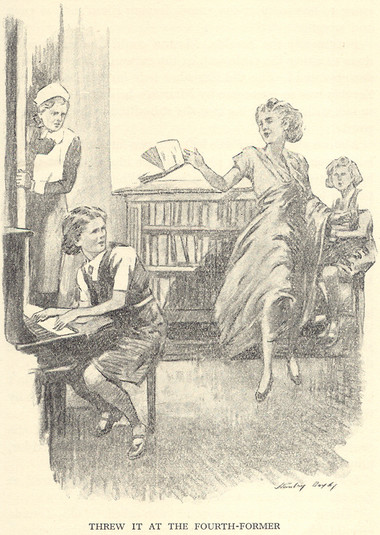
Other teachers

There are of course other teachers, but we see very little of them so I can only provide a brief description.

Miss Linnie

Teaches art, though once she is referred to the sewing mistress in the fifth book. Miss Linnie is known for being easy going, so the girls can mess around in her classes a bit more than some others. She is young and has red hair done in little curls.

Miss Donnelly

Miss Donnelly is the actual sewing mistress. She is gentle, sweet tempered and gives nothing more than mild protests if the girls are misbehaving.

Miss Remmington

Miss Remmington is the games mistress, but is only mentioned in the first book. Alicia calls her Old Remington and implies she’s good at coaching, but

She won’t bother with the duds.

It is Miss Remmington who suddenly decides to hold a swimming display at half-term in First Form.

“So it would be nice this half-term, as it’s so hot, for your people to go down to the breezy pool, and see not only the beauties of the water, but the way their girls can swim and dive!” said Miss Remmington. “We will have a pleasant time down there and then come back for a strawberry and cream tea, with ices!”

Miss Carton

Miss Carton teaches history and is known for her sarcasm.

Miss Carton over there—see her—the one with the high collar and pince-nez glasses on her nose. She’s frightfully clever, and awfully sarcastic if you don’t like history. – Alicia

This is backed up in the Fourth Form.

Miss Carton, the history mistress, knew that the School Certificate form was well up to standard except for miseries like Gwendoline, who didn’t even know the Kings of England and couldn’t see that they mattered anyhow. She used her sarcastic tongue on Gwendoline a good deal these days, to try and
whip her into some show of work, and Gwen hated her.

Miss Greening

Only mentioned once that I can find, Miss Greening teaches elocution and the girls are advised to go to her for help with their pantomime in the fifth form.

Mr Young

I know that this series is Miss Grayling’s girls, and I’ve stretched that to include female teachers/Matrons (I said last time that these should be Miss Grayling’s ladies, if not for continuity) but I can’t miss out the only male teachers.

Mr Young is called both the music master and the singing master, as he takes both music and singing. As well as doing classes he also does individual singing lessons. It is said that he is either in a good temper, and the girls have to judge which and act accordingly. We only see him in Second Form (though he is mentioned in a couple of other books) where the girls play the chalk trick on him, this works well as he always sits on the stool and twirls around until it is the right height for him. He is also often slightly late for his own classes!

There he was, with his funny little moustache twisted up at the ends, his bald head with the three or four hairs plastered down the middle, his too-high collar, and his eyes large behind their glasses.
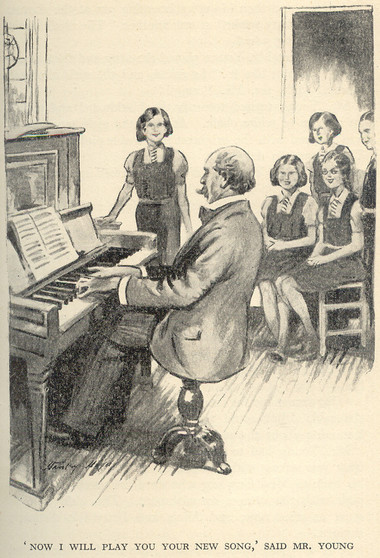
Mr Sutton

The other male teacher, and only mentioned in one book, Mr Sutton teaches carpentry, primarily to the first and second years.

Posted in Characters | Tagged , , , , , , , , , , | Leave a comment

Monday #410

As with every year it seems, February’s weather is worse than the previous winter months put together. So far we’ve had nothing but rain and snow, and we’re still in full lockdown until the start of March at least. Still, there’s a bright spot, and that is that nurseries should be able to resume from the 22nd, and that’s only two weeks away!

Miss Grayling’s Girls part 7: the rest of her teachers

and

Five Go to Mystery Moor

The class saw her back view at once, and gasped. Written across her tightfitting skirt in bright pink letters was the word “OY!” Even Darrell was surprised to see it so clearly, and suddenly felt very uncomfortable. It was one thing to make a patch of pink appear on somebody’s clothes—it could easily be explained away—but how could the word “OY!” be explained? It was quite impossible!

Mam’zelle’s OY causes Darrell some consternation in Second Form at Malory Towers.


Posted in Blog talk | Tagged , , | Leave a comment

If you like Blyton: The Indian in the Cupboard by Lynne Reid Banks

Despite being known as a ‘children’s classic’ I have only read this series for the first time recently. I had seen the 1995 film before and had a certain fondness for it, but the notion of there being a book as well eluded me for a long time. I actually got the film for my Christmas and although I enjoyed it, it wasn’t a patch on the book!

I discovered it was a series in 2014 when I added the first book to my ‘to read’ shelf on Goodreads, though curiously I didn’t add the rest of the series until October last year. I read the first one on my Kindle in October, then while at work at the end of last year I decided to head into the children’s stacks and grab the rest of books as they were all there (in non-matching editions), and I wanted some books to keep me going over Christmas and into the new year if we didn’t reopen straight away.

The series comprises five books of which I’ve read the first three.

  1. The Indian in the Cupboard
  2. The Return of the Indian
  3. The Secret of the Indian
  4. The Mystery of the Cupboard
  5. The Key to the Indian


Who is the Indian, and what is the cupboard?

Little Bull (Little Bear in some editions) is an Iroquois chief from the 18th century. In the story, he begins as a plastic figure given to Omri by his friend Patrick, on his ninth birthday.

Omri is also given an old medicine cabinet by his older brother, and although that seems an odd present he is pleased as he loves secret hiding places for his private treasures.

The cupboard doesn’t have a key but Omri’s mother has a load of old keys and one of those – one she chose as a token from her grandmother before she died – fits the lock.

Omri put the Indian, which initially he was disappointed to receive as a gift, in the cupboard and locks him in, only to discover the next morning that the Indian has come to life, becoming a living, breathing man, but still just three inches tall.


The cowboy in the cupboard

Although the title of the book suggests it’s all about Little Bull, there are other figures brought to life by the cupboard.

Once Patrick knows what the cupboard can do he brings his cowboy figure (and horse) to life. The mistrust between these two tiny men leads to Little Bull being badly injured, and Omri bringing Tommy Atkins, a WW2 medic, to life briefly.

And lastly, as Little Bull has demanded a wife, Omri lets him choose a female figure to bring to life; an Iroquois woman called Twin Stars. In later books more Indians are brought to life, and other medics too.


One for Blyton fans?

On one hand I feel like there’s so much in here that Blyton could have written herself. On the other, Reid Banks has woven together some things that Blyton rarely, if ever, combined.

A magic key or piece or furniture that brings toys to life would fit perfectly into one of Blyton’s fantasy stories. Blyton has written many stories about toys who secretly come to life at night or whenever their children aren’t looking, and I’m sure there are stories about regular toys who are magically brought to life as well.

However, Reid Banks’ toys have something that Blyton’s wouldn’t – we discover along with Omri and Patrick that the toys are imbued with the spirits of real historical people. Little Bear was, or indeed is, a real Native American man from 200 years before, and so he behaves as such. He is naturally terrified of the giant Omri to begin with. He needs to eat and have somewhere safe to sleep, and of course to be kept a secret from Omri’s family. Whenever he is returned to plastic (as the key can do both) he returns to his place in the 18th century, and time passes the same for him as it does for Omri.

That takes us into territory that Blyton didn’t cover in her fantasy tales. Reid Banks begins with a wonderful fantasy which quickly becomes quite a stressful time for Omri – he has great responsibility to care for the tiny people he has brought to life, and as Patrick is rather blasé about them Omri has to battle his friend’s attitudes and actions too. Omri realises that as Little Bear and Boone (and later other ‘toys’) are real people they have to be treated as such regardless of their size. Later books also go deeper into the morals of changing historical events and the fall out of trying. There are several suspenseful scenes as the consequences of various actions are played out, and some tragedies too.

Blyton of course gave us more insightful novels than her fantasy ones (even in those the children debate whether or not their actions would be right or fair but it’s kept reasonably simple) such as The Family at Red Roofs, Those Dreadful Children, The Put-em-Rights and so on. Each of these showed children learning (often the hard way) about responsibility, consequences, respect,  justice and other moral issues.

I’ve gone over this review a few times now and can’t seem to put into words how great these books are – not without outlining multiple scenes and spoiling the story anyway. I wish I had read them as a child as I’m sure revisiting them would be as rewarding as rereading my favourite Famous Fives.


A note of caution: I am aware of some criticisms of these books regarding the portrayal of the Native American characters. I don’t have the right to say that indigenous Americans should or shouldn’t be offended by these books. All I can say is that although Little Bear may seem somewhat stereotypical to begin with (There’s an interesting article about his speech here) and that Reid Banks may have included some inaccuracies regarding specific Native American details, the book delves quite deeply into a lot of issues in a positive way.

I’ll leave a couple of articles I’ve read on the subject here, one positive and one negative so you can be more informed.


Posted in Book reviews | Tagged , , | Leave a comment

January 2021 Round Up

That’s the first month of the long-awaited 2021 over, and to be honest, it wasn’t any better than much of 2020, was it.


What I have read

I set myself a target of 100 books for 2021 and then proceeded to ease myself in slowly, mostly reading easy children’s book as I didn’t feel motivated to read much else what with the new lockdown restrictions and rubbish weather. Thinking back to my stats for last year, my stats for this month are heavily tilted towards both rereads and children’s books. I did read a couple of new grown-up books at the end of the month though!

  • The Return of the Indian (The Indian in the Cupboard #2) – Lynne Reid Banks
  • The Girls of Mulberry Lane (Mulberry Lane #1) – Rosie Clarke
  • Anastasia Krupnik (Anastasia Krupnik #1) – Lois Lowry
  • Anastasia Again (Anastasia Krupnik #2) – Lois Lowry
  • Anastasia At Your Service (Anastasia Krupnik #3) – Lois Lowry
  • Clanlands – Sam Heughan and Graham McTavish
  • Anastasia Ask Your Analyst (Anastasia Krupnik #4) – Lois Lowry
  • K is for Killer (Kinsey Millhone #11) – Sue Grafton
  • Anastasia on Her Own (Anastasia Krupnik #5) – Lois Lowry
  • The Secret of the Indian (The Indian in the Cupboard #3) – Lynne Reid Banks
  • Alice’s Adventures in Wonderland – Lewis Carroll
  • Anastasia Has the Answers (Anastasia Krupnik #6) – Lois Lowry
  • The Radium Girls – Kate Moore
  • Dead Man in Ditch (The Fetch Phillips Archives #2) – Luke Arnold

And I’m still working my way through:

  • L is for Lawless (Kinsey Millhone #12) – Sue Grafton

What I have watched

  • Hollyoaks, as usual.
  • More Mythbusters, Only Connect and Taskmaster, plus the odd episode of The Crown.
  • Some films with Brodie which include A Bug’s Life, Paddington 2, Toy Story 4, Peter Pan, The Incredibles, Hotel Transylvania and Hotel Transylvania 2, The Spongebob Movie: Sponge on the Run and Bee Movie.
  • The Big Fat Quiz of the Year – for once I did better on current affairs (and even sport!) than entertainment.
  • The second series of Dream Home Makeover (I can’t understand why I like this when they’re tone-deaf enough to genuinely think they have customers on a ‘limited’ budget, who are spending $30,000 for redecorating and furnishing a single room.)
  • Tattoo Fixers and Tattoo Fixers on Holiday
  • After reading Clanlands I was in the mood for Outlander so I started back at at season one.
  • Wandavision, the new Marvel show which is on Disney+

What I have done

  • The very hard jigsaw of the Marauder’s Map which I got for Christmas
  • Many wet and cold walks and trips to various parks
  • Some home-baking, Brodie and I have made no-sugar blueberry scones, banana bread and porridge bars. 

  • Played in the snow as it snowed twice in January
  • Had a few ‘special’ teas where we set the table and ate together – steak pie on New Year’s Day and a veggie haggis potato pie on Burns’ night. We also ordered pizza one night, Brodie’s first delivery!

I also spent far too long trying to solve this puzzle from one of the magazines, and in the end sent a photo to my family who were equally baffled. Then finally, a few hours later my dad solved it (he’s the crossword-er in our family).

Let’s see if any of you can solve it? 


If you get it, just say so in the co


What has your month looked like?

Posted in Personal Experiences | Tagged , , , , , , | 2 Comments

Monday #409

I was going to say ‘we’re at the end of January’ but I now realise it will be the start of February when this is published. It has probably been a miserable month for a lot of us; cold and dark and pretty lonely with the tight lockdown restrictions in the UK. But, January is over! Now onto February which is inevitably just as cold (if not colder) than January, but even so, it’s a step closer to spring and the hope that the vaccine roll out will mean an easing of restrictions.

In other news, Stef and I are still working on our next Cunningham and Petrov story. We are halfway through chapter 5 at the moment, where David has just returned to the Evans’ farm with the donkeys trailing after him. I don’t know yet how many chapters it will run to, the last one was meant to be 9, then 12, then ended up being 25 (sort of like how the Famous Five series was meant to be 6, then 12, then 21, but rather than children clamouring for more, it’s just that we cannot be succinct apparently!) so we will hold back on starting to publish it for a wee bit longer.

January round up

and

If you like Blyton: The Indian in the Cupboard by Lynne Reid Banks

“Slithery dithery, musty fusty dusty,” said Kiki, trying to remember the various collections of words she had picked up at one time or another. “Huffin and Puffin.”

Kiki shows off her perhaps irritating intellect in The Mountain of Adventure. She’s actually very like a toddler, if you think about it. Likes rhyming words and repeating things, talks a lot of nonsense, makes a lot of noises, is very loud…

Posted in Blog talk | Tagged , , , | Leave a comment